-
-
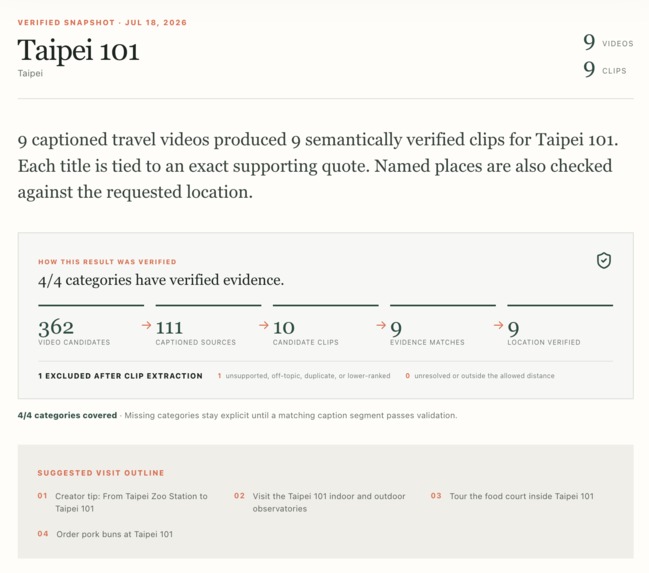
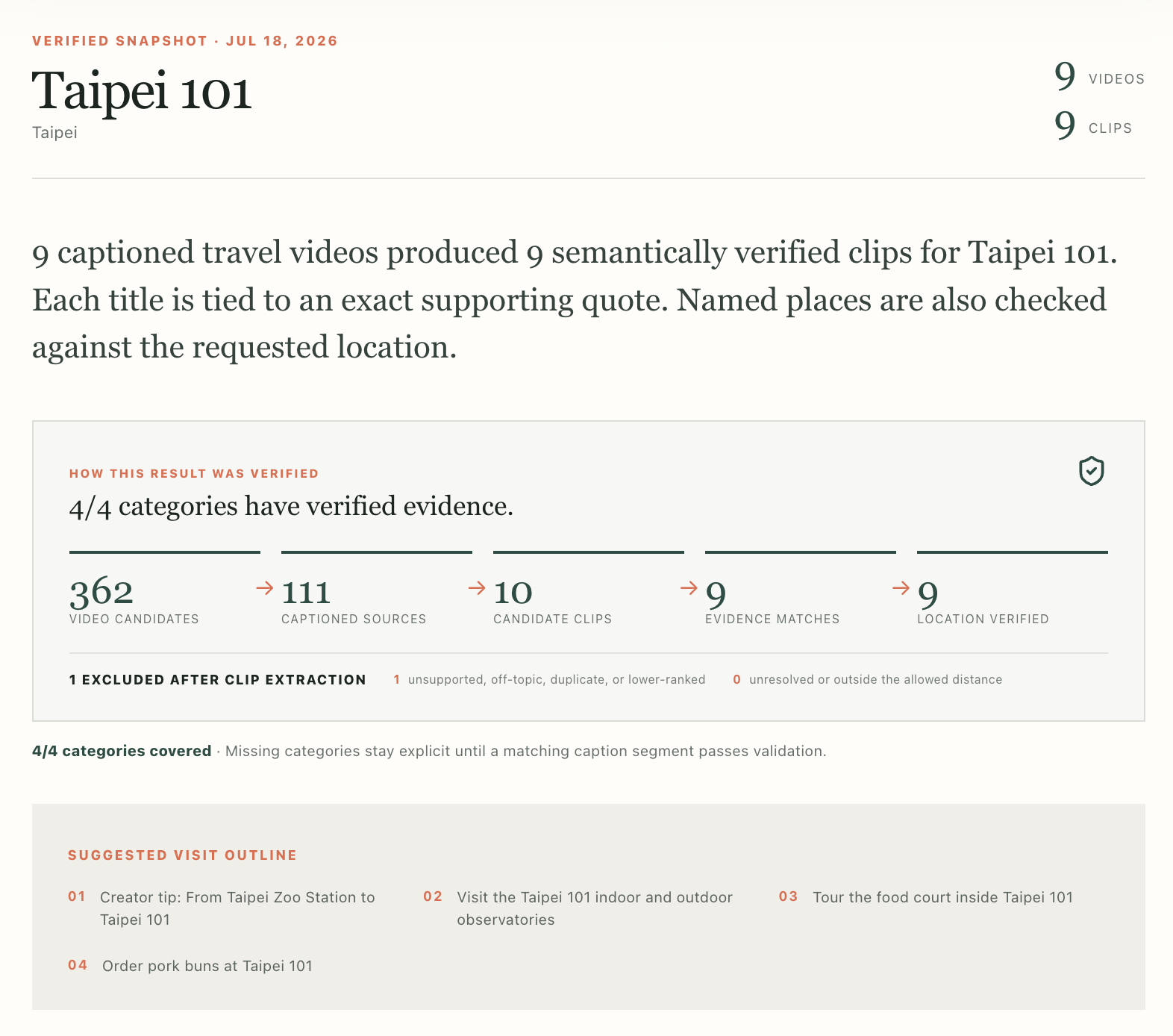
Instead of filling gaps with generic AI suggestions, TripTrace removes unsupported results and clearly shows when evidence is unavailable.
-
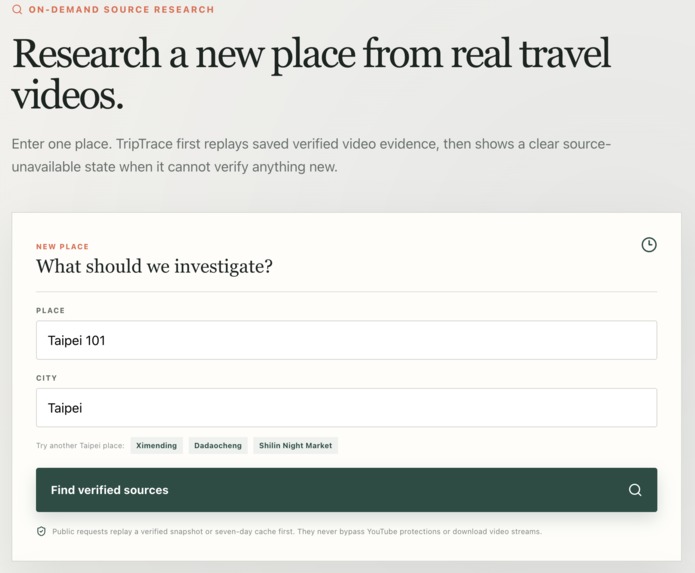
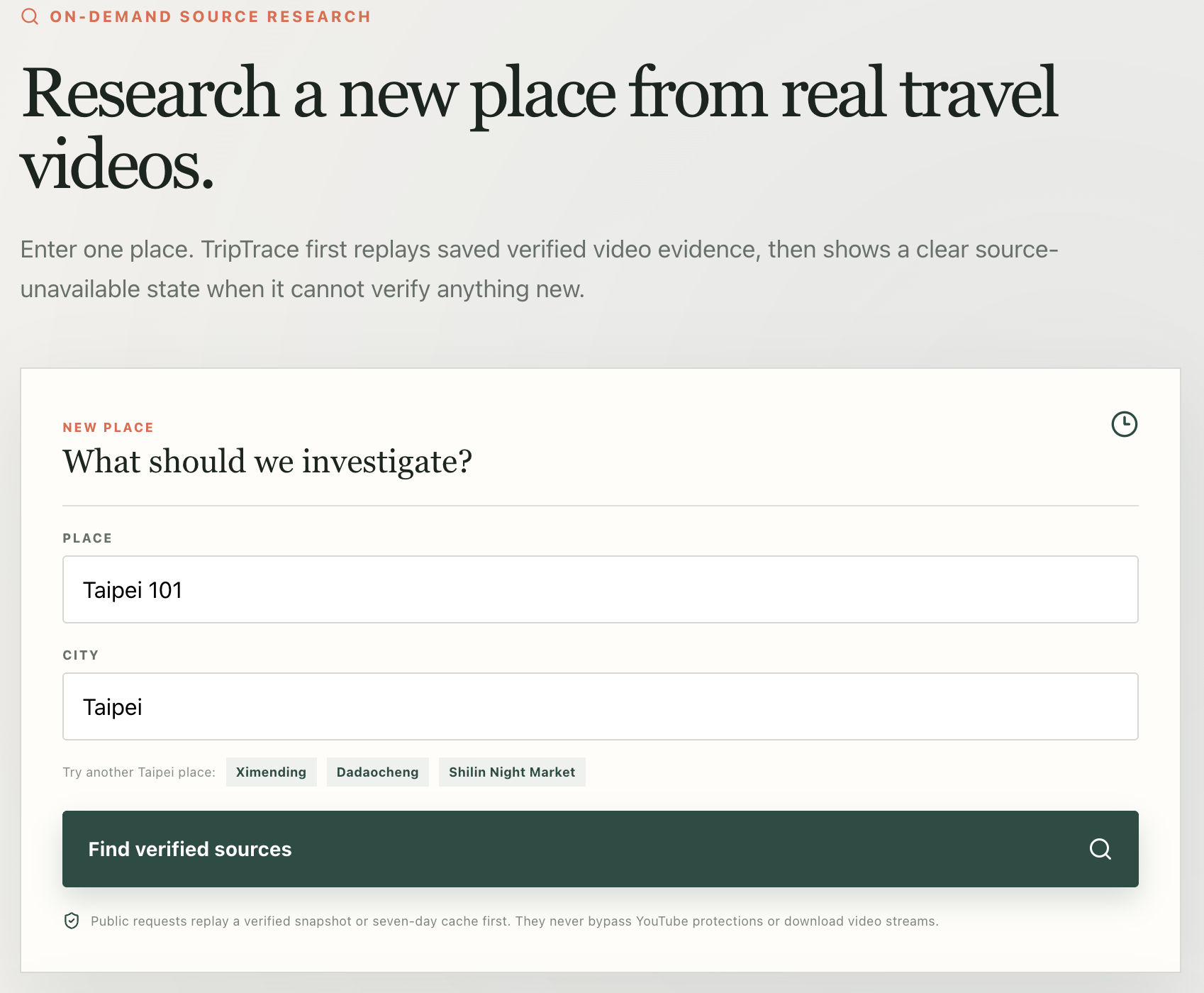
Research any place through real travel videos, with verified sources and evidence-backed recommendations.
-

TripTrace turns real travel videos into verifiable recommendations, backed by exact transcript evidence and location checks.

Inspiration
Travel videos contain some of the best first-hand local recommendations, but useful details are scattered across hours of footage.
Existing AI summaries make the information easier to read, but introduce another problem: users often cannot verify who made a claim, when it was said, or whether a mentioned restaurant or attraction is actually relevant to the requested destination.
TripTrace Research treats travel discovery as an evidence-verification problem, not just a summarization problem.
What it does
TripTrace turns real travel videos into recommendations users can verify.
Enter a destination and TripTrace organizes the findings into four practical categories:
- Why it’s worth going
- What to do
- What to eat
- Good to know before you go
Every recommendation preserves its evidence:
- original video and creator
- exact transcript excerpt
- timestamp
- supporting visual
- location relationship
- direct link to the supporting YouTube moment
Unsupported, ambiguous, or geographically distant recommendations are rejected rather than guessed.
How it works
Timed captions provide the original transcript evidence and timestamps.
GPT-5.6 analyzes only shortlisted, structured evidence. It checks whether a transcript truly supports a recommendation, classifies the visitor intent, and determines how a mentioned location relates to the requested destination.
GPT-5.6 does not generate timestamps. Those come from timed captions and are validated by deterministic code.
OpenStreetMap coordinates and conservative distance rules are used to validate separately named locations.
The public Cloud Run deployment uses verified snapshots and a cache-first architecture. If verified evidence is unavailable, TripTrace reports the limitation instead of creating a generic AI recommendation.
How Codex accelerated the build
Codex was the primary engineering environment throughout the project.
It helped:
- design the typed research and streaming contracts
- implement caption processing and semantic guardrails
- build caching and verified snapshot workflows
- add geospatial and distance verification
- identify incidental-location and false-positive failure cases
- write deterministic regression tests
- review security and privacy boundaries
- prepare and validate the Cloud Run deployment
Important product decisions developed through Codex included keeping API keys server-side, avoiding a database, never downloading YouTube video or audio streams, and preferring fewer verified results over unsupported filler.
Challenges
The main challenge was maintaining traceability despite unreliable public-source availability.
YouTube captions, storyboard frames, and geocoding responses are not guaranteed to be available. Rather than hiding these limitations, TripTrace makes them explicit. Verified partial evidence is preserved, unsupported results are removed, and public cache misses never silently become generic AI summaries.
What we’re proud of
- Exact transcript and timestamp traceability
- Semantic verification with GPT-5.6
- Deterministic evidence-alignment checks
- Multi-source diversity requirements
- Geospatial validation
- Verified partial-result handling
- Production-safe snapshot and cache-first deployment
- Automated regression coverage for common failure cases
What’s next
The next step is supporting more creator-authorized and licensed caption sources, expanding destination coverage, and helping travelers compare evidence across multiple creators without losing traceability.
Built With
- codex
- google-cloud
- google-cloud-run
- gpt-5.6
- next.js
- openai-api
- openstreetmap
- typescript
- youtube-timed-captions

Log in or sign up for Devpost to join the conversation.