Inspiration
Travel products are excellent at showing us more: more lists, more maps, more reviews and more itineraries. But spontaneous travellers often need the opposite. They need one trustworthy answer to a small, immediate question: where should I go next, right now?
NEXT was created for travellers who do not want to plan every hour in advance, but still want their next move to feel personal, realistic and worth the time.
What it does
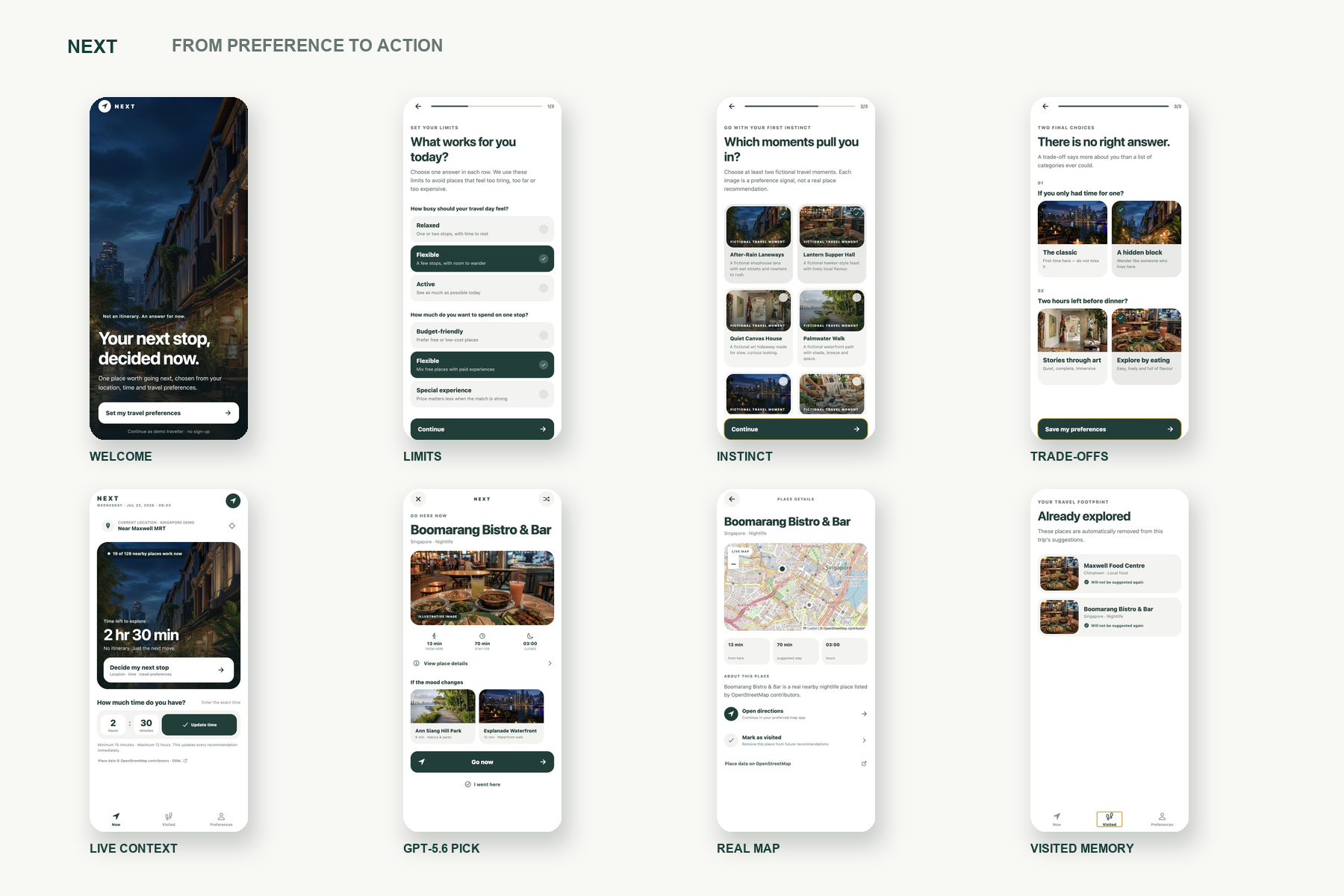
NEXT is a mobile decision companion that recommends one place to go next based on the traveller’s current location, exact time remaining, travel preferences, energy, opening windows, budget and visited history.
Preference learning combines three different signals:
- practical limits such as pace and spending style;
- visual travel moments that reveal instinctive interests;
- pairwise trade-offs between two genuinely appealing options.
When the traveller asks NEXT to decide, the app first removes places that are already visited, closed, over budget, too far away or impossible to enjoy properly in the remaining time.
GPT-5.6 then makes the final contextual trade-off inside that safe candidate set. It returns one primary destination and up to two alternatives through a strict Structured Output. The server validates every selected place ID, so the model cannot invent a venue.
The result screen stays deliberately concise. Travellers can view timing, open the dedicated place-details screen and real map, get directions, choose an alternative or mark the place as visited. Completed places persist and are excluded from future recommendations.
How we built it
NEXT is built as an English-language mobile app with Expo, React Native and TypeScript.
The project includes:
- live OpenStreetMap and Overpass discovery for up to 120 nearby POIs;
- a deterministic feasibility and scoring layer;
- GPT-5.6 through the OpenAI Responses API;
- JSON Schema Structured Outputs;
- server-side API-key protection;
- interactive maps and directions handoff;
- persistent preferences and visited history with AsyncStorage;
- a curated offline fallback so the judging flow never dead-ends;
- a public mobile Web demo for immediate judge access.
Codex was used throughout the core development process: product framing, interaction design, Expo implementation, recommendation logic, GPT-5.6 integration, original visual assets, testing, responsive verification, documentation and submission preparation.
Challenges we ran into
The largest product challenge was balancing distance against preference strength. The nearest place is not always the right answer, but a highly relevant destination should not be recommended when the remaining time makes it unrealistic.
We solved this by separating deterministic feasibility from model judgement. Rules determine what is possible; GPT-5.6 decides which feasible choice best fits the human moment.
Other challenges included normalising incomplete OpenStreetMap records, keeping API keys out of the mobile bundle, creating consistent native and Web map experiences, and fitting a complete decision flow into a compact mobile interface.
Accomplishments that we are proud of
- A complete mobile product experience rather than a technical proof of concept.
- A real GPT-5.6 decision layer that can only choose validated candidates.
- Live, location-scoped POI discovery instead of a tiny fixed recommendation list.
- Persistent visited-place exclusion across app restarts.
- A credential-free public demo and deterministic fallback.
- Original illustrative travel assets with no third-party photo dependency.
What we learned
Recommendation quality improves when factual constraints and subjective judgement are handled separately.
We also learned that actions reveal preference more accurately than questionnaires alone. Accepting, skipping and completing destinations can gradually produce a more truthful travel profile.
What’s next
Next steps include real transit routing, richer commercial opening-hour and venue data, more cities, weather-aware reranking, private preference learning from behavioural feedback and native iOS and Android test releases.## Inspiration
What it does
How we built it
Challenges we ran into
Accomplishments that we're proud of
What we learned
What's next for TravelNext
Built With
- asyncstorage
- codex
- expo-haptics
- expo-location
- expo.io
- github
- gpt-5.6
- leaflet.js
- node.js
- openai-api
- openstreetmap
- overpass-api
- react-native
- react-native-maps
- responses-api
- structured-outputs
- typescript

Log in or sign up for Devpost to join the conversation.