-
-
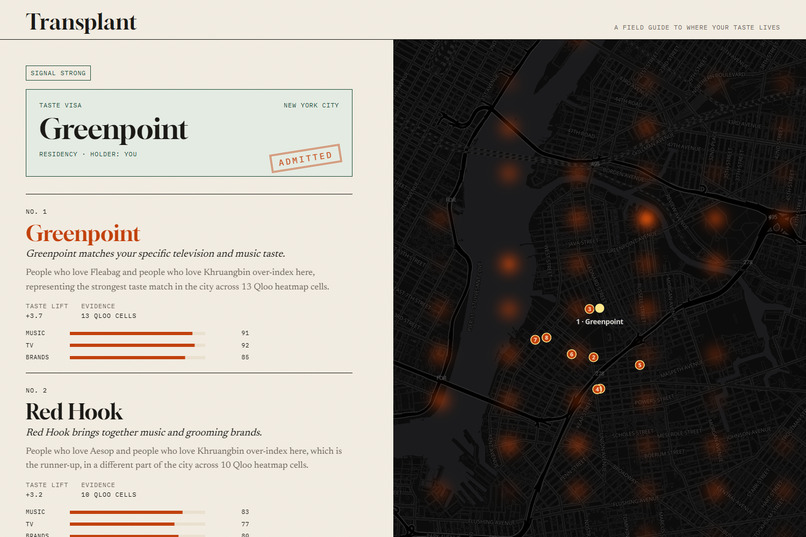
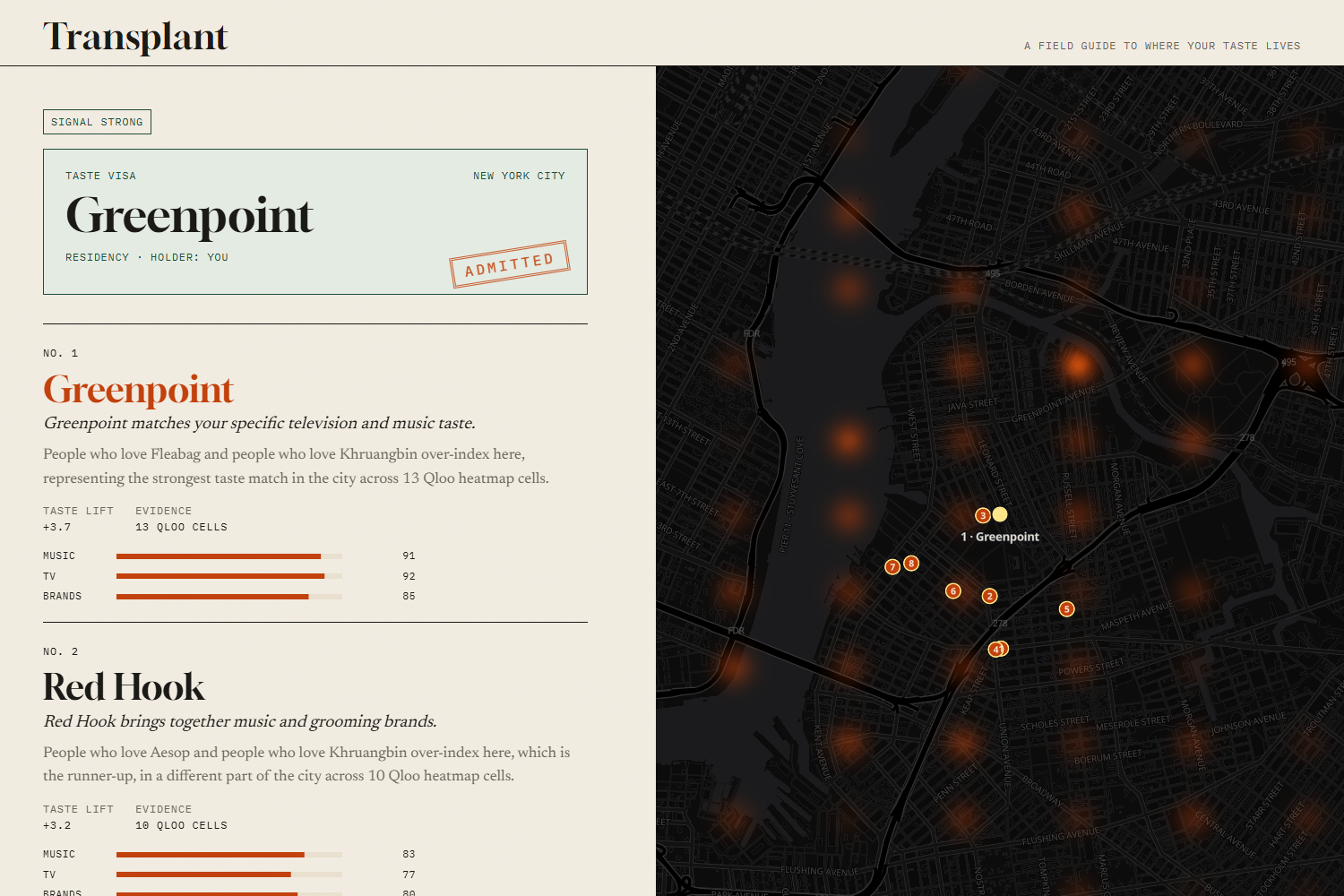
Greenpoint: why it was picked, the Qloo evidence behind it, and nearby spots numbered on the map
-
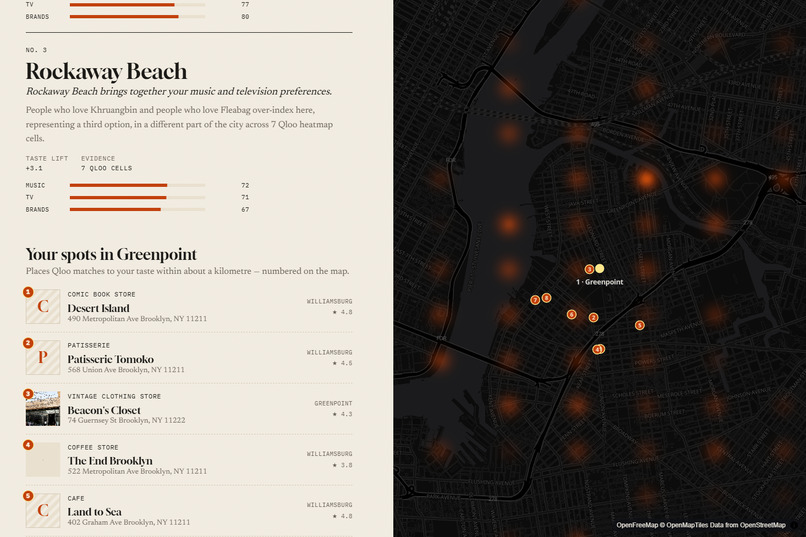
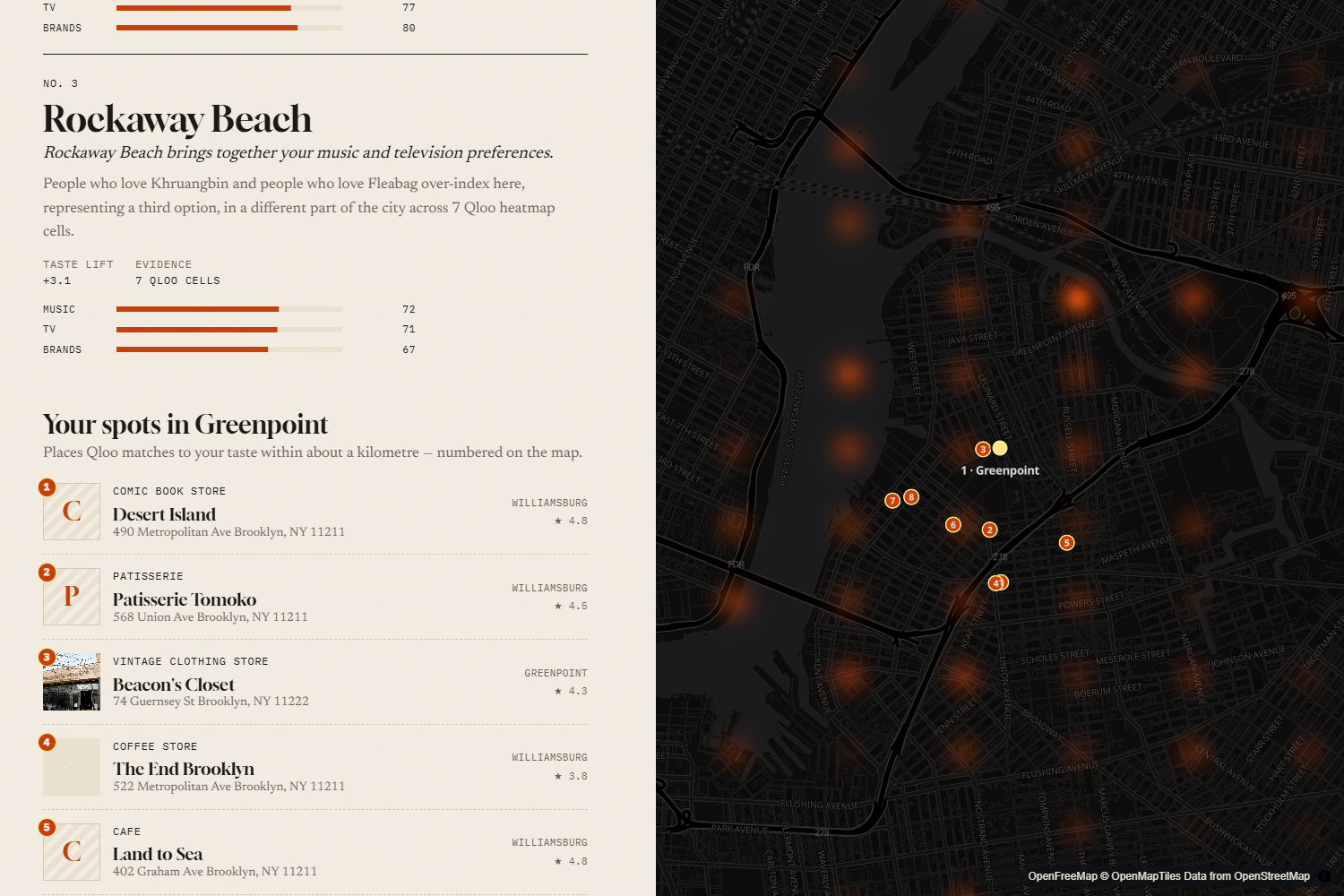
Three neighbourhoods in different parts of the city, then spots with their real neighbourhood and rating
-
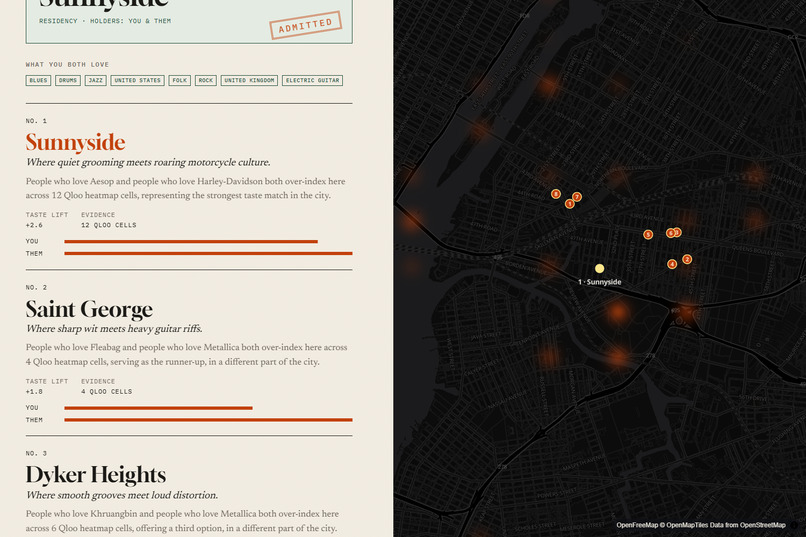
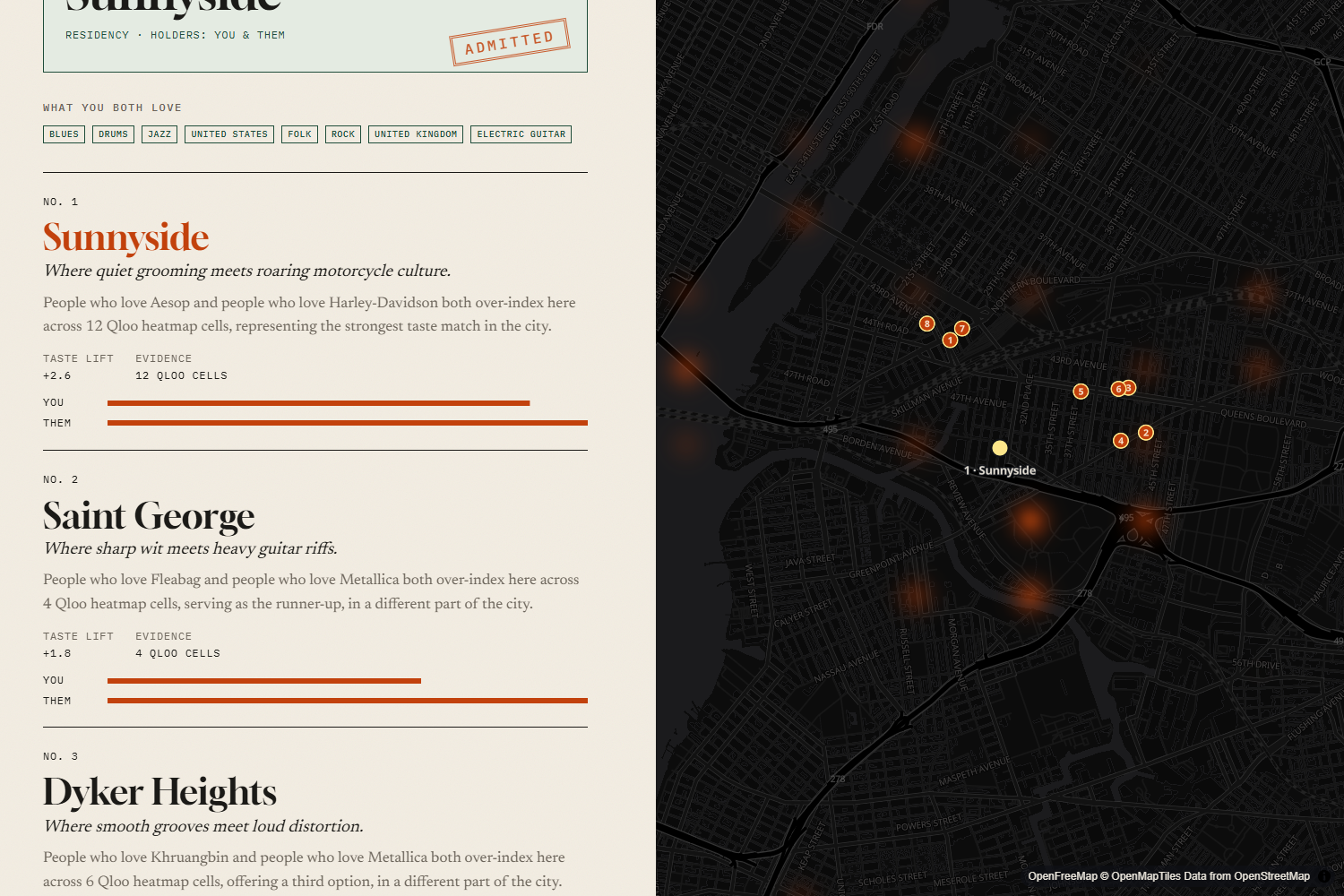
Blend mode: two tastes, one neighbourhood, plus what you both love
-
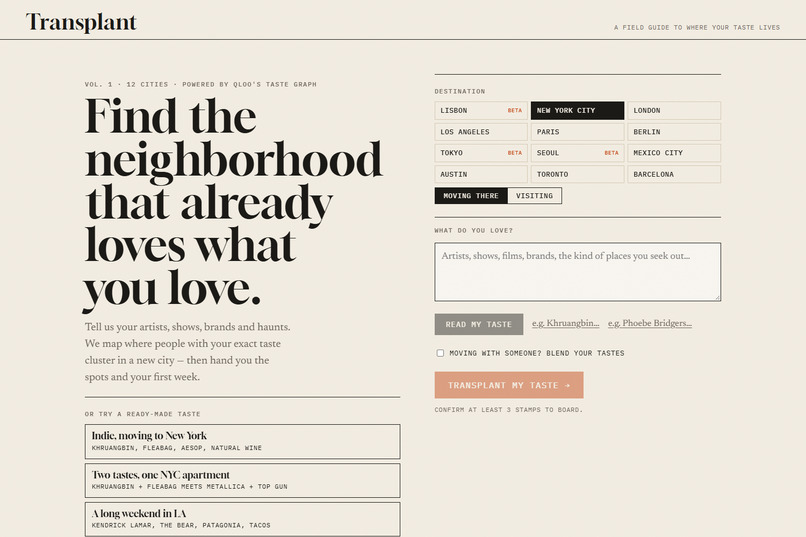
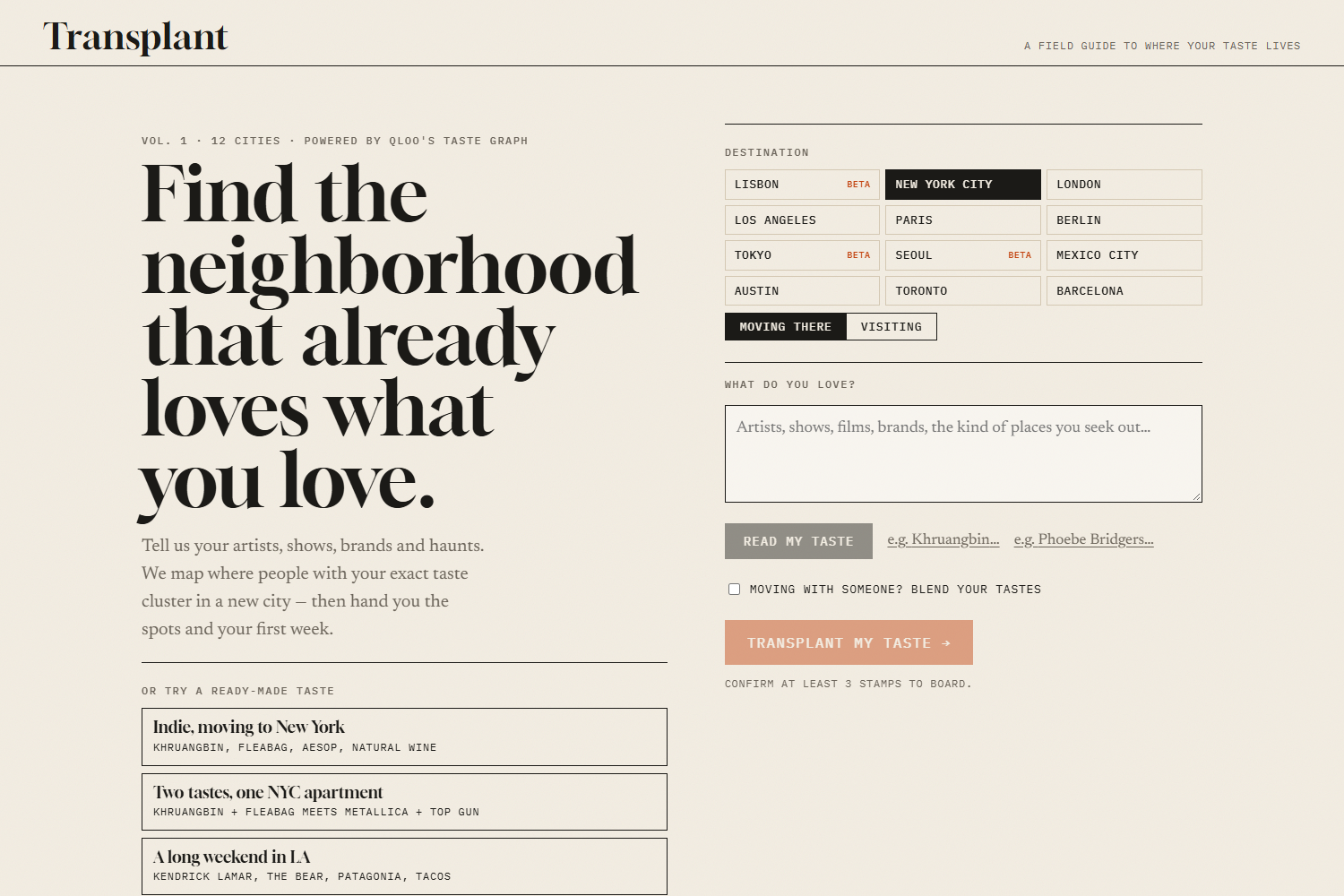
The start page: tell it what you love, or try a ready-made taste
Inspiration
Moving to a new city is a big decision, and the hardest part often isn't the paperwork. It's picking a neighbourhood from a distance. Listings tell you the rent, commute maps tell you the distance, and if you ask a chatbot you get the same three famous areas everyone else gets.
What people actually want to know is simpler: where will I feel at home? That's a question about taste, and Qloo can answer it with geography attached.
What it does
You tell Transplant a few things you love: artists, shows, films, brands, the kind of places you look for. Then you pick a city (there are 12). It shows you where people with that same mix of taste actually live, picks three neighbourhoods, lists spots nearby, and writes you a first week.
Try it: https://transplant-taste.fly.dev. The ready-made tastes are the quickest way in.
A few things I'm proud of:
- It checks what you meant. "Aesop" becomes the skincare brand, not the storyteller. If a name could be several things, like "Monocle", it asks you which one.
- It shows its working. Each neighbourhood shows how much Qloo evidence backs it and which parts of your taste drove it (music, TV, brands). If something you love has no signal in that city, it says "no signal" and the copy won't pretend otherwise.
- The three picks are actually different. They're kept apart, so in London you don't get three streets in the same corner of NW10.
- You can ask a local guide. Type "quieter" or "more nightlife" and an agent searches Qloo's tags and places live, then shows you each lookup it made. It tells you which neighbourhood a place is really in, and if Qloo finds nothing, it says so rather than making something up.
- Moving with someone? Blend mode ranks neighbourhoods by whoever fits least well, so nobody's quietly compromising, and it shows what you both love.
- Other agents can use it too. There's an MCP server at https://transplant-taste.fly.dev/mcp, so you can ask Claude "where in London would I feel at home?" and it calls Transplant.
Why it needs Qloo
This only works because Qloo connects taste across music, TV, brands and places, and knows where that taste lives.
| Step | Qloo API |
|---|---|
| Work out what you meant | /search, /v2/tags |
| Map where your combined taste lives | /v2/insights with urn:heatmap |
| Find spots near a neighbourhood | /v2/insights with urn:entity:place and filter.location |
| What two people share | /v2/analysis/compare |
| The guide's refinements | place-scoped /v2/tags and insights with filter.tags |
The trick that made it work: raw heatmap affinity mostly tracks popularity (a 0.95 to 0.98 correlation in all 12 cities I tested), so a naive map just sends everyone downtown. I fit affinity against popularity for each city and rank neighbourhoods by what's left over. I call that the taste lift. It's averaged over the Qloo cells around each OpenStreetMap neighbourhood, with a small prior so thin evidence doesn't win.
Who it's for
People relocating for work or study, couples moving together, and the people who help them: relocation teams, HR, letting agents. It works for trips too ("a long weekend in LA").
How I built it
It's TypeScript end to end: a Hono API that streams progress to the page, React and MapLibre on the front, and Gemini and Groq for writing and for the agent. Rankings and places always come from Qloo and plain code. The language model only writes the words and picks tools, and I check what it writes. Unknown places get dropped, and if it credits a taste that had no signal, repeats another neighbourhood's line, or invents a number, the app swaps in text built straight from the data.
To stay inside the hackathon quota there's a SQLite cache, a request queue and per-visitor limits. The three demo tastes are cached, so they keep working even if the quota runs low. There are 115 tests, and none of them hit the network.
Challenges
- Popularity bias. My first maps were basically population maps. The taste-lift step fixed that, and I checked it city by city.
- Copy that told the truth. An early version said "people who love The Bear over-index here" in a city where The Bear had zero signal. Now the copy is built from per-type evidence and checked after it's written.
- Patchy tags. "Nightlife" sometimes returns nothing where "night club" works, so the guide retries once with a more concrete word.
What I learned
The interesting part of Qloo is the combination. My music, TV and brand tastes together point somewhere none of them would on their own. I also learned that people trust an answer more when they can see why it was given.
Privacy
Only the names of things you love are sent to Qloo. Your name, account and location are never sent. Results describe groups of people with similar taste, not predictions about you, and the app says that on every page.
What's next
Budget and commute filters alongside taste, more cities, and shortlists that relocation teams can share with the people they're moving.
Built With
- fly.io
- gemini
- groq
- hono
- maplibre
- mcp
- node.js
- openstreetmap
- qloo
- react
- sqlite
- typescript
- vitest

Log in or sign up for Devpost to join the conversation.