-
-
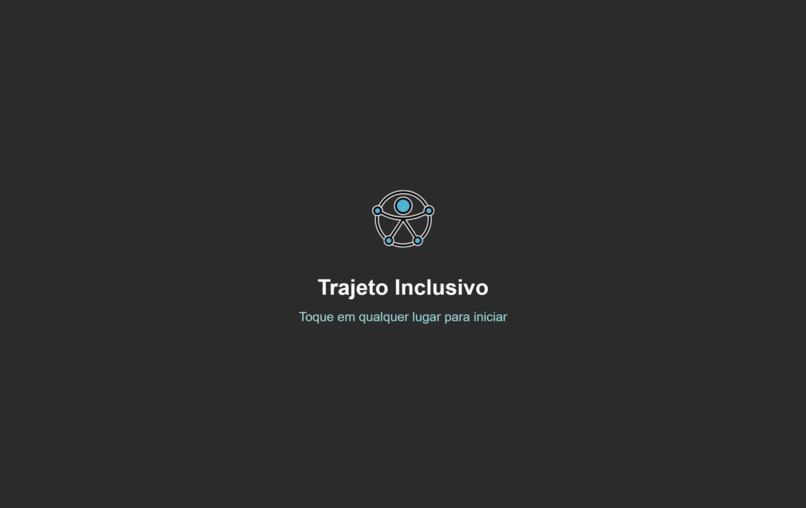
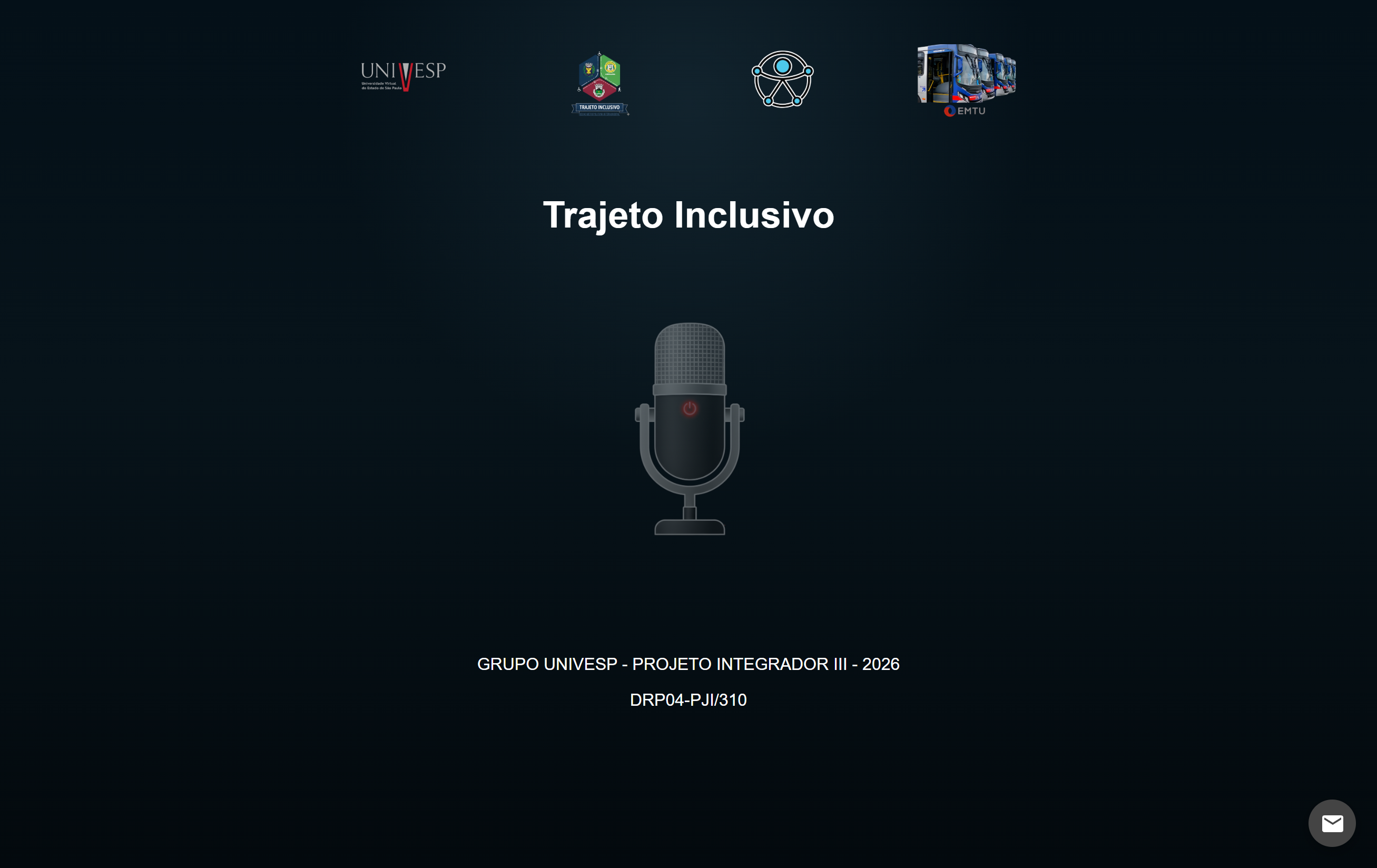
Welcome screen. The user starts an accessible journey using voice guidance and multimodal navigation.
-
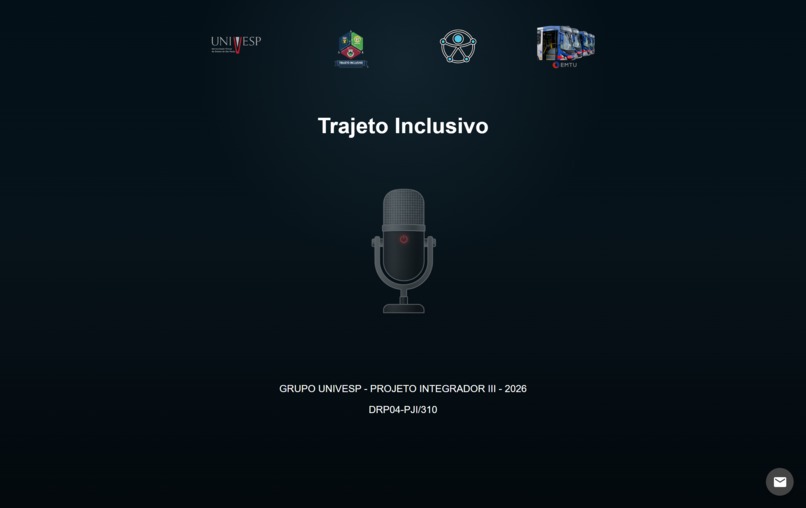
The user starts the journey with a single touch, activating voice-guided navigation.
-
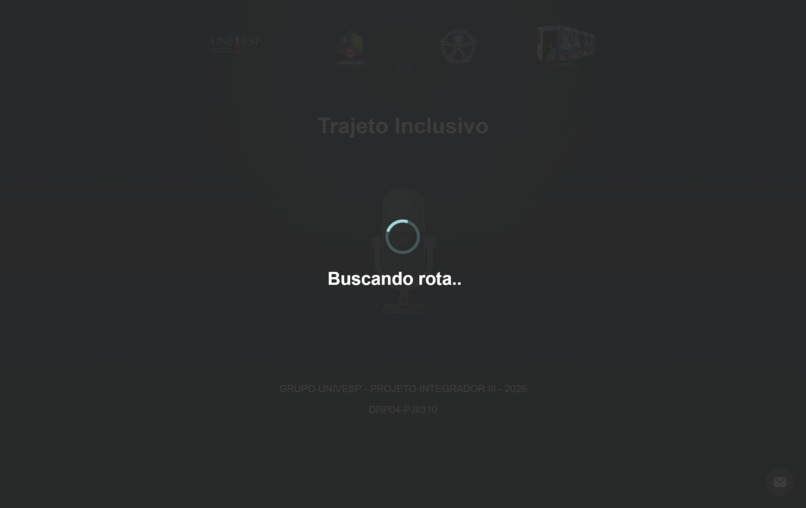
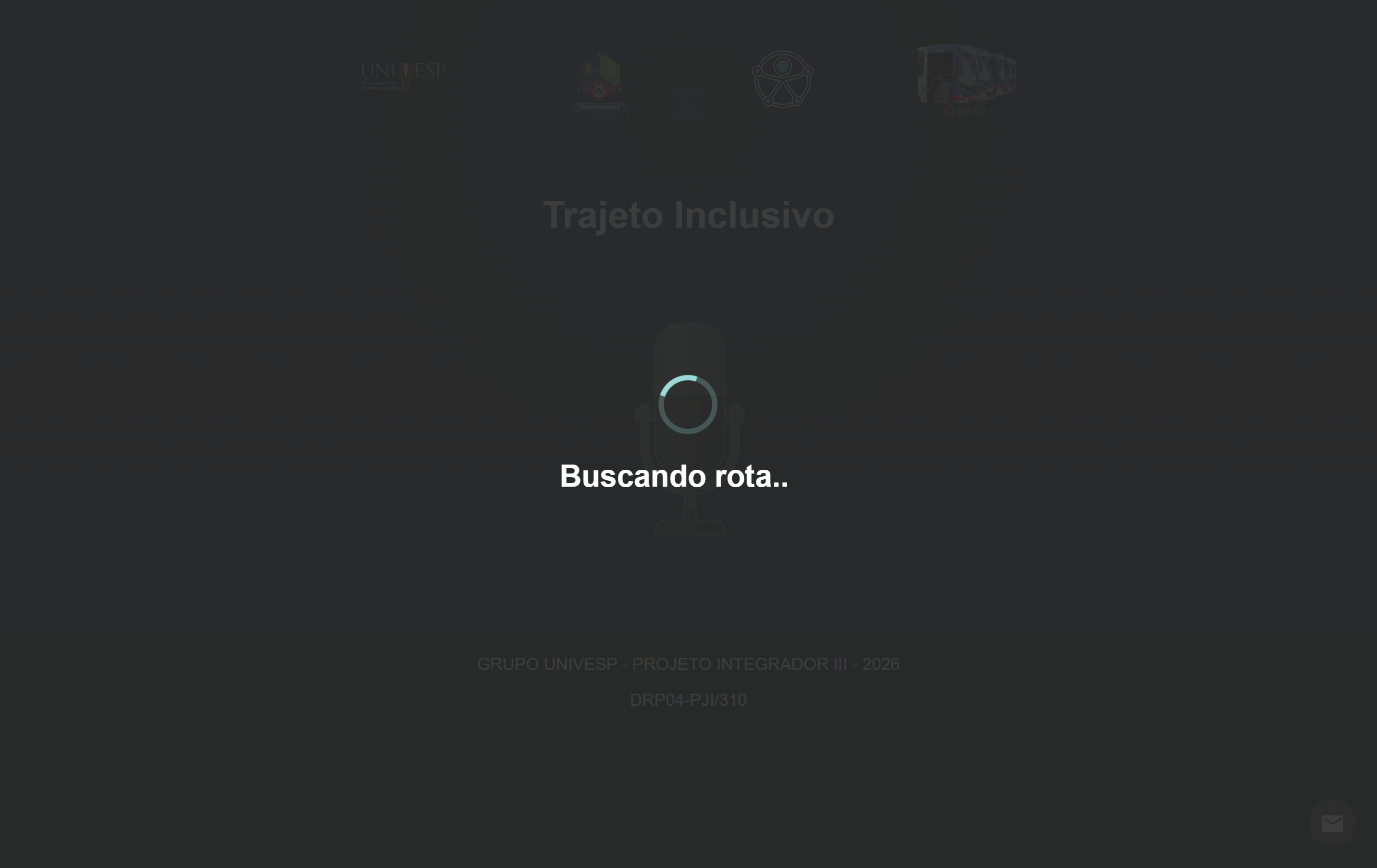
The application searches for the best multimodal route by combining walking and public transportation.
-
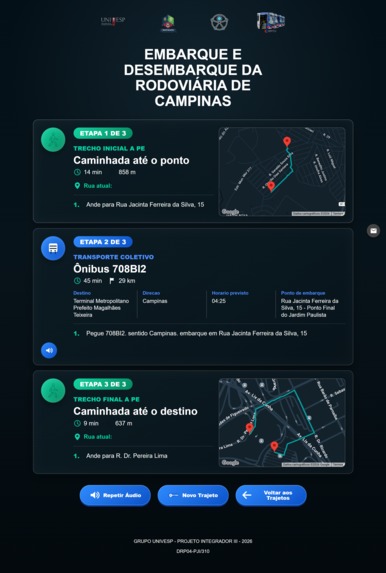
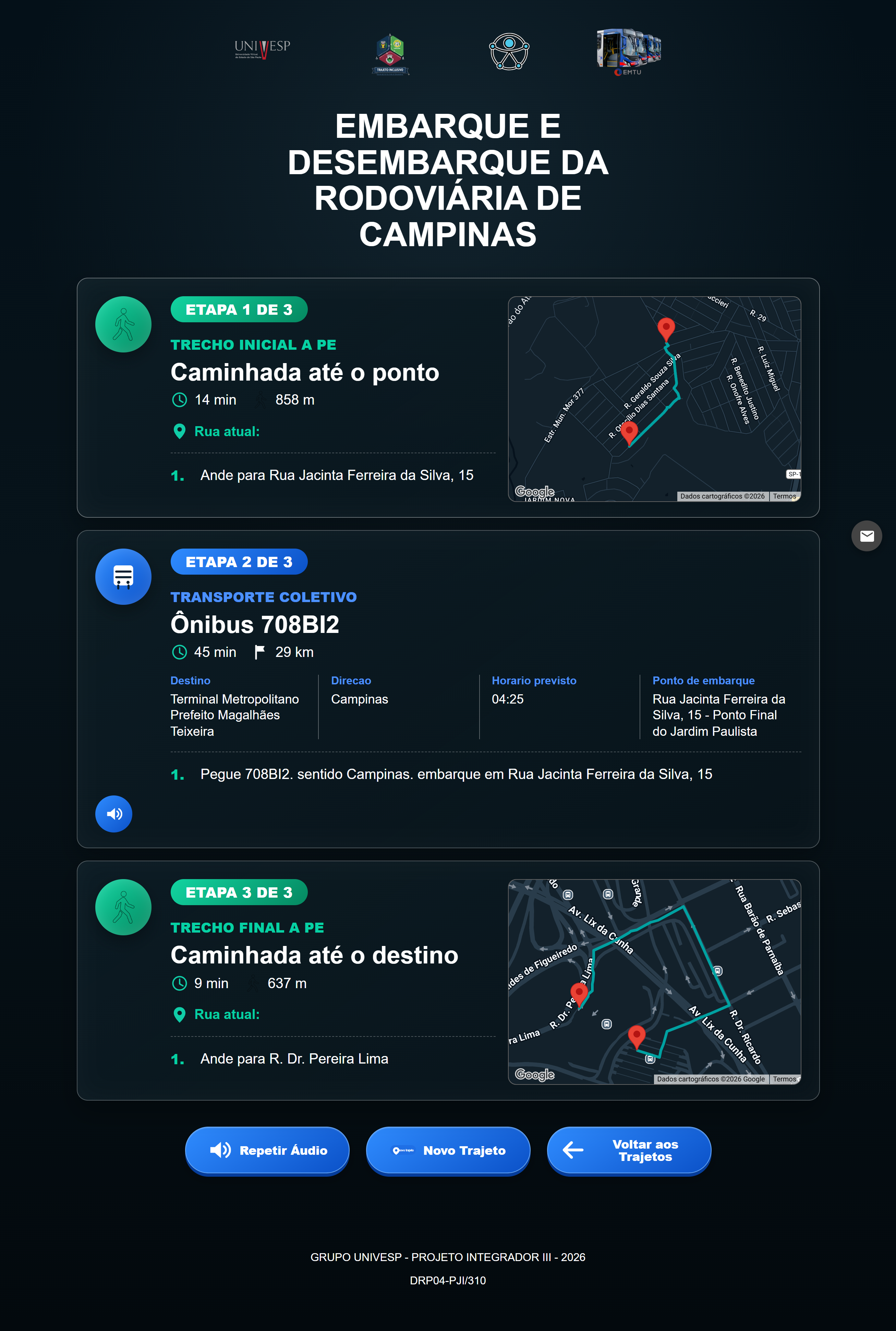
Complete journey overview showing the walking stages, public transport, and the final destination.
-
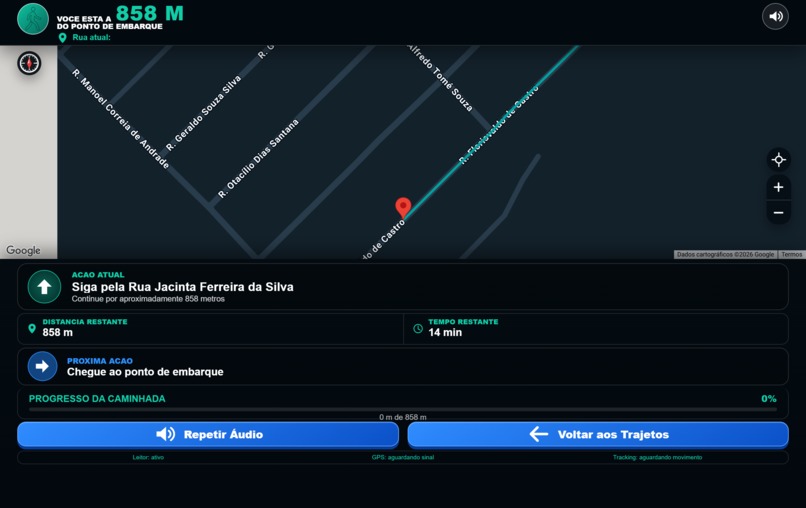
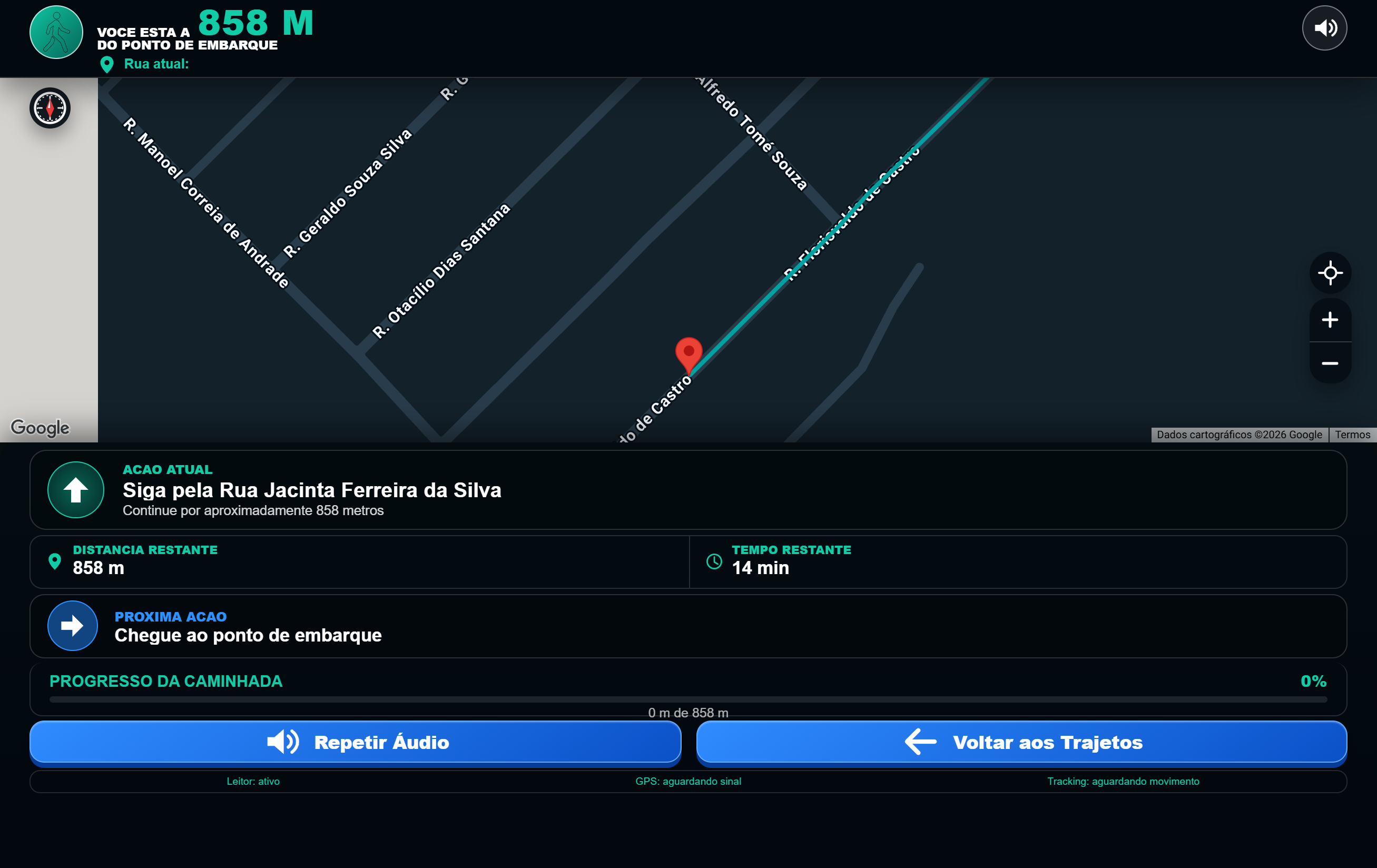
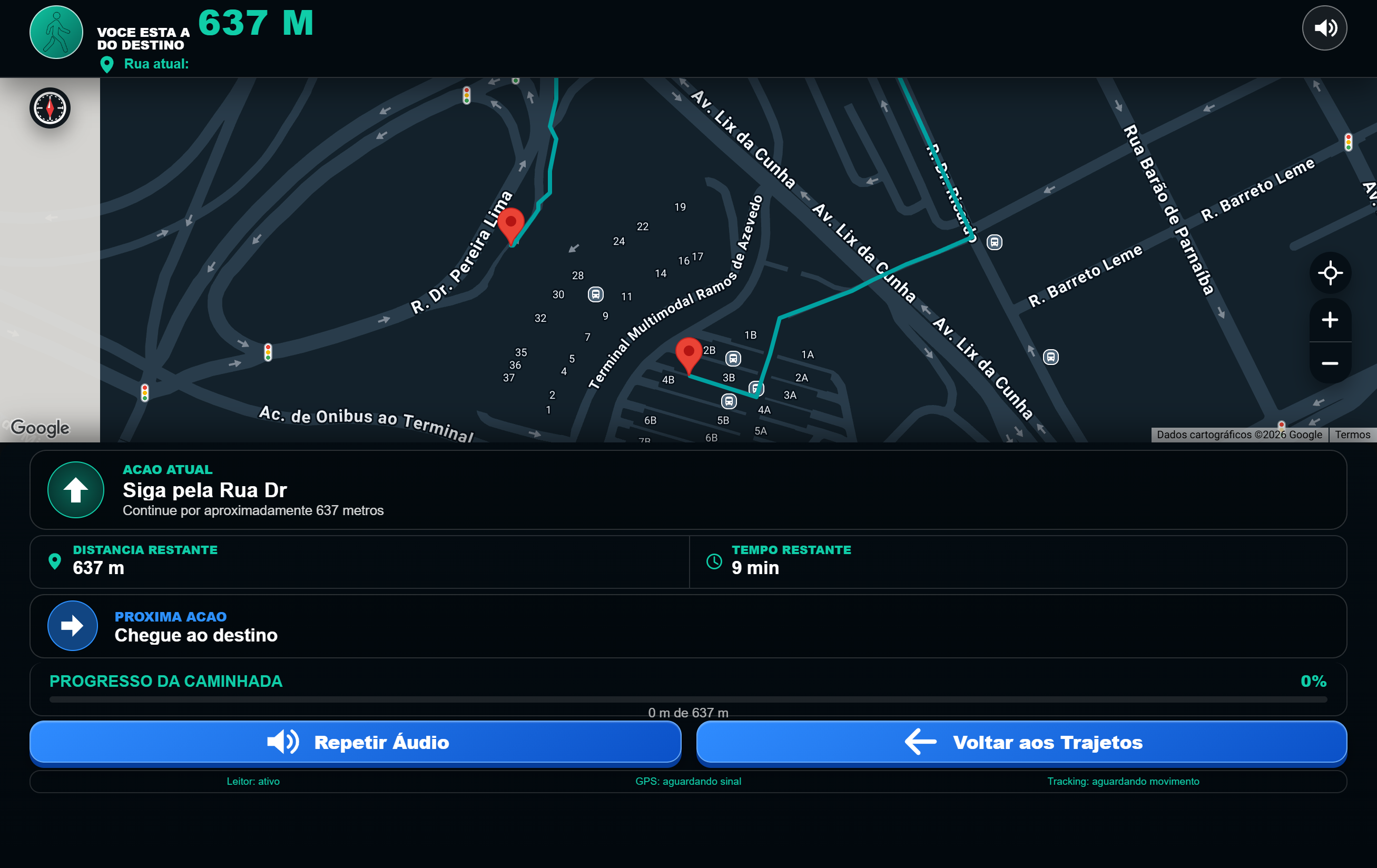
Real-time walking guidance leads the user safely to the boarding point with voice instructions and live navigation.
-
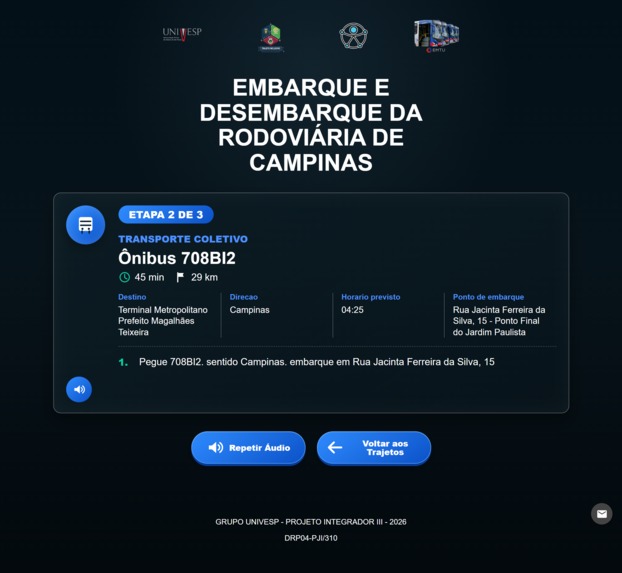
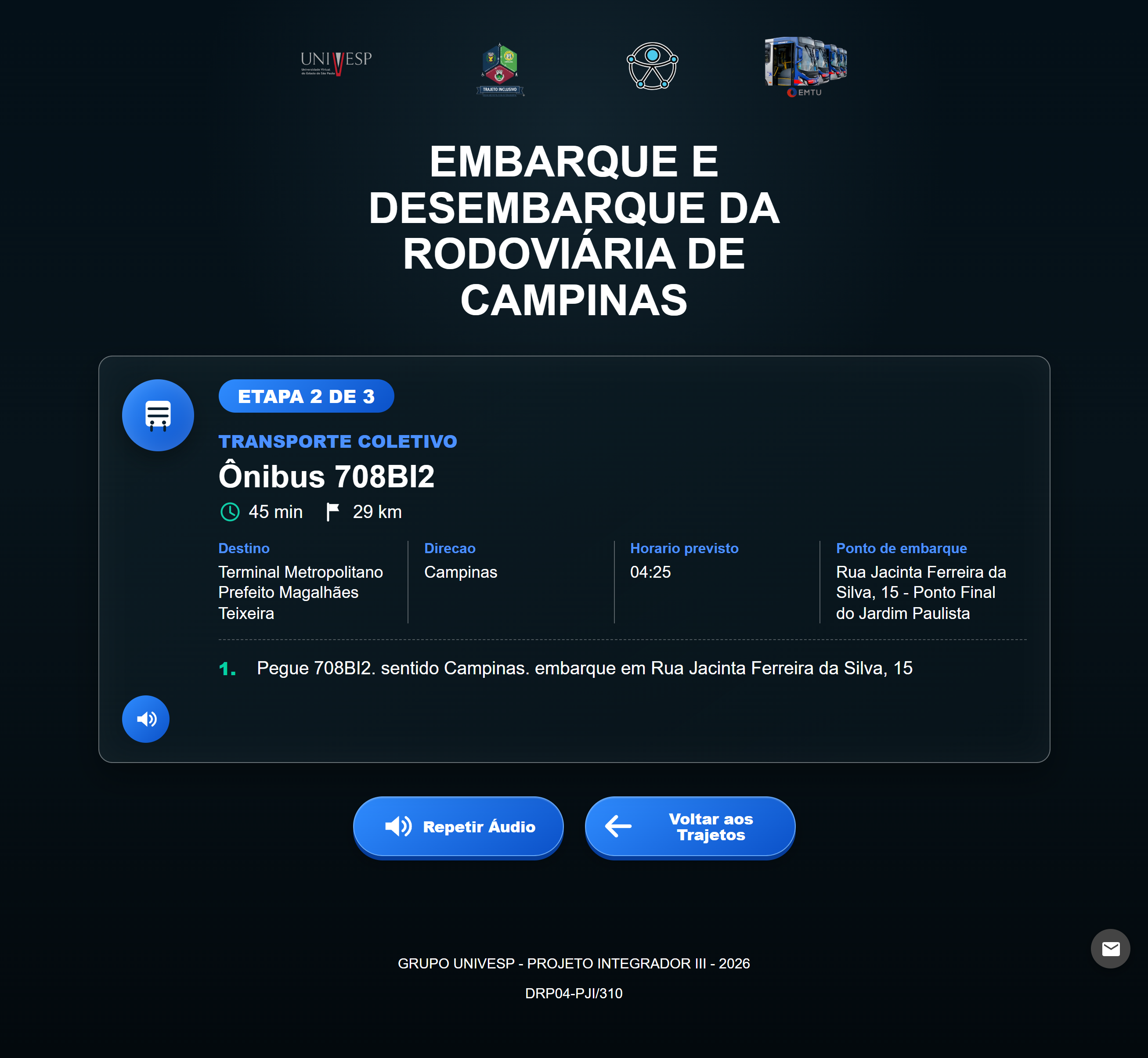
Boarding assistance provides the bus line, destination, boarding location, estimated travel time, and spoken guidance.
-
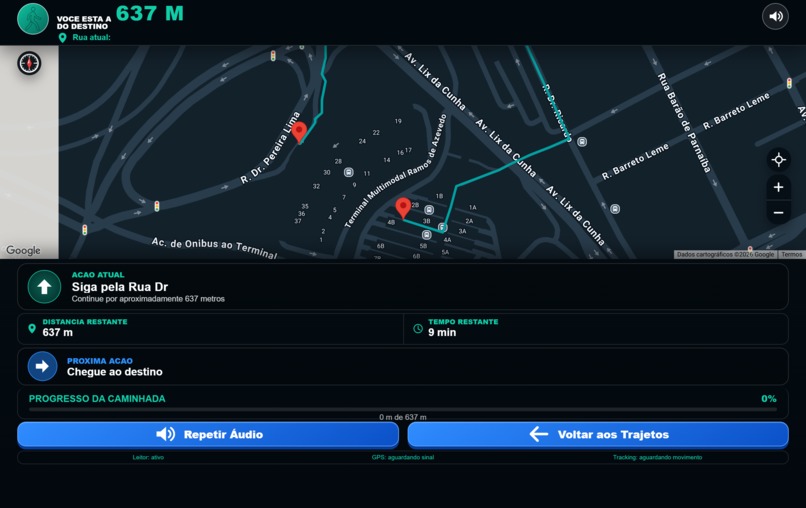
After leaving the bus, Trajeto Inclusivo continues guiding the user safely to the final destination.
Inspiration
Not every project begins because someone has a great idea.
Sometimes it begins because someone refuses to let an idea disappear.
In 2024, during a brainstorming session for our university's Integrative Project, two ideas stood out. One was a parking management system for our campus. The other was a simple concept called Accessible Bus, created to help blind people travel independently using public transportation.
The parking project was selected.
I helped build it until the end, but I couldn't stop thinking about the other idea.
When the next Integrative Project began, I joined a new team and decided to give that unfinished idea a second chance. I wasn't bringing only the original concept anymore. I had spent months thinking about how it could become something much bigger.
A few classmates believed in the idea from the beginning, while others joined as the project evolved. Every contribution, discussion, suggestion and review helped improve the platform. At the same time, I remained responsible for the product vision and for most of the software architecture, implementation and continuous technical evolution that transformed an academic concept into a living platform.
The first version supported only a few bus routes in Piracicaba, Brazil.
Even so, it caught the attention of my academic advisor, who recommended that it become part of UNIVESP's official project repository. The proposal was accepted.
That moment changed everything.
What had started as an academic assignment became a personal mission.
From that moment on, I was no longer building a project simply to complete a university course. I was building something that I truly believed could continue making a difference in people's lives long after graduation.
As development continued, I realized the project could help far more than blind people. Older adults, people with low literacy, tourists, and anyone navigating an unfamiliar public transportation system could benefit from the same accessibility principles.
Today, Trajeto Inclusivo combines multimodal navigation, voice guidance, real-time public transportation information and accessible interaction to help people travel more independently using transit data from cities around the world.
Technology was never the destination.
Helping people reclaim their independence always was.
What it does
Every day, millions of people depend on public transportation to study, work, receive medical care or simply visit the people they love.
For many of them, the journey is routine.
For others, it can be one of the biggest obstacles they face.
Trajeto Inclusivo was created to reduce those barriers.
The platform helps people travel more independently by combining accessible navigation, voice guidance, real-time public transportation information and an interface designed to be simple, clear and inclusive.
What began as a solution for blind passengers gradually evolved to support many other people who experience similar challenges, including older adults, people with low literacy, tourists and anyone navigating an unfamiliar transportation system.
Rather than expecting people to adapt to technology, Trajeto Inclusivo was designed to adapt technology to people.
Whether someone needs spoken guidance, simplified information or more confidence during a journey, the mission remains the same:
To make every trip more accessible, more independent and more human.
How we built it
We built Trajeto Inclusivo by questioning every step of a traditional navigation application.
Instead of asking how to add more features, we asked a different question: how could someone who cannot rely on vision, or who has difficulty reading, complete an entire journey independently? Every design decision started from that perspective.
The first challenge was the application's starting point. Modern browsers require user interaction before granting access to the microphone, audio playback and location services. Rather than presenting permission dialogs that could confuse users, we created an introductory screen that requires only a simple tap. Behind that single action, the browser enables every resource needed for the assistive experience.
After that, users arrive at a clean interface centered around a single microphone. Instead of filling the screen with buttons and menus, the application immediately invites them to speak their destination. Voice instructions are delivered using Microsoft's Francesca Neural voice with a slightly slower speaking rate, making directions easier to understand during real-world navigation.
Searching for a route is also part of the user experience. Instead of leaving users wondering whether the application stopped working, the platform displays a clear progress screen while routes are processed. This small detail reduces uncertainty, especially for users who depend on spoken feedback.
One of the biggest design decisions was not to present transportation data exactly as it is returned by mapping services. Instead, the application reorganizes every journey into simple, sequential stages such as the initial walk, the bus ride and the final walk. Each stage presents only the information needed at that moment, reducing cognitive load and making navigation easier to follow.
During walking segments, the interface changes completely. The map becomes the primary visual element, while current instructions, remaining distance, estimated time and the next action stay permanently visible. Voice guidance can be repeated at any time, allowing users to confirm instructions without restarting the route.
Behind these interfaces, the platform evolved into a modular architecture that separates route processing, mapping services, speech synthesis, geolocation and user interface components. This organization made the system easier to maintain while allowing new features to be incorporated as the project evolved.
Although Trajeto Inclusivo started as an academic project, its development has always been guided by real feedback from users, accessibility associations and continuous testing. Every new version refined existing ideas instead of simply adding more functionality.
Looking back, we realized that the hardest part was never integrating maps or APIs.
It was transforming complex transportation data into something that people could understand with confidence while they were actually moving through the city.
That principle continues to guide every new version of Trajeto Inclusivo.
Challenges we ran into
Building an accessible public transportation platform turned out to be much more than a software engineering challenge.
One of our first difficulties was obtaining reliable public transportation data. While some transit agencies provide standardized GTFS files or open data, others do not. In several cities, we had to contact transportation companies directly to request route, timetable and operational information, and in some cases the data simply was not available or up to date.
Another important challenge was validating the platform with the people it was designed to help. Building partnerships with associations for people with visual impairments and Education for Youth and Adults (EJA) schools required time, coordination and trust. Not every institution we contacted was able to participate, making it harder to gather representative feedback.
Modern web browsers also introduced technical challenges. Security policies require explicit user interaction before granting access to the microphone, audio playback and geolocation. Instead of treating those limitations as obstacles, we redesigned the experience so that a single tap prepares the entire assistive workflow.
As the project evolved from a local prototype into a platform capable of supporting multiple cities, we also had to rethink how we used external APIs. During thousands of development and validation tests, we exceeded our original Google Maps API budget, generating unexpected costs. That experience led us to redesign part of the application's architecture, optimize API requests, introduce caching strategies and reduce unnecessary external calls while preserving the user experience.
Perhaps our greatest challenge, however, was balancing continuous software development with the demands of an academic project. Research, documentation, meetings with partner institutions, user validation and implementation all had to move forward at the same time.
Looking back, we realized that the biggest challenge was never writing code.
It was transforming fragmented transportation data into an experience that people could trust, one that is reliable, accessible and centered on the people who depend on public transportation every day.
Accomplishments that I'm proud of
Looking back, I am not proud simply because I built another navigation application.
I am proud because an idea born during a university brainstorming session became a living project that continues to evolve far beyond the classroom.
From the very beginning, I always had a clear vision of what this project could become and how its technical evolution should happen. With every new version, I continued redesigning the platform, expanding its scope and transforming what started as an academic prototype into a system capable of supporting public transportation in cities around the world.
One accomplishment that means a great deal to me was seeing Trajeto Inclusivo accepted into UNIVESP's official project repository. Knowing that future students can study, improve and build upon this work is one of the project's greatest legacies.
I am also proud that the project has contributed to discussions about accessible public transportation, especially for people with visual impairments and people with low literacy. Throughout its development, I received valuable feedback and encouragement from users, accessibility organizations, professors, teammates, friends and family. Every conversation reinforced that the project was addressing a real problem and encouraged me to keep improving it.
One particularly meaningful moment came when professors recognized the project's potential beyond the university itself and encouraged me to pursue future research and innovation opportunities, including the possibility of submitting it to FAPESP.
From a technical perspective, I transformed a classroom prototype into a complete web platform featuring multimodal navigation, voice interaction, accessible interfaces and a scalable architecture that continues to evolve.
Even after the university project officially ended, the server remains online and I continue developing Trajeto Inclusivo because I believe its journey is far from over, and because the needs of the people who inspired its creation are still very real.
What we learned
Trajeto Inclusivo taught me that accessibility is not a feature that can be added at the end of a project.
It has to influence every technical decision from the very beginning.
Throughout its development, I learned that writing software is often the easiest part. Understanding people's real needs is much harder.
Many of the platform's most important improvements did not come from new technologies. They came from listening carefully to users, accessibility organizations, professors and everyone willing to test the project.
I also learned that good engineering is rarely about adding complexity.
Very often, it is about removing it.
Every screen, every spoken instruction and every interaction forced me to ask the same question:
"Would this still make sense if I couldn't see the screen?"
That question changed the way I design software.
Perhaps the greatest lesson was realizing that technology alone does not solve problems.
People do.
Technology only becomes meaningful when it helps people feel more independent, more confident and more included.
That lesson will continue guiding every project I build in the future.
What's next for Trajeto Inclusivo: Accessible Mobility for Everyone
Trajeto Inclusivo was created to solve a challenge that is easy to understand but remarkably difficult to overcome: making public transportation truly accessible for people with visual impairments while also improving mobility for anyone who needs greater guidance, confidence, and independence throughout their journey.
Originally developed as an academic project, Trajeto Inclusivo continued to evolve beyond the classroom. During the OpenAI Build Week, the platform was significantly extended with new improvements to its architecture, accessibility experience, navigation workflow, and engineering quality. This period became an opportunity not only to add new functionality, but also to rethink existing solutions and strengthen the project's technical foundation.
Throughout this work, GPT-5.6 and Codex became engineering collaborators. They accelerated implementation, reviewed architecture, helped identify regressions, validated technical approaches, improved documentation, and supported rapid experimentation. Product vision, accessibility decisions, engineering trade-offs, and user experience remained human decisions, while AI allowed those ideas to be explored, refined, and implemented more efficiently.
Our next goal is to transform Trajeto Inclusivo into a truly intelligent mobility assistant capable of accompanying users throughout their entire journey, from planning a route to arriving safely at their destination.
Future developments include seamless navigation recovery after interruptions, intelligent route restoration using resources already available on the user's device, contextual walking guidance, proactive assistance during public transportation trips, smart boarding and disembark alerts, and adaptive experiences that respond to each user's individual needs in real time.
As new AI models and capabilities become available, we intend to integrate them responsibly to further improve accessibility, reliability, and user independence while always keeping people, not technologyat the center of every design decision.
We believe Trajeto Inclusivo demonstrates how collaboration between human creativity and Artificial Intelligence can accelerate the development of technology that delivers meaningful social impact.
This project is only the beginning.
Our vision is to help build a future where accessibility is no longer considered a special feature, but a fundamental characteristic of every mobility experience.
Because the greatest achievement of Artificial Intelligence is not writing better software, it is helping people live with greater independence, confidence, and dignity.

Log in or sign up for Devpost to join the conversation.