-
-
Log in
-
3D map
-
Home page with 3D arrow
-
About
-
3D model
Inspiration
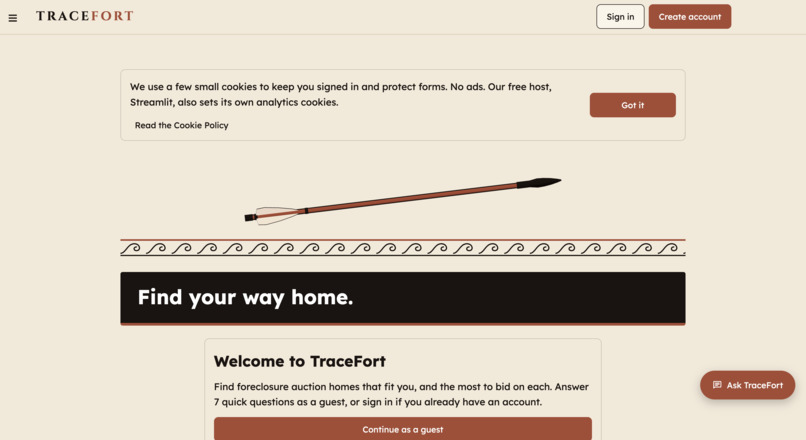
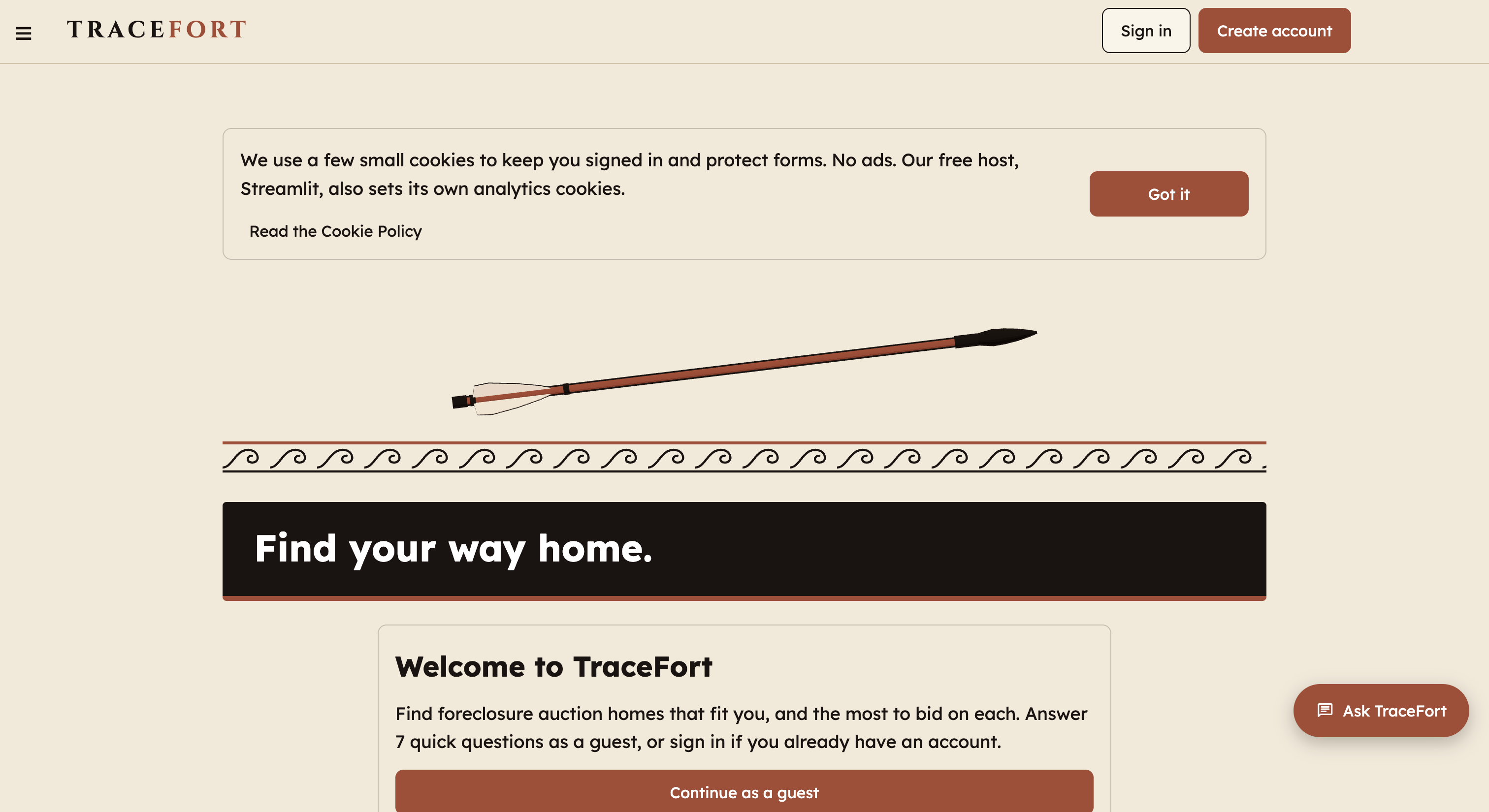
In the Odyssey, the suitors move into a house that isn't theirs and fight over it, and it costs them everything. Odysseus gets home because he knows what the house is really worth and stays out of the fight. He proves the house is his with a single arrow, shot through twelve axe heads, and that arrow is the first thing you see on our home page.
Foreclosure auctions can feel the same for first-time buyers. Experienced investors show up with their numbers worked out, while a lot of beginners show up hoping for a deal. Bidding moves in seconds, and it's easy to keep raising your hand. We built TraceFort so a buyer knows their walk-away bid before the first bid, and can find their way home without overpaying.
What it does
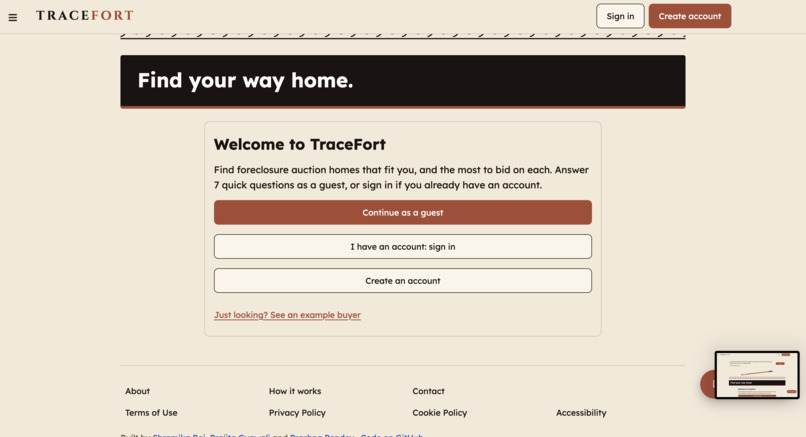
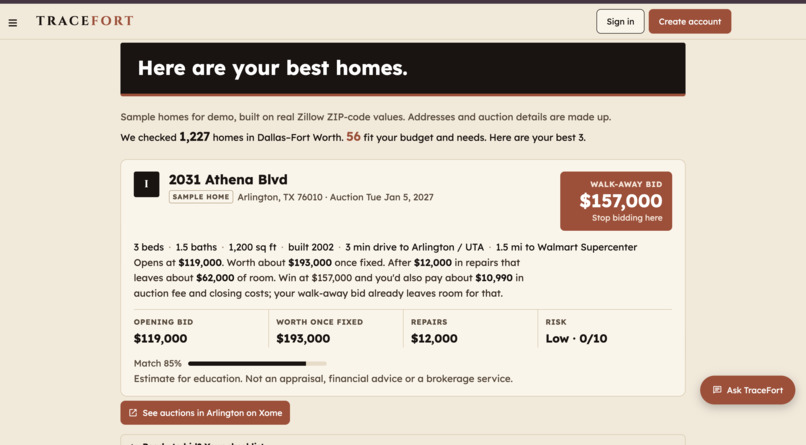
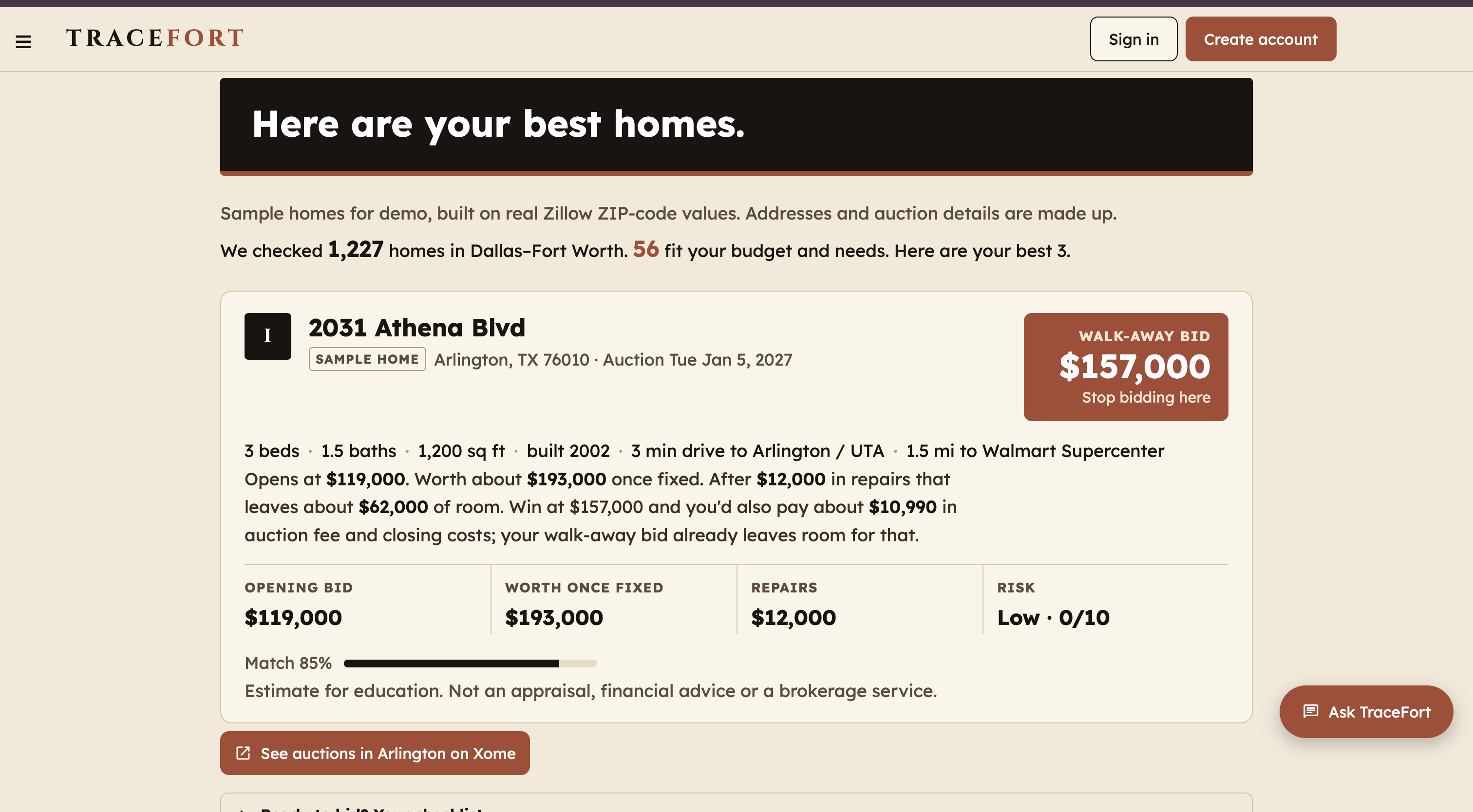
You answer 7 quick questions (goal, budget, bedrooms, work ZIP, drive time, repairs, risk), either as a guest or with an account. TraceFort then shows your best 3 homes out of 1,227 in Dallas-Fort Worth, or 1,043 in Houston. Each home gets a walk-away bid, a repair estimate, a risk score from 0 to 10, a drive time and a Ready to bid? checklist that includes Texas eviction rules for occupied homes.
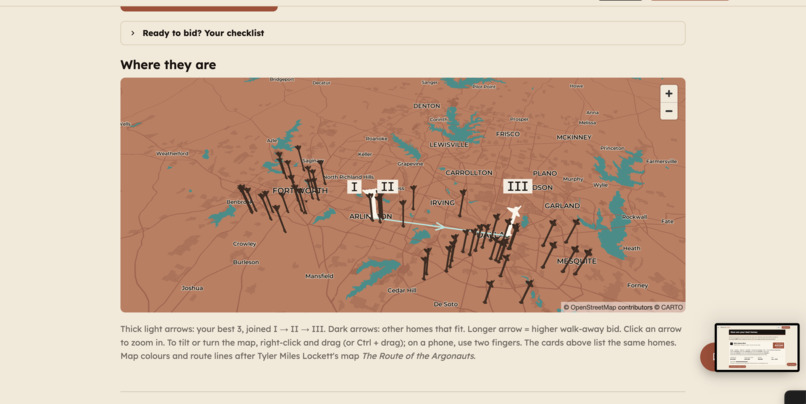
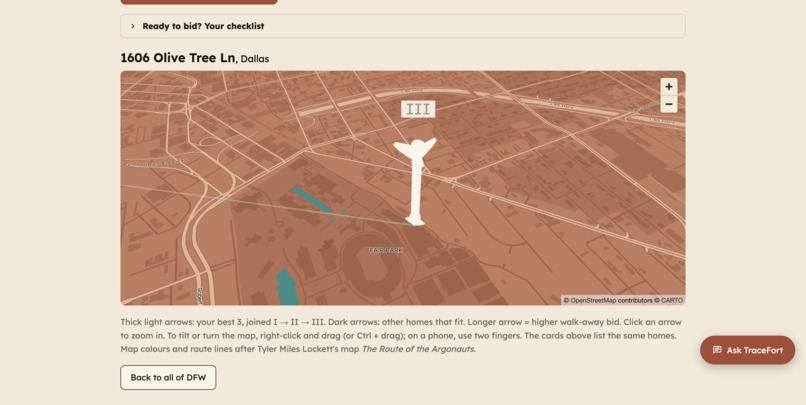
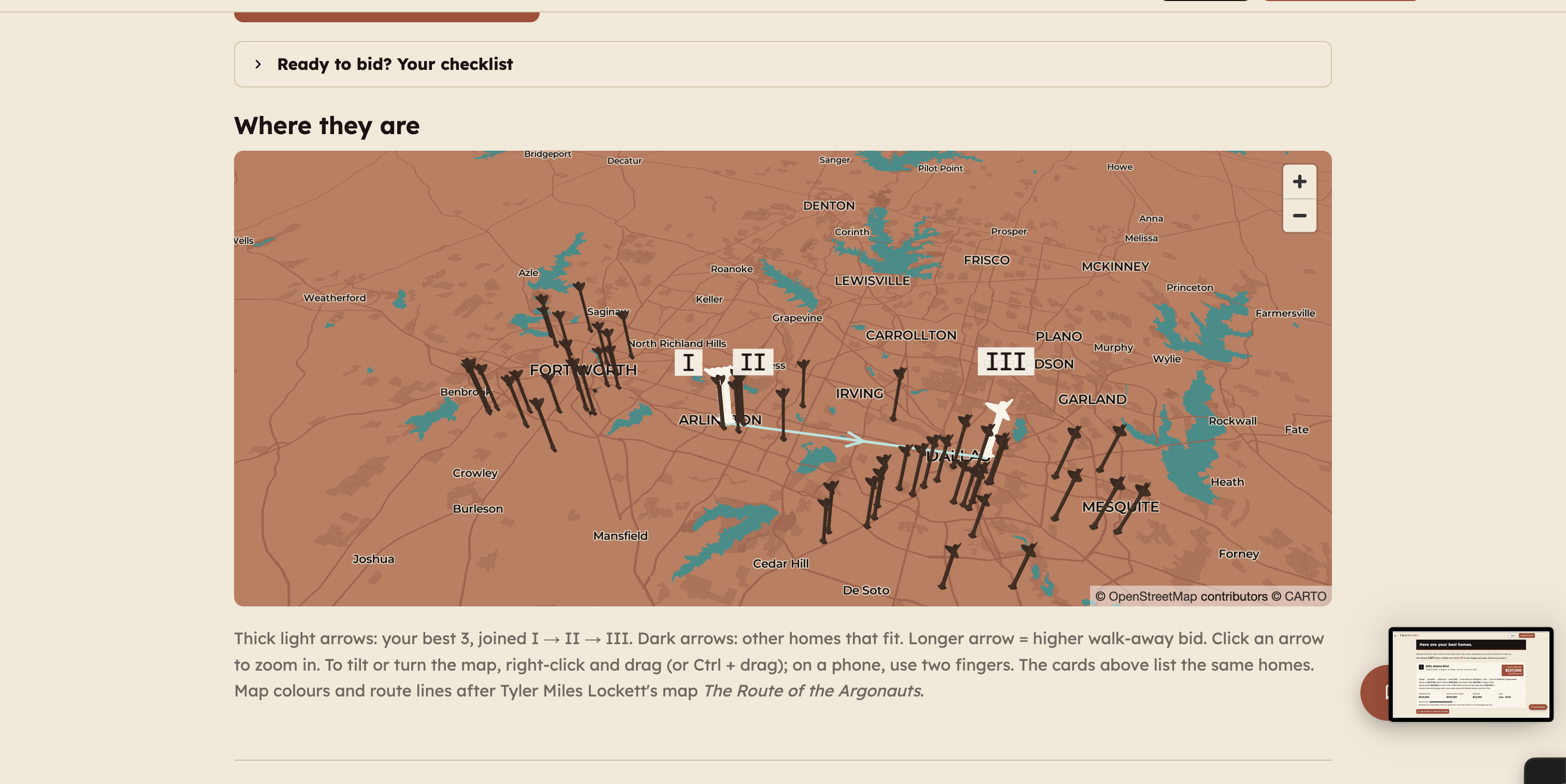
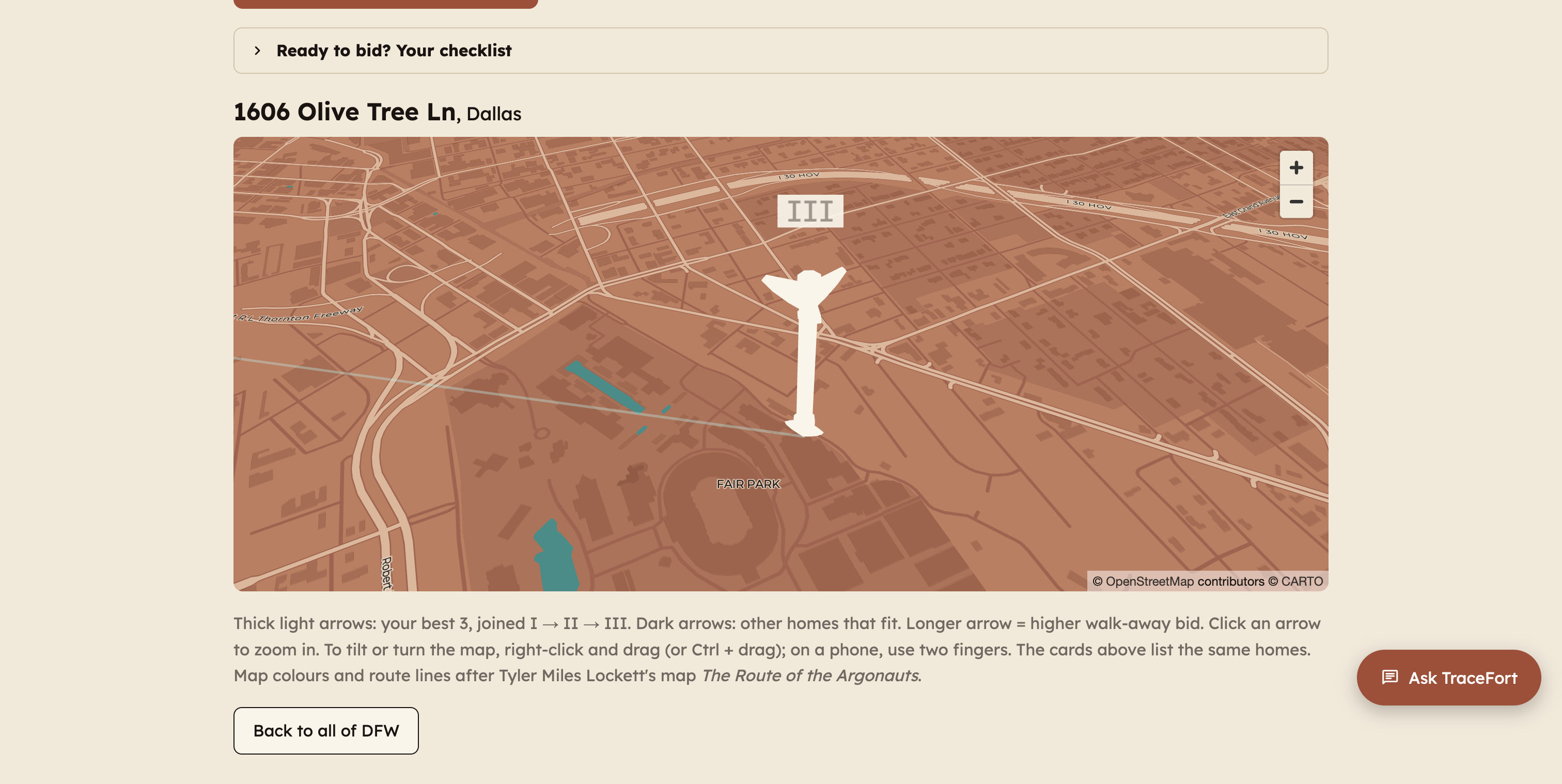
On the 3D map, every home that fits is an arrow standing on its spot, and a longer arrow means a higher walk-away bid. A route joins your top 3 in order, like a voyage, and clicking an arrow zooms in to that street.
Each home also has a See auctions on Xome button. It opens real Xome auctions in that city in a new tab, so the walk-away bid and checklist stay open next to it and you don't have to switch between websites to compare.
Investor mode picks the set of homes that makes the most profit after every cost, with a cap on average risk and no single home taking more than half the money. Ask TraceFort, a helper powered by Claude, is on every page and explains auctions and your own homes in plain words, in any language.
How we built it
Home values are real. They come from Zillow's Home Value Index by ZIP code and bedroom count (September 2026) for every DFW and Houston ZIP that Zillow prices, placed with U.S. Census ZIP locations, with store locations from OpenStreetMap. Real auction listings aren't public, so the 2,270 homes and their auction details are generated by fixed, documented rules on top of those real values. The addresses are made up on purpose.
The walk-away bid starts from the fact that winning costs more than the bid. With bid $x$, Xome's buyer's premium and closing costs are
$$f(x) = \max(0.05x,\ \$2{,}500) + 0.02x$$
For a home worth $V$ once fixed, with repairs $R$, a buyer with budget $B$ and a safety cushion $m$ (set by goal and risk; fix-and-resell uses the investors' 70% rule, $m = 0.30$), the walk-away bid is the largest $x$ that satisfies all three:
$$x \le V(1-m) - R \qquad x + f(x) + R \le B \qquad x + f(x) + R(1+b) \le V$$
Here $b$ is a buffer for repairs running over: 10%, or 25% if nobody has seen inside. The bid, the fees and the repairs together never go over the buyer's budget or past what the home is worth.
Investor mode is a 0/1 knapsack. It chooses homes $y_i \in {0,1}$ to
$$\max \sum_i w_i\, p_i\, y_i \quad \text{s.t.} \quad \sum_i c_i\, y_i \le C,\qquad \sum_i (r_i - \bar r)\, y_i \le 0,\qquad c_i \le \tfrac{C}{2}$$
where $p_i$ is profit after every cost, $w_i$ discounts riskier homes, $c_i$ is the cash a home needs, $C$ is total capital and $\bar r$ is the average-risk cap. SciPy's MILP solver finds the exact answer (Gurobi when it's installed).
The look is Greek pottery: black glaze, parchment and terracotta. We modelled Odysseus's arrow in code (no downloaded 3D files) from a red-figure drawing of him drawing his bow, using the img2threejs skill, and drew it with three.js above a band of Greek wave scrolls. It holds still for anyone who has reduced motion turned on. The same arrow, saved as a 20 KB 3D model, stands on every home on the pydeck map. The base map is CARTO's light map recoloured to a teal sea and rust land, after Tyler Miles Lockett's map The Route of the Argonauts.
The site is Python, pandas and Streamlit, with a 3D pydeck map, a three.js hero, SQLite accounts (PINs hashed with PBKDF2, sign-in paused after 5 wrong tries) and a fixed header with a side menu. It runs on Streamlit Community Cloud, deployed from GitHub. Ask TraceFort uses Claude Haiku 5.5. Before a question reaches the model, free rules check it, and a tiny AI check runs only when the rules can't tell. Homework, code and prompt-injection attempts get a short warning instead of a paid answer.
We test 972 buyer combinations automatically. A separate check that adds real auction costs found 0 money-losing and 0 over-budget walk-away bids across 21,108 cases.
Challenges we ran into
Two of us wrote different bid formulas. We ran both on every home against real auction costs and kept the best parts of each: the safer walk-away formula and the more realistic investor mode.
Both versions first left out the buyer's premium and closing costs, so a "walk-away bid" could still push someone over budget. Fixing that changed our demo numbers ($161,500 → $157,000), and we updated everything to match.
Our homes are samples, and we didn't want to pass them off as real listings. So the Xome button opens real auctions in the same city instead of a fake listing page.
Phones took more work than we expected. The header had to stay in place while scrolling, the side menu had to close itself after you pick a page, and our buttons kept ending up under the host's own overlays until we moved them.
The 3D map fought back too. pydeck reads every piece of text in a map setting as code, so the arrow model and even the word "pixels" broke the map until we wrapped them in quotes. And in our drawing, the arrow is a thin line partly hidden by Odysseus's hand, so its feathers are our best guess.
What we learned
Auction fees and repair overruns change the right bid more than the opening bid does. People notice small problems fast: a menu that stays open or a button they can't tap was enough to make the whole site feel broken. Saying clearly which data is real and which is a sample made the project easier to explain to judges and users. We also learned how to split the work three ways and still end up with one version everyone agreed on.
What's next
We'd like a real listing feed so the Xome button opens the exact home, plus live comps and rent estimates. Adding more states means encoding each state's foreclosure rules. A hosted database would let accounts survive restarts.
Built at HackUTA 2026 by Shramika Rai, Prajita Gyawali and Prashna Pandey. Every number is an educational estimate, not financial advice. Not affiliated with Xome. Map colours after Tyler Miles Lockett's The Route of the Argonauts.
