-
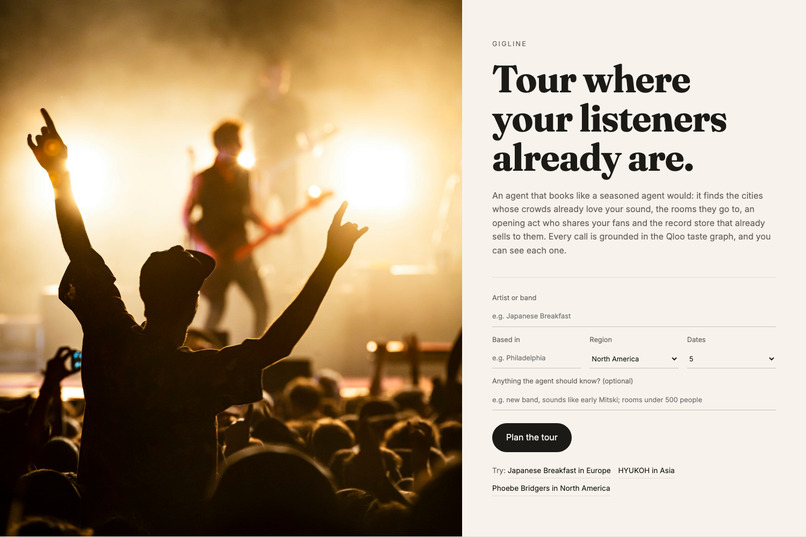
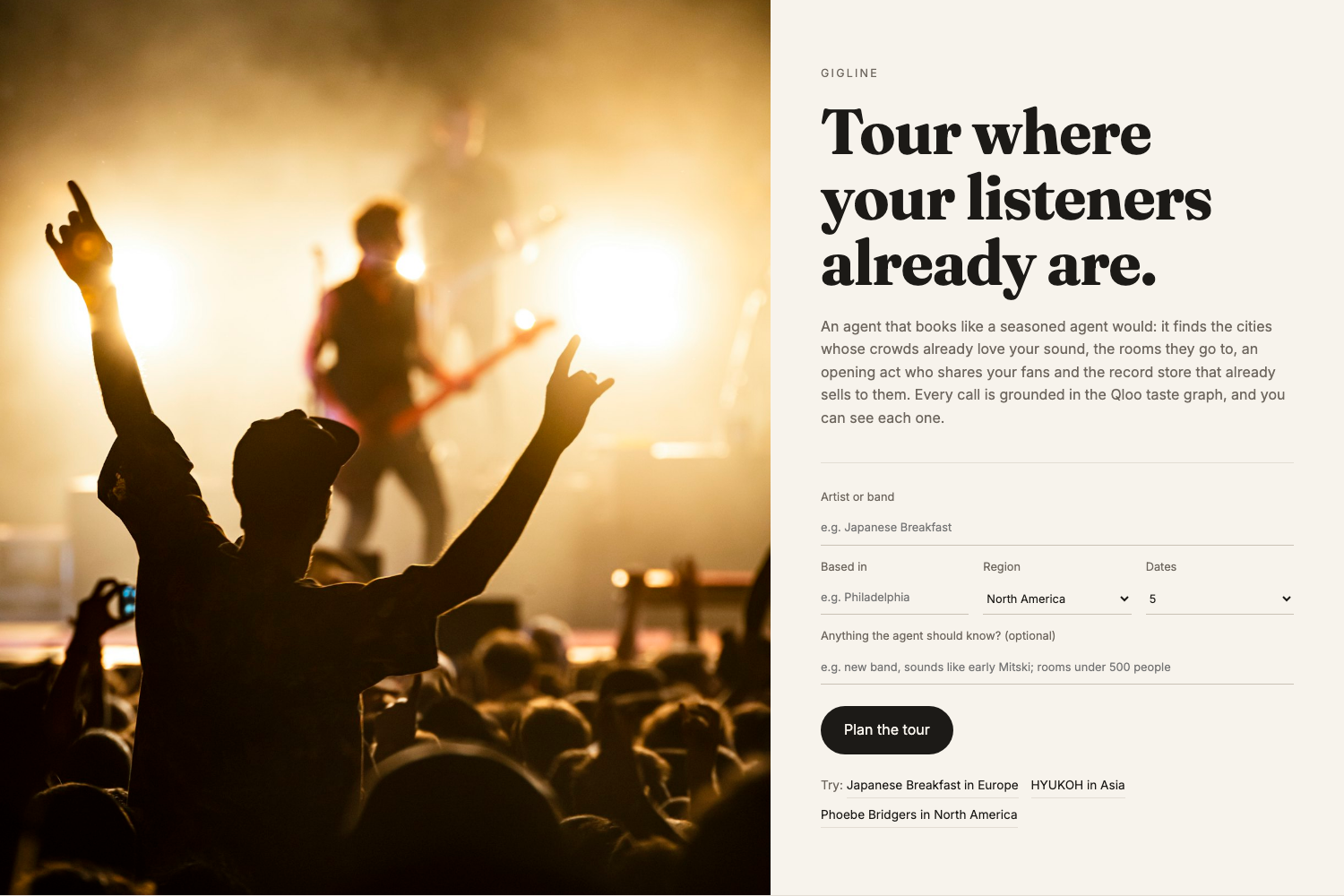
The brief: artist, home city, region and number of dates. Three examples replay real model-written plans.
-
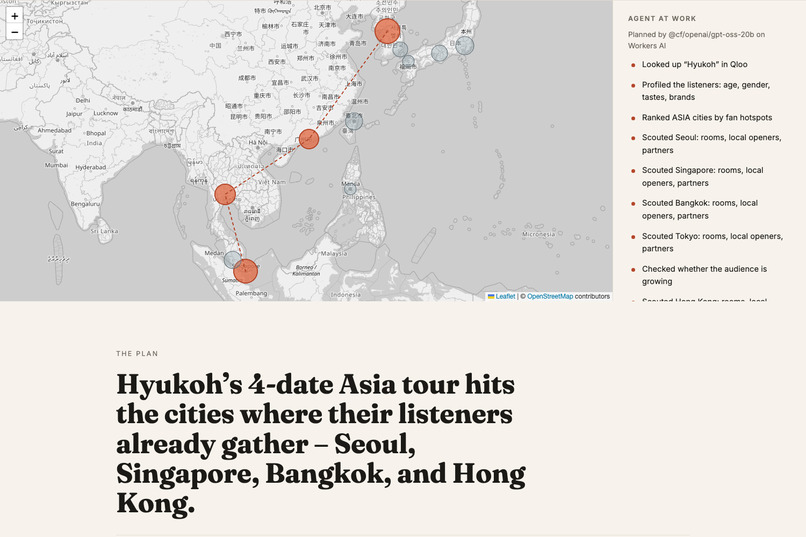
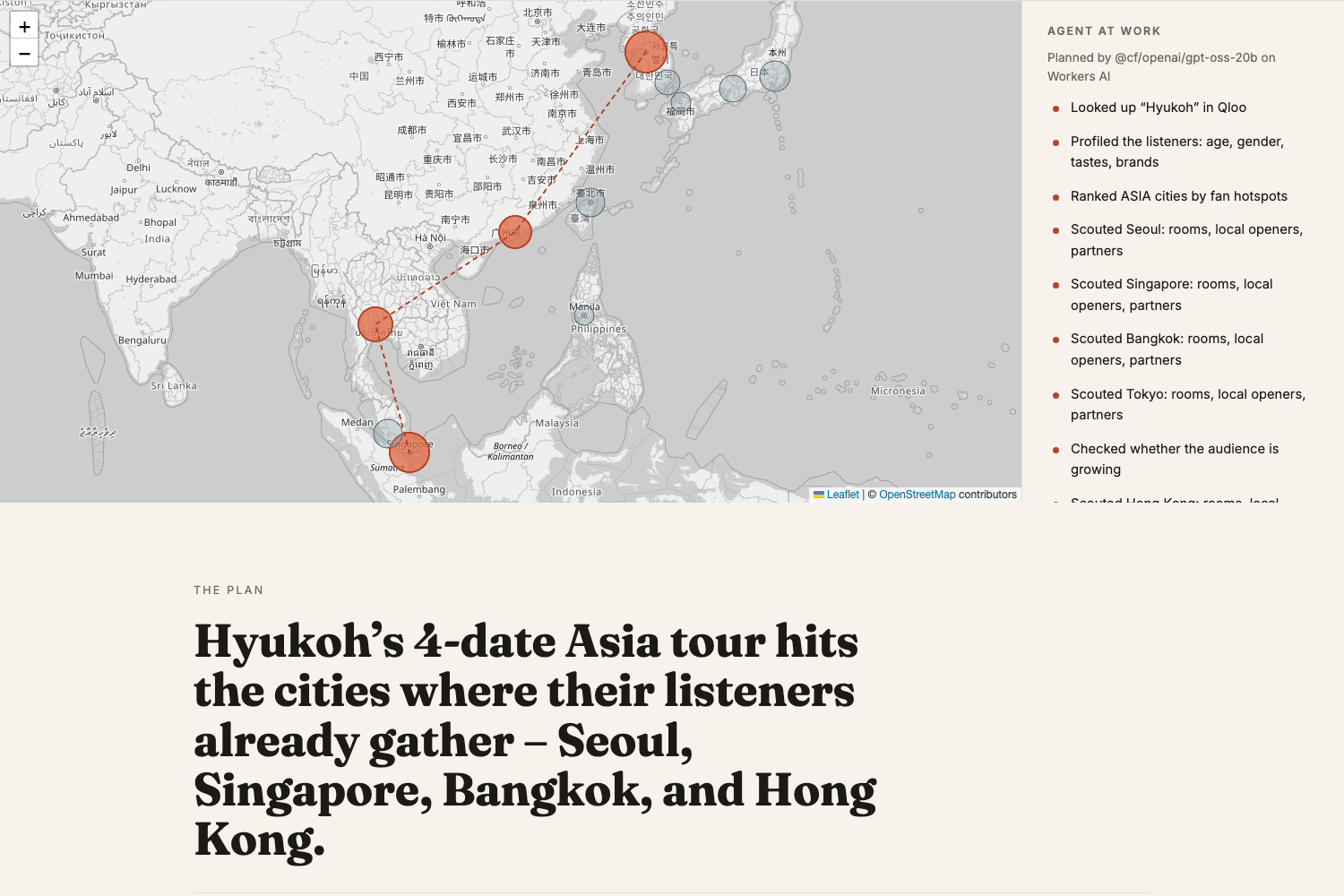
HYUKOH in Asia: fan hotspots from Qloo heatmaps on the map, and the agent's steps as it works.
-
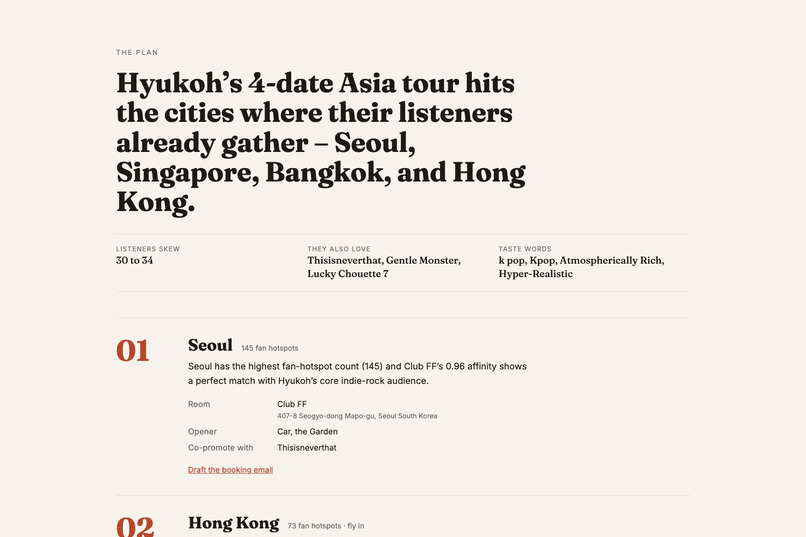
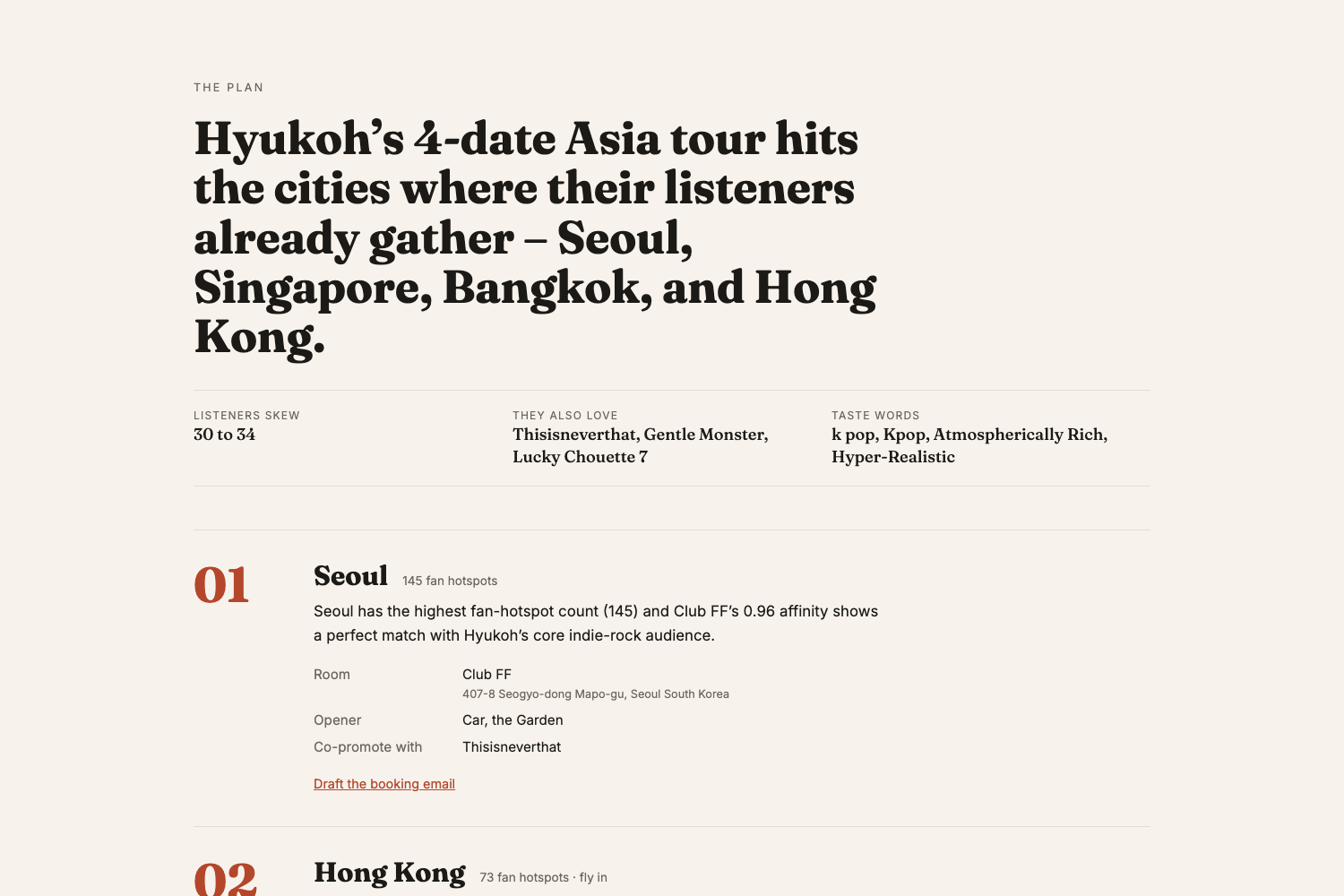
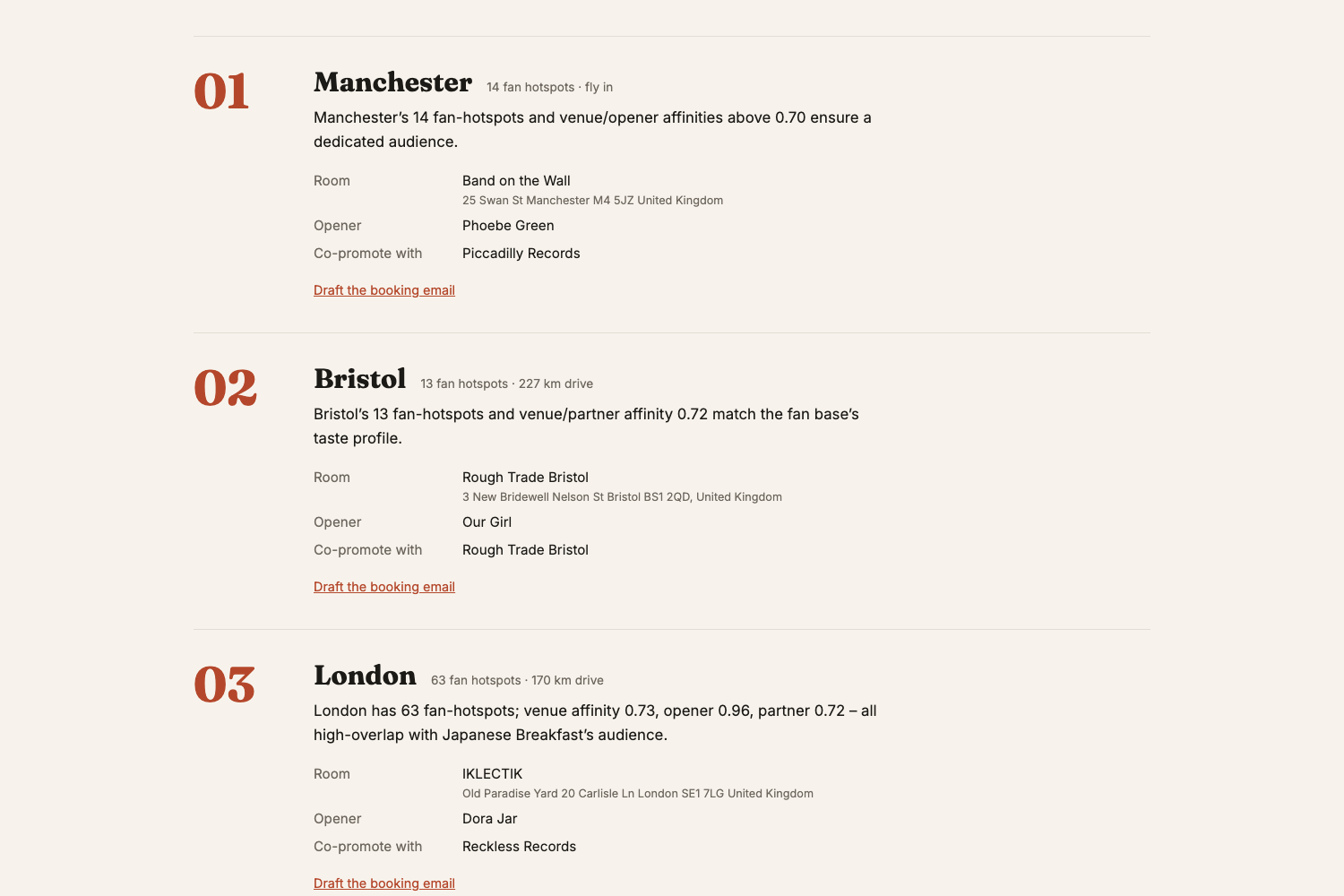
The plan: one stop per date with the room, an opener and a co-promotion partner, each with the Qloo evidence.
-
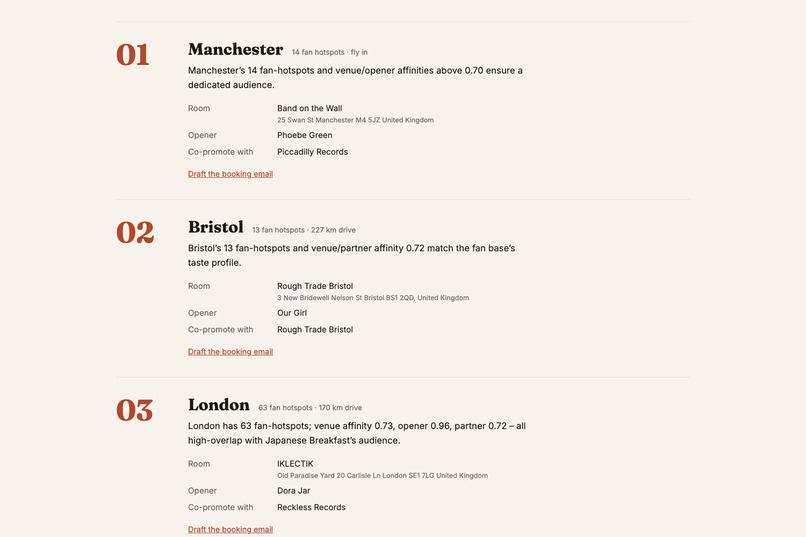
Japanese Breakfast in Europe: rooms checked against Qloo's coordinates, so Glasgow, Kentucky can't sneak in.
-
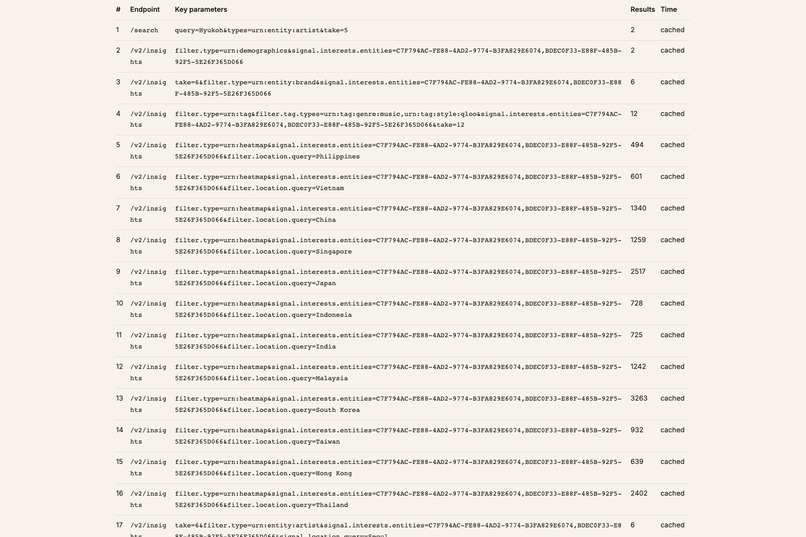
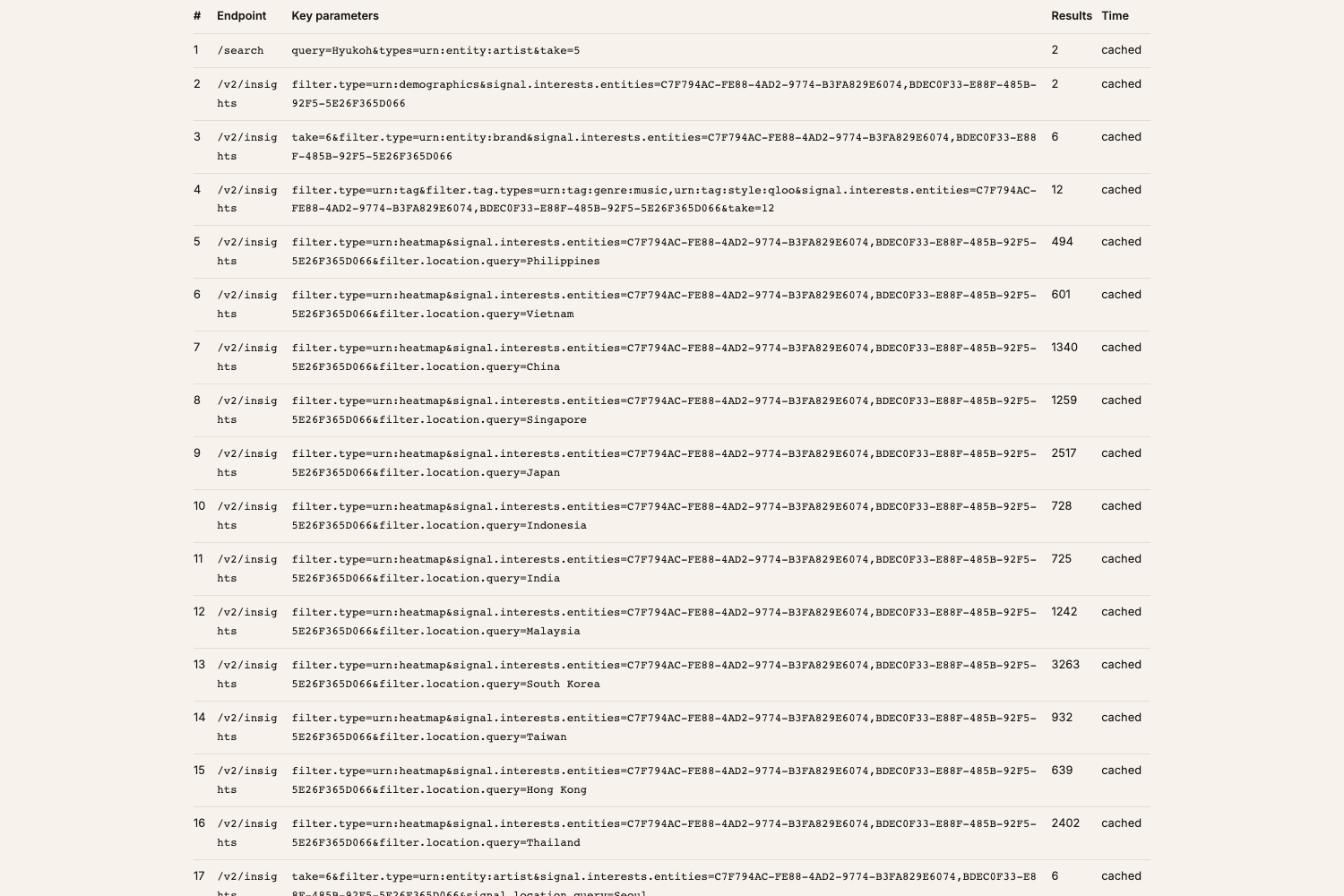
Provenance: every Qloo call behind the plan, with parameters, result counts and cache status.
Why
A touring agent's value is market knowledge: which cities hold an act's listeners, which rooms those listeners go to, who could open. An act without an agent has to guess, and a guessed route costs fuel, hotel nights and empty rooms. Qloo's taste graph holds the answers as data, so Gigline is an agent that asks those questions in order and shows the evidence for every pick, so the band can check it before sending a single email.
What it does
Type the act (or describe the sound if the act is too new to be in any database), the home city, the region and the number of dates. The agent then works through Qloo in front of you:
- Resolves the act, or turns a sound description into Qloo tags and proxy artists.
- Profiles the listeners: age skew, the brands they like, their taste words.
- Asks the heatmap where they are, country by country, and rolls the cells up to touring cities ranked by fan hotspots.
- For the best cities: live music rooms the audience likes, an opening act who shares the fans, and a record store to co-promote with.
- Checks momentum, then writes the plan: one stop per date, routed from home, each with a room, an opener, a partner and one sentence of Qloo evidence, plus risks and next steps. Each stop has a "Draft the booking email" link.
Every Qloo request behind the plan is listed in a provenance table: endpoint, parameters, result count, cached or live.
How I built it
- Cloudflare Workers + Workers AI,
@cf/openai/gpt-oss-20bwith tool calling. One agent step per HTTP request, so each step shows up on the page as it happens and stays inside the free CPU budget. - KV caches every Qloo response and every finished plan. The three example artists on the page replay real model-written plans instantly.
- Code checks around the model: plan validation against the city ranking, a repeated-call guard, a 40-second step timeout with retries, and a deterministic playbook if the model is down, so a visitor always gets a plan.
- Leaflet + OpenStreetMap for the map.
Qloo endpoints and why
/search: resolve the act before asking for any insight./v2/tags(semantic search): for unknown acts, a sound description becomes tag ids, then proxy artists./v2/insights,urn:demographics,urn:tag(filtered tourn:tag:genre:music,urn:tag:style:qloo),urn:entity:brand: who the listeners are. Unfiltered, the top taste tags were a credit card and blueberry pancakes./v2/insights,urn:heatmap+filter.location.query, one call per country (the heatmap returns nothing for "Europe"). Cells roll up to the nearest touring city; cities rank by cells with affinity 0.9 or more./v2/insights,urn:entity:place+urn:tag:genre:place:live_music_venue: rooms.urn:entity:artist+signal.location.querywith popularity capped: openers.urn:tag:genre:place:record_store: co-promotion partners./v2/trending: momentum over 90 days.
What went wrong, and the fixes
- Glasgow, Kentucky. A Europe plan put the Glasgow show at a family fun centre in Glasgow, KY. Qloo resolves a bare city name to any town with that name. Rooms are now kept only when Qloo's own coordinates are within 60 km of the touring city; with nothing left for Glasgow, the agent routed through Bristol instead.
- The band opening for itself. For HYUKOH, the suggested opener was Ohhyuk, the band's singer. Openers whose name is the act's name, an anagram of it, or contains it are now dropped.
- Hostels and museums tagged as venues. Milan's top "live music venue" was a hostel and London's was a composer's house museum. Rooms whose Qloo description says live music now come first, and the model sees that one-line description before it picks.
- Every big city tied. The best heatmap cell is 1.0 in every large city, so ranking by maximum affinity was a tie. Counting cells at 0.9 or more fixed the ranking.
- A shared free AI budget. Workers AI gives 10,000 neurons a day. Measured: a plan takes 10-14 model calls, about 30,000-57,000 input tokens and 2,000-5,000 output tokens, roughly 600-1,200 neurons, so about ten fresh plans a day for free. Example plans are cached so judges clicking them cost nothing.
Real runs (live demo, 2026-10-18, gpt-oss-20b on Workers AI)
| Brief | Plan | Model calls / time |
|---|---|---|
| Japanese Breakfast, from Philadelphia, Europe, 5 dates | Manchester (Band on the Wall, Piccadilly Records), Bristol (Rough Trade Bristol), London (IKLECTIK, Reckless Records), Berlin (LARK), Milan (Magnolia) | 12 / 70 s |
| HYUKOH, from Seoul, Asia, 4 dates | Seoul (Club FF, opener Car, the Garden), Hong Kong (Star Hall, White Noise Records), Bangkok, Singapore (Cool Cats, Choice Cuts Pizza & Records) | 12 / 35 s |
| Phoebe Bridgers, from Los Angeles, North America, 6 dates | Los Angeles, Portland (Mississippi Records), Seattle (The Vera Project, KEXP), Vancouver, Burlington VT, Providence | 14 / 45 s |
What's next
Room capacity against expected turnout, real drive and flight times, and a shareable plan link for the band.
Disclosure
Built by a solo developer in Korea with an AI coding agent (Claude Code). The English text was written with AI help.
Built With
- cloudflare-workers
- gpt-oss
- javascript
- kv
- leaflet.js
- openstreetmap
- qloo
- workers-ai

Log in or sign up for Devpost to join the conversation.