-
-
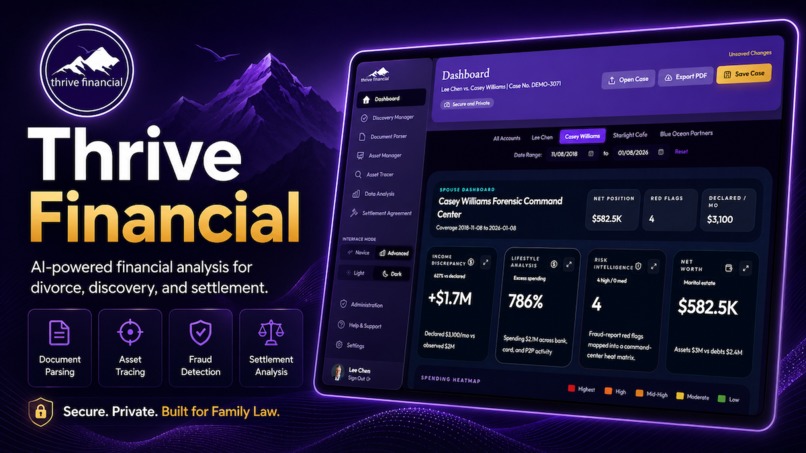
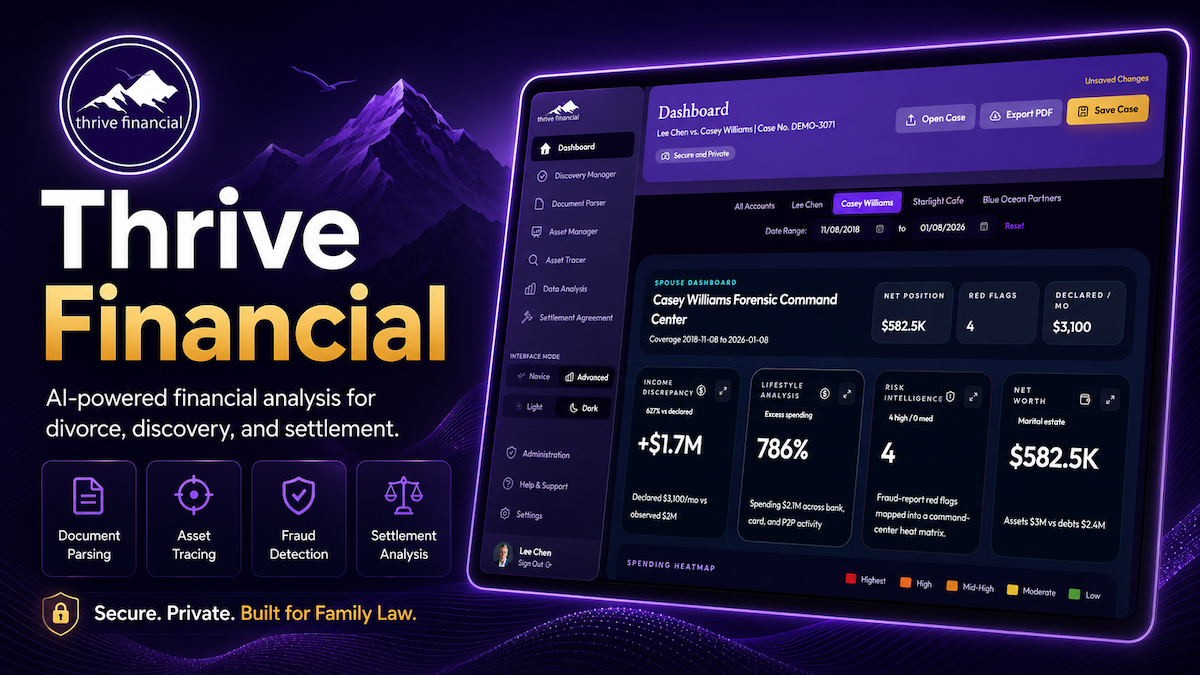
Marketing - The Dashboard
-
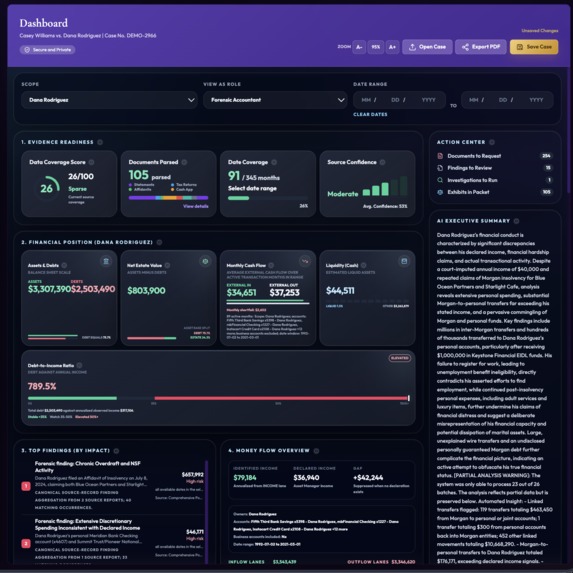
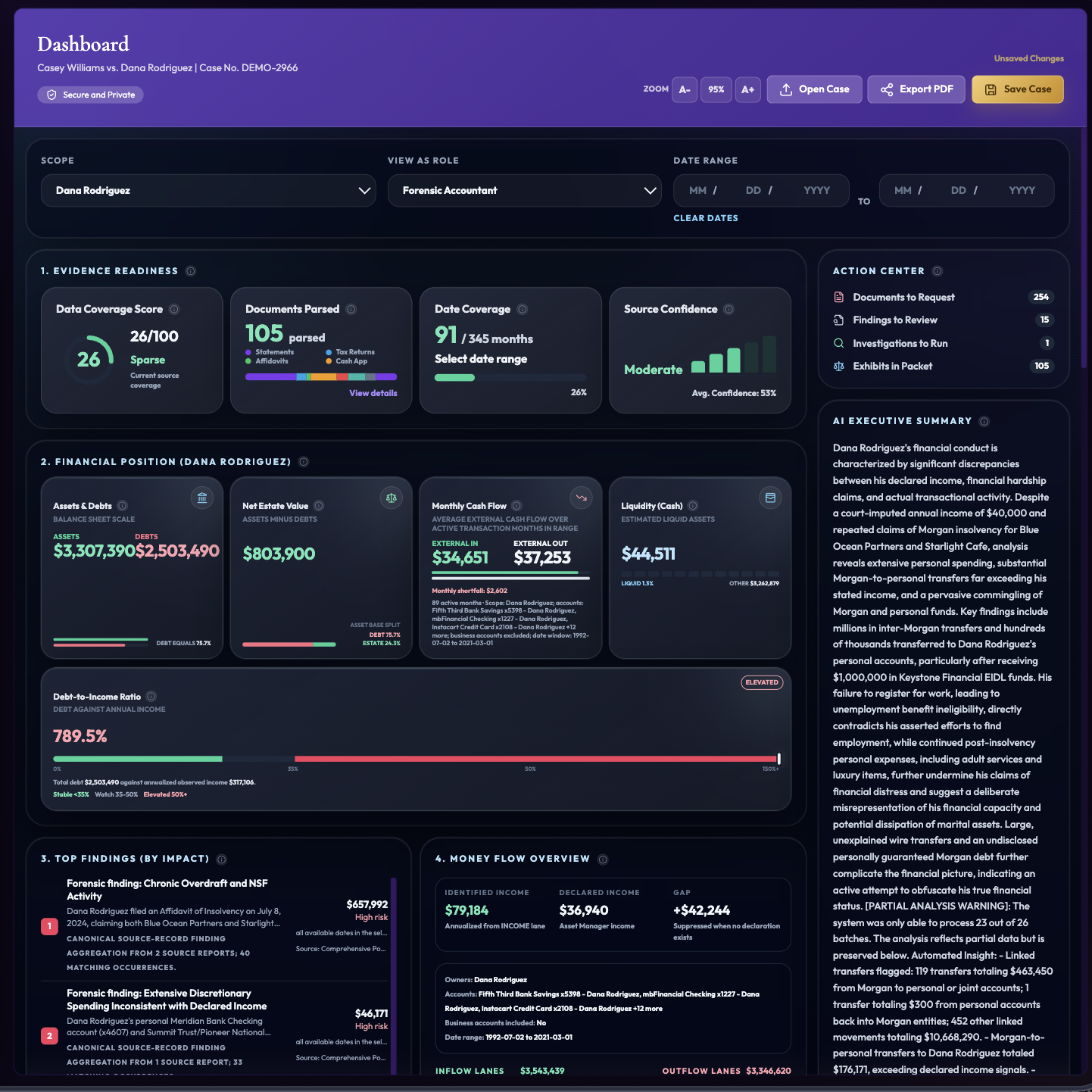
Forensic Accountant Dashboard
-

Divorce Coach Task Management
-
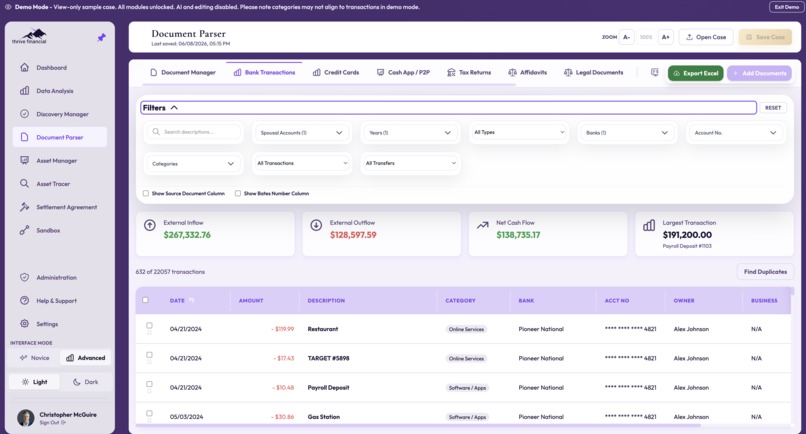
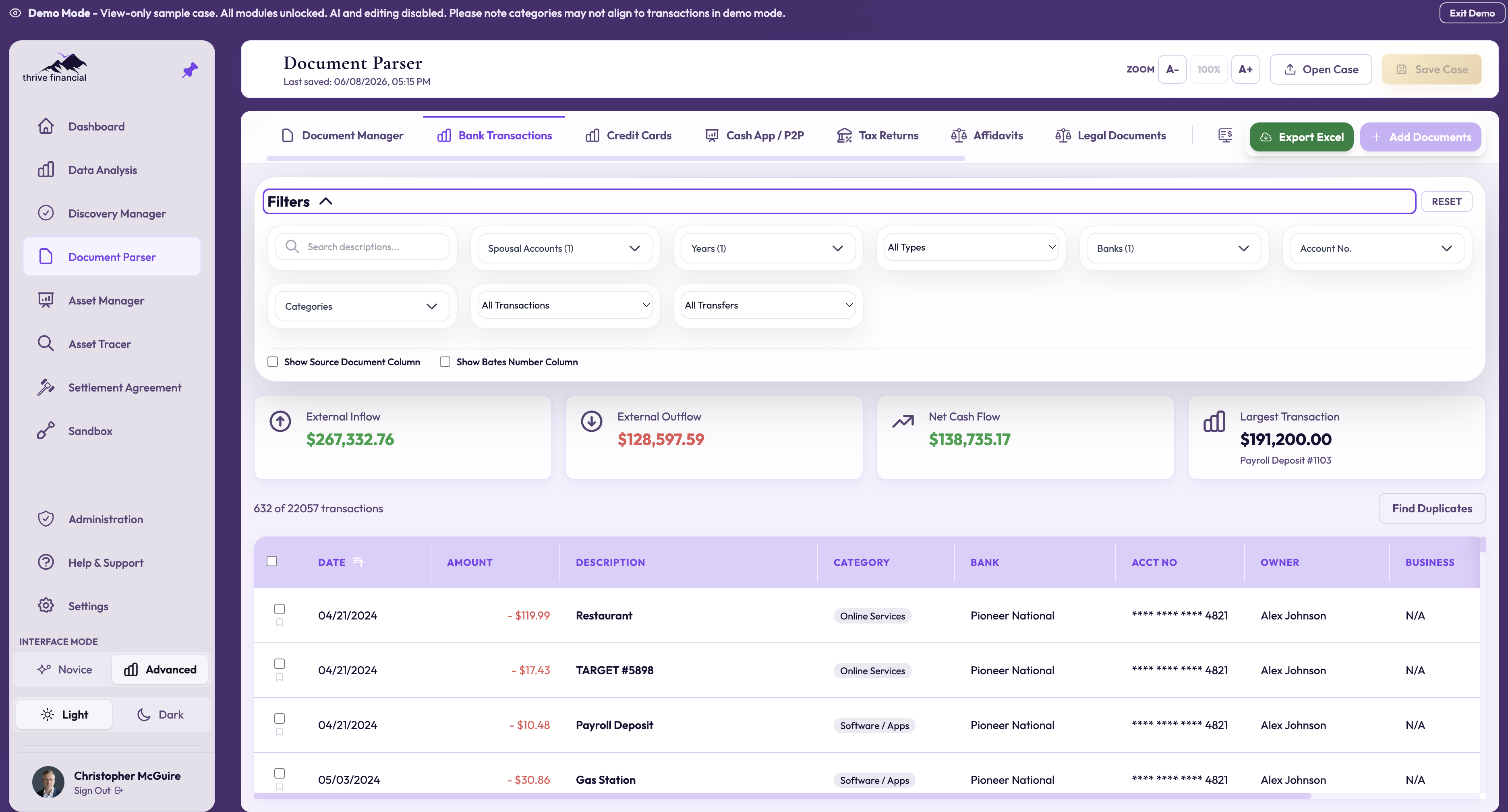
Document Parser
-
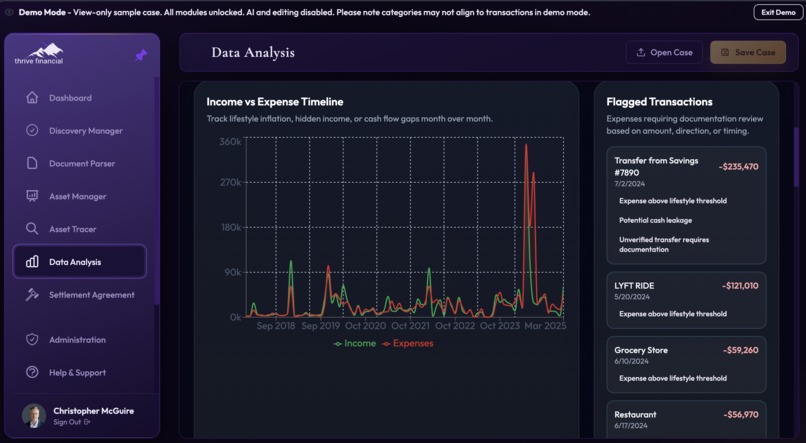
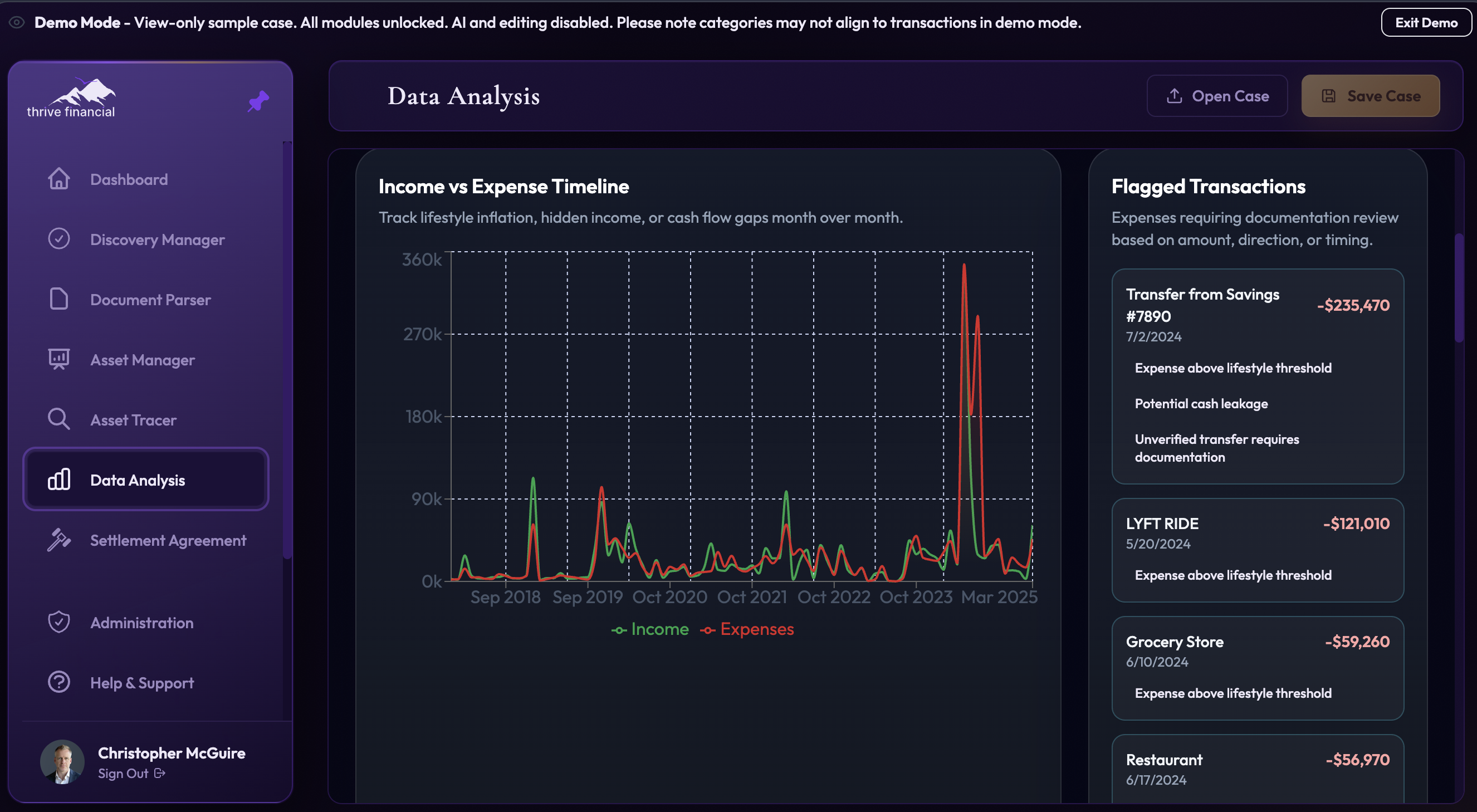
Data Analysis
-
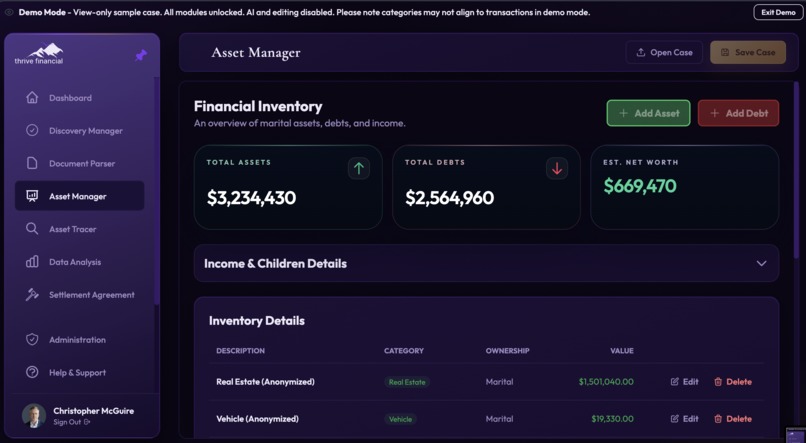
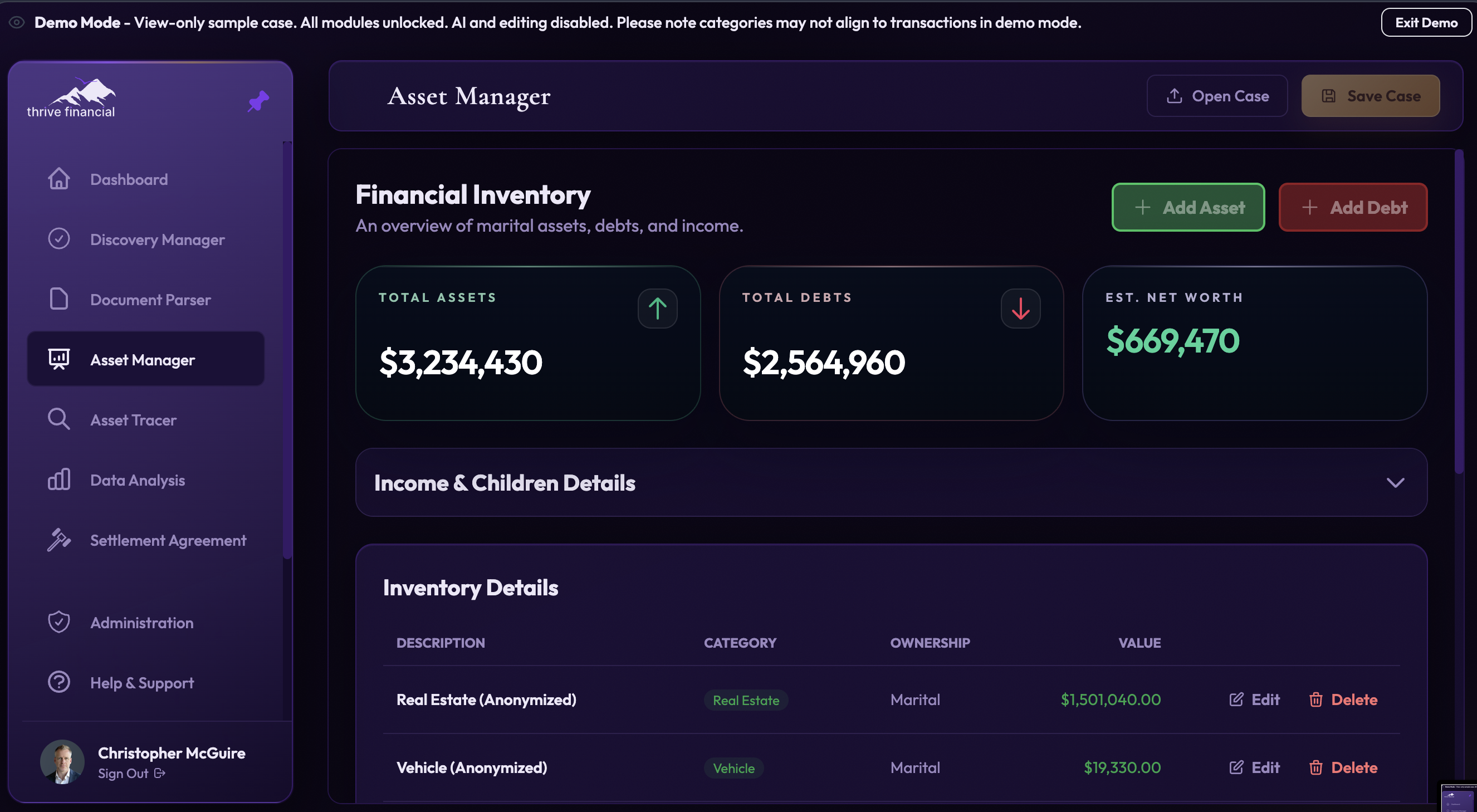
Asset and Debt Manager
-
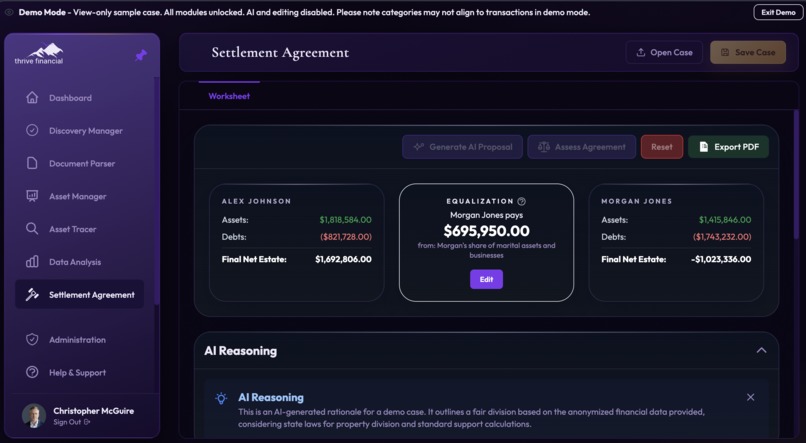
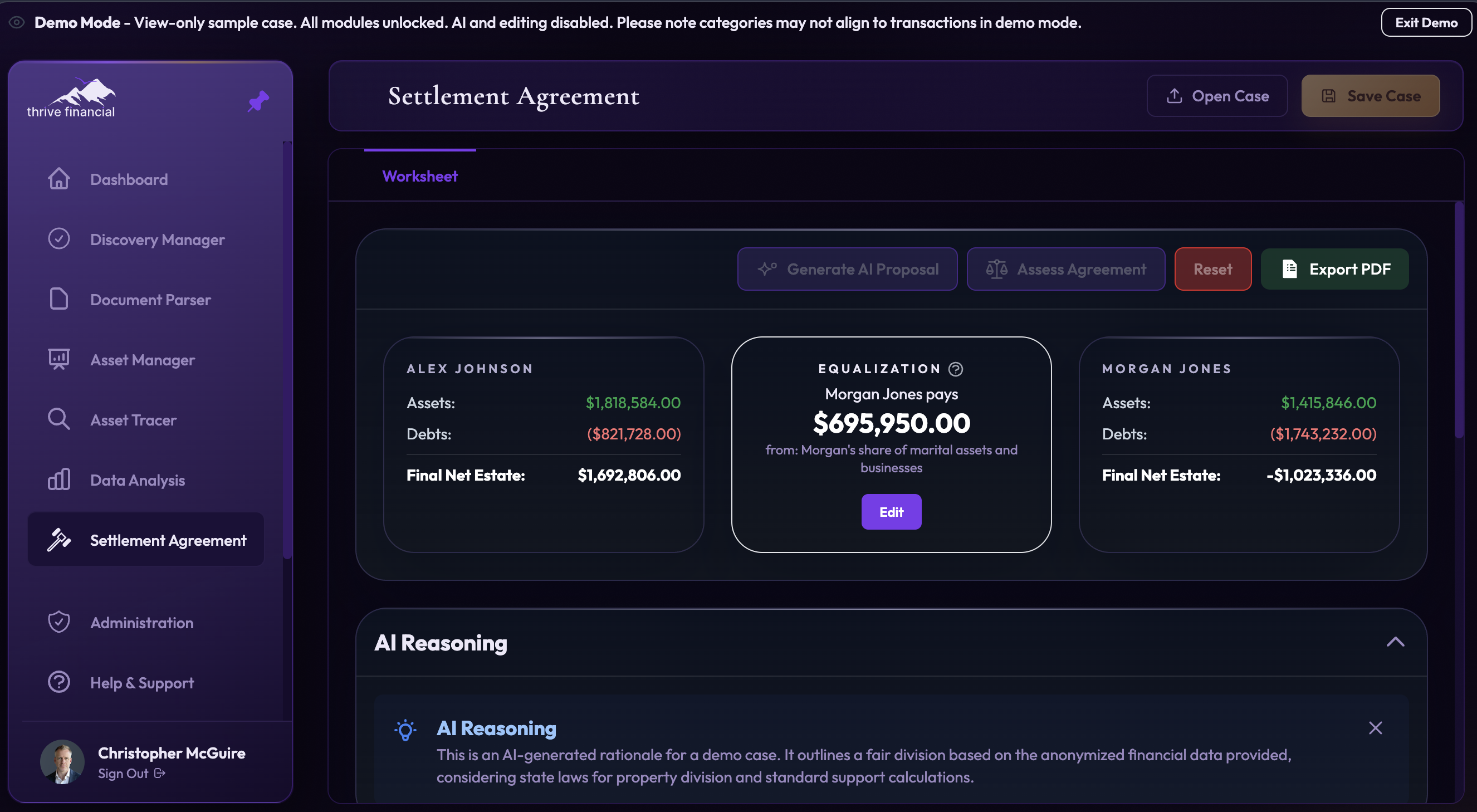
Settlement Agreement Negotiator
-
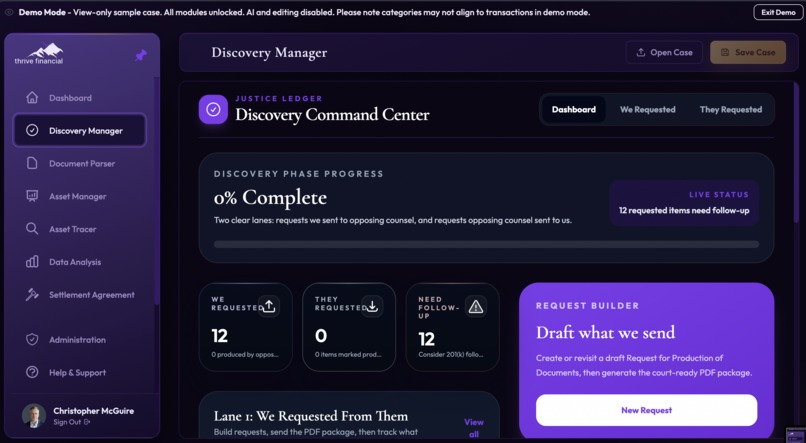
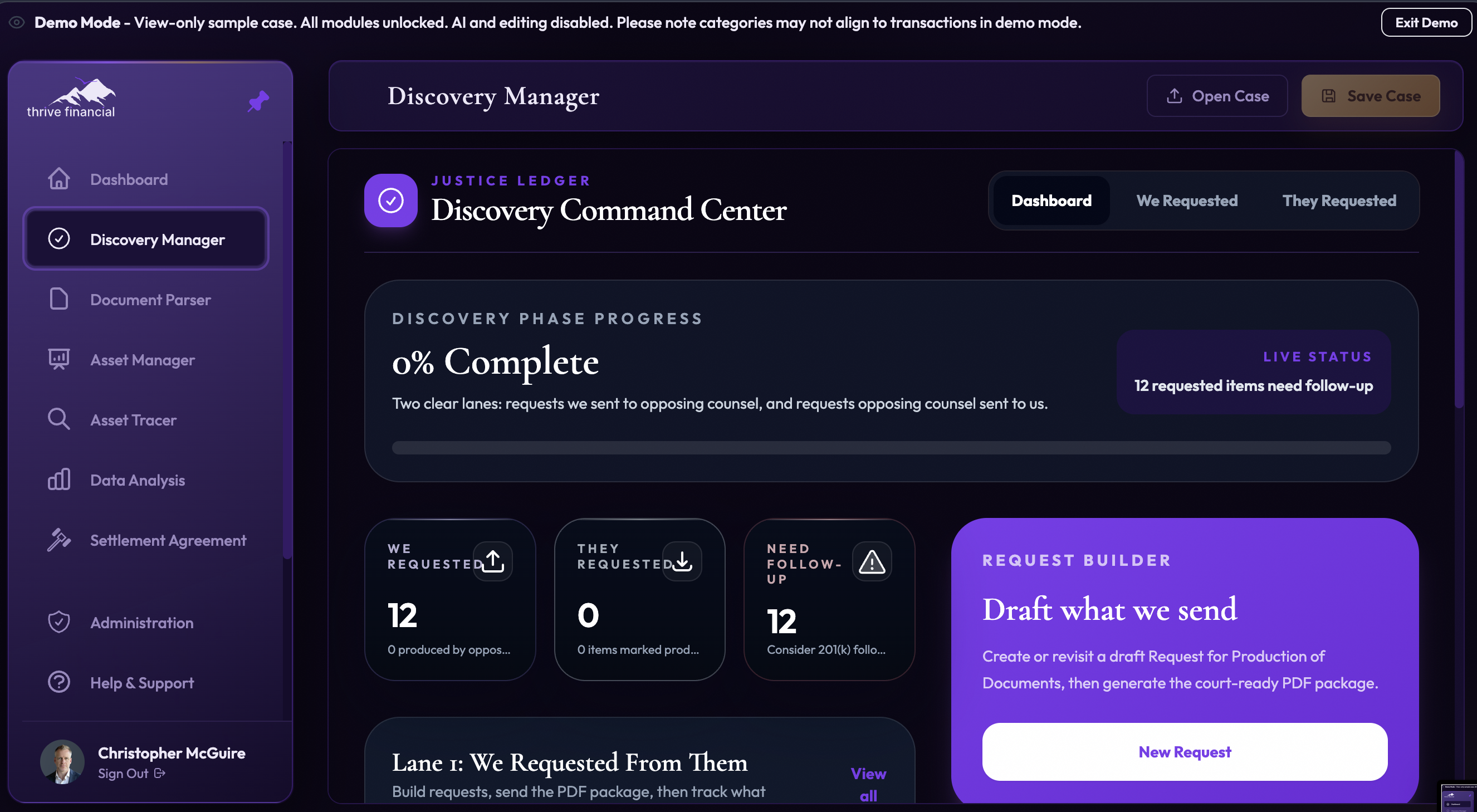
Discovery Manager
-
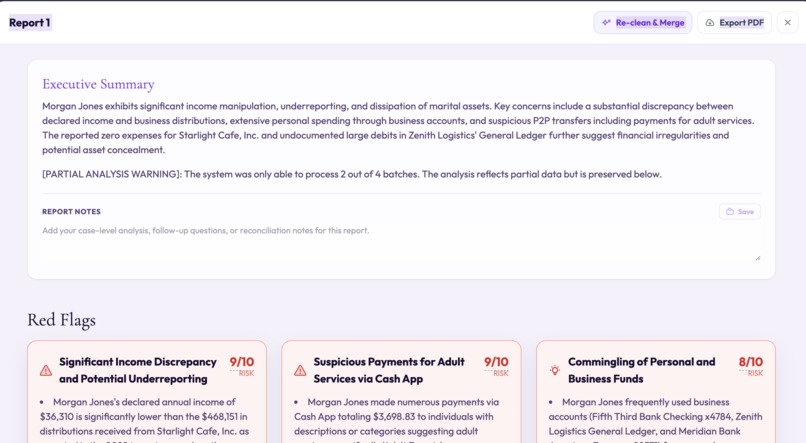
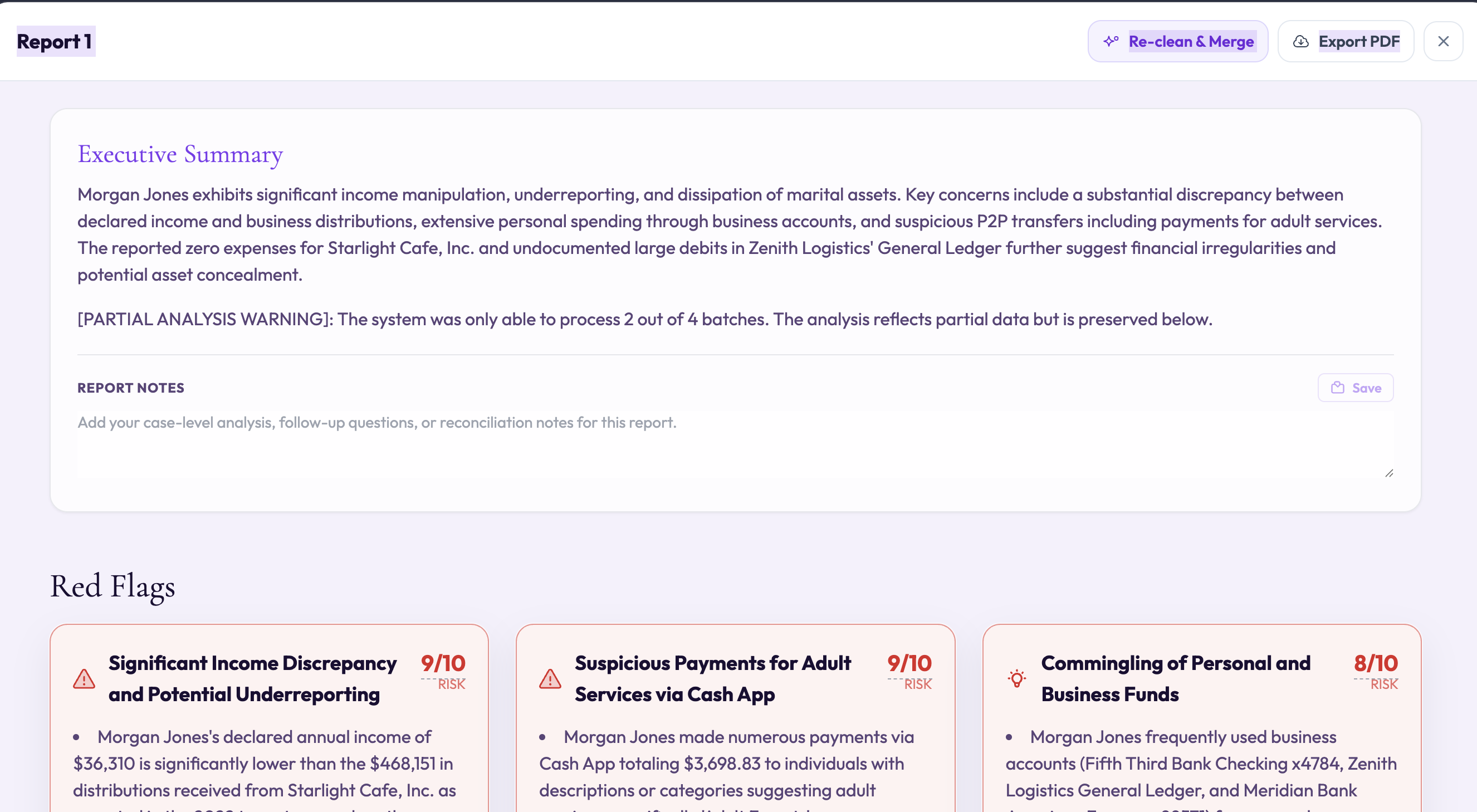
AI Generated Red Flag Report
-
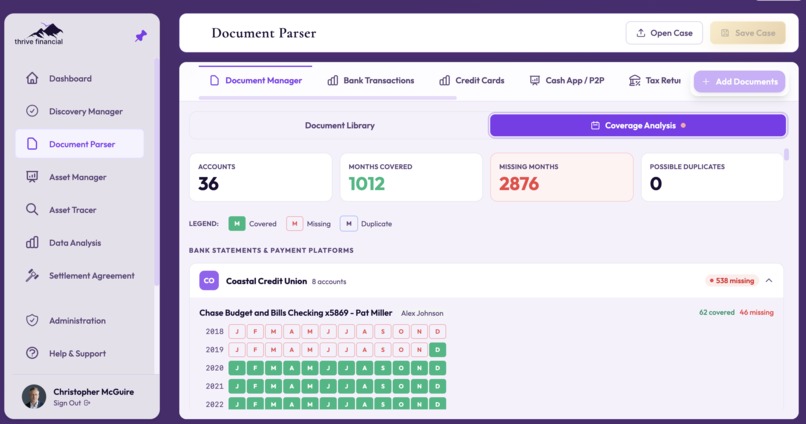
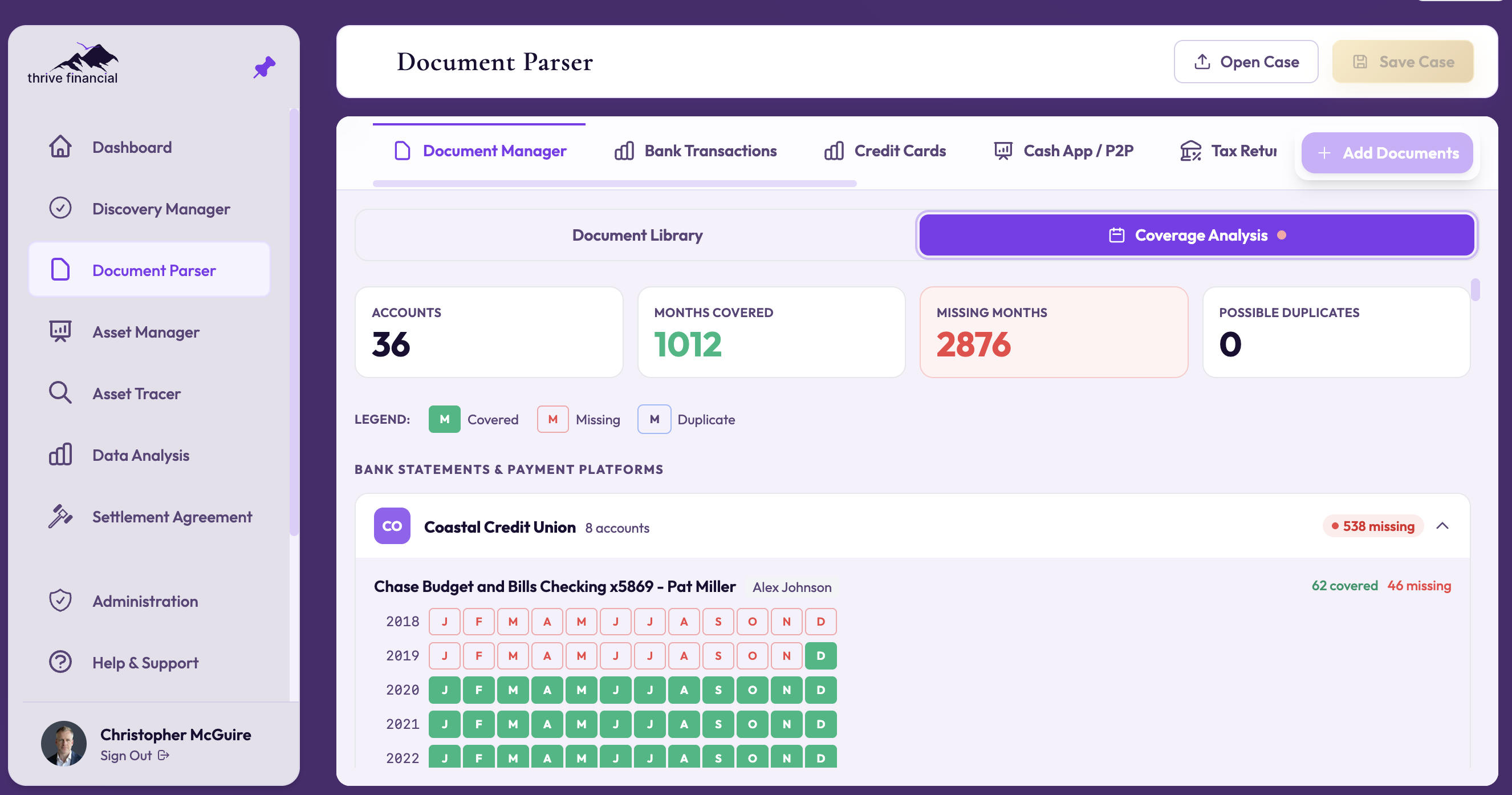
Document Coverage Analyzer
-

Child Support and Maintenance Calculator
-
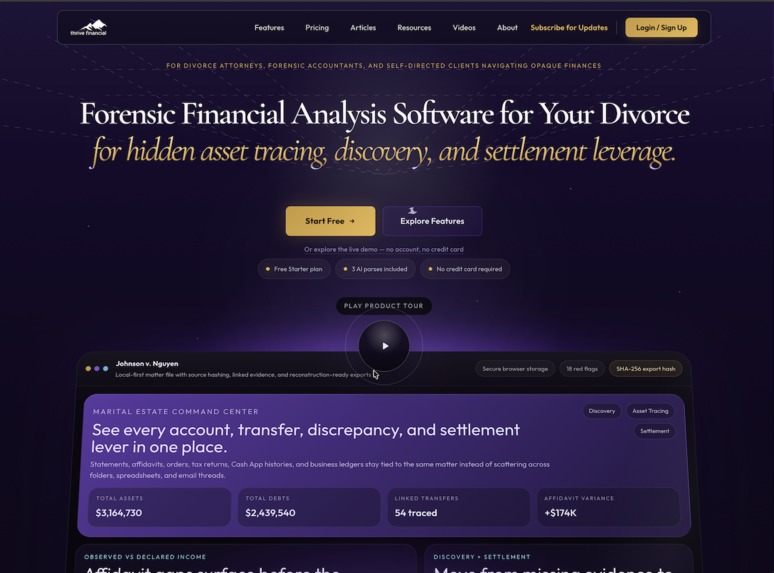
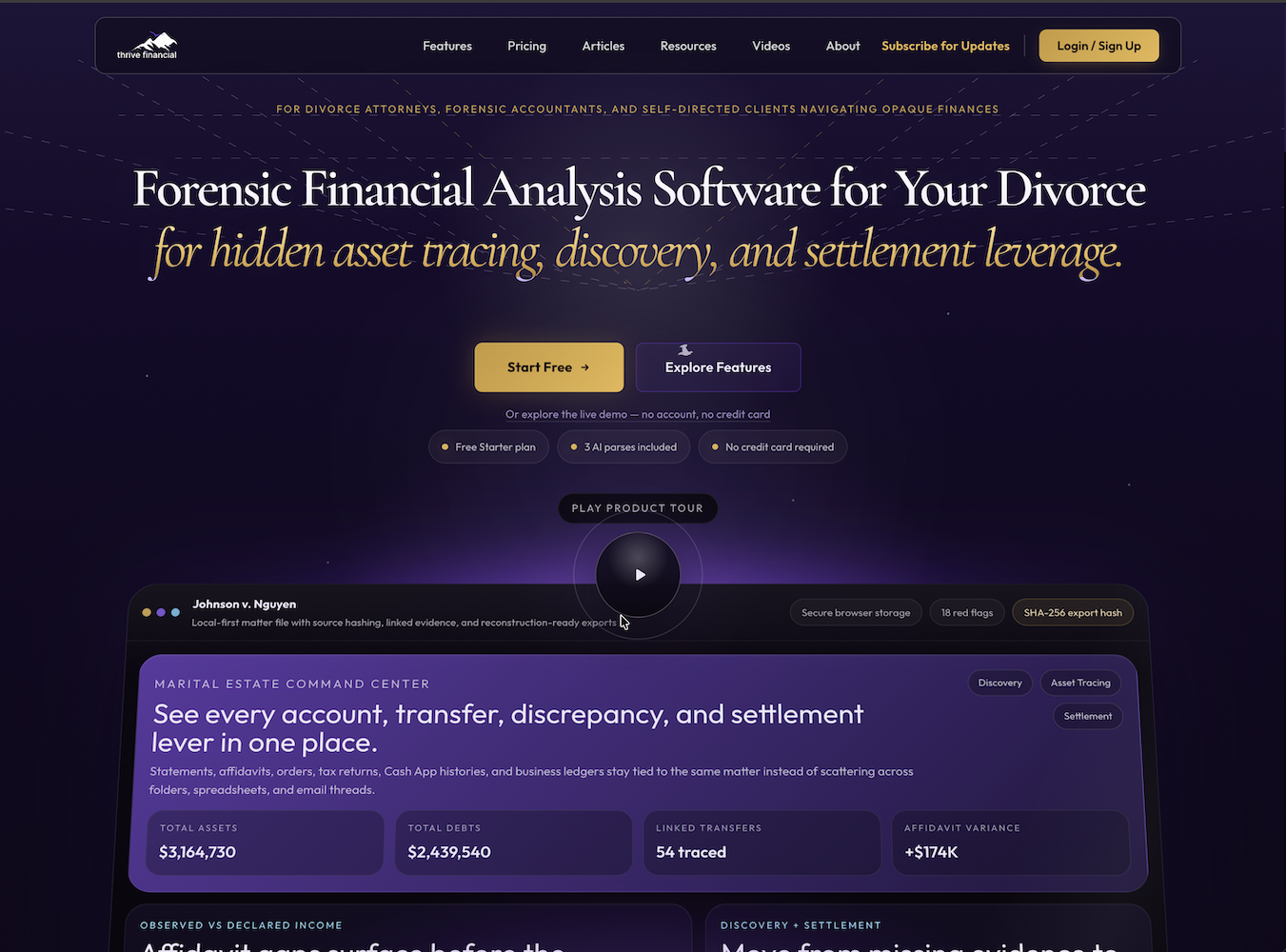
Landing Page
-
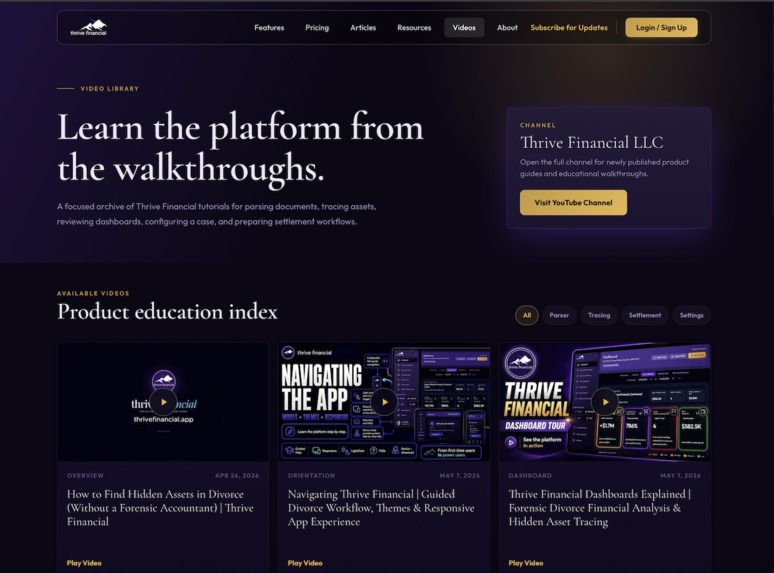
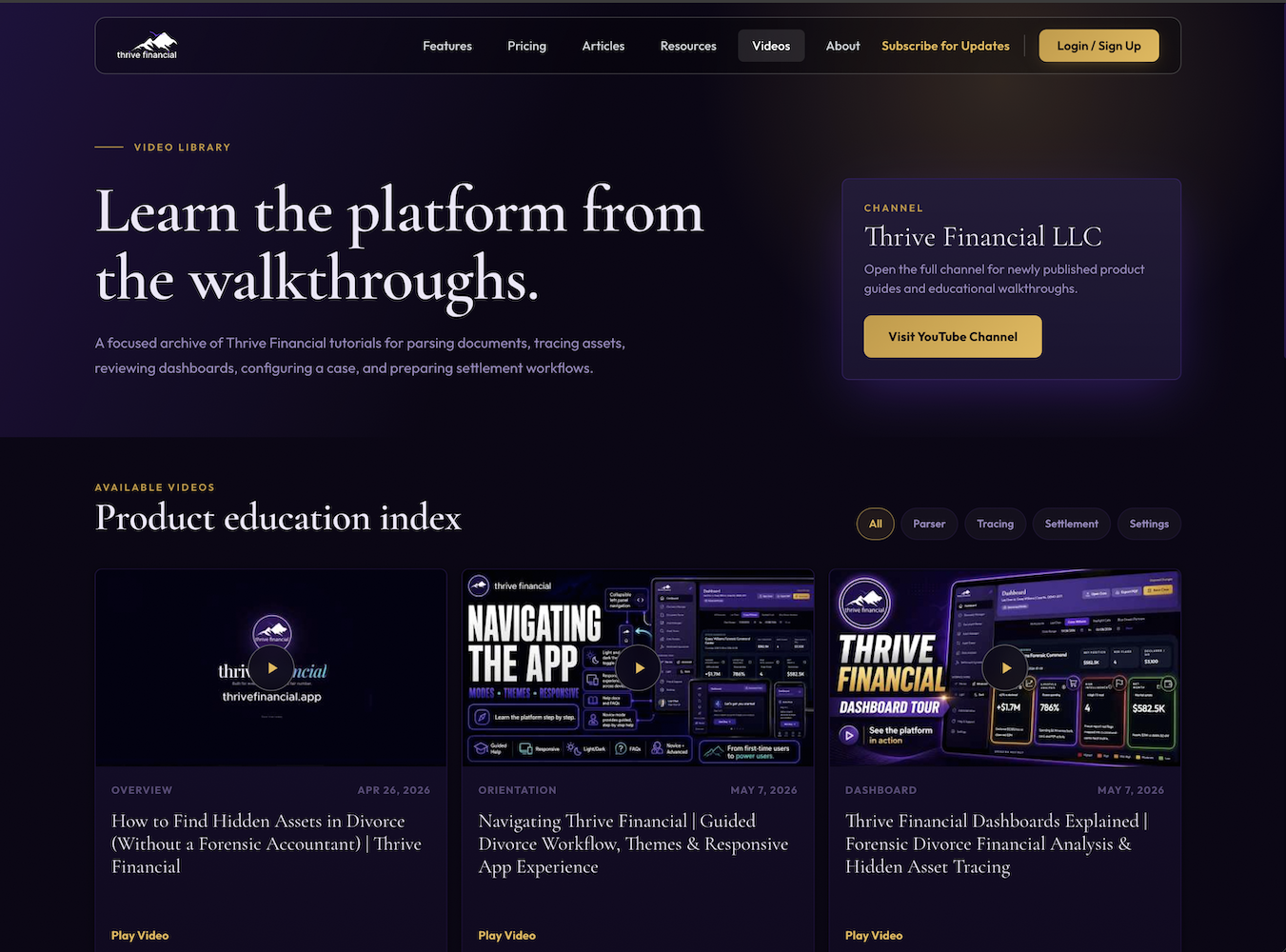
Video Demos and Marketing
-
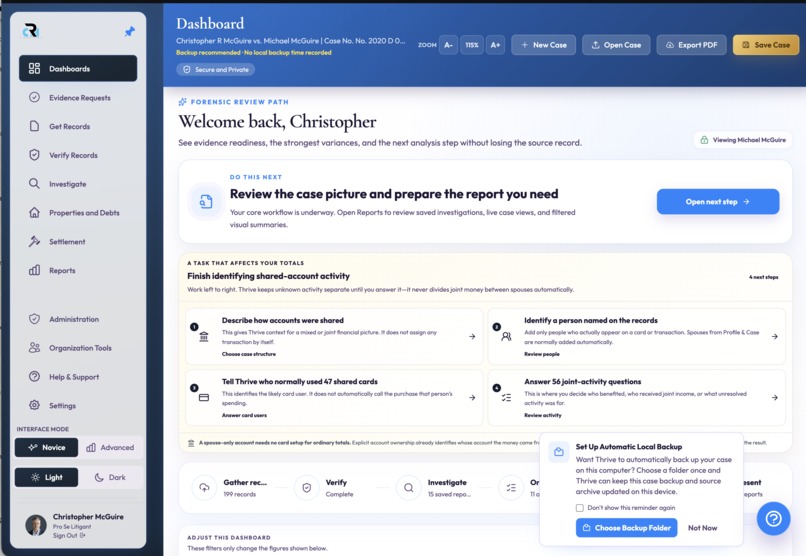
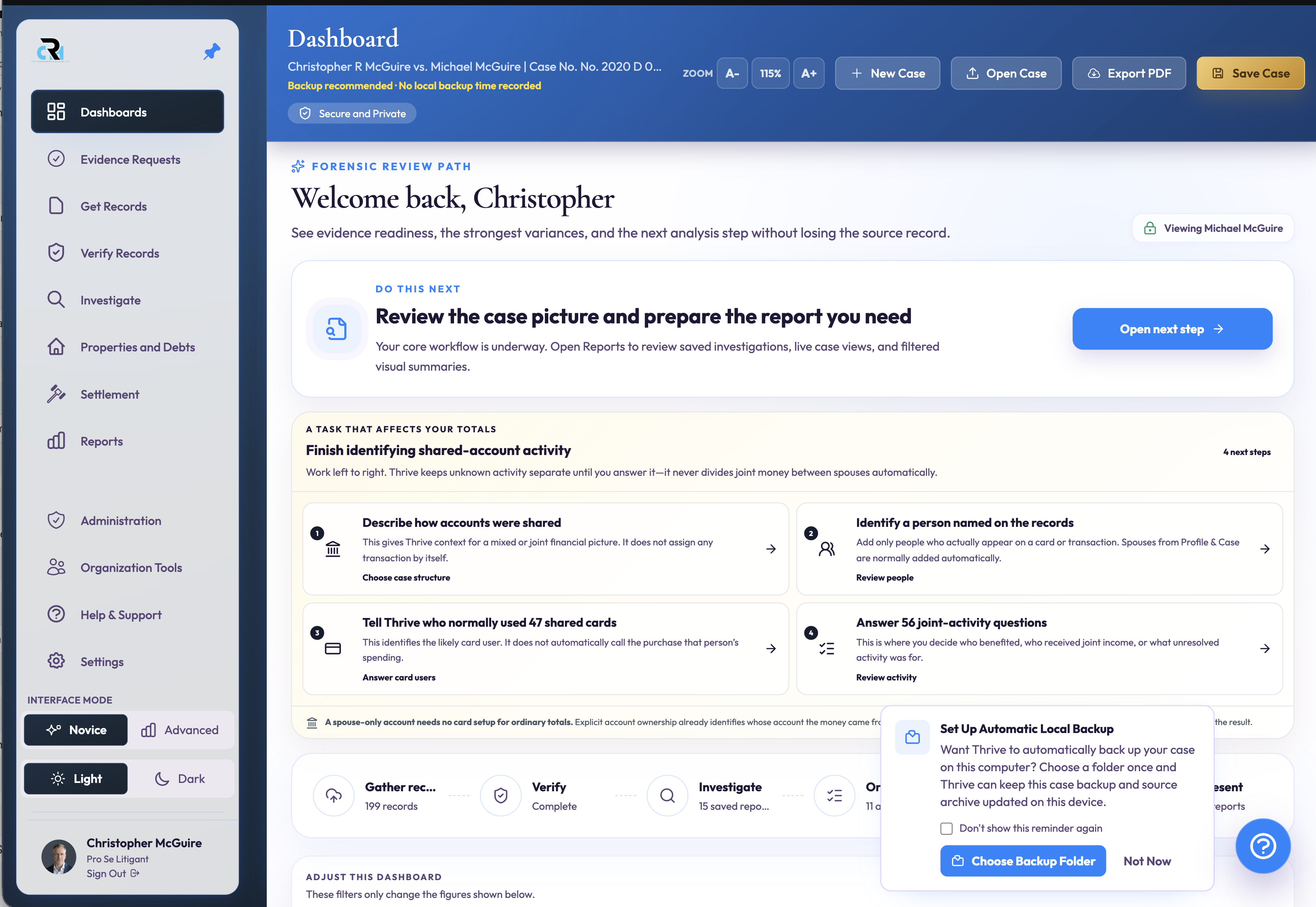
Novice View - Dashboard
-
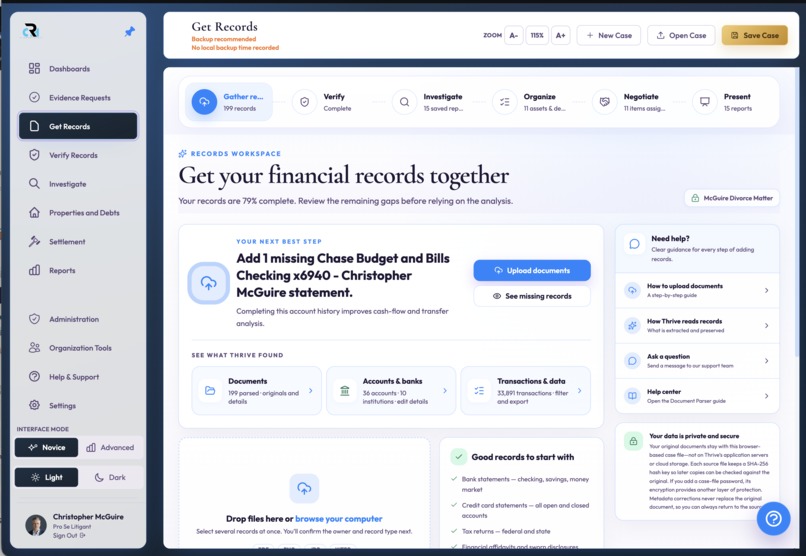
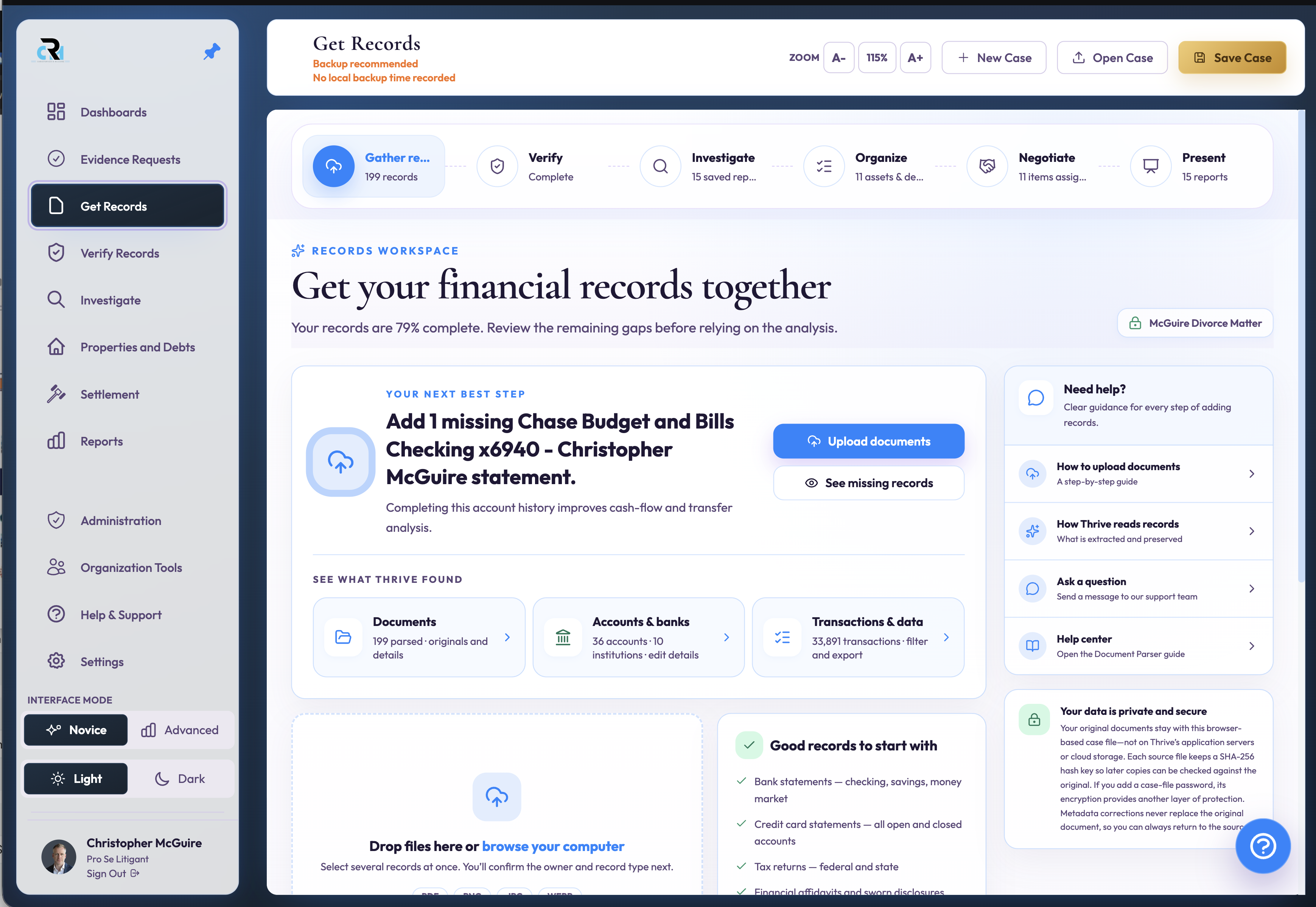
Novice View - Get Records


Inspiration
Thrive Financial was inspired by a simple problem with serious consequences: divorce financial analysis is often too expensive for the people who need it most. In addition, divorce is an area light on tools to help the everyday person, and is a process that can financially devastate lives of the vulnerable.
In many divorce cases, the truth is buried inside years of bank statements, credit card records, tax returns, affidavits, business records, payment-app histories, and discovery productions. Finding that truth usually requires hours of manual review by attorneys, paralegals, forensic accountants, or financial experts.
That cost can quickly become unreachable.
When the record is large, the cost of understanding the financial picture can become a barrier to fairness.
Thrive Financial was created from my own experience with abuse, then divorce. The process financially devastated me and the professionals hired at incredible costs provided little to no value when placed against the fraud and inaccuracies we encountered. The application was designed to assist me at first, then improved to make that process more attainable for others.. It was built for people who need answers, but may not have unlimited money to pay for traditional forensic review. The goal is not to replace attorneys or forensic professionals. The goal is to help users organize the record, surface the right questions, and turn scattered financial documents into clear, traceable evidence. It was built to leverage the strengths of AI. The tool normalizes numerous data sets and then connects the dots to find those buried items many overlook.
At its core, Thrive Financial exists because financial truth should not belong only to the party with more money.
What it does
Thrive Financial is an AI-powered divorce financial analysis platform.
It helps individuals, attorneys, forensic accountants, and divorce coaches organize and analyze the financial side of divorce. Users can upload financial and legal documents, extract structured data, identify missing records, investigate suspicious activity, manage discovery, build financial inventories, and prepare settlement scenarios.
Key capabilities include:
- AI document parsing for bank statements, credit cards, tax returns, affidavits, payment-app histories, legal filings, loan agreements, emails, and business records
- Coverage analysis to identify missing statement months, duplicate-heavy periods, tax return gaps, and incomplete productions
- Asset and debt tracking for the marital estate
- AI-assisted fraud and red-flag investigations
- Deterministic financial review for traceable findings
- Discovery request building and production tracking
- Settlement proposal modeling and fairness assessment
- Dashboards that turn financial activity into visual case insights
- Court-ready exports with source references, methodology statements, and tamper-evident case files
The product is designed around one practical outcome:
Stop guessing. Start proving.
How I built it
Thrive Financial was built as a web application with a strong focus on privacy, legal defensibility, and usability. The application focuses on a local storage model, data file encryption, and is guided by standards for legal tool acceptance.
The application uses a modern web stack with a React and TypeScript front end. Case data is stored locally in the browser using IndexedDB, which allows sensitive financial information to remain on the user’s device instead of being stored on network servers or in the cloud. At any time a user can download a case file locally. The case file is password protected and encrypted.
AI is used for document parsing, legal-document extraction, fraud investigation summaries, discovery parsing, and settlement analysis. The system routes AI requests through a secure backend so API keys are not exposed in the browser. The Google Gemini 2.5-Flash model is the core for all AI work, while Firebase is the platform delegated to route the AI requests, manage authentication and user profiles, and provide edge functions as necessary.
A major design decision was to preserve the connection between extracted data and the original source documents. When documents are parsed, Thrive Financial stores the original file, creates a SHA-256 hash, records audit information, and allows the user to export source-backed reports.
That matters because divorce financial analysis is not just about finding interesting patterns. It is about building a record that can be reviewed, challenged, and verified.
The system was built around several core modules:
- Document Parser turns messy financial records into organized data.
- Dashboard gives users a high-level view of the case.
- Asset Manager tracks assets, debts, income, children, and businesses.
- Asset Tracer investigates suspicious activity and financial inconsistencies.
- Discovery Manager helps users build requests and track missing records.
- Data Analysis visualizes money flows, spending patterns, disclosure gaps, and business activity.
- Settlement Agreement helps model proposed divisions and assess fairness.
- Settings and Audit Tools help preserve, export, and manage the case file.
The product was also built with different users in mind. A spouse may need plain-language guidance. An attorney may need efficient review and exportable reports. A forensic accountant may need traceable source references. A divorce coach may need visual summaries that help a client understand the financial picture.
Challenges I ran into
The largest challenge was document variability.
Financial documents are not standardized. Every bank, credit card company, payment app, tax form, and business accounting system presents information differently. Some PDFs contain clean text. Others are scanned images. Some statements have tables. Others have multi-line transaction descriptions, missing dates, inconsistent account names, duplicate records, or partial account numbers.
Parsing the document was only the first challenge. The harder challenge was making the extracted data useful across the rest of the application.
Another major challenge was avoiding unsupported conclusions.
In divorce finance, a red flag is not the same as fraud. A transfer may be suspicious, but it may also be a reimbursement, an internal account transfer, a loan, a business expense, or a legitimate family cost. Thrive Financial had to be designed to surface review items without overstating what the evidence proves.
Privacy also shaped the architecture. Divorce financial records are extremely sensitive. A server-first product would have been easier in some ways, but it would create additional trust, compliance, and data-control concerns. The local-first model was harder to build, but better aligned with the needs of the users.
Balancing simplicity and power is an ongoing steep hill to climb. The app needed to be approachable for everyday users while still producing outputs that attorneys and financial professionals could take seriously.
Finally, while my background is in computer and electrical engineering, and I have been in the financial services industry for many years, marketing is not my strong suit and is an ongoing battle. I have leveraged Claude, Gemini, and Chat-GPT to create marketing plans, ad campaigns and visual assets, and through the LLM directions have been active on the social platforms to drive eyes to the site.
Accomplishments that I am proud of
I am proud that Thrive Financial turns a traditionally expensive and intimidating process into something more accessible. Many that have been a part of my Thrive Financial demos have stated that the work this platform does just does not exist today. Platforms that attempt this work do a fraction of the functionality at rates only corporations can afford. I created the concept, design, architecture, and code solo, and now am marketing independently. I have taken lessons learned while at Citadel to ensure data loads are fast, usability is of focus, and the platform is fault tolerant.
The biggest accomplishment is the end-to-end workflow. A user can move from raw financial documents to structured data, visual dashboards, red-flag analysis, discovery tracking, asset inventory, settlement modeling, and exportable reports in one connected workspace.
I am also proud of the privacy-first design. Users control their own case files. Sensitive financial records are not stored on our servers. The application is designed to keep the user in control of their own data.
Another major accomplishment is the focus on legal defensibility. Thrive Financial does not just generate summaries. It preserves source documents, creates hash-backed case files, maintains audit history, and connects findings back to the records that support them.
Finally, I am especially proud of building a product that can help multiple audiences:
- Individuals trying to understand their financial position
- Family law attorneys trying to reduce manual review time
- Paralegals organizing discovery
- Forensic accountants running first-pass analysis
- Divorce coaches helping clients understand the financial story
The project shows that AI can be useful in legal technology when it is paired with source preservation, structured data, auditability, and careful product design. I used AI as a pair programmer to show that AI has come a long way, but experience is still essential as I guided the agents in a solid architecture.
What I learned
I learned that AI is most valuable when it helps organize evidence, not when it replaces judgment. AI is not a replacement for professional services, but requires experts to guide it. It reduces the leg work of application development, allowing me to grow in other areas and focus on specific problems.
A good legal technology product cannot simply say, “This looks suspicious.” It needs to explain why something deserves review, where the source came from, what amount is involved, what date it occurred, and what alternative explanations may exist.
I also learned that the user experience matters as much as the analysis. Divorce is already overwhelming. A tool in this space must reduce cognitive load, not add to it. It needs plain-language workflows, guided steps, and clear outputs.
Another key lesson was that trust must be designed into the system from the beginning. In a financial or legal setting, users need to know:
- Where the data came from
- Whether the original document was preserved
- Whether the output can be reproduced
- Whether the finding is based on evidence or inference
- Whether the user remains in control of the case file
I also learned that the most powerful approach combines three layers:
- Structured extraction from documents
- Deterministic calculations and coverage checks
- AI-assisted explanation and investigation
That combination is stronger than AI alone.
What's next for Thrive Financial
The next phase of Thrive Financial is focused on making the product more secure, more collaborative, and more useful for professionals and pro se litigants alike.
Upcoming priorities include:
- AES-256 encrypted, password-protected case files
- Improved shared workflows for law firms and professional teams
- Stronger business-forensics tools for S-corporation and closely held business cases
- More user friendly assistance while in Novice mode to guide individuals through the process
- Better discovery gap analysis and production tracking
- More advanced financial dashboards for court and mediation use
- Expanded export packages for attorneys, forensic accountants, and divorce coaches
- Improved onboarding for users who are not financial experts
- More deterministic review tools that separate evidence from assumptions
- Continued refinement of AI prompts, source citations, and report structure
Longer term, the goal is for Thrive Financial to become the financial command center for divorce cases.
The mission is straightforward:
Make expensive divorce financial analysis attainable. Help people organize the record. Help professionals work faster. Help users stop guessing and start proving.
In the end, Thrive Financial is not for everyone. Many will never have a need for the platform. With that said, for those in a divorce process, it is the tool many struggle to find, never do, and can save their financial futures.
Built With
- adobe-illustrator
- codex
- figma
- firebase
- google-ai-studio
- google-cloud
- google-gemini-2.5-flash
- indexdb
- javascript
- micro-ui
- notebook-lm
- react
- stripe
- tailwind


Log in or sign up for Devpost to join the conversation.