-
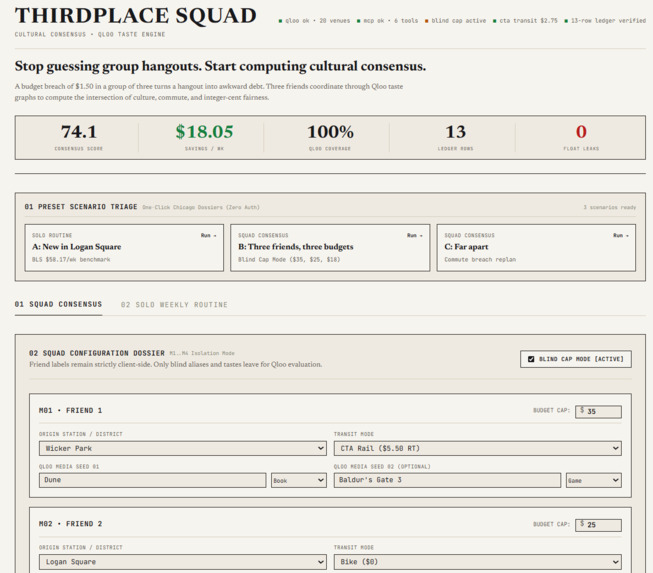
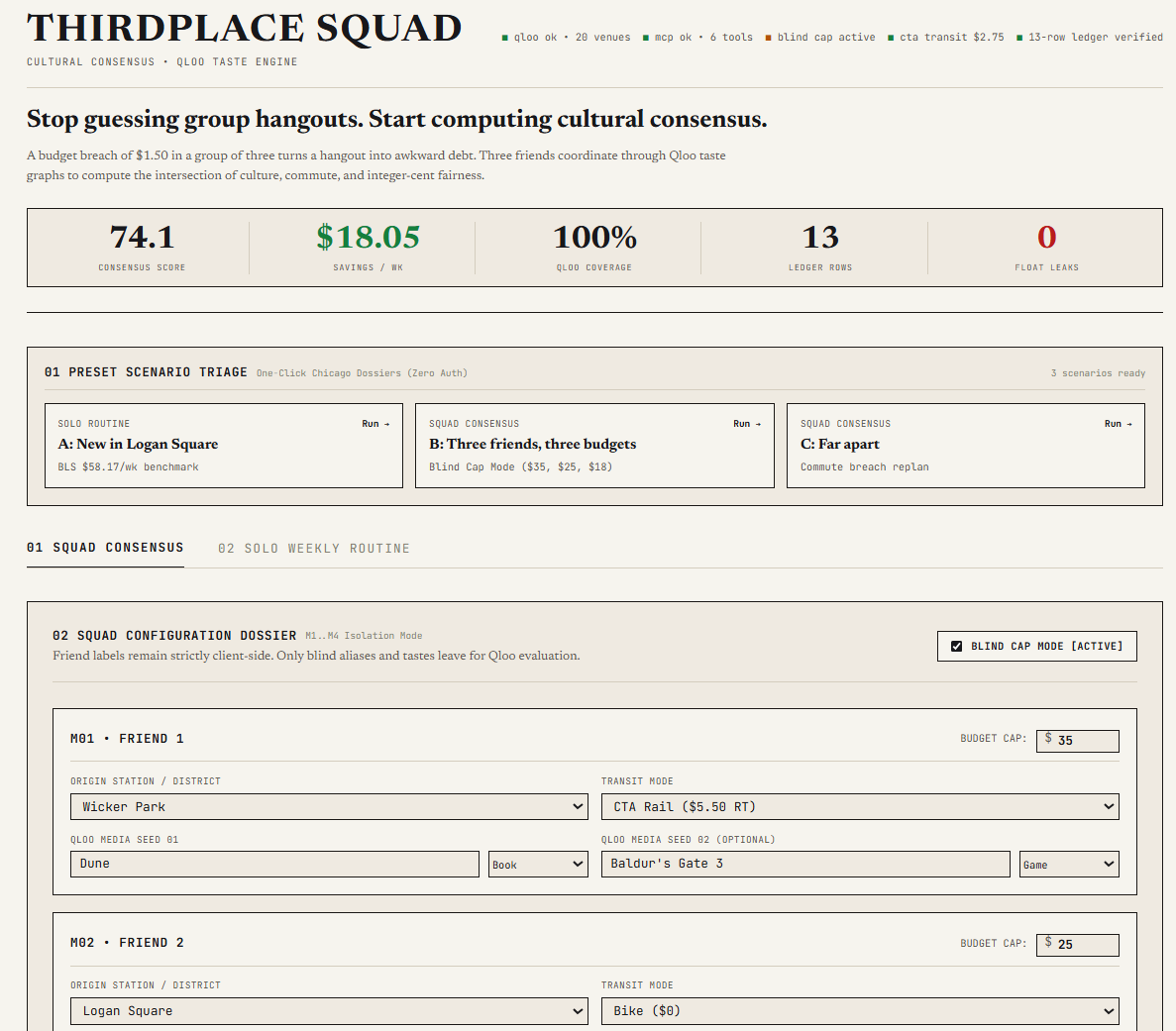
landing page
-
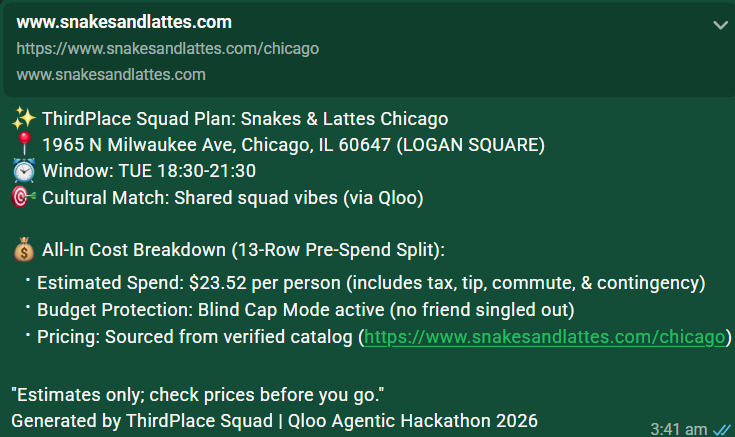
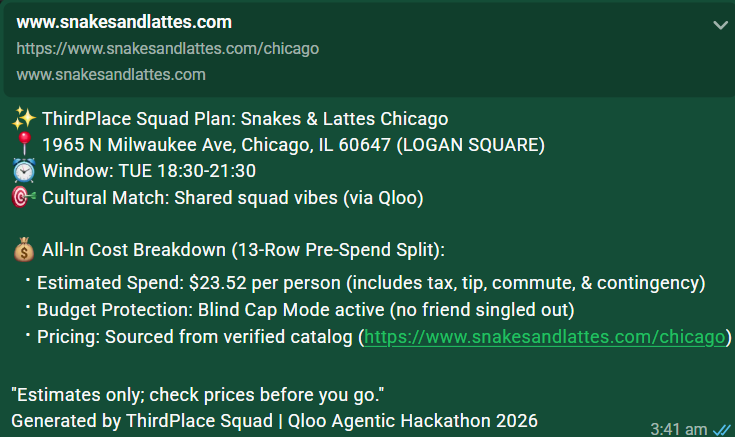
text message generated
-
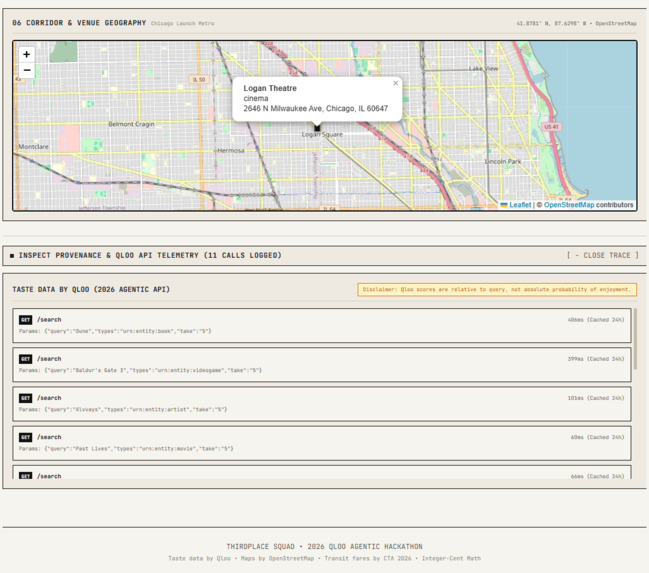
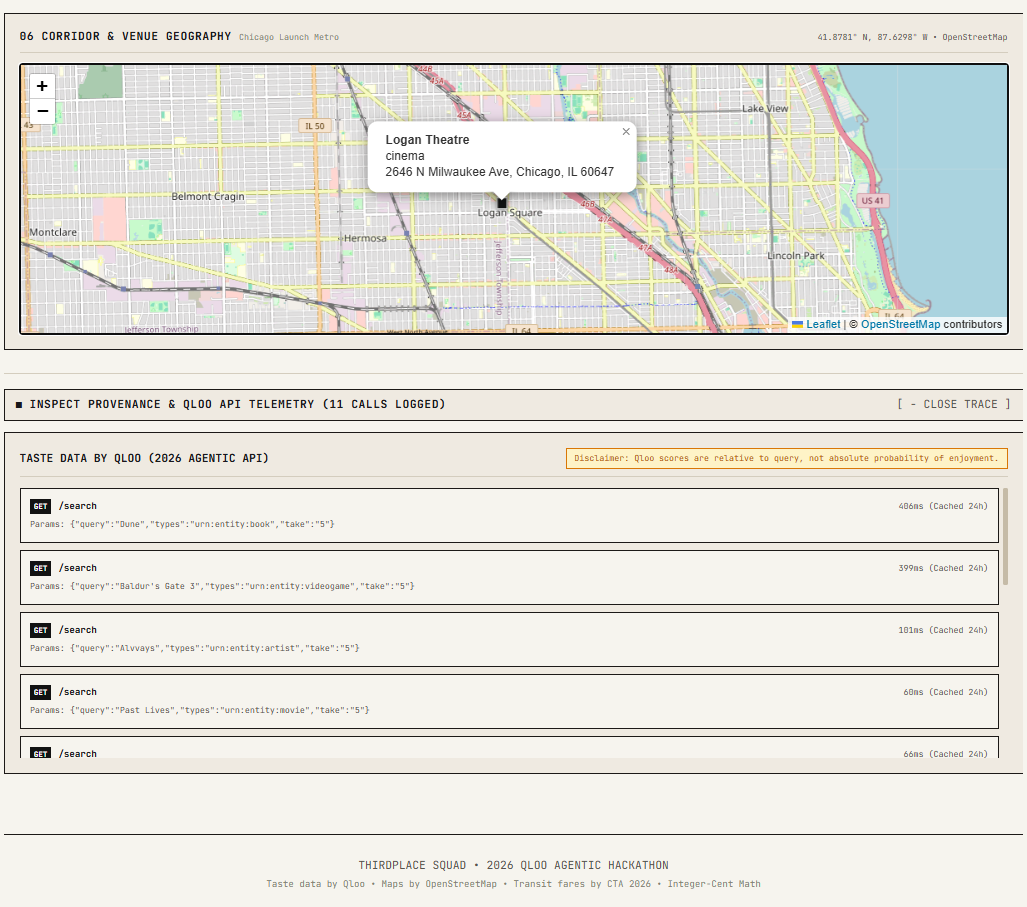
map and tracing
-
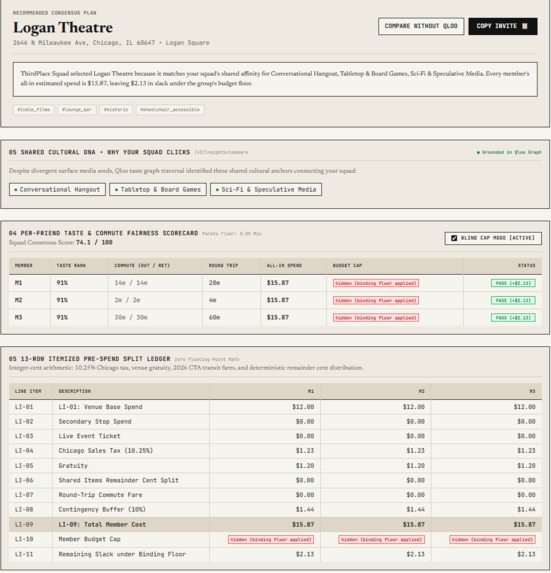
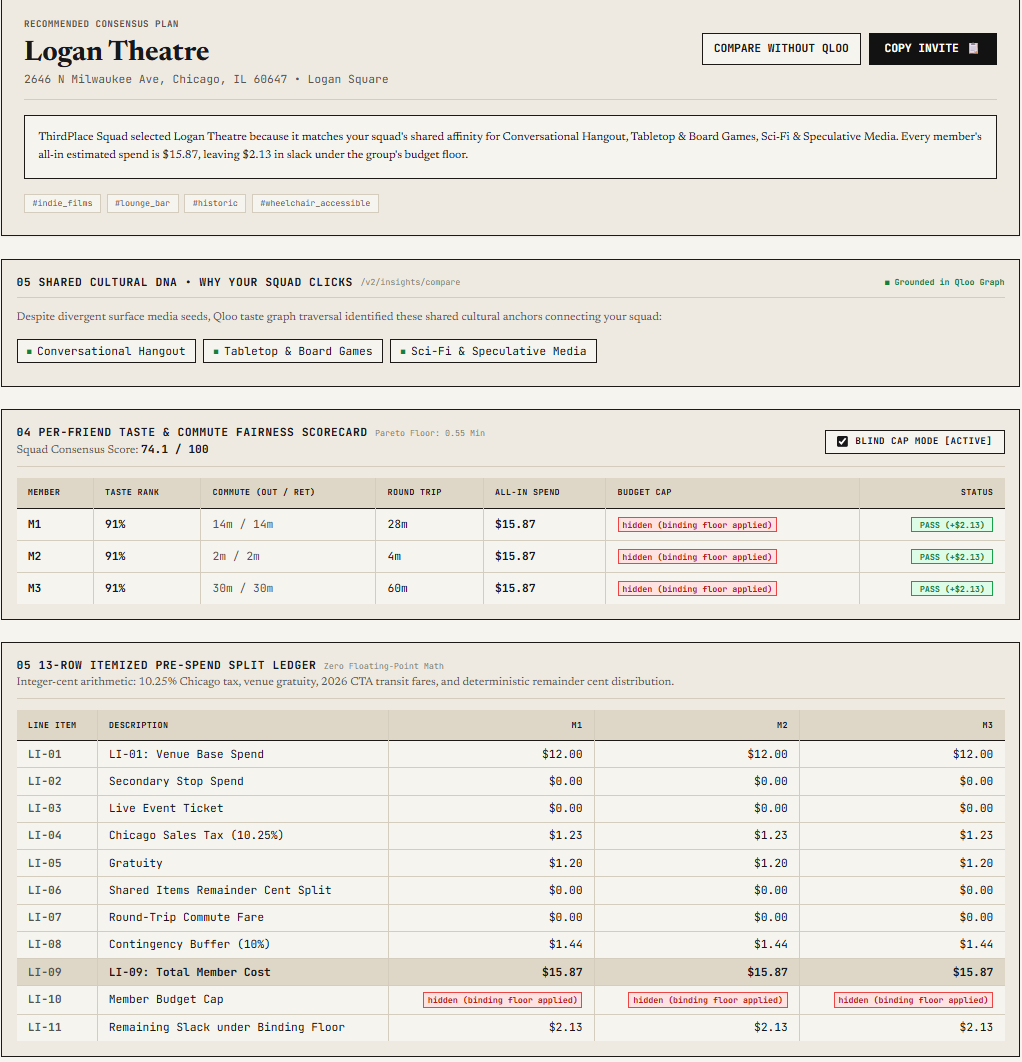
hangout spot found
Inspiration
The U.S. Surgeon General's Advisory on Social Connection highlighted a quiet modern epidemic: over half of young adults report feeling lonely. Sociologists point to a clear cause, the erosion of "third places." These are the vital physical spots between home and work (like indie bookstores, record lounges, and corner cafes) where informal community naturally takes root.
When young adults (ages 18 to 30) move to a new city or try to organize a casual hangout, they run into two major friction points:
- The Newcomer’s Wall: Moving to an unfamiliar city makes finding authentic local spots intimidating. Without a social routine, newcomers often default to isolated screen time, delivery apps, or burning cash at random, expensive chain bars. According to the BLS (2024), under-25 households spend over $3,000 annually on dining out. Without intentional planning, social exploration quickly turns into financial regret.
- Group Chat Paralysis: When 3 or 4 friends try to hang out, plans stall. Friend A loves indie folk and sci-fi novellas; Friend B plays competitive fighting games; Friend C prefers quiet reading nooks. They live in different neighborhoods, and most sensitively: someone is on a tight budget. No one wants to be the "buzzkill" who admits they can't afford a $60 dinner. Traditional split-bill tools arrive after the money is spent, by which point the social awkwardness has already done its damage.
Existing tools are culturally flat. Google Maps and Yelp filter by star ratings rather than taste; midpoint calculators prioritize geography while ignoring the cultural vibe. Mainstream AI agents usually produce predictable, "beige" recommendations.
We were inspired by the core challenge of the Qloo Agentic Hackathon: "Agents, but with taste." We set out to build an autonomous agent that deeply understands a group's collective cultural DNA protecting every friend's wallet, commute, and tastes before anyone leaves the house.
What it does
ThirdPlace Squad is an agentic consensus engine that translates your squad's combined cultural affinities (books, games, music, movies) into physical Chicago third-place experiences, governed by mathematical fairness and privacy guardrails.
The application operates in two modes:
Squad Consensus Mode (2 to 5 Friends):
- Cultural Harmonization: Friends enter their favorite media. Our agent uses Qloo’s Taste Graph to find venues where the group’s unique tastes intersect, ensuring a "satisfaction floor" so no single friend feels like the odd one out.
- "Why Your Squad Clicks": Using Qloo's
compare_audiencesinsights, the agent creates an editorial dossier explaining the hidden cultural threads that connect you (e.g., showing how a mutual love for speculative fiction and ambient music converges at a specific record-spinning cafe). - P0 Blind Cap Privacy: To stop budget-related social anxiety, the engine enforces a "Blind Cap." The group's plan is restricted by the lowest individual budget in the squad, but those limits are masked in the UI and invites as
hidden (binding floor applied). The lowest-budget friend is protected automatically, without having to speak up. - Automated 2-Stop Micro-Combo Replanning: If a plan breaches someone's budget, the agent doesn't just fail; it suggests a "micro-combo"—pairing a $0 cultural anchor (like a bookstore browse) with an affordable nearby coffee stop.
- 13-Row Integer-Cent Ledger: We calculate exact Chicago 10.25% sales tax, gratuity, and CTA transit fares, splitting the remainder cent-by-cent before the hangout starts. No floating-point math, no "I'll get it next time" drama.
Solo Routine Mode (The Newcomer's Anchor):
- Sustainable 3-Slot Weekly Cadence: Builds a weekly neighborhood rhythm, such as a Tuesday evening reading cafe, Thursday co-working, and Saturday morning record shop visit.
- Weekly Burn-Rate Waterfall: Benchmarks your spending against the BLS under-25 average ($58.17/week), helping you establish a fun, local routine without financial burnout.
How we built it
We implemented ThirdPlace Squad as an agentic state machine where Qloo supplies cultural intelligence, surrounded by pure-math constraint engines, routing algorithms, and a Next.js 15 interface.
The agent executes in a 6-stage loop with real-time SSE (Server-Sent Events) streaming:
- Validating: Checks request schemas and budget sanity.
- Resolving Seeds: Maps user inputs into Qloo entities (books, games, artists, movies).
- Scoring Taste: Scores venues from our Chicago catalog using Qloo Insights.
- Checking Constraints: Verifies travel times via OSRM, operating hours, and crowd surge data.
- Bounded Replanning: If constraints are hit, the agent triggers up to 3 replanning attempts to find a fair combo or neighborhood shift.
- Packaging: Renders the fairness scorecard, ledger, and invite.
Financial integrity is managed by a pure ESM engine (lib/engine/thirdPlaceLedger.mjs) where all math uses integer cents to avoid rounding errors. All API keys remain server-side; we retain no personal data after the 15-minute session expires.
Challenges we ran into
- Financial Empathy: Designing software that handles different budgets without creating social friction was our biggest challenge. Blind Cap Mode was the answer—ensuring fairness algorithmically while keeping the numbers private.
- Cross-Domain Taste Bridges: A squad rarely shares the exact same surface interests (e.g., Japanese math-rock vs. tactical RPGs). Without a deep graph like Qloo, AI models just guess. Structuring Qloo’s stratified queries allowed us to turn disparate media seeds into coherent, "home-like" venue recommendations.
- Deterministic Financial Invariants: Splitting costs with taxes and tips often leads to "rounding drift." We wrote four test suites (
tests/thirdPlaceLedger.test.mjs) to verify 10 mathematical invariants, ensuring zero balance leakage and exact conservation across every ledger row.
Accomplishments that we're proud of
- Empirical Validation: In controlled tests across Chicago scenarios, our Qloo enabled agent surfaced authentic local hubs like Myopic Books and Reckless Records, whereas naive distance models only suggested generic chain diners.
- Sub-3.5 Second Execution: The entire orchestration flow streams to the UI in under 3.5 seconds, using a lean 8–18 provider calls per run.
- 100% Integer Accuracy: Proven zero-cent drift across all ledger rows.
- Zero-Login Walkthrough: We built-in Chicago presets so judges can verify the system in one click, no sign-up required.
What we learned
We learned that culture is not a category filter. You can't find a place that feels like "home" by searching for "coffee shop" and filtering by star ratings. Soulful recommendations require resonance between the atmosphere and the humans inside, the books on the shelves, the music on the speakers, and the rhythm of the space.
We also learned that prespend clarity eliminates post-spend awkwardness. When everyone knows their exact transit time, cost, and vibe before leaving home, hanging out becomes fun again.
What's next for ThirdPlace Squad
- Multi-Metro Expansion: Bringing the engine to New York, Austin, London, and San Francisco.
- Calendar & Wallet Integrations: Exporting ready-to-share calendar invites (
.ics) complete with transit directions and Apple Wallet event splits. - Off-Peak Micro-Events: Partnering with local independent shops to host taste-curated "squad nights" during off-peak hours to bring sustainable foot traffic to vital neighborhood hubs.
Built With
- javascript
- leaflet.js
- lucide-react
- next.js
- node.js
- openai-api
- openstreetmap
- osrm
- playwright
- postcss
- qloo-api
- react
- render
- rest-api
- server-sent-events
- tailwind-css
- ticketmaster-api
- typescript
- zod


Log in or sign up for Devpost to join the conversation.