-
-
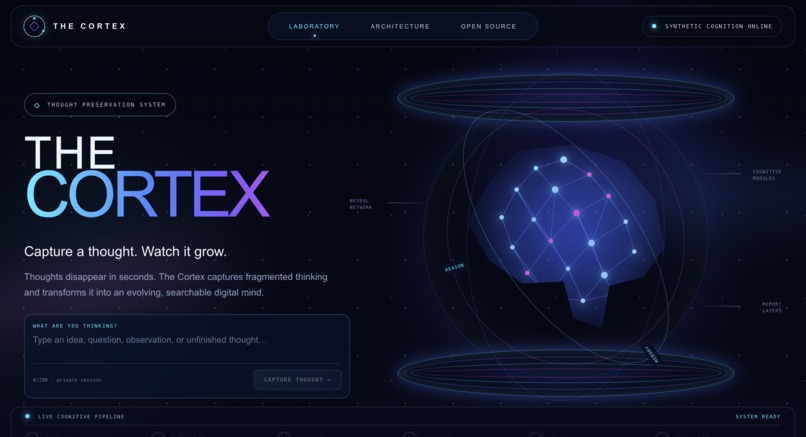
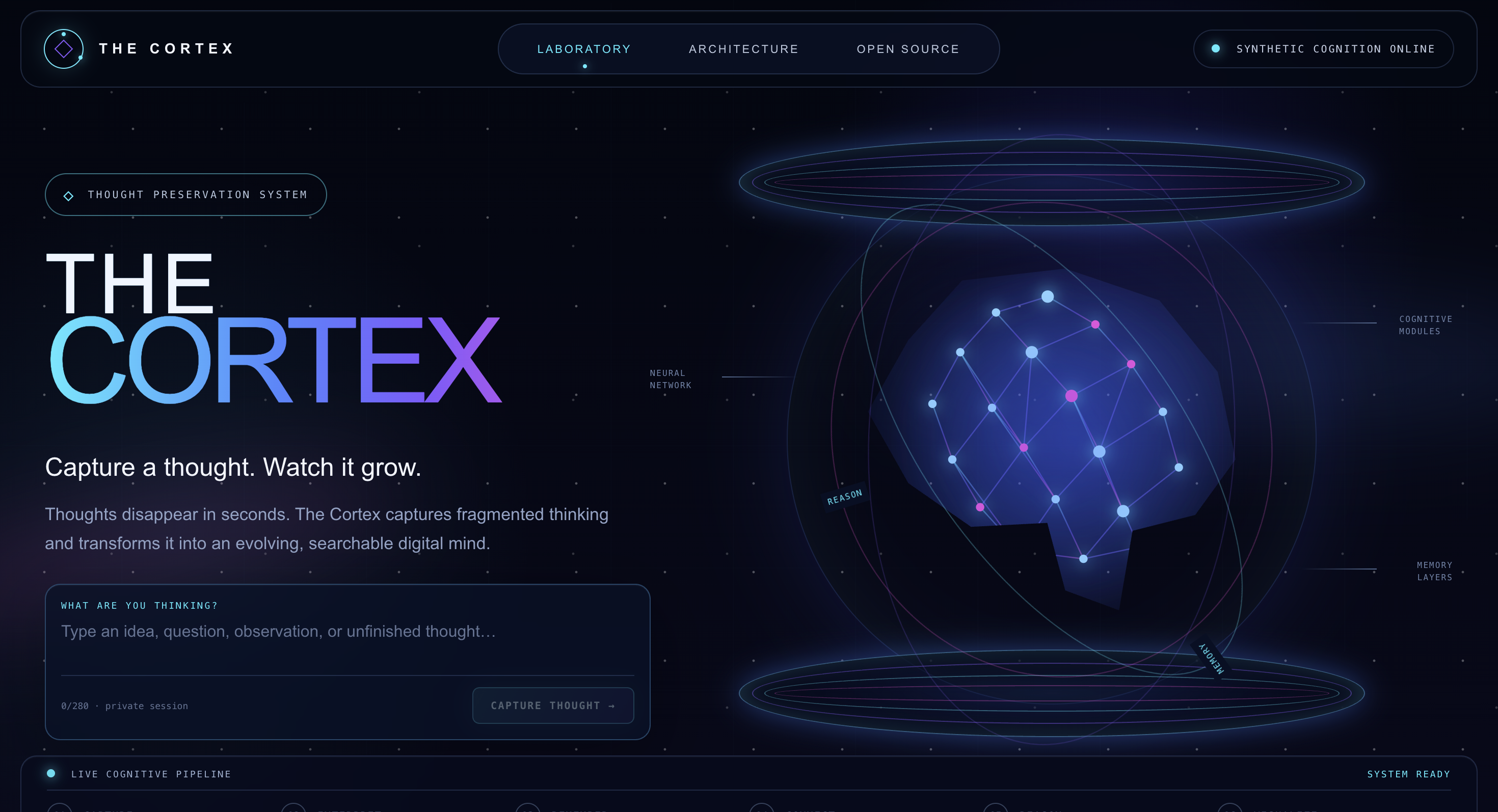
Homepage of The Cortex
-
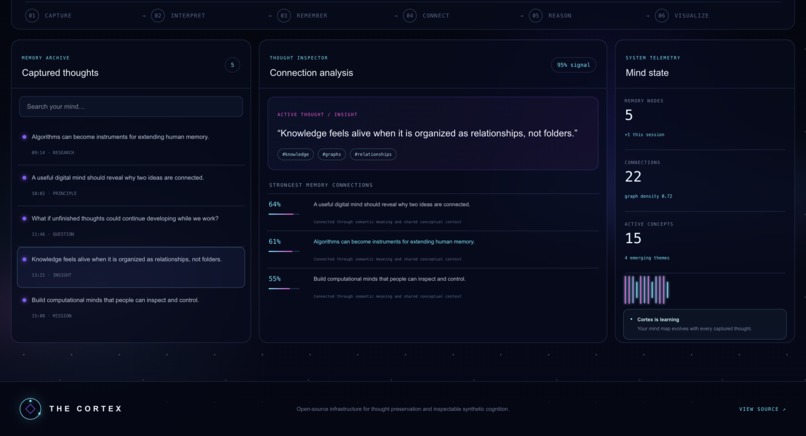
Also the homepage
Inspiration
Some of our most valuable thoughts disappear within seconds.
An idea might appear while we are studying, working, reading, or trying to solve a difficult problem, but before we can develop it, the thought is replaced by something else. Even when we write it down, it often becomes an isolated note buried inside a document, messaging app, or folder. Traditional note-taking tools are good at storing information, but they do not preserve the connections and reasoning that make a thought meaningful.
This inspired me to create The Cortex, an interactive system that captures fragmented thoughts and transforms them into an evolving digital mind.
As an Electrical Engineering student interested in algorithms, artificial intelligence, and the architecture of intelligence, I wanted to explore a question that has fascinated me for a long time:
What if we could build a computational mind that does not merely store information, but continuously connects, develops, and organizes the way we think?
The Cortex is not intended to recreate the biology of the human brain. Instead, it focuses entirely on the structure of the mind: ideas, memories, relationships, reasoning pathways, and the process through which scattered information becomes understanding.
What it does
The Cortex captures thoughts before they disappear and converts them into interconnected units inside a visual digital mind.
A user can enter an unfinished thought, question, observation, or idea. Instead of saving it as another isolated note, The Cortex analyzes its meaning, identifies important concepts, and connects it with related thoughts already stored in the system.
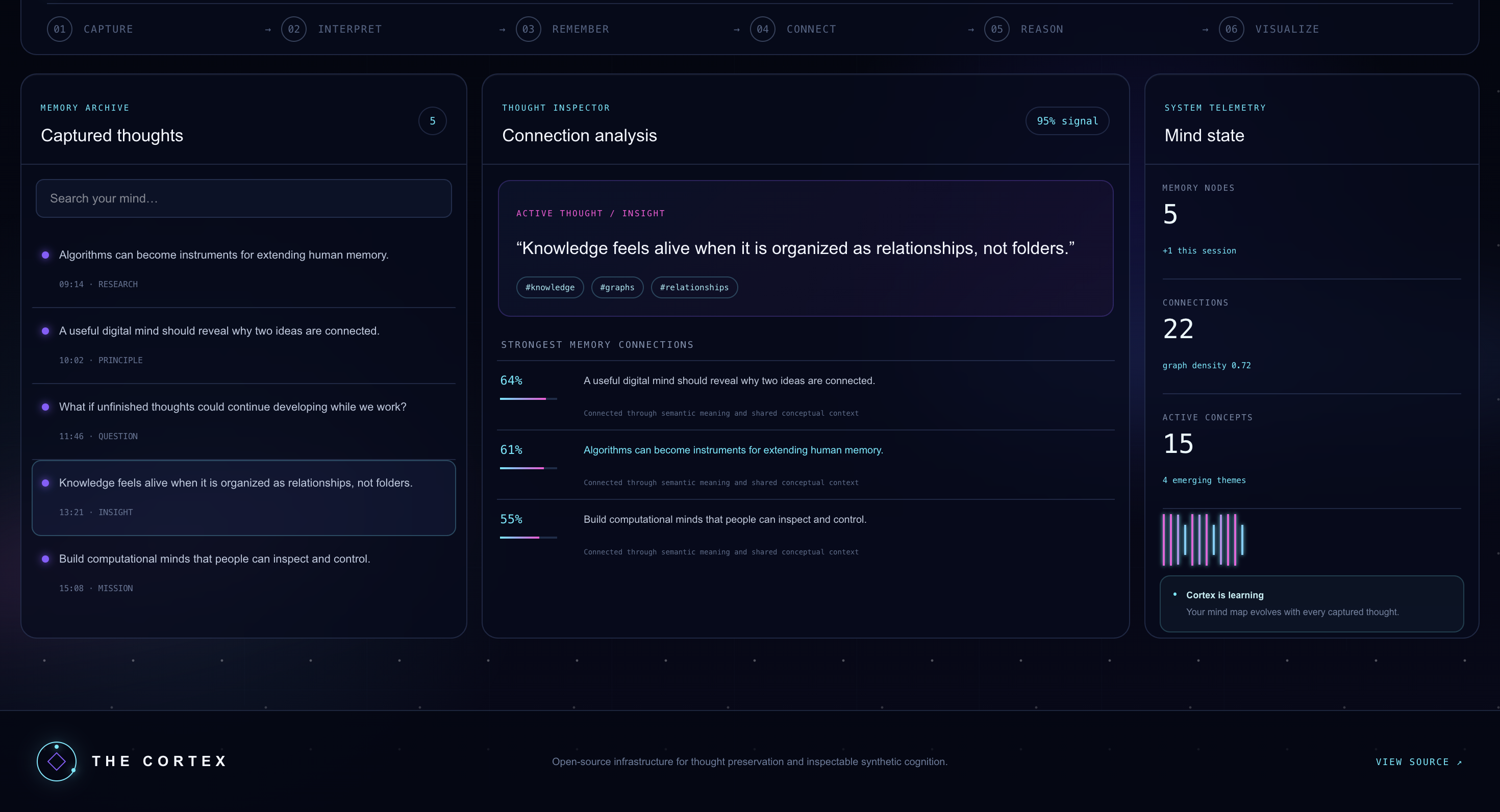
Inside the interactive laboratory, users can:
- Capture thoughts, ideas, questions, and observations
- Explore thoughts through an interactive neural network
- Discover relationships between ideas that were recorded at different times
- Search their memory using natural language
- inspect why two thoughts were connected
- Develop incomplete thoughts into structured concepts or projects
- Observe how their digital mind changes as new information is added
- Track active concepts, emerging themes, and unexplored connections
Each thought becomes a node, while meaningful relationships become weighted connections between nodes. A simplified representation of a connection between two thoughts (i) and (j) is:
$$ w_{ij} = \alpha S_{ij} + \beta K_{ij} + \gamma T_{ij} $$
where:
- (S_{ij}) represents semantic similarity
- (K_{ij}) represents shared concepts or keywords
- (T_{ij}) represents temporal context
- (\alpha), (\beta), and (\gamma) control the importance of each factor
This allows The Cortex to organize information by meaning rather than relying only on folders, filenames, or manually created categories.
How I built it
I designed The Cortex as a web-based algorithm laboratory with a cosmic observatory interface. The visual system represents the user's digital mind as a luminous network suspended inside an interactive research environment.
The interface was built with Next.js, React, TypeScript, and CSS. The visual network uses dynamically generated nodes and connections to represent thoughts and their relationships. Interactive animations, orbital movement, layered glass panels, and live system indicators help turn an abstract computational process into something users can observe and understand.
The current prototype separates the system into several conceptual stages:
- Capture, where the user's raw thought enters the system
- Interpretation, where important concepts and meaning are extracted
- Memory, where the thought is compared with previously stored information
- Connection, where related thoughts are identified and linked
- Reasoning, where the system suggests patterns, questions, or possible developments
- Visualization, where the updated digital mind becomes explorable
I intentionally designed these stages as modular components. This makes the architecture easier to inspect, improve, and eventually extend with different embedding models, language models, databases, and reasoning algorithms.
Challenges I faced
The largest challenge was deciding how to represent something as abstract as a thought.
A note is easy to store as text, but a thought also contains context, relationships, uncertainty, and unfinished reasoning. Treating every entry as a simple document would reproduce the limitations of existing note-taking applications. I therefore had to design a structure that could preserve both the content of a thought and its relationship with the rest of the user's mind.
Another major challenge was balancing visual ambition with usability. The Cortex needed to feel like a living cosmic laboratory, but it could not become a decorative animation that failed to communicate useful information. Every major visual element therefore represents part of the system. Nodes represent thoughts, connections represent relationships, pulses represent information movement, and interface panels expose the state of the computational pipeline.
I also had to keep the system explainable. Automatically connecting ideas is only useful when users can understand why a connection exists. The project therefore treats transparency as a core feature rather than an optional technical detail.
Finally, building a polished and responsive interactive experience within the hackathon deadline required careful prioritization. I focused on creating a coherent working prototype that clearly demonstrates the central idea while leaving the architecture open for future expansion.
What I learned
Building The Cortex taught me that storing information and preserving thought are two different problems.
People do not necessarily need another place to write notes. They need a way to recover the context, relationships, and possibilities hidden inside those notes. I learned that the most useful intelligent systems may not be the ones that produce the most information, but the ones that help people retain and develop their own thinking.
I also learned how important explainability is when designing AI-assisted products. If a system organizes a person's thoughts without showing its reasoning, it can make the user's own mind feel less understandable. Visualizing the path between ideas makes the system more trustworthy and gives users greater control over how their knowledge develops.
From a technical perspective, I strengthened my understanding of modular interface architecture, graph-based data representation, responsive interaction design, state management, and the challenge of translating algorithmic processes into intuitive visual experiences.
What makes The Cortex different
Most note-taking tools organize information into pages, folders, or manually created links. The Cortex approaches the problem from a different direction: it treats every captured thought as part of a continuously evolving computational mind.
The goal is not simply to remember what the user wrote. It is to preserve how ideas relate, reveal connections that might otherwise remain invisible, and help unfinished thoughts become something useful.
The Cortex also separates itself from biological brain simulation. It does not attempt to model neurons, chemistry, or anatomy. It is a laboratory for the architecture of thought itself.
What's next for The Cortex
The next version of The Cortex will expand the prototype into a persistent personal thinking system with:
- Semantic vector search and embeddings
- A graph database for long-term thought relationships
- Voice capture for thoughts recorded in real time
- Image, document, and link ingestion
- Configurable privacy and local-first storage
- Explainable connection scoring
- Thought timelines and evolving concept maps
- Collaborative minds for research teams
- User-controlled AI reasoning modules
- Exportable research and project structures
- Cross-device synchronization
In the long term, I want The Cortex to become more than a productivity tool. I envision it as an open platform for experimenting with memory, reasoning, and synthetic cognition, allowing researchers, students, builders, and curious thinkers to construct computational minds they can actually inspect and understand.
Accomplishments that I'm proud of
I am proud that The Cortex turns an ambitious and abstract idea into something people can see, explore, and understand. Instead of presenting artificial intelligence as an invisible black box, the project makes thought capture, memory formation, and idea connection part of an observable system.
Most importantly, The Cortex reflects the kind of technology I want to build: technically meaningful, visually ambitious, and designed to extend human thought rather than replace it.
Built With
- algorithms
- css3
- data
- design
- graph
- html5
- javascript
- language
- natural
- next.js
- node.js
- open
- processing
- react
- responsive
- search
- semantic
- source
- typescript
- visualization


Log in or sign up for Devpost to join the conversation.