-
-
Brief description of the product
-
Architecture
-
Platform Architecture
-
Technologies
-
Technologies
Inspiration
There is no planet B for my two years old boy, my partner 12 years old daughter and our team of young people passionate by Blockchain technology, and especially by Near and the Rust programming language. We are all responsible for climate change and we all must be part of the solution. All the institutional stakeholders have made numerous “commitments” especially since the Paris Climate Change Agreement. For example, the European Commission’s promised in 2019 to cut greenhouse gas emissions by at least 55% by 2030 but in 2022, we can already say that this objective does not look currently reachable. Indeed, very few specific funding solutions support our society necessary green transition.
The carbon bank teams believes strongly that one of the main solutions for climate change is to develop the carbon credit market. We believe that greenhouse gas emissions to the atmosphere should be treated like any other waste stream. Most people accept the fact that living our lives creates waste, such as garbage, and most people accordingly pay garbage collectors to remove that waste and break it down, recycling what they can, and responsibly storing the parts that can’t be recycled. Because it will be possible for suppliers to make money by providing the service of removing carbon dioxide and other greenhouse gases from the atmosphere, we want to demonstrate that economic prosperity and stewardship of the earth can work hand in hand.
We believe—as has been the experience in traditional waste management and recycling markets—that once we launch the Carbon Bank removal market, more opportunities for the recycling and productive use of the removed and stored carbon will be developed and commercialized. Carbon credits markets put a cost on GHG emission. We are in an era when companies and people will become increasingly engaged in compensating their carbon footprints. The carbon credit market is straightforward and increasingly viable as the urgency of the problem grows in the collective consciousness.
Our main inspiration was Hans Jonas’ book “The Imperative of Responsibility”. We are responsible for what we will let for the next generation. It is for us not only necessary to reduce our current emissions, but also to create the tools to draw down CO2 and other greenhouse gases from the atmosphere.
What it does
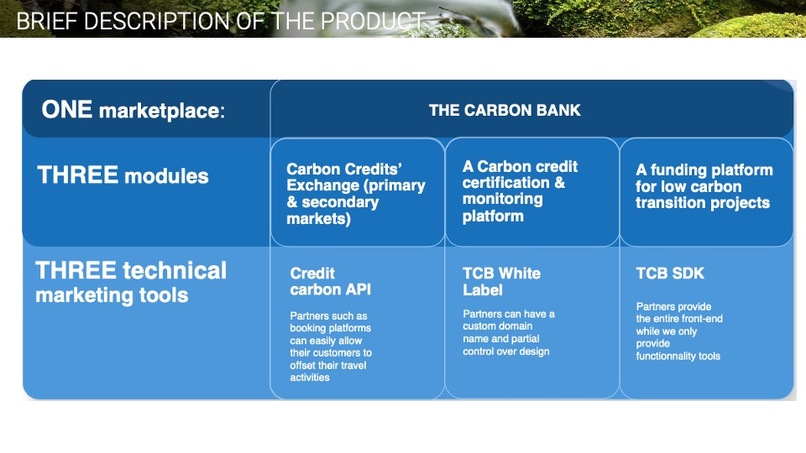
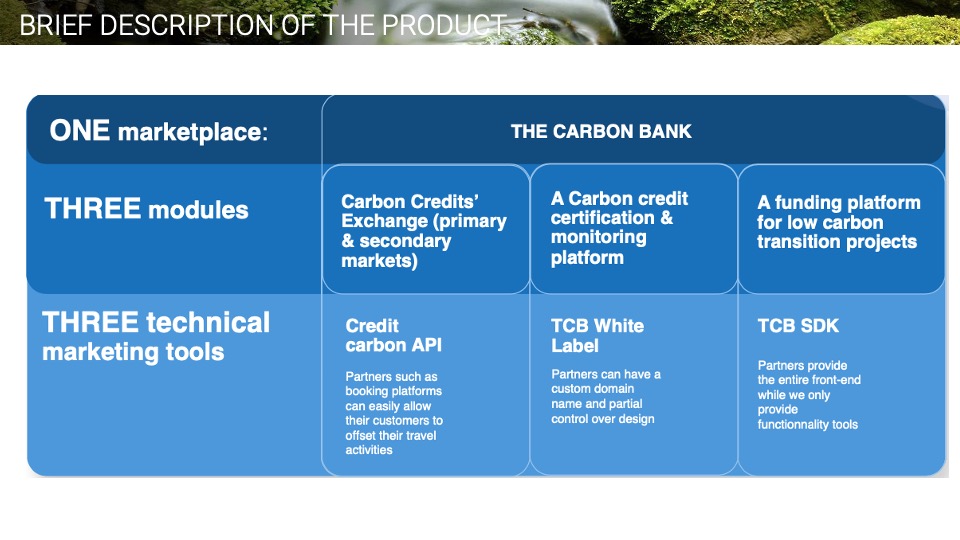
To accelerate climate action of private and public stakeholders, The Carbon Bank is finalizing a NEAR Blockchain marketplace that provides: ● A fair and trustworthy solution for issuing and certifying carbon credits that will be used to offset the carbon footprint of companies and individuals’ activities ● A solution to stimulate investments in certified projects that sequestrates CO2 emissions or reduces them thanks to the use of new technologies ● A transparent and traceable process for carbon credits purchase and staking
- Thanks to the NEAR Blockchain, we tokenize: a. in fungible tokens, Carbon credits. b. In non fungible tokens, carbon offsets.
- These carbon offsets are ex-ante which means that the tokens represent the projected volume of reductions/removal over the project’s lifetime. This is perfectly legal, and we are for example using the carbon credits provided by the “Low Carbon Cooperative La Rochelle” that has been created by the City of La Rochelle and the Region Nouvelle-Aquitaine in France. The aim of favoring ex-ante carbon credits is to support the development and funding of certified projects that are at a medium and small scale.
- We only select certified carbon offset projects, and we do our best to select the best and the most impactful ones that we think are going to bring the most value to our partners. We have a sophisticated backend infrastructure for housing the data and all the information around these projects. We also share all kinds of details around the project such as technical details, origination documentation or its stakeholders
- Investors have access to a secure Near Blockchain marketplace where they can invest in one of the most interesting commodity products for the next years. The investors can purchase carbon offset token in Fiat or in NEAR tokens. The carbon offsets tokens are stocked on its wallet. They can stack them and keep them just like securities linked to a commodity. Or they can “burn” them and transform them in NFT.
- With Carbon offset NFTs, investors, businesses and organizations can immediately start mitigating their carbon footprint as they go through the challenging process of decarbonizing their operations as a whole. They have an immutable and traceable proof of their carbon offset and can communicate on it in a transparent way.
- We have also developed endpoints to calculate the carbon footprint for all kinds of human and business activity from e-commerce to travel and anything transportation. We collect customers’ data, process business energy consumption data and then generate carbon estimates. Our free carbon footprint calculator is, of course, available through our API. Then, still through our API or directly on our website, we allow the automatic purchase of carbon offsets to help our customers achieve their sustainability goals.
- We have internal dashboards for all types of reporting that can be customized and broken down for businesses and individual needs. The idea there is to bring a lot more granularity a lot more visibility into carbon reduction process both from an emissions estimate perspective as well as the offsetting and the budget ones. We also produce a lot of reports for our clients to help them again monitor their activity but also communicate about it with their stakeholders, their partners, and their customers.
- The Carbon Bank API is free to use for testing and app building, but we do charge a transaction fee but only when businesses or customers purchase offsets that's how we keep the lights on. But again we don't charge this to our offset providers, we don't charge people for playing around with our sandbox keys in our app to build new products. Our goal is to build quickly a large community of offset providers and to support them funding their projects. Of course, all our Blockchain developments are open source.
- So just to recap really quickly, we do emission calculations, we are creating a broad portfolio of tokenized carbon offsets with our institutional partners in France. Our api is super lean and easy to integrate with ERP system and ecommerce site. We have added a Near Blockchain layer to our platform as we do believe that the tokenization of Carbon offsets on Near Blockchain is necessary to provide trust and transparency to support the funding of sustainable projects.
- Let’s make of Near the first Blockchain that accelerates climate action
How we built it
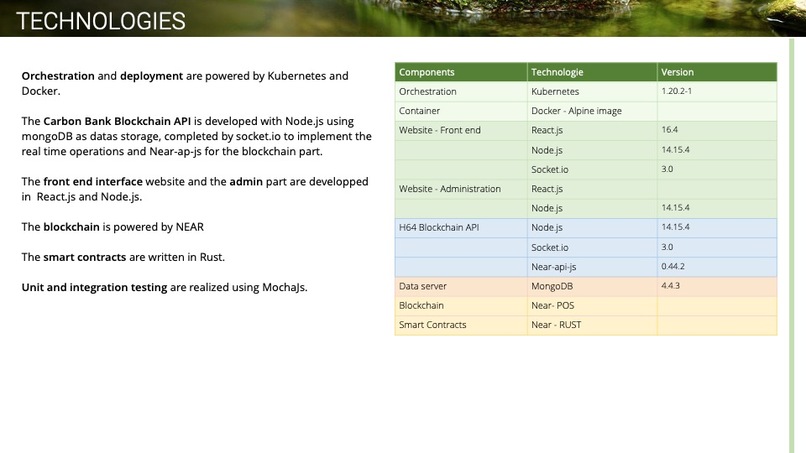
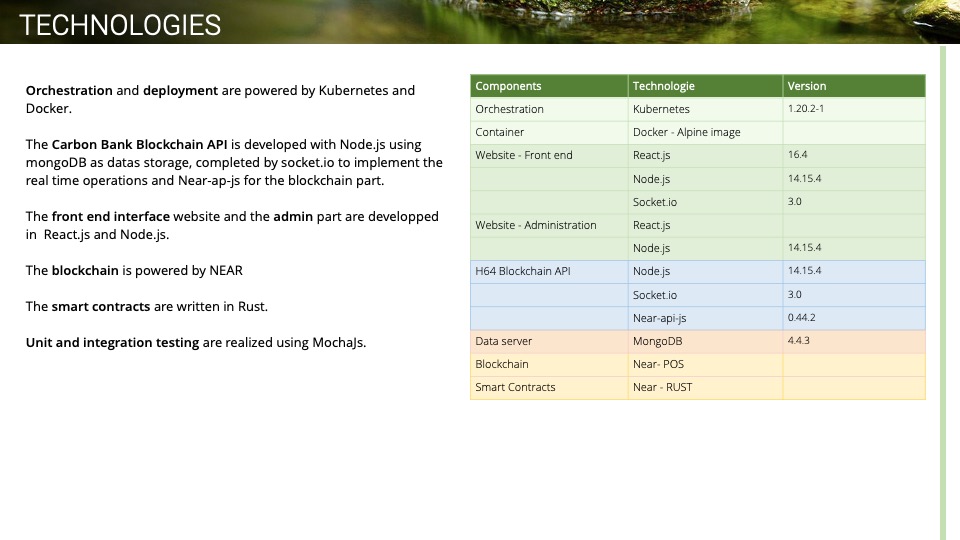
The technologies used are the following:
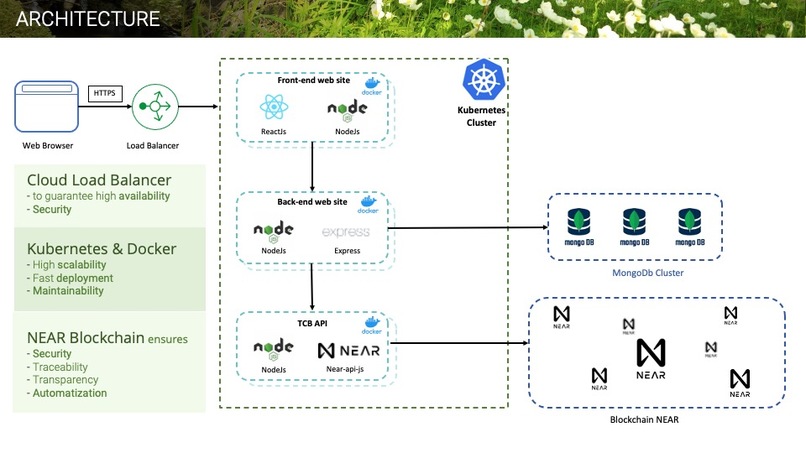
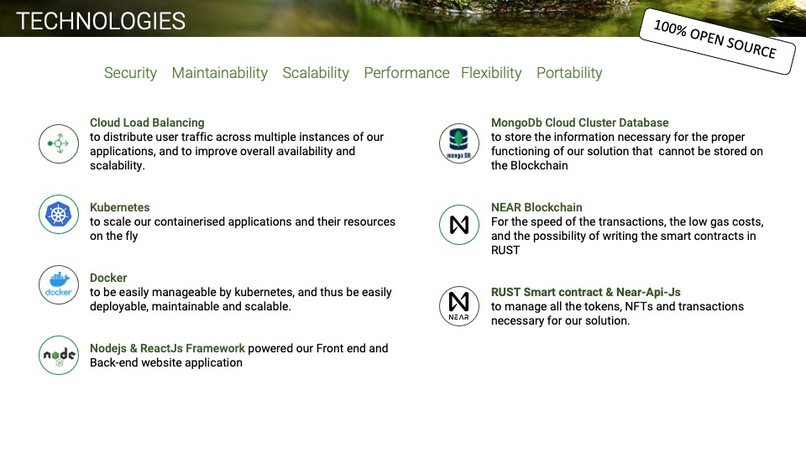
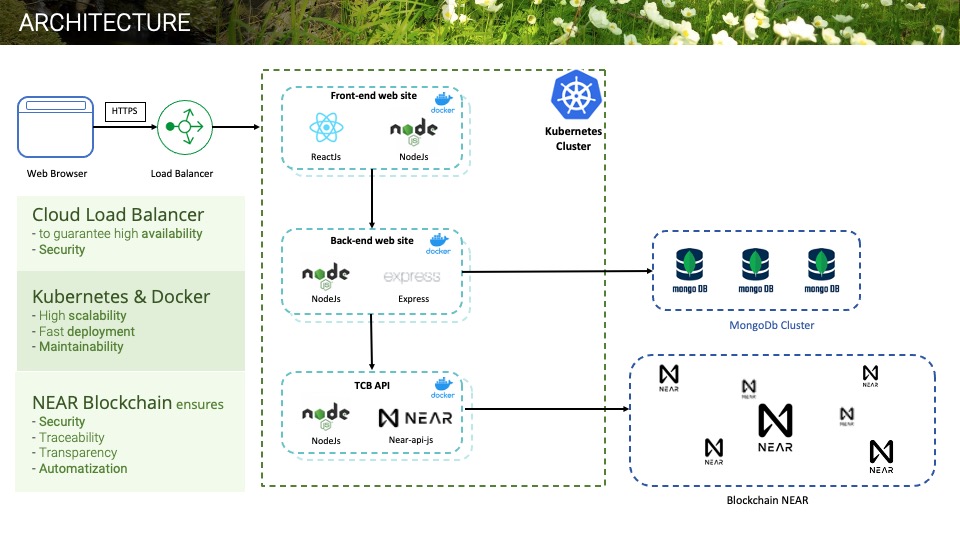
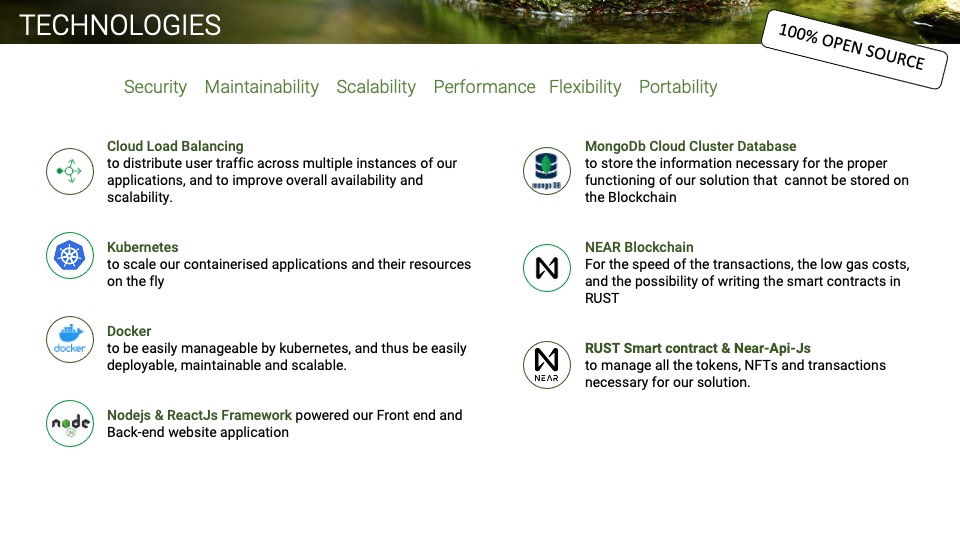
- Orchestration and deployment are powered by : a. Kubernetes to distribute user traffic across multiple instances of our applications, to improve overall availability and scalability and to scale our containerised applications and their resources on the fly. b. Docker to be easily manageable by kubernetes, and thus be easily deployable, maintainable and scalable.
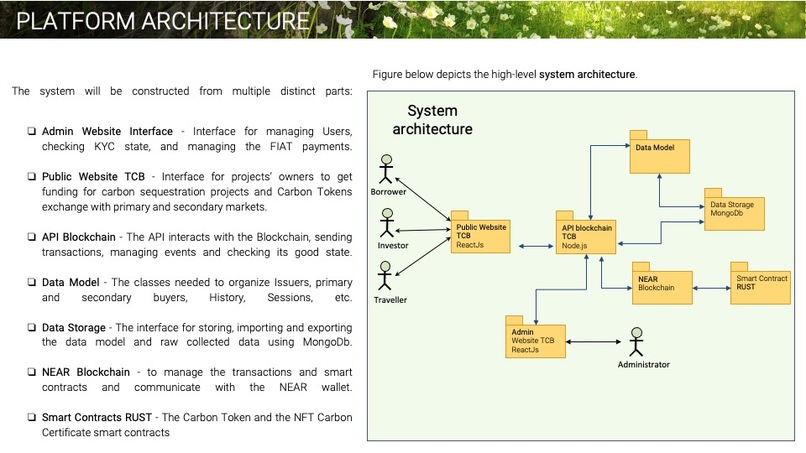
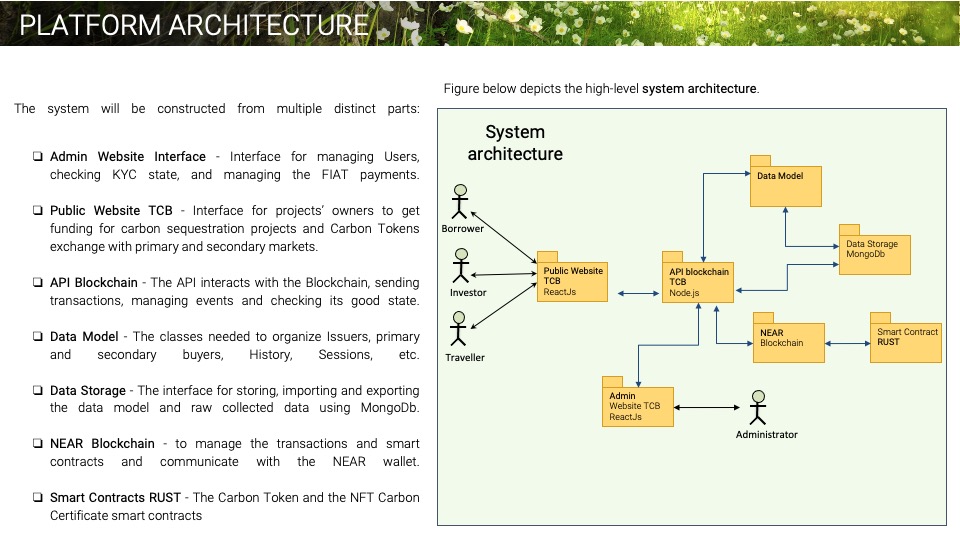
- The Blockchain API is developed with Node.js using mongoDB as datas storage, completed by socket.io to implement the real time operations and Near-ap-js for the blockchain part.
- The front end interface website and the admin part are developped in React.js and Node.js.
- The blockchain is powered by NEAR
- The smart contracts are written in Rust.
- Unit and integration testing are realized using MochaJs.
Challenges we ran into
We had some difficulties to find our way in the meanders of the documentation for the writing of smart contracts in RUST and the implementation of the calls to the smart contracts in our Front end, especially the part of the management of the events, after this stage, we took a real pleasure to use the Near technology.
Accomplishments that we're proud of
We chose to use Near for the speed of the transactions, the low gas costs, and the possibility of writing the smart contracts in RUST. The creation of the Fungible TCC and Non Fungible Token smart contracts representing the carbon certificates was relatively easy. The use of the near-api-js library for the connection to the walett and the call to the different functions of the smart contracts allowed us to reach our goals quickly.
What we learned
We learned that tokenization via a cryptocurrency enables a new method of financing carbon removal and to be confident in our ability to learn new technologies and to integrate new layers in our solution.
Indeed, the Carbon Bank solution was not thought as a Blockchain solution. Our aim was and remains, as the Near blockchain integration gives us a real added value, to build a sustainability as a service platform with an API that makes carbon offsets available :
- for everyday activities like e-commerce deliveries, ride sharing, flights and a lot more or
- for businesses organizations to help them move along the path to become carbon neutral or even carbon negative
The NEAR Blockchain inspired us and we designed The Carbon Bank marketplace and its Tokens to be as open and as simple as possible to become a “primitive”, or “building block” for creating new projects. Our tokens will enable users to embed carbon offsetting to build applications allowing consumers and small businesses to offset their activities and purchases and to create new applications we have not yet imagined. The Carbon Bank Tokens does not bring innovation to markets or trading, but rather innovation in usability for offsetting.
We believe that the Carbon Bank fungible and non-fungible Tokens will enable, with the support of our API, others to innovate and create new applications for carbon credits as we did it in this Hackathon by using the NEAR Blockchain.
What's next for The Carbon Bank
1) Launch of the API (April 2022) It will give access to our value added resellers at the Carbon Bank API features: ❏ Company authentication ❏ Create wallet ❏ Check Balance ❏ Buy TCB carbon ❏ Burn TCB carbon to receive Nft certificate
2) Launch of the White Label module (May 2022) Our partners will be able to embed a fully functional carbon marketplace in their website using an IFrame and will be able to commercialize in the same time on the Carbon Bank main platform: ❏ Customize the look and feel ❏ Fast integration ❏ Source code examples
3) Launch of the MVP ( June 2022) The MVP will be used to approach potential customers and consolidate our partners’ ecosystem in France, our first test country. It will be launched in partnership with the Nouvelle-Aquitaine Region in France, the Tourism Lab Nouvelle Aquitaine, the NAOS programme, the Technopole Helioparc and numerous SMEs.
In autumn 2022, we will launch our ICO. We are waiting to have enough customers and to test our Go To Market Strategy before as òur aim is to build a sustainable and successful project.
Built With
- back-end
- css
- docker
- express.js
- html
- javascript
- linux
- materialui
- mongodb
- mongoose
- node.js
- openstreetmap
- ovh
- react
- rust
- stripe
- testnet
- ubuntu


Log in or sign up for Devpost to join the conversation.