Inspiration
Many people on our company love the ocean, namely swimming, scuba diving, and snorkeling to enjoy the beautiful marine life. During COVID period, many of us are cooped up at home, and since we can’t go to the real ocean to see nature, we figure why not use AR technology to recreate the beauty that we see in the ocean?
On top of that, we also know that many oceans around the world have been polluted by our trash. As a result, many marine lives died or stopped reproducing. So when we heard about the Lensathon, we thought that doing something educational and related to the ocean will be our inspiration.
What it does
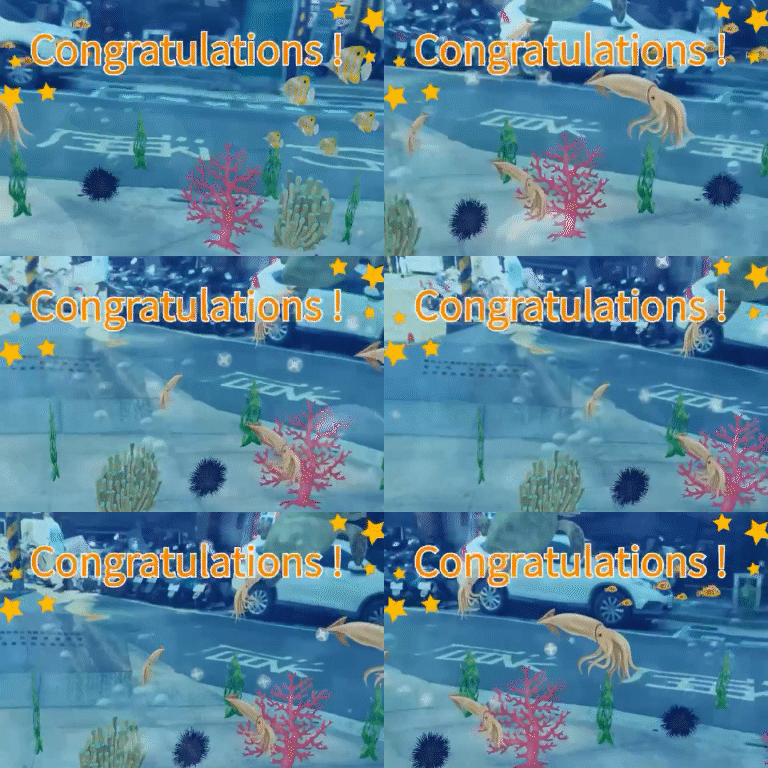
As a result, we built something related to the ocean and picking up trash in the ocean. Something that it suitable for anyone over the age of 13 or even younger! When you turn on the lens, you be in the ocean, but surrounded by various trash and garbage. By clicking on the trash, it will disappear one by one. Once you've cleared all the trash, the ocean you see will be filled with vibrant marine life again!
How we built it
At first we were really excited about the Machine Learning capability in Lens Studio, thinking that we can really use it and make some really cool, interactive filters related to marine life. But then after we've participated in the workshop, we soon realized that it isn't made for people like us who don't have a coding background, so we reverted back to the existing templates and our knowledge from Spark AR.
So we incorporated a bit of gamification in the lens and started to see what will be a good trigger. Having been in the AR business for a while, we definitely do have some very useful material we can throw in. One of us designed what the game will look like, another one studied how to trigger the game and how to play the game, yet another combined all the parts together and presented it in our application.
A more detailed version of our build goes something like this:
First, all the 3D objects will need to have a script that goes with it, but as a whole, they are under one object, we call it Game Manager. We used “touch ended” to trigger the tapping of the objects. Then set a mesh visual around each object so it can be separated from the background.
Challenges we ran into
When we knew about the game, it was mid-June and towards the end of June already, so we were pretty pressed with time.
Accomplishments that we're proud of
Since we made many AR filters before, we were able to go through our past work and come up with an idea quickly and build everything in a speedy way despite the little time we got. Also, since we're all responsible for different elements of the competition, we work together like a well-oiled machine and are able to produce quality result.
What we learned
A few things we've learned, Snap Lens is definitely a bit more powerful than Spark AR (something we are very used to), on the other hand, Snap Lens still relies pretty heavily on coding and scripts if we were to make more complex commands or effects. All of us think that we might dabble more into the coding side after the Lensathon.
What's next for Save the Ocean
We hope that kids and adults will enjoy Save the Ocean and the lens will somehow inspire them to become a more responsible human. We’re all here for a limited amount of time, so we really need to do the best we can to preserve the beauty of this earth. We hope we will create more fun and inspiring lenses after this Lensathon.
Built With
- 3ds-max
- adobe-illustrator
- photoshop
- substance-painter


Log in or sign up for Devpost to join the conversation.