-
-
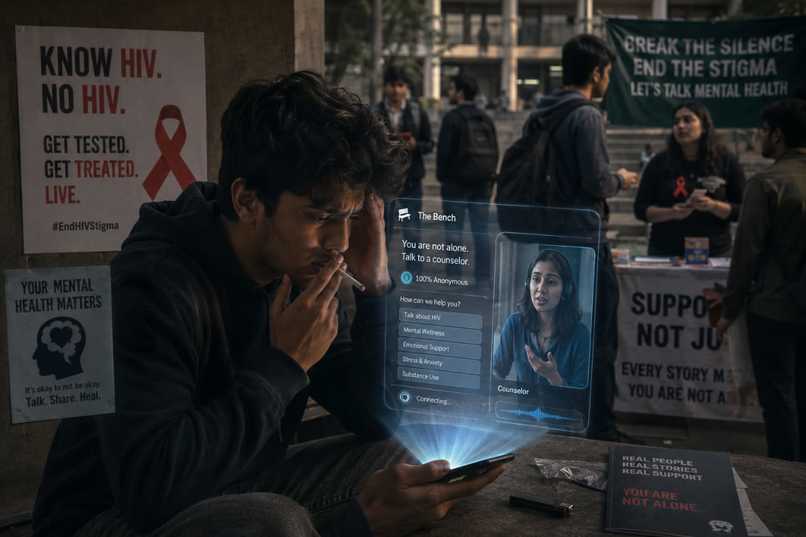
Your safe space to ask the questions you are too afraid to ask out loud. Anonymous wellness and HIV support for students.
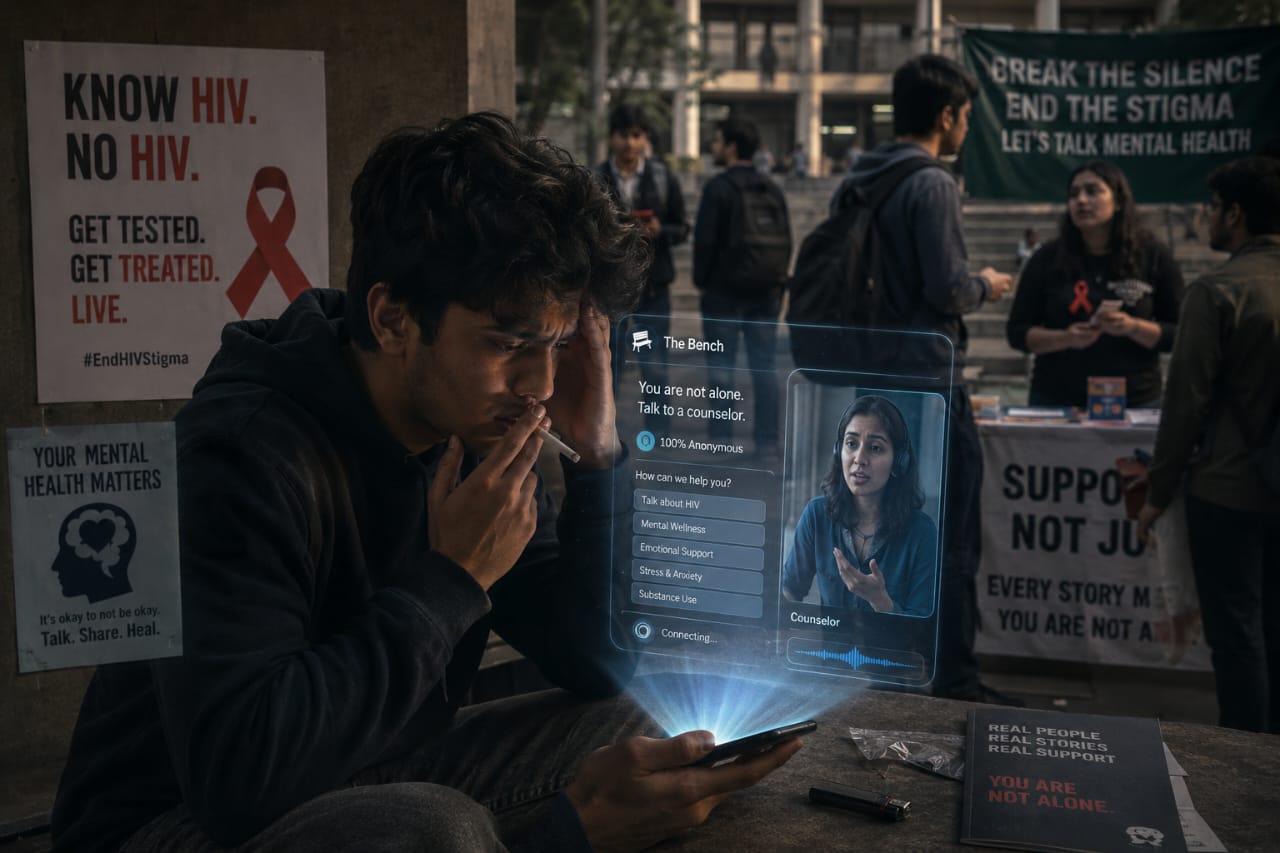
Inspiration
Walking across any university campus, you notice something. Students are laughing, studying, living their lives. But behind that, a silent crisis is happening. 76% of students face stigma that prevents them from accessing health services they desperately need. HIV, STIs, mental health struggles, relationship challenges, these are topics that carry so much shame in communities around the world that young people would rather suffer alone than risk being seen asking for help.
We kept asking ourselves one question. What if there was a bench, a quiet, safe place on campus where anyone could sit down, without judgment, without anyone knowing, and just get help? That question became this app.
What it does
The Bench is an anonymous, privacy-first mobile wellness platform built for university and college students globally. It requires zero personal information to use. Students pick a nickname and they are in.
Ruva, the app's AI wellness companion, is available 24/7 for judgment-free conversations about HIV, sexual health, mental wellness, relationships, and more. Students can also switch at any point to chat with, call, or video call real human supporters including peer educators, pastors, and certified health professionals — all while remaining completely anonymous.
The app features offline-capable maps that guide students to nearby clinics, counseling offices, and safe spaces. A unique Last 50 Metres navigation feature gives discreet step-by-step instructions for arriving at a location without drawing attention. A Quick Shield button instantly disguises the app as an academic timetable if someone looks over the user's shoulder.
Most critically, the platform actively monitors conversations for crisis language. The moment a distress signal is detected, it opens an Emergency Resource Gateway connecting students immediately to local crisis helplines and on-call counselors relevant to their region.
All data: chat history, mood logs, community stories, is stored locally on the device. Nothing identifying ever leaves the phone.
How we built it
We built The Bench as a native Android application. The UI is built entirely with Jetpack Compose and Material 3, using a custom forest green, warm sand, and off-white theme designed to feel calm and safe. All asynchronous operations including AI queries, voice processing, and database access run through Kotlin Coroutines and StateFlow to keep the experience smooth and responsive.
The AI backend is powered through the OpenRouter API and Gemini SDK, with carefully crafted system prompts tuned specifically for student wellness counseling. Voice interactions use Android's native Text-to-Speech engine with custom pitch and speed settings to make Ruva sound warm and human, paired with Android SpeechRecognizer for voice input. Local data persistence runs on Room Database with Kotlin Symbol Processing. Maps are rendered using Leaflet and OpenStreetMap inside an embedded WebView.
Challenges we ran into
Designing for genuine anonymity while still delivering a personalized experience was our biggest challenge. Every feature had to be rethought through the lens of a student who is terrified of being identified. The Quick Shield, the anonymous student IDs in the professional portal, the local-only storage, and the alias-based onboarding all came from asking the same question repeatedly: what would make a scared student actually trust this?
Tuning Ruva's voice to feel warm and not robotic took significant iteration. Getting the Text-to-Speech pitch and cadence right so that it felt like a companion and not a machine was something we cared deeply about.
Building offline map functionality that works reliably in low-connectivity environments, a reality for many students not just in Zimbabwe but across Africa, Asia, and other parts of the world, required careful implementation of the Leaflet WebView integration.
Accomplishments that we are proud of
We are proud that we built something that could genuinely save a life. The crisis detection and Emergency Resource Gateway is not a gimmick. It is a carefully designed safety net for a student who may have no one else to turn to at that moment, whether they are in Harare, Nairobi, Manila, or Manchester.
We are also proud of the zero-PII architecture. In a world where every app wants your data, we built one that actively refuses it.
What we learned
We learned that building for vulnerable users forces you to be a better engineer and a better designer. Every shortcut you might take in a normal app becomes unacceptable when the person on the other end is already in a fragile state. Privacy, warmth, and trust are not features you add at the end. They have to be the foundation.
What is next for The Bench
We want to expand the network of verified professionals on the platform, localize crisis helpline data for universities across different countries and regions, and grow the community stories database into a truly global peer support network. We are also exploring a web companion version for students without Android devices.
The long-term vision is for The Bench to be present on every campus in the world, a universal safe space that travels with every student, wherever they are.
The bench has always been a place where anyone can sit. We want to make sure every student, everywhere, has one.
Built With
- android
- android-speechrecognizer
- gemini-sdk
- google-text-to-speech
- jetpack-compose
- kotlin
- kotlin-coroutines
- kotlin-symbol-processing-(ksp)
- leaflet.js
- material-3
- openrouter-api
- openstreetmap
- room-database
- stateflow


Log in or sign up for Devpost to join the conversation.