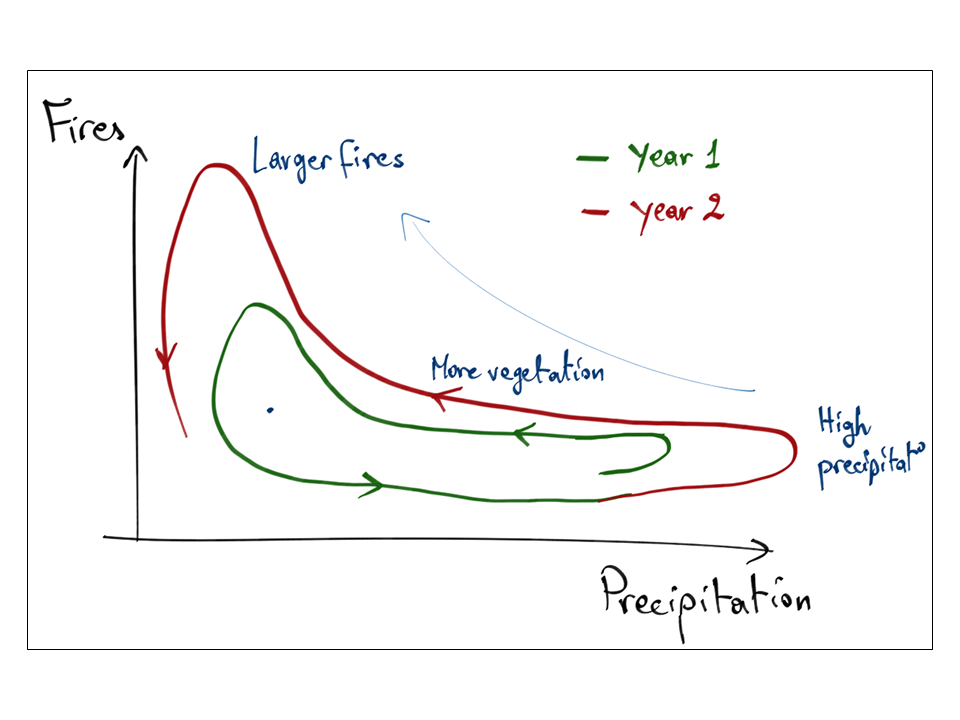
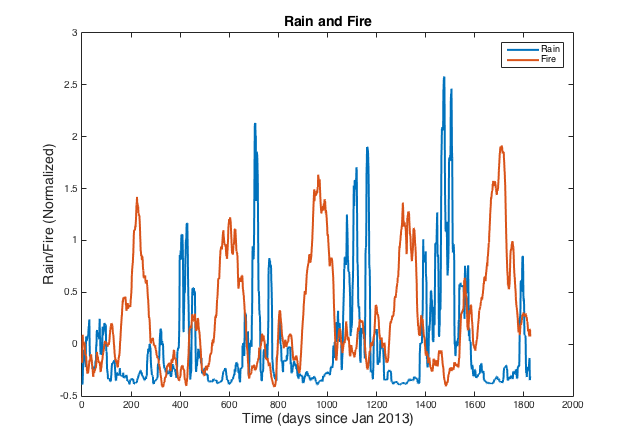
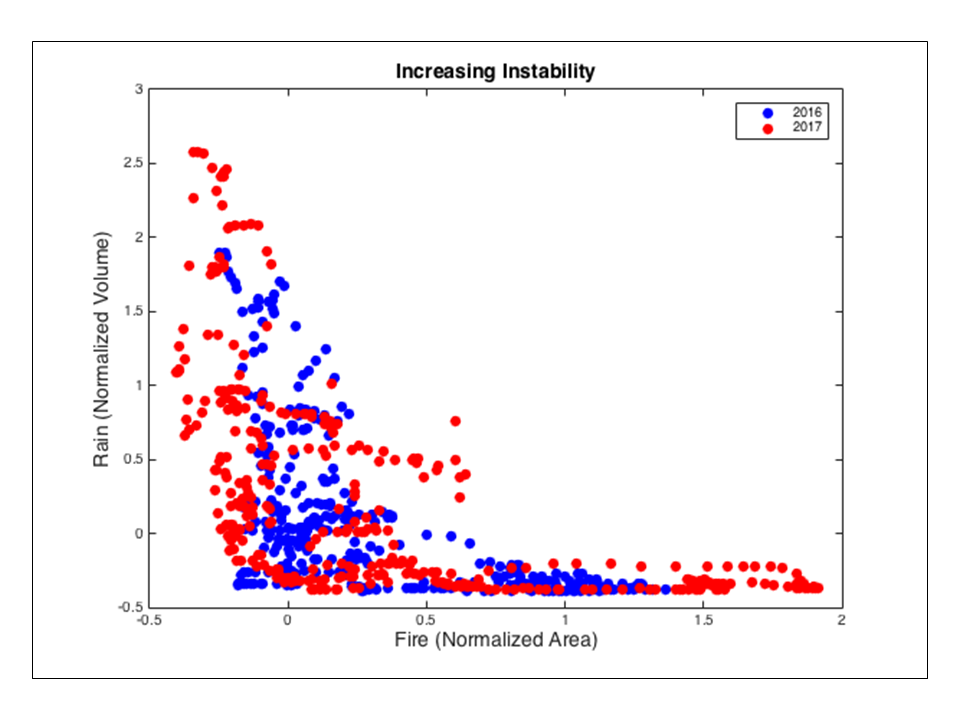
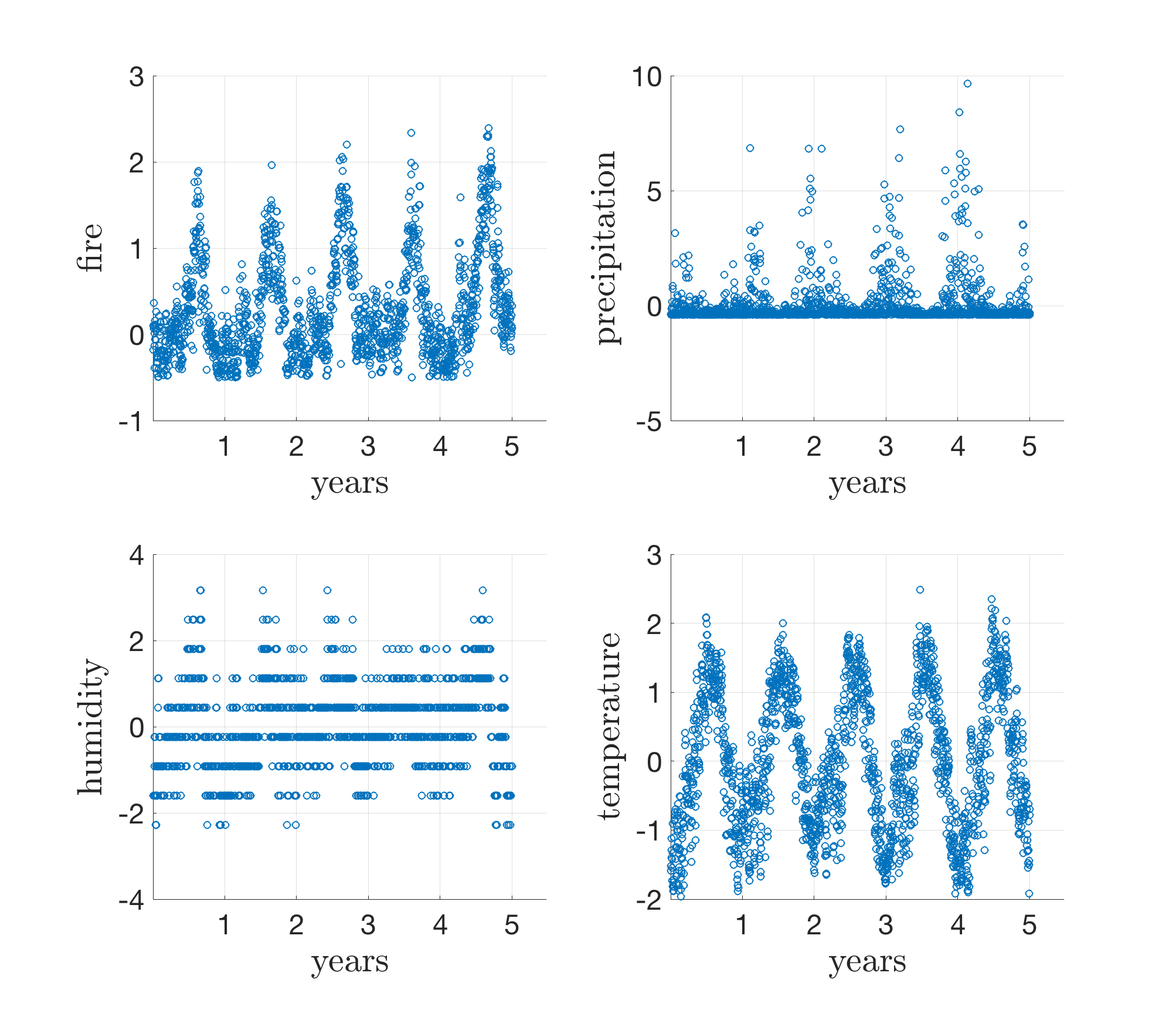
In October 2017, the city of Santa Rosa California was totally consumed by fire. 22 people died in the fire due to the unpredictably rapid spread of fires in northern California. Although the number of incidences of wildfire has been steadily decreasing, the total affected areas have been increasing in recent years [1]. What are the environmental factors behind this phenomenon? The intensity of last year’s fires correlated with the extreme precipitation rates in the preceding winter. Could high levels of precipitation have enabled an easier spread of fires? Our hypothesis is that high levels of winter rain favour growth of dense forests and plants; these crops in turn become dry by the end of the summer thus making it easier for fires to spread. This hypothesis is motivated by the need to study climate change as a dynamical system with multiple interconnected environmental factors having nonlinear and feedback interactions. We sometimes think of the ecology as a set of static factors that should be monitored and controlled (e.g. CO2 level in the air, average temperature etc.). But climate change, as we have witnessed in the past few years, is reflected in extreme temperatures, precipitation and wildfires. Those extremes are part of large oscillations, which in engineering terms are indicators of an unstable system. If we properly think of our ecology as a complex dynamical system made of interconnected limit cycles, we must aim to maximize the stability of the system as a whole. For this reason, we would like to study this instability caused by the precipitation->plant growth->fires cycle and see it in data. In this project, using the Google Earth Engine [2], we extracted datasets for fire incidences, and environmental factors like level of existing vegetations, level of precipitation, humidity, temperature and average wind speed in California. We used this data to understand the correlation between wildfires and environmental factors; in particular precipitation and the amount of vegetation growth. Our aim is to understand the planet as a dynamical systems, where sometimes dynamical changes lead to a positive feedback, thus causing instabilities. For example, fires might cause more fire, as the forest gets more fertile due to fire, and therefore favours growth of more plants.
Team Glacier
Can we estimate California wildfire size by GGE and Planet datasets?

Updates

Leave feedback in the comments!
Log in or sign up for Devpost to join the conversation.