-
-
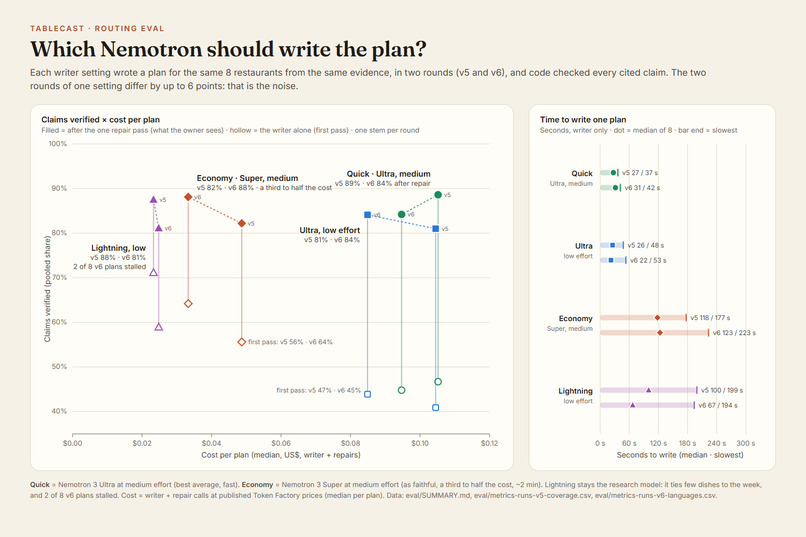
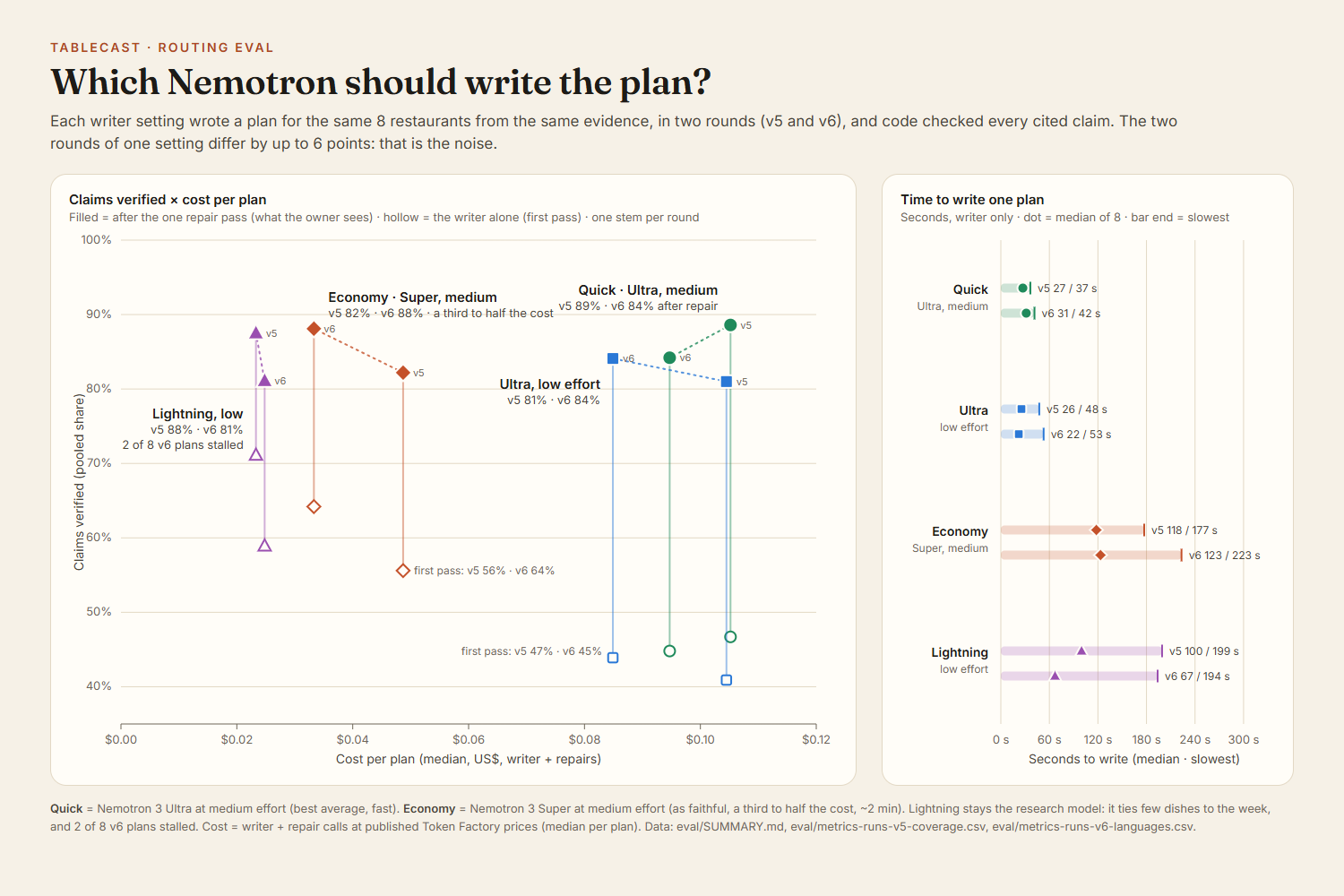
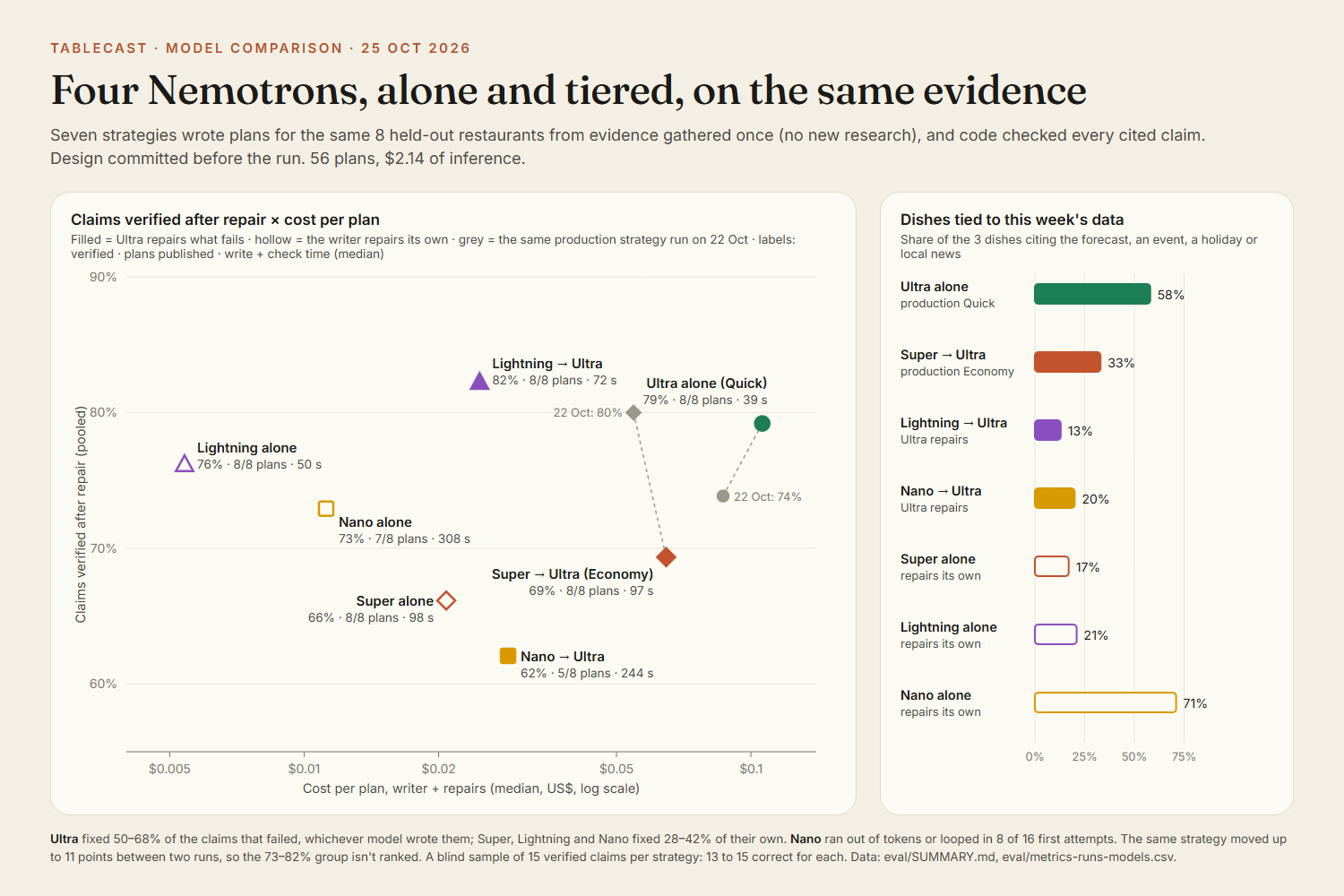
Which Nemotron writes the plan: claims verified after repair against cost, two rounds per setting so the noise shows, and time.
-
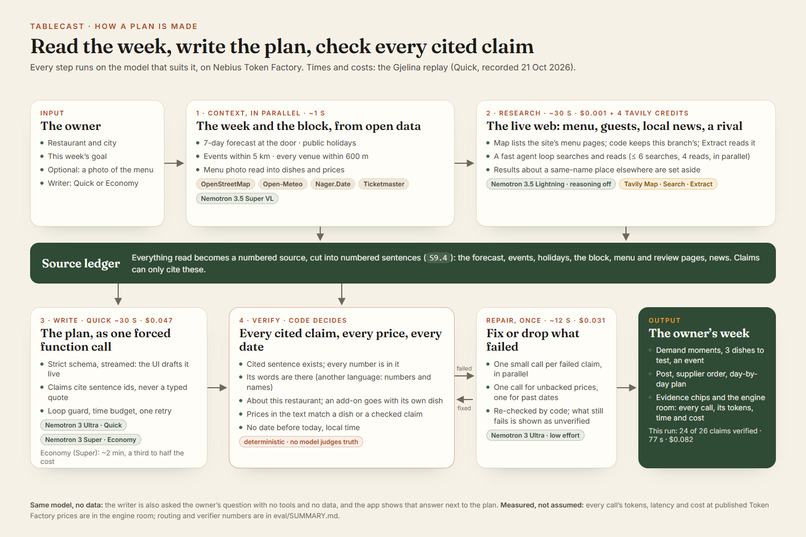
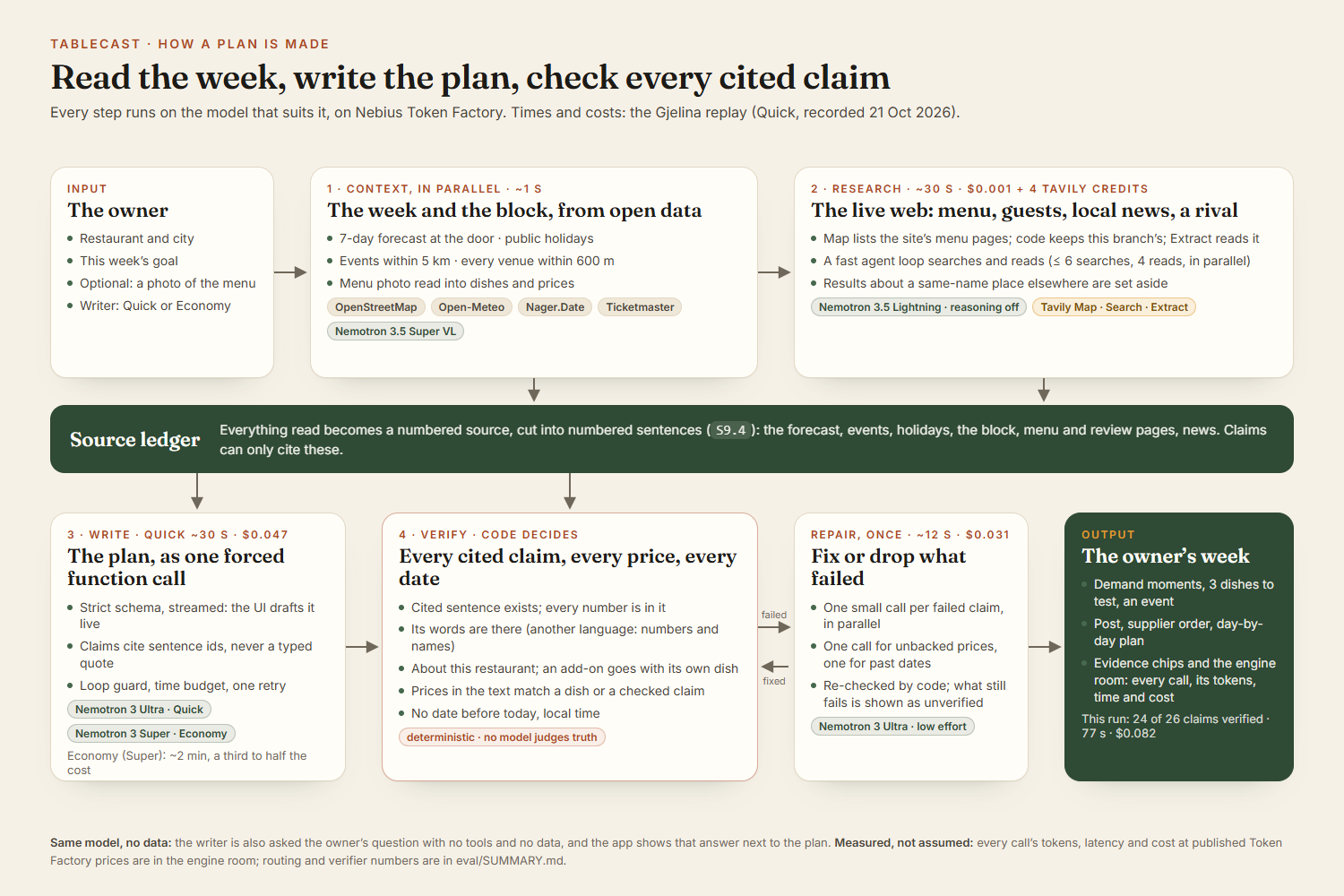
Read the week, write the plan, check every cited claim: open data and Tavily, Nemotron writes, code verifies, Ultra repairs once.
-
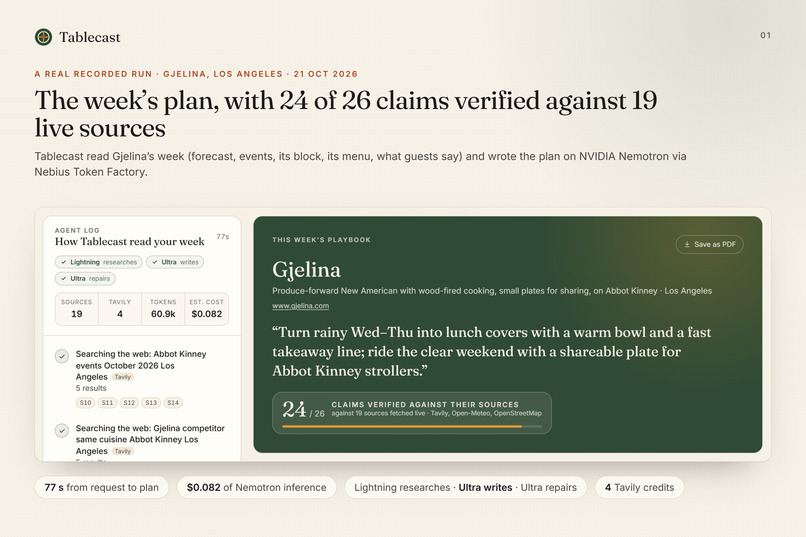
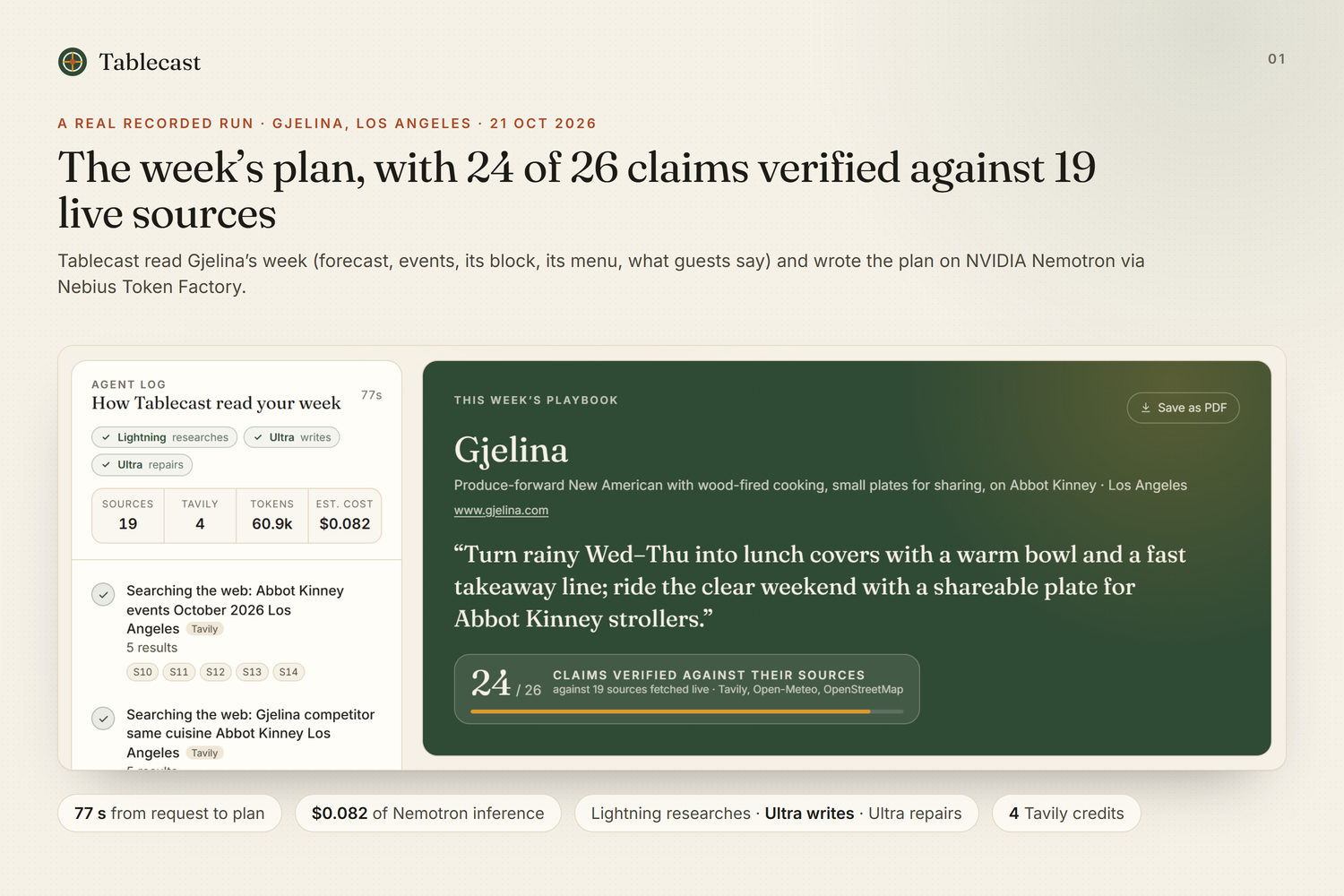
A real recorded run for Gjelina, Los Angeles: 24 of 26 claims verified against 19 live sources, in 77 s for $0.082.
-
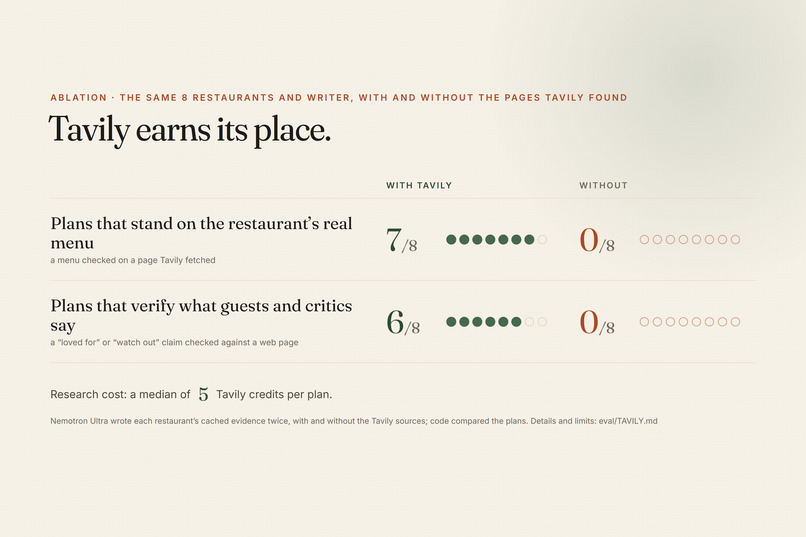
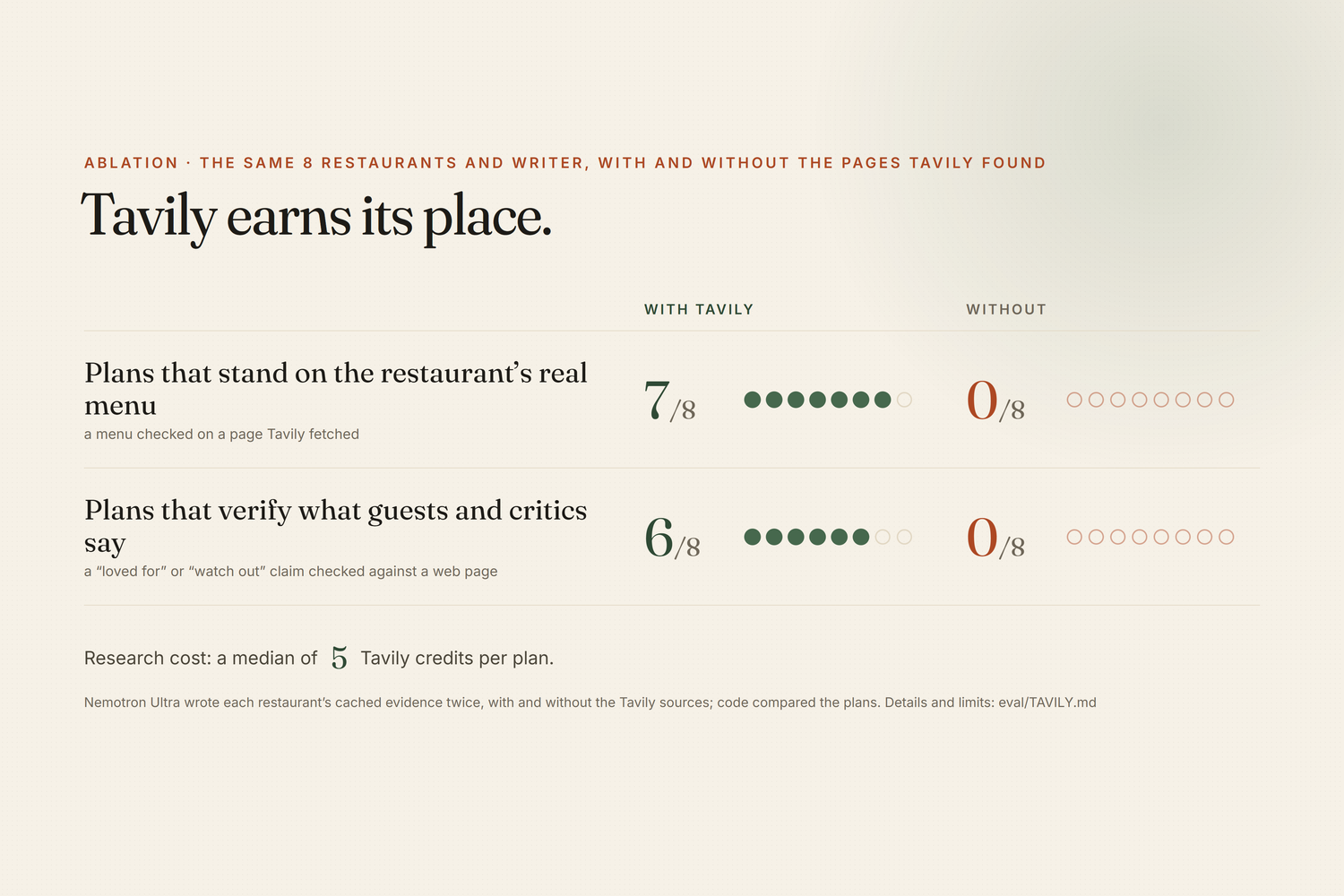
Tavily ablation over 8 restaurants: with it, 7/8 plans stand on the real menu and 6/8 verify what guests say. Without it, 0/8.
-
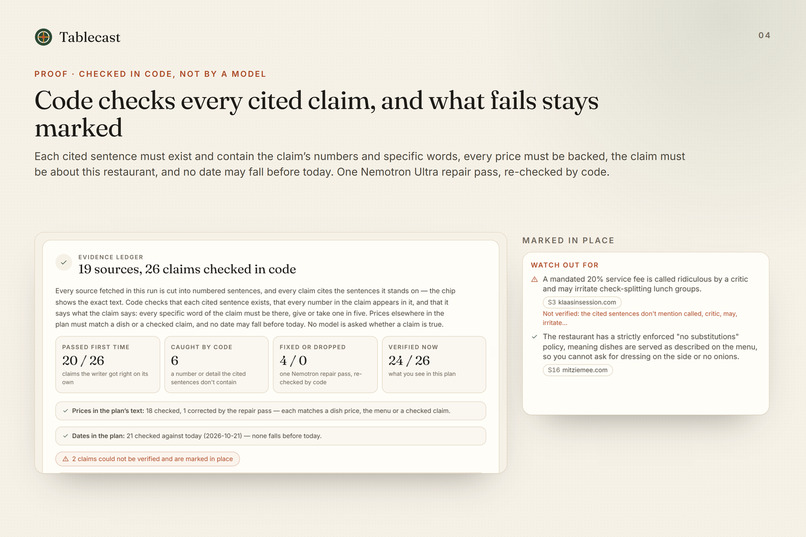
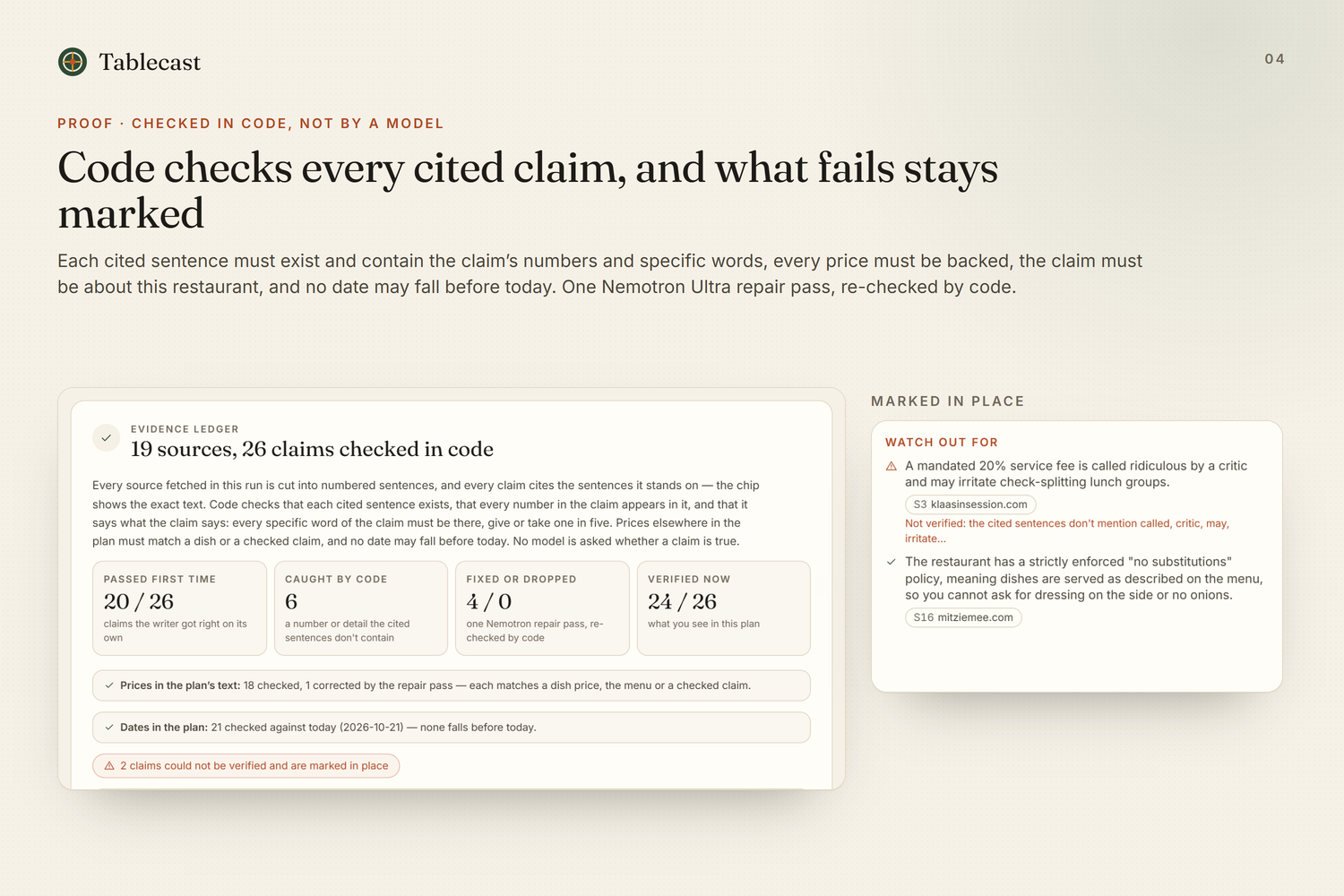
Code checks every cited claim: 20 of 26 passed first, a repair fixed 4, and the 2 that still fail stay marked in place.
-
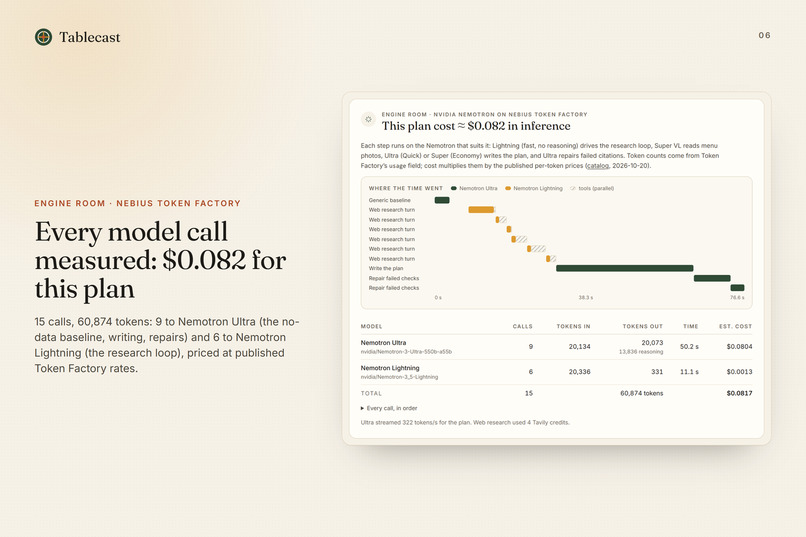
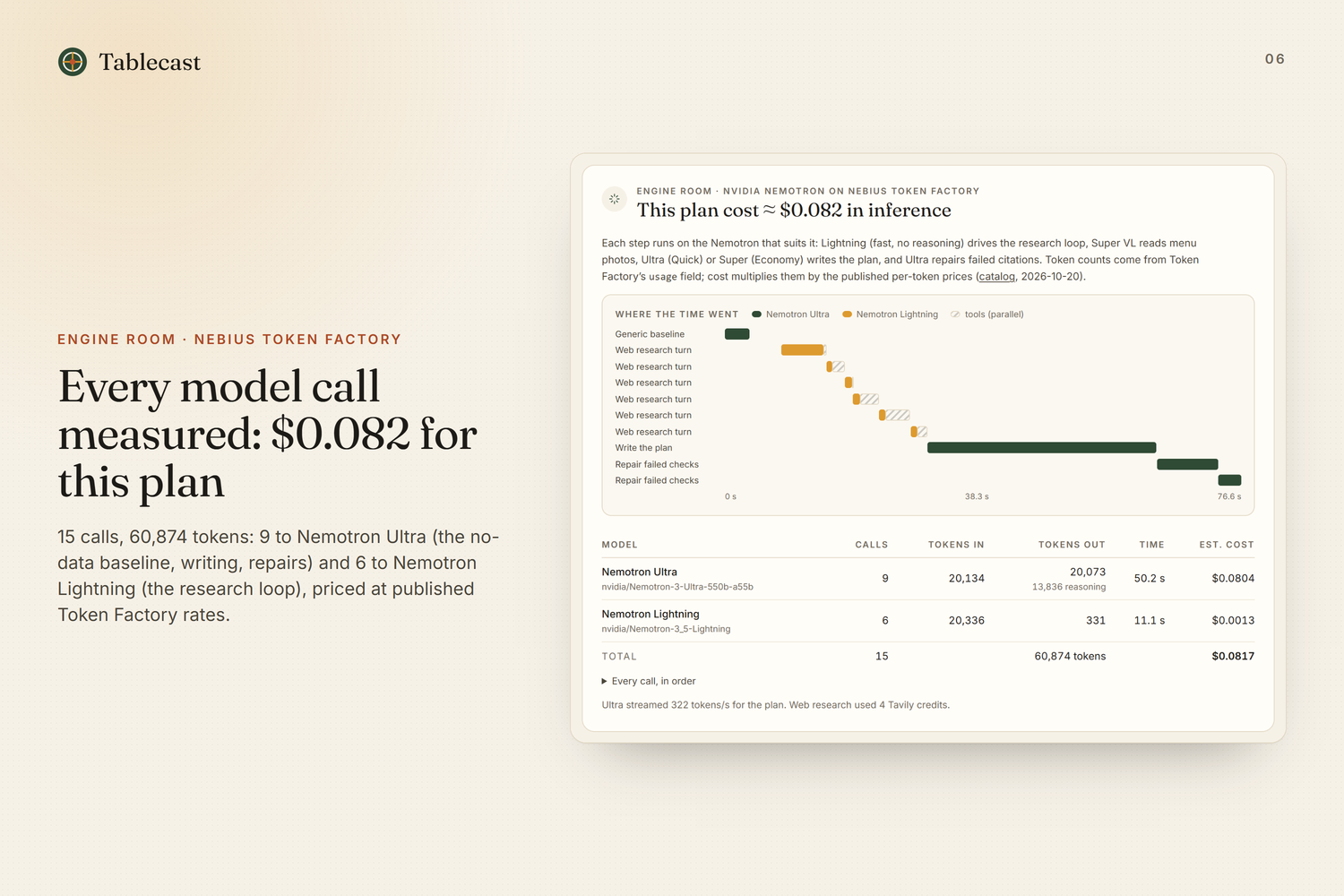
Engine room: 15 Nemotron calls on Nebius Token Factory, 60,874 tokens, $0.082 for this plan, each call timed and priced.
-
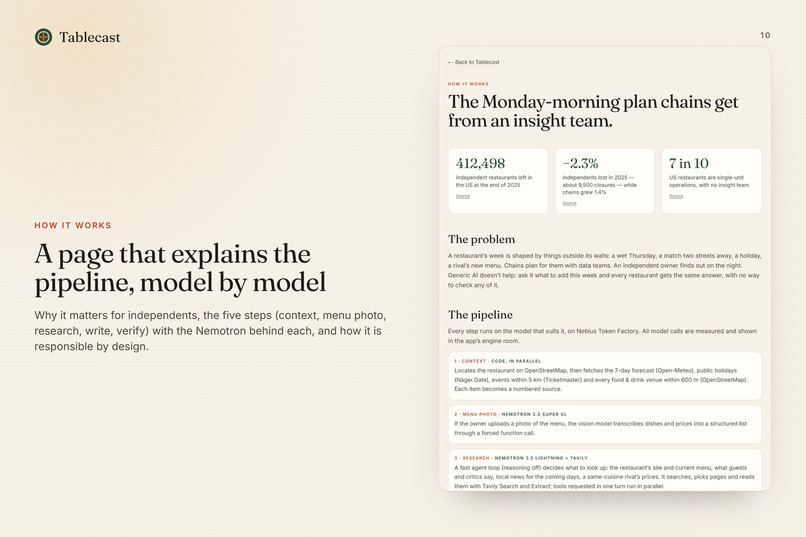
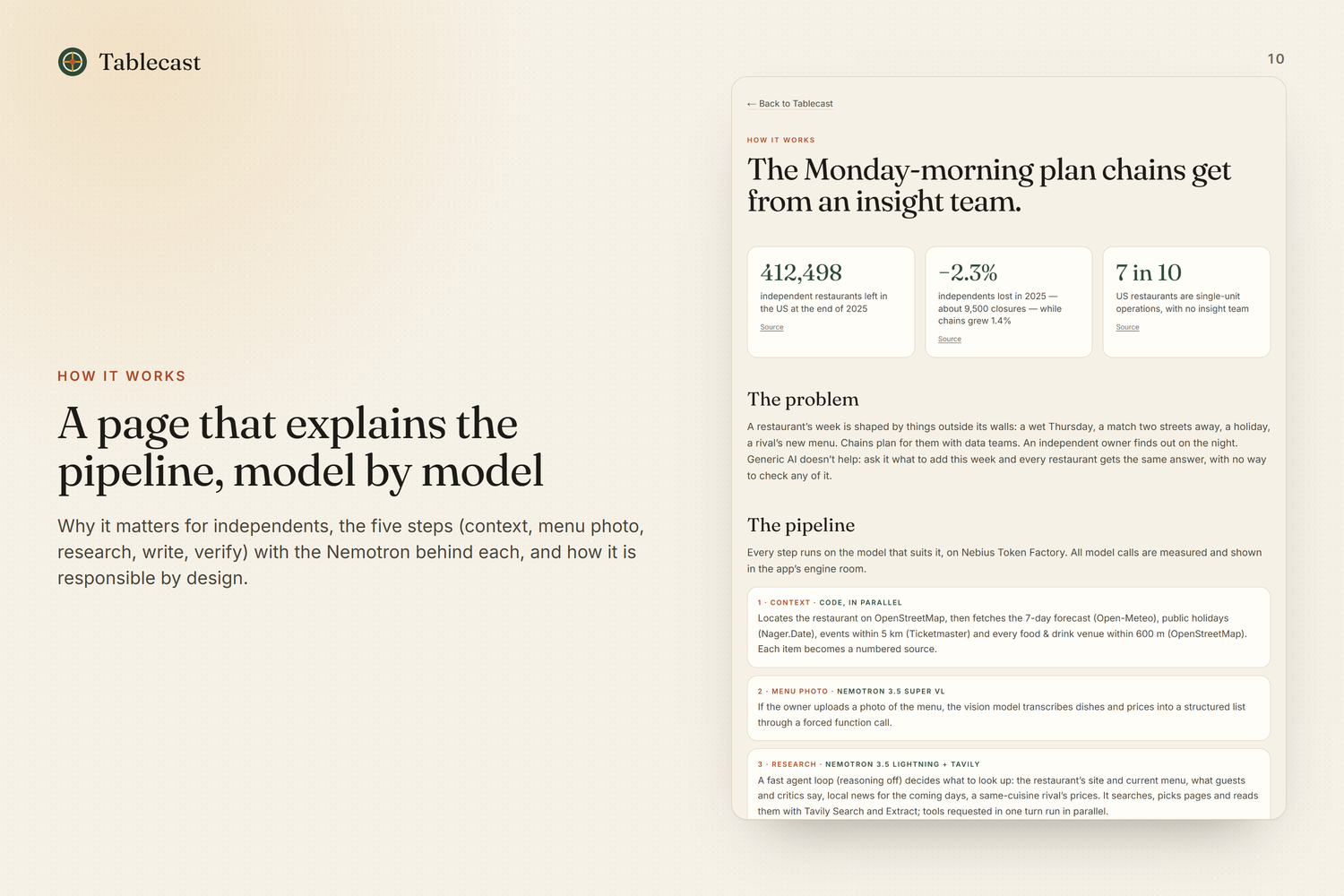
How it works: why it matters for independents, the pipeline with the Nemotron behind each step, and how it stays responsible.
-
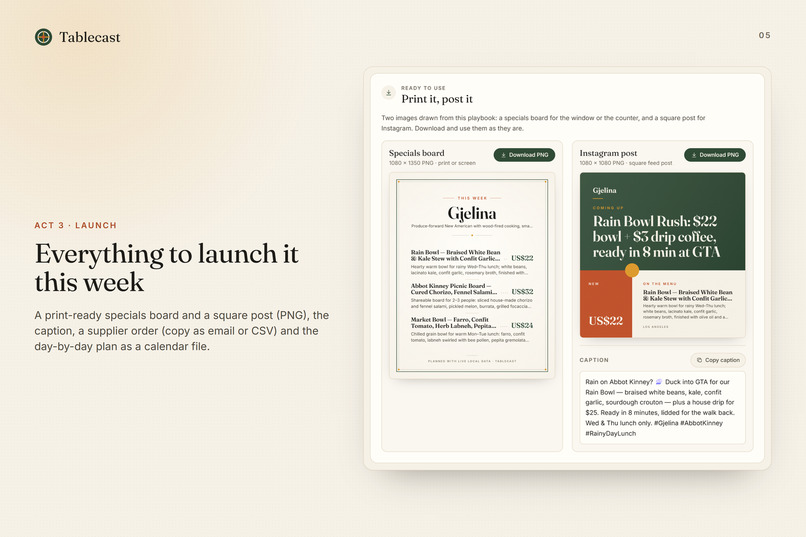
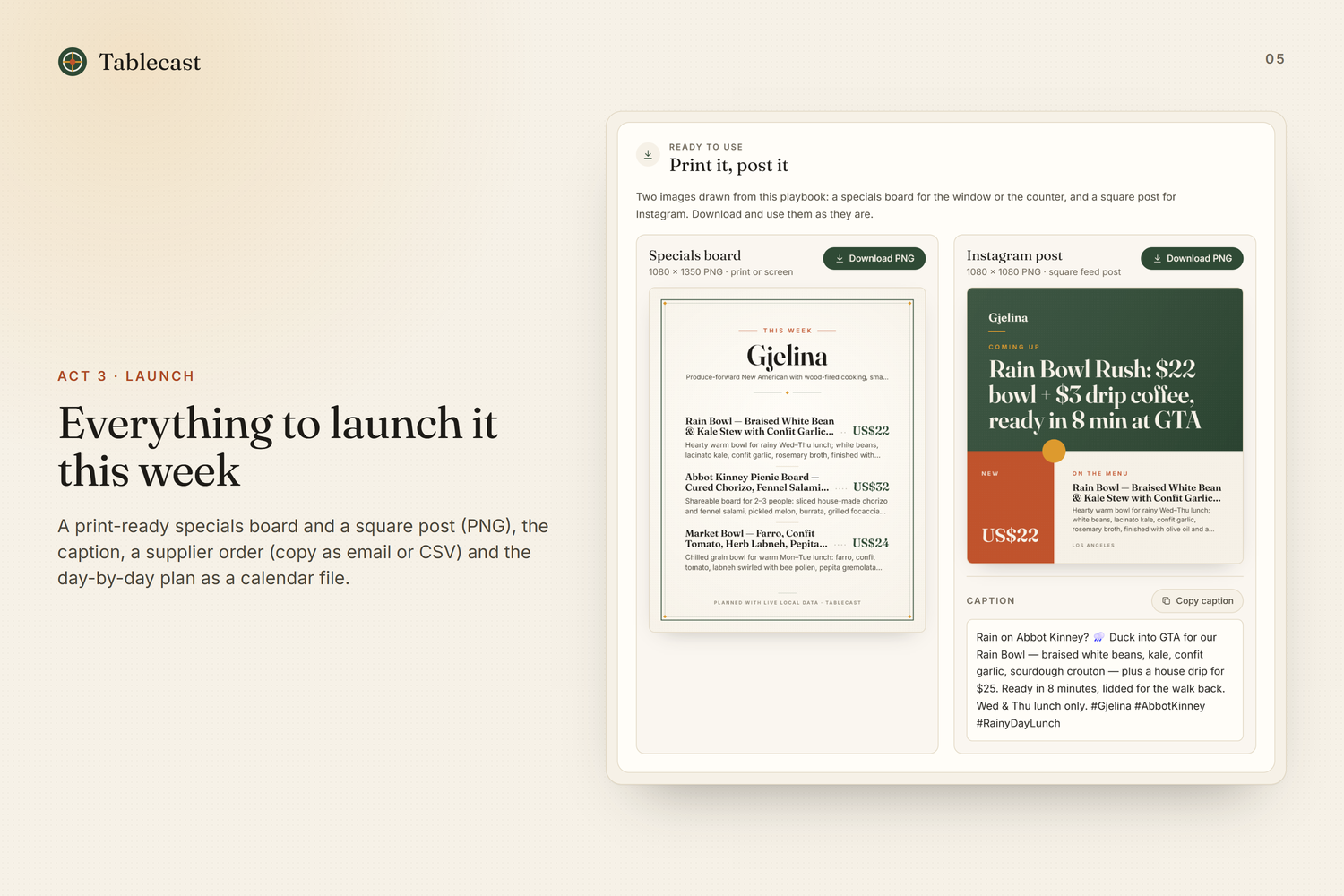
Ready to launch: a print-ready specials board, a square post with its caption, a supplier order and the week as a calendar.
-
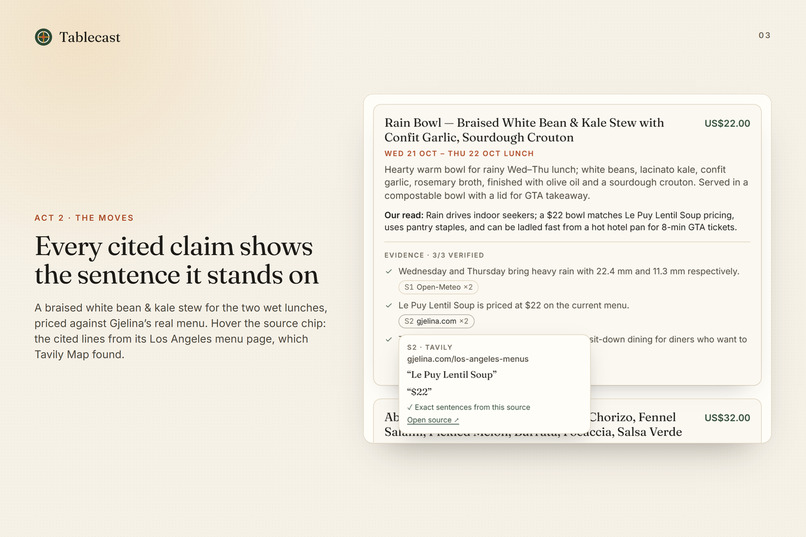
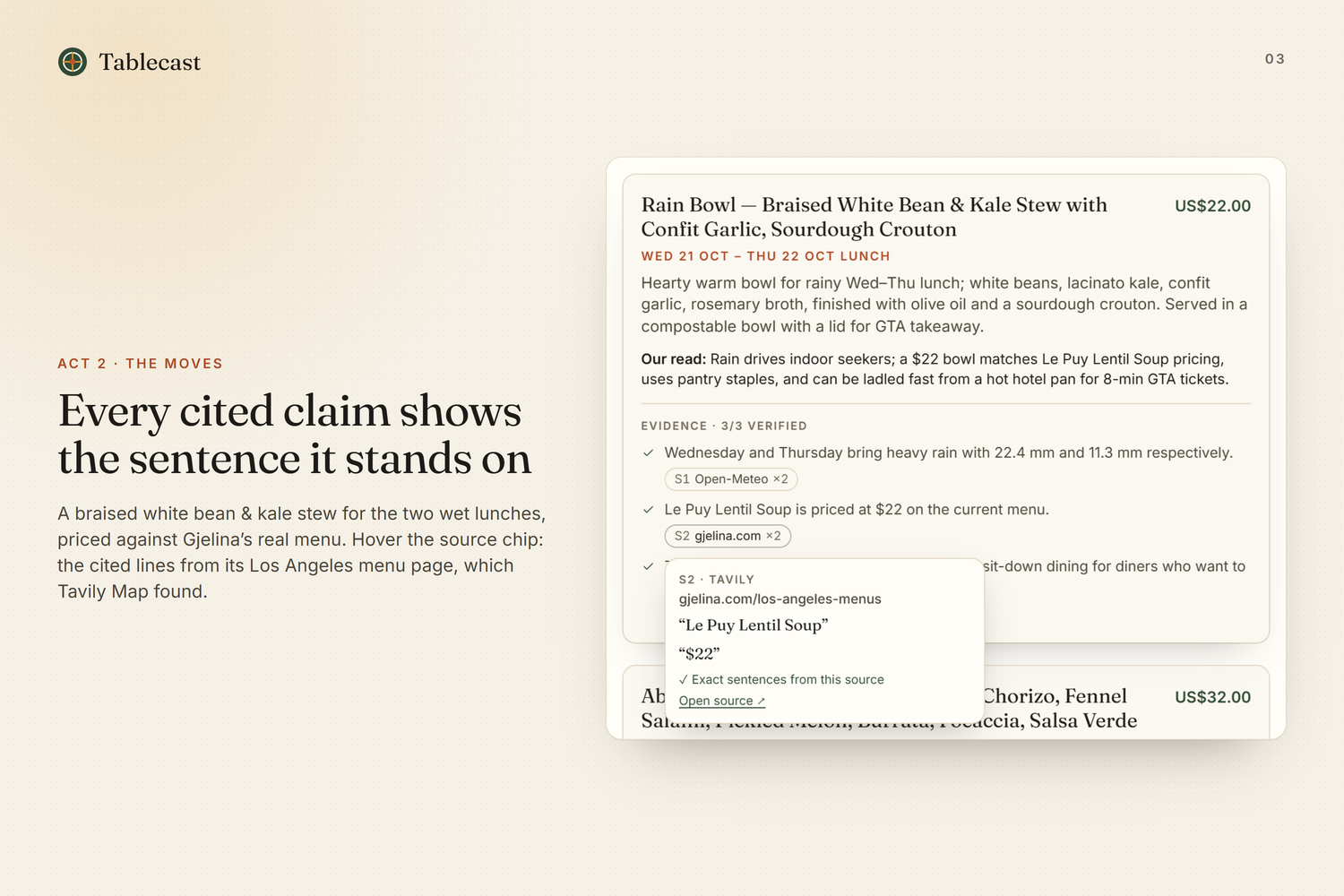
A white bean and kale stew for the two wet lunches, priced against the real menu. The source chip shows the exact lines.
-
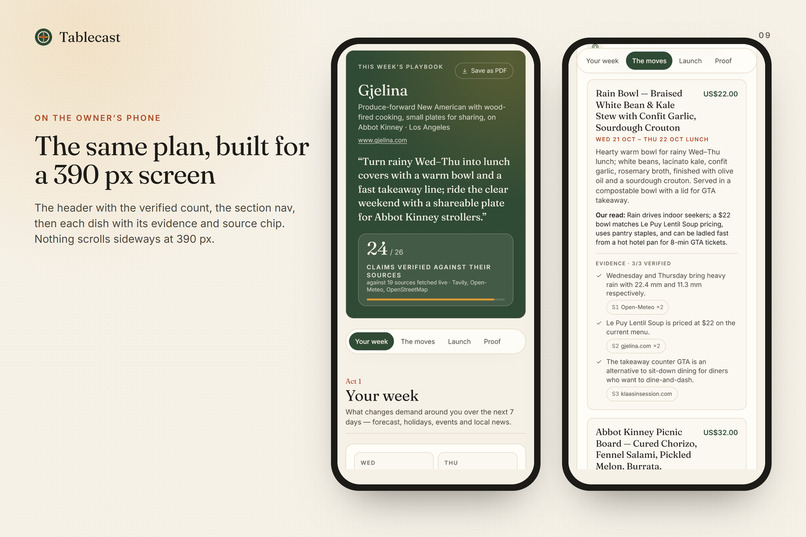
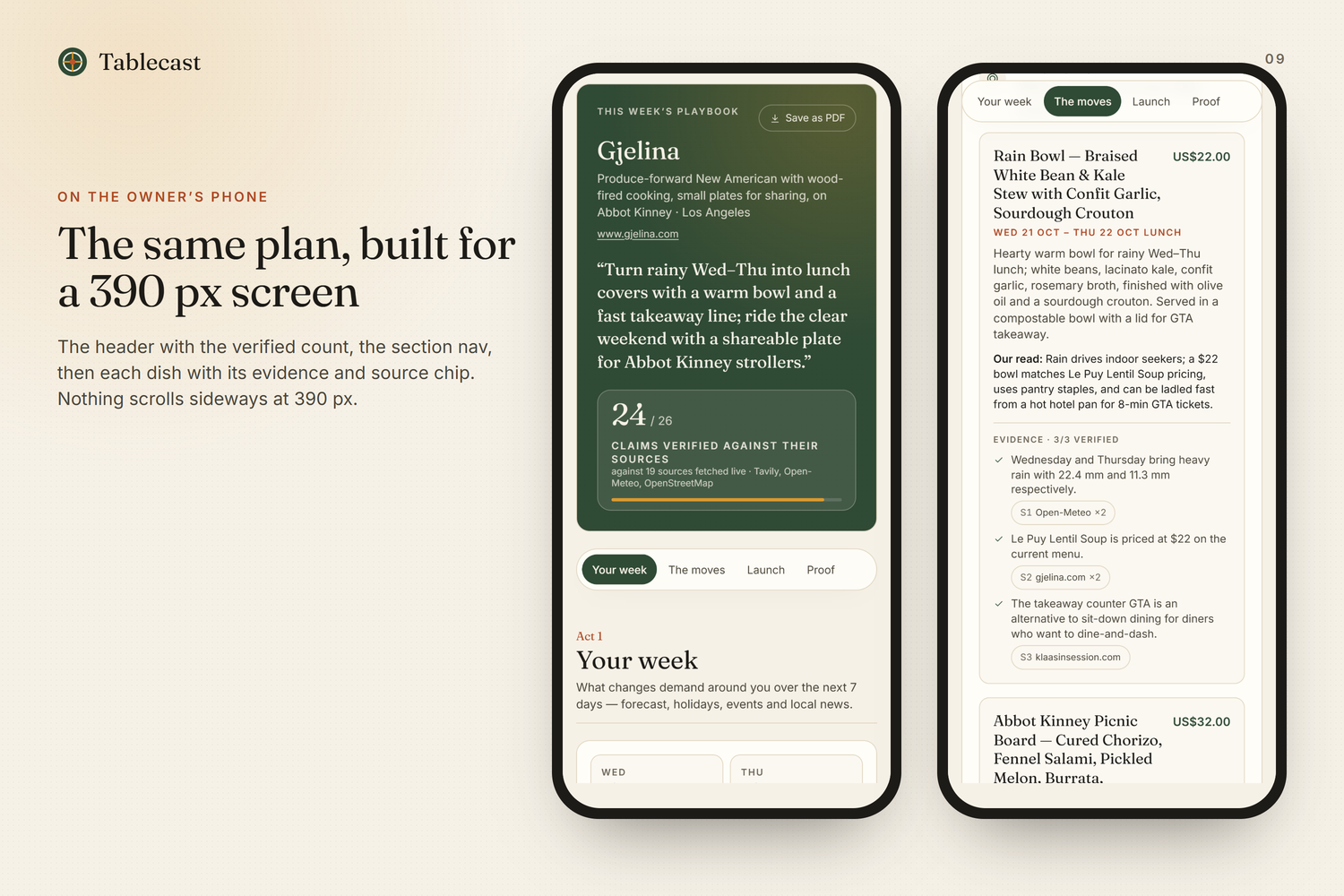
The same plan on a 390 px phone: the verified count up top, then each dish with its evidence and source chip.
-
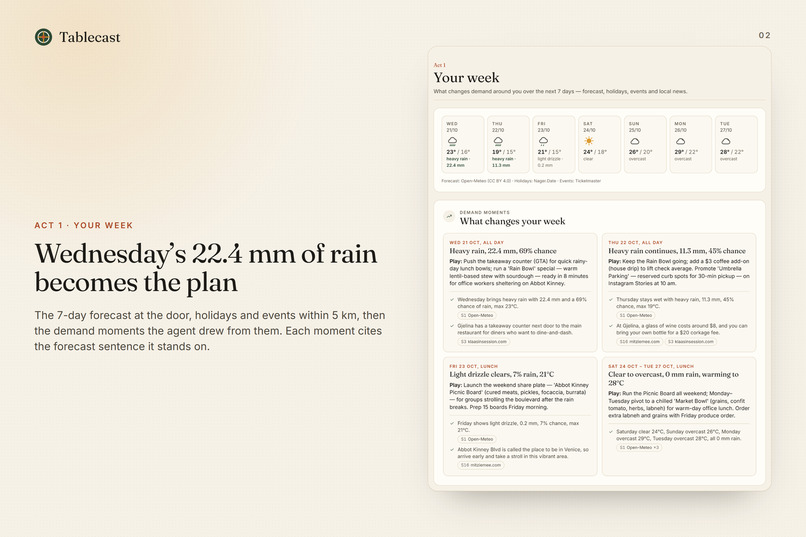
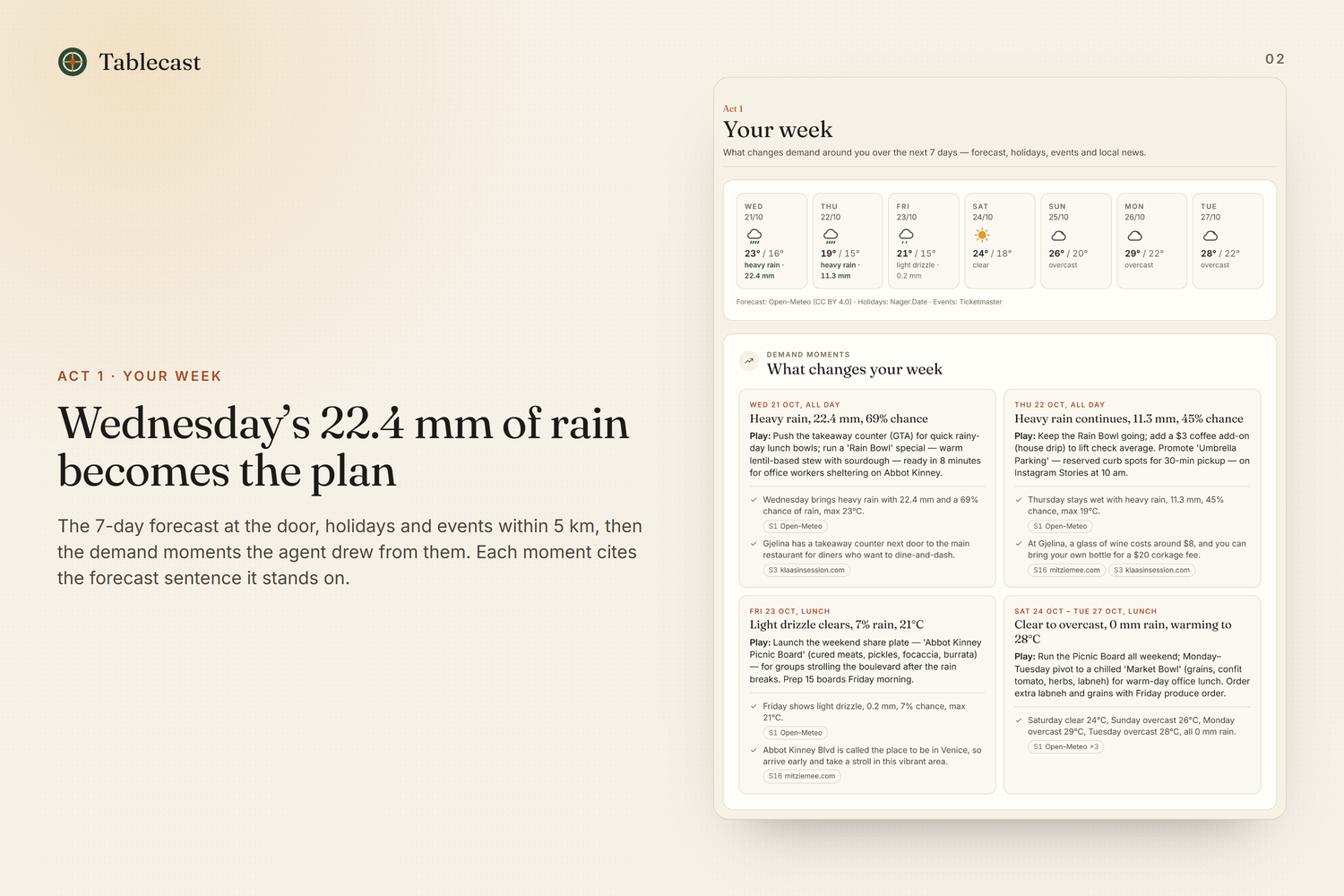
Your week: Wednesday's 22.4 mm of rain and Thursday's 11.3 mm become demand moments, each citing its forecast line.
-
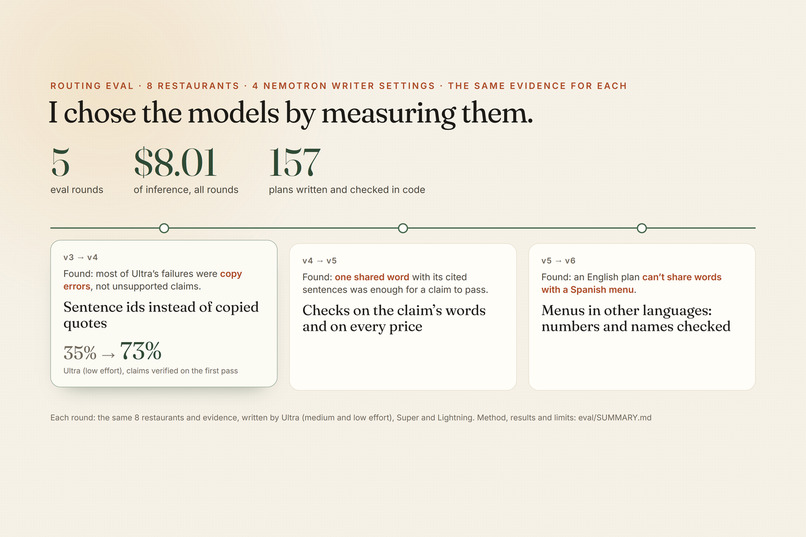
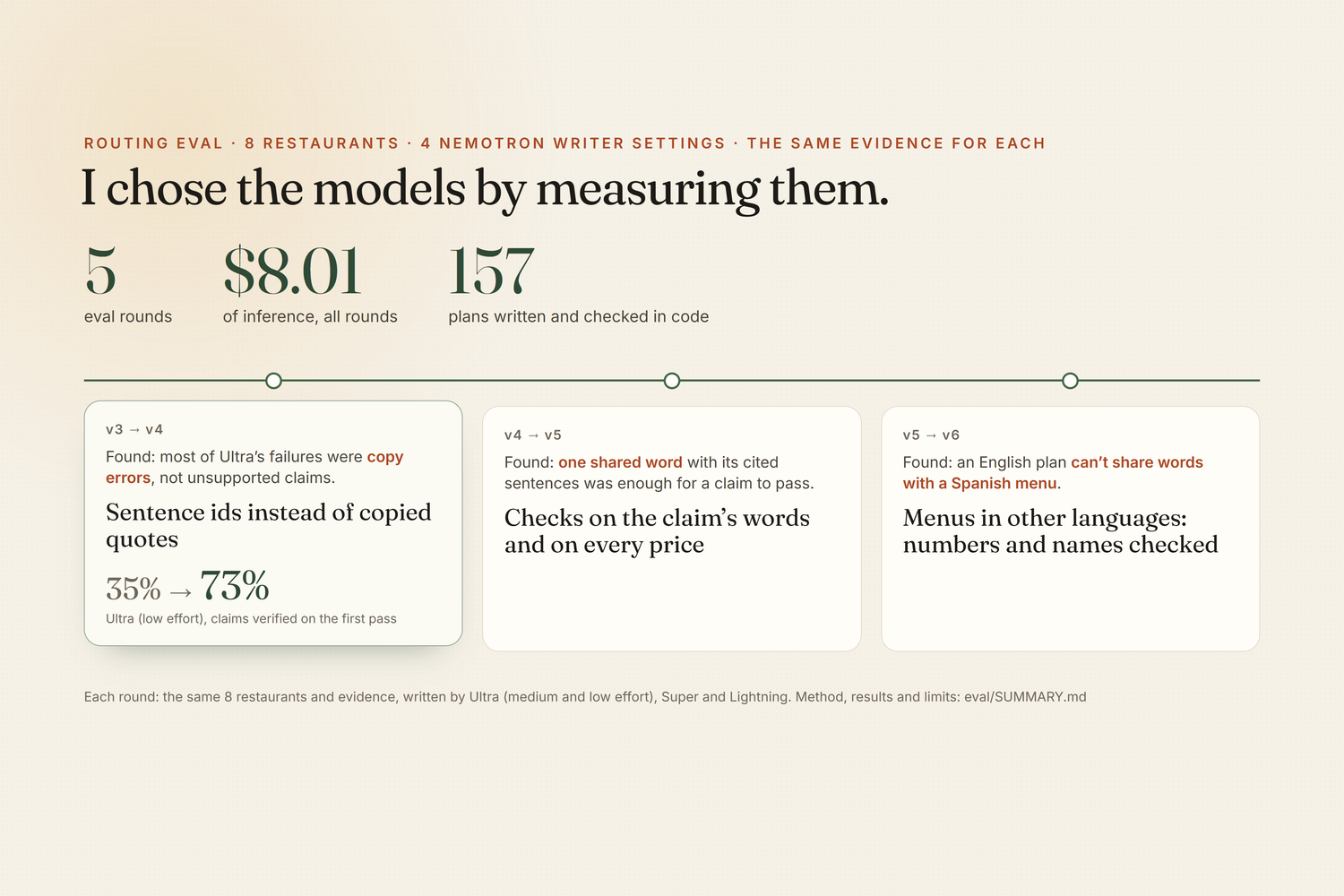
I measured the models: 5 rounds, 157 plans, $8.01. Ultra's first pass went 35% to 73%, then 44% under a stricter check.
-
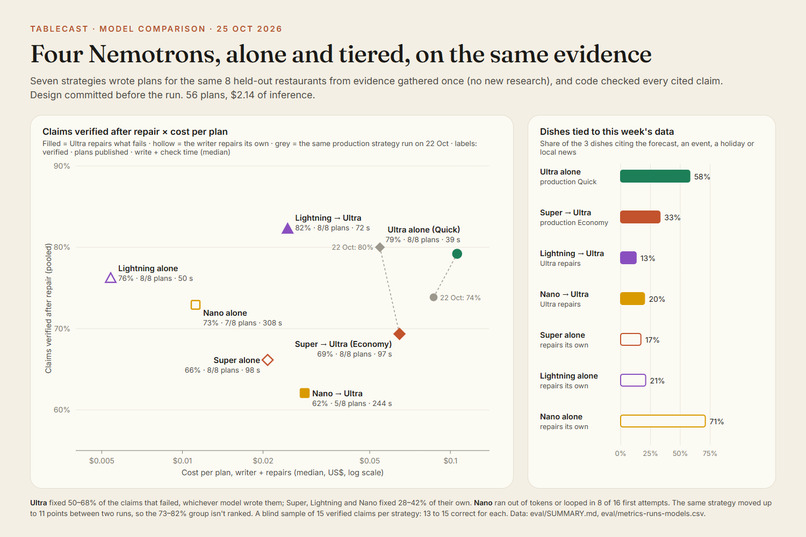
Four Nemotrons on the same 8 held-out restaurants: claims verified against cost per plan, and dishes tied to the week.
The problem
A 40-seat restaurant plans its week on gut feel. You find out about the wet Wednesday, the match two streets away or the Monday holiday when the dining room is already empty, or packed. Chains have insight teams for this. An independent place has the owner, at 11 pm, after service.
The weather alone moves the numbers. On days with medium to heavy rain in 2018, restaurant foot traffic fell 7.4% on average in New York, Chicago and Atlanta (Foursquare and AccuWeather). And more than 7 in 10 US restaurants are single-unit operations (National Restaurant Association, 2025), so nobody there has planning the week as a job.
I've seen this up close. Before this hackathon I built an invoice reader for a family-run restaurant in Spain (it has processed 715 supplier delivery notes), and the weekly planning there is still done by hand. On 22 Oct I ran Tablecast for it, in Spanish: a rain menu of Asturian stews for the wet Friday and Tuesday, and a quick dinner before a concert on Saturday, with 19 of its 21 claims verified against 21 sources. It's a plan, not a result yet.
A chatbot doesn't fix it. When I ask Nemotron for this week's specials at a Los Angeles restaurant without giving it any data, it suggests a Korean BBQ bibimbap, a quinoa falafel wrap, a peach and burrata salad and a chef's table lunch on Wednesday, the day 22.4 mm of rain is forecast there. None of that is about this week, and none of it can be checked.
Judge it in 60 seconds
- Open https://tablecast-app.vercel.app and press Watch this run (Gjelina, Los Angeles). It's a real run I recorded on 21 Oct 2026, replayed in a few seconds and labelled as a replay.
- Look at the green header. Do this week comes first: the three dishes with their days and prices, the event, when to post and the supplier order, and each line takes you to its card and its evidence. Next to it: 24 of 26 claims verified against their sources, 19 sources fetched live, 77 s, $0.082 of inference.
- Your week: 22.4 mm of rain on Wednesday and 11.3 mm on Thursday become a braised white bean and kale stew for the two wet lunches, sold from the takeaway counter next door and priced against Gjelina's real Los Angeles menu. Tavily Map found that menu and set aside the New York and Las Vegas ones. Hover or tap any source chip to read the exact sentence behind a claim.
- Proof & engine: the two claims that failed are marked in place, with the reason (a "20 times" that no cited sentence says, and a critic's fee complaint stretched past its line). Next to the plan sits the same Nemotron with no data: one call, $0.0029, and a generic list with nothing to check. The plan took 14 more calls and $0.0787. The engine room lists every Nemotron call with its tokens, latency and cost.
- Try any restaurant live. Quick (Nemotron Ultra writes) takes one to two minutes. Economy (Nemotron Super) takes about 2 to 3 minutes and costs roughly half to two thirds as much. Each replay card says which one wrote it.
What it does
You type the restaurant, the city and a goal ("win more lunch covers"), and you can add a photo of the menu. Tablecast reads the coming week and gives back a plan:
- Your week: the 7-day forecast at the door, public holidays, events within 5 km, and the 2 to 4 moments that will move covers, each with something to do about it.
- Your block: every restaurant, bar and café within 600 m (OpenStreetMap) and what competitors charge.
- How you come across: what guests and critics like and complain about.
- The moves: three dishes to test, built on the real menu and tied to the days they suit, plus an event and a post with the best time to publish it.
- Launch: a specials board, a post image, a supplier order (email and CSV) and the week as a calendar file.
- Proof & engine: every source, every check and what each model call cost.
Accessibility
Plans come in English or Spanish, whatever language the sources are in. It works on a 390 px phone and prints as a PDF. Everything works from the keyboard with a visible focus ring, the source chips open on focus as well as on hover or tap, and with reduced motion turned on nothing slides or drifts. axe-core finds no violations on the home page, on a full plan or on the About page, on desktop and on a phone.
How it uses NVIDIA Nemotron on Nebius Token Factory
Every model call goes to Nebius Token Factory through the official openai SDK. I picked a Nemotron for each step:
| Step | Model | Why this one |
|---|---|---|
| Web research loop | Nemotron 3.5 Lightning, reasoning_effort "none", parallel tool calls to Tavily | lots of short "what next" decisions, about 0.6 s each; capped at 20 s, with Ultra as backup |
| Menu photo (optional) | Nemotron 3.5 Super VL, forced function call | turns a photo into dishes and prices |
| Write the plan, Quick | Nemotron 3 Ultra, medium effort, one forced streamed function call against a strict schema | best average in my eval, about 30 s to write and one to two minutes end to end; you watch the plan being drafted |
| Write the plan, Economy | Nemotron 3 Super, medium effort (Ultra takes over if time runs out) | roughly half to two thirds of the cost on new restaurants (43%, 63% and 61% in my held-out rounds), close to Quick on verified claims until the latest round (69% against 79%), about 2 min to write and 2 to 3 min end to end |
| Repair failed claims | Nemotron 3 Ultra, low effort, one small call per claim, in parallel | every fix gets checked again by code |
I measured it, found what broke and changed the design
I wrote scripts/eval-routing.ts to gather the evidence for 8 fixed restaurants once. Each writer setting then writes from the same evidence, and code scores the plans. I've run it five times (157 plans, $8.01 of inference), each time after changing something:
- v3 to v4: cite sentence ids instead of copying quotes. Ultra kept copying the right words under the wrong source, so only 35% of its claims passed first time. Now every source is split into numbered sentences and the writer cites ids like S9.4. First pass went up to 73%.
- v4 to v5: a stricter check, after I audited my own demo. The old check let through a dish with "oregano and basil" that cited a menu line mentioning neither, and a $24 headline price that matched no dish. Now the claim's own words have to be in what it cites, and every price in the text is checked. Every writer lost first-pass points: Ultra at low effort went from 73% to 41%, and Quick sits at 45% in v6. The check got stricter; the writer didn't get worse.
- v5 to v6: sources in another language. A plan in English citing a Spanish menu can't share words with it, so correct claims were failing in Madrid and Barcelona. Across languages the code checks numbers and names, and the app tells you when it did that.
- v6 to v7: a review of my own demo run found three more things. The check had called Gjelina's English menu Italian because of dish names like "Cacio e Pepe", so it skipped the word check. Now the word check always runs first, and a page counts as another language only if its running text is. The plan said the Vegetable Sandwich had an "add egg" option for $3, but on the menu that line sits under the BLT. Now an add-on belongs to the dish above it. And the plan scheduled an order for the day before it was made. Now the writer gets the restaurant's own date and the week as a calendar, and code checks every date. Re-checked with no model calls, v7 rejects 39 claims that v6 had passed in my cached plans. Reading them, 15 had a real error and 24 were right but worded beyond their lines.
- v7 to v7.1: I read my whole demo run against its sources and Gjelina's live menu (eval/AUDIT.md). Its 24 verified claims held up: 20 correct, 4 minor slips, none wrong. But the free text said "the nearest pizza is $22 at Abbot's", and no source prices Abbot's. The price check only asked whether $22 was a price the plan could back, and Gjelina's own Pomodoro is $22. Now an amount next to a competitor's name has to come from that competitor. Across 94 cached plans it flags one more amount, a proposed "$1 off at The Brig". The same reading found two things no rule here catches: a verified "$8 glass of wine" from an undated blog, which Gjelina's own list contradicts ($14 to $30), and two pizzas the plan calls "cured meats". Both are in the audit, by name.
- Picking the models. The same writer moved by up to 6 points between two rounds on my tuning restaurants, and later by 11 on held-out ones, so I only act on bigger gaps. Ultra at medium effort has the best average, so it writes Quick. Super costs a third to a half as much on the tuning set and 43 to 63% as much on held-out restaurants, and it verified close to Quick within that noise until the latest round (69% against 79%). It's slower, about 2 minutes to write, so it writes Economy. Lightning stays as the researcher.
Then I tested it where I hadn't tuned it. I committed a list of 8 new restaurants to the repo before running anything (Austin, New Orleans, Toronto, Manchester, Melbourne, Lisbon, Mexico City and Rome), gathered their evidence once and had both writers plan them with v7, next to the same model with no tools and no data:
| Held-out, v7 | Quick (Ultra) | Economy (Super) | Same model, no data |
|---|---|---|---|
| Verified, first pass to after repair | 38% to 73% | 63% to 74% | nothing to check |
| Dishes tied to this week's data | 42% | 33% | 0 of 48 |
| Plan dates before the restaurant's today | 0 of 165 | 0 of 154 | not applicable |
| End to end (median) | 59 s | 157 s | 2 to 3 s |
| Cost per plan (median) | $0.096 | $0.041 | under $0.004 |
That's lower than on the tuning set, where the same plans re-checked with v7 score 82%. The round also found a bug: one Quick run died when Token Factory's stream errored on a 4,305-digit number in the model's JSON. Now a server error ends that attempt instead of the run, and the plan is retried once. The held-out round cost $1.16 of inference and 56 Tavily credits.
Then I did it again, harder. I committed 8 more new restaurants before running them (New York, Chicago, London, Paris, Madrid, Florence, Singapore and Philadelphia), ran both writers with v7.1, and read every claim the 16 plans show as verified, not a sample. 186 of 212 were right (88%), 19 had a minor slip and 7 were wrong. That's below the sampled 94 of 100, and it's the number I trust more. Three of the wrong ones stand on one news page about a festival in Florence, Alabama, which my place check let into a plan for a trattoria in Florence, Italy. After repair, 74% (Quick) and 80% (Economy) of the claims were verified, close to the first held-out round. Every verdict is in the repo, one line each.
Then I compared the models, with their cost. I wrote the design down and committed it before running anything: seven strategies on the same 8 held-out restaurants and the same evidence, so no new web searches. Ultra, Super, Lightning and Nano each wrote and repaired alone, and the three smaller ones also wrote with Ultra repairing. The 56 plans cost $2.14.
| Strategy | Plans published | Claims verified after repair | Dishes tied to this week | Write and check time (median) | Cost per plan (median) |
|---|---|---|---|---|---|
| Ultra alone (Quick) | 8 of 8 | 79% | 58% | 39 s | $0.106 |
| Super writes, Ultra repairs (Economy) | 8 of 8 | 69% | 33% | 97 s | $0.065 |
| Lightning writes, Ultra repairs | 8 of 8 | 82% | 13% | 72 s | $0.025 |
| Nano writes, Ultra repairs | 5 of 8 | 62% | 20% | 244 s | $0.029 |
| Super alone | 8 of 8 | 66% | 17% | 98 s | $0.021 |
| Lightning alone | 8 of 8 | 76% | 21% | 50 s | $0.005 |
| Nano alone | 7 of 8 | 73% | 71% | 308 s | $0.011 |
Ultra is what makes the cheaper models usable here. It fixed 50 to 68% of the claims that failed my check, whichever model wrote them, while Super, Lightning and Nano fixed 28 to 42% of their own. Lightning writing with Ultra repairing verified the most for a quarter of Quick's cost, but it tied only 13% of its dishes to the week, and tying the plan to the week is the point of the product. Nano couldn't write this plan reliably: it ran out of tokens or looped in 8 of 16 first attempts and took 4 to 5 minutes. The biggest lesson was the noise. Economy verified 80% of its claims on 22 Oct and 69% on the same evidence three days later, so I don't rank the strategies between 73% and 82%. Claude Code read a blind sample of 15 verified claims per strategy without knowing which model wrote them, and 13 to 15 of the 15 were correct in every strategy. I kept the routing as it is, as the design said I would.
How a cited claim gets checked (code decides, not a model)
- Everything the agent sees becomes a numbered source (the forecast, events, web pages, the block, the menu photo), split into numbered sentences.
- Each claim cites the sentence ids it stands on, and you can read those sentences.
- Code checks that each cited sentence exists, that every number in the claim is in it, and that the claim's specific words are there too. Any price in the plan's text has to match a dish, a menu price or a checked claim, and no date in the plan may fall before today.
- Claims that fail go back to Nemotron once, in parallel. A fix only counts if it passes the same check. Anything that still fails is shown as unverified. It isn't hidden.
A web page only becomes a source if it's on the restaurant's own site or names its city, street or postcode. I re-checked 543 verified claims from my eval with the place check: it rejected 6, and on reading all 6 rejections were correct (a competitor's private room, the Las Vegas branch, a combo price).
So how good is "verified"? With Claude Code's help I read 100 verified and 50 rejected claims one by one against their cited lines, a seeded random sample, half from the held-out round (eval/AUDIT.md lists every verdict). 94 of the 100 verified claims were right, 4 had a minor slip and 2 were wrong. Both wrong ones kept every word of their sentence and changed its meaning: rave reviews read as a complaint, and a metaphor about jazz read as live music. Of the 50 rejections, 12 were true claims rejected for their wording. This is my own audit, not an independent one.
How it uses Tavily, and what that adds (measured)
The clearest example is in the London replay. In the week I recorded it (Dishoom Covent Garden, 21 Oct), Ticketmaster listed 25 shows nearby. Only Tavily's news search found that the Ballon d'Or ceremony comes to London for the first time on Monday 26 October. The plan built a moment and a dish around that night, and both claims are verified against the press release.
Tavily is how the agent sees the live web. Search finds the menu, reviews, press, local news and a competitor with the same cuisine. Extract reads the pages it picks. Map runs on the restaurant's own site first: it finds this branch's menu page and sets aside other branches' menus before research starts. To see what Tavily really adds, I wrote the same 8 weeks with and without the Tavily sources (eval/TAVILY.md). It doesn't raise the number of verified claims; it changes what they're about. With Tavily, 7 of 8 plans show the restaurant's real menu checked on a fetched page (0 of 8 without), and 6 of 8 plans verify what guests say (0 of 8). Without it, the writer makes up a menu from memory.
Challenges
- Keeping a language model honest about numbers across about 30 sources. What worked was a deterministic verifier, sentence-id citations and one repair pass that gets checked again.
- Reasoning loops, silent streams and server errors on the biggest models. I added loop and stall guards, a retry on a failed attempt, a lower-effort fallback and a time budget for the whole run.
- Restaurants with the same name, and public map servers that were overloaded. I added the place check, backup Overpass mirrors and a Nominatim fallback that says when its list is partial.
What I'm proud of
- The routing choice is part of the product (Quick or Economy), with five measured rounds, two held-out rounds and a comparison of four Nemotrons behind it.
- From a restaurant's name to dishes, an event, a post, a supplier order and a calendar in one to two minutes, for 6 to 12 cents of inference in my recorded runs.
- I built a check strict enough to fail my own demo run three times, and I changed the design each time.
What I learned
Open models work well for this kind of agent if you measure them. Lightning is a great tool dispatcher. Ultra and Super write long structured outputs reliably once you budget their reasoning. And the decision about what counts as verified should be made by code, not by another model.
About the problem itself, three things I didn't expect. A restaurant's website is often more than one restaurant: Gjelina's lists menus for Los Angeles, New York and Las Vegas, and a plan priced from the wrong branch looks fine and is wrong, so Map now picks this branch's menu before research starts. The nights that move covers aren't always on a ticketing API: Ticketmaster listed 25 shows around Dishoom that week and missed the Ballon d'Or. And names collide more than I thought: the place check turned away the Las Vegas branch and a competitor's private room as evidence about the restaurant.
A real restaurant tried it
My family's restaurant in Spain tried a Tablecast plan for two days in the last week of October and put its suggestions on the menu. It's too early for numbers, but my mother told me on the phone that guests liked it a lot and told them to keep it going.
What's next
What it costs: a weekly Economy plan is $0.04 to $0.07 of Nemotron (the medians of my three held-out rounds) plus 6 to 9 Tavily credits, roughly 9 to 14 cents a week or 40 to 60 cents a month per restaurant at Tavily's pay-as-you-go price. Next, a scheduled Monday run on Economy, when nobody is waiting for it. Then I'd measure it: four weeks at the family restaurant, specials on the days the plan picks against the same weekdays before, counting covers and waste. After that, POS sales data to learn which dishes actually sold, and distribution through POS systems, reservation platforms and food distributors (the shopping list is already an order).
Known limits
This is a check that each cited claim matches the sentences it cites, tested on 24 restaurants with one week of evidence each, not proof that a plan is right or that it sells. My family's restaurant has tried it for two days, but no restaurant has run a full Tablecast week with numbers yet, and I won't claim it sells until one has. When I read all 212 verified claims of a held-out round, 26 were wrong or slightly off. The failures I know of: a claim that keeps the words of a line and changes its meaning, a page from a city with the same name in another country, a price from an undated page that the restaurant's own list contradicts (a verified "$8 glass of wine"), and a page extract that joins two items so one gets the other's details. With the two production writers, 69 to 80% of claims end up verified on restaurants I never tuned on, and the same setting moved 11 points between two runs. Forecasts more than about 3 days out are uncertain.
Where this comes from
I first built this idea as Tastecraft, on a proprietary taste API. Tablecast is a separate project, rebuilt from scratch for open infrastructure: NVIDIA Nemotron on the Nebius Token Factory, plus Tavily for the live web. It shares no code or data with that earlier project, and the repo's commit history starts here.
Built With
- leaflet.js
- nager-date
- nebius
- nebius-token-factory
- nemotron
- nemotron-lightning
- nemotron-super
- nemotron-super-vl
- nemotron-ultra
- next.js
- nvidia
- open-meteo
- openai-sdk
- openstreetmap
- react
- tailwindcss
- tavily
- ticketmaster
- typescript
- vercel
- vitest
- zod
