-

The same brief in Vietnamese, for the owners it is built for
-
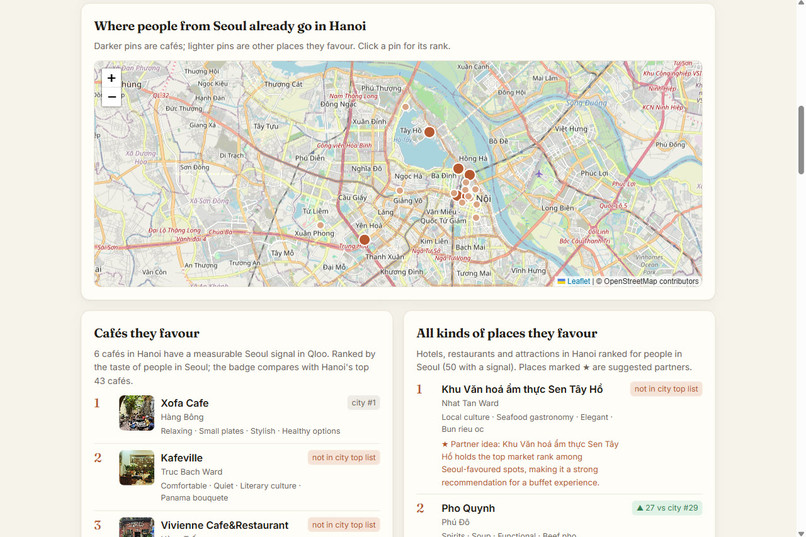
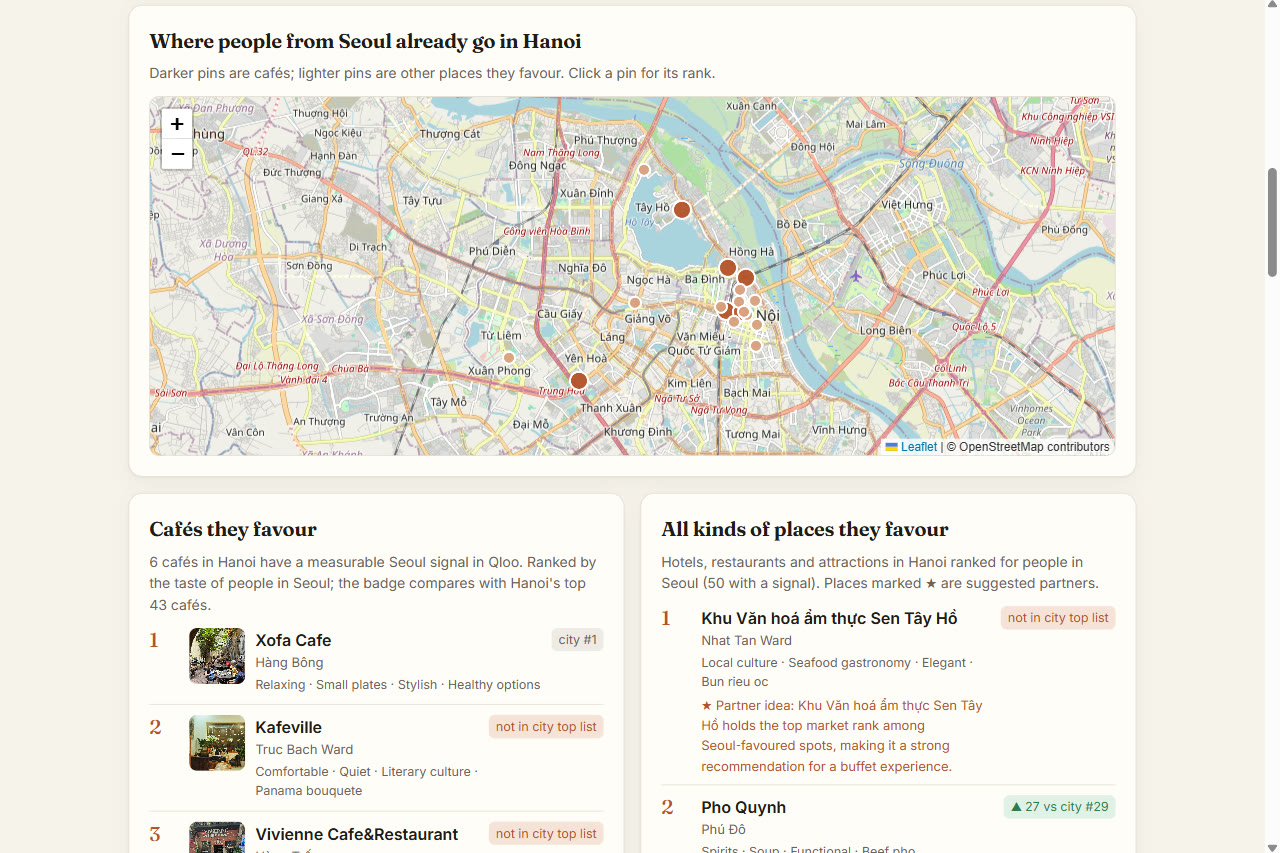
Where people from Seoul already go in Hanoi, from Qloo: cafés with photos, and every kind of place they favour on a map
-
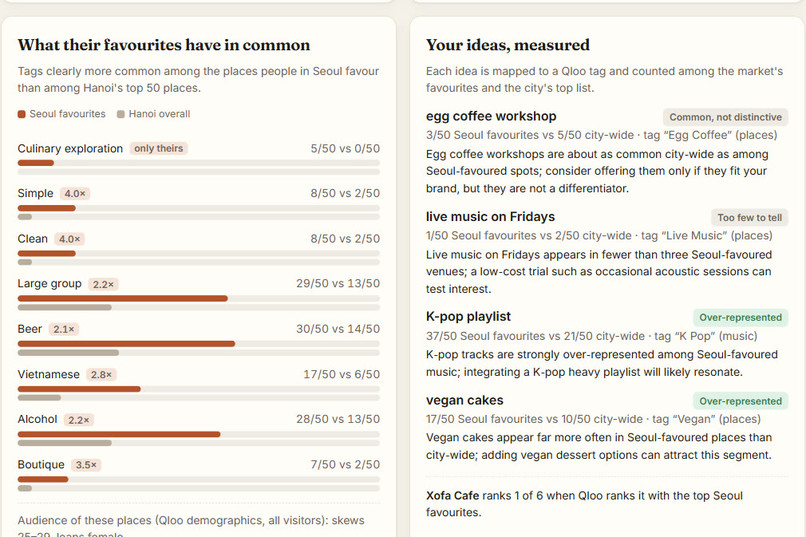
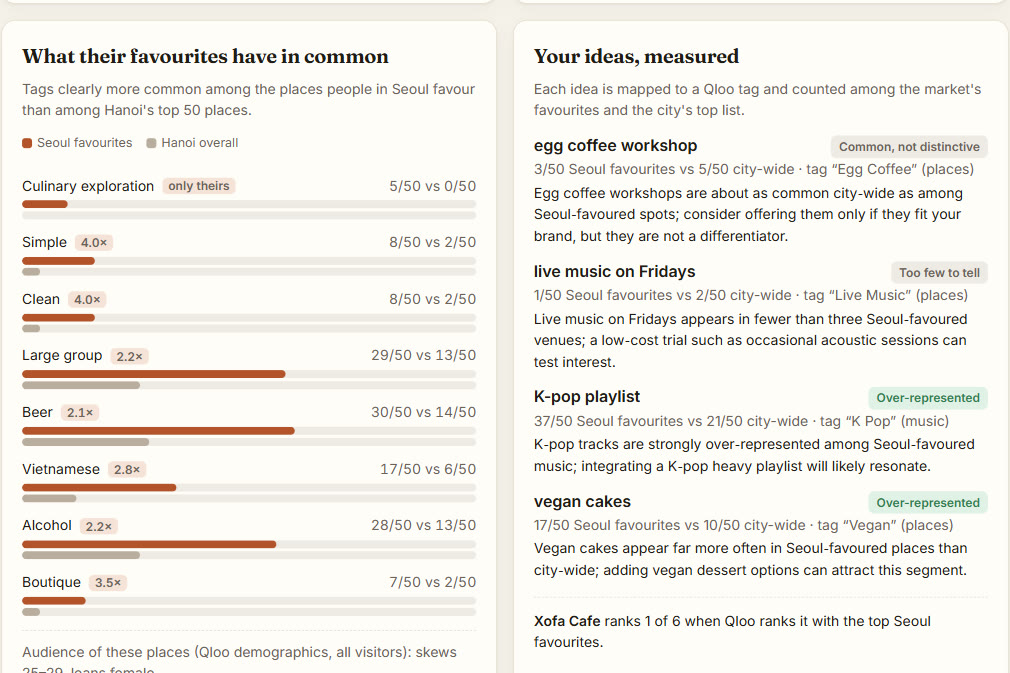
Tags clearly more common among their favourites than city-wide, and the owner's ideas scored against the same lists

Inspiration
Small cafés, homestays and tour operators in Vietnam live on foreign visitors, but they market to "tourists" in general. An owner who wants more guests from Seoul can guess, or ask a chatbot that answers from general knowledge. Both name the same famous places and the same global stars. Qloo can answer a sharper question: which places in my city do people from Seoul favour more than the city does overall, and what do those places have in common?
What it does
Pick a business type, a Vietnamese city and the visitors you want. Taste Brief returns a one-page plan, in English or Vietnamese:
- Where they already go: places of your kind ranked by Qloo for the taste of people in the visitor city, next to the city's own ranking, plus every kind of place they favour on a map (hotels, restaurants, attractions), with partner ideas.
- What their favourites have in common: tags clearly more common among those places than among the city's top 50. In Hanoi, "Simple" is on 8 of the 50 places people in Seoul favour, against 2 of the city's top 50.
- Your ideas, measured: an agent maps each idea to a Qloo tag and scores it against the same lists. "K-pop playlist" is over-represented (the K-Pop tag is on 37 of the 50 artists people in Seoul favour, 21 of Hanoi's); "egg coffee workshop" is common rather than distinctive.
- Your own place: found in Qloo and ranked against the market's favourites.
- Music both sides know: artists loved in the visitor city that the host city also loves.
- Same question, no Qloo: the same model answers without data, and each place it names is looked up in Qloo. In the Hanoi example it names Café Giảng, The Note Coffee and Cong Caphe; Qloo knows all three, but none has a measurable Seoul signal.
Every action links to the Qloo results behind it. Before a brief runs, the form shows how strong Qloo's signal is for that city and market. The same tools are served as an MCP server at /mcp.
How I built it
- Node.js/Express server; the Qloo key stays server-side. Requests go to
/v2/insights(places with and withoutsignal.location.query, artists and TV by location, demographics),/v2/tagsand/search. - An evidence ledger stores each Qloo result with a short reference and the exact request that produced it. Peers are confirmed by Qloo's primary genre, so a pho shop does not count as a café.
- NVIDIA Nemotron 3 Super on Nebius Token Factory runs a tool loop (find tags, score ideas) and then writes the brief from a fact sheet. The server drops actions without a valid citation, actions that push an idea the data does not support, and actions naming places that are not in the data. Names and numbers on the page come from the ledger.
- Vietnamese readers get a translation of the checked English brief by Qwen3-235B on Nebius; it is rejected and retried if it is not Vietnamese, changes the number of items or leaves English words.
- The page streams the agent's steps live. Seven saved examples, in English and Vietnamese, open instantly; a map (OpenStreetMap) and Qloo place photos make the result easy to read.
- Rate limits are respected: the client paces to 4 requests a second, retries 429s, caches for 12 hours, and pauses live briefs before the monthly quota runs low.
Challenges I ran into
- Tag-level affinity with a location signal returns nothing for most tag families, so ideas are scored by counting tagged places (or artists) among the market's favourites versus the city's top list.
- Qloo's tag filters are loose (a resort carries "Bar", a pho shop carries "Coffee"), so peers are checked against each place's primary genre.
- Coverage varies by city: Hanoi and Ho Chi Minh City have signals for most markets, smaller cities have few. I measured all 112 city–market pairs once so the form can warn before a thin brief.
- The model sometimes overstated weak signals; verdicts are computed in code and the model only explains them.
Accomplishments that I'm proud of
- A plan where every claim can be clicked back to the Qloo request that supports it.
- A side-by-side that shows, on real data, where a general model's answer differs from what a market actually favours.
What I learned
Qloo's location signal turns "tourists" into specific audiences, and the useful insight is the difference between what a market favours and what the city favours overall.
What's next
More Vietnamese cities and markets as coverage grows, a monthly re-run so owners can see how a market's favourites change, and a one-tap summary owners can share with partner hotels and tour operators.
Built With
- express.js
- leaflet.js
- model-context-protocol
- nebius
- node.js
- nvidia-nemotron
- openstreetmap
- qloo
- qwen
- vercel

Log in or sign up for Devpost to join the conversation.