RIFT🔥
What if we could test an evacuation plan before people's lives depended on it?
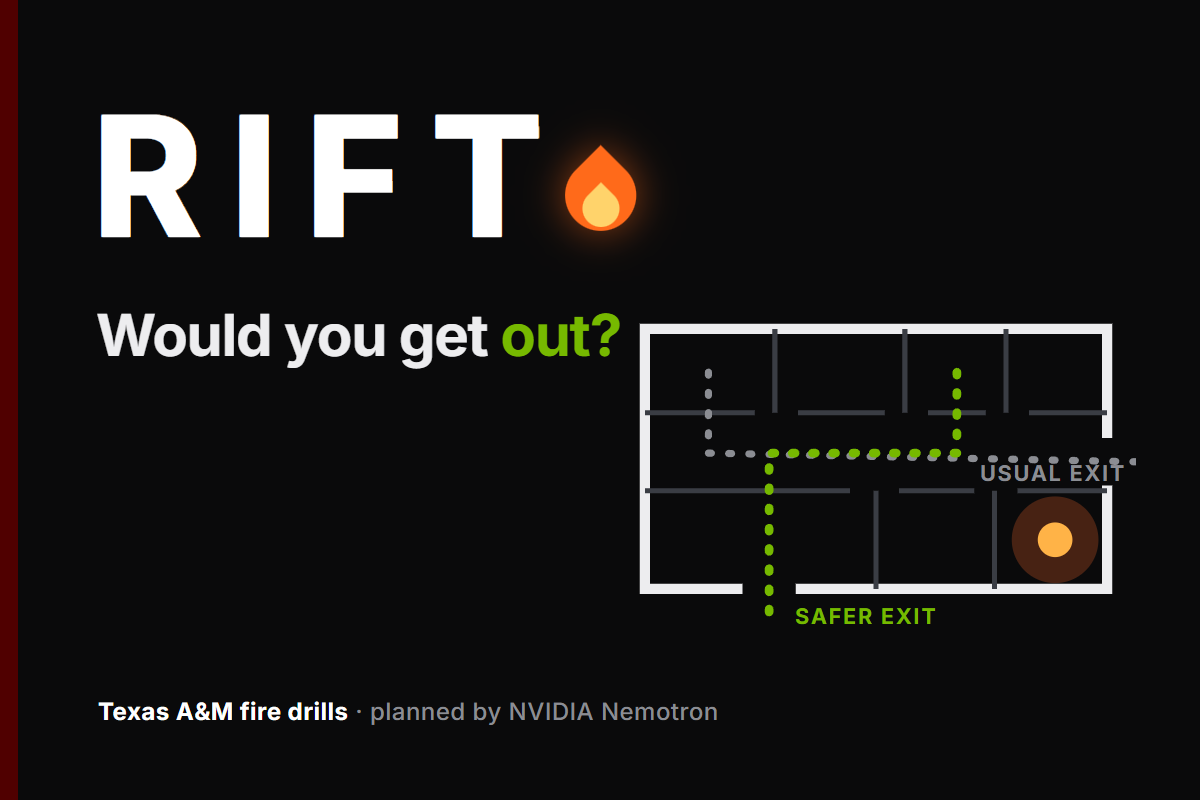
RIFT is an AI-powered emergency evacuation platform that combines 3D digital twins, simulated human behavior, fire modeling, and NVIDIA Nemotron to test evacuation strategies and find safer alternatives before an emergency happens.
Inspiration — Four Fire Drills, One Realization
Last week, we had four fire drills at Mosher Hall, our dorm at Texas A&M.
If you've ever lived in a dorm, you know how it goes. The alarm goes off, everyone groans, you grab your shoes, follow everyone downstairs, stand outside for a while, and eventually go back to whatever you were doing.
By the fourth drill, we were pretty tired of it. But while we were standing outside, we started asking ourselves a question:
What if one of those alarms had actually been real?
We started thinking about what we'd just done. Everyone was following the same familiar routes, crowding into stairwells, and assuming the exits would be accessible. What if a staircase was filled with smoke? What if the fire started near our usual exit? What if someone couldn't move as quickly as everyone else?
We'd practiced evacuating four times, but none of us felt confident we knew what would happen in a real emergency.
That's when we realized something: one of the most overlooked problems in building safety isn't necessarily the infrastructure. It's the evacuation plan itself.
Buildings have fire alarms, sprinklers, and emergency exits. But the people inside them aren't predictable, and neither are emergencies.
We couldn't exactly start a real fire in Mosher to find out which evacuation strategies worked. But we figured we could simulate one.
That's why we built RIFT.
What We Built
RIFT turns buildings into interactive evacuation laboratories, letting users experience emergencies, identify weaknesses in evacuation procedures, and test AI-generated improvements.
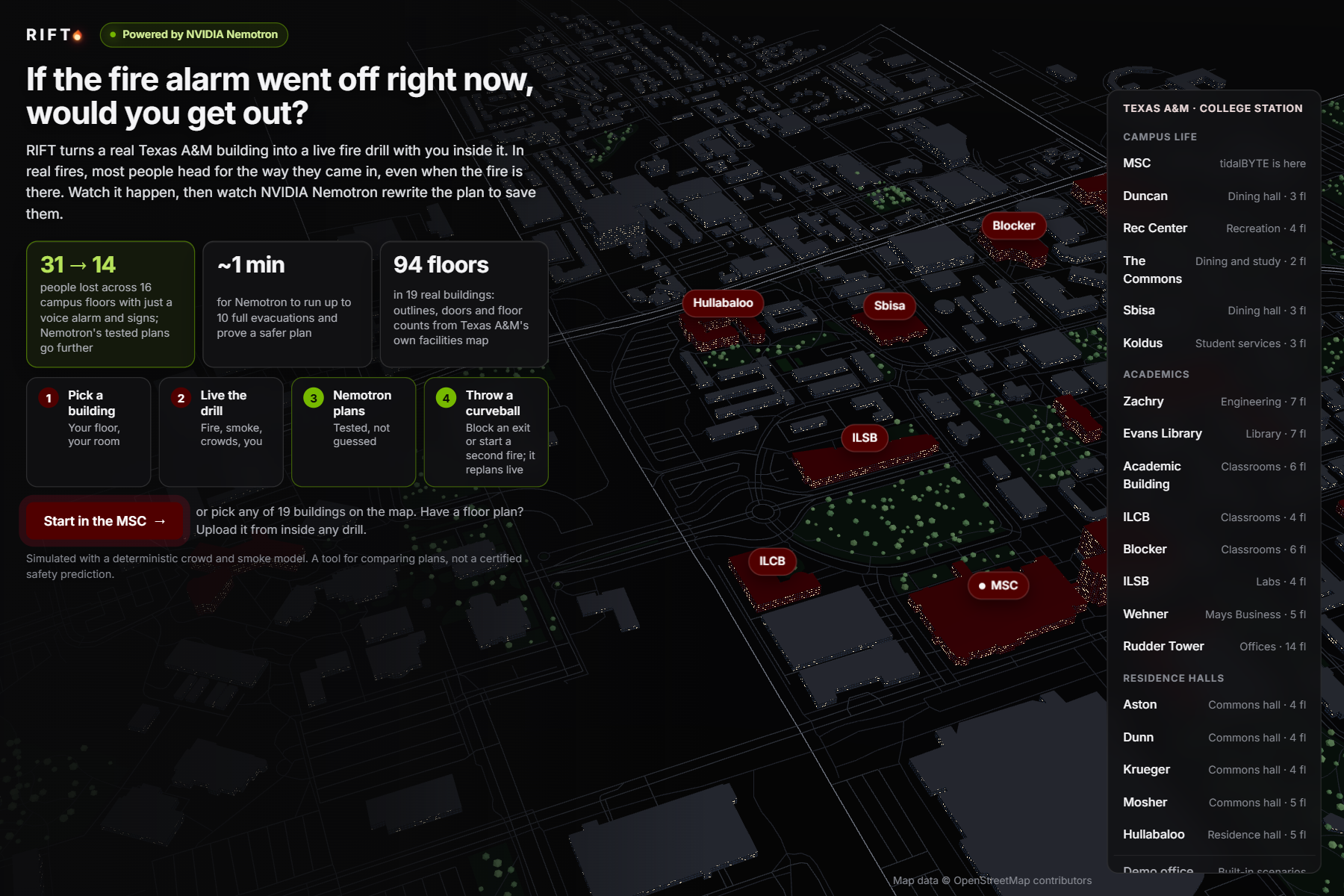
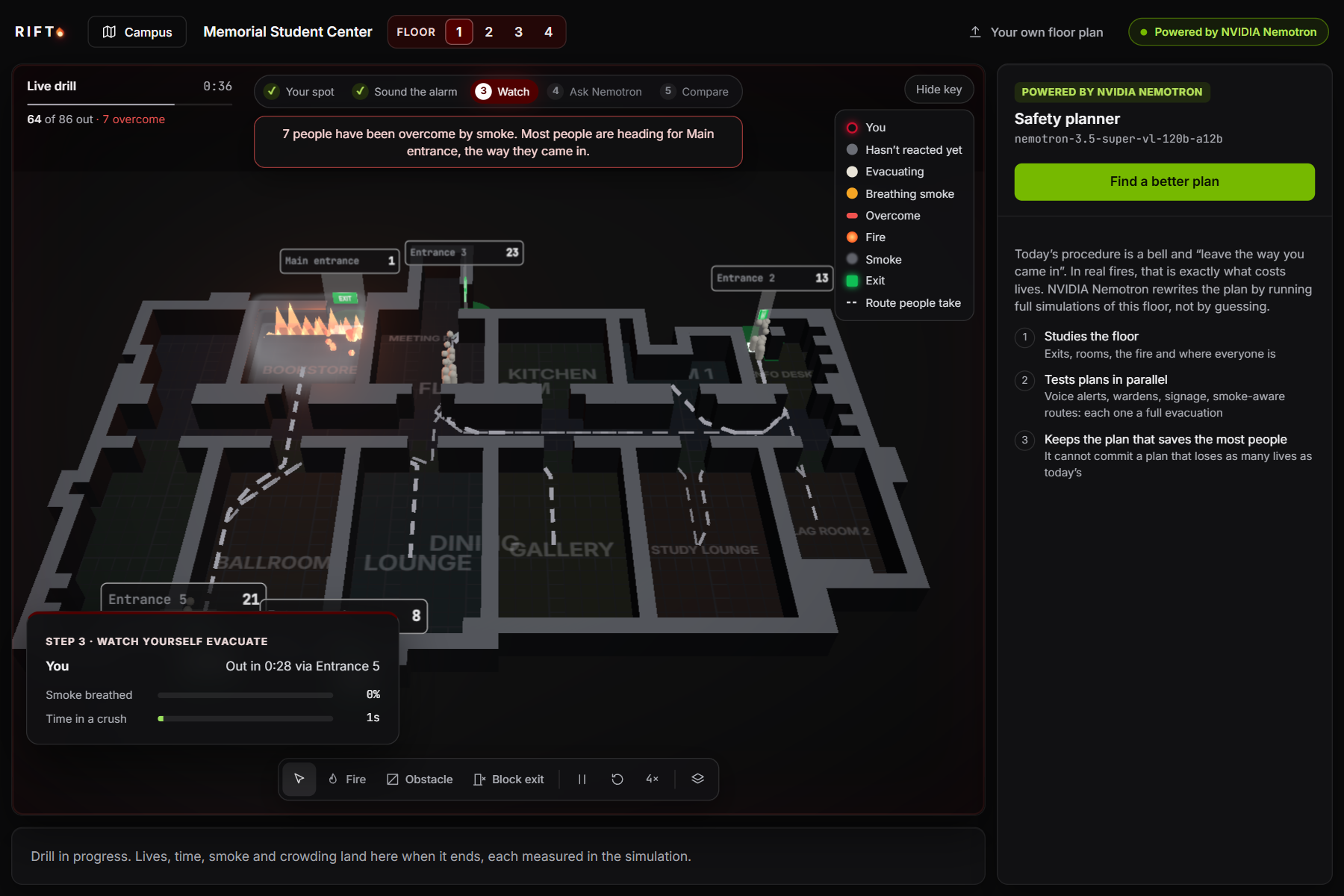
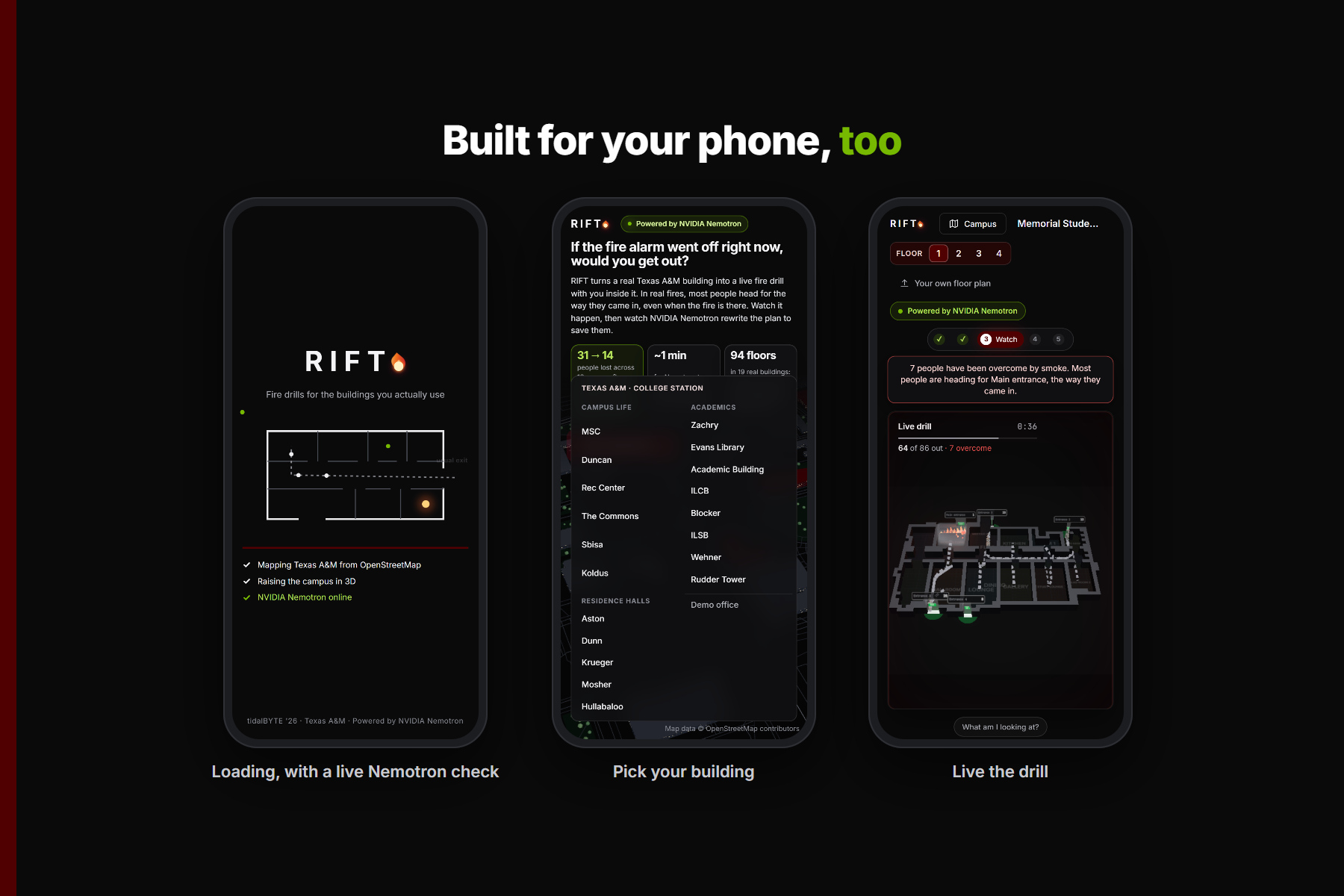
We reconstructed Texas A&M's campus in 3D, allowing users to select buildings, enter a simulated floor, choose where they're standing, and trigger a fire alarm.
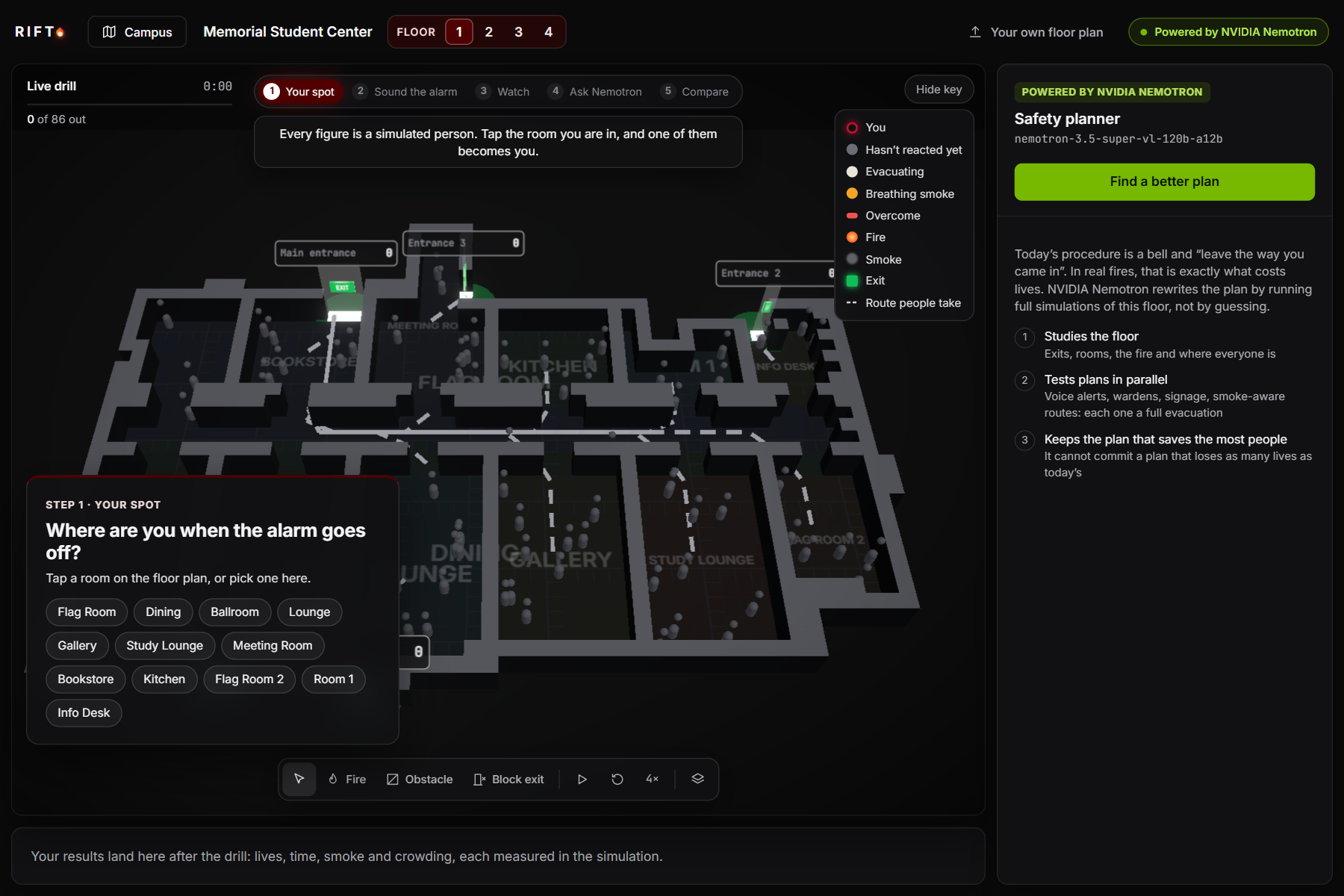
From there, they can watch hundreds of simulated occupants navigate spreading fire, smoke, crowded hallways, and blocked exits. They can even follow their own simulated evacuation and see whether they make it out.
Rather than filling the building with identical agents, we use NVIDIA's Nemotron-Personas-USA dataset to generate a synthetic occupant population. Our agent-based simulation then models how occupants move, respond to alarms, and interact with congestion and hazards.
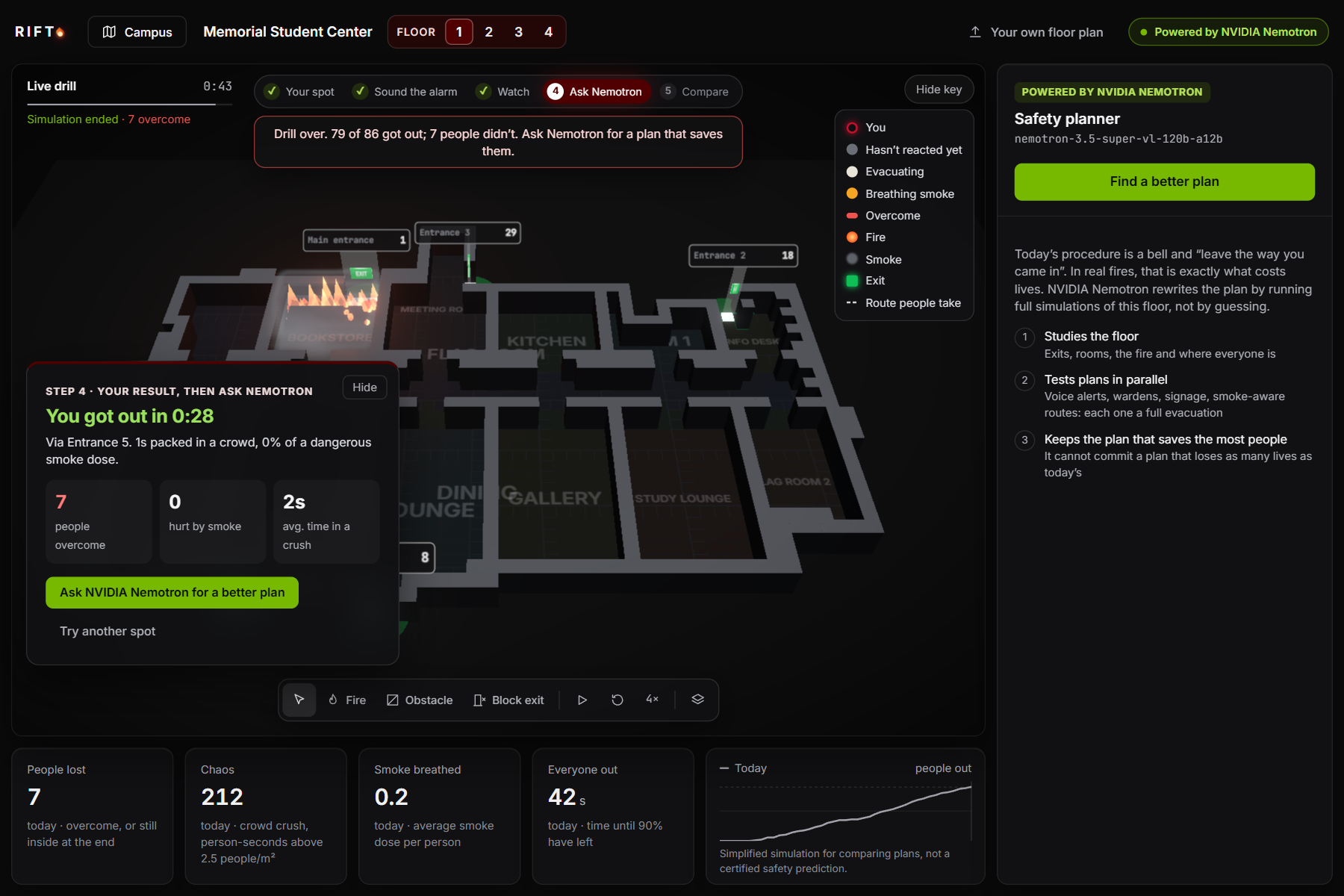
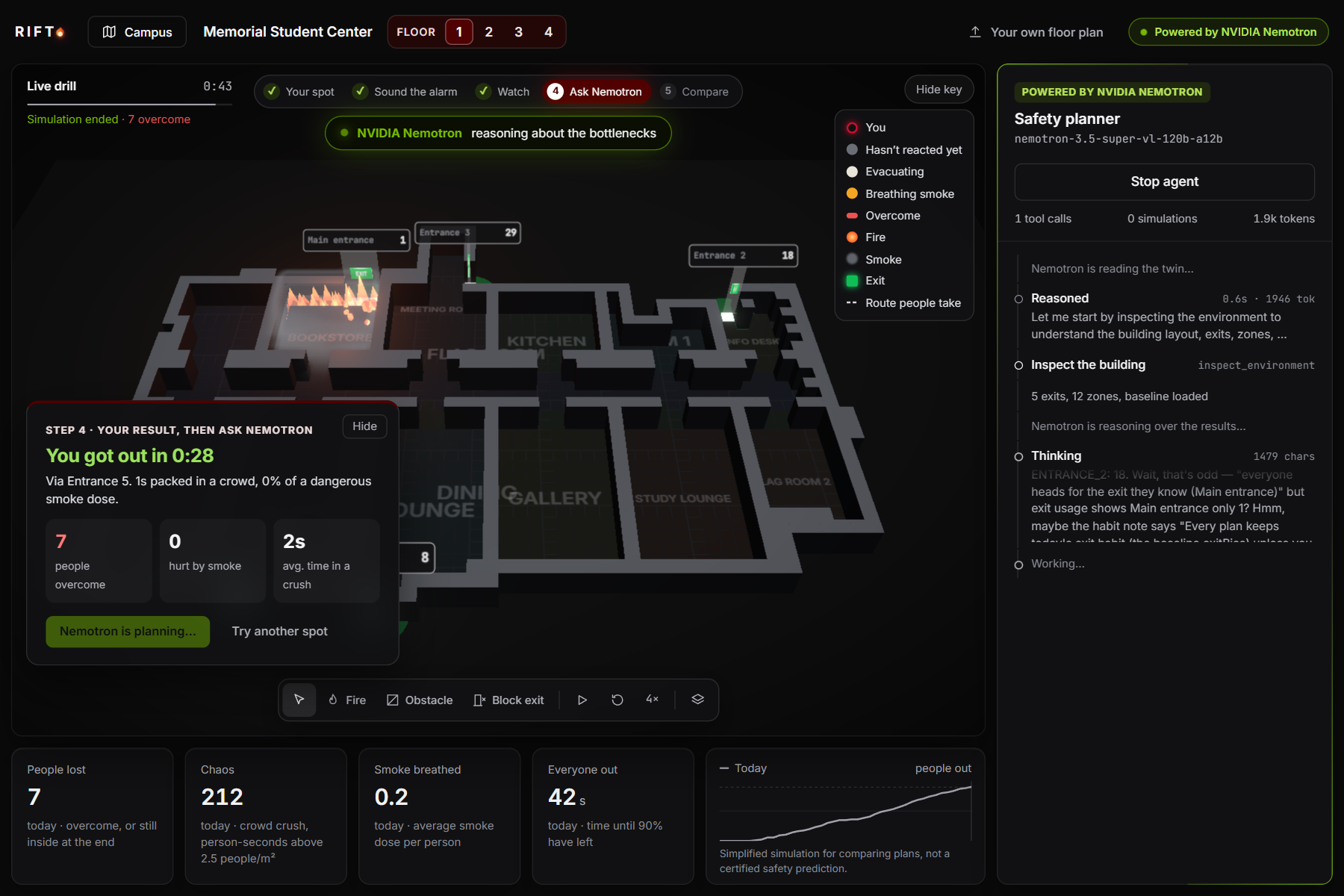
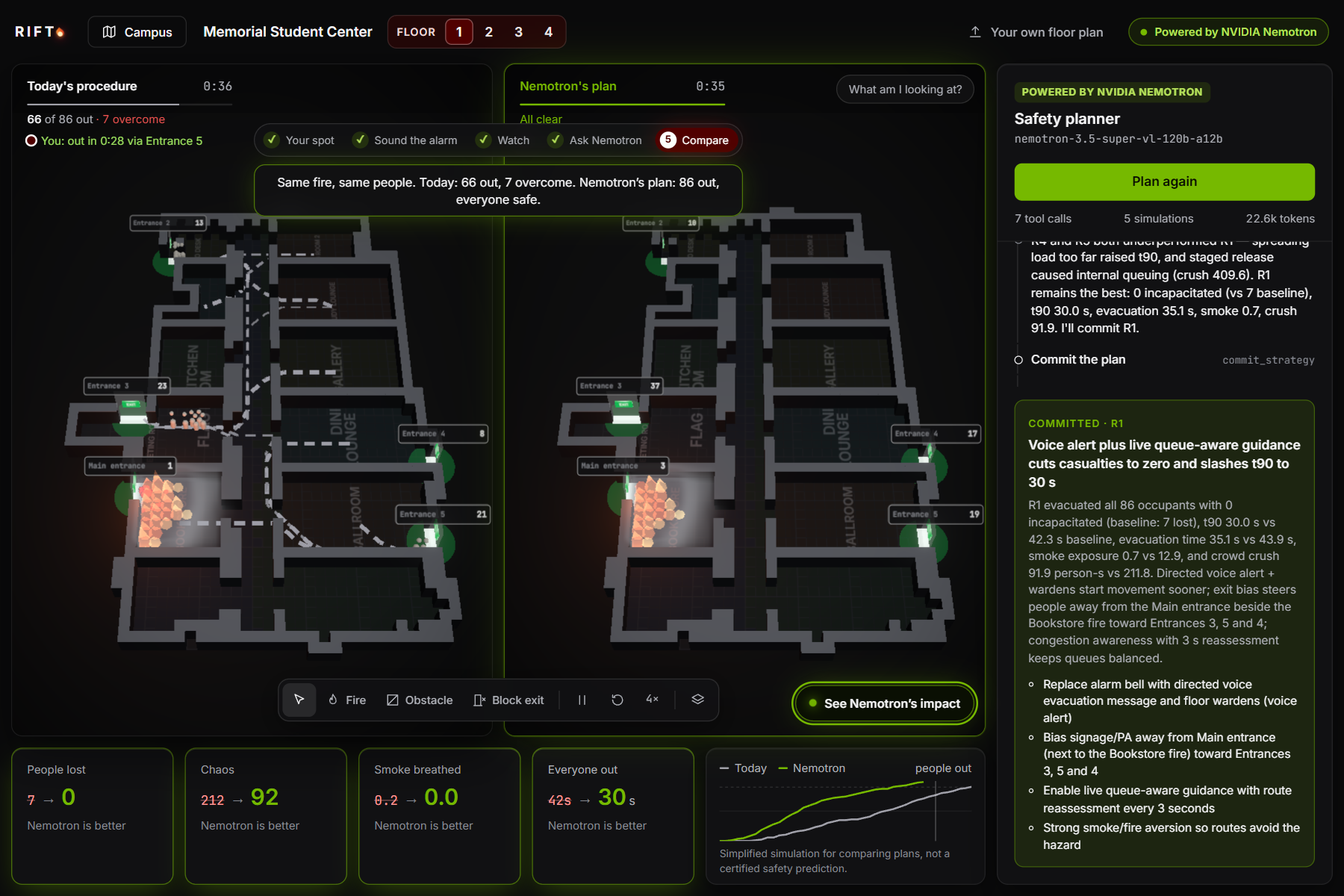
Users can introduce obstacles, block exits, or start additional fires. They can then ask NVIDIA Nemotron to find a better evacuation strategy and compare the results side by side.
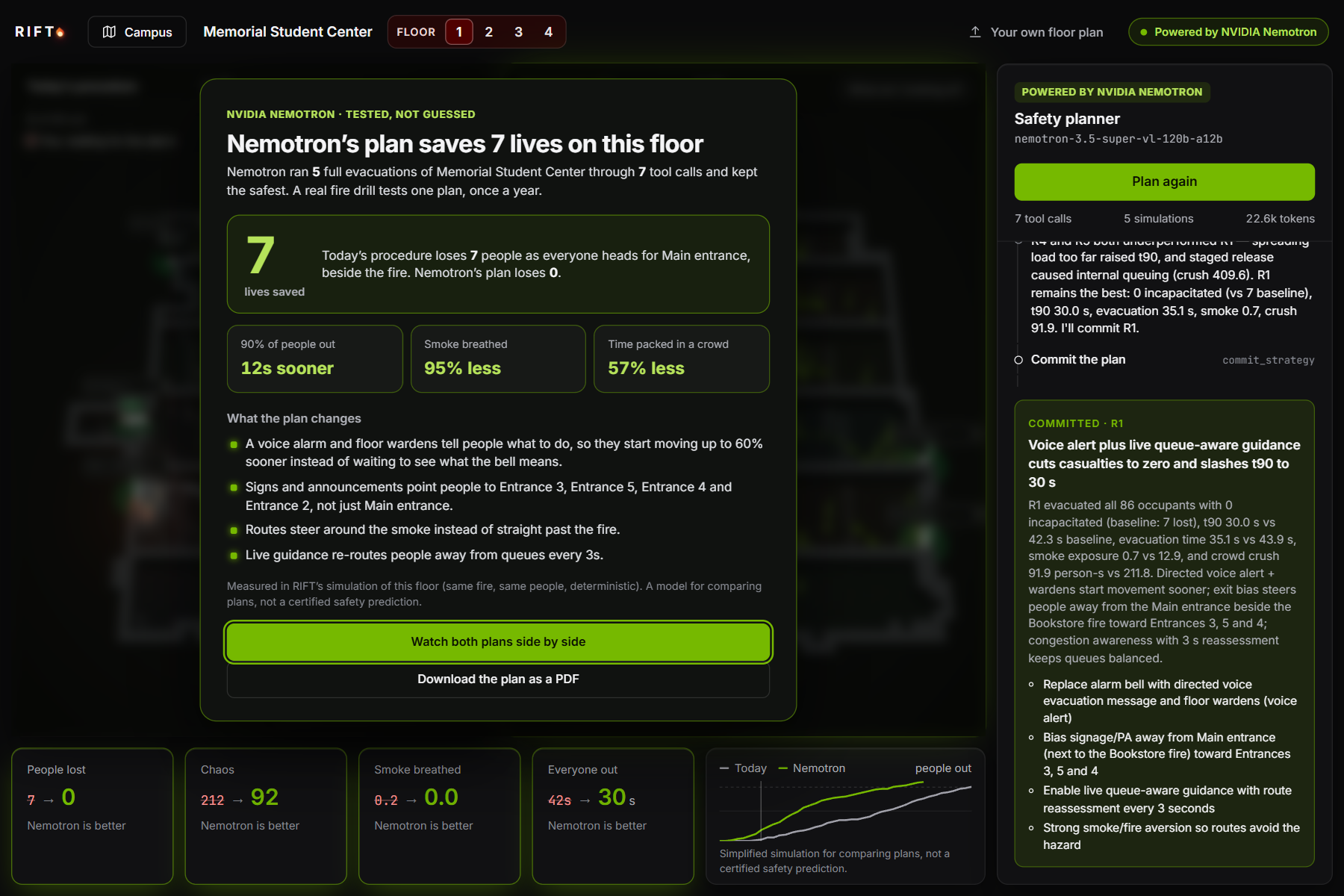
RIFT tracks evacuation time, smoke exposure, congestion, and simulated casualties, and can generate a downloadable evacuation-plan PDF.
We didn't just want to show what happens when an evacuation goes wrong. We wanted to build something that could help figure out how to prevent it.
NVIDIA Nemotron — AI That Actually Tests Its Ideas
We built RIFT around NVIDIA Nemotron 3.5 Super VL 120B-A12B, using it as an autonomous planning agent rather than a conventional chatbot.
Instead of simply asking an AI which exit people should use, we gave Nemotron the ability to examine an environment, run experiments, analyze the outcomes, and select an improved strategy.
We implemented four tools:
inspect_environment— Examines exits, occupancy, hazards, and baseline evacuation performance.run_simulation— Executes full evacuation simulations with different strategies.analyze_bottlenecks— Identifies congestion, dangerous exit loads, and smoke exposure.commit_strategy— Selects a previously tested strategy based on measured results.
Nemotron can experiment with alternative exits, directional signage, voice alerts, floor wardens, staggered departures, and congestion-aware routing.
Its vision capabilities also help interpret uploaded floor plans, converting building information into structured inputs for the digital twin.
What makes this exciting to us is that Nemotron isn't just generating advice. It's running experiments to determine whether that advice actually helps.
Every result comes from our simulation engine, not numbers invented by the model. Proposed strategies are checked against the baseline, and the system prevents Nemotron from committing a worse modeled life-safety outcome.
When an exit becomes blocked or a new hazard appears, Nemotron can reassess and test another strategy.
To us, this is a much more meaningful application of agentic AI: an AI that reasons, acts, measures, and adapts.
How We Built It
Building RIFT meant bringing together several different technical systems.
3D Digital Twin: We used OpenStreetMap data, React, Three.js, and React Three Fiber to recreate Texas A&M's campus, including approximately 800 building footprints and 19 featured interactive buildings.
Human Simulation: NVIDIA's Nemotron-Personas-USA dataset provides synthetic population data, while our custom agent-based simulation models occupant movement, reaction delays, and crowd interactions.
Fire and Crowd Physics: We built a 64 × 40 simulation grid modeling fire propagation, smoke diffusion, exit capacities, and congestion. Navigation uses Dijkstra-based flow fields and A* pathfinding, with density-dependent pedestrian movement.
Agentic Optimization: Nemotron uses structured tool calls to test strategies through deterministic simulations. Web Workers execute candidate simulations in parallel, keeping the 3D experience responsive.
Interactive Experience: Users can move from a campus-wide view into a building, experience an evacuation from their own position, and compare the original and improved strategies visually.
One of our biggest challenges was generating usable interiors without verified architectural plans. We developed schematic floor layouts from actual building footprints and mapped entrances, alongside support for importing floor-plan images.
The result is a working prototype connecting geographic data, human simulation, AI reasoning, and interactive visualization.
The Impact — Why This Matters
The most meaningful part of building RIFT was seeing how much difference an evacuation strategy could make.
In one modeled test across eight campus buildings, the conventional evacuation approach resulted in 31 simulated losses. Introducing voice alerts and alternative-exit signage reduced that number to 14.
In another test on the first floor of the Memorial Student Center, Nemotron selected a strategy that reduced simulated losses from 3 to 0.
These results are specific to our simulation assumptions, not predictions of real casualties. But they demonstrate why testing different evacuation strategies matters.
The building didn't change. The fire didn't change. The people didn't change. The evacuation strategy did.
We started by thinking about our dorm, but this problem extends far beyond Mosher Hall.
Imagine a hospital trying to evacuate patients with limited mobility, a stadium managing thousands of people, or a school determining whether its emergency procedures can handle a blocked exit.
These are scenarios where mistakes can have enormous consequences, yet realistically testing every dangerous possibility is difficult or impossible.
We believe AI-powered simulations could eventually help safety professionals identify dangerous bottlenecks, evaluate alternatives, and improve procedures without exposing people to actual danger.
Even identifying one previously overlooked evacuation risk could make a meaningful difference.
RIFT isn't a certified fire-safety tool, but it's a step toward making advanced emergency-planning analysis more accessible, understandable, and actionable.
Why RIFT Fits the TIDAL Challenge
TIDAL's prompt asks us to apply AI and machine learning to real-world problems in ways that create meaningful, cross-disciplinary impact.
That is exactly what motivated RIFT. We wanted to take something that affected us personally and use AI to explore a solution that could eventually help far more people.
We believe RIFT addresses each judging criterion:
Technicality: RIFT combines agentic NVIDIA Nemotron reasoning, vision-based floor-plan interpretation, synthetic population data, custom fire and crowd simulation, pathfinding algorithms, deterministic testing, and parallel computation. The AI doesn't just produce text; it operates a functioning simulation system.
Ingenuity: Instead of generating static evacuation instructions, we built a system where AI can repeatedly test its own ideas. Connecting an autonomous reasoning agent to a measurable digital environment lets us approach emergency planning as an optimization problem rather than a one-time recommendation.
Diversity: The project brings together AI, software engineering, architecture, fire safety, population modeling, crowd dynamics, and behavioral science. Using NVIDIA Persona USA also allows us to work with a varied synthetic population rather than treating every occupant as identical.
Applicability: The problem is immediate and recognizable. We experienced it in our own residence hall. With further validation and accurate building data, the underlying approach could support emergency-planning research in universities, hospitals, offices, stadiums, and public buildings.
Looks: We wanted a system that people could understand without needing to know anything about simulation engineering. RIFT combines a detailed 3D campus, interactive building exploration, animated evacuation scenarios, a personal escape experience, and side-by-side visual comparisons to make complex results intuitive.
Our goal was to make sophisticated AI useful for a problem that actually affects people's lives, while making the technology accessible enough for anyone to explore.
Challenges and What We Learned
Our biggest challenges were making the simulations meaningful, building navigable environments from incomplete building data, and getting Nemotron to reliably interact with our tools.
We quickly learned that building something visually convincing is much easier than building something whose results can be meaningfully compared. Assumptions about reaction times, movement, smoke, and congestion all matter.
We also learned that AI becomes significantly more powerful when it can test its own recommendations rather than simply generate them.
But the biggest lesson was personal.
Before those four fire drills, we hadn't spent much time thinking about whether our evacuation plan would actually work. Now, after building RIFT, we realize how many decisions and assumptions go into something as seemingly simple as leaving a building safely.
What's Next
We want to incorporate verified architectural floor plans, connected multi-floor simulations, accessibility-aware evacuation modeling, and validation against established fire-safety tools.
Longer term, we'd love to make this type of analysis accessible to schools, universities, hospitals, and facilities teams that could benefit from testing and improving their evacuation procedures.
RIFT is still a research prototype, but the problem it addresses is very real.
We built RIFT because four fire drills made us question whether we'd actually be safe in our own dorm. We kept building because we realized millions of other people rely on evacuation plans they may never have seen tested under realistic emergency conditions.
Nobody should have to experience a real emergency to discover that their evacuation plan doesn't work.
Built With: NVIDIA Nemotron 3.5 Super VL, NVIDIA Nemotron-Personas-USA, NVIDIA API, React, TypeScript, Three.js, React Three Fiber, OpenStreetMap, Web Workers, Vite, Zustand, Node.js, Netlify, jsPDF.
Built With
- nemotron-3.5-super-vl
- netlify
- netlify-edge-functions
- node.js
- nvidia-api-catalog
- nvidia-nemotron
- openstreetmap
- overpass-api
- react
- react-three-fiber
- three.js
- typescript
- vite
- vitest
- web-workers
- zustand


