-
-
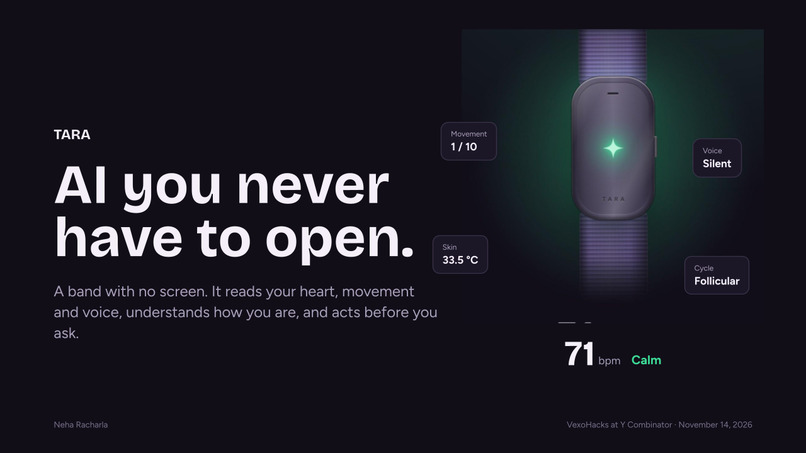
Other bands tell you what’s wrong. TARA does something about it, before you ask.
Inspiration
What it does
How we built it
Challenges we ran into
Accomplishments that we're proud of
What we learned
What's next for TARA: AI you never have to open
Inspiration
Every AI today waits for you to open it. But the moments that matter most are exactly when you can't.
- 50% of US women always or often feel unsafe walking alone at night, and 1 in 4 never walk alone at night (YouGov).
- 1 in 4 adults over 65 falls every year (CDC), and 26% of adults 65+ in the US live alone (Pew Research).
- 46% of Gen Z say they feel stressed (Gallup, 2023), and students far from home skip meals with nobody noticing.
I moved across the world alone for my master's. Most days, nobody knows if I ate, if I'm stressed, or if I got home safe. Today's wearables see all of it: they count calories, detect hard falls, show a stress score. But they only report. Nobody acts in the moment. So I built TARA: AI you never have to open.
What it does
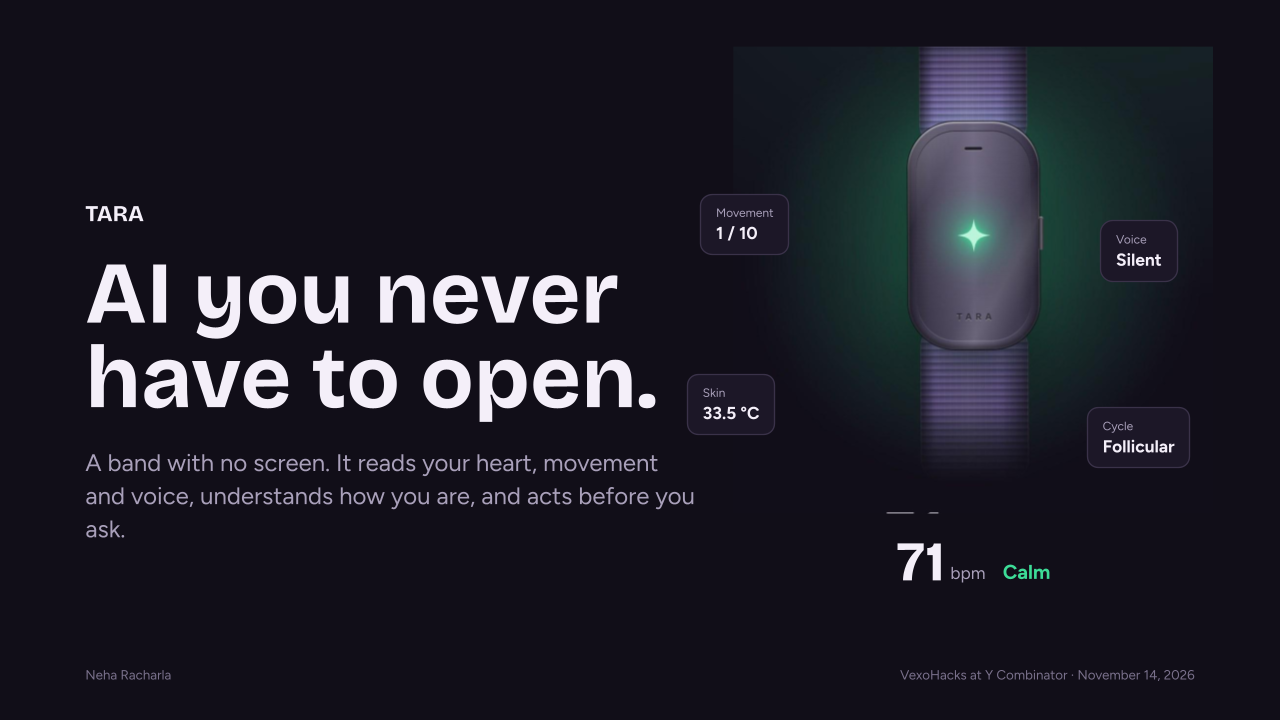
TARA is a screenless band plus an AI agent. It senses your body, decides what's happening, and acts before you ask.
Fuel — food before you crash. TARA already knows your daily calorie needs from your body profile (height, weight, age, activity, goal, e.g. 2,000 kcal). It tracks eaten vs burned all day. When you've burned ~400+ kcal and gone 3+ hours without food, it steps in: "You burned about 450 calories. Hungry? 1, Chipotle. 2, Sweetgreen…" You say a number, say yes, and it's ordered and paid (Stripe test mode). Food tips follow your cycle: iron during your period, magnesium before it.
Guard — help when you can't ask for it. Imagine Ramesh uncle, 68, living alone, slipping in the kitchen with his phone in another room. Or Priya, 21, being followed home and unable to make a call. The Vexo band feels a hard jolt followed by stillness, TARA asks "Are you okay?", and if there's no answer in 10 seconds, the trusted contact gets a Telegram alert with a live map that follows the wearer. Silent options: three taps on the band (silent SOS) or a secret code word hidden in a normal sentence, where the screen shows "Cancelled" but the alert still goes out. It also warns your contact if your phone battery drops during an alert.
Whisper — calm, and nobody knows. In a pitch or a hard call, TARA listens to your speaking pace (words are counted, never saved). Speaking faster than 170 words a minute with a racing heart? One quiet nudge only you notice.
A voice you love. When panic hits, TARA breathes with you in the voice of someone you love, like your mom, recreated with her permission using ElevenLabs, private to you and deletable anytime. Research on mothers' voices (Seltzer et al., 2010) suggests a familiar voice can calm stress in a way a stranger's can't. No wearable we know of does this today.
Built for women, through Saheli. I also built Saheli, a women's health app. It shares your cycle, pregnancy or menopause phase with TARA. In the luteal phase, resting heart rate naturally rises about 2.7 bpm (WHOOP study, npj Digital Health), and most wearables mistake that for stress. TARA moves its limits with your body. In our simulation through TARA's real engine, this cut false alarms by 78% (268 down to 59) while still catching 38 of 40 real stress moments.
Memory — your day, remembered. A diary written for you and tagged by feeling. Ask it "when was I stressed?"
How TARA is different
| Today's wearables | TARA |
|---|---|
| Count calories burned | Knows your needs and orders food before you crash |
| Detect hard falls, SOS button | Also catches panic, "help", 3-tap SOS, a secret code word, and sends a live map |
| Stress score after the moment | One quiet nudge during the moment, then a calm reset |
| Cycle tracking in a separate app | Your cycle changes alarm limits and food advice |
| A screen and notifications | No screen. You never have to open it |
How we built it
- Vexo band connected over USB (Web Serial) for motion, falls, taps and gestures
- Next.js + React on Vercel
- Gemini AI agent that picks one action at a time and says why, on top of clear rules that read the body every second
- ElevenLabs for TARA's voice and the loved-one voice
- Telegram bot + live map page for safety alerts
- Stripe (test mode) for voice orders
- Supabase for memory and state, locked behind secured functions
- Owner PIN so only the wearer can send real alerts; visitors see demo alerts only
How TARA detects (the hard part)
A racing heart can mean a run, a pitch or real danger. TARA checks heart rate against movement, so a workout is never called panic.
- Fall: a hard jolt, then 3 seconds of stillness
- Danger: a 35 bpm jump in 10 seconds with a jolt, or a heart 25 bpm faster than your movement explains, or "help" said with a racing heart
- Stress: a heart 20 bpm above your normal while sitting still, or speaking faster than 170 wpm
- Fuel: calories burned since your last meal (estimated from heart rate) vs your daily target
Challenges
- The Vexo band has motion, taps and a mic, but no heart-rate sensor, so heart rate in the demo comes from a simulator (a Bluetooth strap or phone camera works in real use).
- Avoiding false alarms: every alert starts with a 10-second "Are you okay?" check, and limits adapt to your resting heart rate and cycle.
- Making voice reliable in a noisy room, so every voice step also has a one-tap fallback.
What we learned
People don't need more data. They need something that acts at the right moment, quietly, without making them open an app.
What's next
- A band that changes colour with your mood or your outfit (already live on screen; next with LEDs behind a light-diffusing strap, then colour-changing fabric)
- "Hey TARA" on the band's own mic, no phone needed
- "Book me a table", where TARA also checks what you've eaten today and suggests what to order
- Real food and booking partners
- A band with built-in heart rate, then glucose and ECG partners
- TARA for parents living alone: care from a distance for families
Market
Wearables: $105B in 2026, growing to $239B by 2032 (MarketsandMarkets). Smart personal safety devices: $44.5B in 2025, growing to $94B by 2035 (SNS Insider). We start with students and women, then families with parents living alone.
Built With
- broadcastchannel-api
- css
- deepgram
- elevenlabs
- gemini
- next.js
- node.js
- openstreetmap
- opentable
- osrm
- playwright
- postgresql
- react
- stripe
- supabase
- telegram
- three.js
- typescript
- vercel
- vexo-open-kit
- web-bluetooth
- web-serial
- web-speech-api
- webaudio
