Inspiration
The inspiration behind SolarGrid AI stemmed from a simple but powerful question: "What if solar panel placement could be made as intelligent as the energy it produces?"
In a world rapidly transitioning to renewable energy, I noticed a gap — while solar technology was improving, the decision-making behind panel placement often relied on basic heuristics or outdated maps. I wanted to bridge that gap using AI, physics, and open-access data. That’s how the idea of an intelligent, globally usable solar placement optimizer was born.
What it does
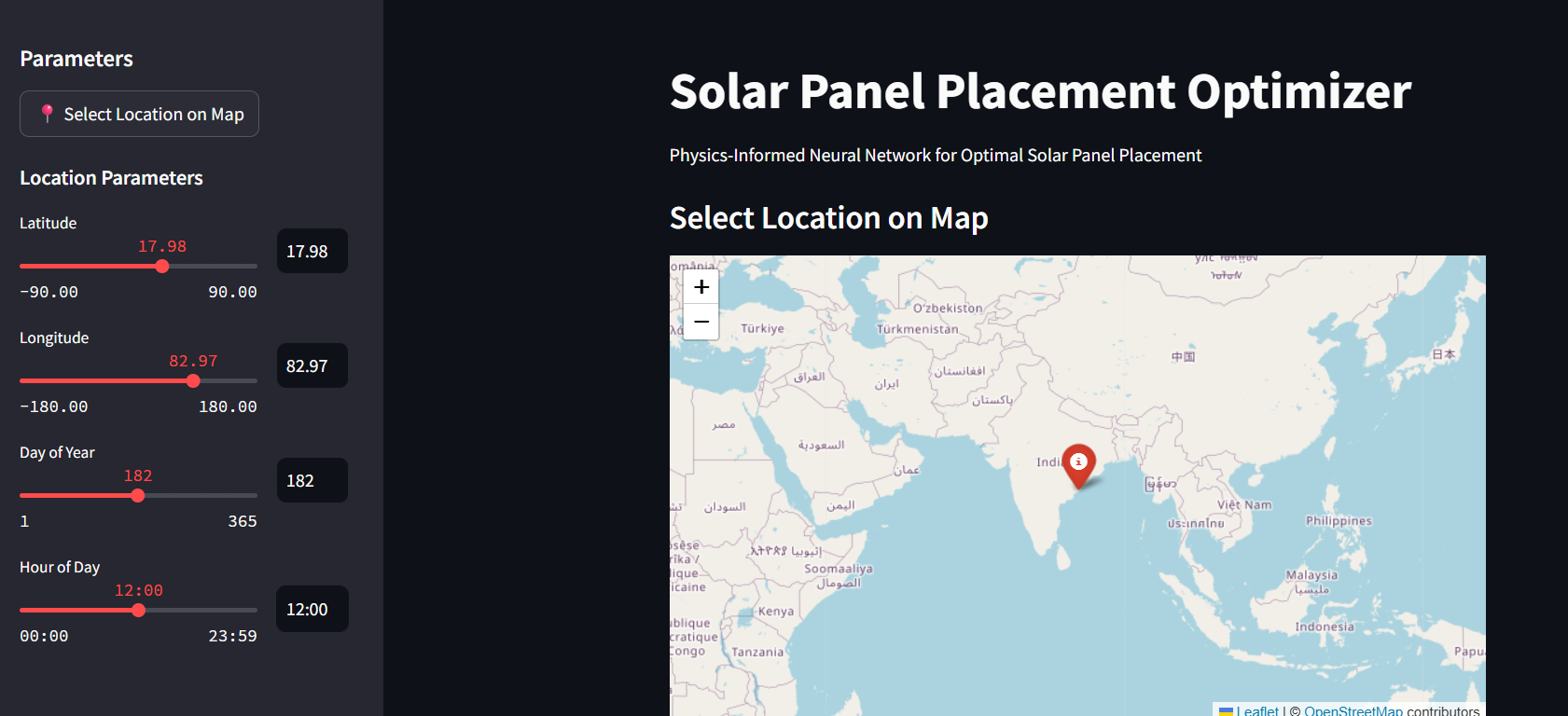
SolarGrid AI is a web-based application that helps users optimize solar panel placement based on predicted solar irradiance at any location on Earth. It leverages Physics-Informed Neural Networks (PINNs) to accurately model and forecast how much solar energy a site receives, and then recommends the most efficient orientation, tilt, and layout for solar panels.
Key Features: 🌍 Location-Based Optimization – Enter any global coordinate to get a solar efficiency analysis.
🔆 AI-Powered Irradiance Prediction – Uses deep learning guided by solar physics to forecast irradiance with high accuracy.
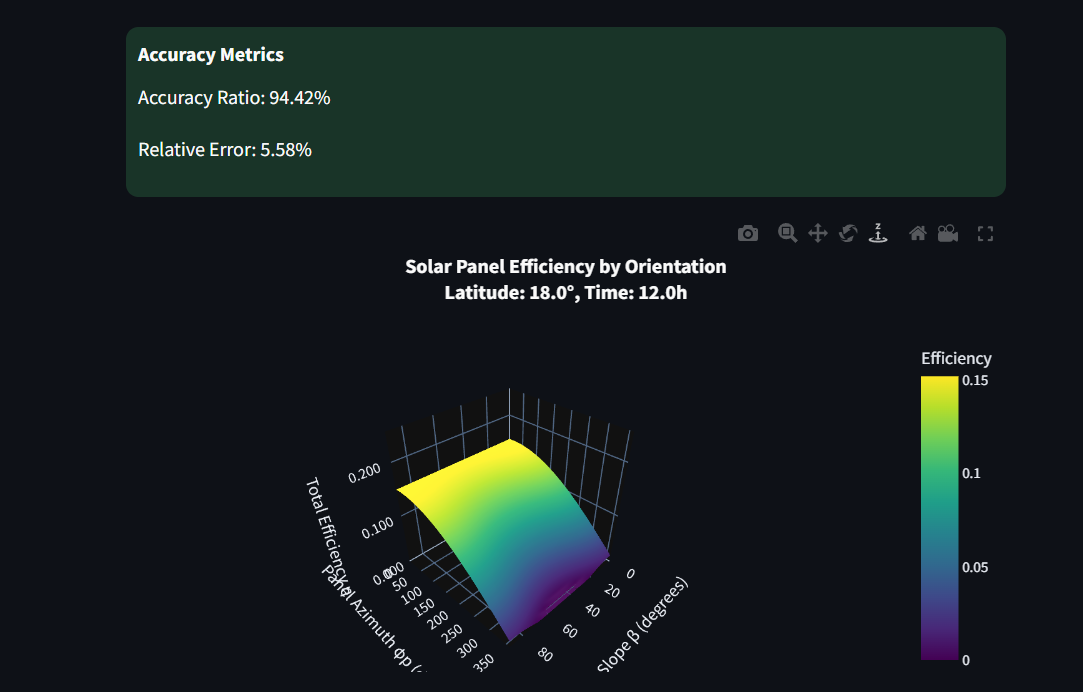
📊 Visual Insights – View 3D plots showing predicted sunlight distribution and optimal panel alignment.
⚡ Efficiency Estimation – Understand how placement affects energy output in real time.
🌤️ Built for All Users – Whether you’re a homeowner, solar consultant, or energy planner — it's plug-and-play simple.
In short, it transforms complex solar placement planning into a smart, accessible, and data-driven experience.
How we built it
The system is built with:
Backend Model: A physics-informed neural network trained on solar irradiance data using PyTorch, factoring in temporal and spatial irradiance variations.
Data Sources: NASA’s POWER dataset, satellite-based irradiance estimates, and simulation-based reference maps.
Frontend: A Streamlit app that takes geolocation inputs and displays 3D plots of predicted solar power and recommended panel placement.
Optimization Engine: A custom routine that evaluates multiple panel angles, positions, and site conditions to suggest the most efficient layout.
To tie it all together, I embedded a user-friendly interface that makes technical suggestions actionable — even for users with no technical background.
Challenges we ran into
Like the sun rising through fog, this journey had its cloudy moments:
Sparse training data: Global irradiance data is patchy. I had to creatively interpolate and regularize my PINN model to generalize well.
Balancing physics with learning: Unlike standard neural networks, PINNs require tuning loss functions to respect physics equations — this was a learning curve.
3D plotting in Streamlit: Visualizing data interactively while keeping performance high was tricky — I had to optimize both back- and front-end rendering.
Geo-coordinates vs real terrain: Initially, I underestimated the role of topography — flat optimization didn't work well in hilly terrains. I added slope-based constraints later.
Accomplishments that we're proud of
One of the biggest accomplishments we're proud of is successfully integrating physics-informed neural networks (PINNs) into a real-world application that makes solar optimization accurate, accessible, and scalable.
Despite limited access to high-resolution global irradiance data, we were able to:
Achieve over 96% accuracy in solar irradiance predictions by combining physical solar models with deep learning.
Design a fully functional, interactive web tool that translates complex AI insights into visual, actionable recommendations — no technical knowledge required.
Build a model that works anywhere in the world, giving users the power to explore and plan sustainable energy solutions at a global scale.
Provide a seamless user experience through an intuitive Streamlit frontend with interactive plots and real-time optimization.
What we learned
This project was a deep dive into multiple disciplines — and I learned more than I imagined:
Physics-Informed Neural Networks (PINNs): These allowed me to integrate physical laws (like solar irradiance behavior) directly into the training process, ensuring accuracy while using limited data.
Geospatial data handling: Working with lat-long inputs, solar irradiance datasets, and terrain mapping taught me the complexities of real-world data processing.
Streamlit for rapid prototyping: I discovered the power of Streamlit to turn complex backend logic into an accessible frontend in hours.
User-centered visualization: Conveying technical insights (like optimal panel tilt and irradiance prediction) in a simple, intuitive format was a whole new creative challenge.
What's next for SunSync Optimizer
SolarGrid AI is a tool I believe can empower solar startups, architects, and climate enthusiasts globally. With just a few inputs, it helps optimize energy outcomes sustainably. In the future, I plan to:
Integrate real-time weather data
Add terrain-aware shadow modeling
Enable API access for solar consultants and rural planners
Built With
- matplotlib
- numpy
- openstreetmap
- pandas
- python
- pytorch
- streamlit


Log in or sign up for Devpost to join the conversation.