-
-
Icon
-
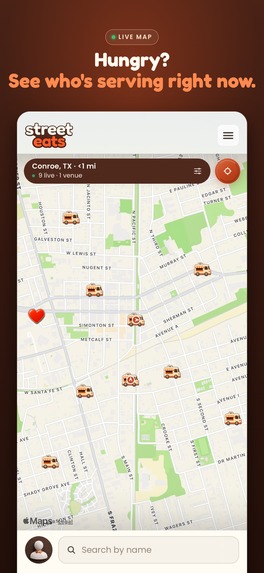
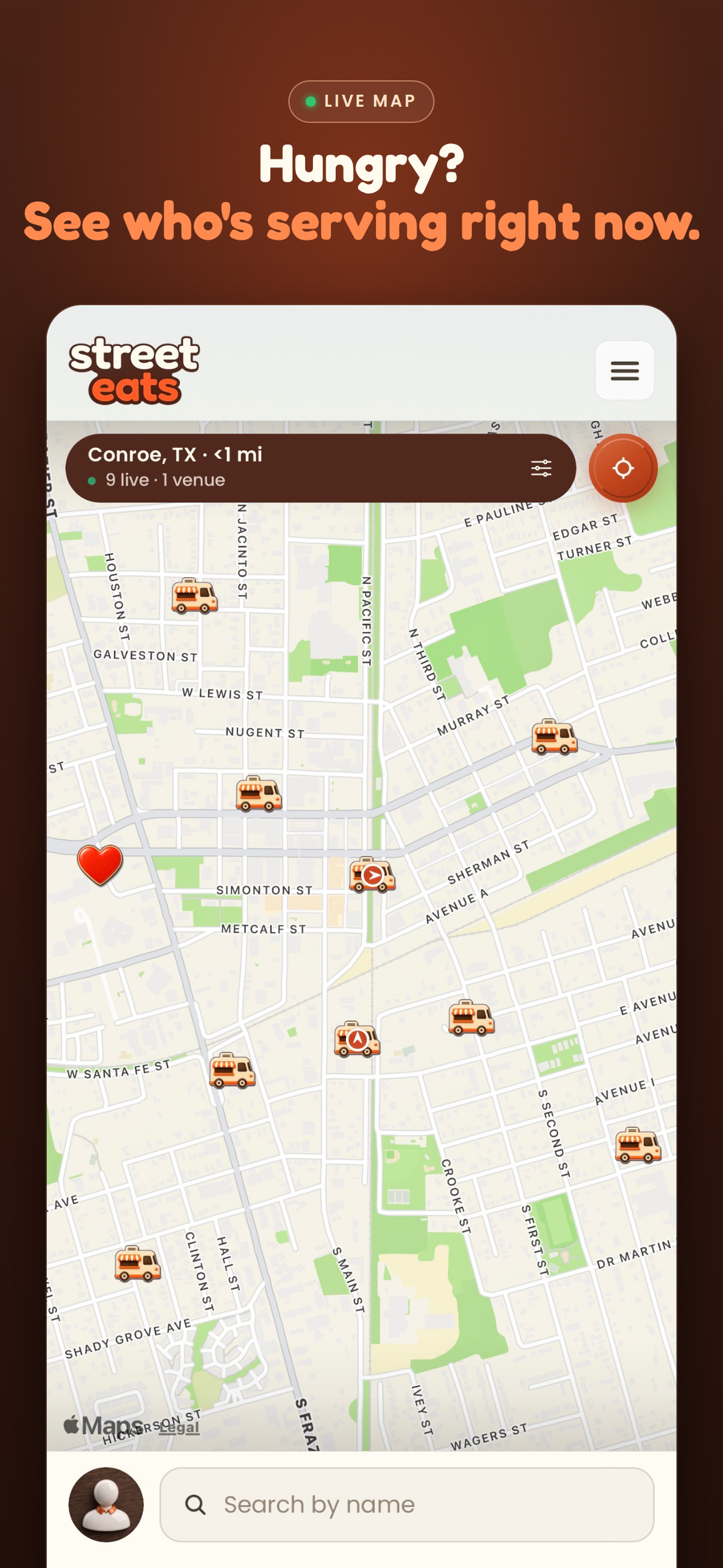
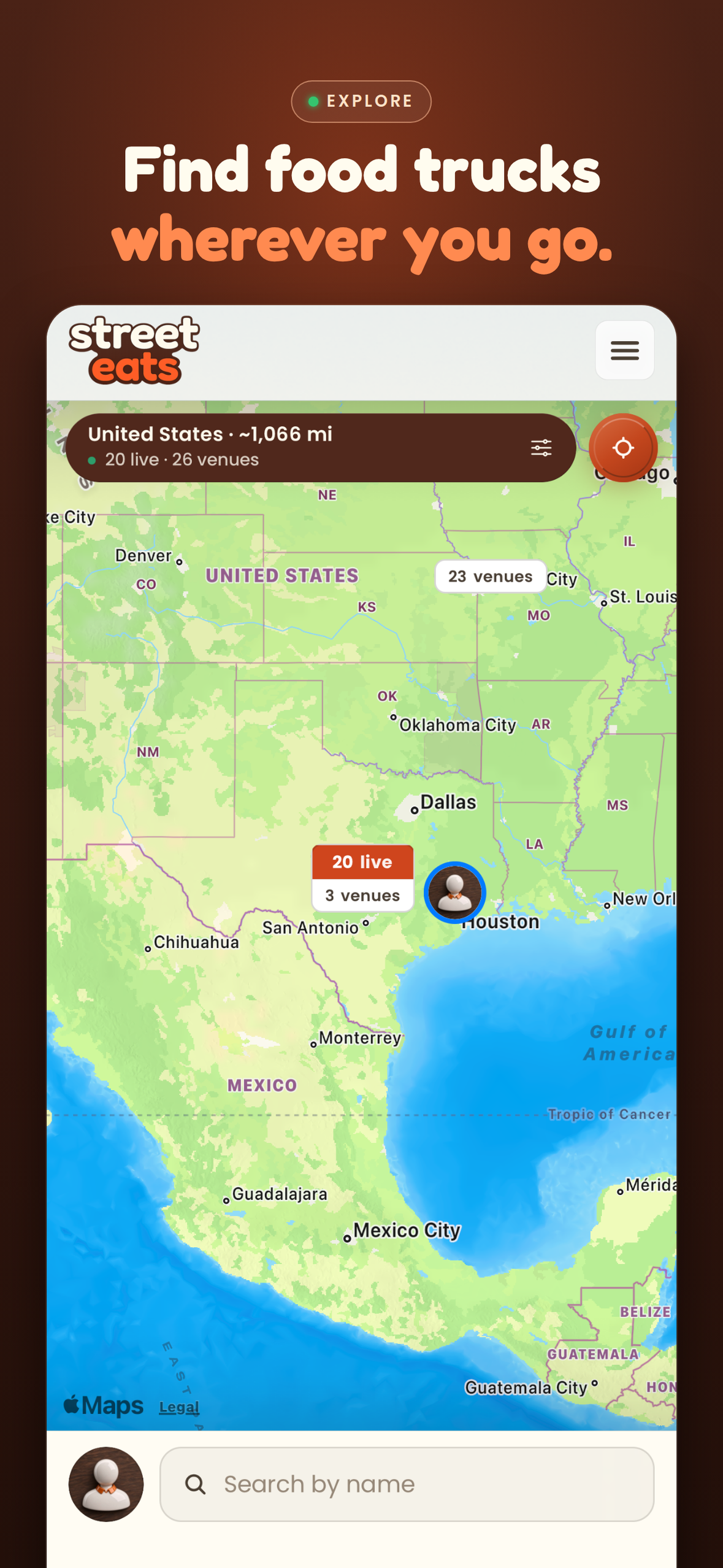
Hungry? See who's serving right now.
-
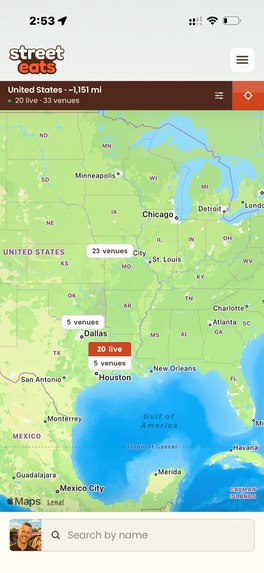
Unedited screen from the live app.
-
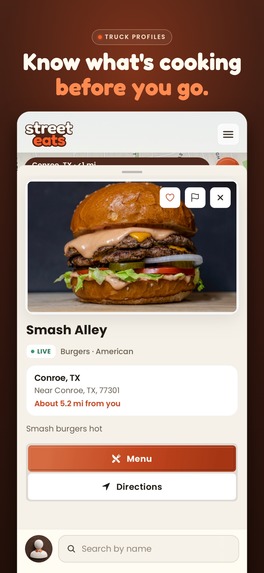
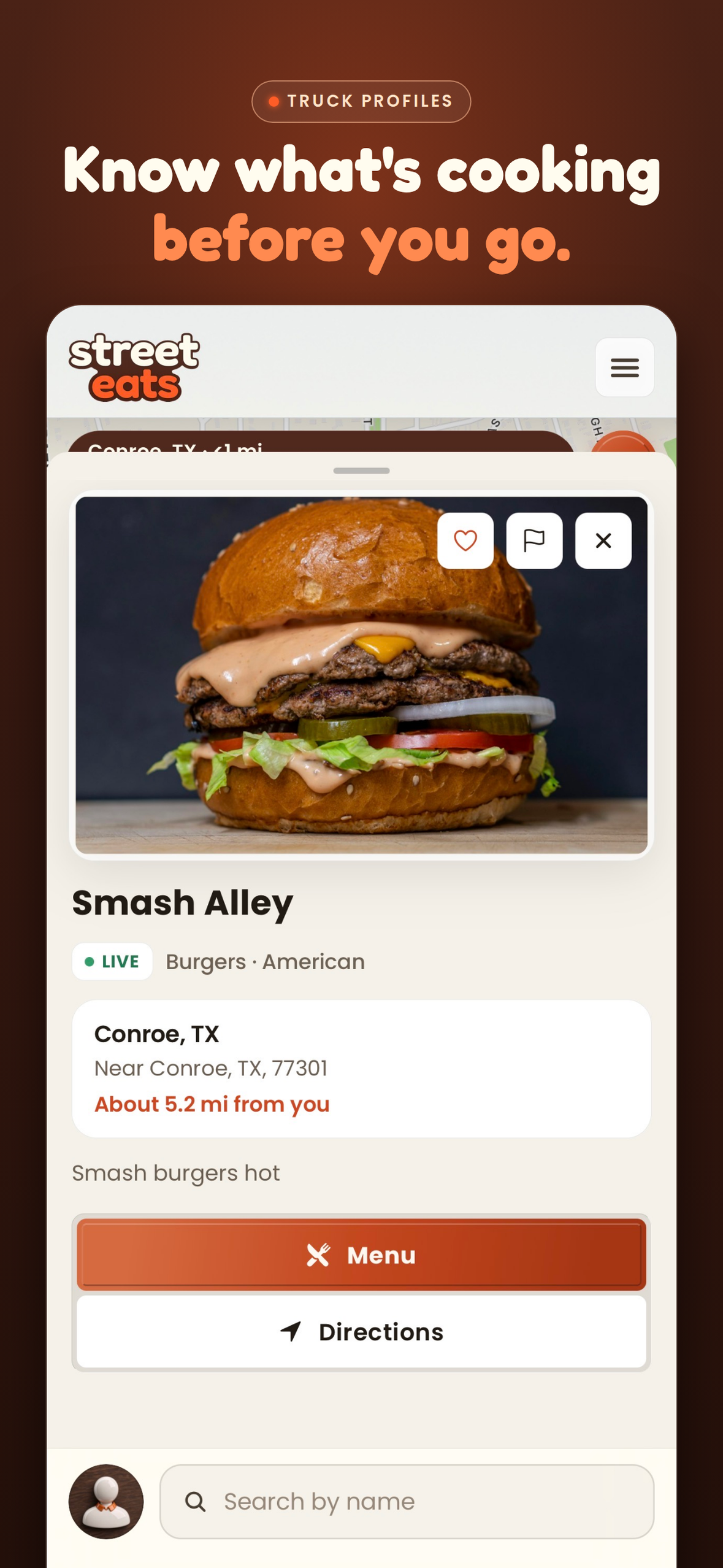
Menus and details before you walk up.
-
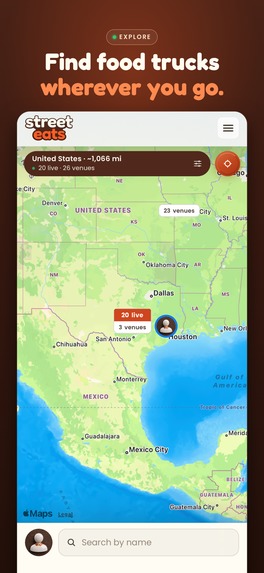
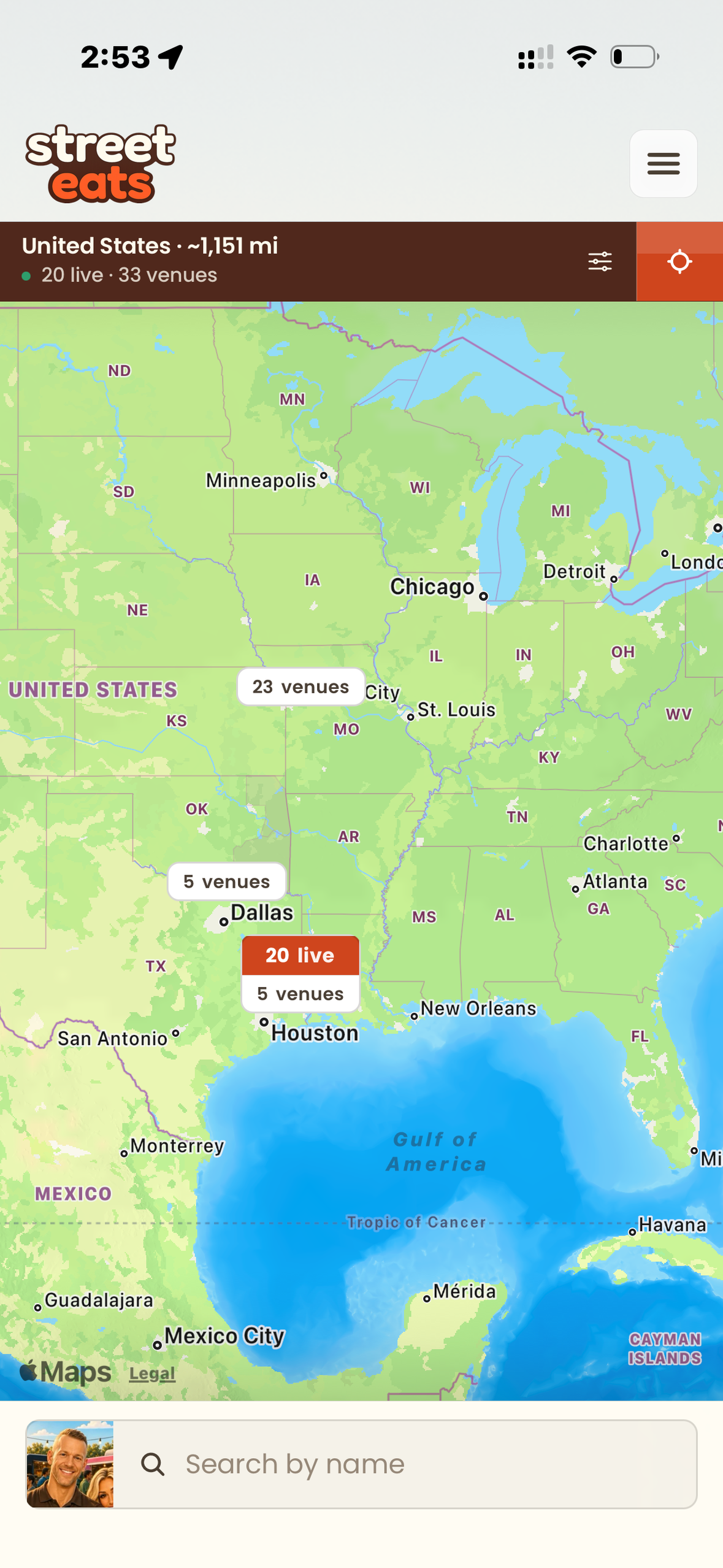
Nationwide visibility, expanded at user request.
-
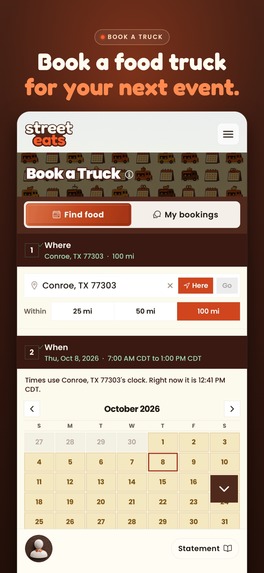
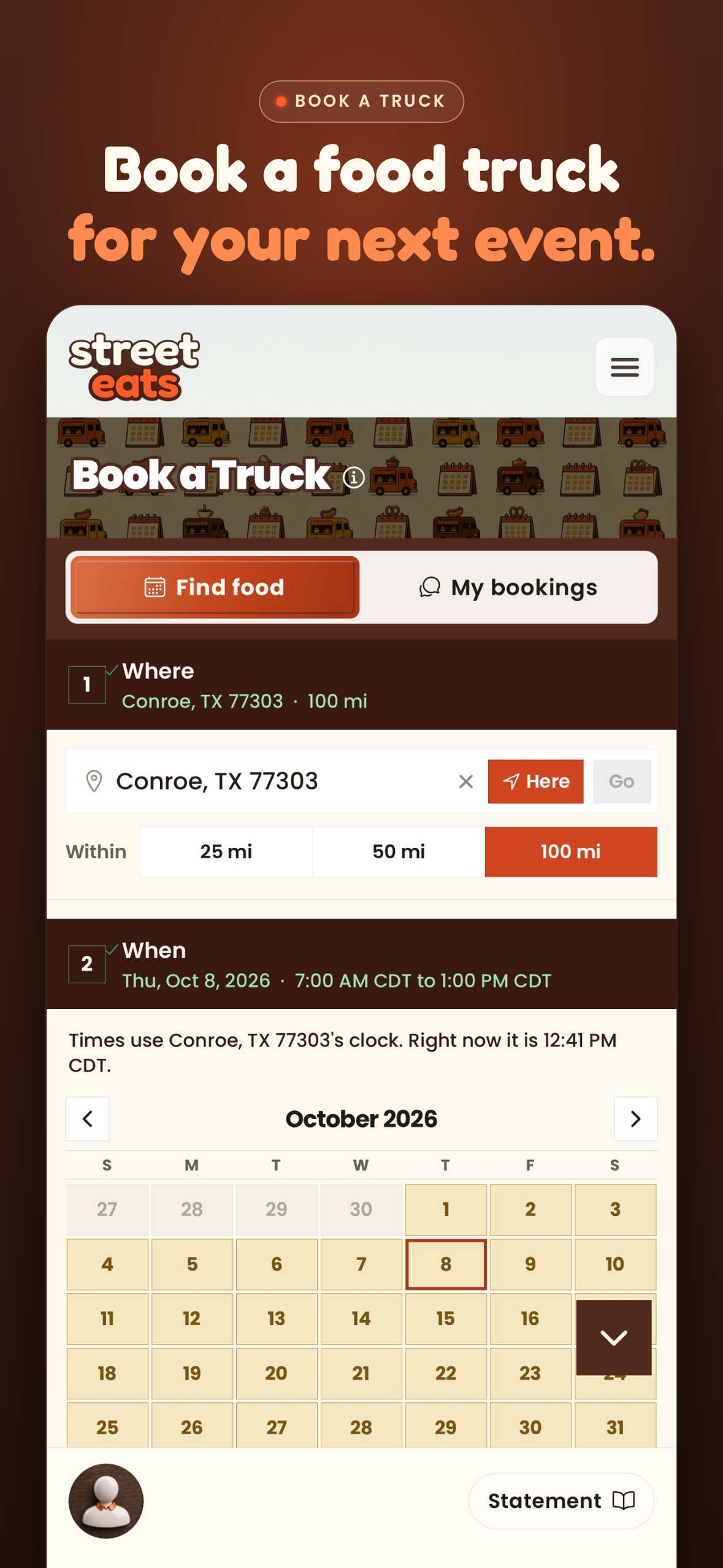
Book a Truck (v2.0.0, rolling out during pre-judging).
-
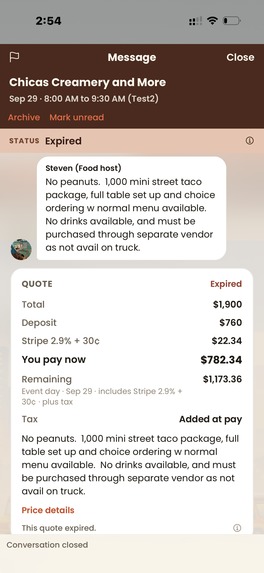
Unedited Book a Truck scheduling screen (v2.0.0).
-
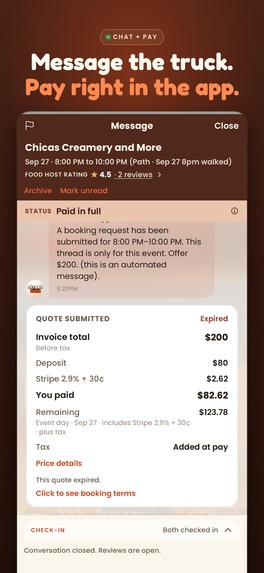
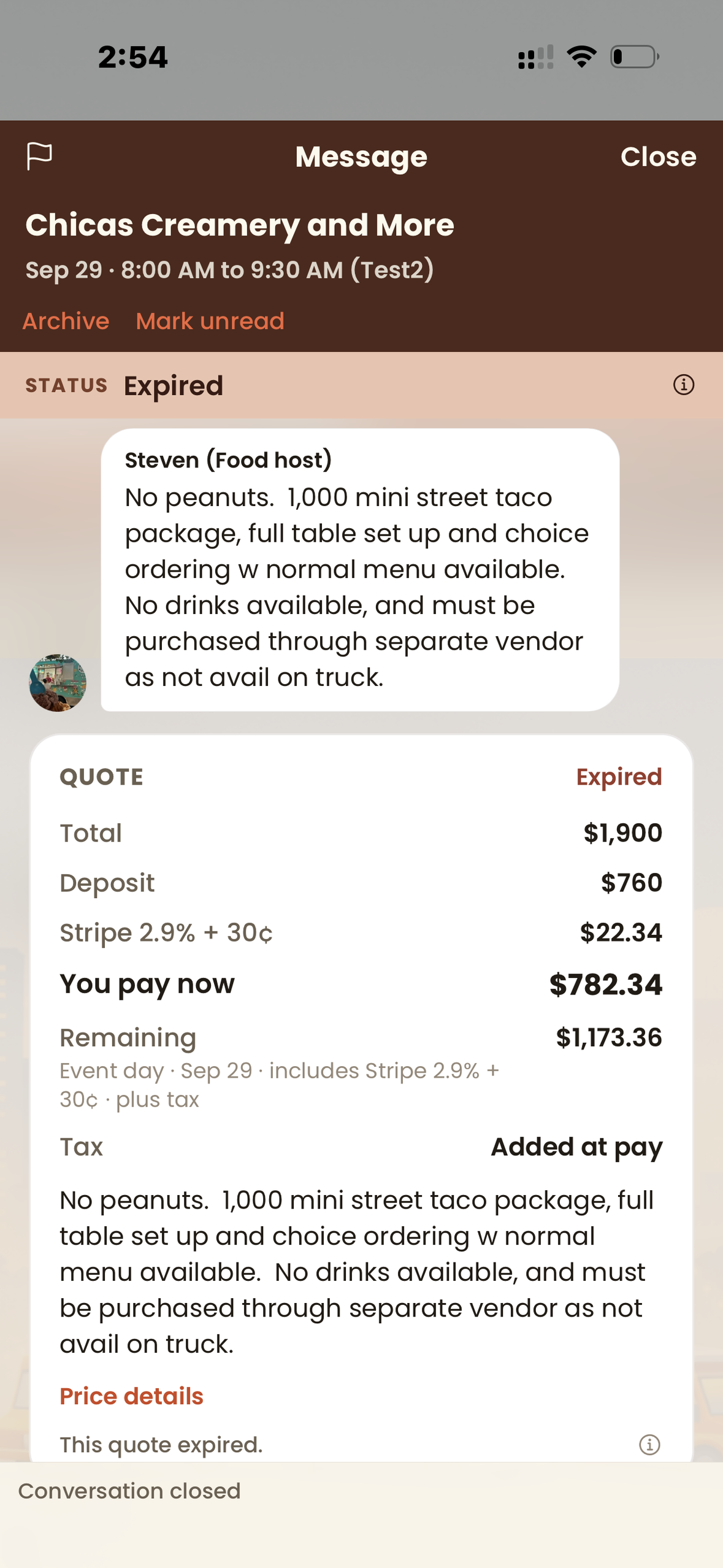
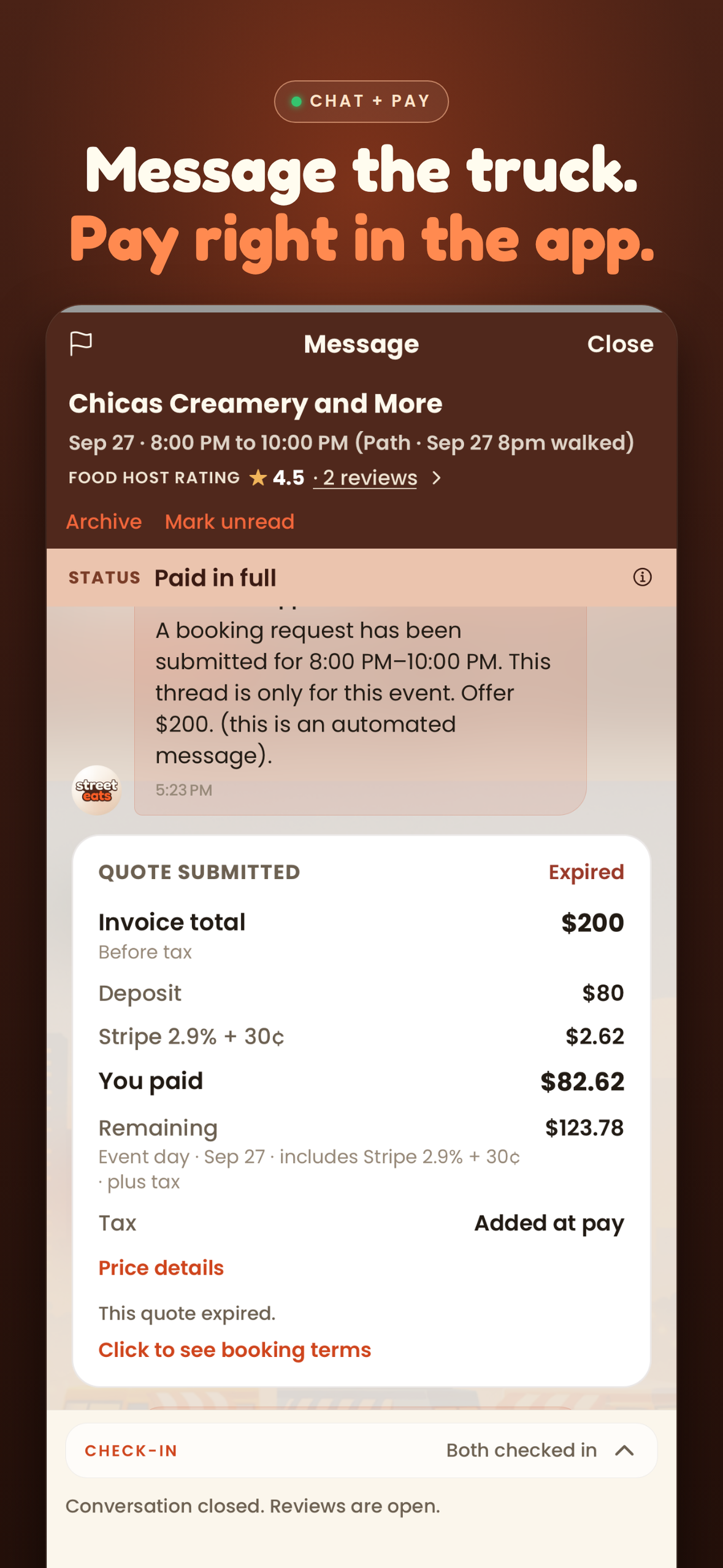
Chat, quote and pay in-app (v2.0.0).
Food trucks make the best food in America that nobody can find. Catering is the food everybody can find and nobody enjoys booking. Street Eats solves both. In the 51 days since launch, we proved the first half with real trucks, real hours and real users. Now we're shipping the second.
I'm Steven, a veteran and founder of Buhrn Technologies. Street Eats is a live map of food trucks, carts, trailers and pop-ups that are actually open and serving right now. Eaters use it free. Operators pay a membership to be found.
The numbers (Aug 10 – Sep 30, 2026)
- Shipped on both stores: App Store Aug 10 (the same day Apple approved), Google Play Aug 22
- 254 first-time installs: 210 iOS (App Store Connect) + 44 Android (Play Console), plus 15 iOS redownloads
- 218 registered users (in-app analytics)
- 450+ hours of live truck broadcasting by our partner trucks and our first membership truck
- Google Play: 66.1% store listing conversion. Last 28 days vs. previous 28: impressions +174%, acquisitions +136%, first opens +170%, monthly active devices +50%. Play itself drove 23 organic Explore acquisitions in 90 days.
- App Store: 1.99K impressions → 874 product page views, 19.3% daily-average conversion
- 5.0★ on both stores. One review on each, from two different partner trucks.
- First membership truck: in free trial, converts to paid on Oct 4
- 0 → 466 Instagram followers in about two months, and nearly 800 new followers across Instagram, X and LinkedIn. All organic, all local, $0 in paid acquisition.
What judges can test today
For eaters (always free):
- Live map of trucks that are open and serving right now
- Menus, photos and details before you walk up
- Saved favorites
For truck owners (Street Eats Membership, powered by RevenueCat):
- Publish your truck
- One-tap Go Live to broadcast your serving location
- Manage menus, photos and team
Judge test path:
- Download the app and browse the map as an eater.
- Create an owner account and start the monthly plan. The first month is free and unlocks every owner feature.
- Restore Purchases and cancellation are both in the app.
Early and effective release (Grand Prize)
We shipped the day Apple said yes. We targeted July 31. Apple approved August 10, and we went live that same day instead of waiting for Android. In a two-sided marketplace, every day without live trucks is a day the map is empty. Real trucks broadcasting real locations was the only test that mattered, and only a live build could run it.
We created demand before the listing existed. We held a public launch party on August 2 at Mainstreet Tavern in Kansas City, so operators and eaters met the product in person before they could download it. We emailed the prelaunch list the minute the App Store page went live.
That first build gave us the answer we needed: trucks will actually use it. They broadcast for 450+ hours, and both of our store reviews came from operators running their business on the app.
Growth by numbers (Grand Prize)
1. Local density over vanity installs. Street Eats is a B2B2C marketplace. Every truck makes the map worth opening for eaters. Every eater makes Go Live worth paying for. Scattered national installs would have produced a ghost town of empty pins, which kills trust on both sides. So we grew deliberately inside Kansas City and Conroe, building supply and demand together. Result: 450+ hours of live broadcasting, so the map has real trucks on it. Not a directory of stale locations.
2. Trucks as our distribution channel. Our best acquisition channel was working alongside our trucks and their customers: packing boxes on service days, co-marketing and running promos together. Helping their business grow is how ours grows, and it tells every operator who we are from day one. Result: both 5★ reviews and our first membership truck came from this channel.
3. Store optimization, applied across platforms. Google Play launched 12 days after iOS, so we applied our early App Store lessons to the Play listing before it went live. Result: 66.1% store listing conversion, and impressions up 174% month over month. Those same learnings rebuild our App Store listing in 2.0.0. We're testing how far we can lift conversion from its 19.3% baseline.
4. Content over follower-chasing. We posted real truck stories, launch moments and behind-the-scenes building, aimed at our local market rather than a global tech audience. Result: 0 → 466 on Instagram, and nearly 800 new followers across channels. The bigger result is the feedback loop that redirected our roadmap (see Building in public).
5. Shipping after launch. We shipped updates with:
- clearer membership language
- smoother Sign in with Apple
- honest empty-city map copy
- faster support tools
What we learned, what we cut, what ships next
We planned a Hot Spot demand heatmap for owners. Our research with trucks showed that a map of maybe-demand is worth far less to an operator than a confirmed, paid booking. Nearly every partner conversation turned to events and catering. So we cut Hot Spot Map and put that effort into the product our users were actually asking for.
Book a Truck: shipping in v2.0.0 during judging
Not part of the build judged here. It's where everything above was leading.
Find a truck, see the real menu, chat with the operator in-app, pick a date and time, and pay. All in one place, as familiar as booking a vacation rental. Catering has never had that, neither has food trucks.
- 4.99% platform fee. That's it. On a $2,000 catering job, the truck keeps $1,900.20. Booking marketplaces commonly take 10–20%, which would leave the truck $1,600–$1,800.
- Nationwide map, because our users asked us to go beyond regional visibility
- A fully rebuilt booking UI and UX
- Launch order: Conroe and Greater Houston first, then Phoenix, Austin, Kansas City and Springfield, MO
Next 30 days: we launch Book a Truck in Conroe, then go door to door with offices and event planners. Our target is 1,400 users in the launch zone. Everything above was built while I was still building the product full time. This next stage is the first time we put real distribution behind it.
Monetization strategy and results (HAMM Award)
Two revenue streams, one for each side of the market. Eaters never pay to discover. Hungry people are the inventory, and we don't tax them.
Stream 1: Street Eats Membership (live, RevenueCat).
- Plans: $120.99/month with the first month free, or $600 for six months. Two honest choices beat a cluttered paywall.
- Pricing: every price on screen comes live from StoreKit through RevenueCat, so the paywall and the purchase sheet can never disagree.
- Honest savings: the "you save" line is calculated from real prices and hidden during the free trial. A discount next to a free month would be dishonest.
- Entitlements: a signed RevenueCat webhook grants or revokes access, and entitlements fail closed. RevenueCat is the source of truth for trials, renewals, billing issues and restores. We never run our own charge clock.
Stream 2: Book a Truck booking fee (Stripe, v2.0.0).
- The split: the guest pays the quote plus card processing and tax. Street Eats takes 4.99% from the truck's collected amount, and the truck keeps the other 95.01%.
- Why Stripe here: catering is a real-world service consumed outside the app, so it runs on Stripe per App Store Review Guideline 3.1.3(e).
- Two clean rails: digital access runs through RevenueCat, and physical services run through Stripe. There's no double-billing path.
Why this goes beyond a standard subscription:
- A recurring floor plus transaction upside. Membership is predictable recurring revenue that keeps the map honest, because operators pay to be visible when they're actually serving. The booking fee scales with what trucks earn, so we only grow when they grow.
- Pricing is the moat. 4.99% against the 10–20% common in this industry is the wedge that pulls trucks off incumbent platforms. Guest-paid processing makes the truck's math transparent: quote minus 4.99%, nothing hidden.
- It scales city by city. Each new market adds both memberships and bookings on the same local density we've already proven.
Results to date: our first membership truck is in its free trial and converts to paid on October 4. Trial-to-paid with our partner operators is the loop we're running now.
Social good (RevenueCat Peace Prize)
Impact. Independent mobile vendors have no fixed storefront. When people can't find them, they lose the lunch rush and food goes to waste. Those 450+ broadcast hours are 450 hours that small, owner-operated businesses were findable on demand. Book a Truck extends that impact:
- A 4.99% fee instead of 10–20% keeps hundreds of dollars per event with local operators.
- Guest-paid processing means trucks aren't eating the cost of getting paid.
- Lower platform costs let schools, offices, churches and community events feed people for less.
Feasibility. This isn't a concept.
- It's live on both stores.
- Real trucks broadcast on it daily.
- Partner operators rate it 5★.
- Launch cities are already set.
- The business model never charges the people it serves to find food.
Street Eats is disabled veteran-founded and built from a real Kansas City problem, now launching in Conroe and Houston.
Design (RevenueCat Design Award)
Innovative ideas:
- A presence map, not a directory. Trucks appear only while they're actually live, which removes the stale pins that make every food truck directory untrustworthy.
- Privacy by design. Background location runs only while an owner has explicitly gone Live, and never otherwise.
- One-tap Go Live. It turns a truck's location into a broadcast with a single action.
Aesthetics, and where to look:
- The live map: dark and light mode, large type, built for a glance on a lunch break.
- The owner Go Live flow: one decision, instant feedback.
- The paywall: designed like a business receipt, with clear price, trial and renewal terms. No consumer gimmicks.
The 2.0.0 booking flow follows the same principle: familiar, simple and complete.
Building in public (#BuildInPublic Award)
- Instagram: https://instagram.com/street.eats.app
- X: https://x.com/BuhrnFounder
- YouTube: https://youtube.com/@BuhrnFounder
- LinkedIn: https://www.linkedin.com/in/buhrnfounder
- Press and launch party: https://eatonthestreets.com/press
- Highlights: https://x.com/BuhrnFounder/status/2089003938183823416 · https://x.com/BuhrnFounder/status/2092280198251020452 · https://x.com/BuhrnFounder/status/2101704738794328208
Sharing our story. We built in public across four channels and grew to nearly 800 new followers organically. Our campaign was deliberately local. In a marketplace, a follower who can actually visit a truck is worth more than a thousand who can't. We shared the full arc: the launch party, App Review delays, the day Apple approved, real trucks going live, and the pivot to booking.
Engagement → features we shipped.
- Users asked for a bigger map. In 2.0.0, visibility goes from regional to nationwide.
- Truck operators kept asking about events and catering. That became Book a Truck, our main product layer.
- Partner trucks became public advocates. Both of our 5★ reviews came from operators we built alongside.
Lessons learned.
- In a two-sided marketplace, content has to serve both sides at once. Posts that helped trucks get customers grew our user base too. We have regional champions who post everyday about their use and their customers use of the new app. This drives teaching the consumer base how to use the app and how easy it is slowly and organically.
- Building in public taught us what to cut. Feedback showed a demand heatmap was worth less than a real booking, so we cut Hot Spot Map.
- Your supply side is your best distribution. Our trucks market us because we show up for them, sometimes literally packing boxes on their service days and building marketing material they can use for their truck to support the app.
How we built it
- App: React Native, Expo and TypeScript
- Backend: Supabase for auth, data and realtime
- Sign-in: Sign in with Apple and Google
- Location: live location for eaters; background location only while an owner is Live
- Billing: RevenueCat SDK and App Store Server Notifications for memberships, Stripe for Book a Truck services
- Reliability: we load-tested billing against the live map so a renewal burst can't take discovery down at lunch and even built our own Audit system (BTAS) and ran it through its most critical pathways for highest reliability and capability.
Try it
Built With
- apple
- cloudflare
- eas
- expo.io
- in-app
- location
- maps
- native
- node.js
- notifications
- oauth
- postgresql
- purchase
- react
- react-native-maps
- revenuecat
- sentry
- server
- storekit
- supabase
- typescript


Log in or sign up for Devpost to join the conversation.