🌊 StreamSense
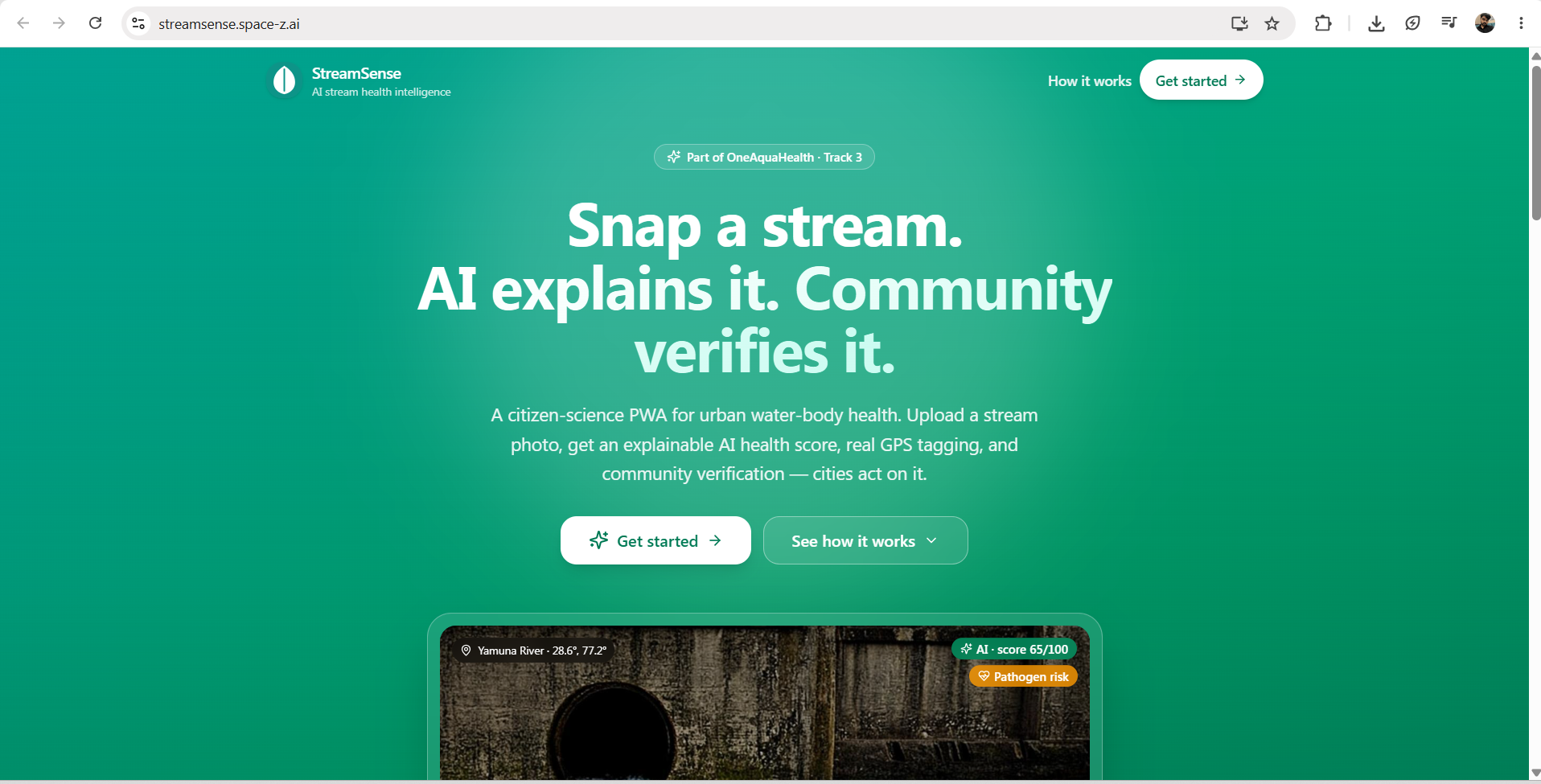
Snap a stream. AI explains it. Community verifies it. Cities act on it.
The Problem
Freshwater streams are often the first place where environmental changes become visible.
A citizen may notice unusual foam, algae, floating waste, murky water, an oil-like sheen, or other changes — but simply seeing something unusual does not explain what it could mean, whether it is recurring, or whether other people are seeing the same thing.
Traditional environmental monitoring can also be difficult to scale across every stream and every neighborhood.
The missing layer is a simple way to connect:
citizen observations → explainable AI → community verification → environmental intelligence → action.
Our Solution
StreamSense is an AI-powered community stream monitoring platform that turns everyday observations into structured, explainable environmental signals.
A citizen can photograph a stream and receive an AI-assisted analysis of visible environmental indicators. Instead of treating the AI as the final authority, StreamSense puts the citizen and community into the loop.
The observer can correct the AI's interpretation, submit the observation, and nearby community members can verify whether the reported condition is actually visible.
When observations repeatedly appear around the same location and time, StreamSense can surface a potential environmental signal and provide precautionary One Health context for people, animals, and ecosystems.
The goal is not to replace scientists, laboratory testing, or environmental authorities.
The goal is to create a scalable early observation and community intelligence layer.
How It Works
1. 📷 Observe
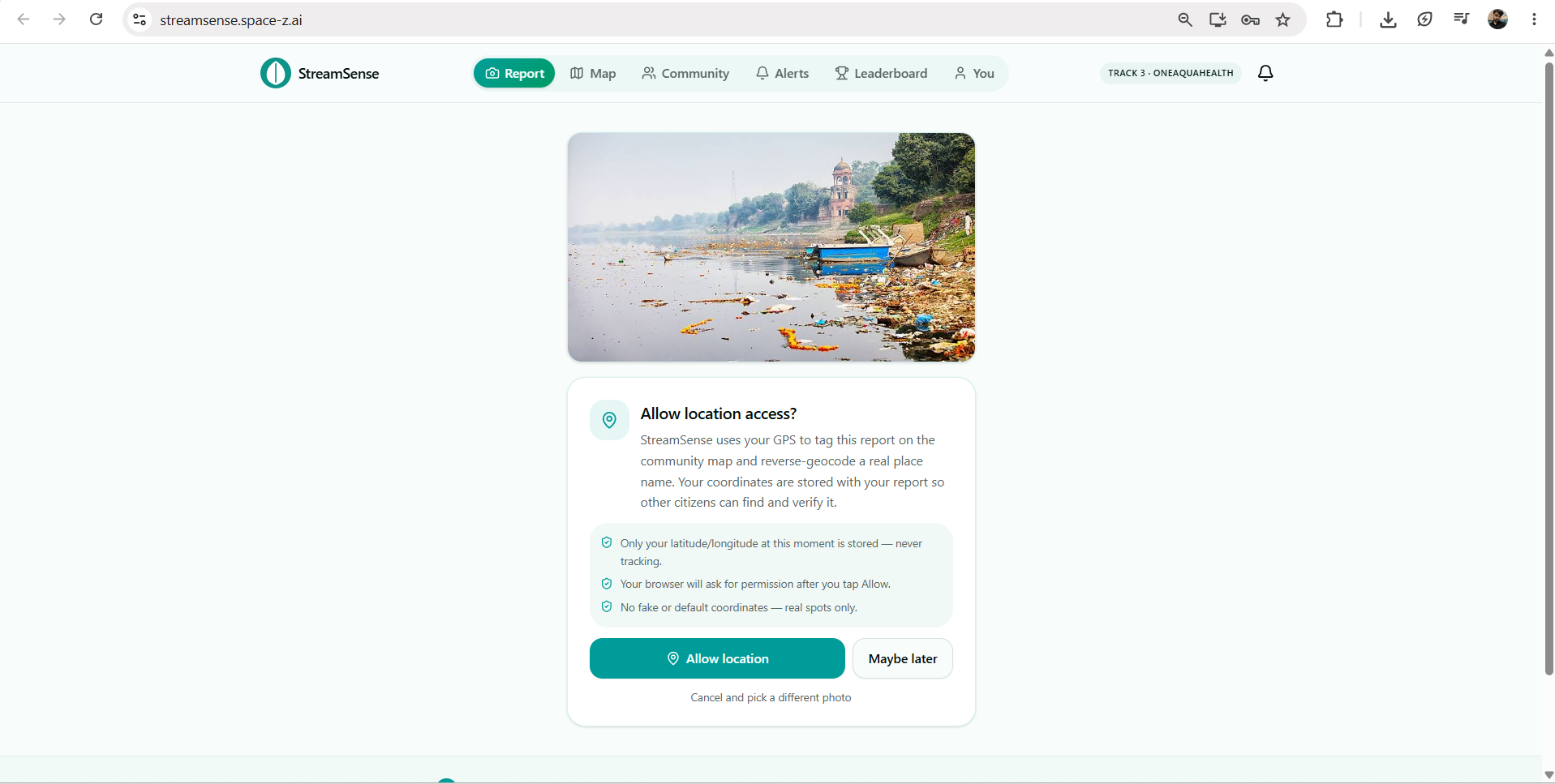
A citizen opens StreamSense and takes or uploads a photo of a stream.
The application captures the observation time and, when available, the user's geographic location.
2. 🧠 AI Analysis
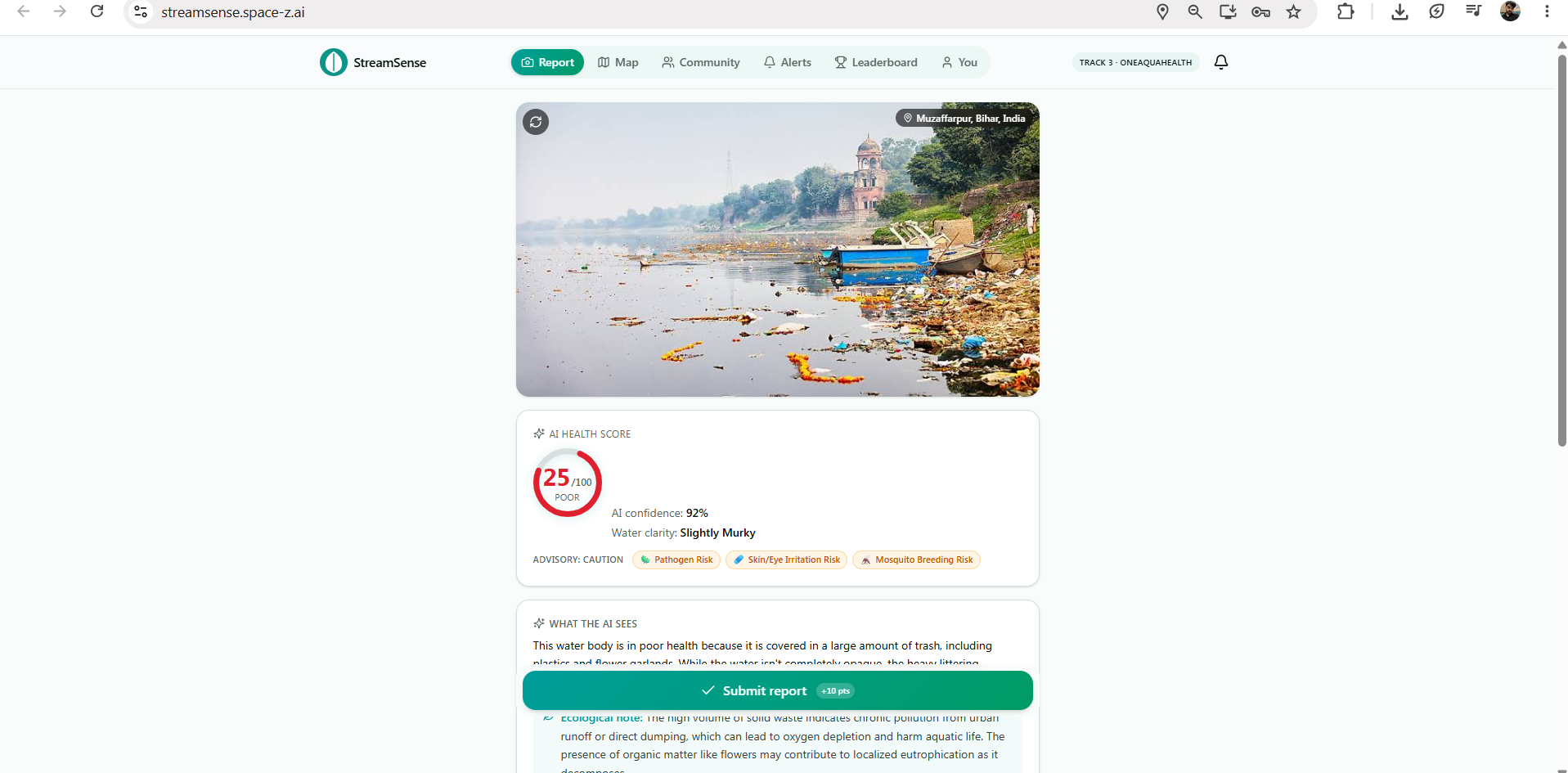
The image is analyzed for visible environmental indicators such as:
- Surface foam
- Algae
- Floating waste
- Murky water
- Unusual coloration
- Oil-like sheen
- Stagnant conditions
- Other visible environmental changes
The AI provides:
- Confidence
- Visible evidence
- Possible environmental context
- Precautionary recommendations
Importantly, the system does not claim that a photograph proves toxicity, pathogens, chemical contamination, or disease.
3. ✏️ Citizen Correction
AI is not treated as ground truth.
The citizen can confirm or correct the detected indicators before submitting the observation.
This creates a human-in-the-loop workflow where community knowledge can improve the quality of the collected data.
4. 👥 Community Verification
Other people can review nearby observations and answer:
"Do you see the same thing?"
Their responses create a community agreement signal.
A report can become a Community Verified Observation when sufficient nearby observations and agreement support the same visible condition.
This is community verification — not laboratory confirmation.
5. 🗺️ Environmental Intelligence
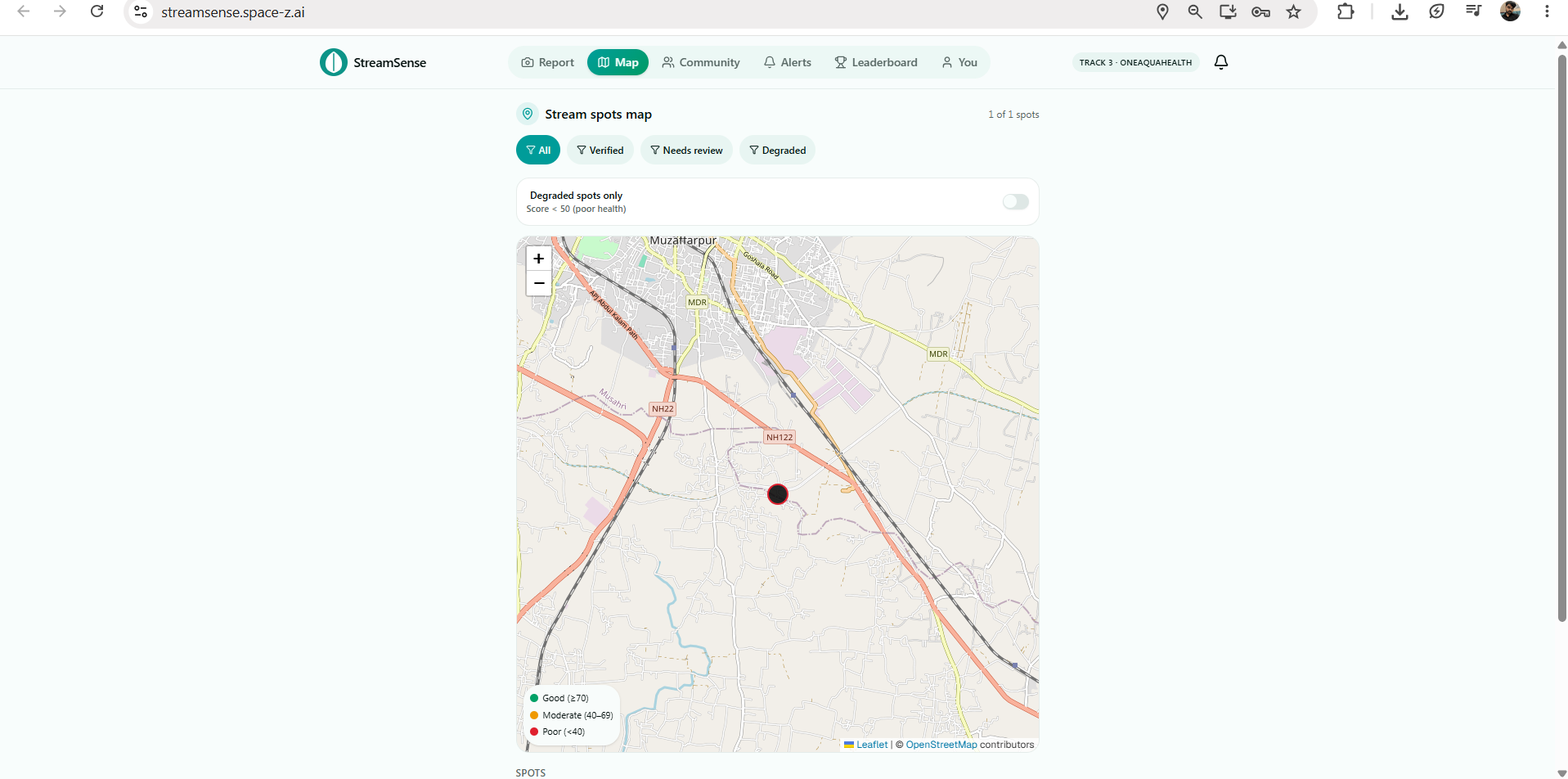
Reports are grouped spatially and temporally.
The platform can then reveal:
- Repeated observations
- Locations receiving increased attention
- Health-score trends
- Community agreement
- Emerging environmental signals
Instead of showing isolated reports, StreamSense helps turn observations into a developing picture of stream conditions.
6. 🌱 One Health Context
Environmental conditions can affect interconnected systems.
StreamSense presents precautionary context across:
People → Animals → Ecosystems
For example, unusual algae or waste accumulation may trigger guidance to avoid unnecessary contact while additional verification is performed.
The system deliberately uses cautious language such as "possible environmental signal" and "requires verification" rather than making unsupported health or pollution diagnoses.
7. 🚨 Action
Repeated observations can surface potential environmental alerts.
A location with several recent observations and strong community agreement can be highlighted for additional investigation or review.
This creates the complete loop:
Observe → Explain → Correct → Verify → Detect → Contextualize → Act
What Makes StreamSense Different?
Many environmental applications focus primarily on maps or dashboards.
StreamSense focuses on the verification loop behind the data.
The core idea is:
An AI prediction is only the beginning of an environmental observation — not the conclusion.
StreamSense combines:
AI assistance + citizen correction + community verification + spatial clustering + temporal trends + One Health context
This makes the platform useful even when individual observations are uncertain.
A single photo may be ambiguous.
Repeated, geographically connected observations from multiple people can become much more informative.
Key Features
AI-Supported Assessment
Explainable image analysis with confidence, visible evidence, possible context, and uncertainty.
Human-in-the-Loop
Citizens can correct AI results instead of blindly accepting them.
Community Verification
Multiple observers can independently verify whether an environmental condition is visible.
Environmental Health Map
A map-based view of observations, verification status, and environmental signals.
Stream Health Timeline
Historical observations are visualized to reveal changes over time.
One Health Advisory
Environmental observations are connected with precautionary context for people, animals, and ecosystems.
Environmental Alerts
Repeated observations can create potential signals that deserve additional review.
Community Participation
Points, badges, contributor profiles, and verification activity encourage sustained participation.
Interoperability
Environmental observations can be exported in a structured FHIR-compatible representation for future integration.
Technology
StreamSense is built as a modern web application using:
- Next.js
- React
- TypeScript
- Tailwind CSS
- Supabase
- PostgreSQL
- Supabase Storage
- AI Vision
- Leaflet
- OpenStreetMap
- Recharts
- Zod
- Vercel
The architecture separates the presentation layer, application APIs, database, storage, AI analysis, and mapping components.
Architecture
                    ┌─────────────────────┐
                    │       Citizen       │
                    │ Photo + Observation  │
                    └──────────┬──────────┘
                               │
                               ▼
                    ┌─────────────────────┐
                    │     StreamSense     │
                    │     Web Platform    │
                    └──────────┬──────────┘
                               │
              ┌────────────────┼────────────────┐
              ▼                ▼                ▼
       ┌────────────┐   ┌────────────┐   ┌─────────────┐
       │ AI Vision  │   │ Supabase   │   │  Leaflet    │
       │ Analysis   │   │ PostgreSQL │   │    Map      │
       └─────┬──────┘   │ + Storage  │   └─────────────┘
             │          └──────┬─────┘
             ▼                 │
       Explainable             │
       Observation             │
             │                 │
             └────────┬────────┘
                      ▼
             ┌──────────────────┐
             │ Citizen Corrects │
             └────────┬─────────┘
                      ▼
             ┌──────────────────┐
             │ Community        │
             │ Verification     │
             └────────┬─────────┘
                      ▼
             ┌──────────────────┐
             │ Spatial + Time   │
             │ Signal Detection│
             └────────┬─────────┘
                      ▼
             ┌──────────────────┐
             │ One Health       │
             │ Context + Alerts │
             └──────────────────┘
Responsible AI
Environmental AI requires careful handling of uncertainty.
StreamSense therefore follows several principles:
- Visible evidence over unsupported conclusions
- Confidence instead of certainty
- Citizen correction instead of blind automation
- Community verification instead of single-model decisions
- Precautionary guidance instead of medical diagnosis
- Human review for uncertain observations
StreamSense does not claim that computer vision can replace laboratory analysis or professional environmental assessment.
What We Learned
Building StreamSense highlighted an important challenge in AI-powered citizen science:
The hardest problem is not detecting something in an image. It is deciding how much trust should be placed in that observation.
This led us to design the product around multiple layers of evidence.
Instead of:
Photo → AI → Answer
we designed:
Photo
  ↓
AI-assisted observation
  ↓
Citizen correction
  ↓
Community verification
  ↓
Repeated observations
  ↓
Environmental signal
This approach makes uncertainty part of the product rather than something hidden from users.
Challenges
One of the biggest challenges was designing an AI experience that remained useful without making environmental claims that a photograph cannot support.
Another challenge was connecting individual observations into meaningful location-based signals without treating a small number of reports as definitive proof.
We addressed these challenges through:
- Explainable AI
- Confidence scores
- Human-in-the-loop correction
- Community verification
- Spatial and temporal clustering
- Explicit uncertainty language
- One Health precautionary guidance
Future Development
StreamSense could be extended with:
- Multilingual citizen reporting
- Offline-first field collection
- More advanced geospatial analysis
- Expert review workflows
- Municipal dashboards
- Sensor and IoT integration
- Historical watershed datasets
- Automated notification systems
- Stronger interoperability with environmental and health information systems
- Regional environmental risk models
The long-term vision is to create a bridge between citizen observations and institutional environmental intelligence.
Why It Matters
Healthy waterways support healthy ecosystems and communities.
StreamSense aims to make environmental observation:
simpler for citizens, more explainable through AI, more trustworthy through community verification, and more actionable through structured environmental intelligence.
🌊 Healthier Streams
👥 Healthier Communities
🌍 A Healthier Planet
Built With
- ai
- artificial-intelligence
- citizen-science
- computer-vision
- environmental-monitoring
- leaflet.js
- next.js
- one-health
- openstreetmap
- postgresql
- react
- recharts
- supabase
- tailwind-css
- typescript
- zod

Log in or sign up for Devpost to join the conversation.