Track 7: Digital Health Standards. StreamLink models OneAquaHealth citizen stream checks in HL7 FHIR, conforming to the project's own Implementation Guide, and uses standard FHIR workflow resources (ServiceRequest, then result, then Communication) to turn a citizen report into a lab visit and back into feedback for the volunteer. It also touches Track 1 with the three-minute picture-based check, Track 2 with the city board and Track 3 with explainable, human-in-the-loop trust checks, but it is submitted under Track 7.
Inspiration
I opened the OneAquaHealth Resilience Map expecting recent water data and found the opposite. All 96 monitored sites have exactly one lab health-risk campaign on record, and 95 of those campaigns are from 2023. That is nobody's failing. Lab work is expensive, so campaigns are rare by necessity.
The trouble is that what actually makes an urban stream dangerous does not wait for the next campaign. A sewage misconnection, a pipe discharging into the channel, a spill upstream. These happen in between, and they are visible to anyone walking past. OneAquaHealth already has volunteers doing exactly that walk, through its Citizen Science App. But their reports sit somewhere separate. No health or environmental system can read them, nobody knows how far to trust any one of them, and in practice nothing follows from filing one.
So the gap I wanted to close was not "collect more citizen data". It was to turn a citizen report into something a city can act on, and have it count as a health record while it is at it.
What it does
Every stream gets one living record that citizens, experts, the city and the lab all share.
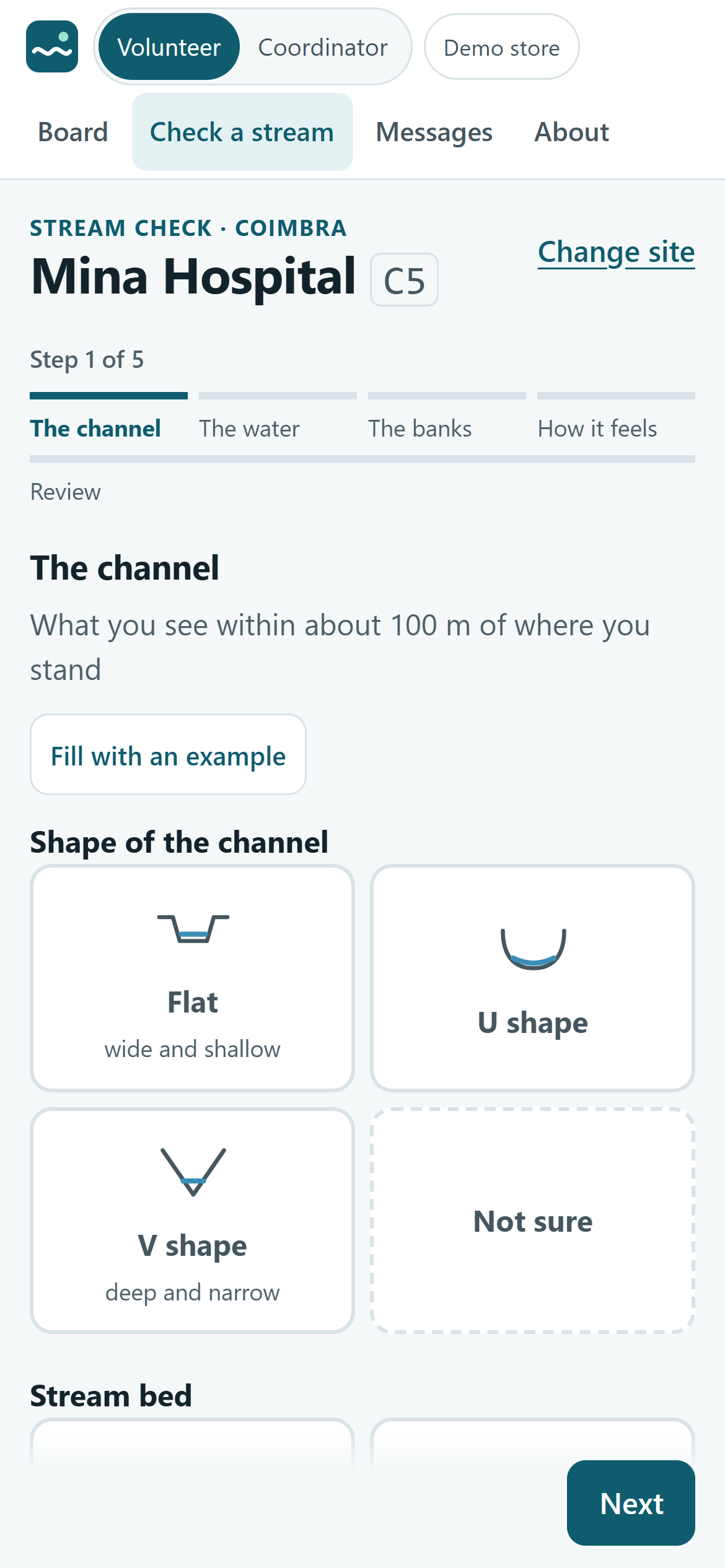
A volunteer does a stream check on their phone. It is the OneAquaHealth citizen app's own question set, asked as pictures, and it takes about three minutes. It works with no signal, which matters when you are standing on a riverbank. The check is stored as FHIR immediately, with status "preliminary".
Before it sends, the app runs eight plain-language consistency checks over the answers. If you rated the water as good and also reported a sewage smell, it says so in those words, and you either fix it or confirm you meant it. The trust score and every individual flag are stored in a FHIR Provenance resource, so the reasoning travels with the data instead of sitting in a filter somewhere behind the scenes.
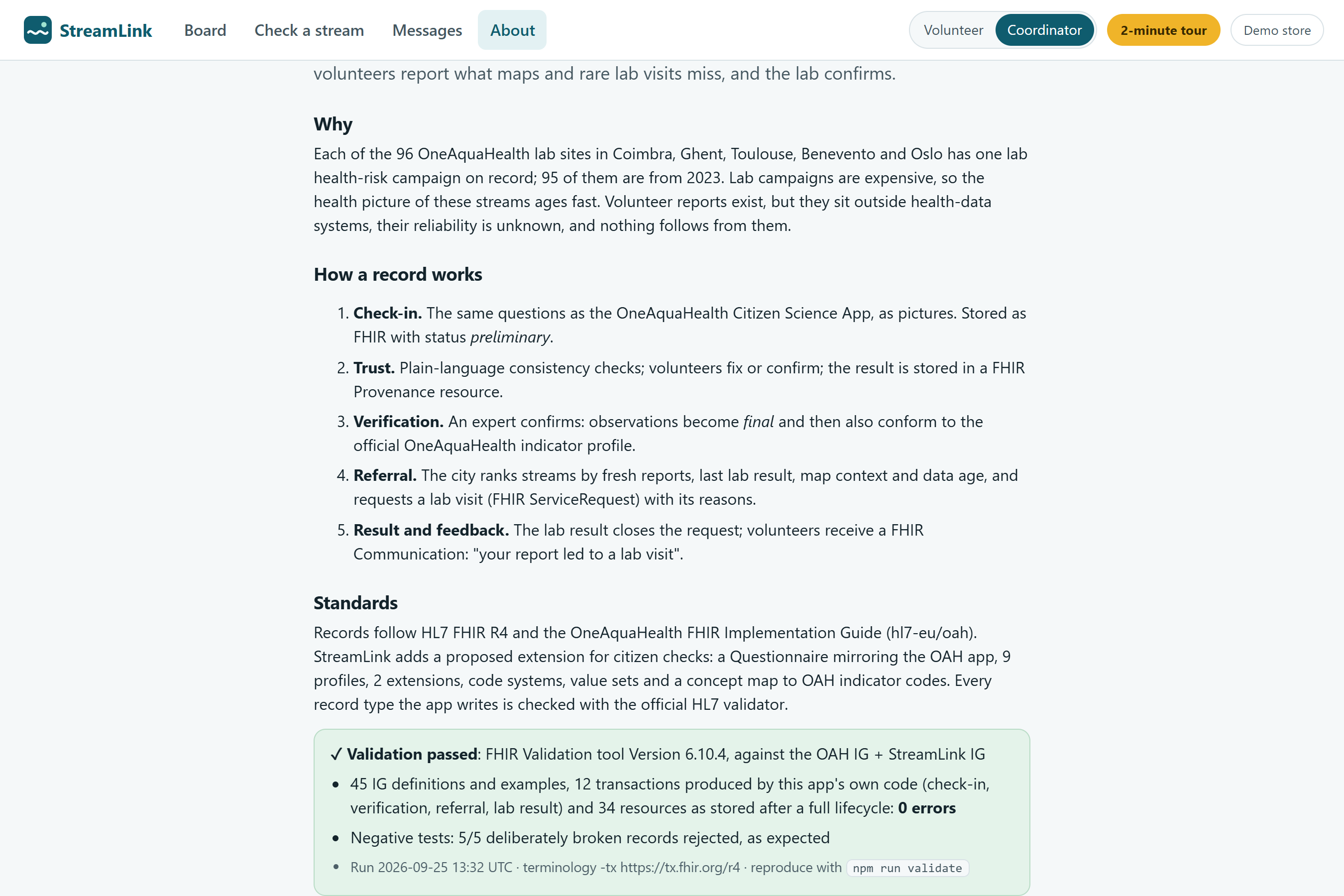
An expert then verifies the check, and this is the part I find most interesting. OneAquaHealth's own indicator profile fixes status to "final", which means an unverified citizen observation cannot conform to it, by construction. So citizen checks get their own profile at "preliminary", and verification is what promotes them: the observations become final and pick up the official OAH profile alongside ours. Unverified crowd data can never quietly pass itself off as project data.
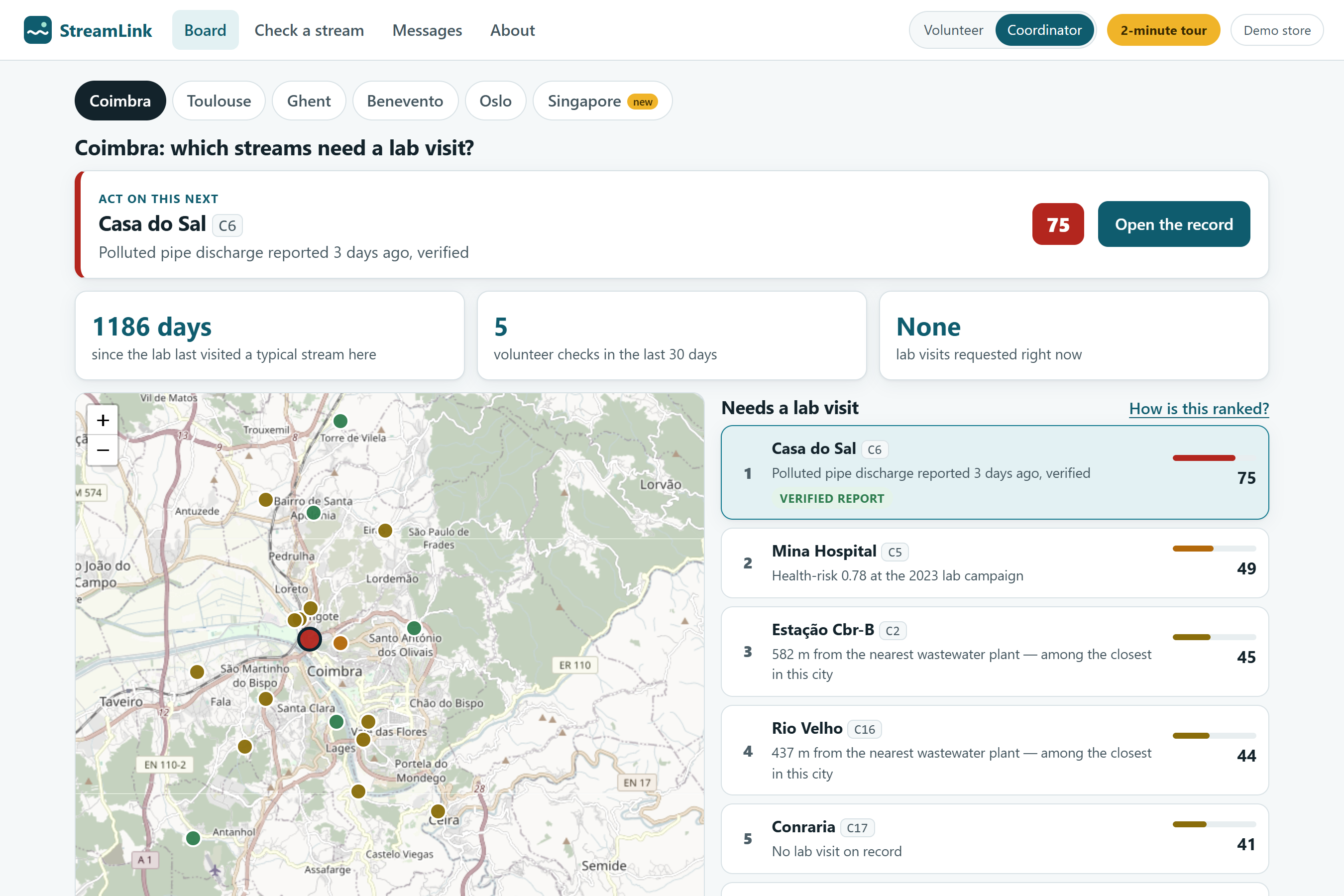
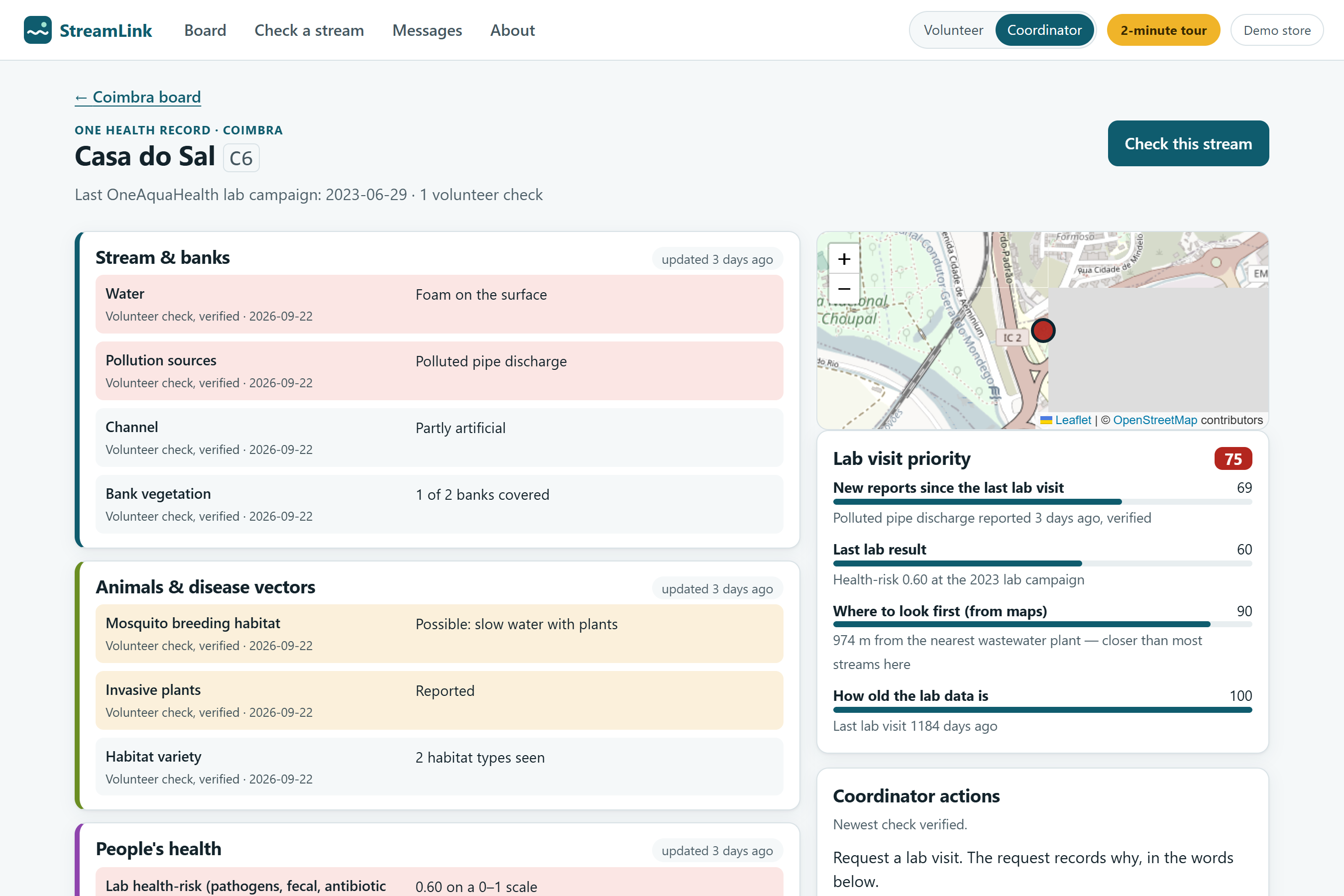
The city then sees which streams need a lab visit, ranked on four things: fresh reports weighted by trust, the last lab result, map context, and how old the lab data is. Every weight is on screen and adjustable, and every ranking comes with a sentence saying why that stream sits where it does. Requesting a visit creates a FHIR ServiceRequest that carries those reasons with it.
When the lab reports back, the request closes, the result settles the reports that triggered it, and the volunteer gets a message saying their report led to a lab visit. That last step is small and it is the whole point. It is the reason someone files a second report.
Adding a city is a config file. Map features come from OpenStreetMap, so a city with no lab data at all still gets a starting point. Singapore ships as an example: 10 real streams and canals, labelled as having no lab data and as outside the range the model was tested on.
How I built it
It is a static web app with no back end of its own. TypeScript and React on the front, and the FHIR server is the database. It ships with an in-browser demo store so anyone can try it without setup, and it can be pointed at any FHIR R4 server instead.
The standards work is a proposed extension to the OneAquaHealth Implementation Guide, written in FSH: a Questionnaire mirroring the citizen app, 9 profiles, 2 extensions, code systems, value sets, a ConceptMap onto the OAH indicator codes, 19 examples and 5 deliberately broken records. The official HL7 validator runs over all of it, over the 12 transaction bundles the app's own code produces, and over the 34 resources left in the store after a full lifecycle. Zero errors, and all 5 broken records get rejected, which is the part that proves the validation is doing anything at all.
For map context I rebuilt OneAquaHealth's features from OpenStreetMap so they work in cities the project has not surveyed, then tested them against their lab data leaving one city out at a time.
Challenges I ran into
The indicator profile fixing status to "final" looked like a blocker for about an hour, then turned out to be the most interesting thing in the project. It is the standard correctly refusing to let unreviewed data in. Working out that verification should be the promotion step, rather than trying to bend the profile, is the design decision I would most want a judge to look at.
The map model was humbling. My first version used three features and scored a pooled held-out AUROC of 0.33, which is worse than guessing. A later variant looked excellent at 0.72 until I found the number came from pooling raw feature values across folds that were not comparable. Scored properly it was 0.32. What survived was a single feature, distance to the nearest wastewater plant, ranking streams within one city at a Spearman of 0.22. That is a weak signal. It is described as weak on the About page, and the failed model is kept in the model card as a documented negative result. Shipping 0.22 instead of a 0.72 that was not real is the decision I am most pleased with.
The HL7 Europe sandbox gave me two genuine defects to report, and then went offline in the middle of production. I had already run the full lifecycle on it, 34 resources written and read back, so the recording of that segment is real footage from when the server was up, captioned to say so. I would rather caption it than re-shoot something that never happened.
Accomplishments that I'm proud of
Running the complete lifecycle on the official OneAquaHealth sandbox rather than a mock. Check, verification, lab request, result, volunteer message, all of it written to their server and read back, with the verified observations coming back carrying both profiles.
The negative tests. It is easy to say "FHIR validated" and mean nothing by it. Five records that must fail, and do, is the difference.
And the honest numbers. There is no usability study, so the submission says there is no usability study rather than implying one. The map signal is weak and is labelled weak inside the product, not just in the small print.
What I learned
That most of the work in a standards project is not writing resources. It is reading someone else's profile carefully enough to understand why it says no.
And that an evaluation which flatters you is worth less than one that does not. I caught the 0.72 result because the leave-one-city-out design was decided before I looked at any numbers. If I had tuned first and evaluated after, I would have shipped something broken and never known.
What's next for StreamLink
Authentication is the honest blocker for real use. The coordinator and volunteer views are a UI role right now, not a security boundary, and a city would need SMART-on-FHIR or equivalent before this touches anything real. After that: photo storage, moderation and duplicate handling once there is volume, and a pilot with one city's coordinator to find out whether the ranking matches what they would have chosen anyway.
The IG extension is written to be given away. If OneAquaHealth wants a citizen-check model in their Implementation Guide it is sitting in the repository under fhir/, and the two sandbox defects and the Ghent data problem are written up for them.
Built With
- axe-core
- fsh
- github
- hl7-fhir
- leaflet.js
- openstreetmap
- playwright
- python
- react
- sushi
- typescript
- vite


Log in or sign up for Devpost to join the conversation.