-
-
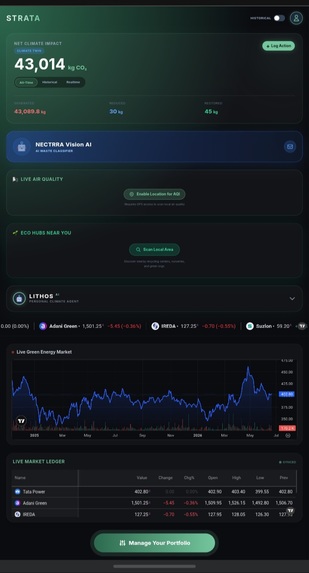
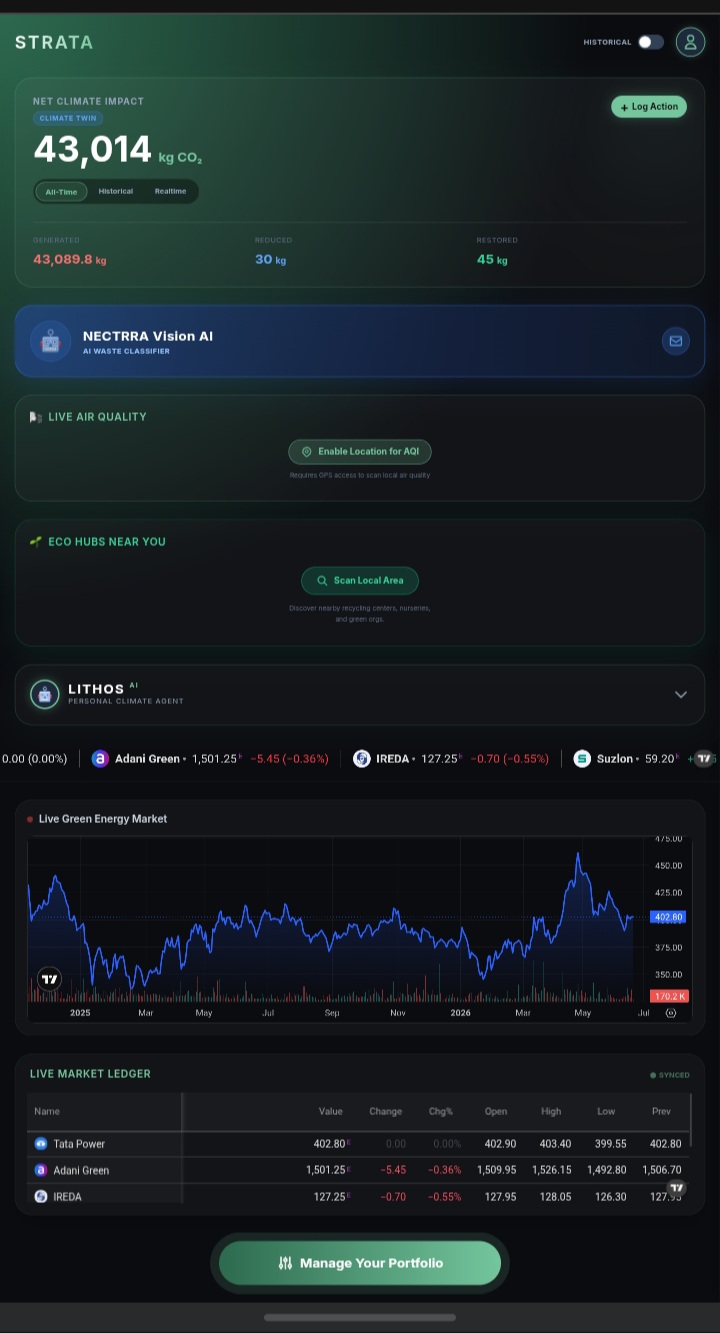
Home Page
-
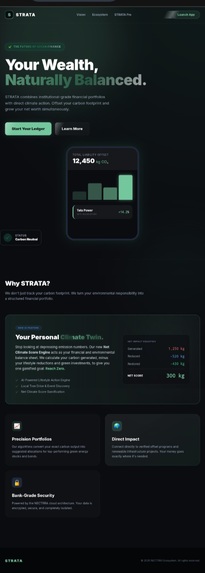
Landing Page
-
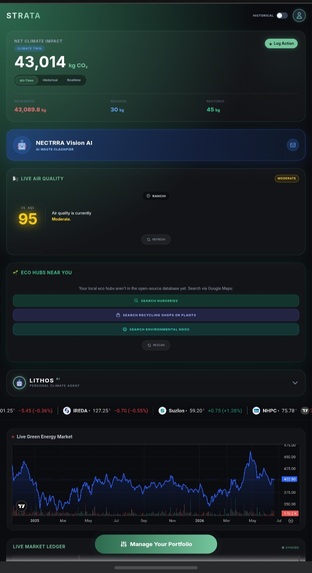
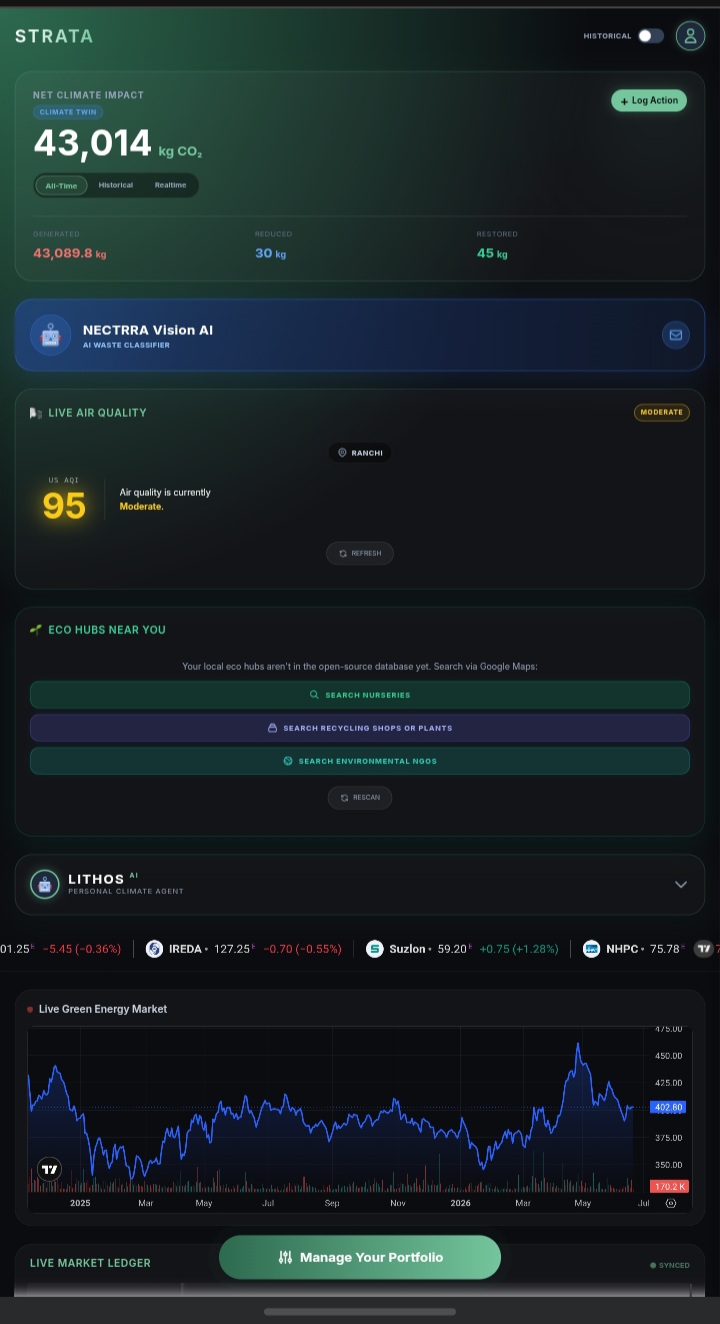
AQI of your Area
-
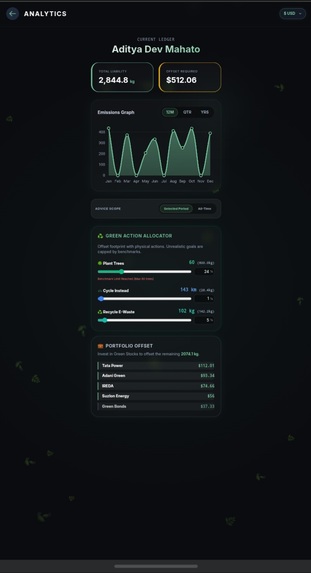
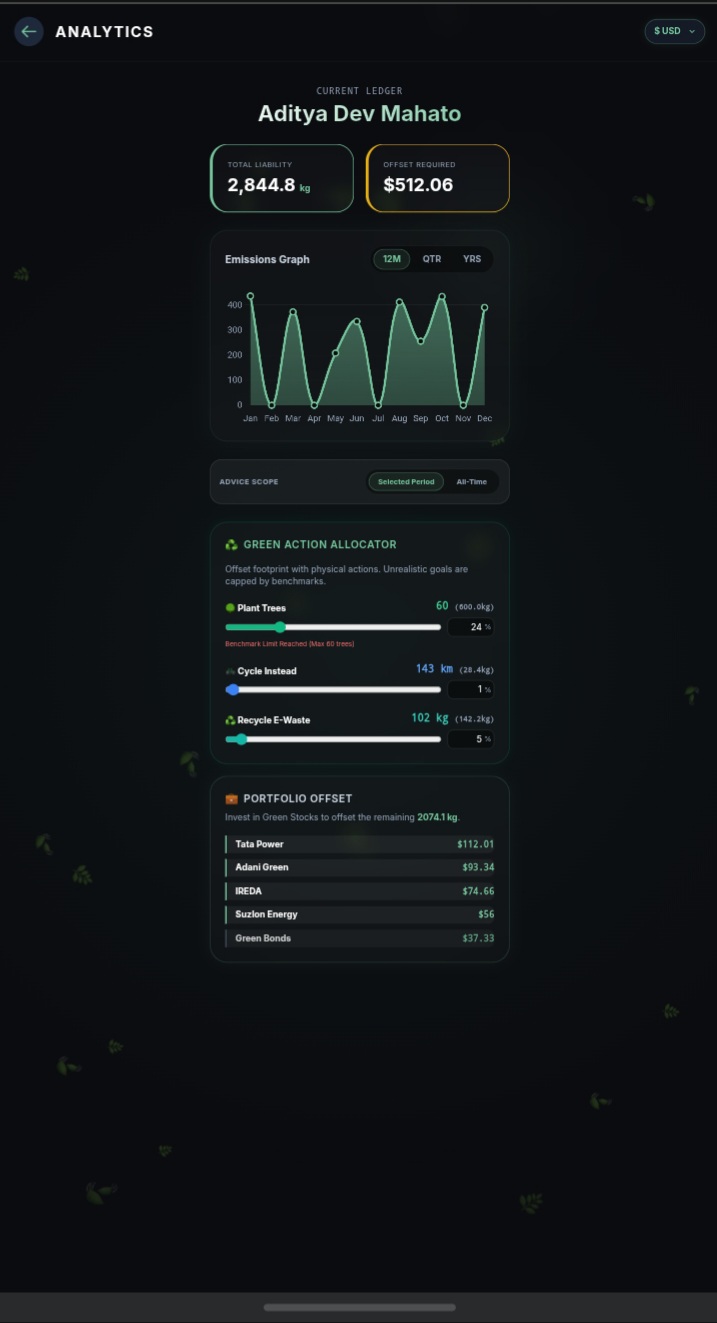
Analytics Ledger
-
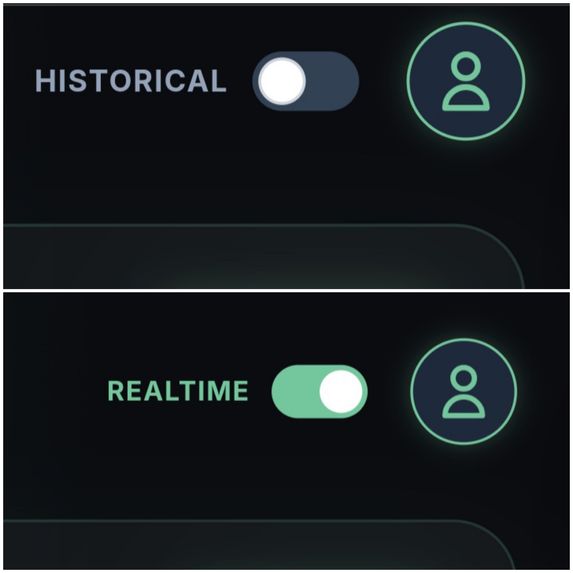
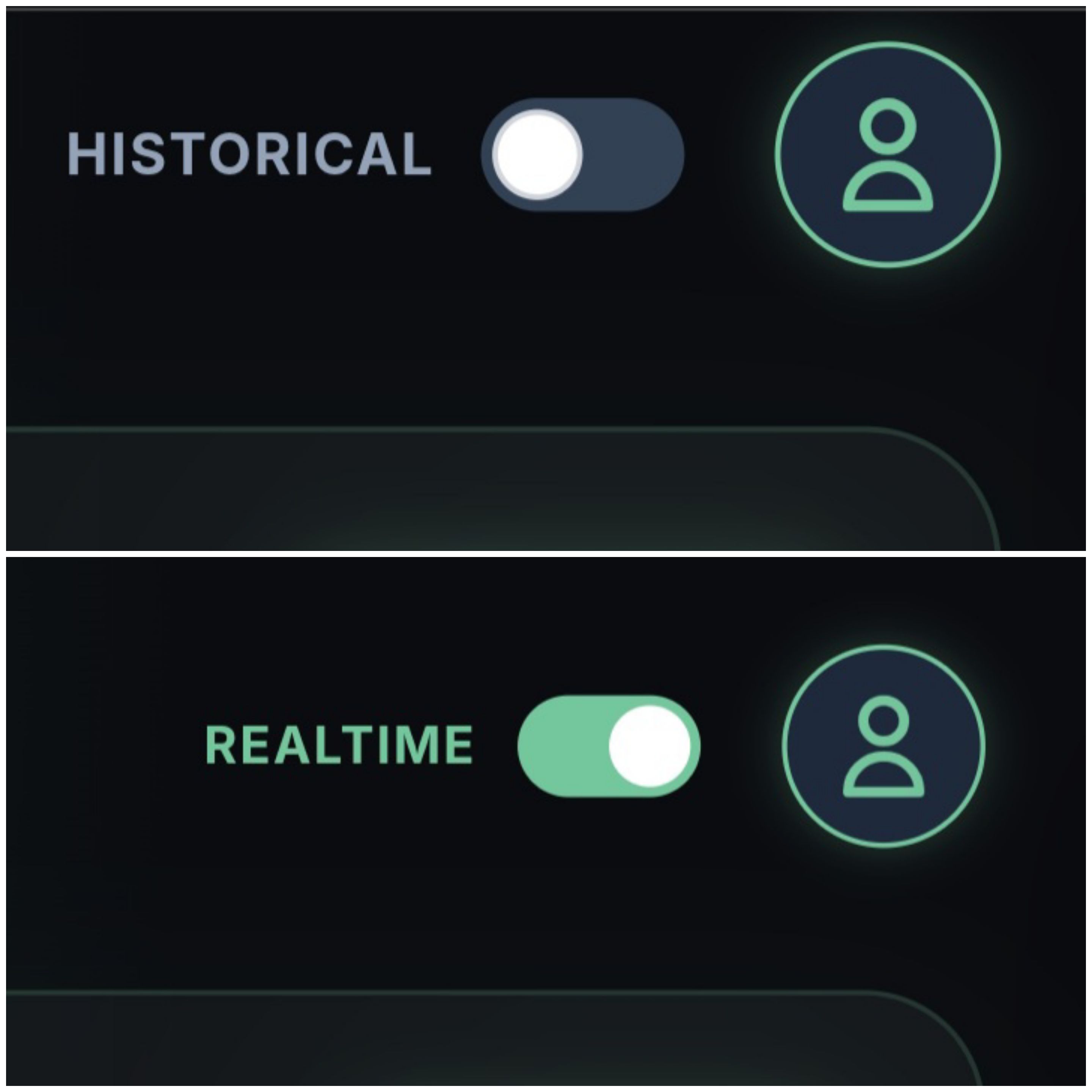
Historical and Realtime Modes.
-
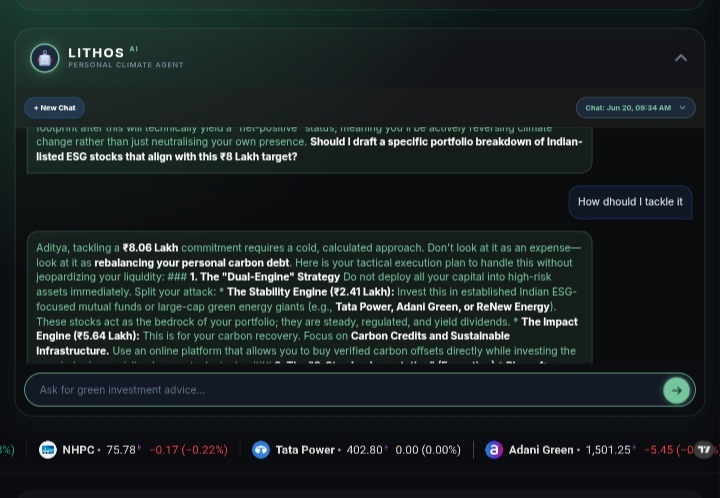
Lithos AI
-
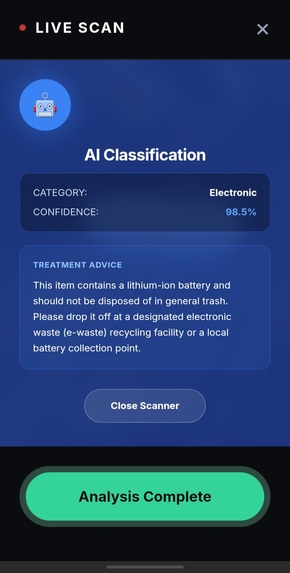
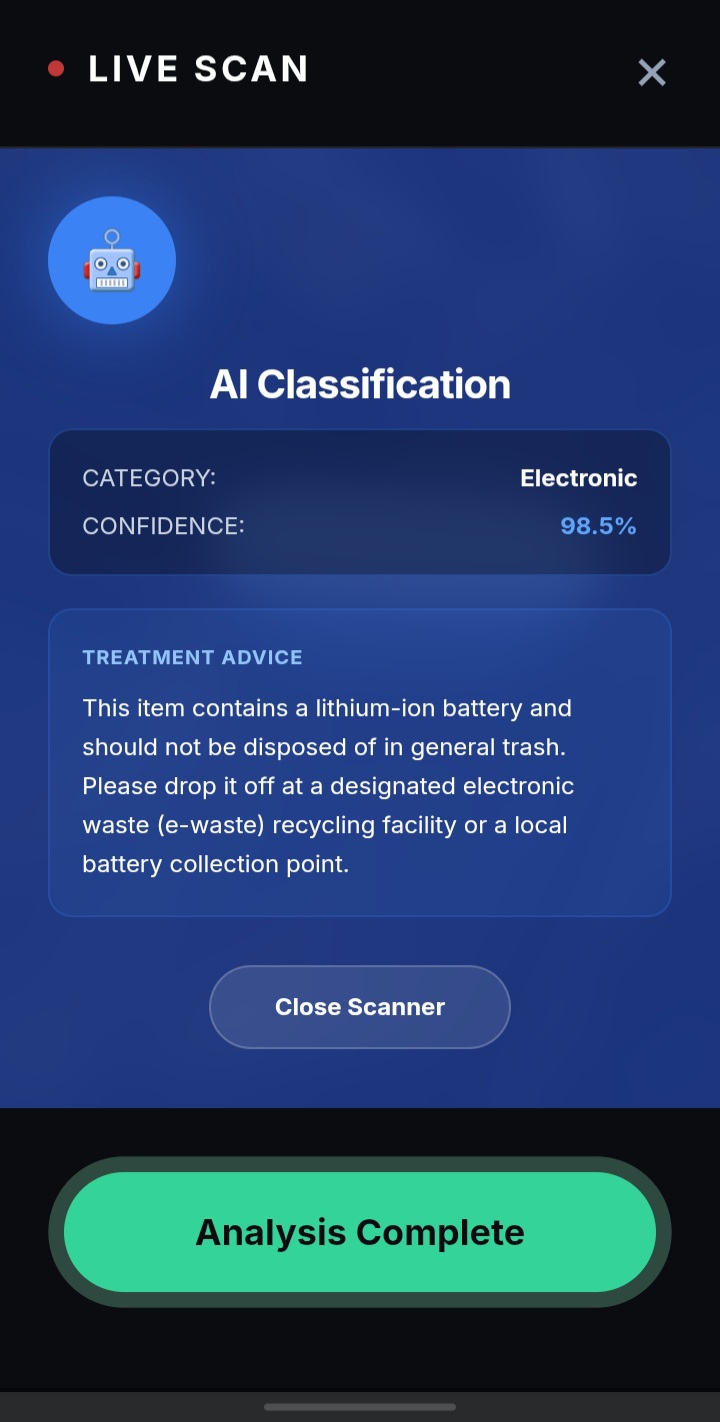
AI Powered Waste Classifier
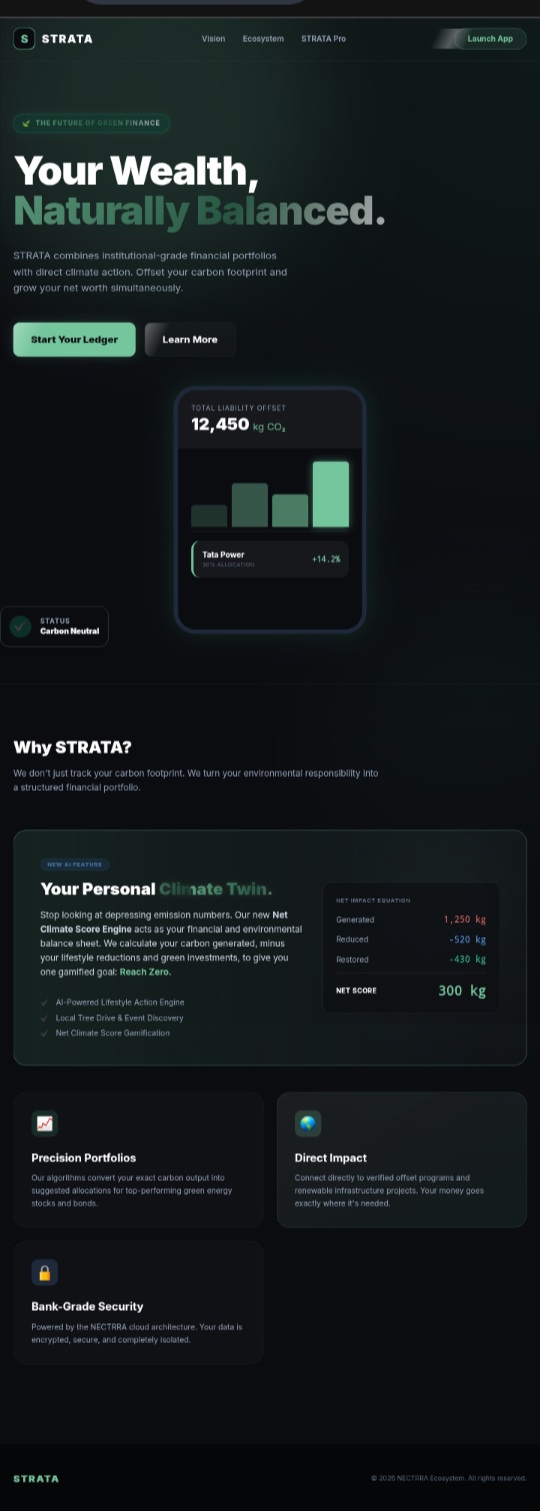
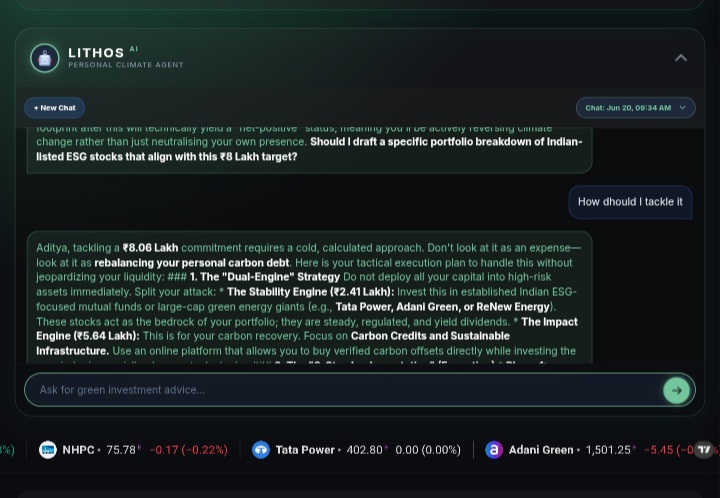
💡 Inspiration Climate change often feels distant and abstract. When people hear that they generated "1 kg of CO₂," it rarely translates into meaningful understanding or action. We wanted to bridge the gap between awareness and impact by making environmental responsibility measurable, visual, and actionable. This inspired us to create STRATA, an AI-powered Climate Intelligence Platform that combines carbon tracking, environmental analytics, waste management, and sustainability coaching into a single ecosystem. Rather than simply displaying emissions, STRATA helps users understand their footprint, discover local environmental resources, and take personalized actions toward a more sustainable future.
⚙️ What It Does STRATA is a comprehensive environmental intelligence platform designed to help individuals make smarter climate decisions. 🌱 Carbon Engine Calculates a user's estimated carbon footprint based on electricity consumption, transportation habits, and lifestyle choices, translating daily activities into measurable environmental impact. 📊 Analytics Ledger Generates a dynamic environmental dashboard featuring a personalized Net Climate Score, emissions trends, and AI-generated sustainability insights. The platform also estimates educational green investment opportunities and sustainability-focused portfolios. ♻️ NECTRRA Vision AI A multimodal waste-classification system that uses device cameras and AI-powered image analysis to identify recyclable materials, e-waste, biodegradable waste, and more. Users receive instant disposal and recycling guidance. 🤖 Lithos AI Coach An intelligent sustainability assistant that answers environmental questions, provides personalized recommendations, and guides users toward practical climate actions. 📍 Eco-Hub Radar & Live AQI Uses geolocation and mapping technologies to discover nearby recycling centers, NGOs, plant nurseries, and environmental initiatives while displaying real-time air quality information.
🏗️ How We Built It STRATA was designed as a fast, scalable, and lightweight web platform powered by modern cloud technologies and AI. Frontend Vanilla HTML, CSS, and JavaScript Tailwind CSS Custom animations, glassmorphism, and responsive UI design Backend & Infrastructure Firebase Authentication for secure user access Cloud Firestore for real-time environmental data storage and synchronization Artificial Intelligence Google Gemini 1.5 Flash API Natural language conversations through Lithos AI Coach Multimodal image analysis for NECTRRA Vision AI Structured JSON outputs for reliable frontend integration Geospatial & Environmental Data OpenStreetMap Overpass API Nominatim Reverse Geocoding Open-Meteo APIs Live Air Quality Index integration Mathematical Carbon Engine Our environmental ledger continuously calculates emissions and recovery metrics using a set of carbon conversion models. Net Climate Score: $$ \text{NetScore} = \text{Generated}_{CO_2} (\text{Reduced}{CO_2} + \text{Restored}{CO_2}) $$ Example Offset Calculations: $$ \Delta \text{Cycle Offset} \text{Distance (km)} \times 0.2 \text{ kg CO}_2 $$ $$ \Delta \text{Vegan Meal Offset} \text{Meals} \times 1.5 \text{ kg CO}_2 $$ $$ \Delta \text{Recycle Offset} \text{Mass (kg)} \times 1.4 \text{ kg CO}_2 $$ These calculations allow users to visualize the environmental impact of their actions in real time.
🧗 Challenges We Faced
- Reliable AI Outputs Large Language Models naturally generate conversational responses. For waste classification, however, our frontend required deterministic data structures. We carefully engineered prompts to ensure Gemini consistently returned structured JSON outputs that could be parsed safely.
- Managing Complex Async Operations Without using frameworks like React, coordinating Firebase listeners, geolocation services, AI responses, environmental APIs, and real-time dashboard updates required careful state management and asynchronous programming.
- Global Localization Supporting multiple regions introduced challenges involving currency conversion, time zones, environmental datasets, and localization. We implemented dynamic formatting systems that adapt calculations and dashboards to different user locations.
🧠 What We Learned Through STRATA, we gained valuable experience across multiple domains: Integrating AI as an application layer rather than a standalone chatbot. Designing reliable prompt engineering workflows for structured outputs. Working with geospatial data and environmental mapping systems. Building reactive, data-driven interfaces using Vanilla JavaScript. Translating environmental science concepts into meaningful user experiences. Most importantly, we learned that sustainability tools become significantly more effective when they focus on action rather than awareness alone.
🚀 What's Next for STRATA We plan to expand STRATA into a complete environmental intelligence ecosystem. Future developments include: Smart-home IoT integration for automatic electricity tracking. Advanced AI-powered climate simulations. Community sustainability leaderboards. University and corporate climate competitions. Enhanced carbon recovery planning and local environmental engagement tools. A full financial ecosystem that also take the accountability of sustainable development. Our long-term vision is to transform STRATA from a personal sustainability tracker into a global platform that empowers individuals, organizations, and communities to achieve measurable environmental impact together.
Built With
- chart.js
- cloudfirestore
- css3
- firebase
- firebaseauthentication
- firebasehosting
- geolocationapi
- googlegeminiflash-liteapi
- html5
- intl.datetimeformatapi
- javascript
- javascript(es6+)
- latex
- mathjax
- nominatimapi
- open-meteoapi
- openstreetmap
- overpassapi
- tailwindcss

Log in or sign up for Devpost to join the conversation.