-
-
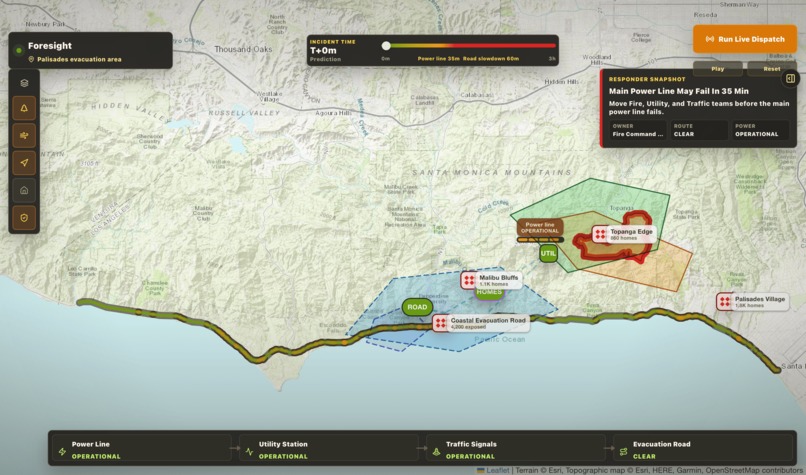
Screenshot of Foresight
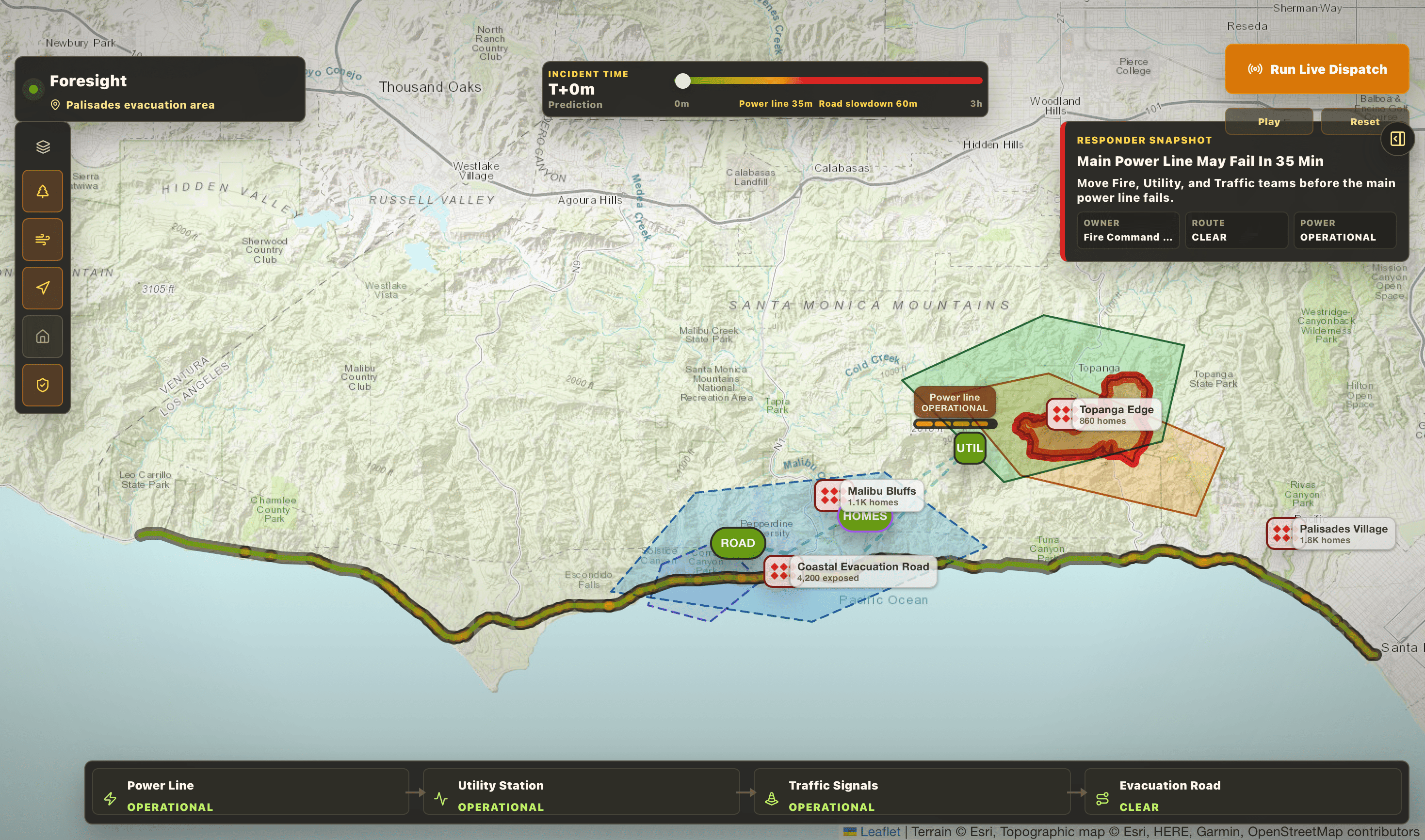
Foresight
The disaster has not happened yet. We have already mapped it.
Inspiration
The January 2025 Pacific Palisades wildfire exposed a dangerous gap in emergency response: people often do not die from the initial disaster alone, but from the cascading infrastructure failures that follow.
A wildfire can damage power lines, trigger substation outages, disable traffic signals, block evacuation routes, and create secondary hazards like debris flows—all across agencies that traditionally operate in silos.
We asked:
What if emergency responders could see the full cascade before it happens, with AI recommendations they can actually trust?
That became Foresight.
What It Does
Foresight is a multi-agent emergency response coordination platform that models wildfire-driven infrastructure cascade failures in real time.
It helps emergency operators understand not just where a wildfire is, but what that wildfire will do next.
For our demo scenario, Foresight simulates the Pacific Palisades wildfire and predicts a cascading failure where:
- Fire threatens transmission infrastructure
- Power infrastructure fails
- Traffic signals lose power
- Evacuation routes become blocked
- Secondary hazards, including debris flow, emerge
Instead of showing isolated incidents, Foresight provides a unified operational picture across agencies.
How We Built It
Foresight was built as a distributed multi-agent emergency intelligence system with a simulation dashboard, orchestration backend, deterministic validation engine, and AI coordination layer.
Frontend
Built with:
- React
- Vite
- Leaflet
- Interactive map simulation
- Cascade replay timeline slider
- Validator event feed
- Agency command panels
The frontend visualizes wildfire spread, infrastructure failures, evacuation impact, and cross-agency recommendations in a real-time operations dashboard.
Backend
Built with:
- FastAPI
- Python
- Server-Sent Events (SSE)
- Structured JSON contracts
- Timestep simulation orchestration
The backend manages simulation state, event propagation, agent execution, and communication with the frontend.
AI Layer
Our AI coordination system includes:
- Hazard Agent
- Cascade Agent
- Secondary Hazard Agent
- Coordinator Agent
Powered by:
- Featherless AI API
- IBM watsonx.ai Granite
Each agent specializes in a different operational domain, allowing parallel reasoning and coordinated emergency recommendations.
Physics Validation Layer
A major differentiator is deterministic validation.
Foresight validates AI outputs against physical reality before recommendations reach operators.
Validation models include:
- Rothermel wildfire spread modeling
- Deterministic infrastructure dependency logic
- USGS debris-flow probability modeling
Debris flow risk is evaluated conceptually as:
P = f(slope, burn severity, rainfall intensity)
If an AI recommendation conflicts with known physical constraints:
Foresight rejects the output and forces a replan.
This prevents hallucinated emergency recommendations from reaching decision-makers.
Challenges We Ran Into
The biggest challenge was balancing ambitious real-world disaster modeling with hackathon execution speed.
Key challenges included:
- Designing a believable multi-agent architecture under extreme time constraints
- Integrating deterministic validation with probabilistic AI outputs
- Synchronizing frontend simulation visuals with backend state changes
- Modeling infrastructure dependencies clearly enough for judges to understand instantly
- Building a dashboard that feels like a real emergency operations centre
- Managing integration across parallel team workflows
One especially difficult challenge was explainability.
In emergency response: > "AI says so" is not acceptable.
Operators need reasoning they can trust—not black-box outputs.
Building trust became just as important as building intelligence.
Accomplishments That We're Proud Of
Physics-Validated AI Recommendations
Foresight checks AI-generated recommendations against deterministic physical models before surfacing them.
This dramatically improves reliability in high-stakes scenarios.
Cross-Agency Coordination Emergency response is often fragmented.
Foresight brings together:
- Fire response
- Utility operations
- Traffic management
- Evacuation planning into a single coordinated operational picture.
Clear Simulation Storytelling
The infrastructure cascade is visually understandable within seconds:
Wildfire → Power Failure → Traffic Failure → Evacuation Blockage → Secondary Hazard
That clarity makes the platform both technically compelling and immediately understandable.
Multi-Agent Architecture
We successfully built a distributed AI coordination system where specialized agents collaborate instead of relying on one monolithic model.
What We Learned
This project taught us that emergency AI systems need more than intelligence.
They need trust.
We learned that:
- LLMs are powerful for coordination, but require guardrails
- Deterministic validation dramatically improves reliability
- Visualization is just as important as backend sophistication
- Multi-agent systems are effective for decomposing complex emergency workflows
- Disaster response requires interoperability across domains
Most importantly:
Impactful AI is not about replacing experts. It is about augmenting decision-making under pressure.
What's Next for Foresight
Foresight currently focuses on wildfire infrastructure cascade response, but the architecture is extensible.
Next steps include:
- Real-time live incident ingestion
- Flood response modeling
- Hurricane infrastructure cascade simulation
- Earthquake emergency coordination
- GIS infrastructure integrations
- Emergency notification system integration
- Predictive evacuation route optimization
- More advanced infrastructure dependency modeling
- Incident commander collaboration tools
- Multi-region deployment support
Our long-term vision is to make Foresight a trusted operating system for disaster coordination: Transparent, validated, AI-assisted emergency decision-making when every minute matters.
Built With
- fastapi
- featherless-ai-api
- git
- github
- ibm-granite
- ibm-watsonx.ai-api
- javascript
- json
- leaflet.js
- nasa-srtm
- nifc-geojson
- open-meteo-api
- openstreetmap
- python
- react
- react-leaflet
- rest-apis
- server-sent-events
- tailwind-css
- twilio
- vite


Log in or sign up for Devpost to join the conversation.