-
-
Cover image
-
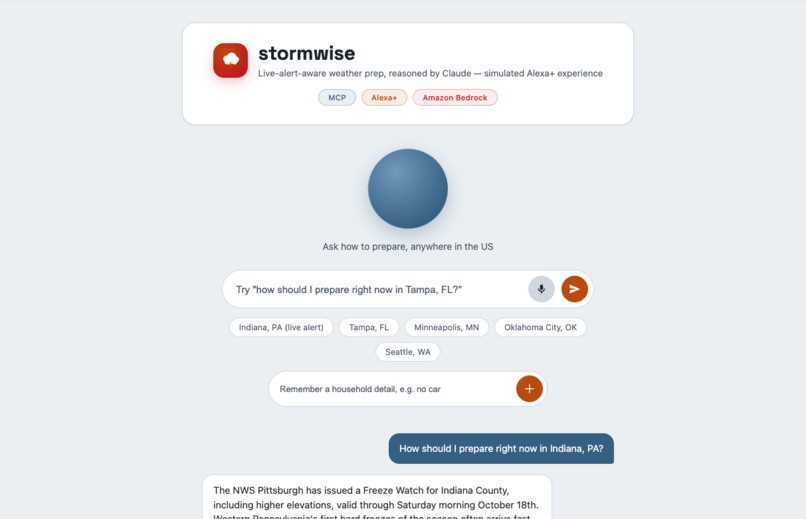
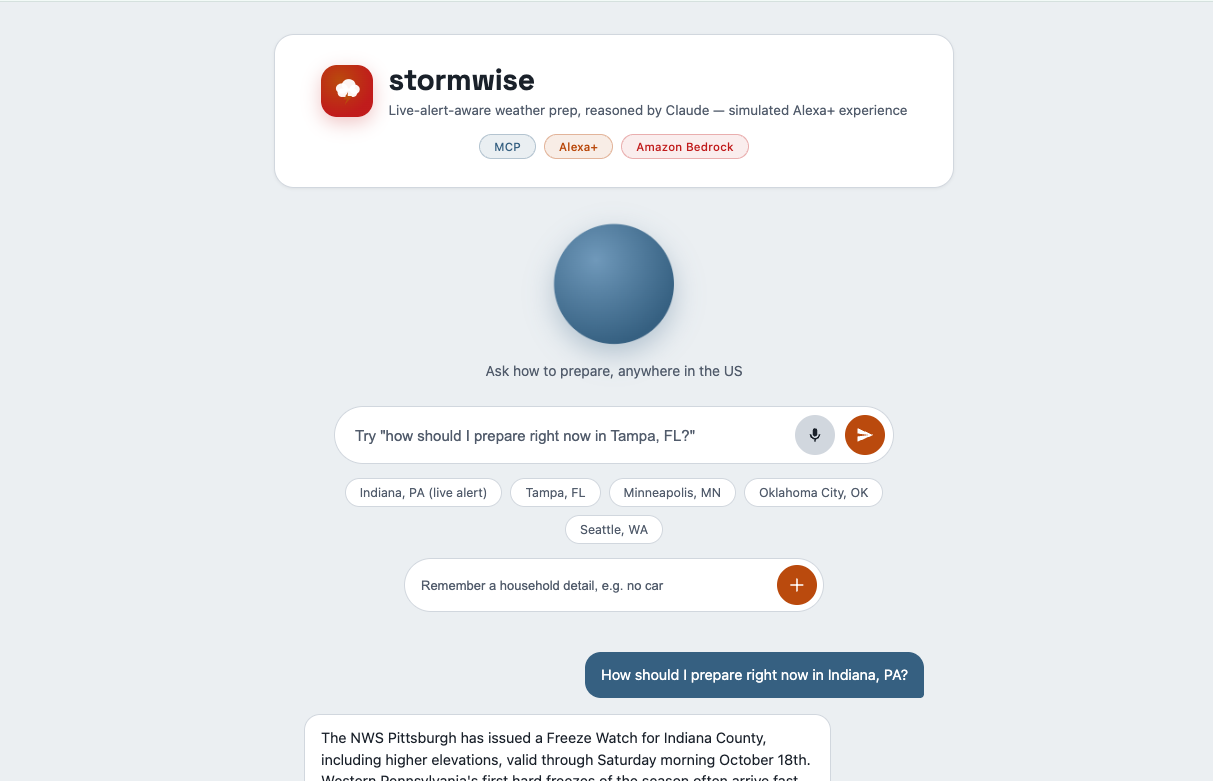
Simulated Alexa UI
-
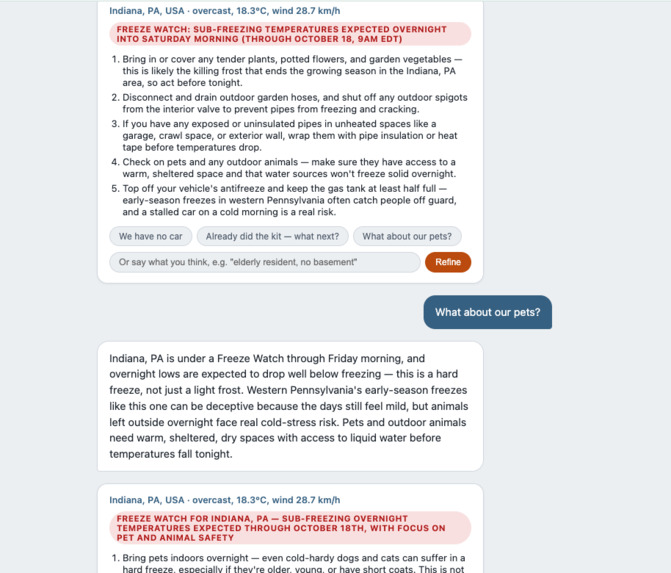
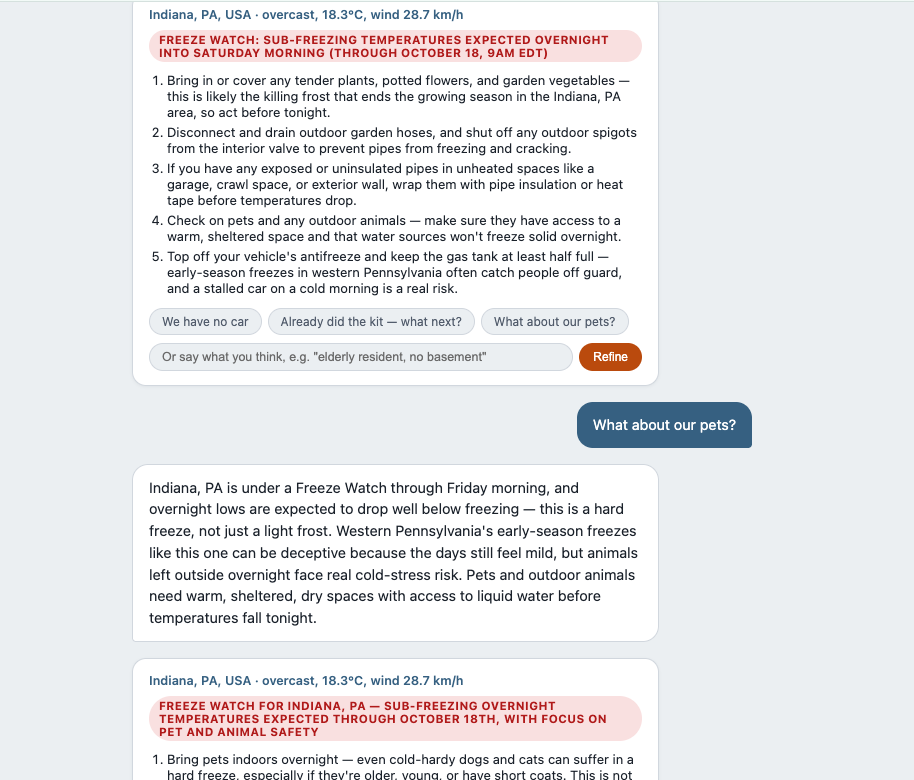
Live Alert
-
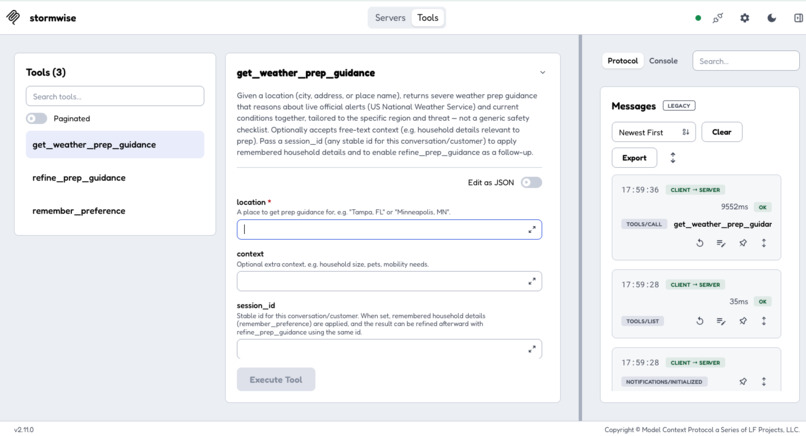
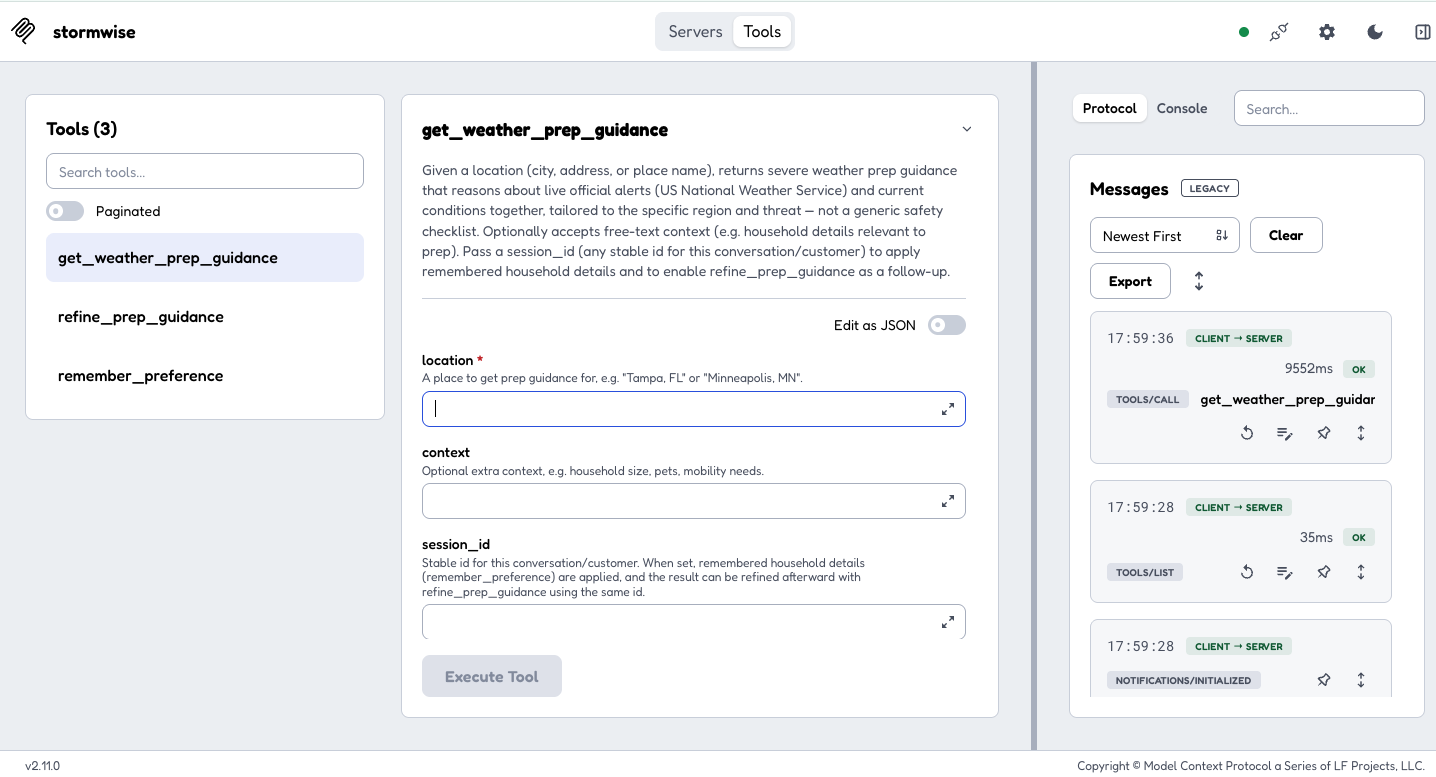
MCP tool recommendation
-
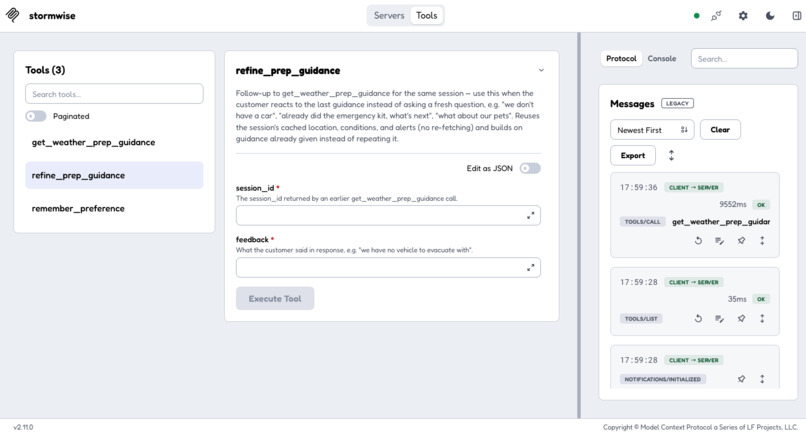
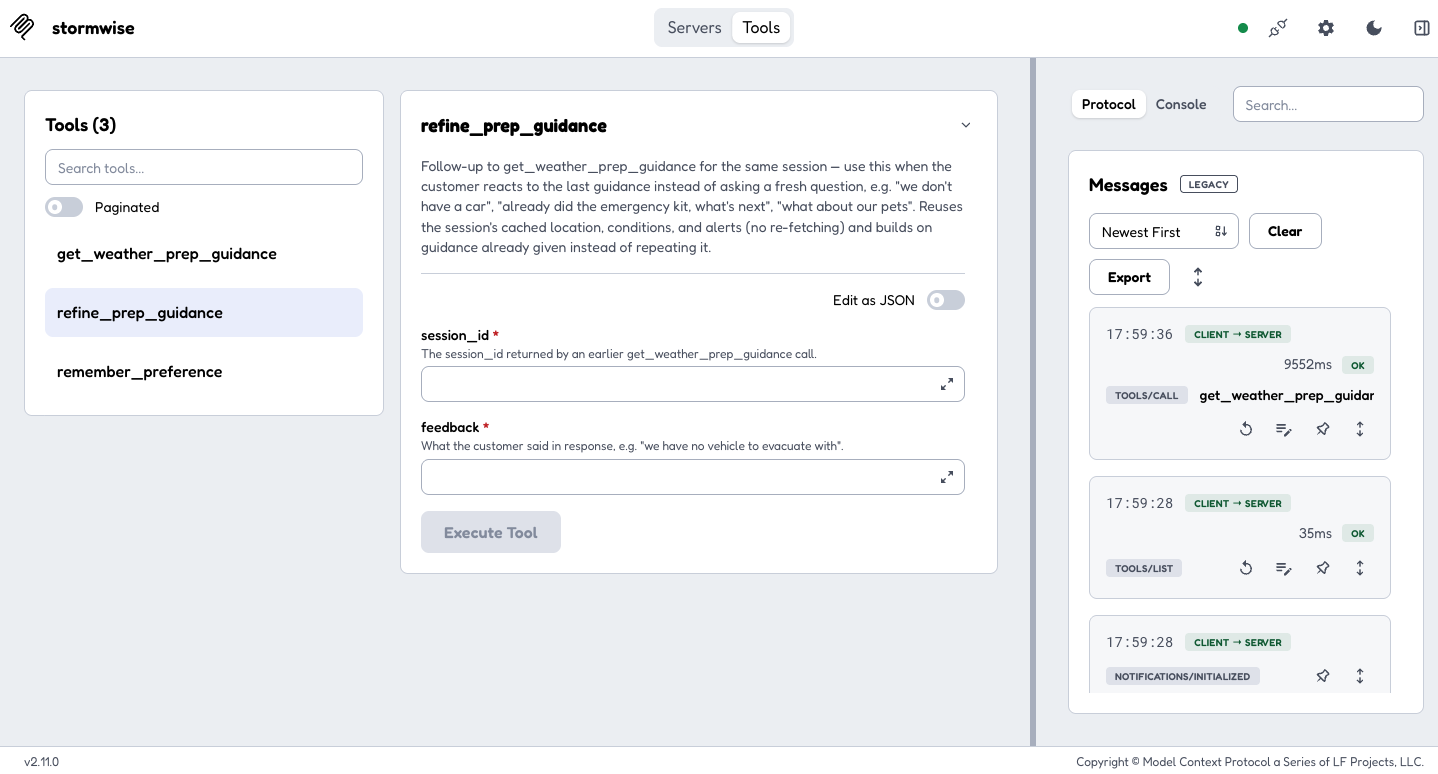
MCP tool refinement
Inspiration
Forecast Fork taught me the shape of a good Alexa+ MCP tool: external real-time data + LLM reasoning, callable mid-conversation. But dining recommendations are a convenience. I wanted a second project on the same architecture solving something with actual stakes — a domain where generic advice isn't just less helpful than specific advice, but can be actively wrong at the moment it matters most. Severe weather prep was the obvious answer: what you need to do during a flash flood warning in a desert city, a blizzard warning in the upper Midwest, or a wildfire red-flag day in California are completely different, and a generic-tips assistant can't tell the difference.
What it does
Stormwise is an MCP server exposing three tools Alexa+ can call mid-conversation:
get_weather_prep_guidance— give it a location, and it geocodes it, pulls current conditions and any live official alerts from the US National Weather Service, then asks Claude (on Amazon Bedrock) to reason about what to actually do — specific, regionally-calibrated prep steps with a severity rating, not a generic "have a kit ready" checklist. Outside the US, where NWS doesn't have coverage, it says so honestly rather than pretending there's no risk.remember_preference— stores a standing household detail ("no car", "elderly resident", "two dogs") against asession_id, so it's applied automatically to every guidance call in that conversation instead of the customer repeating it.refine_prep_guidance— a follow-up turn ("we already did the kit, what's next?", "we have no car") that reuses the session's cached location, conditions, and alerts (no re-fetching) and builds on the guidance already given instead of repeating it.
That last pair turns this from a single-turn Q&A bot into a multi-turn conversation — a customer states a constraint like "no car" once, and every later call, including follow-ups, reasons with that constraint already in mind.
How I built it
The core pipeline: geocode (Google Geocoding API) → current conditions (Open-Meteo, no key) and
active alerts (NWS, no key, just a courtesy User-Agent header) in parallel → Claude on Bedrock
with forced tool-use, returning structured guidance (primary_concern, severity, prep_steps[],
reasoning).
Session memory sits alongside that pipeline as a small in-memory store keyed by session_id:
get_weather_prep_guidance writes the location/conditions/alerts/steps it just produced (and any
remembered household details it applied), and refine_prep_guidance reads that back so it can
reason again without repeating an API call or repeating advice already given.
Same three-path validation as Forecast Fork — MCP Inspector for protocol proof (now also showing
refine_prep_guidance carrying session state across calls), a restyled Echo-style web UI with a
severity-badge/prep-steps card plus a "remember a household detail" field and per-guidance refine
chips, and alexa-skill-mcp-bridge for a real orchestrator conversation. I also built a
comparison mode: the same location reasoned about with live alert data versus an "alert-blind"
baseline (season and conditions only, roughly what a static tips page would produce).
Challenges I ran into
The comparison mode surfaced something I didn't expect. Testing Tucson, AZ during an actual live Flash Flood Warning, the alert-blind baseline didn't just sound vaguer — it stated as fact that there were no active alerts, when there were two. That's not a quality gap, it's a factual error, and it reshaped how central that comparison became to the whole pitch.
No free, global severe-weather-alert API exists. NWS is excellent but US-only. Rather than
fake international coverage, I built an explicit "unsupported" state and documented the gap
honestly instead of glossing over it.
The latency problem is worse here than in Forecast Fork. Prep guidance tends to be more detailed than a dining suggestion, so my average Bedrock call runs 7.2 seconds against Alexa+'s <500ms target — a gap I chose to document rather than hide.
Accomplishments that I'm proud of
- A concrete, real proof that live data changes correctness, not just quality — the alert-blind baseline's false "no active alerts" claim, caught during an actual live warning, not staged.
- 100% success across 15 US regions spanning hurricane coastlines, tornado alley, blizzard country, and wildfire terrain — real load-test data with measured token costs: ~1183 input / ~362 output tokens per call, working out to roughly $0.009/query at Sonnet-class Bedrock pricing.
- Built and validated against a real, live severe weather event (Tucson's Flash Flood Warning), rather than only synthetic test cases.
- Personalization and multi-turn refinement, not just single-shot answers:
remember_preferenceandrefine_prep_guidancelet a customer state a household constraint once and react to guidance naturally ("what about our pets?") without repeating themselves or restarting the conversation. - Reused a proven architecture responsibly — same rigor (three validation paths, real load testing, honest limitations) as my first project, not a lower-effort copy.
- A deliberately distinct visual identity: rather than reusing forecast-fork's dark cyan/violet theme, stormwise's demo UI is light and NWS/NOAA-styled — amber-to-red severity colors doing the brand work instead of blue, so the two companion projects read as genuinely different products, not a palette swap of the same template.
What I learned
Domain choice matters as much as architecture. The exact same technical pattern — geocode, pull
live data, reason with an LLM — produces a far more compelling story when the live data genuinely
changes correctness rather than just specificity. I learned to run baseline comparisons against
real conditions, not assumed ones — the "no active alerts" hallucination was only visible because
I happened to test during an actual live warning. And carrying the session-memory pattern over
from Forecast Fork confirmed it wasn't a one-off trick: the same session_id mechanism that made
dining follow-ups feel natural did the same for prep guidance, which suggests it's a reusable
building block for any Alexa+ MCP tool, not something specific to one domain.
What's next for Stormwise
- International alert coverage — aggregating multiple national meteorological agency APIs to close the US-only gap.
- Elicitation and the OAuth 2.1/PRM auth layer — the same gaps as Forecast Fork, not yet closed here either.
- A proactive mode — alerting an Alexa+ household when a new severe warning is issued for their area, not only answering on request, which fits the safety domain better than a purely reactive assistant.
- Multi-hazard expansion — air quality and extreme heat advisories alongside NWS's storm/flood/wind alerts.
- Durable session storage — today's session memory is an in-memory
Mapper server process; moving it to a shared store (Redis/DynamoDB) would let it survive restarts and scale across multiple instances, which matters more here than for a dining app, since a household's prep context is exactly what you don't want to lose mid-emergency. - Faster response — given this project's latency gap (~7.2s vs. Alexa+'s <500ms target) is the largest of anything I've built so far.
Built With
- agentic-ai
- alexa+
- amazon-alexa
- amazon-bedrock
- amazon-nova
- amazon-web-services
- anthropic
- aws-sdk
- bedrock-agentcore
- claude
- css3
- express.js
- google-geocoding-api
- google-maps
- html5
- javascript
- llm
- mcp
- model-context-protocol
- national-weather-service-api
- node.js
- open-meteo
- strands-agents
- typescript
- web-speech-api

Log in or sign up for Devpost to join the conversation.