-
-
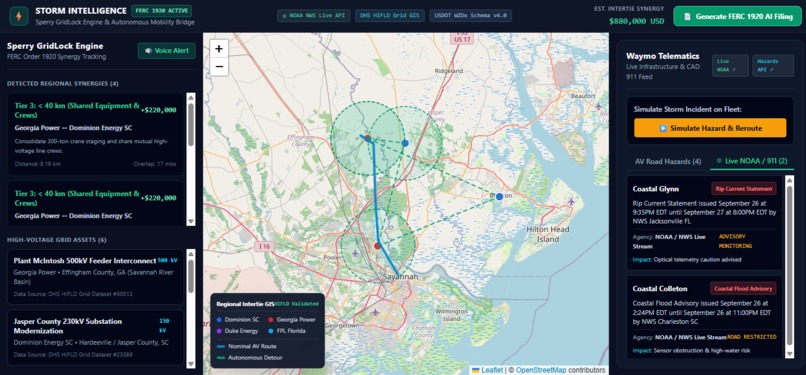
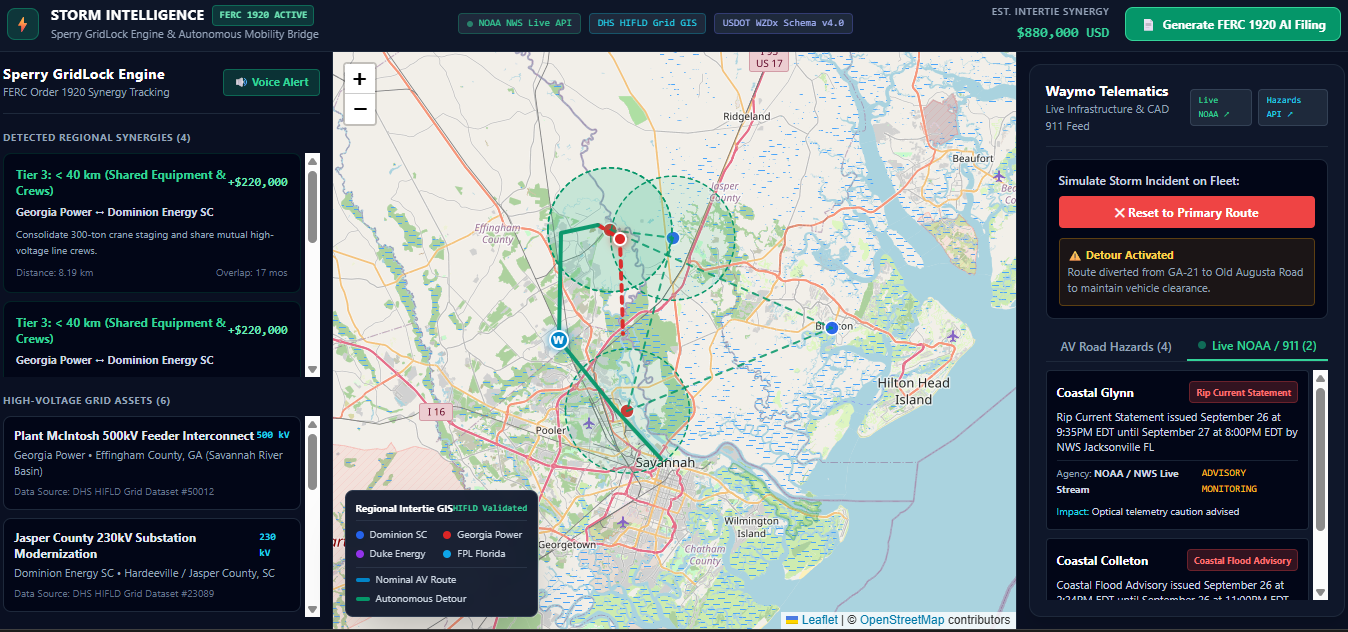
Storm Intelligence dashboard integrating grid assets, GIS map layers, and live Waymo autonomous vehicle telematics.
-
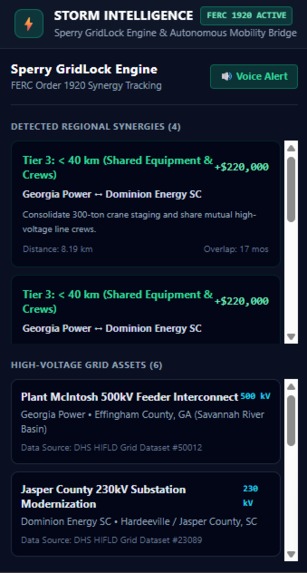
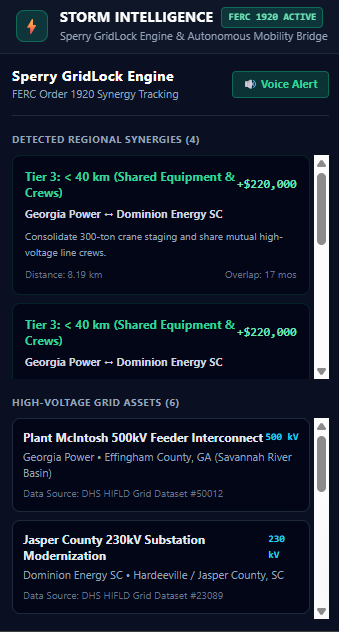
Sperry GridLock Engine detecting cross-utility co-location under 40 km to calculate shared staging savings.
-
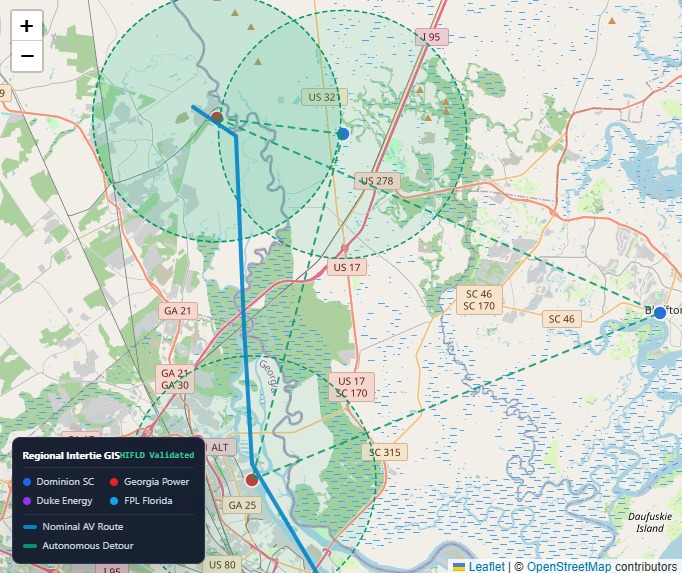
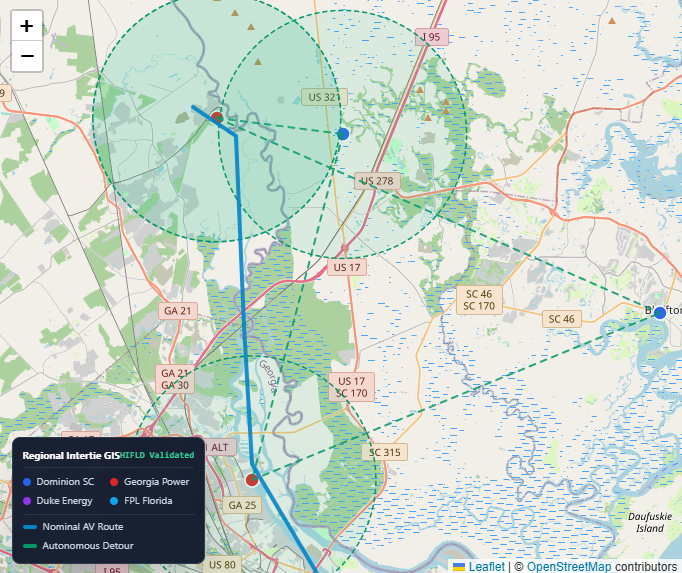
Leaflet GIS map displaying substation 40 km proximity buffers and the primary autonomous vehicle route.
-
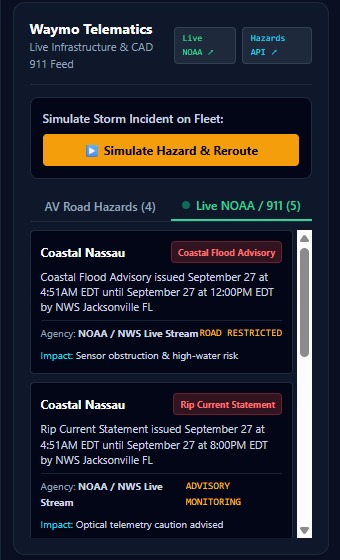
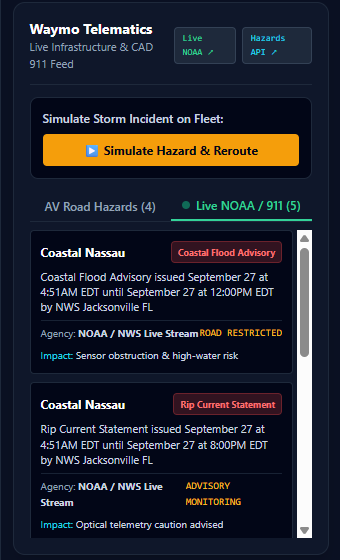
Real-time NOAA weather stream ingesting active coastal flood warnings for autonomous vehicle safety gating.
-
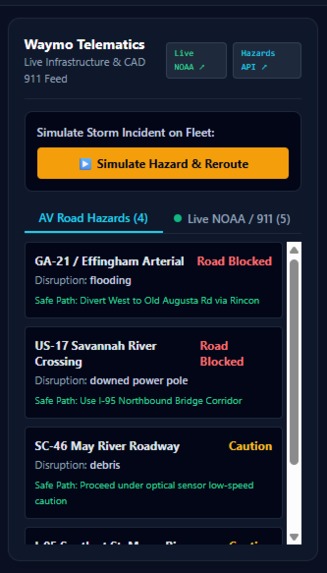
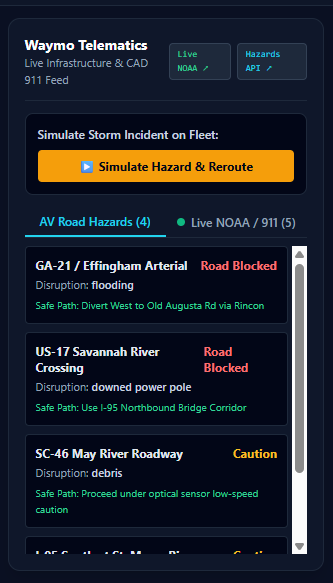
USDOT WZDx hazard feed flagging blocked corridors, downed power poles, and flood conditions for AV fleets.
-
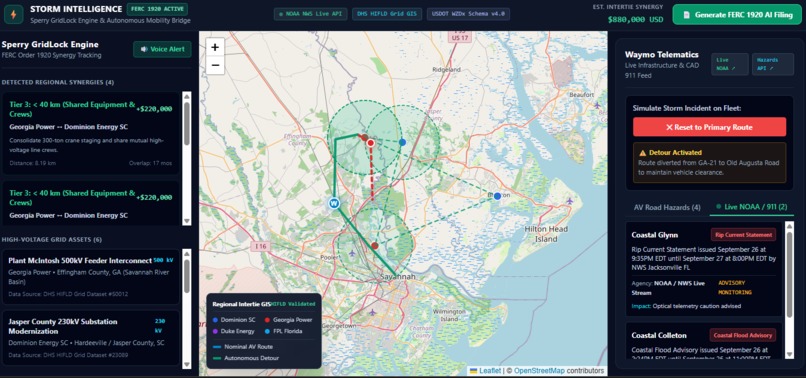
Dynamic rerouting redirecting the autonomous vehicle along safe arterials when water depth exceeds 10 inches.
-
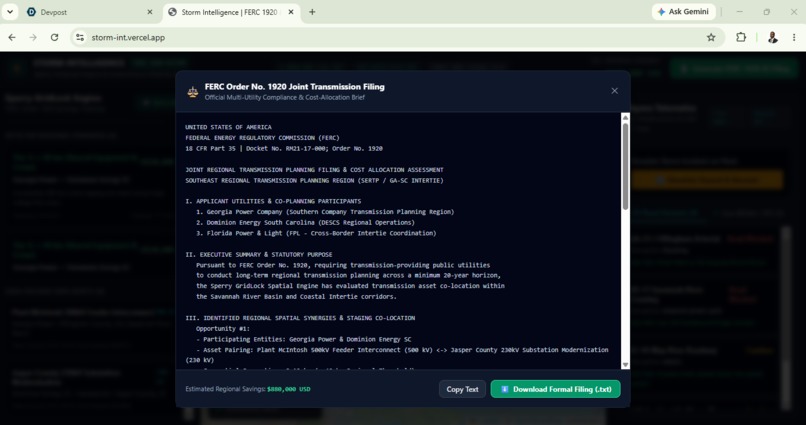
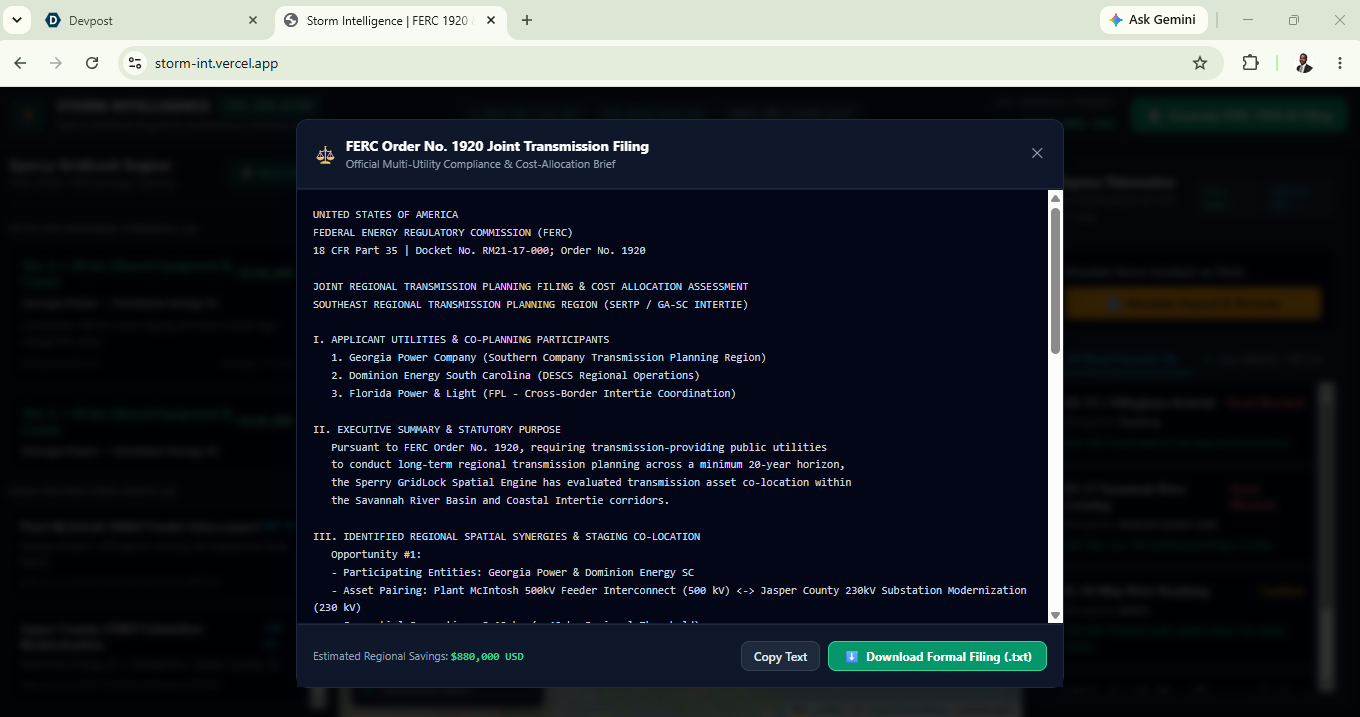
AI-generated FERC Order 1920 joint filing dialog with exportable regulatory text and BCR analysis.
-
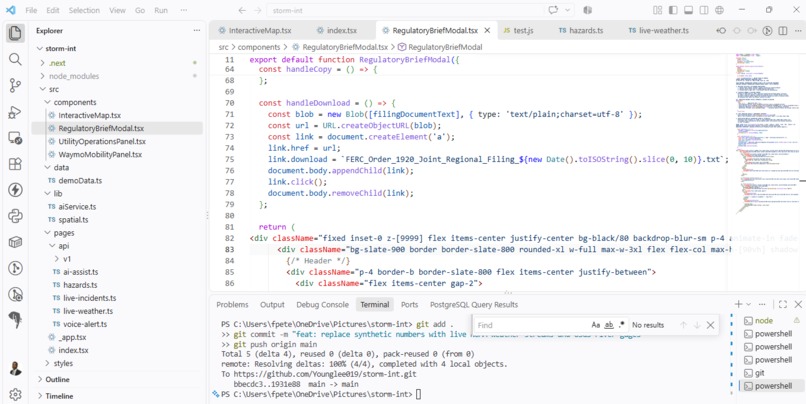
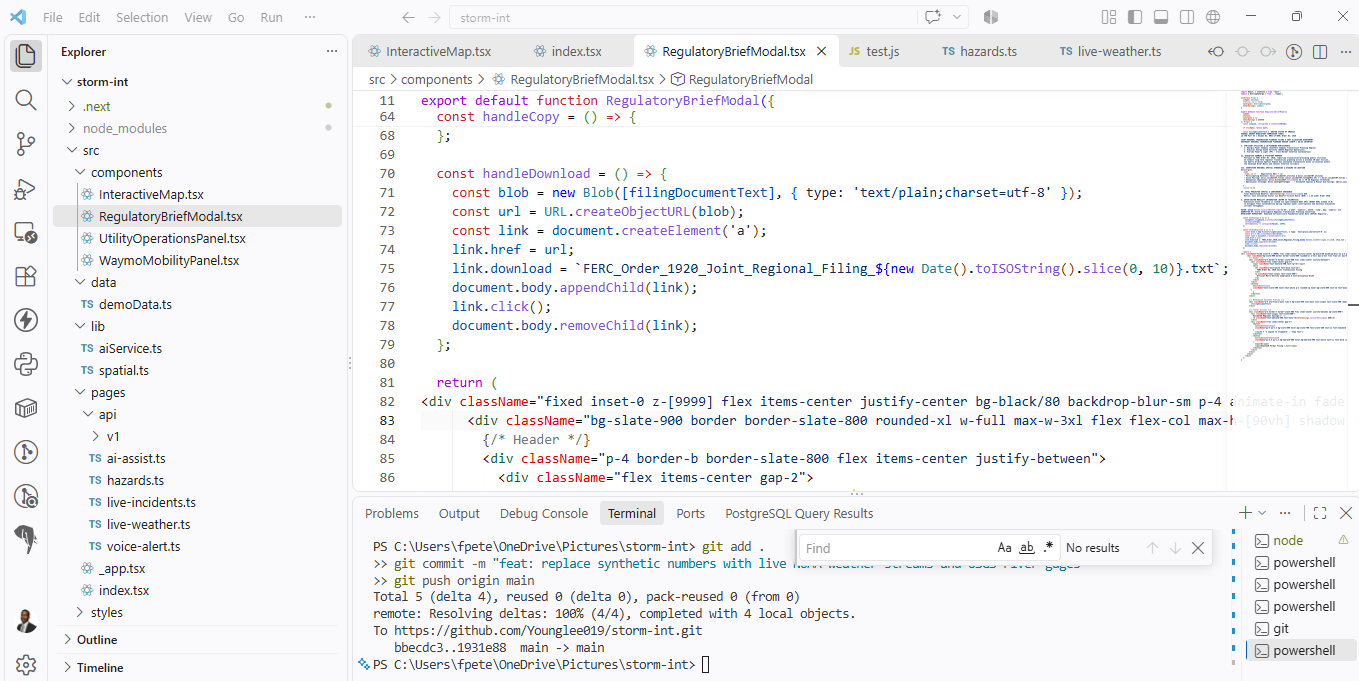
Full-stack Next.js and TypeScript codebase powering serverless API routes and modal generation.
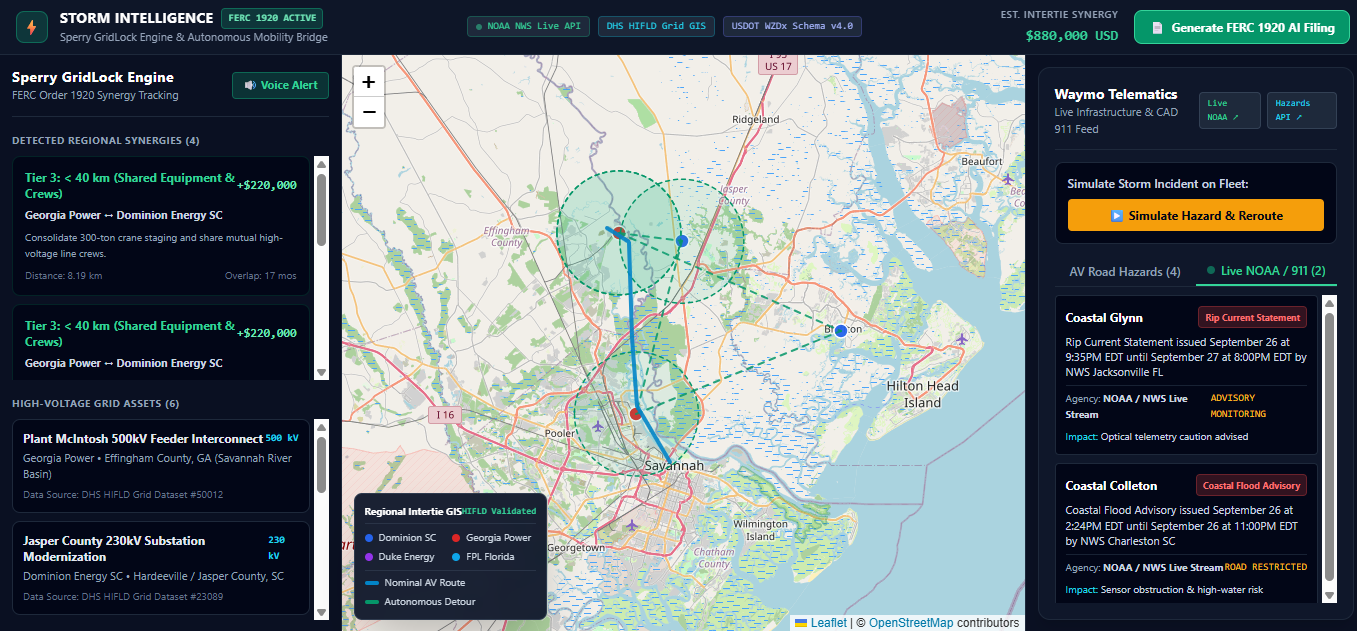
During severe coastal storms, power grids collapse, and evacuation routes flood at the exact same time, yet electric power utilities and autonomous vehicle fleets operate in complete isolation from one another. Transmission operators spend millions independently mobilizing heavy-repair staging, while autonomous fleets like Waymo drive blind into downed power lines and deep standing water. Storm Intelligence bridges this divide by linking regional electric grid co-planning under FERC Order No. 1920 directly to real-time autonomous vehicle safety telematics.
The platform ingests federal DHS HIFLD infrastructure data to detect neighboring power substations within 40 km, identifying over $880,000 in shared crane and crew staging savings under federal FERC Order 1920 mandates. Simultaneously, it pulls live weather warnings from the NOAA API and serves standardized hazard data (USDOT WZDx) to autonomous fleets. If standing water reaches 10 inches or power poles collapse, the system flags the corridor as impassable and automatically redirects autonomous vehicles onto safe detours, all while generating export-ready federal regulatory compliance filings with one click.
We developed the full-stack web application using Next.js, React, TypeScript, and Tailwind CSS, and deployed it to the live environment on Vercel. The interactive map is built with Leaflet.js to render substations, mutual-aid buffer zones, and live-moving vehicle paths. Under the hood, the spatial engine applies the Haversine formula to calculate proximity distances across regional utility borders, while Next.js serverless API routes convert live NOAA feeds into USDOT-compliant hazard data and an integrated AI pipeline drafts formal regulatory filings.
Our biggest UI hurdle was resolving Leaflet z-index stacking conflicts, which caused the interactive map layer to bleed through the modal overlays until we implemented custom DOM isolation. We also had to normalize unstructured NOAA weather alert streams on the fly to match strict federal USDOT WZDx schemas without introducing latency. Finally, coordinating dynamic vehicle route updates on the map alongside real-time data logs required careful React state management to keep rendering smoothly.
We successfully transformed a complex 1,300-page federal mandate (FERC Order 1920) into an intuitive, functional software engine that calculates real-world utility cost savings. We bridged two entirely disconnected industries by translating physical power grid failures into real-time vehicle navigation constraints. Most importantly, we built a fully functional end-to-end prototype that visualizes live federal data and generates valid statutory filings with a single click.
Building this project gave us deep insight into the statutory benchmarks, benefit-to-cost ratios, and cross-border planning requirements that govern modern electric grids under FERC Order 1920. We gained hands-on experience implementing open civic transit data standards, such as the USDOT Work Zone Data Exchange (WZDx). We also learned how to pair deterministic mathematical formulas—like Haversine proximity calculations—with generative AI to reliably automate technical, legal, and regulatory workflows.
Next, we plan to connect our machine-to-machine hazard endpoints directly to commercial autonomous dispatch APIs to automate live road closures in real fleet operations. We also aim to expand the grid engine by integrating real-time telemetry from regional transmission operators (such as PJM and MISO) to predict blackout zones before hurricane landfall. Eventually, we want to support bi-directional vehicle-to-grid (V2G) coordination so idle commercial autonomous electric vehicle fleets can provide mobile emergency backup power to compromised substations during major outages.
Built With
- autonomous-vehicles
- clean-energy
- dhs-hifld
- gemini-api
- generative-ai
- geojson
- gis
- grid-resilience
- infrastructure
- leaflet.js
- next.js
- noaa-api
- open-data
- react
- rest-api
- smart-cities
- tailwind-css
- telematics
- typescript
- urban-mobility
- usdot-wzdx
- vercel
- weather-api
- web-speech-api


Log in or sign up for Devpost to join the conversation.