-
-
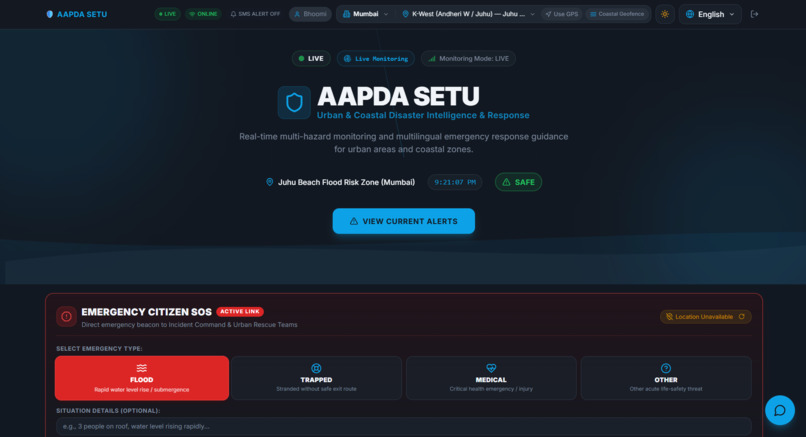
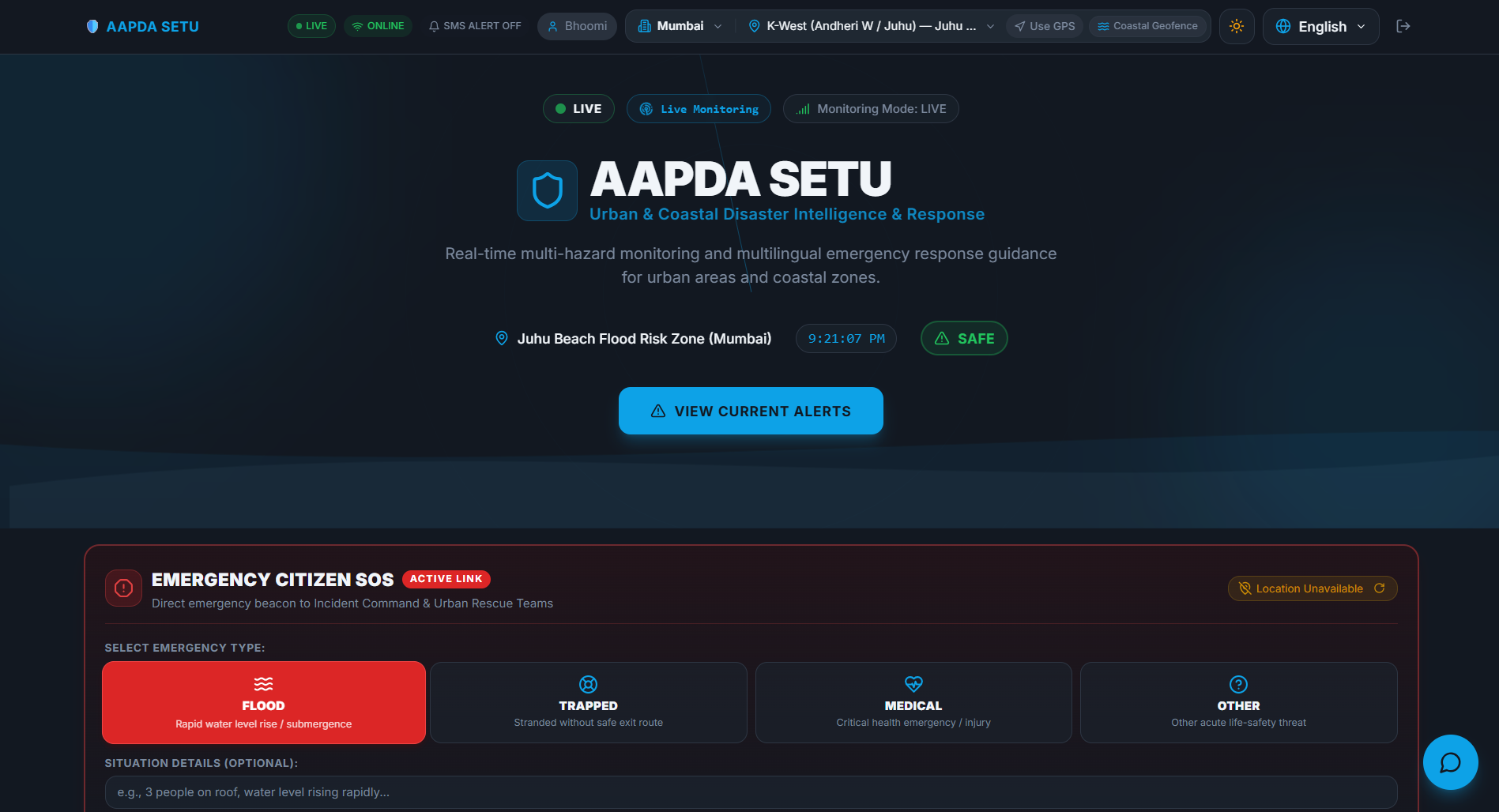
AAPDA SETU's main dashboard, presenting the disaster intelligence platform and emergency alert overview.
-
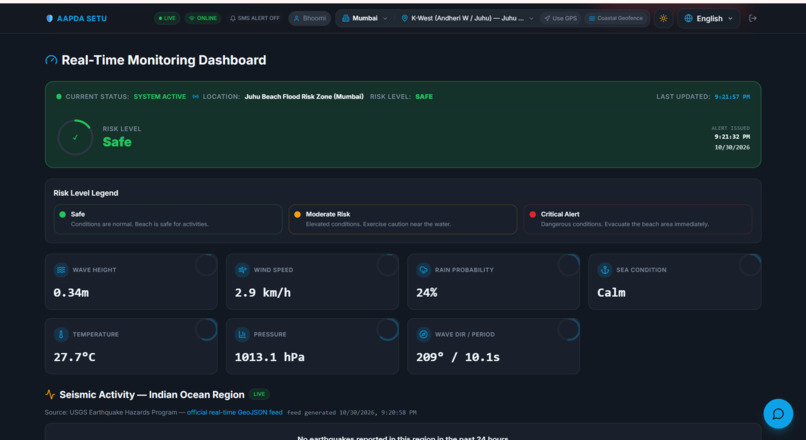
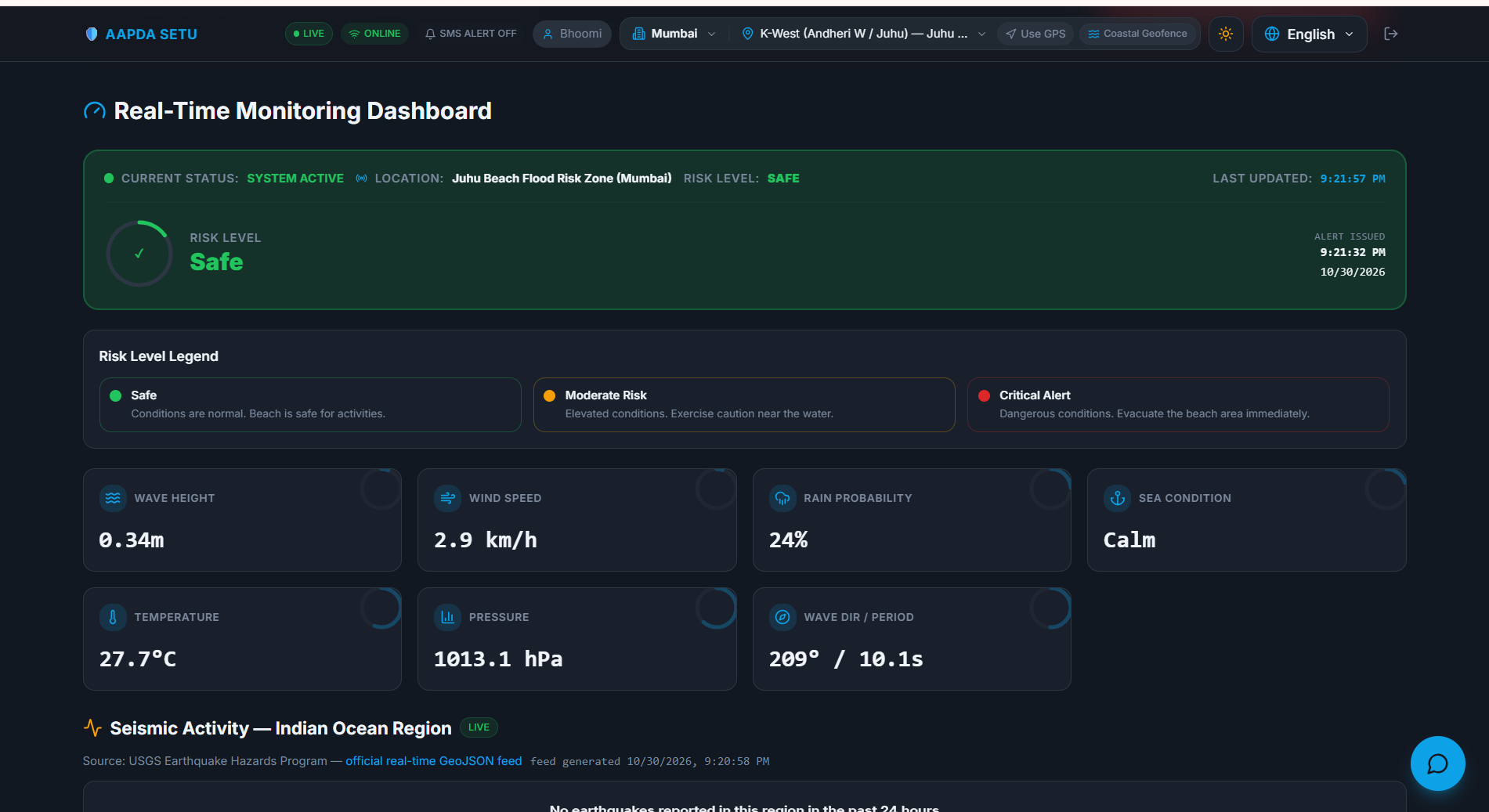
Live environmental monitoring and multi-horizon risk indicators, with source status and measurement visibility.
-
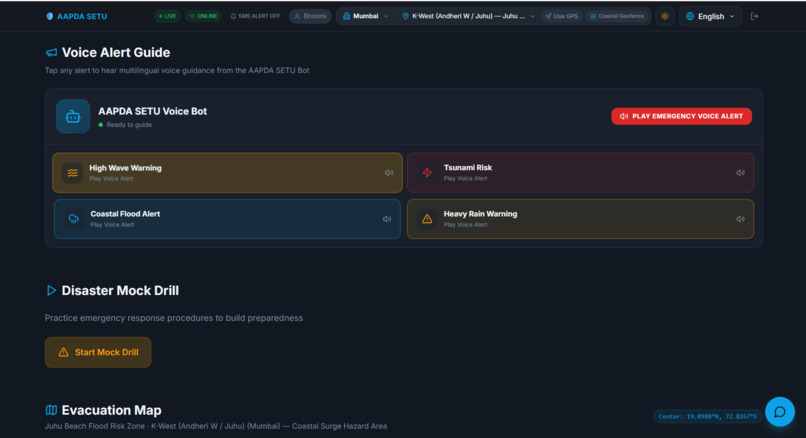
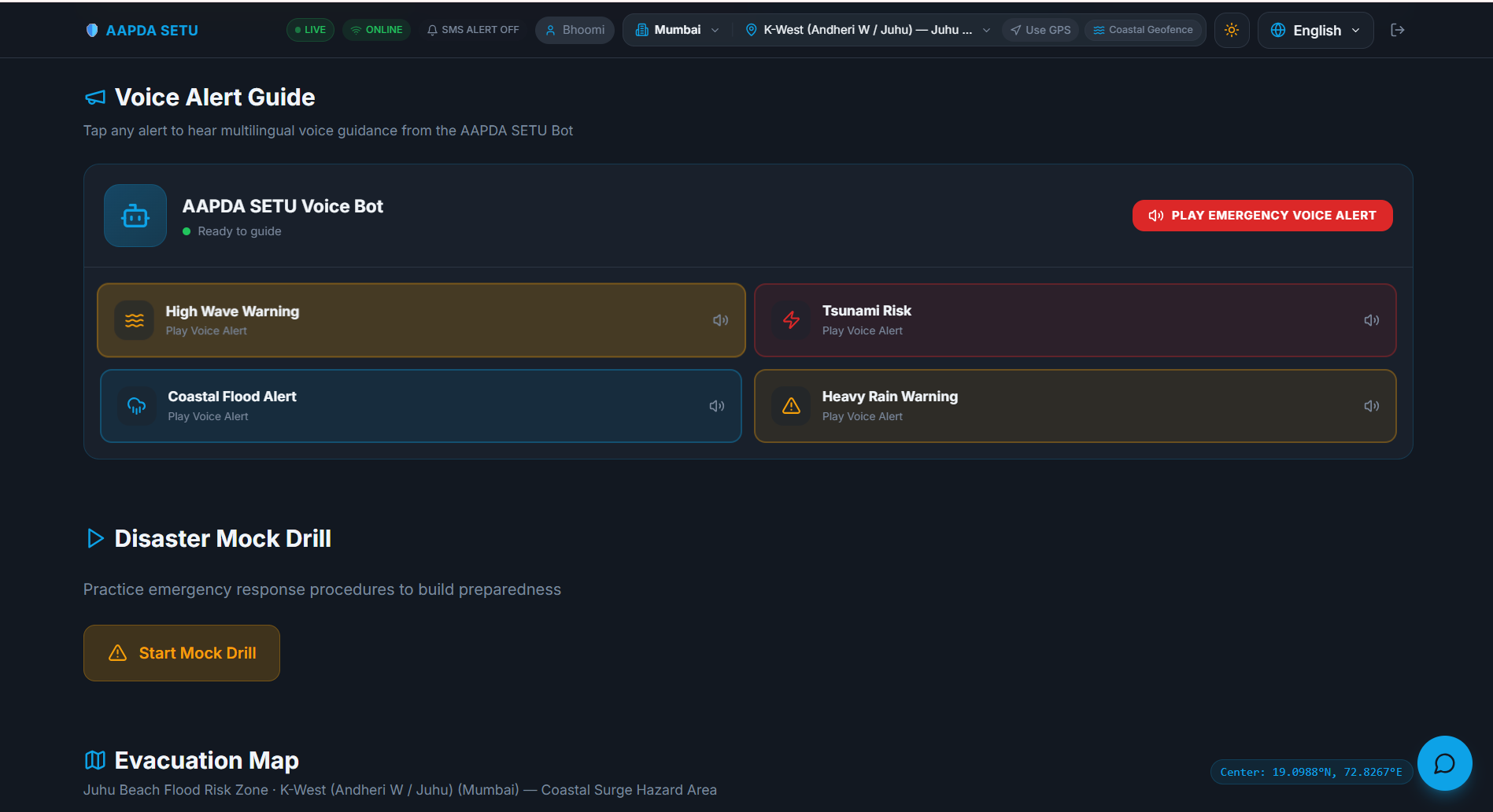
Incident intelligence and response coordination, connecting reported situations with responder workflows and resource actions.
-
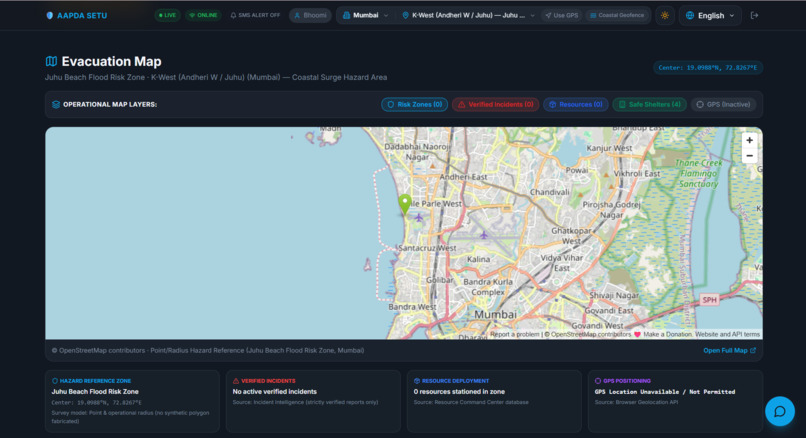
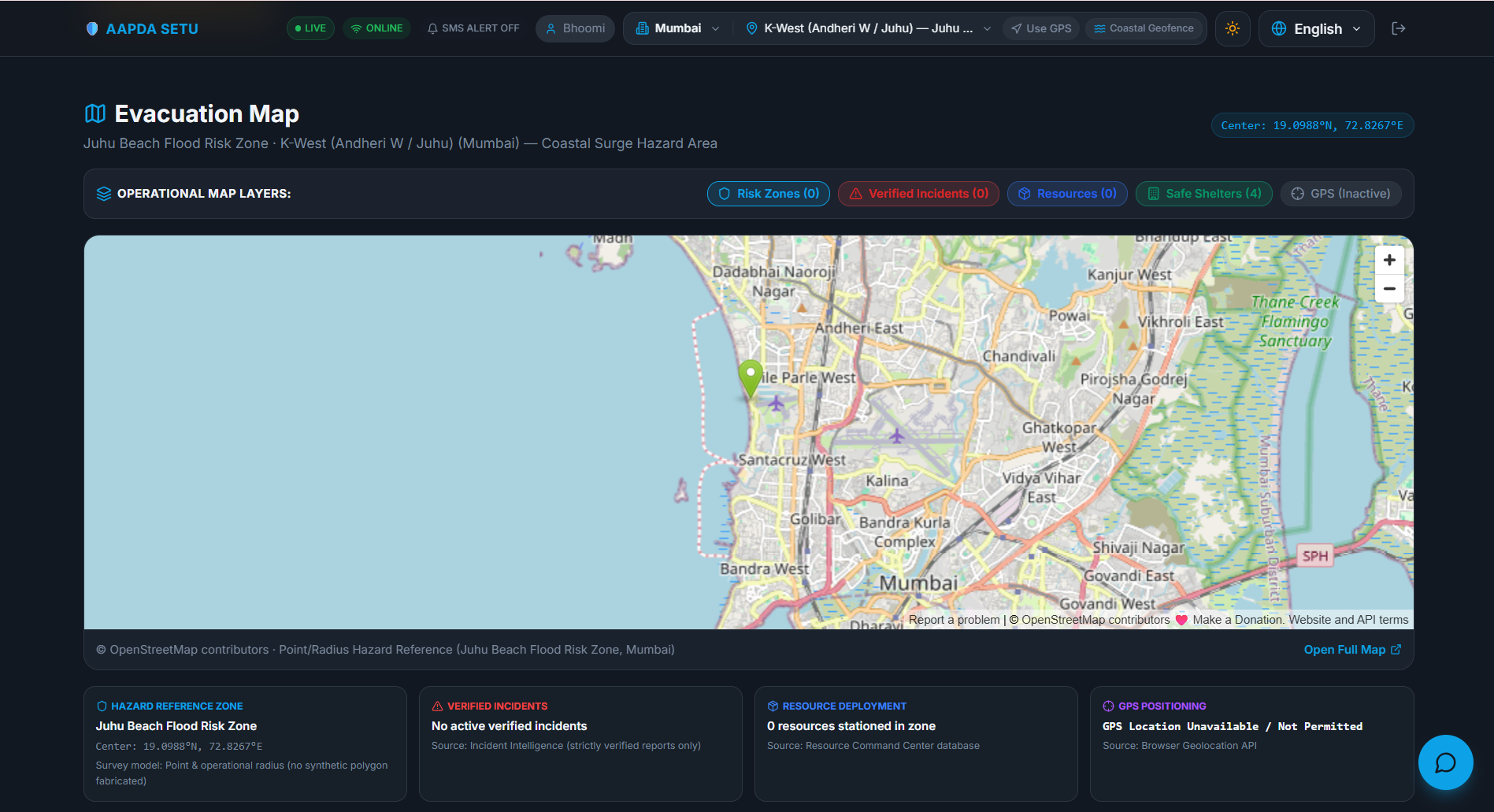
Interactive geographic view for understanding incident locations and supporting location-aware emergency response.
AAPDA SETU — Urban Disaster Intelligence & Response
The problem
During a disaster, information is fragmented. Weather services report environmental conditions, citizens report incidents, and emergency responders operate with incomplete situational awareness. The gap between detecting a threat and coordinating an effective response can cost valuable time.
AAPDA SETU aims to bridge that gap through a unified disaster-intelligence and response platform.
Our solution
AAPDA SETU combines live environmental monitoring, explainable risk assessment, citizen incident reporting, and responder coordination in one system.
Instead of treating disaster response as a single prediction problem, the platform connects several stages of the response lifecycle:
- Environmental intelligence: Integrates weather and marine information through Open-Meteo and seismic information through USGS.
- Multi-horizon risk assessment: Evaluates conditions across NOW, +1 hour, +3 hours, +6 hours, and +24 hours.
- Data reliability: Distinguishes LIVE, STALE, UNAVAILABLE, and OFFLINE sources. Missing measurements remain unknown rather than being treated as zero or safe.
- Citizen reporting: Enables people to submit incidents with location and optional photographic evidence.
- Responder workflow: Supports incident review, verification, rejection, dispatch, and resolution.
- Resource coordination: Provides resource inventory and compatibility-based recommendations while keeping consequential decisions under human control.
- Accessible communication: Provides multilingual guidance in English, Hindi, Marathi, and Gujarati, with voice assistance.
Intelligence architecture
AAPDA SETU uses a deterministic risk engine for its core risk assessment. AI is an assistance layer, not the authority that decides whether an area is safe.
The project includes an integration path for NVIDIA Nemotron 3 Super through Nebius Token Factory, using a server-side inference architecture. The model is intended to explain supplied context and assist with response-oriented questions without inventing observations or overriding deterministic assessments.
The architecture separates observed information, computed risk assessments, and AI-generated suggestions. It also treats missing or stale information as uncertainty rather than evidence of safety.
How we built it
The application uses React, TypeScript, Vite, Tailwind CSS, Supabase, PostgreSQL, Leaflet, and external environmental data sources.
We focused on connecting data ingestion, risk assessment, incident workflows, and response coordination into one coherent system. We also designed for unreliable data, constrained information, and the need for human verification during emergencies.
Challenges and learnings
One of the hardest problems was avoiding false confidence. A disaster platform must not interpret unavailable data as safe conditions. We therefore made source freshness and availability explicit throughout the system.
Another challenge was balancing AI assistance with operational reliability. A language model can help explain information, but it should not fabricate live measurements, issue authoritative evacuation orders, or replace emergency services.
Building AAPDA SETU reinforced an important engineering principle: in high-impact systems, knowing what the system does not know is just as important as knowing what it knows.
Our vision
We want AAPDA SETU to evolve into a dependable disaster-intelligence layer connecting citizens, environmental information, emergency responders, and local authorities.
AAPDA SETU — From fragmented signals to coordinated response.
Built With
- ai
- framer
- leaflet.js
- nebius
- nemotron
- nvidia
- open-meteo
- openstreetmap
- postgresql
- react
- supabase
- tailwind
- token
- typescript
- usgs
- vite


Log in or sign up for Devpost to join the conversation.