-
-

Stagehand: find your space.
-
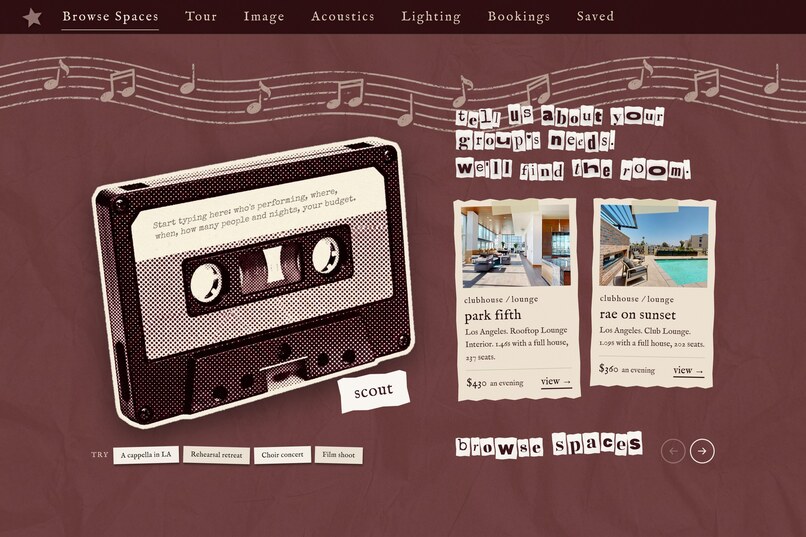
Describe your show on the cassette and we’ll find the room. Real scanned venues are on the shelf.
-
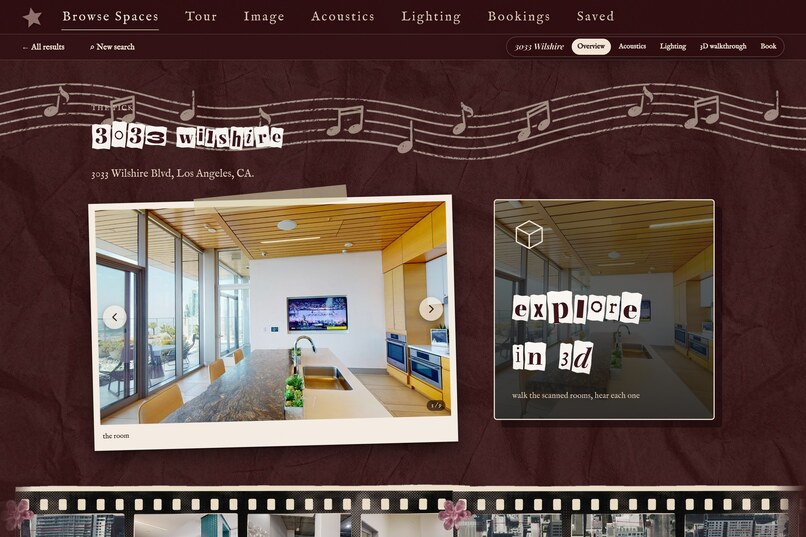
Every venue starts from its real 3D scan, with photos from inside the rooms and the building from above.
-
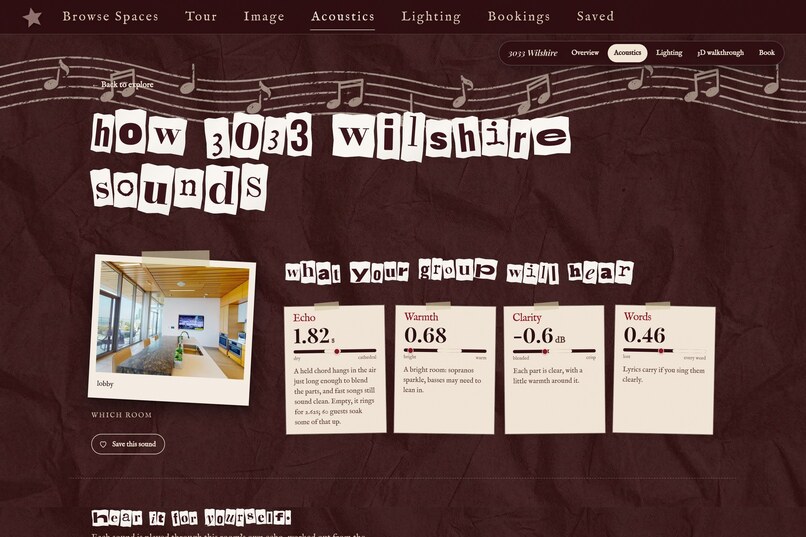
What your group will hear: echo, warmth, clarity and how well words carry, worked out from the room’s size and finishes.
-
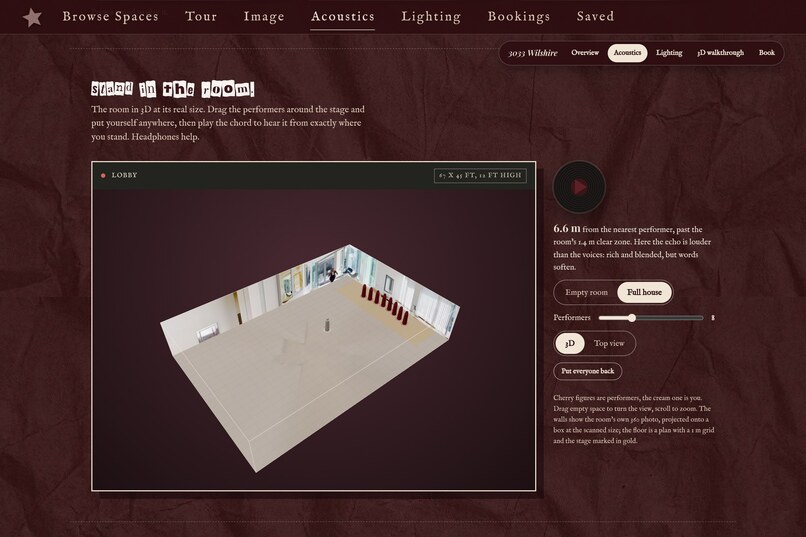
Drag the performers, stand anywhere, and hear the chord from exactly where you are.
-
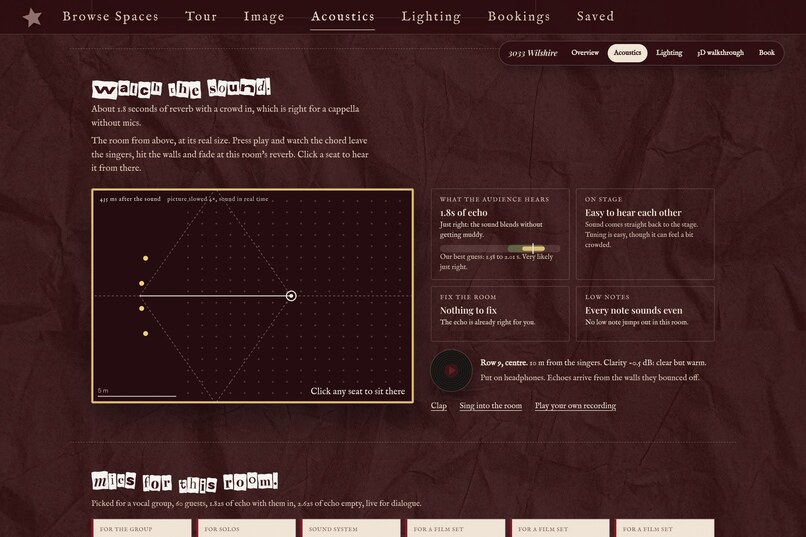
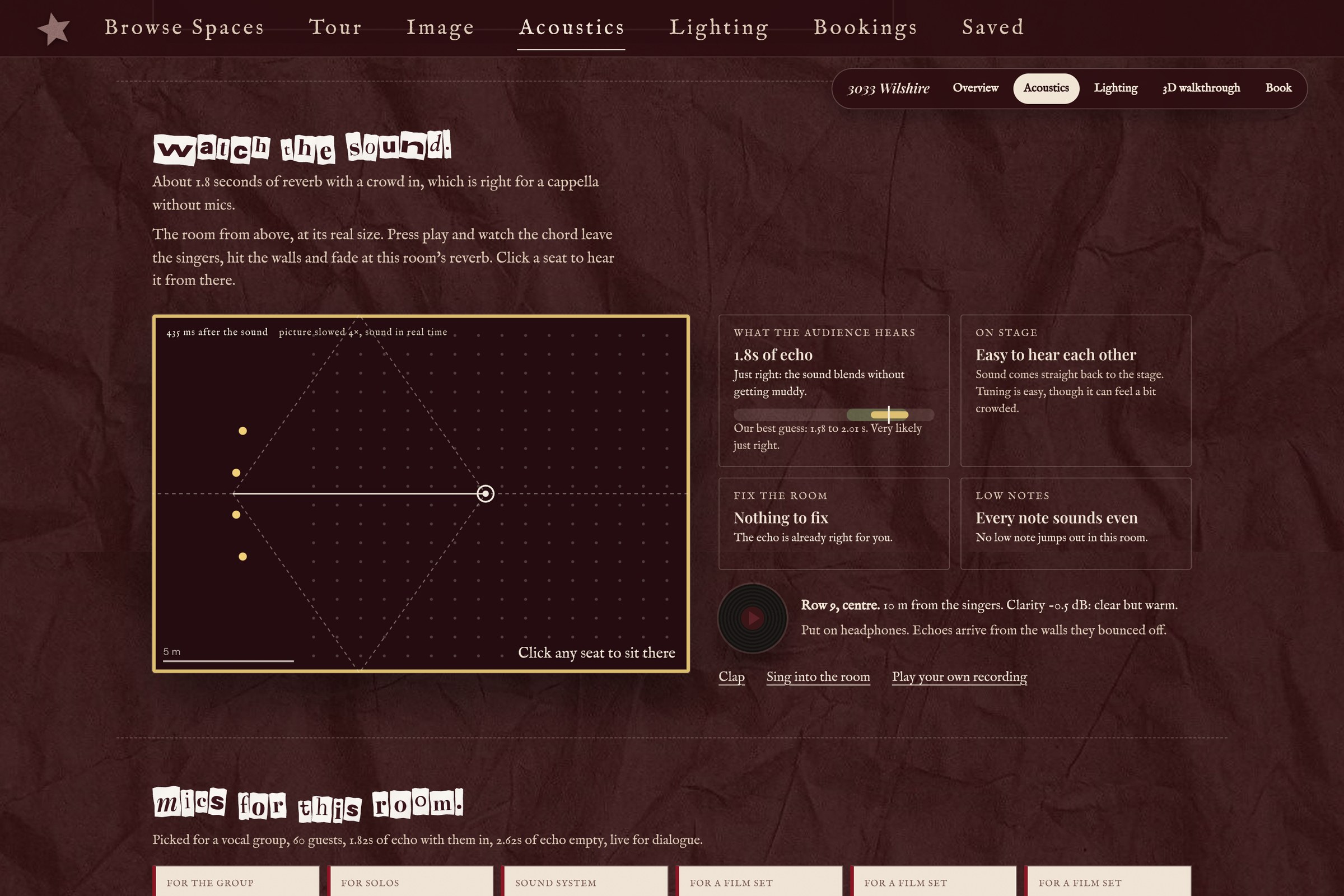
A live wave simulation shows the sound leave the stage, hit the walls and fade at the room’s real rate.
-
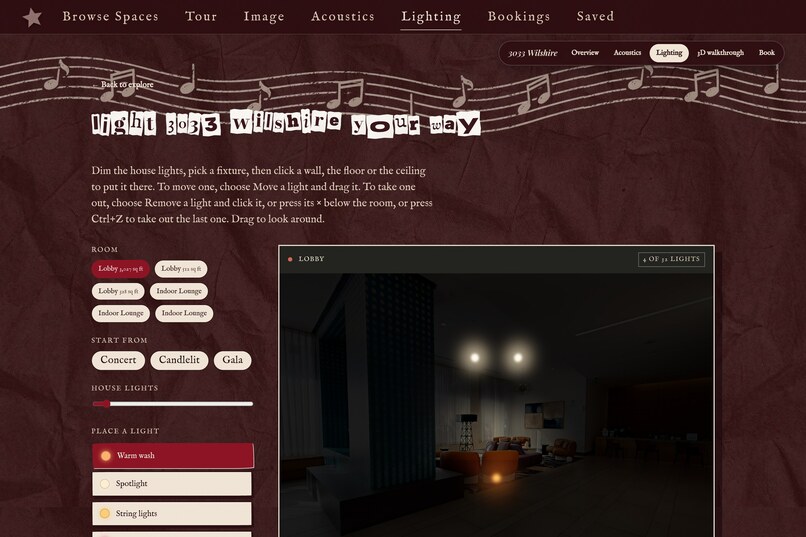
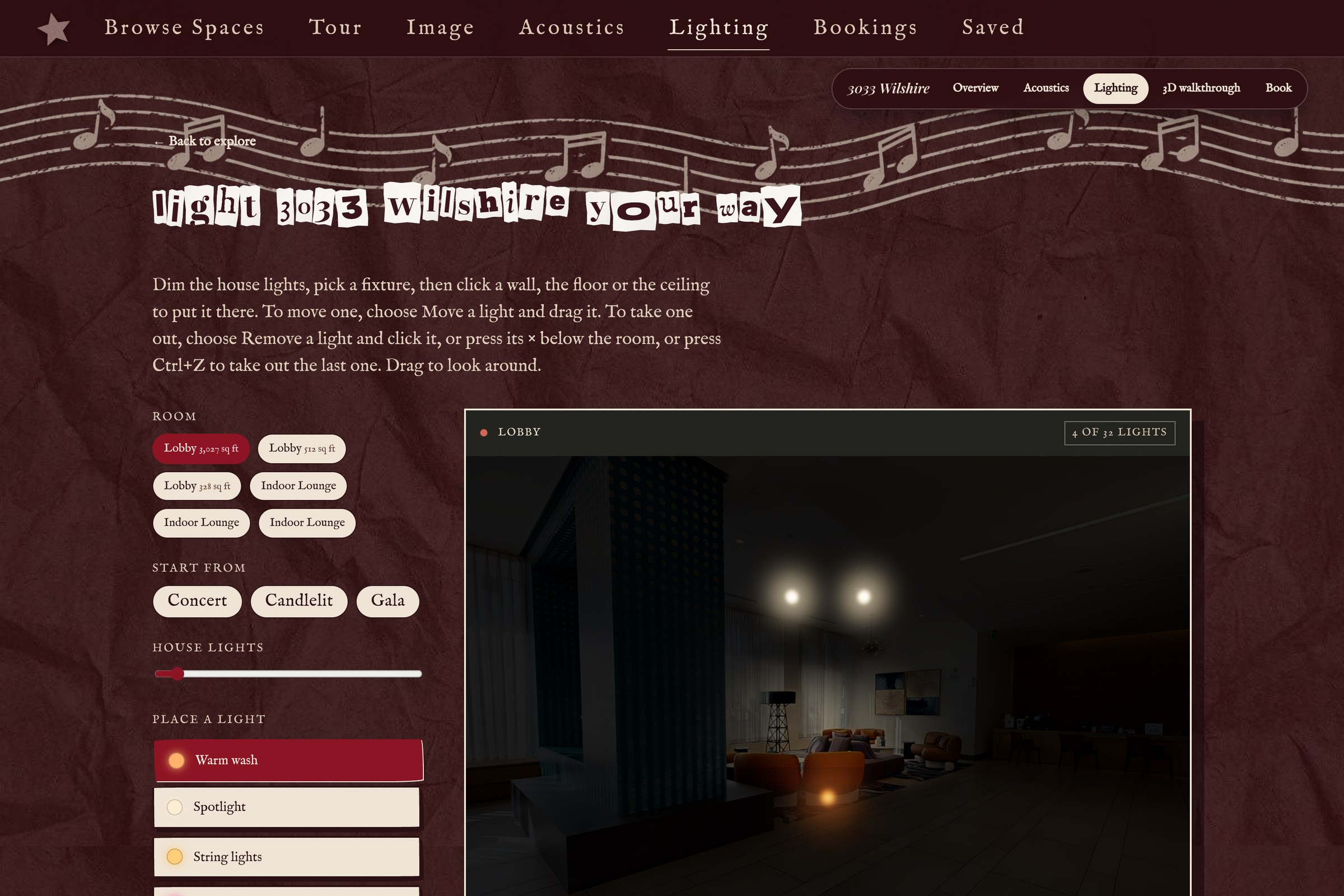
Light the room your way: place fixtures, dim the house lights and see the mood before you book.
-
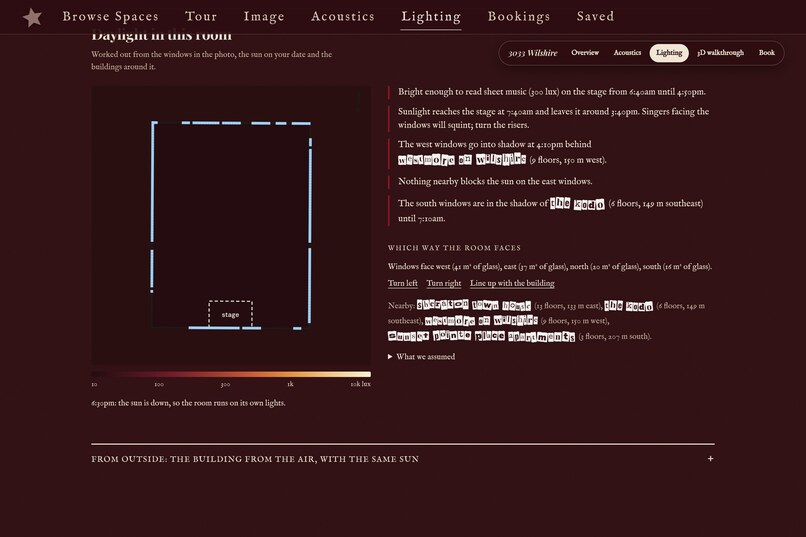
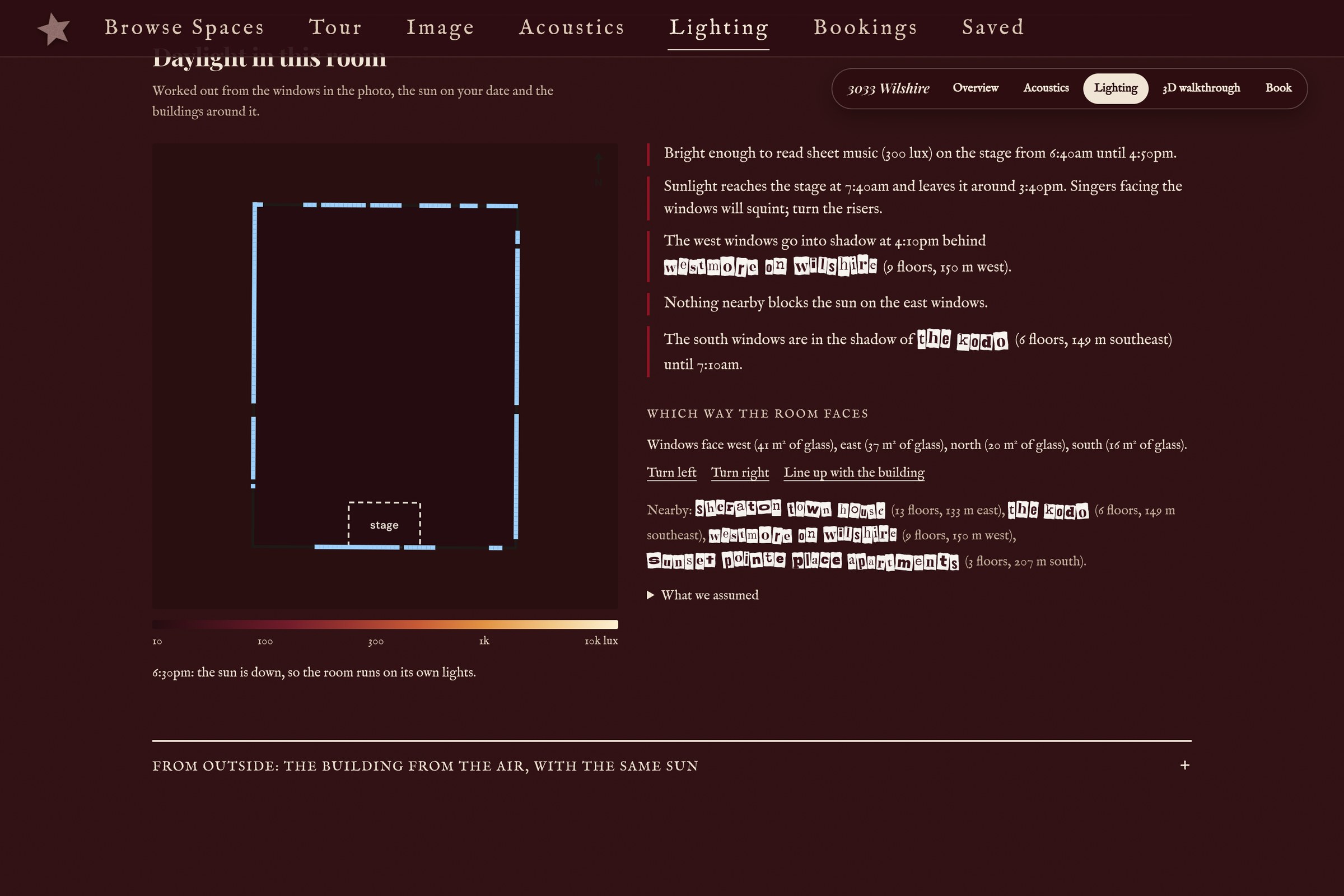
Real sun on your date, and which neighbouring building shades which windows when.
-
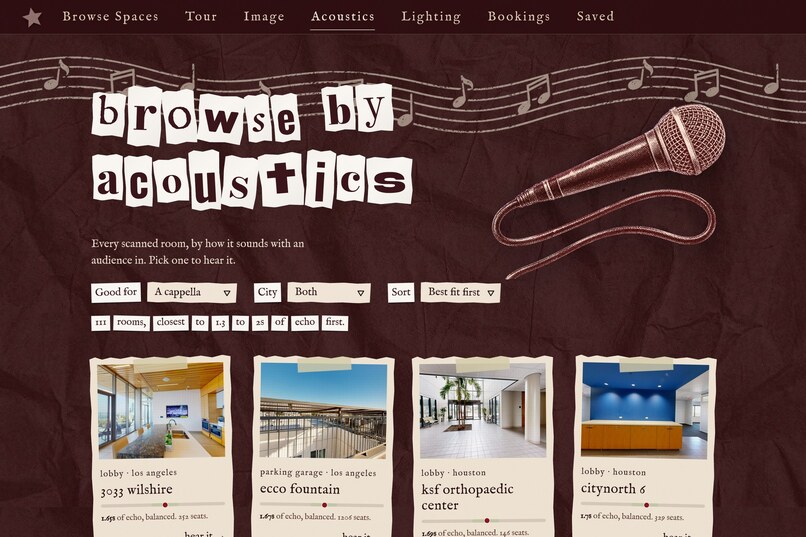
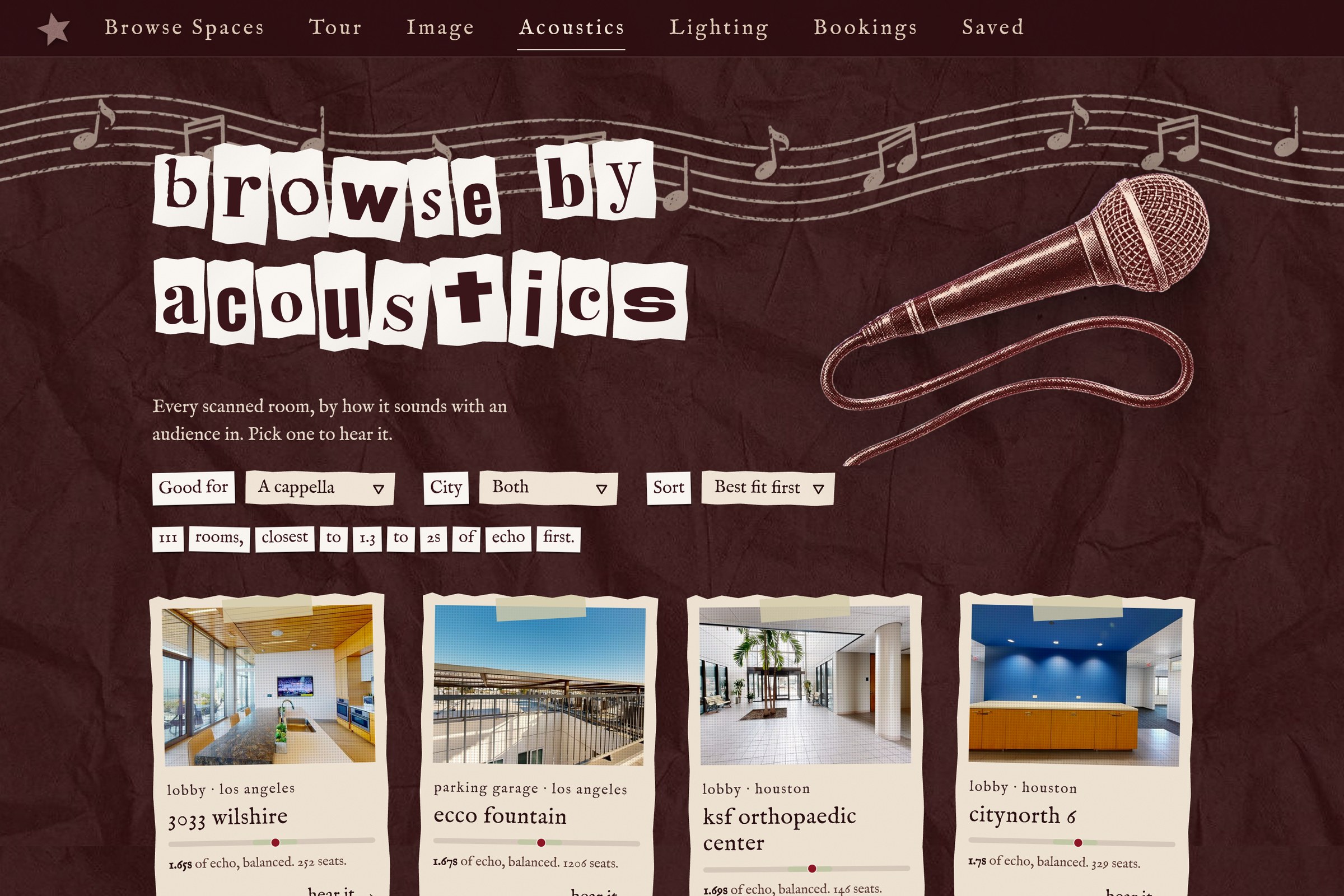
Every scanned room, sorted by how it sounds for what you’re putting on.
-
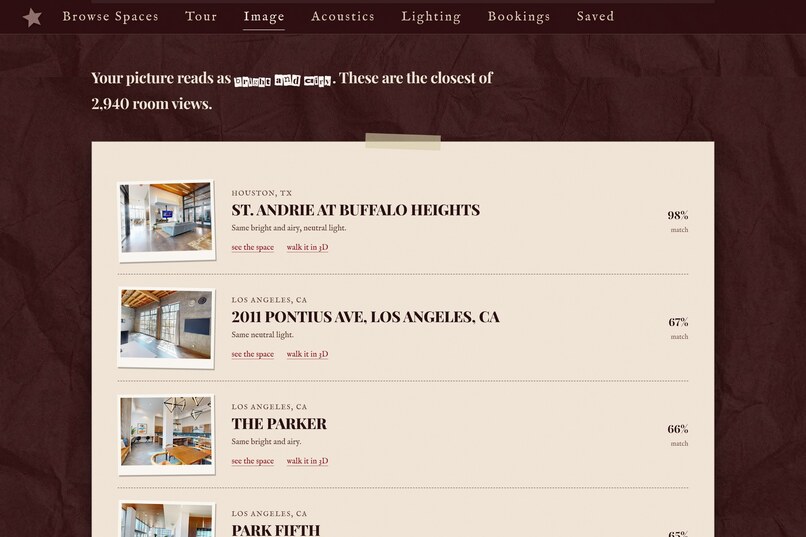
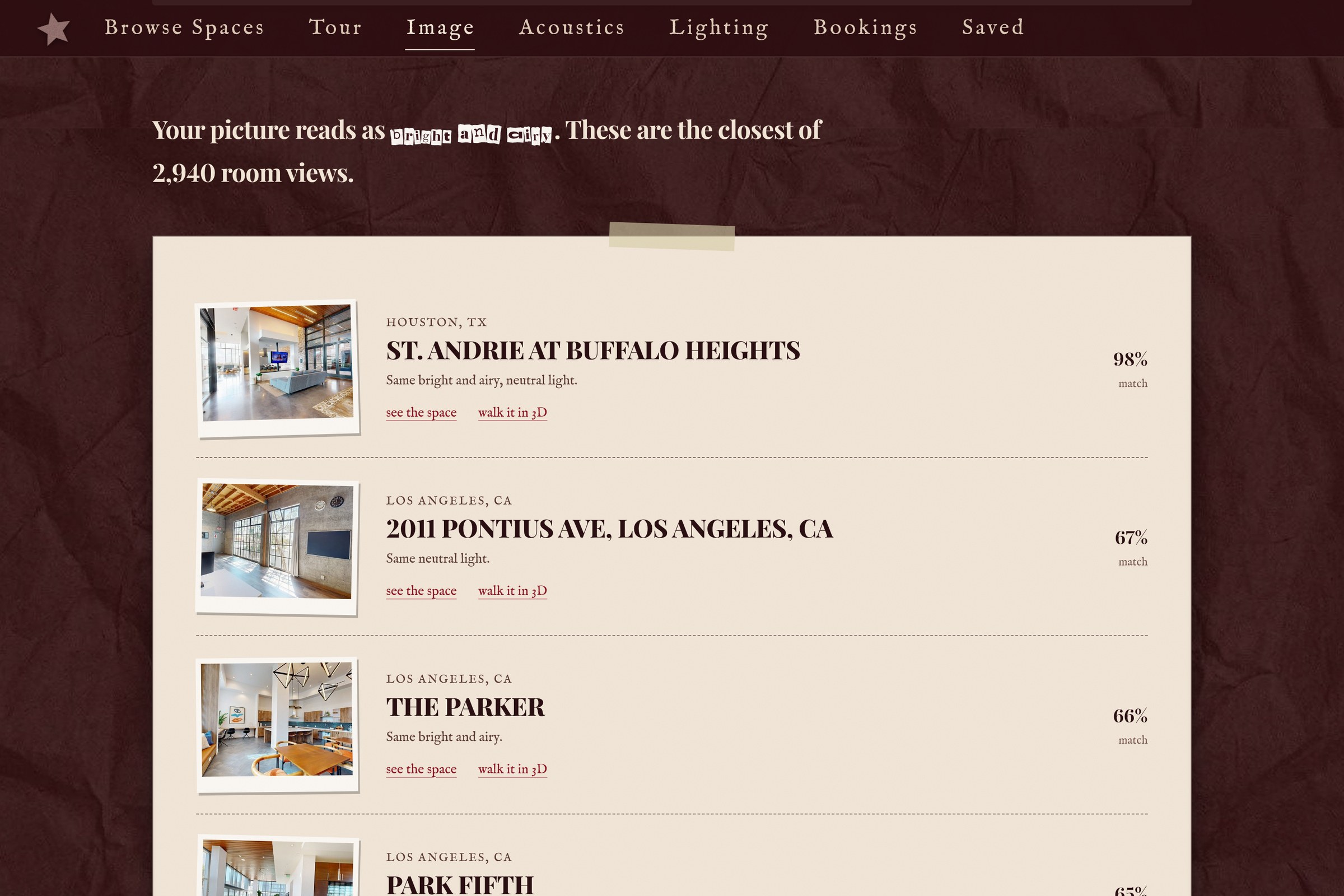
Drop in a film still and find the real rooms that match its look.
-
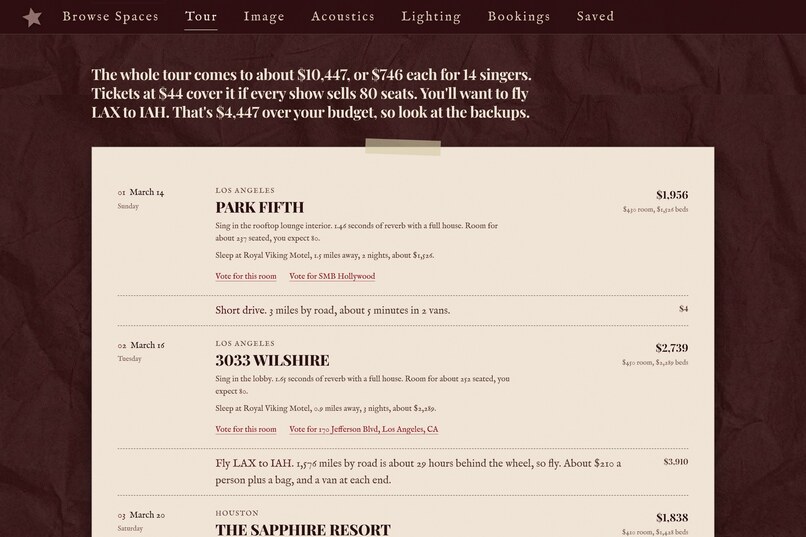
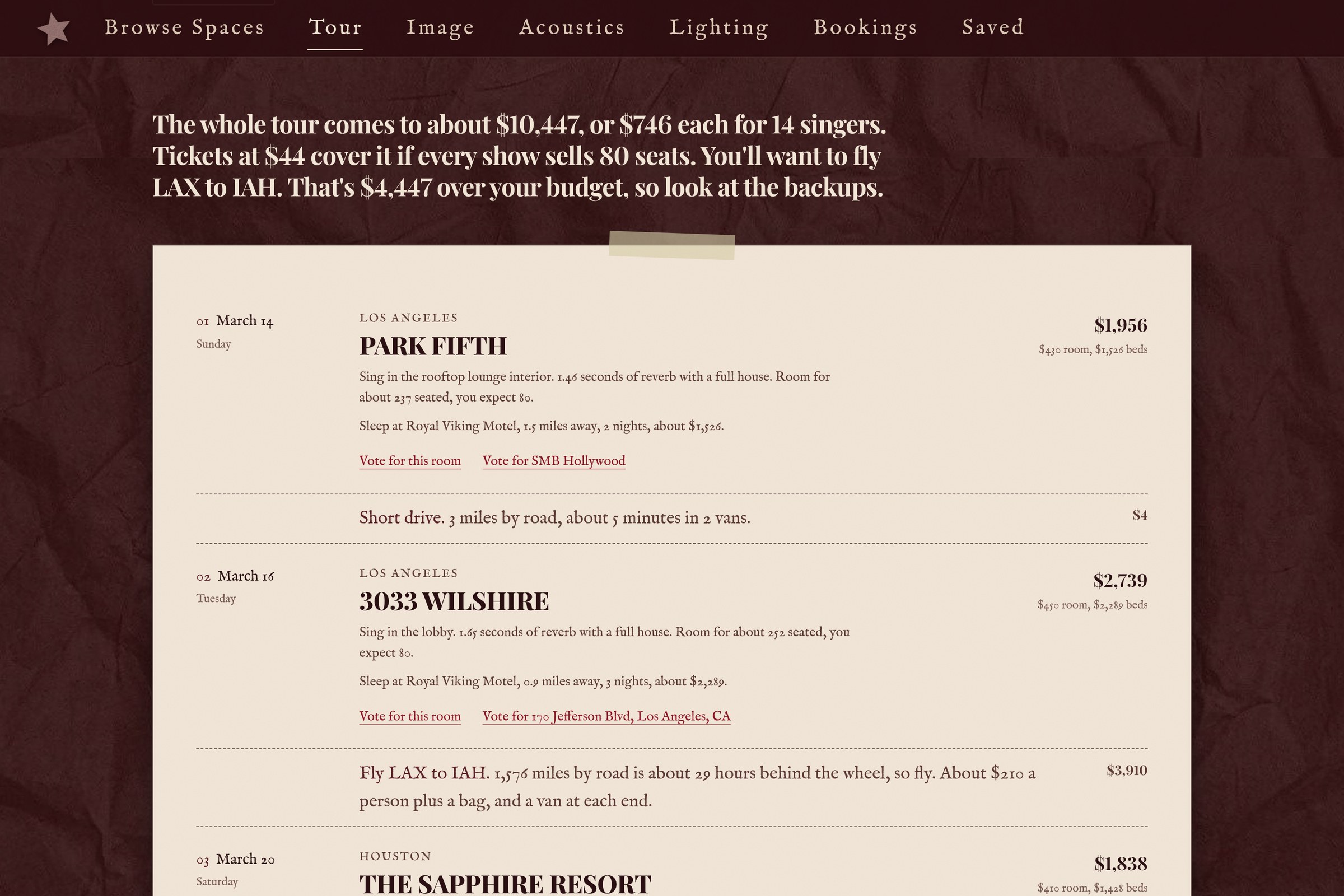
One sentence becomes a whole tour: a room and a bed for each stop, travel, a total, and a vote for the group.
-
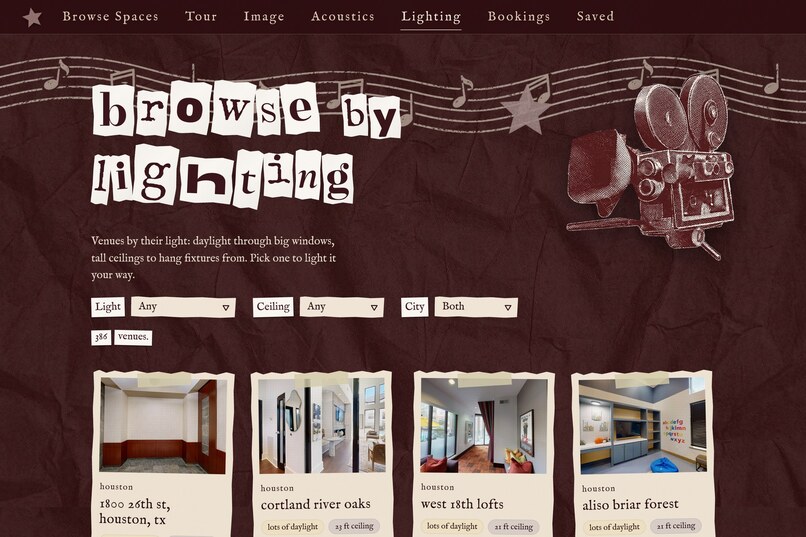
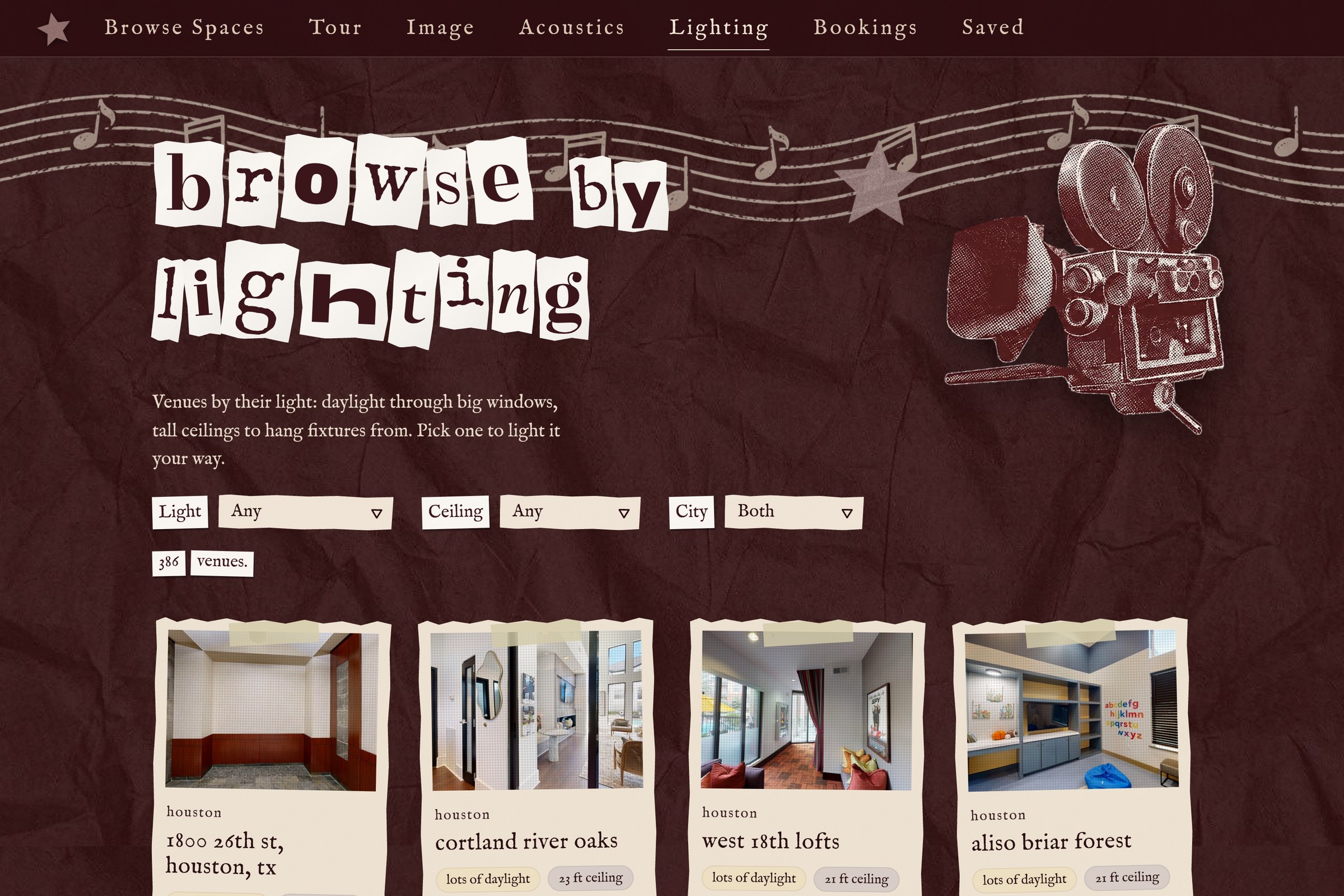
Browse by lighting: 386 venues sorted by their light, from daylight through big windows to tall ceilings for hanging fixtures.
-
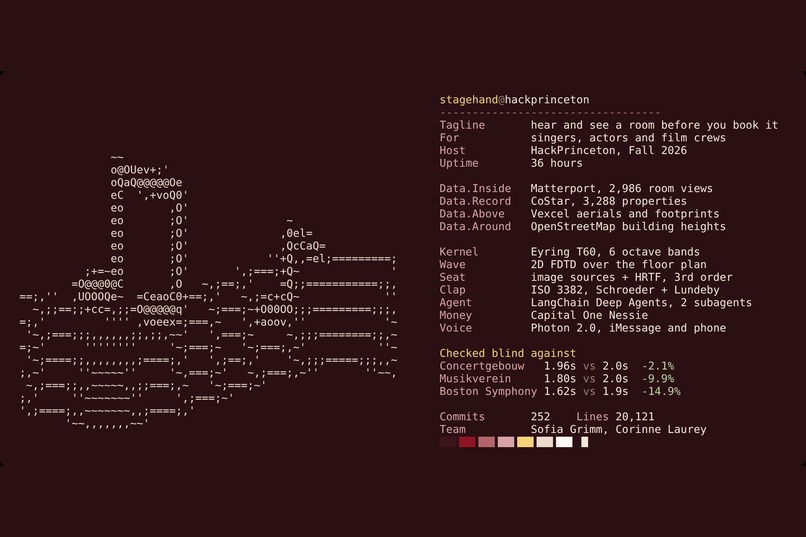
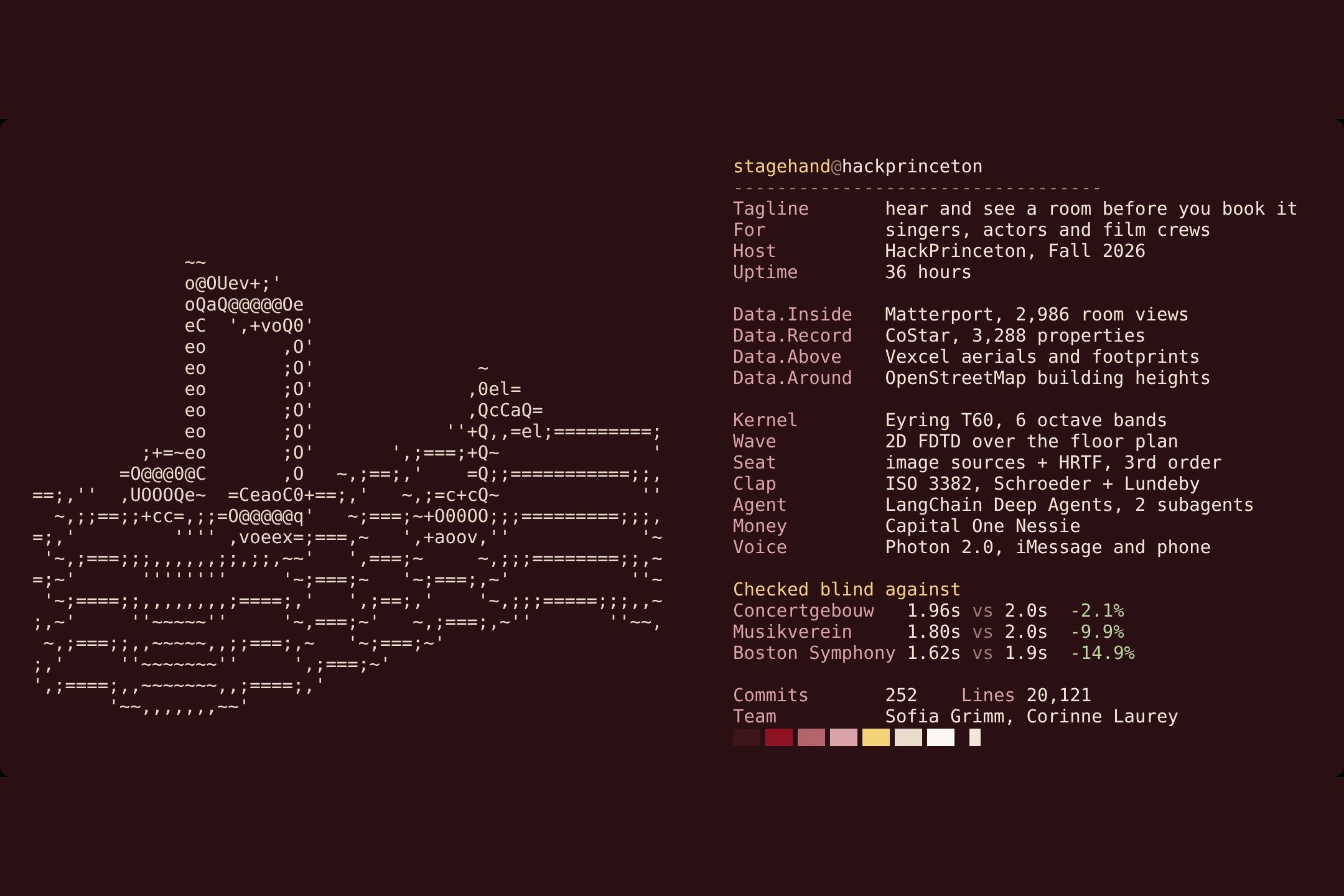
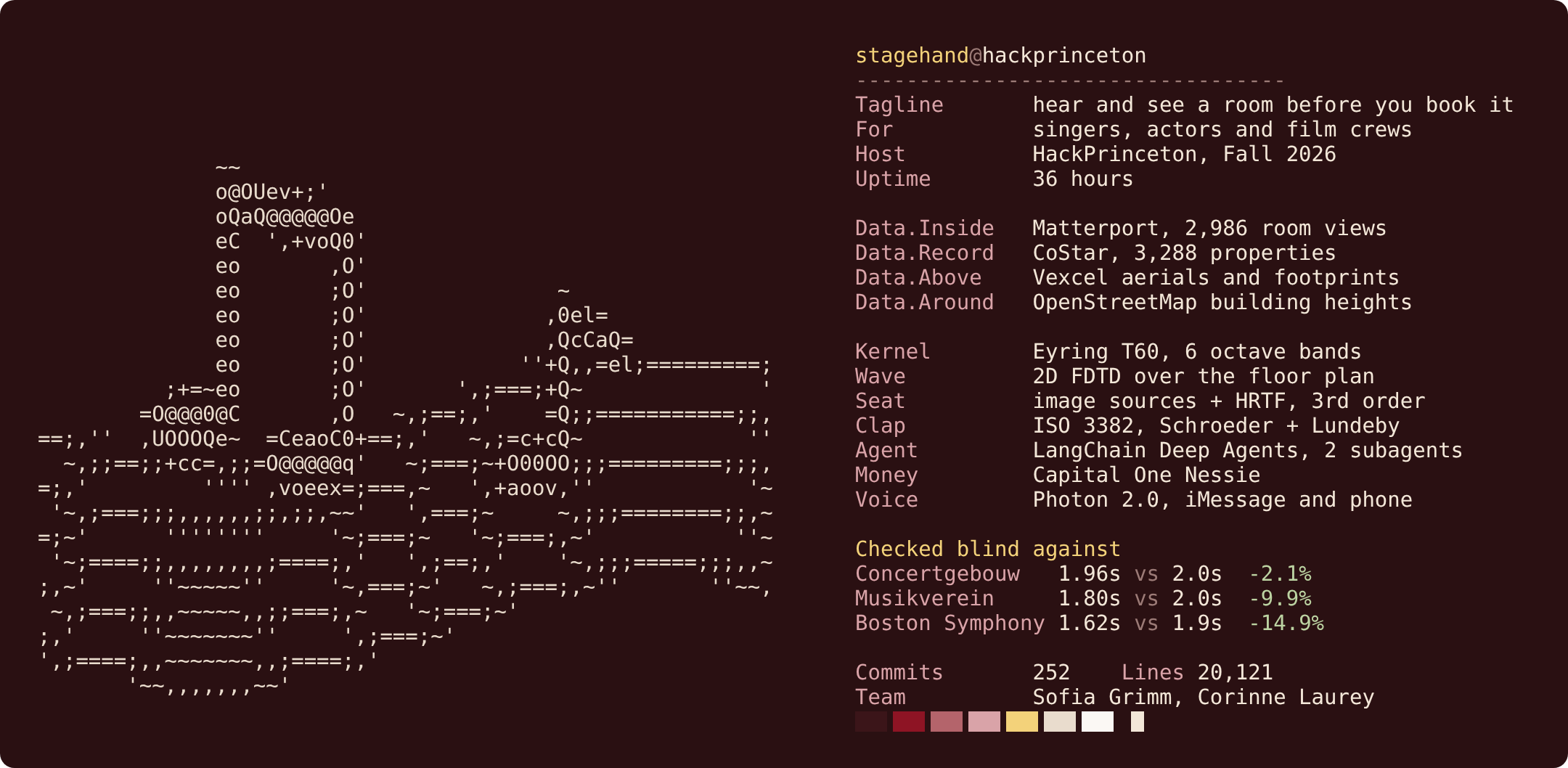
Stagehand at a glance: four data layers, the acoustics engine, and blind checks against three concert halls.

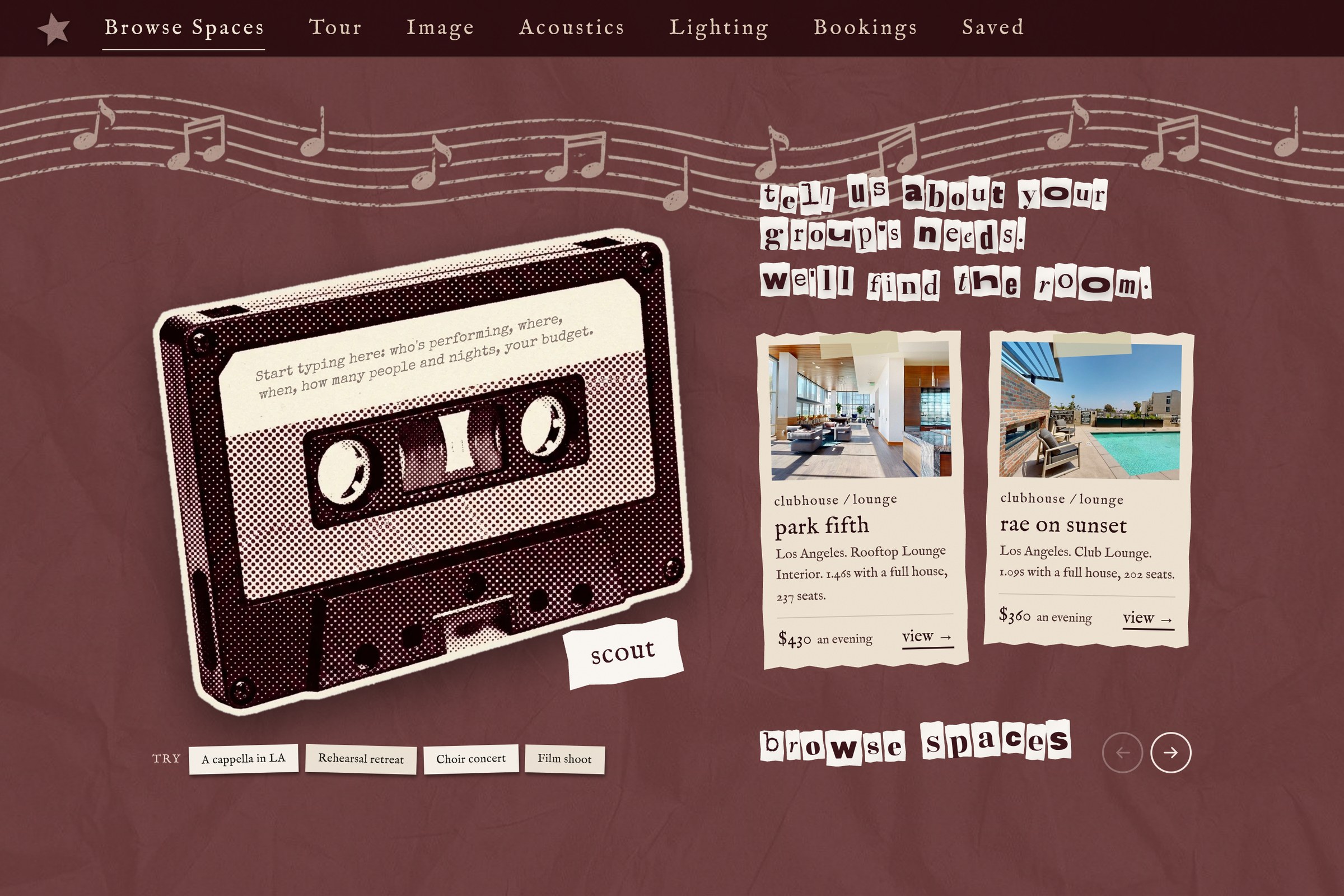
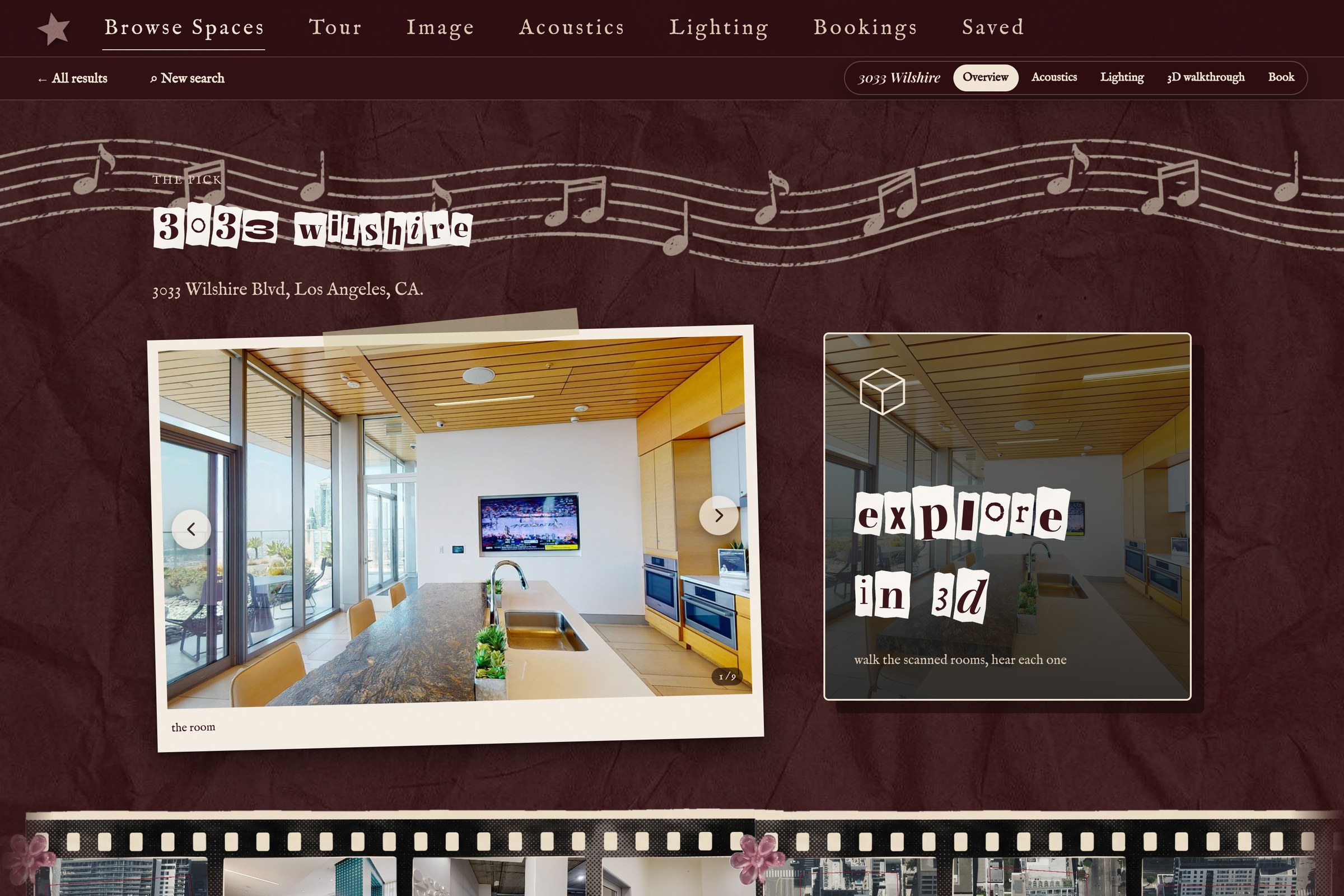
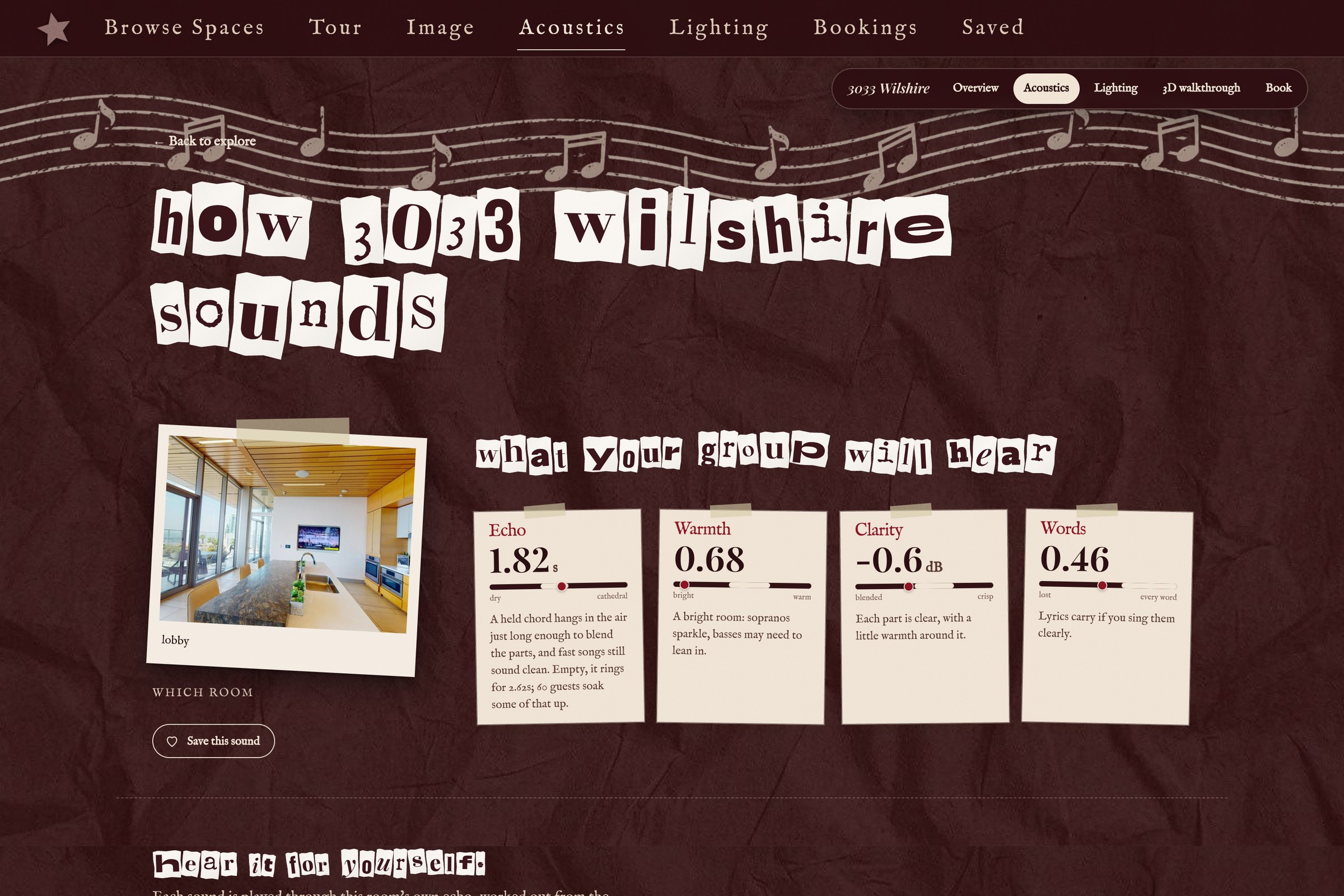
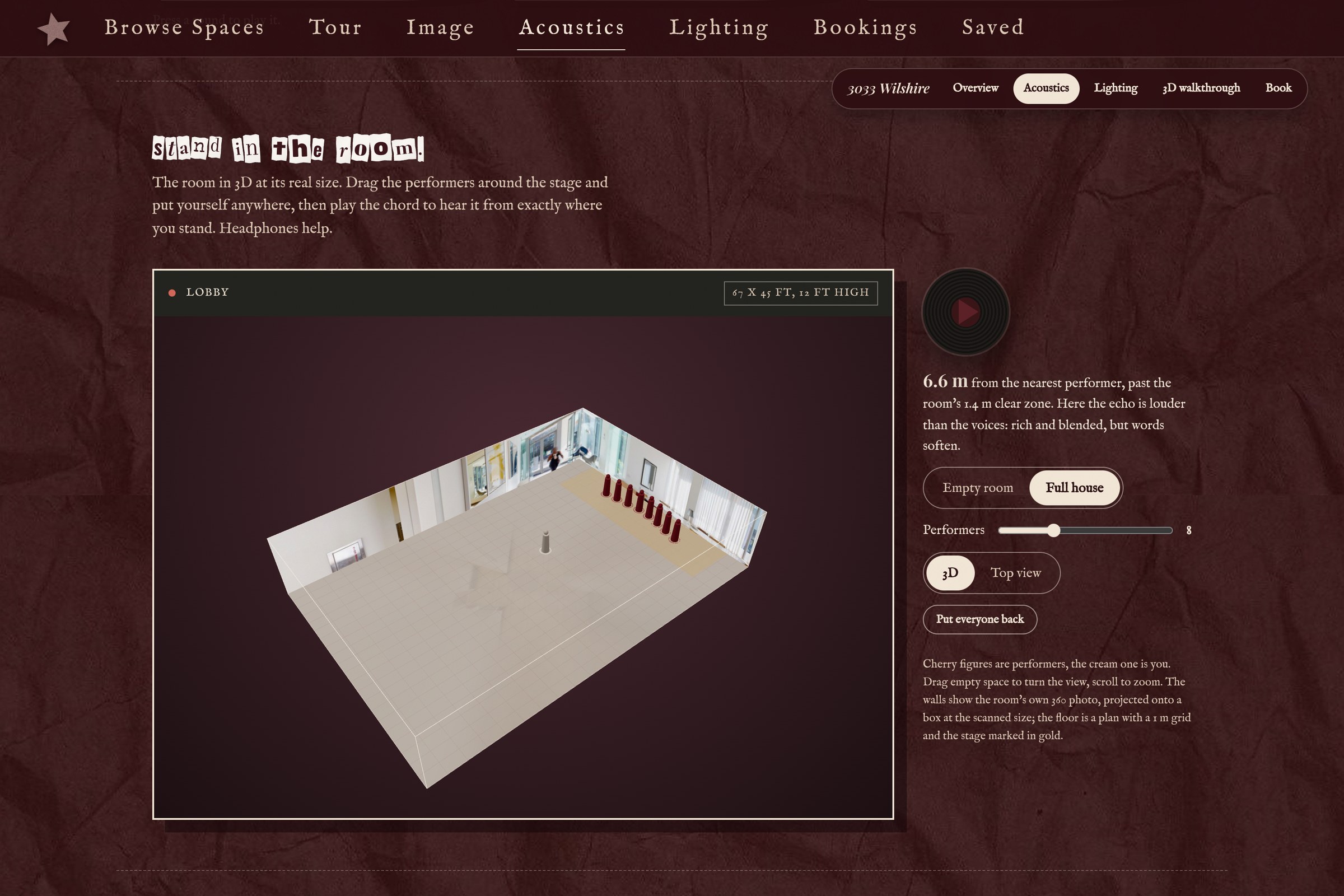
For singers, actors and film crews, Stagehand lets you hear and see a room before you book it, using the 3D scans already made of thousands of real buildings, so you never walk into a space that ruins months of work.
3,288 buildings · 2,986 room views · 6 octave bands · 400 simulations per room · 3 world-famous concert halls, all inside our range · 1 sentence → a whole tour
Inspiration
You rehearse for months. Then the room ruins it. A carpeted ballroom swallows your harmonies. A stone lobby turns every line of dialogue to mush. The west windows blow out your shot at 5pm. More than 54 million Americans sing in a choir, and countless more act, film and perform, yet every one of them still books a space from a listing photo and finds out on the day.
Big productions hire acoustic consultants and location scouts. A student a cappella group or a first-time filmmaker can't. What struck us is that the data to answer the question already exists. Thousands of commercial spaces have been 3D-scanned to the centimetre for virtual tours, and nobody had used those scans to ask the questions creatives actually have: How will this room sound? How will it look? What will it feel like to perform here?
Built with a real group: Out of the Blue
We built Stagehand around a real touring a cappella group: Out of the Blue, at Yale. We asked them how they research venues for a tour and where it breaks down.
"Different spaces have different sounds, and that affects our show order and choice of soloists. A technology to help us find out before we book venues would be really helpful!"
"We are an a cappella group at Yale, and when we tour it can be hard to tell what equipment we'll need to bring to each gig."
- Out of the Blue (via [email protected])
That shaped what we built:
- "What equipment we'll need." Every room gets a plain answer on whether you need a PA at all, which mics to bring for the group, and a separate mic for soloists. All of it is worked out from how long that room rings with a full house.
- "Different spaces have different sounds." That's why every room starts with hear it. Play a chord in the room before you book it, from the seat your audience will sit in.
- "Our show order and choice of soloists." Stagehand names which notes will boom in a room and which voice parts sing them, and whether words will carry, so the group can pick the right soloist and the right songs for that room before they arrive.
- A tour is several rooms and one budget. One sentence becomes a room and a bed for every stop, with travel, a total, and a link where members vote on each stop.
Peri Forward Deployed: consulted Out of the Blue (Yale a cappella group), contact via the group's email, [email protected]. Evidence: their written statement, quoted above.
What it does
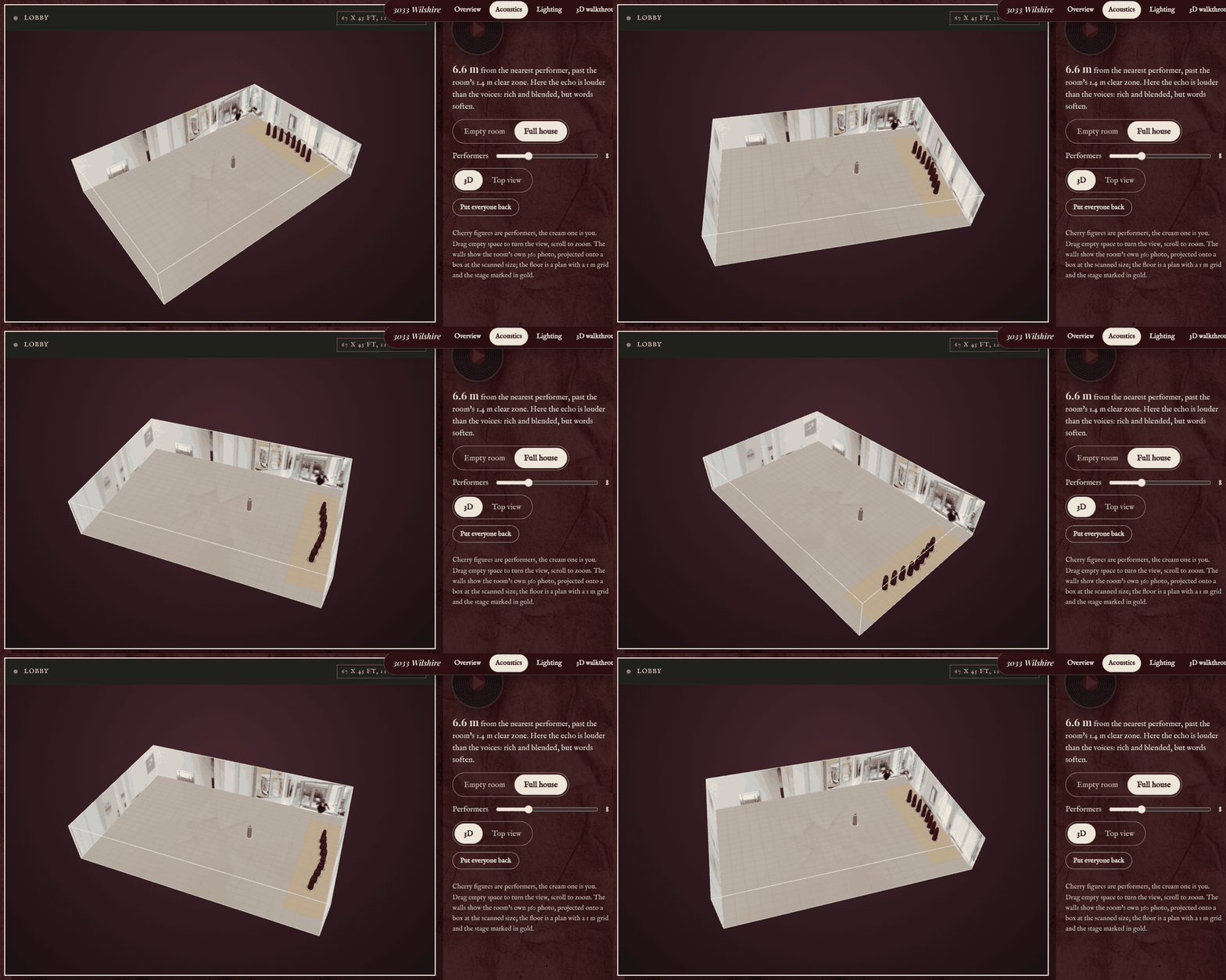
Hear it from any seat. Pick a scanned room and press play. You hear a four-part chord, a clap or your own voice in that room, with the echo worked out from its real size and finishes. Drag the performers around a to-scale 3D model and stand anywhere. The sound is rebuilt for exactly where you are, with every echo arriving from the wall it bounced off.
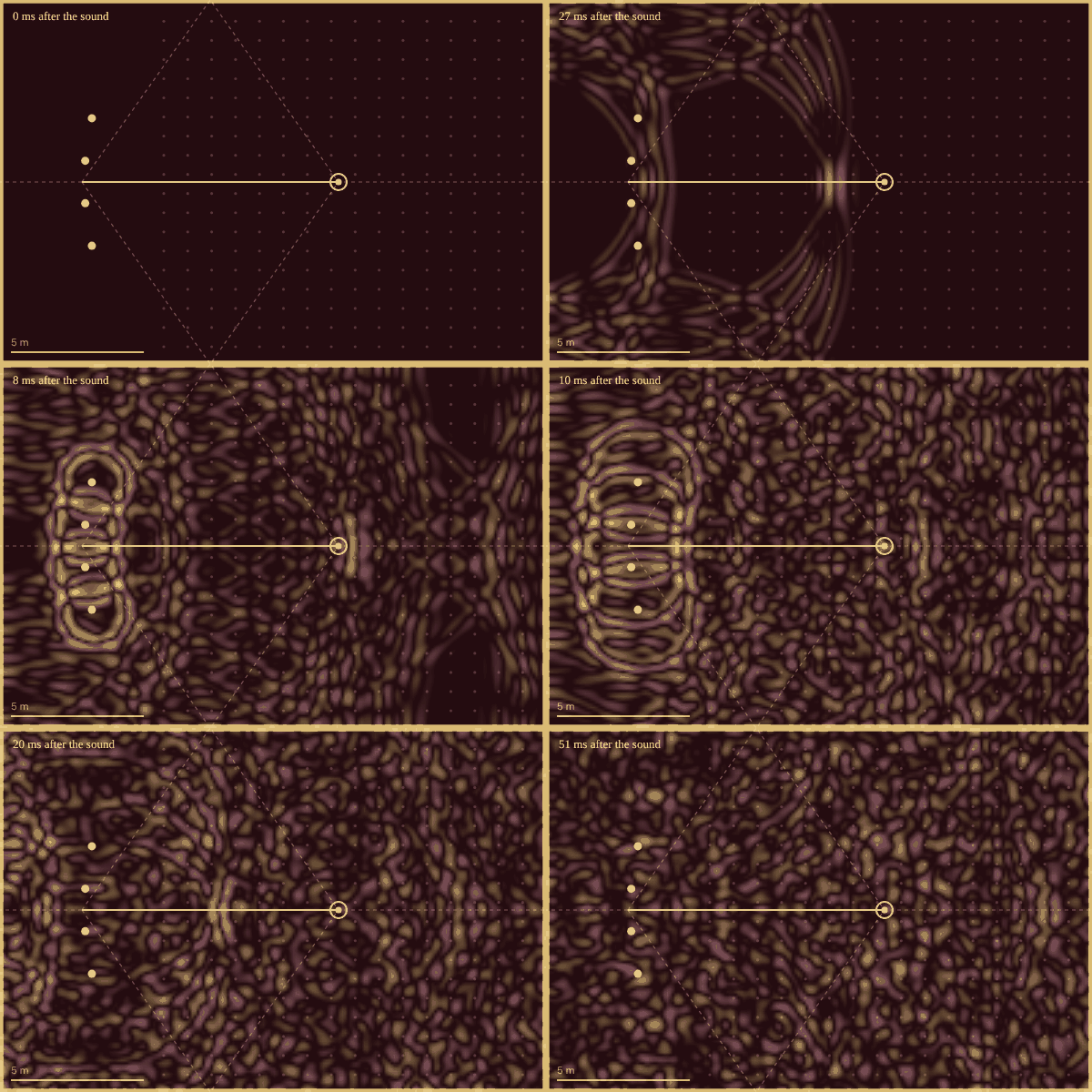
Watch the sound. A live wave simulation shows sound leave the singers, hit the walls and fill the room at its real rate, so you can see why one seat is muddy and another is clear.
Know what it means. How long the room rings, shown as a likely range rather than a fake-precise number. Whether lyrics and dialogue will carry. Which notes will boom, named as pitches with the voice parts that sing them. Whether you need a PA, and which mics to bring for a stage or a film set.
See the light on your date. Where the sun lands in the room on your show or shoot date, in lux, and which neighbouring building shades which windows when: "The west windows go into shadow at 4:10pm behind Westmore on Wilshire." Then light it your way with fixtures you place yourself.
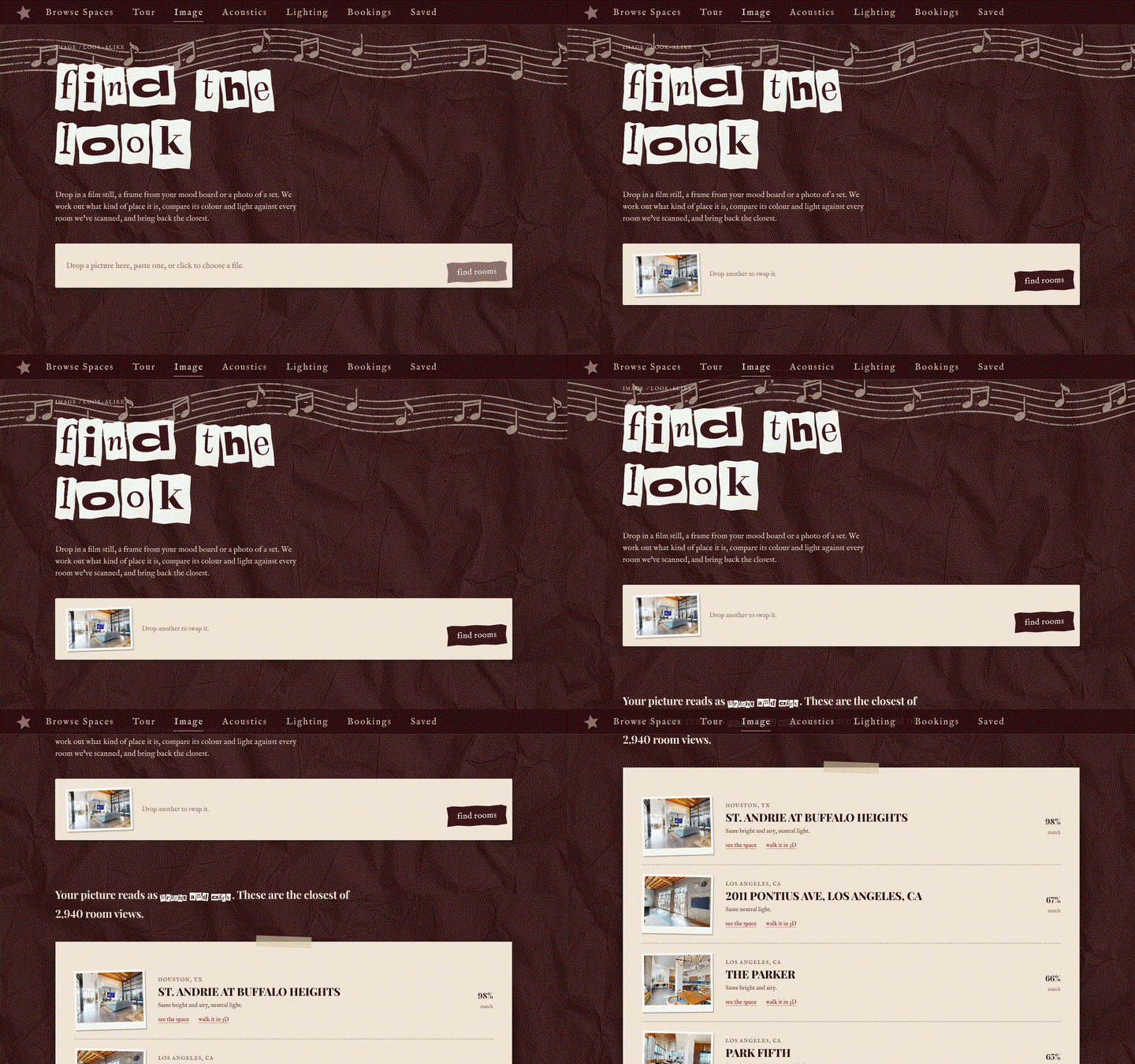
Find the look. Drop in a film still or a mood-board frame. Stagehand works out what kind of place it is and finds the real rooms that match its look, with a reason for each.
Plan the whole tour. "14 singers, LA March 14, LA March 16, Houston March 20, budget $6,000" becomes a room and a bed for every stop, travel in between, and a total the group can vote on.
Ask the scout. An AI agent takes your brief and does the legwork: it searches, compares rooms, checks the site, finds lodging, checks the budget and drafts the email to the venue. You can also text it or call it.
How we built it
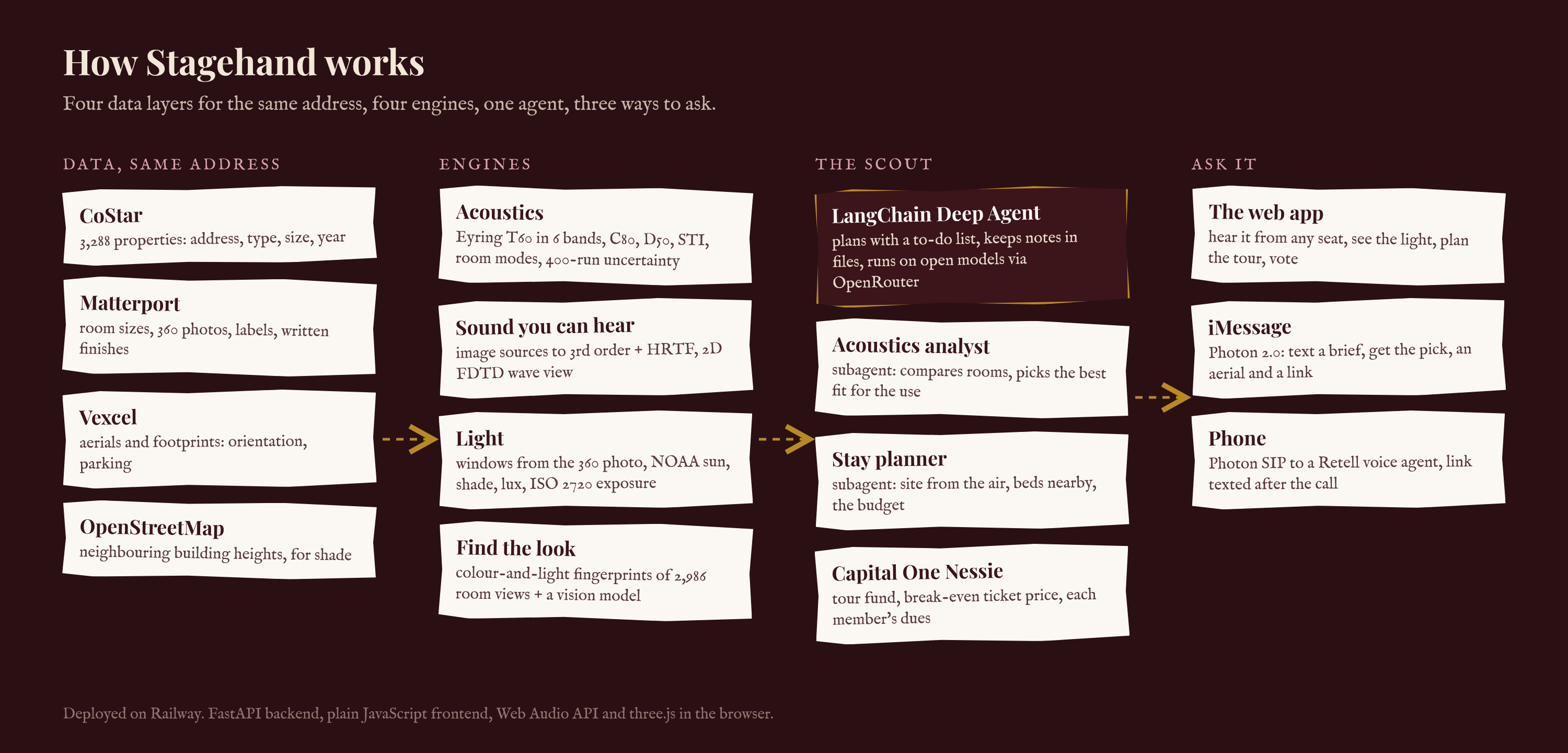
Data: CoStar, Matterport and Vexcel, combined for the same address.
- CoStar: 3,288 commercial properties in Los Angeles and Houston.
- Matterport: each room's dimensions, 360 photos, room labels, and the scan's own description of its finishes.
- Vexcel: aerial imagery and building footprints, used to orient each room to the real sun and check parking and load-in.
- OpenStreetMap: neighbouring building heights, for shade.
The acoustics engine
For each octave band from 125 Hz to 4 kHz we compute the reverberation time with the Eyring equation, including air absorption:
$$T_{60} = \frac{0.161\,\overset{\text{volume}}{\overbrace{V}}}{\underset{\text{walls, seats, audience}}{\underbrace{-S\ln\left(1-\bar{\alpha}\right)}} + \underset{\text{air}}{\underbrace{4mV}}}$$
where \(S\) is the total surface area and \(\bar{\alpha}\) the area-weighted absorption of the finishes, furniture and audience. The finishes are parsed out of Matterport's own scan descriptions ("large-format tile flooring… floor-to-ceiling windows"), and the matched phrases are shown as evidence.
Which notes boom comes from the room's standing waves, which rule below the Schroeder frequency:
$$f_{n_x n_y n_z} = \frac{c}{2}\sqrt{\left(\frac{n_x}{L}\right)^2 + \left(\frac{n_y}{W}\right)^2 + \left(\frac{n_z}{H}\right)^2}, \qquad f_S = 2000\sqrt{\frac{T_{60}}{V}}$$
with axial modes weighted strongest, then tangential, then oblique. We report them as note names, with the voice parts that sing them.
Clarity and definition at a seat follow Barron's revised theory:
$$C_{80} = 10\log_{10}\frac{\int_{0}^{80\,\mathrm{ms}} p^2(t)\,dt}{\int_{80\,\mathrm{ms}}^{\infty} p^2(t)\,dt}, \qquad D_{50} = \frac{\int_{0}^{50\,\mathrm{ms}} p^2(t)\,dt}{\int_{0}^{\infty} p^2(t)\,dt}$$
plus speech intelligibility (STI) and bass ratio.
Honest uncertainty. A scan tells you a room's size but not exactly what its walls are made of. So we rerun the model 400 times, jittering each surface's absorption, the audience, and the ceiling height when the scan didn't measure it:
$$A_k \to A_k\,e^{\varepsilon_k},\ \ \varepsilon_k \sim \mathcal{N}(0,\,0.30^2)$$
$$A_{\text{aud}} \to A_{\text{aud}}\,e^{\varepsilon},\ \ \varepsilon \sim \mathcal{N}(0,\,0.15^2)$$
$$H \to H\,e^{\varepsilon},\ \ \varepsilon \sim \mathcal{N}(0,\,0.18^2)$$
and report the middle 80%, \(\left[P_{10},\ P_{90}\right]\), as "our best guess." Each use has its own target: a cappella, choir, rehearsal and spoken theatre, vocal recording, film dialogue (0.3 to 0.6 s), and amplified shows.
Hearing it and seeing it
Per-seat sound (Web Audio API). Image-source reflections up to third order, each placed by the browser's 3D-audio panner from its true direction and dulled by every bounce. Then a diffuse tail per octave band, starting at the room's mixing time of about \(\sqrt{V}\) ms.
Watching the sound. A 2D finite-difference time-domain (FDTD) solution of the wave equation over the floor plan:
$$p^{n+1}[i,j] = 2p^{n}[i,j] - p^{n-1}[i,j] + \lambda^2\,L^{n}[i,j]$$
where the five-point sum over neighbouring cells is
$$L^{n}[i,j] = p^{n}[i+1,j] + p^{n}[i-1,j] + p^{n}[i,j+1] + p^{n}[i,j-1] - 4p^{n}[i,j]$$
and the time step stays stable as long as
$$\lambda = \frac{c\,\Delta t}{\Delta x} \le \frac{1}{\sqrt{2}}$$
with walls modelled as sound-absorbing boundaries set by their finish (Kowalczyk & van Walstijn 2008).
Measuring your own room. Clap into your phone in your rehearsal space. We octave-filter the recording and take Schroeder's backward integral,
$$E(t) = \int_{t}^{\infty} p^2(\tau)\,d\tau$$
truncate the noise with Lundeby's iterative method, and fit \(T_{20}\), \(T_{15}\) or \(T_{10}\) depending on how loud the clap was. Then compare your room with any venue.
Light
Windows are found per pixel in the 360 photo, in 25 cm cells. The sun's position comes from NOAA's solar equations, with shadows cast by real neighbouring buildings. Light and exposure follow three laws. The light landing on a surface falls off with the square of the distance and with the angle it arrives at:
$$E = \frac{I\cos\theta}{d^2}$$
A spotlight spreads its lumens over its cone, where \(\theta\) is half the beam angle:
$$I = \frac{\Phi}{2\pi\left(1-\cos\theta\right)}$$
And the camera exposure comes from the ISO 2720 light-meter standard:
$$EV = \log\nolimits_2\frac{100\,E}{250}, \qquad t = \frac{N^2}{2^{EV}}$$
Find the look
Each of 2,986 room views is reduced to a colour-and-light fingerprint: a hue histogram in Lab space, a \(4 \times 4\) map of where light falls, and brightness, contrast, colourfulness and warmth. Matching against all of them takes about a second. A vision model then names the kind of space, rooms whose Matterport labels match move up, and the model compares the shortlist with your picture and says what each room shares with it.
The scouting agent (LangChain Deep Agents)
The lead agent plans with a to-do list, keeps its notes in a virtual file system, and hands work to two subagents: an acoustics analyst and a stay planner. It runs on free open models through OpenRouter. A rule-based planner runs the same tools when no model is available.
| Tool | What it does | Data |
|---|---|---|
search_venues |
Ranks rooms by fit for the use and the crowd | CoStar + Matterport |
analyze_venue |
Reverb, clarity, booming notes, the uncertainty range | Matterport scan |
site_check |
Parking, load-in, the building from above | Vexcel |
find_housing |
Beds nearby, with a cost | CoStar |
tour_budget |
Balance, break-even ticket price, each member's share | Capital One Nessie |
draft_outreach |
The email to the venue | All of it |
add_to_pipeline |
Saves the venue to the group's bookings | Stagehand |
Tour money (Capital One Nessie). The tour fund, the budget check for each venue and collecting each member's share of the dues all run on Nessie accounts, bills and transfers.
Deployed on Railway, with a FastAPI backend and a frontend in plain JavaScript modules with no framework.
Challenges we ran into
The 3D room smeared. Projecting a 360 photo onto a box at the room's size works for walls the camera faced head-on. But the floor is seen at a grazing angle, so a single pixel got stretched across metres into long streaks. We now measure the viewing angle \(\lvert \hat{d}\cdot\hat{n} \rvert\) for every pixel in the shader: head-on surfaces keep the sharp photo, and grazing ones fade to a blurred version of the same colour.
Floors and ceilings don't exist in a floor plan. Our 2D wave simulation had nothing above or below to absorb sound, so it rang forever. We size a uniform loss so the field dies away at the room's real 3D \(T_{60}\), while the walls keep their own absorption.
A clap is a terrible test signal. It's short and quiet and buried in background noise. Lundeby's iterative noise truncation, plus choosing the fit window from the measured dynamic range, made the measurement repeatable.
Nobody knows what the walls are made of. That's the biggest unknown in room acoustics. We stopped pretending and turned it into a range.
The site was slow because of images, not code. At first, picking each room's best photo meant the browser downloaded dozens of photo faces per card to score them. We moved that to the server, cached it, and serve card-sized copies. Each photo went from 95 KB to 30 KB.
Free models think before they answer. Our vision model spent its whole token budget reasoning and returned half a JSON object. A bigger budget and a fallback chain of models fixed it.
Accomplishments that we're proud of
We ran our engine blind on three of the most measured concert halls in the world. We gave it only what a scan would give us, with nothing tuned to the halls, and compared the result with the occupied reverberation times published in Beranek's Concert Halls and Opera Houses:
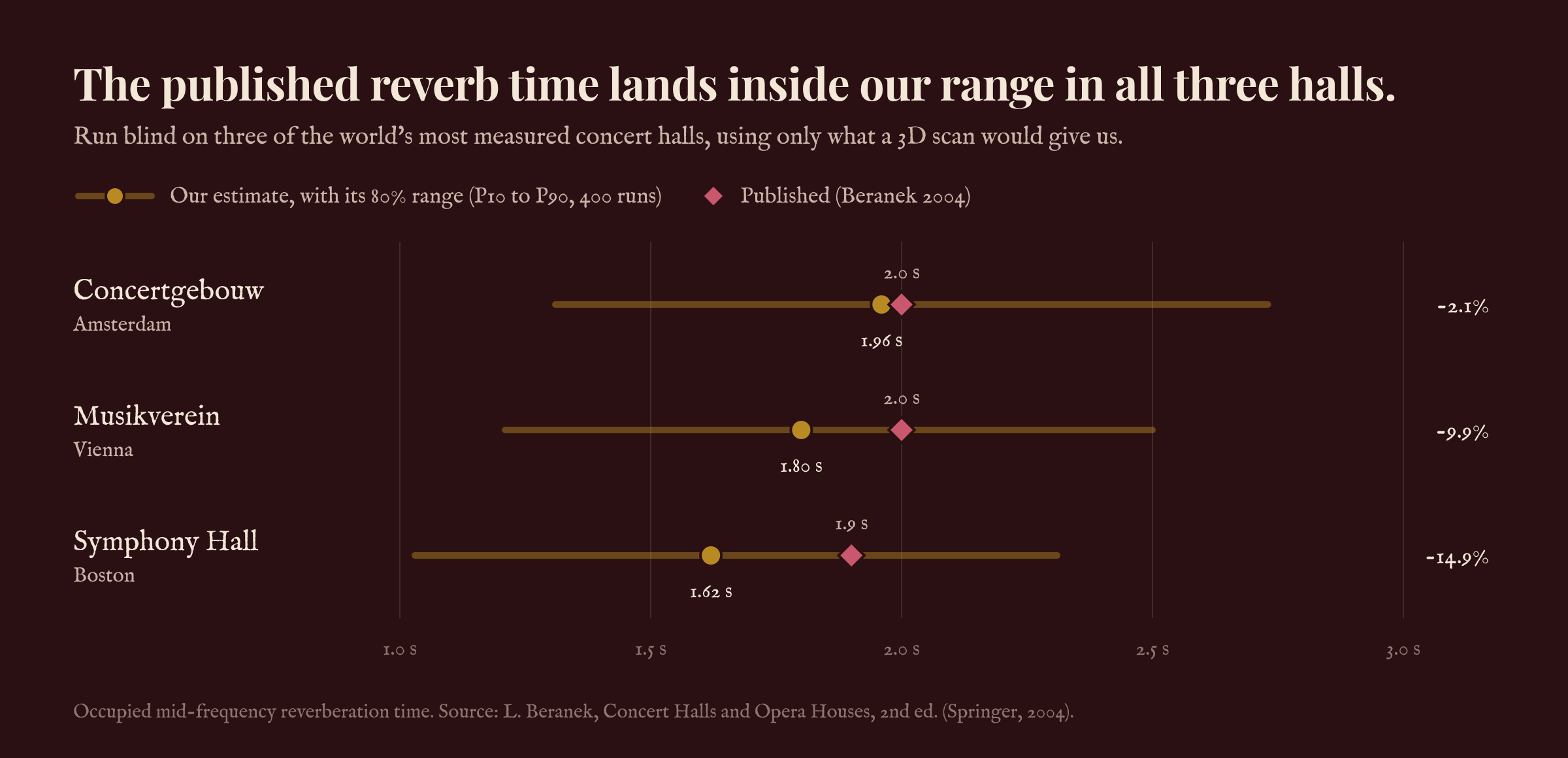
| Hall | Published \(T_{60}\) | Ours | Our 80% range | Error |
|---|---|---|---|---|
| Concertgebouw, Amsterdam | 2.0 s | 1.96 s | 1.31 to 2.73 s | −2.1% |
| Musikverein, Vienna | 2.0 s | 1.80 s | 1.21 to 2.50 s | −9.9% |
| Symphony Hall, Boston | 1.9 s | 1.62 s | 1.03 to 2.31 s | −14.9% |
$$\boxed{\;T_{60}^{\,\text{published}} \in \left[P_{10},\ P_{90}\right] \text{ in all three halls, run blind}\;}$$
You can hear a room you've never been in, from a specific seat. Moving one seat over changes what you hear.
All three data layers do real work together. The scan gives the room's shape and finishes. The aerial footprint orients it to the sun and shows where the trucks can park. The property record places it on a map and in a budget. None of the features works with only one layer.
What we learned
The hard part of room acoustics isn't the equations, which have been around since the 1920s. It's knowing what the walls are made of. Showing a range is more honest, and more useful, than one confident number. Our estimates also ran consistently a little low against the real halls, which tells us exactly where to calibrate next.
Talking to Out of the Blue taught us that sound is only half the problem. The room also decides the show order, who solos and what gear to pack, and a whole group has to agree on it, along with the city and the budget.
Text or call the scout: Photon
Tour managers don't plan from a laptop; they plan from group chats. So Stagehand also lives in iMessage, and answers the phone, built on Photon 2.0.
- Text it: send "14 singers, LA, March 14, 80 guests, 2 nights." Photon delivers it to our server, the same scouting agent runs on it, and the reply lands in the same thread. It contains the pick and why (acoustics, capacity, lodging, budget), a Vexcel aerial photo of the venue, and a link that opens the room with "hear it" ready to play.
- Follow up naturally: "something cheaper," "what about Houston?" or "for 120 people" re-run the search with the new details.
- Or call it: Photon routes the call over SIP to a Retell voice agent. Tell it what you're putting on (a choir concert, a play, a film shoot) and it calls our scouting functions and answers in a sentence or two. A film crew hears "good for recording dialogue"; a choir hears whether the sound will blend. It offers alternatives and nearby lodging, then texts you the hear-the-room link from the same number.
What's next for Stagehand
- Read materials straight from the 360 photos (carpet vs. hardwood vs. glass) to narrow the range.
- Calibrate per building type with clap measurements from real venues. All three halls came out a little low, so there's a clear correction to learn.
- A full 3D wave simulation for the bass, where the floor-plan view is least accurate.
- Live availability from venue calendars, so you can book straight from the room you just listened to.
Built With
- capital-one-nessie
- costar
- deepagents
- fastapi
- javascript
- langchain
- matterport
- numpy
- openrouter
- openstreetmap
- photon
- python
- retell
- three.js
- vexcel
- web-audio-api


