Inspiration
First-come, first-served feels fair because whoever arrives first gets priority. But in university libraries, students stretch that principle too far. They leave their belongings behind after they've left the space, which lets them keep claiming a seat under the "I was here first" rule, even though they're no longer actually using it.
Our research found a contradiction: almost everyone was frustrated by seat saving, yet almost everyone admitted to doing it themselves. Existing solutions like BRB cards and LibCal have also had limited success. Only 9% of students we surveyed knew about BRB cards, while LibCal adds extra steps to simply use a seat.
This led to our How Might We Statement:
How might we create a more equitable way of allocating shared spaces without losing the simplicity of first-come, first-served?
What It Does
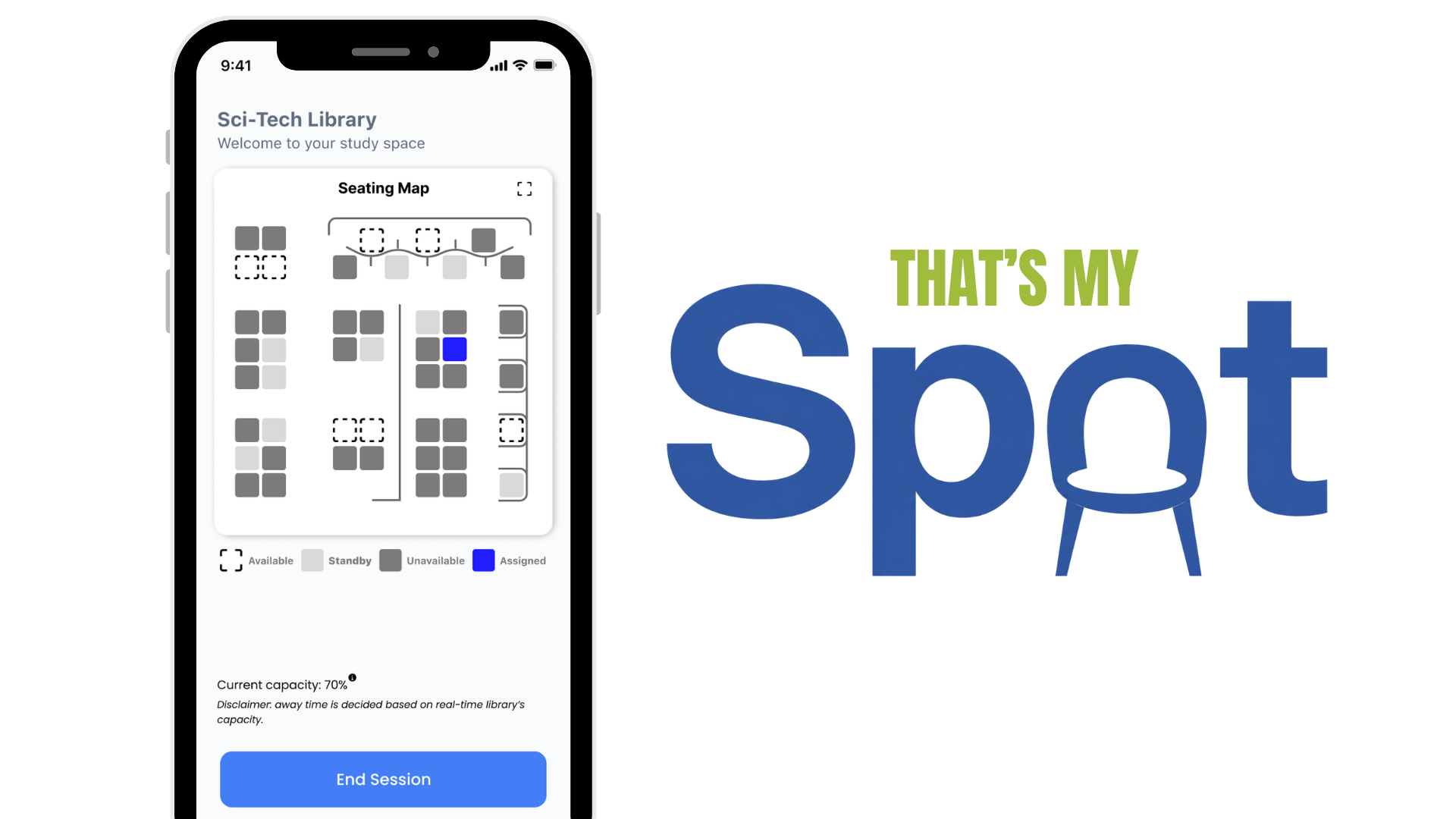
Spot uses a simple, time-based system to make seat sharing more fair.
Students tap their phone on an NFC point to claim a table. When they leave, the table enters an "away" state with a temporary hold timer. The timer adapts to how busy the library is, giving students more time during quiet periods and less during peak times. When a timer expires, the seat becomes available again.
When entering the library, students can scan a QR code to see available seats and navigate to them.
If belongings are left behind, a clear process tells the next student where to place them. Confirmation from the web app removes the awkwardness of deciding whether they can move someone else's things.
How We Built It
We combined surveys and interviews with secondary research into seat saving and first-come, first-served social behaviours.
We then prototyped:
- NFC seat check-in
- QR-based seat map finding
- Adaptive timers
- Notifications for breaks and expiring seat claims
We chose NFC because students almost always have their phones with them and it's simpler than introducing a new card system. Rather than building a dedicated app, which adds friction since no one wants to download something new just to sit at a desk, Spot runs as a web app that opens instantly on tap or QR scan.
Challenges
Our biggest challenge was designing a system that positively reinforced giving up your seat when you're not using it, making more seats consistently available so people stop hogging desks out of the fear that "I won't be able to find a seat when I come back."
What We're Proud Of
Spot removes the awkward uncertainty around belongings left unattended for long periods of time — the "do I move their stuff because I can't find any empty seats?" moment that nobody has a clear answer for.
What We Learned
We learned that seat saving is not necessarily caused by bad intentions. The bigger issue is the lack of accountability for shared resources.
We also learned that convenience is important. Existing solutions add friction, so Spot keeps the interaction simple:
Tap. Sit. Study.
What's Next
We want to test Spot in a real library using NFC hardware and QR wayfinding, then measure whether adaptive timers reduce seat saving during busy periods.
The same system could also work for other shared resources, such as:
- Company hot desks
- Gym equipment
- Poolside seating
Built With
- adobe-illustrator
- figma


Log in or sign up for Devpost to join the conversation.