-
-
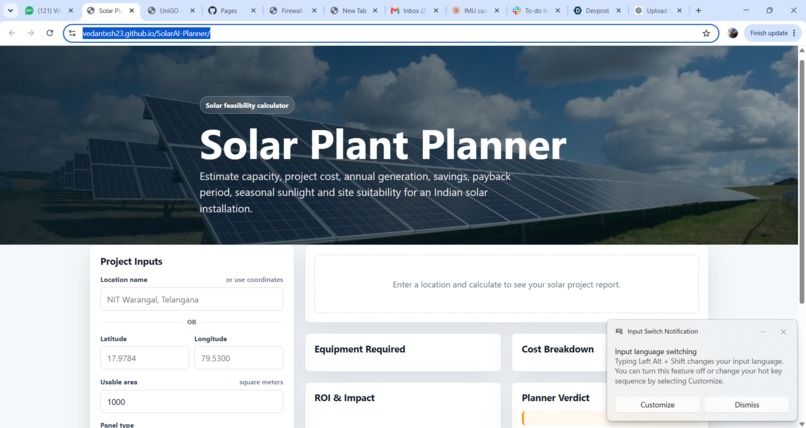
Website Page
-
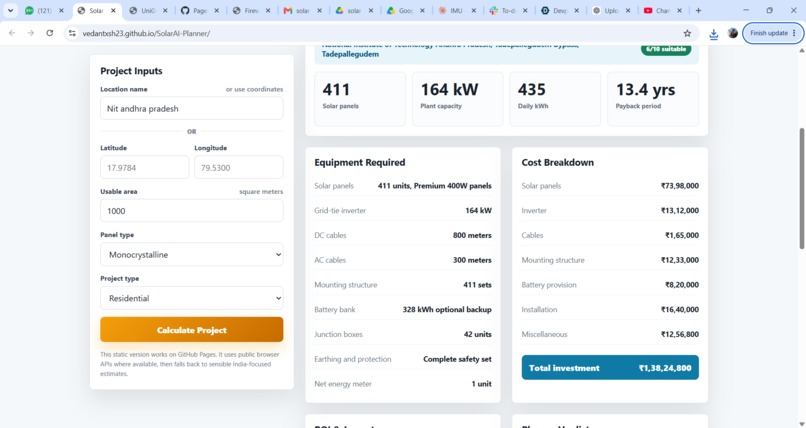
Result
Inspiration
India has enormous solar energy potential, yet planning a solar power plant remains a complex and time-consuming process. Users often need to collect data from multiple sources, estimate costs manually, analyze weather conditions, calculate return on investment, and understand government incentives. We wanted to simplify this entire process by building an AI-powered platform that automatically gathers solar resource data, analyzes project feasibility, and generates actionable insights for users. This led to the creation of SolarAI Planner.
What it does
SolarAI Planner is an intelligent solar project planning platform that helps users evaluate the feasibility of installing a solar power plant at any location in India.
The platform:
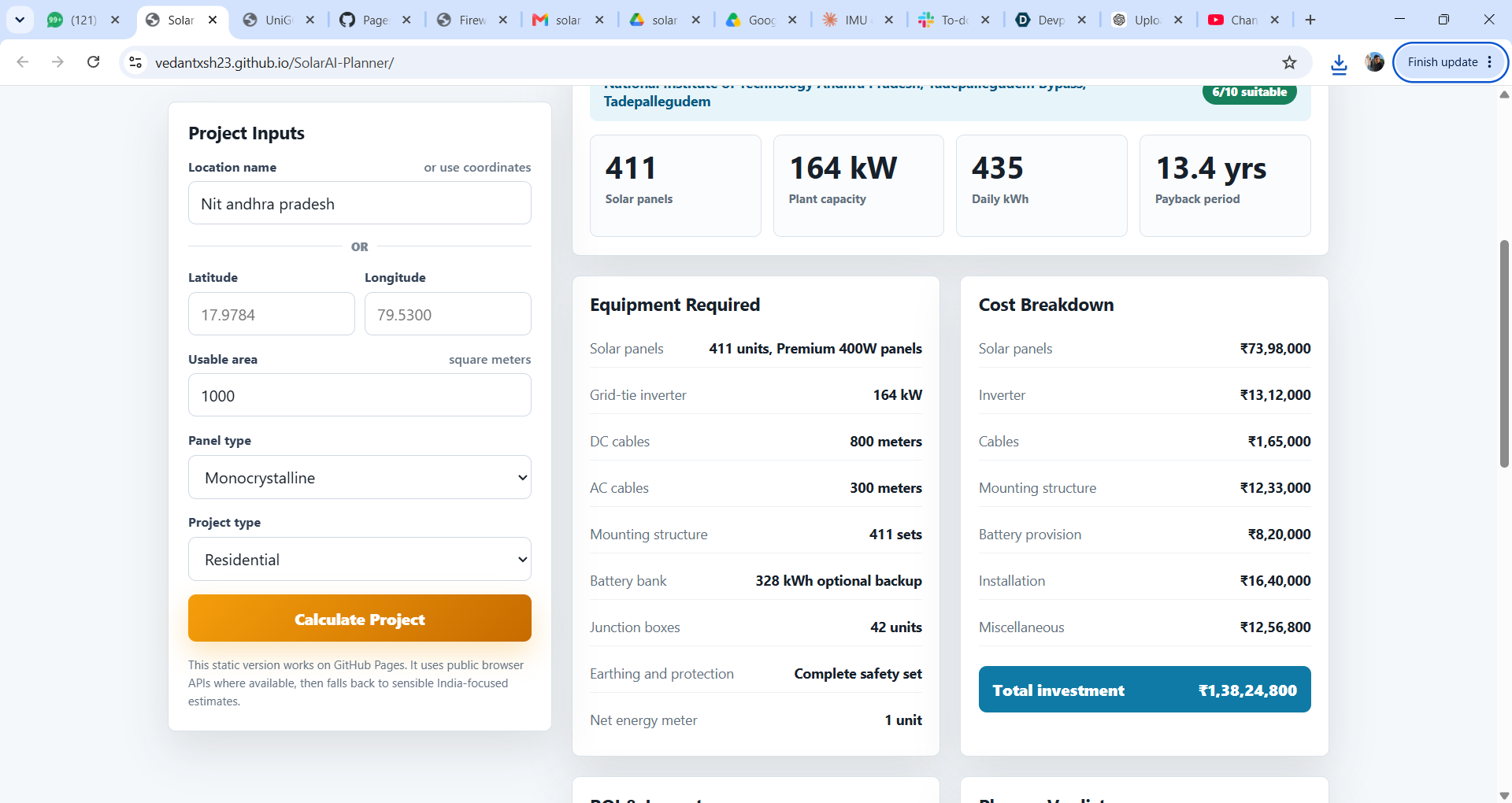
Accepts a location through coordinates or place name. Automatically identifies the site and displays it on a map. Fetches solar irradiation data from NASA POWER and PVGIS. Retrieves real-time weather information such as temperature, cloud cover, UV index, and wind speed. Estimates solar panel requirements and plant capacity. Calculates energy generation, project costs, annual savings, and ROI. Provides AI-generated feasibility reports and recommendations. Suggests optimal panel tilt angles and installation considerations. Learns from user feedback to continuously improve future predictions
How we built it
We developed SolarAI Planner using a combination of web technologies, AI, and external data sources.
Technologies Used Python for backend development Flask for the web framework HTML, CSS, and JavaScript for the frontend Groq LLM (Llama 3.3 70B) for AI-powered analysis NASA POWER API for solar radiation and climate data PVGIS API for photovoltaic energy estimation Open-Meteo API for live weather information OpenStreetMap & Nominatim for geolocation and mapping BeautifulSoup for web scraping energy pricing information
Workflow
User enters a location and project details. The system converts location names into coordinates. Multiple solar and weather data sources are queried. Solar generation and financial calculations are performed. AI analyzes the collected information and generates a detailed report. User feedback is stored to improve future recommendations.
Challenges we ran into
Integrating data from multiple APIs with different formats and response structures. Handling missing or inconsistent solar resource data across locations. Creating reliable estimates when live data sources were unavailable. Balancing accuracy and performance while aggregating data from several services. Building a feedback mechanism that allows the AI system to learn from user corrections. Managing real-world uncertainties such as weather variability and regional electricity tariffs.
Accomplishments that we're proud of
Successfully integrated multiple solar intelligence sources into a single platform. Automated solar feasibility analysis that typically requires significant manual effort. Developed an AI-powered reporting system capable of generating location-specific recommendations. Built a user-friendly interface that requires minimal technical knowledge. Implemented a feedback-based learning mechanism to improve prediction quality over time. Created an end-to-end solar planning workflow from site selection to ROI estimation.
What we learned
Through this project, we gained valuable experience in:
Renewable energy analytics and solar resource assessment. Working with large language models for domain-specific decision support. API integration and real-time data processing. Full-stack web development using Flask. Data validation and handling unreliable external sources. Building AI systems that combine deterministic calculations with intelligent reasoning.
What's next for SolarAI Planner
We plan to expand SolarAI Planner into a comprehensive renewable energy decision platform by adding:
Satellite imagery-based rooftop detection. Automatic roof area estimation using computer vision. Solar panel layout optimization. Battery storage sizing and recommendations. Financial modeling with subsidies and financing options. Carbon footprint and sustainability reporting. Multi-country support beyond India. Predictive maintenance recommendations. Mobile application support. Advanced machine learning models trained on historical solar plant performance data.
Built With
- api
- beautiful-soup
- css
- flask
- github
- groq
- html
- javascript
- llm
- nasa
- nominatim
- open-meteo
- openstreetmap
- power
- pvgis
- python
- requests


Log in or sign up for Devpost to join the conversation.