-
-
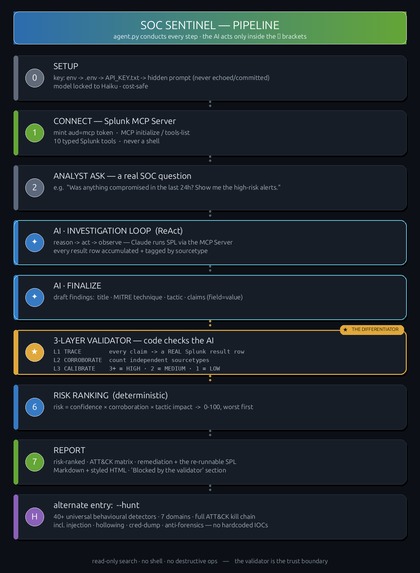
Pipeline
-
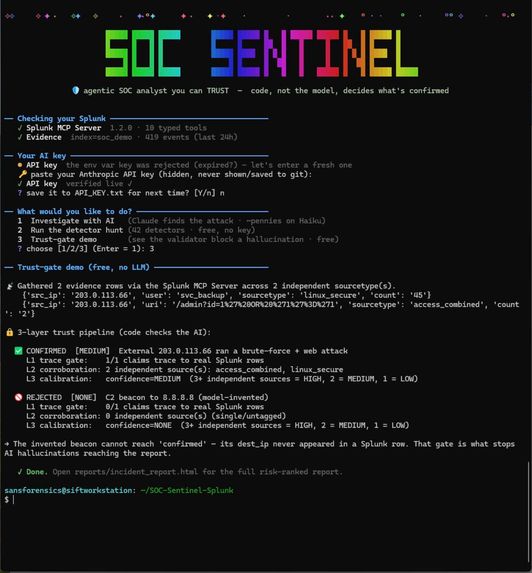
Hunting
-
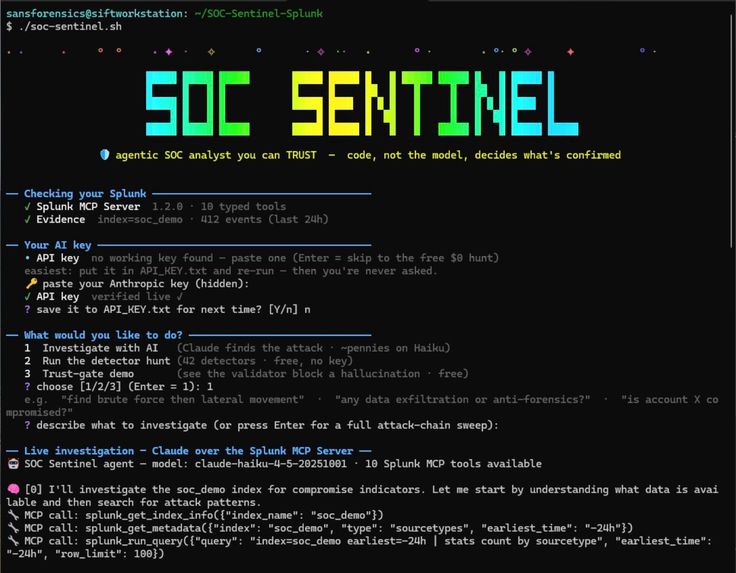
Starting
-
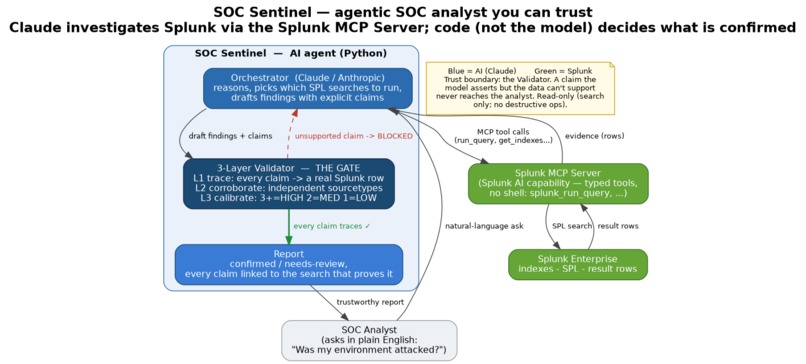
Architecture
Inspiration
The problem Point an AI at your SIEM and ask "was I breached?" and it will confidently invent an attacker IP, a hostname, a whole "confirmed" breach that isn't in your data. In security a confident wrong answer is worse than no answer - wasted IR hours, wrong escalations, real threats missed. It's the #1 reason agentic SOC tooling isn't trusted in production.
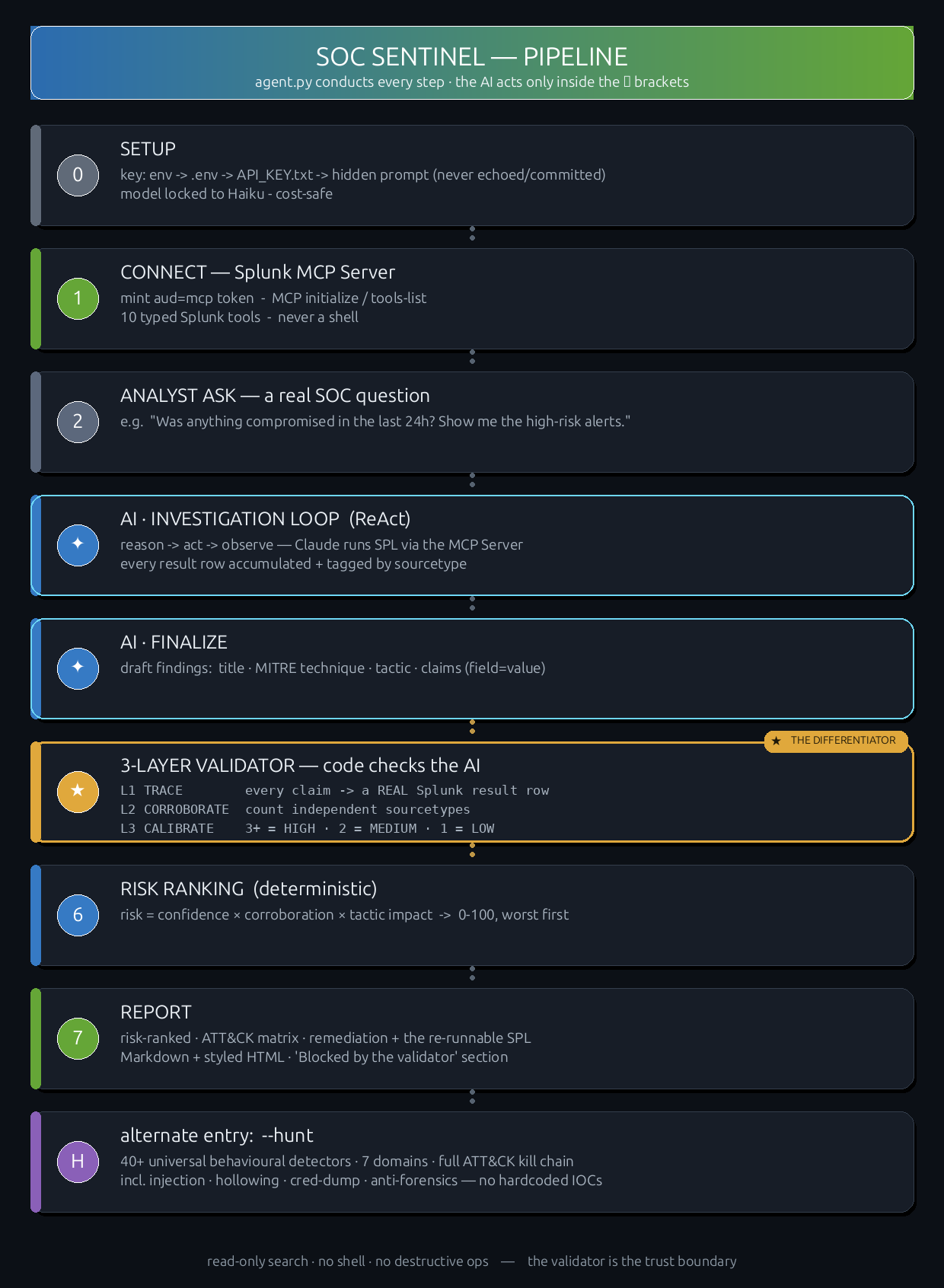
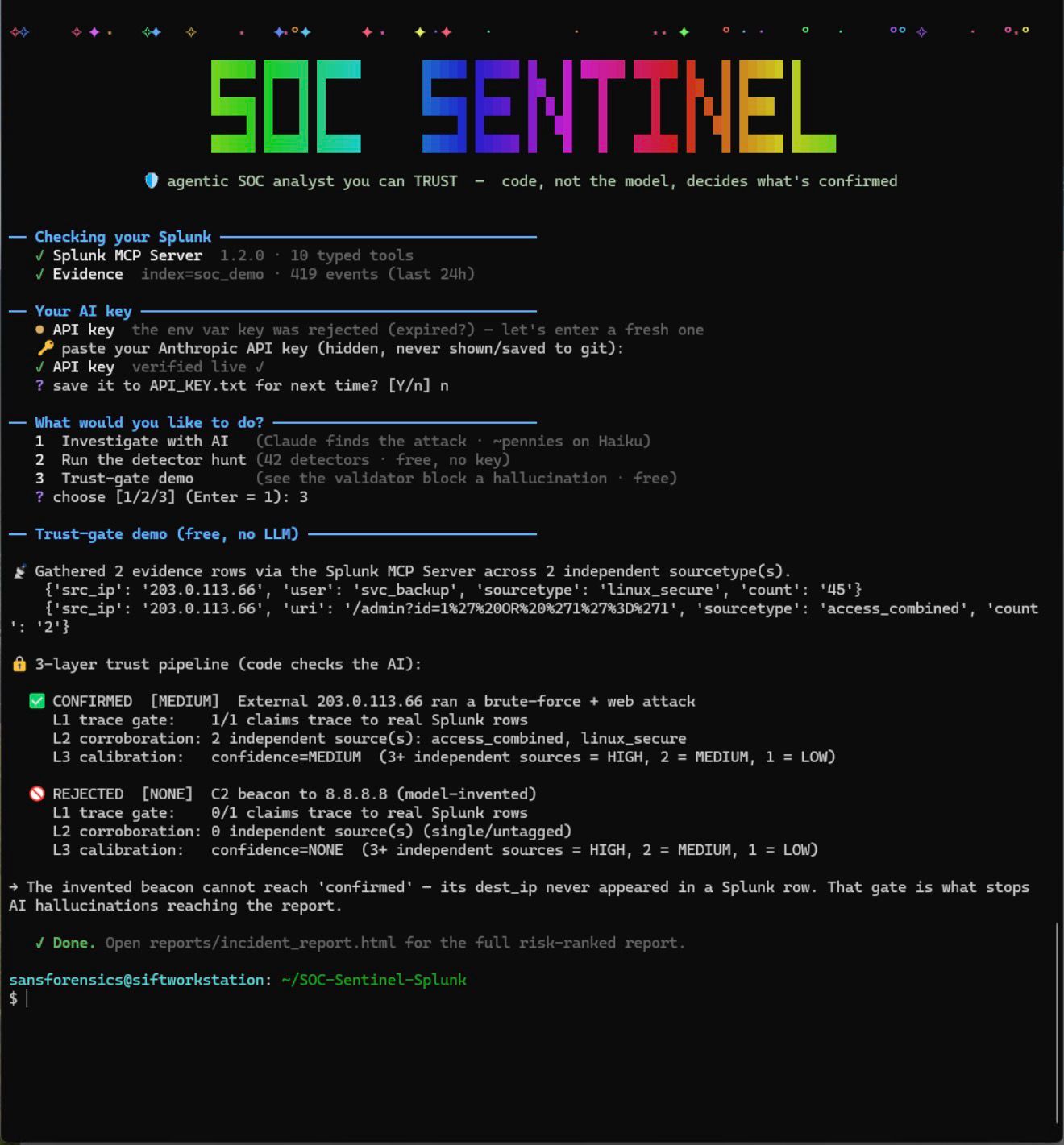
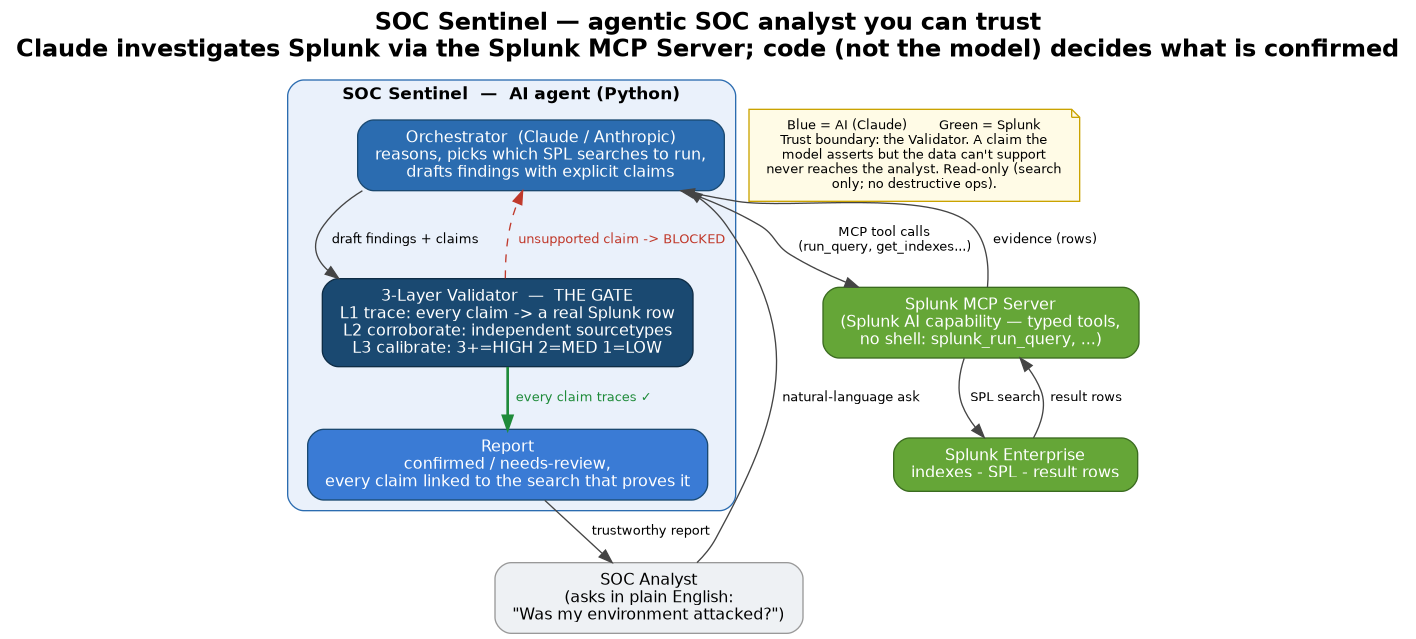
What it does SOC Sentinel is an autonomous SOC analyst for Splunk. You ask a plain-English question; Claude investigates your Splunk data through the Splunk MCP Server, then a deterministic 3-layer validator checks every claim against real Splunk result rows -anything it can't prove is blocked before it reaches you. You get a risk-ranked, MITRE-mapped report where every finding traces back to a re-runnable SPL search.
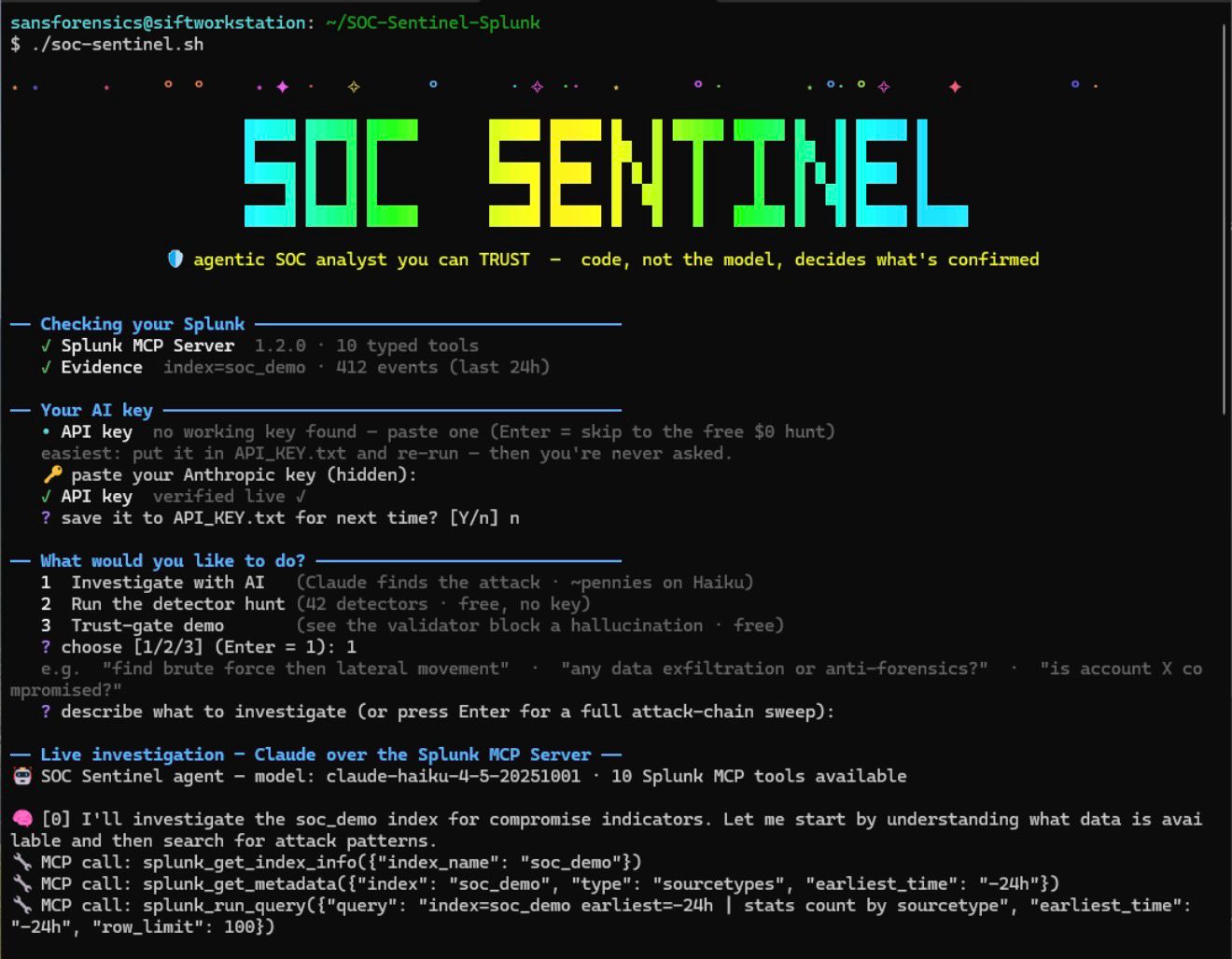
How AI + Splunk are used (at runtime - not mocked) Splunk AI capability: the Splunk MCP Server (Splunkbase app 7931, Splunk-supported) is the agent's only channel to Splunk - live splunk_run_query and friends over JSON-RPC at /services/mcp. Verified live: 24 MCP tool calls, 382 result rows, $0.0886 per investigation (76% prompt-cache hit) on Claude Haiku. Reasoning: Claude forms a hypothesis, picks which SPL to run, reads the rows, proposes findings. The guardrail (the differentiator): a 3-layer validator - L1 trace (every claim → a real row), L2 corroboration (independent sourcetypes), L3 calibration (3+ sources = HIGH) - gates every finding. Code, not the model, decides what's confirmed. How we built it splunk_mcp.py - a stdlib MCP client: mints an aud=mcp token, speaks MCP Streamable-HTTP JSON-RPC. finding_validator.py - the 3-layer trust pipeline. detections.py — 42 universal behavioural detectors across identity, endpoint, network, AWS, Azure, GCP — including the log-native equivalents of Volatility malfind/hollowprocess (CreateRemoteThread, ProcessTampering, reflective DLL) - no hardcoded IOCs (a test enforces it). agent.py — the Claude tool-use loop with prompt caching + tool-result memoization (a full run = ~9¢, 76% cached). report.py — risk-ranked Markdown + HTML reports with remediation and the re-runnable SPL. seed_demo_index.py - a reproducible 6-sourcetype ATT&CK breach so judges can run the whole thing in two minutes. ./soc-sentinel.sh - a one-command guided onboarding. Challenges Reverse-engineering the MCP Server's aud=mcp token auth; a WinEventLog:* source silently disabling field extraction; keeping the agent honest (forced findings-finalization, then the validator).
Accomplishments A live agentic Splunk integration (most entries fail this), a novel and cross-track auditable anti-hallucination trust layer, and a universal, multi-cloud, MITRE-mapped detection library - all reproducible and case-neutral.
What's next Wire the saia_* NL→SPL tools; push confirmed findings back into Splunk ES as notable events; a baseline/anomaly layer on top of the behavioral detectors.
Built with Python (stdlib) · Splunk Enterprise 10.4 · Splunk MCP Server (app 7931) · Model Context Protocol · Claude (Anthropic) · MITRE ATT&CK · graphviz.


Log in or sign up for Devpost to join the conversation.