-
-
App icon
-
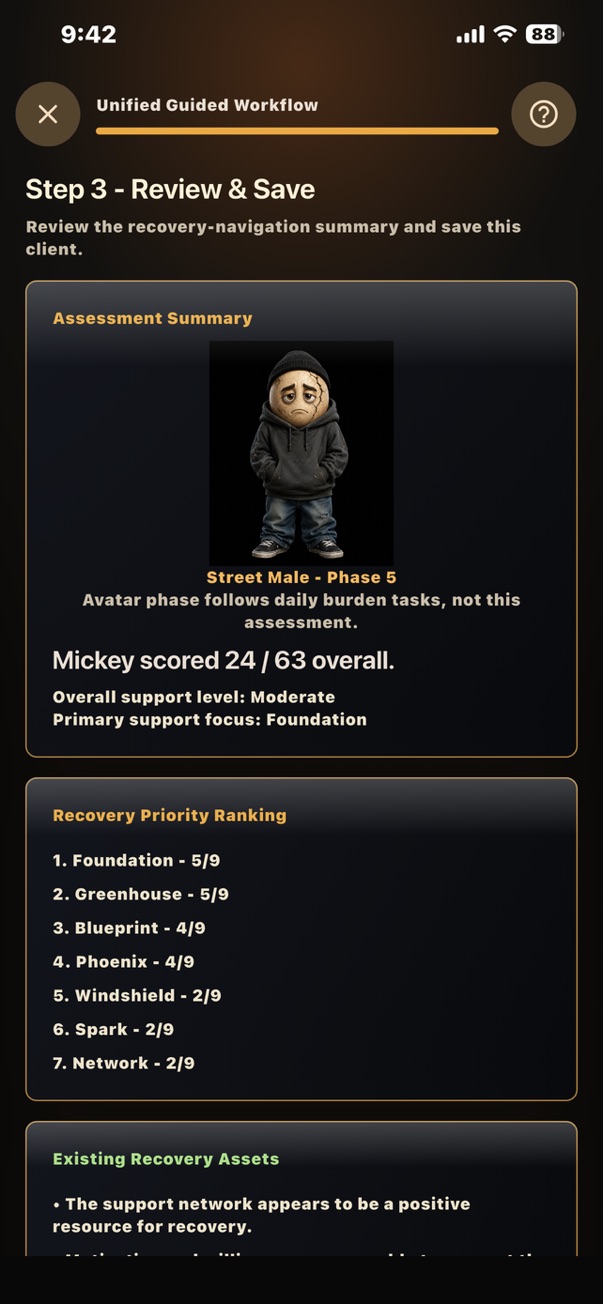
Assessment score screen
-
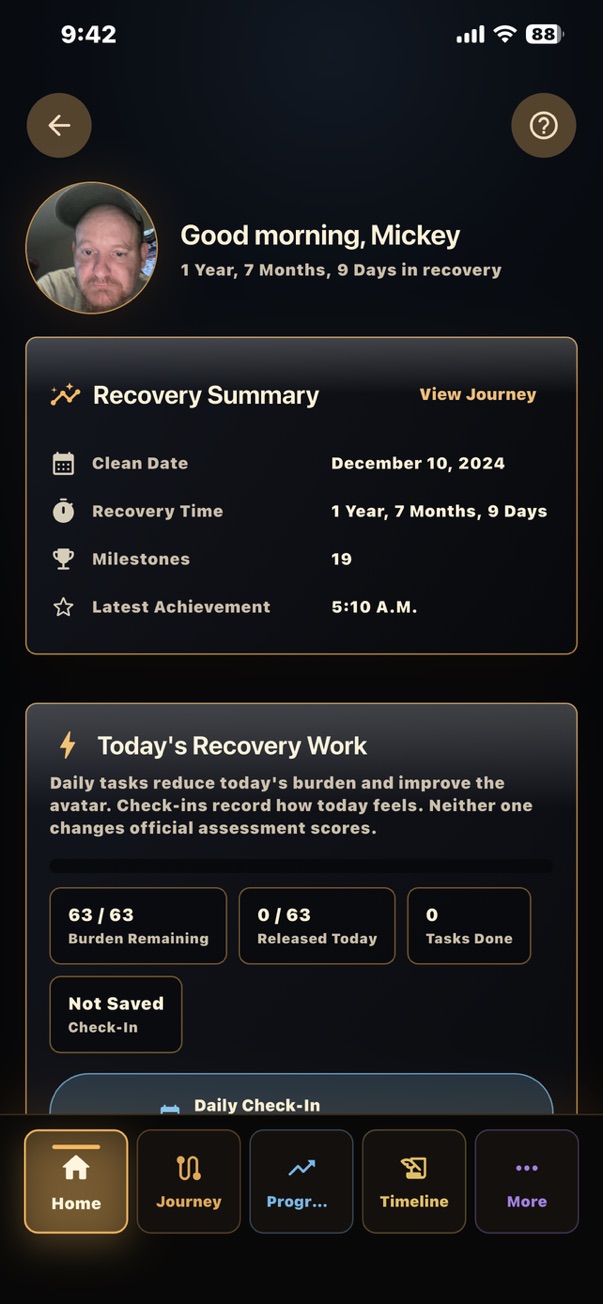
Home screen
-
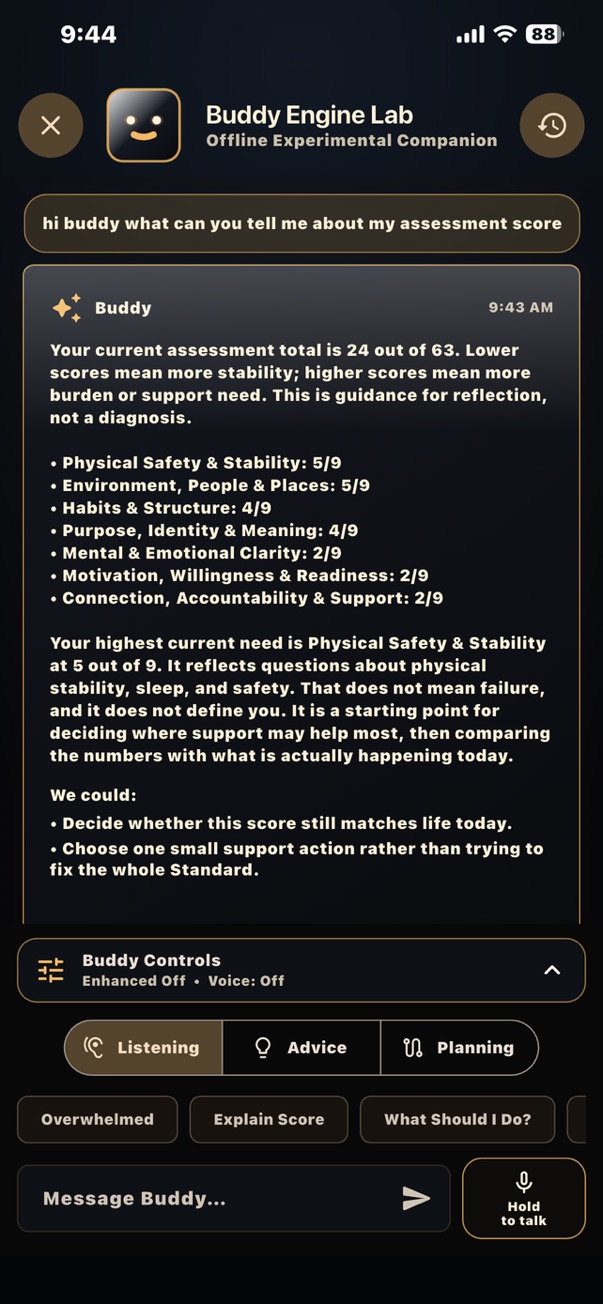
Conversation with buddy AI
-
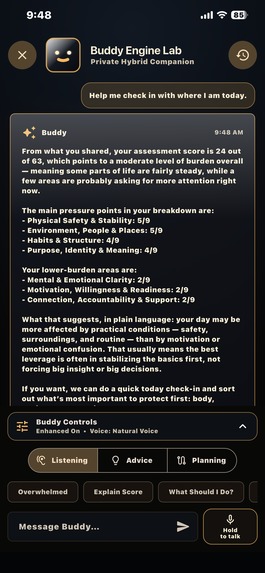
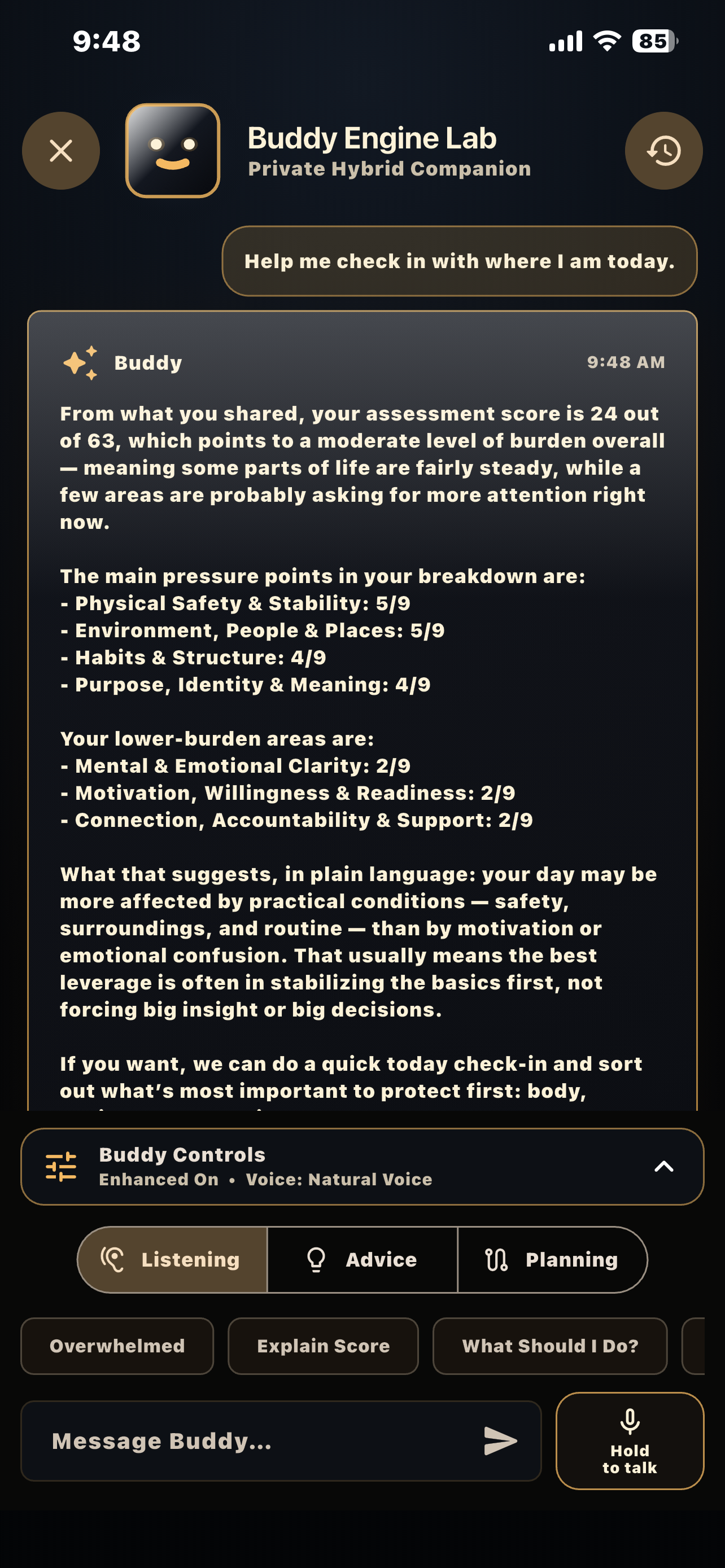
Conversation with buddy AI pic 2
Inspiration
Sober Side Up did not begin as a hackathon idea. It began during one of the hardest periods of my life.
On December 10, 2024, I survived a ruptured brain aneurysm. Recovery was slow and difficult. I experienced fatigue, memory problems, and headaches, and I had to rebuild my life while trying to remain focused on the future.
Like many people recovering from addiction or a major medical event, I discovered something that surprised me:
Recovery was not just about surviving.
It was about figuring out what to do during the hundreds of hours between appointments.
Traditional recovery support is often organized around counseling, outpatient treatment, and peer-support meetings. Those services are valuable, but they occupy only a small part of a person's week. Someone may spend an hour in counseling and another hour in a meeting, then return home to days of unstructured time in which boredom, isolation, anxiety, and old habits can return.
Living in a small community like Elma, Washington, I also found that local support options were limited. There were few recovery meetings, few structured activities, and very little available outside normal business hours. Recovery could feel like something a person was expected to figure out alone once an appointment or meeting ended.
That became the question that started everything:
What supports someone during the other 166 hours of the week?
I wanted to create a system that could encourage healthier decisions, help people recognize where they were struggling, celebrate progress, provide practical tools, and remind them that they were still moving forward even when immediate support was unavailable.
That idea became Sober Side Up.
What began as handwritten notes gradually developed into the Seven Standards of Recovery, community recovery meetings, educational lessons, journals, assessments, progress tracking, and eventually a Washington State nonprofit supporting people in recovery.
The mobile application grew from those real-world experiences and from direct contact with people attending Sober Side Up meetings. Its assessments, lessons, journal prompts, daily tasks, and recovery tools address needs that appear in life outside the meeting room—not needs invented solely for a competition.
For OpenAI Build Week, I wanted to explore one more step:
What if artificial intelligence could help someone understand current recovery pressure and identify one constructive next step?
Not as a replacement for counselors, treatment, peer support, sponsors, emergency services, or trusted people.
Instead, Buddy is a privacy-controlled recovery companion within the larger Sober Side Up system. Sober Side Up Buddy is built around a simple belief:
Recovery should not exist only during appointments. Support, structure, reflection, and practical next steps should be available throughout everyday life.
What it does
Sober Side Up Buddy helps turn a large recovery problem into one useful next step.
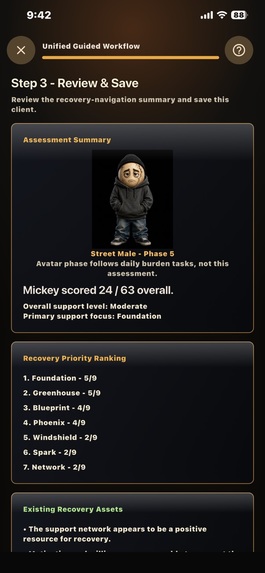
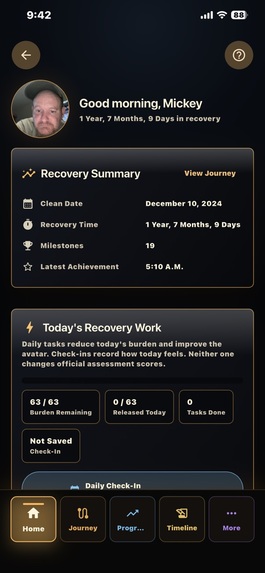
The application uses the Seven Standards to organize reflection across physical stability, mental and emotional clarity, motivation, structure, environment, identity and purpose, and connection. It includes assessments and reassessments, daily check-ins, tasks, tools, lessons, a private journal, Recovery Journey milestones, community resources, reminders, progress systems, achievements, avatars, recovery worlds, and user-controlled backups.
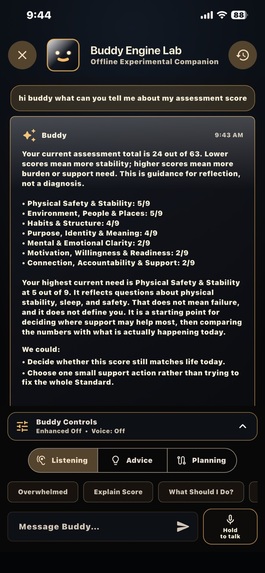
Buddy sits on top of that working system. A person can ask Buddy to explain a score or current struggle. Buddy responds in plain recovery-specific language and can route the person toward a practical in-app tool, lesson, resource, meeting, or human-support action.
Buddy is not a generic chatbot, therapist, doctor, sponsor, or emergency service. It is an explanation and navigation layer designed to keep human support at the center.
How we built it
The cross-platform application is built with Flutter and Dart. Ordinary recovery information is stored locally, and Buddy includes recovery-specific local guidance so that the product remains useful without enhanced AI or a network connection.
Enhanced Conversation is optional and stays off until the person accepts a plain-language consent screen. The client sends a minimized request containing the sanitized current message, no more than four sanitized recent turns, the selected conversation mode, and a small set of short theme labels. A bounded score summary is included only when the person asks about scores.
The request excludes the profile name and ID, recovery start date, journal text, check-in notes, photos, contacts, personal files, resources, and detailed Journey entries.
A Node.js and Express backend repeats minimization and crisis checks, keeps the OpenAI API key outside the application, and calls GPT-5.6 through the OpenAI Responses API. It uses no response storage, low reasoning effort, bounded output, a privacy-preserving safety identifier, and strict structured output. The model has no direct authority over local records or app navigation.
If Enhanced Conversation is unavailable or disabled, Buddy falls back to local recovery-specific guidance. Crisis-sensitive language is intercepted before ordinary AI conversation and routes the person to Help Now information.
Voice controls allow typed or spoken interaction. Device Voice provides a non-OpenAI audio option, while an optional Natural Voice demonstrates enhanced speech. The interface clearly shows when fallback occurs, includes hold-to-talk and release-to-send behavior, and lets the person replay a complete reply when wanted.
How Codex and GPT-5.6 helped
Codex served as a supervised development and submission partner throughout the real project. With my authorization, it inspected the Flutter applications and assets, traced the active client and backend architecture, audited public claims against the source code, identified privacy and metadata discrepancies, created a clean judging repository, restricted legacy full-context routes, added payload and safety tests, verified the builds, and prepared architecture, testing, demo, and submission materials.
Codex also helped me install and test the application on an Android emulator and a physical iPhone, refine Buddy's controls and voice behavior, debug implementation problems, prepare the demonstration video, create professional nonprofit materials, and work through the Devpost submission process.
ChatGPT helped me refine and organize the Seven Standards framework and related educational material, draft nonprofit documents, create knowledge-base content, write safety policies, build website content, debug problems, and maintain momentum while dealing with memory difficulties from my aneurysm recovery.
I remained responsible for the mission, lived and community knowledge, original recovery content, factual confirmation, safety decisions, and all final public claims.
GPT-5.6 powers the optional Enhanced Conversation endpoint in the judging build. It receives the minimized, consented request and returns a structured response. It does not receive the person's complete on-device recovery record.
Challenges we ran into
The hardest challenge was balancing useful personalization with privacy. A recovery application may contain extremely sensitive information, so sending the entire local record to an AI system was unacceptable. We built explicit consent, payload minimization, backend revalidation, crisis interception, strict output structure, and a complete local fallback instead.
Another challenge was turning a large ecosystem of assessments, daily tools, education, progress systems, visual worlds, and community resources into a coherent experience. Buddy needed to direct people toward the system rather than becoming a separate generic chatbot.
We also had to distinguish today's pressure from long-term assessment status. Completing a small task can build momentum, but the application must not falsely suggest that one action changed a person's overall recovery condition.
Finally, we prepared and verified both Android and iOS builds, resolved onboarding and branding issues, refined accessible voice interaction, cleaned the repository, protected secrets, and documented a repeatable judging setup.
Accomplishments that we are proud of
- Built a substantial working recovery application rather than a technical proof of concept
- Developed an original seven-domain recovery-navigation framework
- Distributed the Android application to multiple regular meeting participants in its intended community
- Created a local-first architecture with useful offline recovery guidance
- Made enhanced AI optional, consent-based, minimized, and replaceable by local fallback
- Added crisis-sensitive routing and clear boundaries against diagnosis or treatment
- Verified the project on an Android emulator and a physical iPhone
- Built voice and text interaction without making paid AI audio mandatory
- Used Codex not only to write code, but to audit claims, test privacy boundaries, prepare evidence, and help submit the finished project
What we learned
Responsible recovery technology is not about making the AI sound like it knows everything. It is about limiting what the AI receives, being honest about what the application can and cannot do, and connecting insight to a practical action.
We also learned that local intelligence and enhanced AI do not need to compete. Local rules can preserve privacy, reliability, and affordability, while optional AI can add conversational explanation when the person knowingly chooses it.
Most importantly, we learned that lived experience, community feedback, safety boundaries, and technical implementation have to develop together.
Potential impact
The application is already being used by multiple regular Sober Side Up meeting participants. That early community use demonstrates a real intended audience and an ongoing setting for responsible feedback, without claiming a measured clinical outcome.
The longer-term opportunity is to extend structured support between meetings and appointments, help people recognize needs across the Seven Standards, connect them with practical tools and local resources, and give peer-led organizations a repeatable educational framework while keeping sensitive information local by default.
The goal is not to suggest that software can solve addiction. The goal is to make the next constructive action easier to see while keeping meetings, treatment, crisis services, and trusted people at the center.
What's next for Sober Side Up Buddy
After Build Week, Sober Side Up plans to continue consent-based community feedback, improve accessibility and resource routing, expand the practical content library, and develop responsible measures for usability, engagement, continuity, and connection to support before making any outcome claims.
We also plan to migrate and maintain the enhanced knowledge system under the nonprofit's permanent OpenAI account, control API costs carefully, and keep improving Buddy without weakening its local-first privacy model.

Log in or sign up for Devpost to join the conversation.