-
-
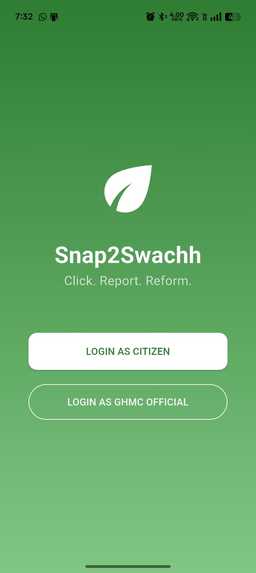
Login page
-
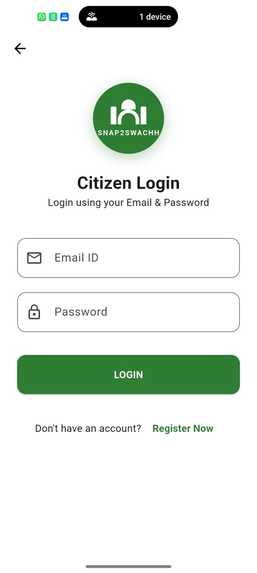
Citezen login
-
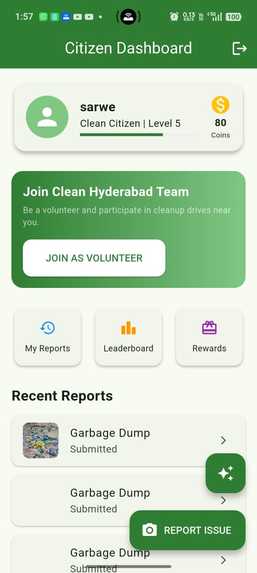
Citezen dashboard
-
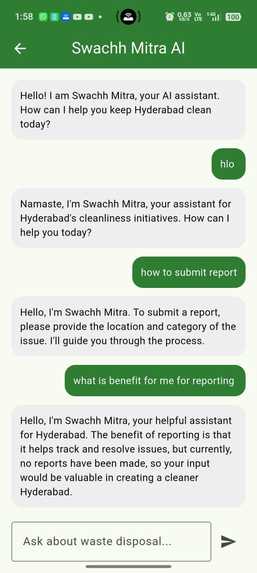
ai assistant for Citezen
-

reporting through camera
-
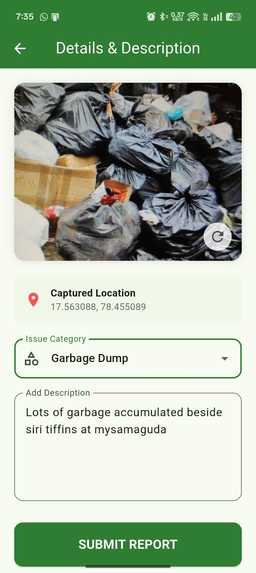
adding description and location
-
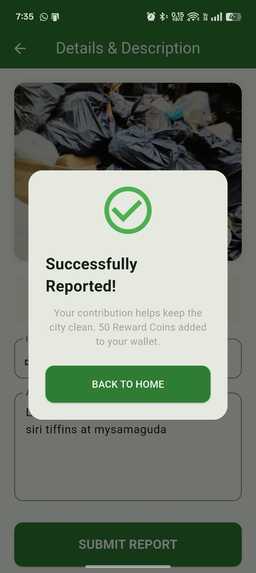
submitting report
-

Leaderboard
-

Reward system
-

redeeming rewards
-
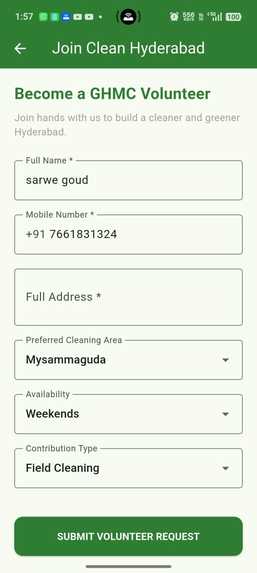
Volunteer registration
-
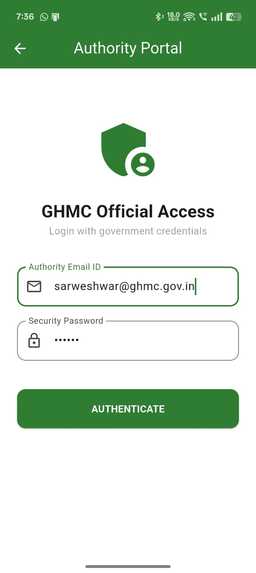
GHMC Authority login
-
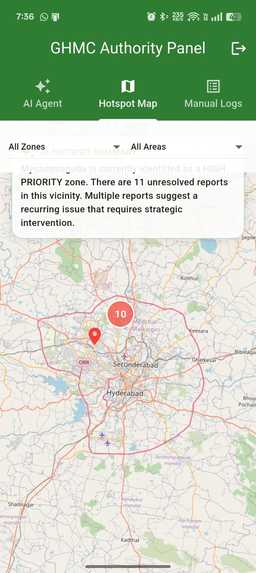
Interface for GHMC Authority login and map for viewing hotspot locations created
-
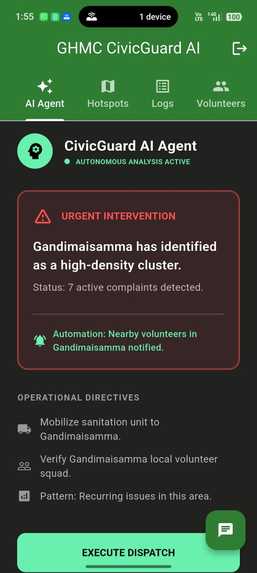
Civic agent for authorities
-
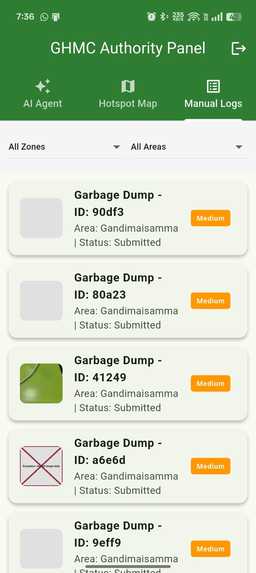
Submitted reports by citezens
-
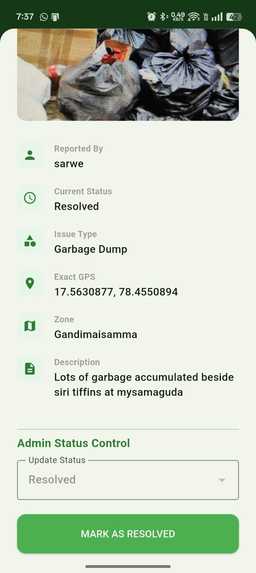
Checking indepth submitted report of citezens(for if authority wants to check manually)...and updating the status of that individual reports
-
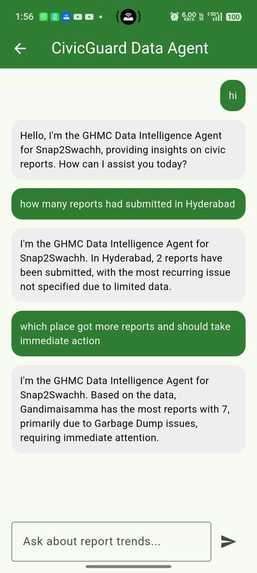
Chat bot for authority queries


Inspiration
While walking through different areas of Hyderabad—from the historic lanes of Charminar to the busy tech hubs of Hitech City—I observed a recurring problem. Many places suffer from sanitation issues such as:
-Irresponsible garbage dumping.
-Unmanaged sanitary conditions.
-Lack of awareness among citizens.
Most people assume that maintaining cleanliness is entirely the responsibility of GHMC (Greater Hyderabad Municipal Corporation), while some citizens remain careless about their surroundings.
Initially, I believed that these issues were mainly due to negligence from both authorities and citizens.
However, after observing more closely, I realized that the problem is much more complex. Rapid population growth and increasing urban activity make it extremely difficult for GHMC to monitor and maintain cleanliness in every street and locality in real time.
This led me to think deeper:
1️⃣Why should the responsibility of city cleanliness rest only on GHMC?.
2️⃣Many citizens are willing to contribute but lack a proper platform.
3️⃣There is no structured communication between citizens and authorities.
To address this gap, I came up with the idea of creating a platform that:
1️⃣Connects citizens with GHMC.
2️⃣Enables real-time issue reporting.
3️⃣Encourages community participation.
4️⃣Uses AI and geospatial intelligence for smarter decision-making.
Snap2Swachh was inspired by the vision of transforming citizens from passive observers into active contributors, building a cleaner, smarter, and more sustainable city through collaboration and technology.
What it does
Snap2Swachh is an AI-powered civic intelligence platform that acts as a bridge between citizens and GHMC (Greater Hyderabad Municipal Corporation). It transforms scattered complaints into structured, actionable insights while encouraging citizen participation through rewards and community engagement.
Snap2Swachh – System Flow (with AI Integration)
👤 Citizen Flow
1️⃣ Citizen opens the app and captures a photo/video of a sanitation issue.
2️⃣ App automatically collects GPS location (latitude & longitude) using geolocation services.
3️⃣ Citizen adds a short description and submits the report.
4️⃣ Data (image + location + text) is uploaded to the backend (Supabase).
5️⃣ AI Processing Starts:
AI categorizes the issue (garbage, drainage, waste, etc.)
AI validates report relevance (basic filtering)
6️⃣ Citizen receives Swachh Coins as rewards for valid submissions.
7️⃣ Citizen can optionally:
interact with ai Assistant chatbot for app related queries
Track complaint status
Join volunteer cleanup programs
🏢 GHMC Authority Flow
1️⃣ Officials access the dashboard with all submitted reports.
2️⃣ Instead of raw data, they see:
AI-generated summaries
Hotspot locations
Priority-ranked areas
3️⃣ System suggests:
Cleaning actions
Resource allocation
Optimized routes
4️⃣ Officials take action and update the complaint status.
5️⃣ Updates are reflected in real-time to citizens
6️⃣Authorities interact with ai assistant chatbot for queries related to the reports and database and users ,volunteers.
🤖 AI Processing Flow (Core Intelligence Layer)
CivicGuard Vision Agent (CV) – Simulates real-time image analysis to categorize waste types (plastic, organic, drainage) and calculate a Severity Score (0.0 - 1.0). • Swachh-Cluster Engine (Geo-Spatial AI) – Implements Marker Clustering algorithms to autonomously detect emerging "Hotspot Zones" by grouping high-density reports in real-time. • Llama-3 Summarization Agent (Groq-Powered) – Leverages LLMs to parse hundreds of raw descriptions and generate professional executive summaries for officials (e.g., "High sanitation risk detected in Mysammaguda with recurring drainage issues"). • Behavioral Pattern Analytics – AI Agents detect citizen negligence patterns and "Repeated Dumping" hotspots to suggest systemic infrastructure improvements rather than just temporary cleaning. • Ai Assistant for both citezen and authorities for info about the app and the reports
How we built it
The mobile application was developed using Flutter (Dart) to create a smooth cross-platform user experience. Supabase was used as the backend platform for authentication, database management, storage, and real-time updates. The system stores report data in a PostgreSQL database, while uploaded media is saved in Supabase Storage. For geospatial analysis, algorithms such as Haversine distance and marker clustering help identify sanitation hotspots and visualize them on the map.
AI integration
🔹 AI-Powered Core
Uses LLM (Llama 3.3) to analyze reports and generate real-time insights.
🔹 CivicGuard Chatbot (Authority AI)
Helps GHMC officials analyze data, get summaries, and make quick decisions.
🔹 Swachh Mitra Chatbot (Citizen AI)
Guides citizens on waste disposal, rewards, and encourages participation.
🔹 Multi-Agent System
Different AI agents handle tasks like analysis, summarization, and automation.
🔹 Smart Summarization
Converts multiple complaints into short, high-priority summaries.
🔹 Easy Data Interaction
Officials can ask questions like “Reports in Gachibowli?” and get instant answers.
🔹 Hotspot Detection
Automatically identifies high-problem areas using clustering.
🔹 Geo-Spatial Intelligence
Uses location data to track and visualize sanitation issues.
🔹 End-to-End Automation
Transforms reports into actions for faster and smarter city management
Challenges we ran into
One of the main challenges was designing a system that could effectively process location-based reports and convert them into meaningful insights for authorities. Another challenge was integrating real-time updates so that report status and rewards could update instantly for users. Balancing usability for citizens while maintaining structured data for municipal decision-making was also an important design consideration.
Accomplishments that we're proud of
We successfully developed a working prototype that connects citizens and municipal authorities on a single platform. The system not only allows issue reporting but also introduces volunteer participation and reward mechanisms to encourage responsible civic behavior. Integrating geospatial analysis and automation helped transform simple reports into actionable insights.
What we learned
Through building Snap2Swachh, I learned how technology can be used to solve real-world urban problems. I gained practical experience in developing a mobile application using Flutter and integrating backend services like Supabase for authentication, database management, and storage. I also learned how to work with geolocation data, map visualization, and real-time systems. Most importantly, this project helped me understand how combining technology, data, and citizen participation can create impactful solutions for building smarter and more sustainable cities.
What's next for snap2swach-Ai powered Civic intelligence platform
In the future, we plan to integrate AI-based image analysis to automatically detect types of waste and verify reports. We also aim to implement predictive hotspot detection to identify areas likely to experience sanitation issues. Expanding the volunteer program and integrating with official municipal systems can further strengthen community-driven urban sustainability.
Built With
- dart
- flutter
- geolocator
- git
- github
- google-maps
- gradle
- groq
- haversine-distance-algorithm
- kotlin
- llama-3
- marker-clustering
- openstreetmap
- postgresql
- supabase
- supabase-auth
- supabase-storage


Log in or sign up for Devpost to join the conversation.