🐍 About SnakeSOS
Snakebite incidents can become life-threatening when people cannot quickly identify a snake, find reliable information, or reach the right help. In many communities, especially in rural and developing regions, the problem is not only the lack of medical treatment—it is also the lack of fast, reliable coordination between the person reporting an incident, rescuers, and nearby healthcare facilities.
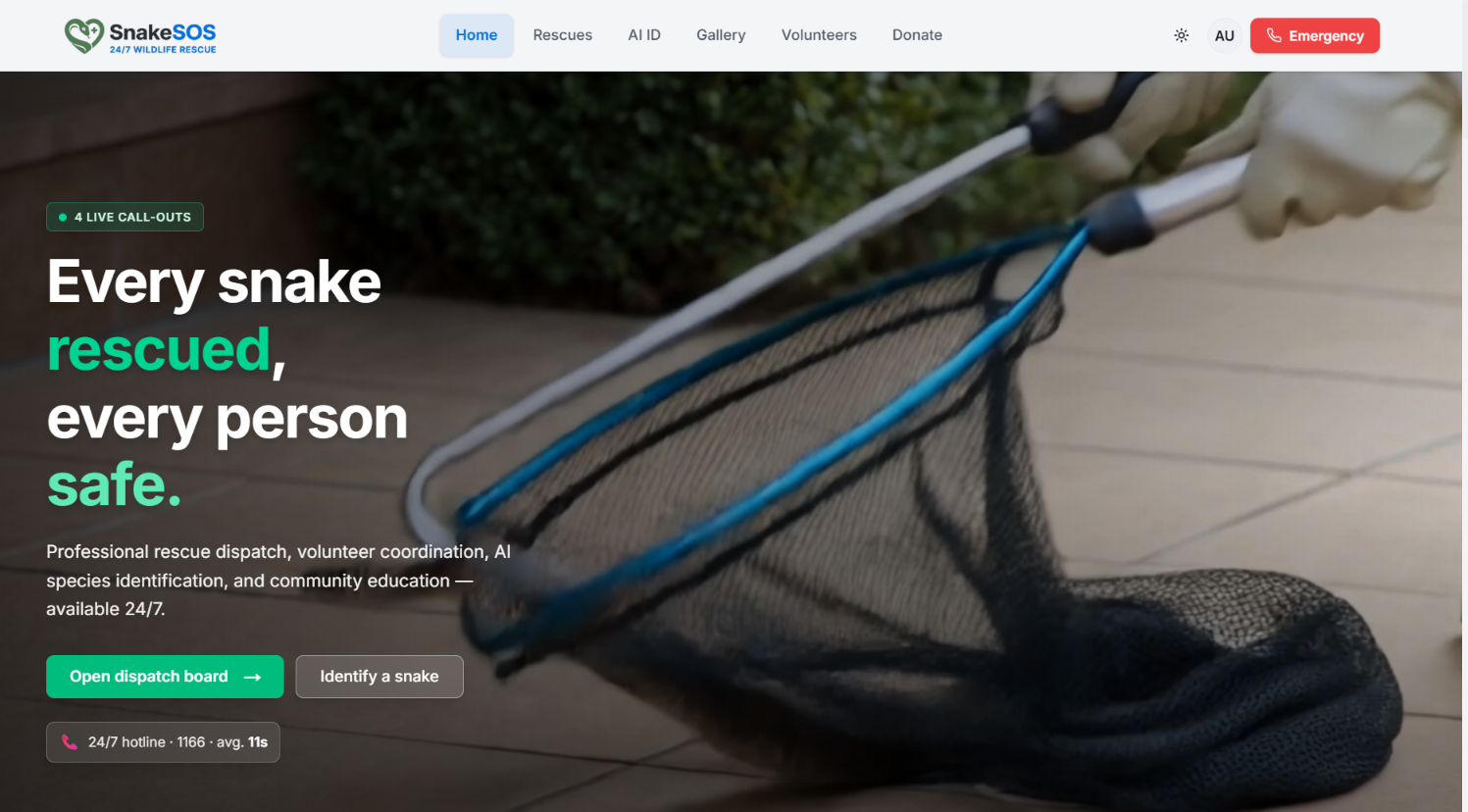
That inspired us to build SnakeSOS, an AI-powered snake safety and rescue platform designed to make the response to snake encounters faster, more informed, and better coordinated.
💡 The Inspiration
The idea came from a simple question:
What if someone encounters a snake and, within seconds, can understand the potential risk and connect with the right people for help?
Existing solutions often address only one part of the problem. A snake identification tool may identify an animal but does not help coordinate a rescue. A map can show hospitals but does not understand the emergency context. A rescue service may have people available but lack an integrated digital workflow.
SnakeSOS brings these pieces together into a single platform.
🎯 What SnakeSOS Does
The platform is designed around the complete snake-rescue workflow:
Snake encounter → AI identification → Safety information → Rescue request → Nearby rescuer → Healthcare facility
Key capabilities include:
- 🐍 AI Snake Identification — analyze an uploaded snake image and classify it using a dedicated machine-learning model.
- ⚠️ Safety & Risk Information — provide users with relevant guidance based on the identification result.
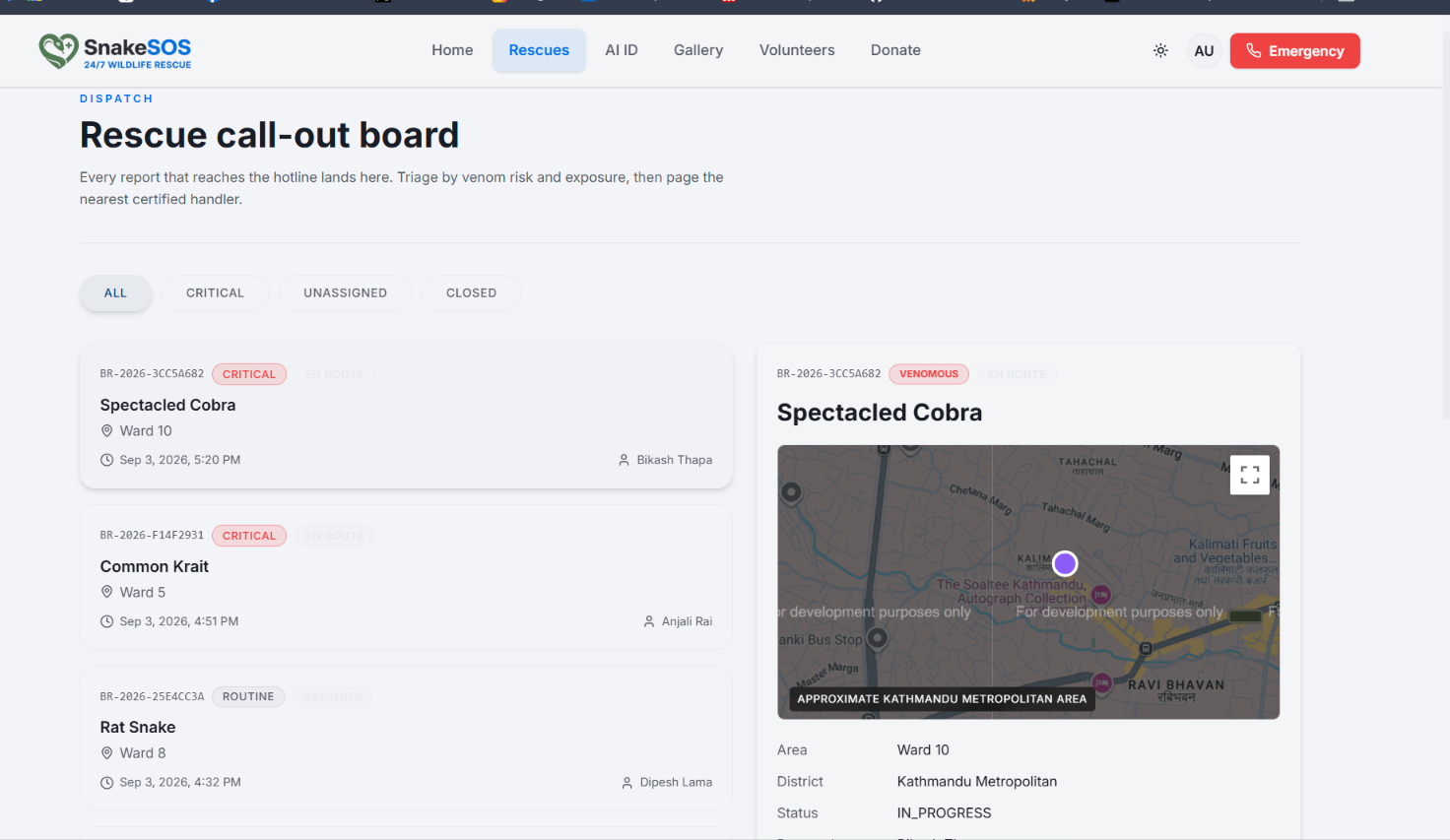
- 🚨 Rescue Requests — allow citizens to request assistance when a snake is found.
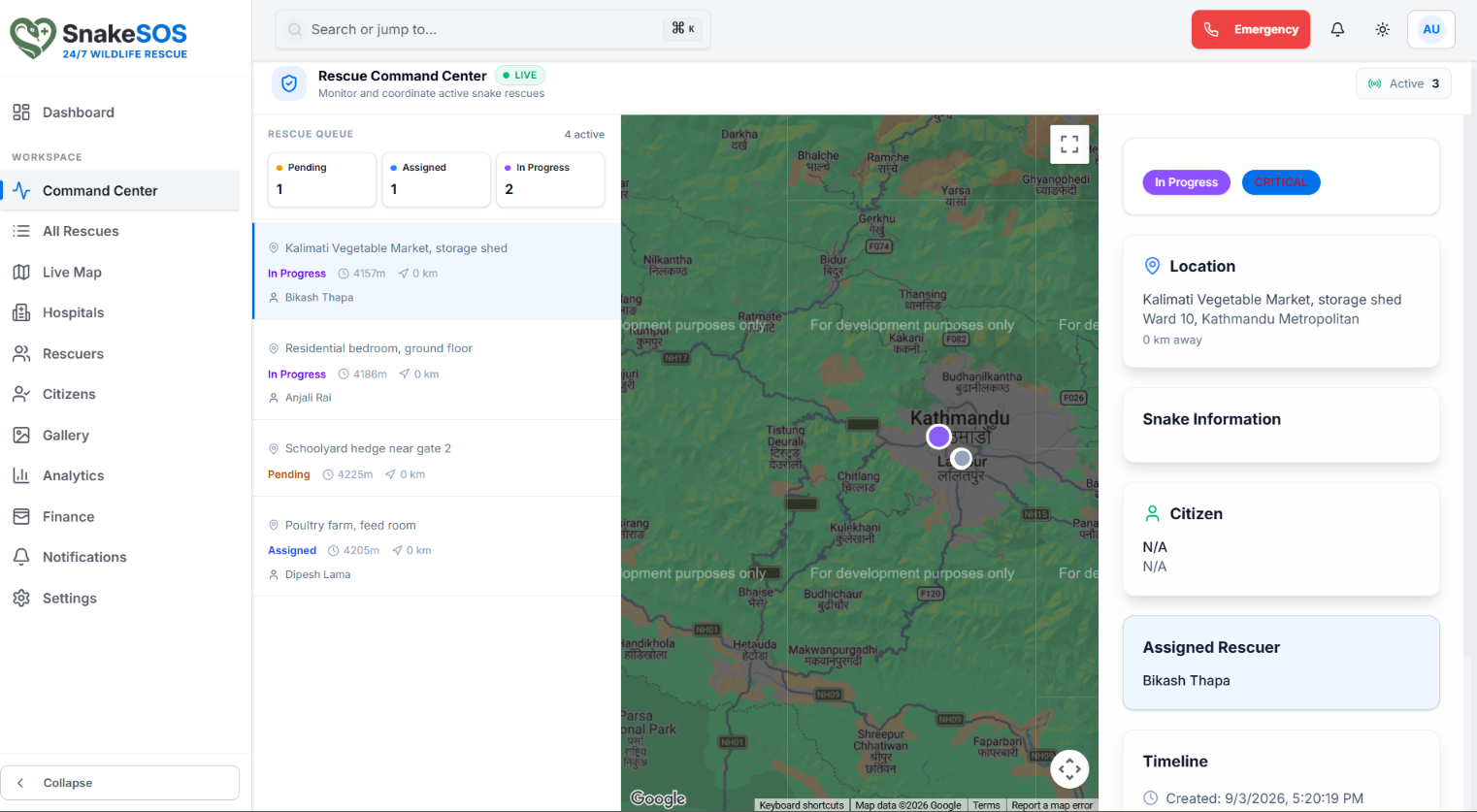
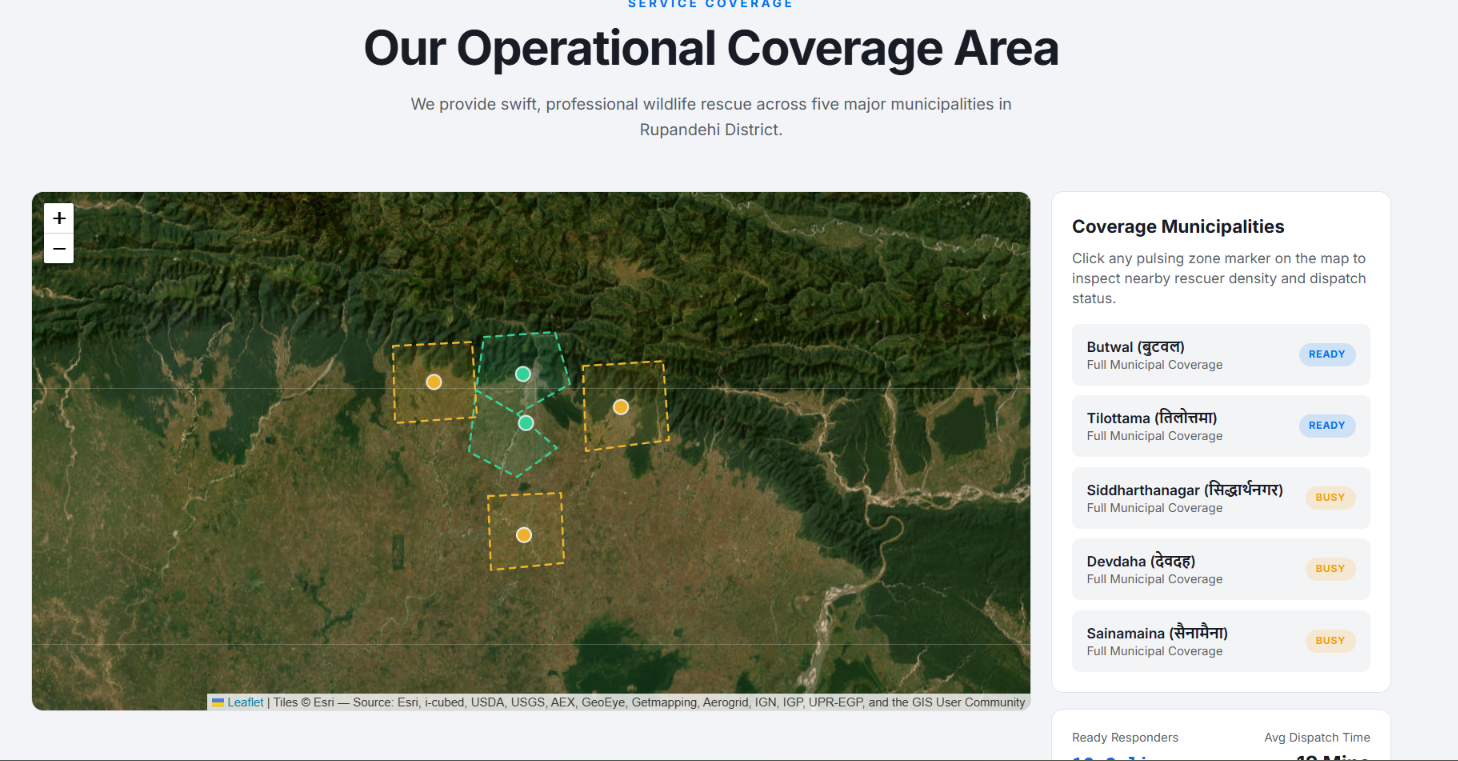
- 📍 Location-Based Rescue Coordination — connect rescue requests with nearby rescuers.
- 🏥 Hospital Discovery — help users locate relevant healthcare facilities.
- 🗺️ Interactive Maps & Routing — provide geographic context for rescuers and hospitals.
- 👨🚒 Rescuer Workflow — allow rescuers to receive and manage rescue requests.
- 🔐 Authentication & Role-Based Access — separate experiences and permissions for citizens, rescuers, administrators, and other platform roles.
- 📊 Administrative Management — provide operational tools for managing rescue activities and platform data.
The goal is not simply to build another image classifier. The goal is to create a complete emergency-response ecosystem around snake encounters.
🧠 AI Approach
Instead of relying entirely on a third-party vision API, we developed a separate AI training pipeline for snake classification.
The current model is based on EfficientNet-B0 and is trained to distinguish between:
- Venomous
- Non-venomous
Keeping the AI model as a separate project allows the machine-learning lifecycle to evolve independently from the main application.
The architecture can therefore support future improvements such as:
- More snake species
- Regional species classification
- Improved dataset quality
- Model versioning
- Confidence scoring
- Additional visual characteristics
- Continuous evaluation and retraining
Importantly, AI identification is treated as decision support, not as a replacement for professional medical diagnosis.
🏗️ How We Built It
SnakeSOS uses a modern full-stack architecture designed to keep the system modular and scalable.
Frontend
- Next.js
- React
- TypeScript
- Tailwind CSS
- Nx monorepo architecture
Backend
- GraphQL
- Apollo Server
- Node.js
- PostgreSQL
- Prisma
AI
- Python
- PyTorch
- EfficientNet-B0
- Dedicated snake image dataset
- GPU-accelerated model training
Platform Services
- Cloud-based media storage
- Maps and geolocation services
- Authentication
- Payment infrastructure
- API-based communication between application services
The project is organized as separate application and library layers so that core functionality can be shared without tightly coupling the entire system.
🔄 System Workflow
A typical user journey looks like this:
- A citizen encounters a snake.
- They upload or capture an image.
- The AI model analyzes the image.
- Snake classification and confidence information are returned.
- The user receives appropriate safety guidance.
- If physical assistance is required, the citizen creates a rescue request.
- The platform uses location information to identify suitable nearby rescuers.
- A rescuer can accept and manage the request.
- The rescuer navigates to the reported location.
- Relevant healthcare facilities can be identified when medical attention is required.
This creates a connected workflow instead of forcing users to search across multiple disconnected services.
🧩 Challenges We Faced
One of the biggest challenges was realizing that snake identification alone does not solve the actual problem.
Building the AI model was only one component. We also needed to think about:
- Dataset quality and class imbalance
- Model accuracy and generalization
- Connecting an ML model to a production application
- Geolocation and map-based workflows
- Real-time rescue coordination
- Authentication and authorization
- Safe handling of emergency-related information
- Designing a scalable backend architecture
- Keeping AI infrastructure independent from the main application
- Handling unreliable or incomplete information
Another challenge was balancing technical ambition with safety. A model predicting "venomous" or "non-venomous" should never encourage someone to handle a snake or delay emergency medical treatment. The platform therefore treats AI output as an assistive signal, while emphasizing appropriate safety and medical guidance.
📚 What We Learned
This project taught us that building an AI-powered product is much more than training a model.
We learned how to connect machine learning, distributed application architecture, geospatial services, authentication, APIs, databases, and real-world workflows into one product.
We also learned the importance of separating concerns. By keeping the AI training and inference system independent from the main application, the model can evolve without forcing major changes throughout the platform.
Most importantly, we learned to design technology around a real human problem rather than starting with technology and searching for a problem afterward.
🌍 The Bigger Vision
SnakeSOS is currently focused on snake identification and rescue coordination, but the underlying architecture can become much broader.
The long-term vision is to create a technology platform that helps communities respond to wildlife encounters and emergency situations through:
AI + Location Intelligence + Human Responders + Healthcare Connectivity
For us, the most important metric is not simply model accuracy or the number of features.
It is whether technology can help someone make a faster, safer, and better-informed decision when it matters most.
🚀 What's Next
Future development will focus on:
- Expanding the snake species dataset
- Improving model accuracy and confidence estimation
- Species-level identification
- Better regional snake coverage
- Real-time rescuer availability
- Improved emergency routing
- More comprehensive hospital and antivenom information
- Model monitoring and versioning
- Multilingual support
- Offline/low-connectivity support for rural communities
- Analytics for rescue organizations and administrators
SnakeSOS is our attempt to turn AI from a standalone prediction tool into a practical system that connects people, information, rescuers, and healthcare resources when they need them most.
Built With
- api
- apollo
- artificial
- cloudinary
- efficientnet
- emergency
- gps
- graphql
- healthcare
- intelligence
- learning
- machine
- maps
- node.js
- nx
- postgresql
- prisma
- python
- pytorch
- rest
- server
- typescript


Log in or sign up for Devpost to join the conversation.