Inspiration
Modern air travel is information-heavy but insight-poor.
Passengers can see flights, airports, and delays but rarely get contextual help when they actually need it. Finding nearby hotels during a layover, understanding flight status, or deciding where to eat near an unfamiliar airport still requires switching between multiple apps.
SkyPort AI was inspired by a simple question:
What if flight tracking, local discovery, and AI assistance lived in one real-time interface?
Instead of static dashboards, SkyPort AI turns live airspace into an interactive travel companion.
What it does
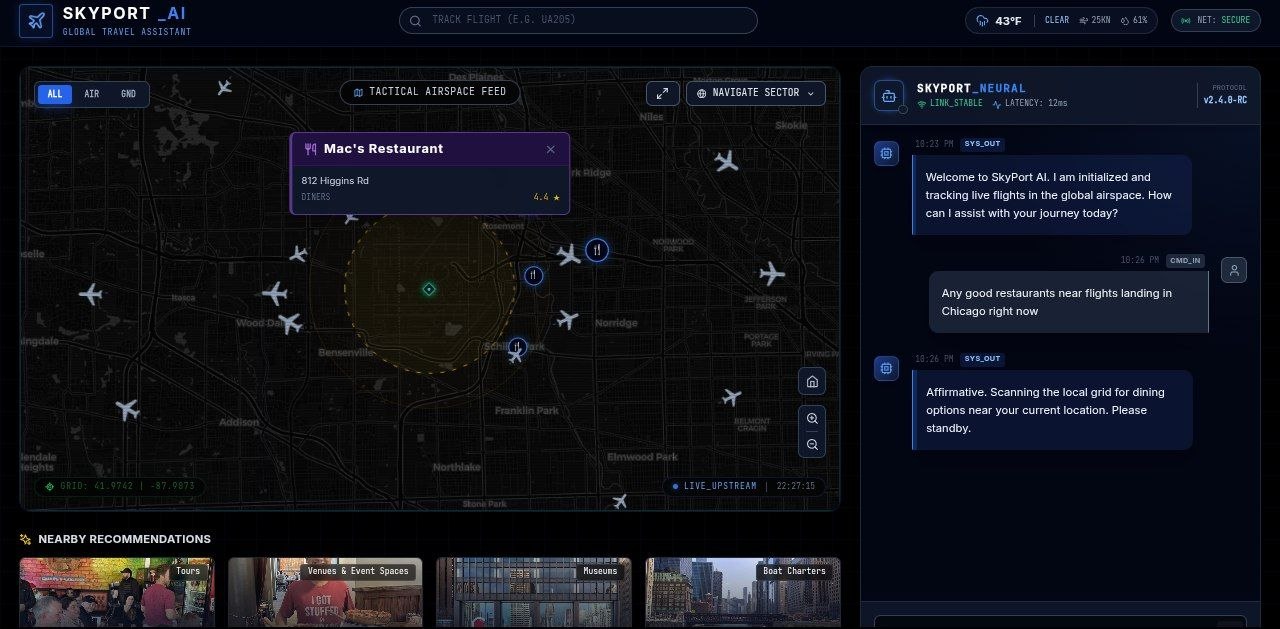
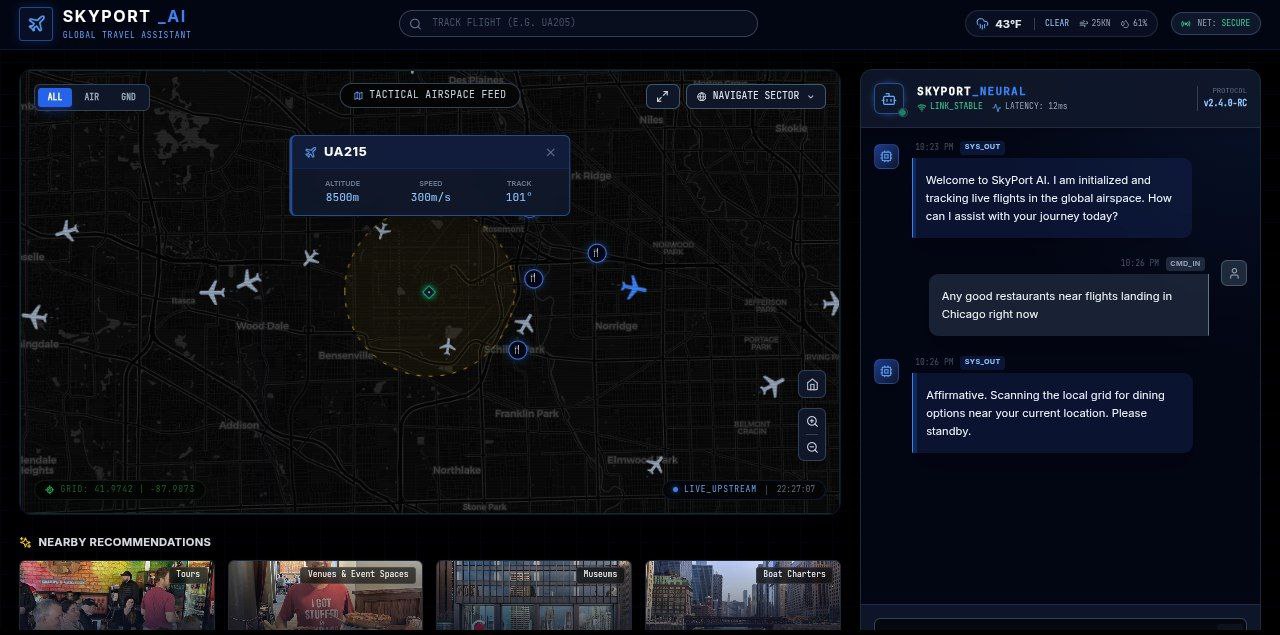
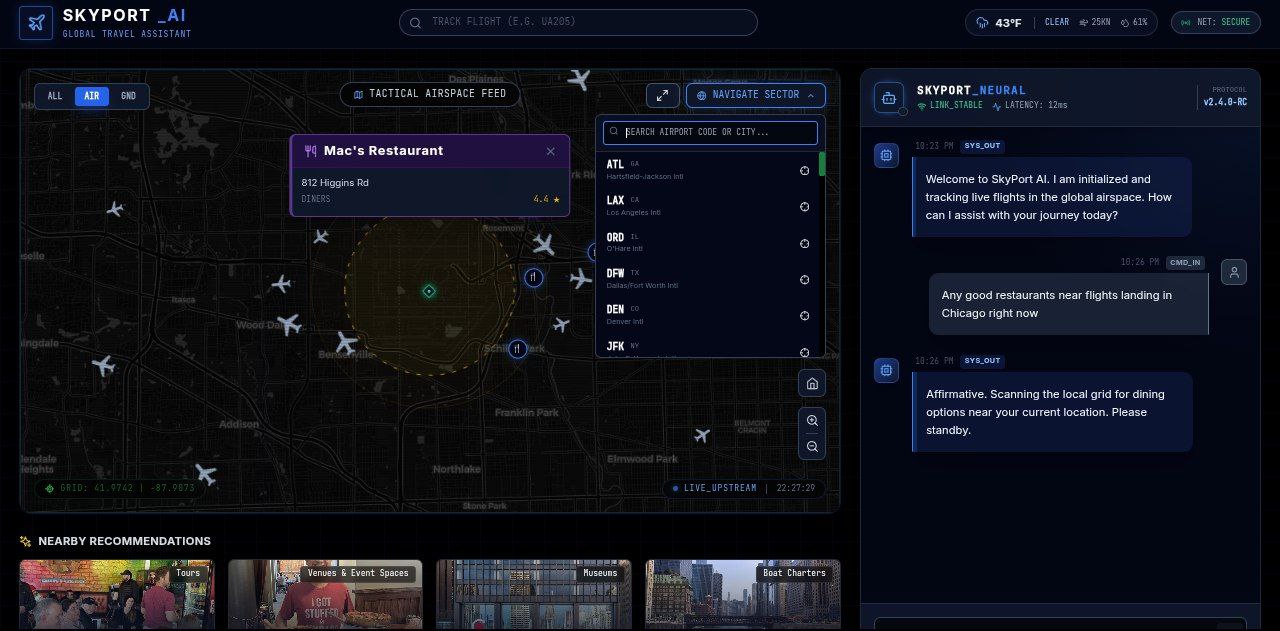
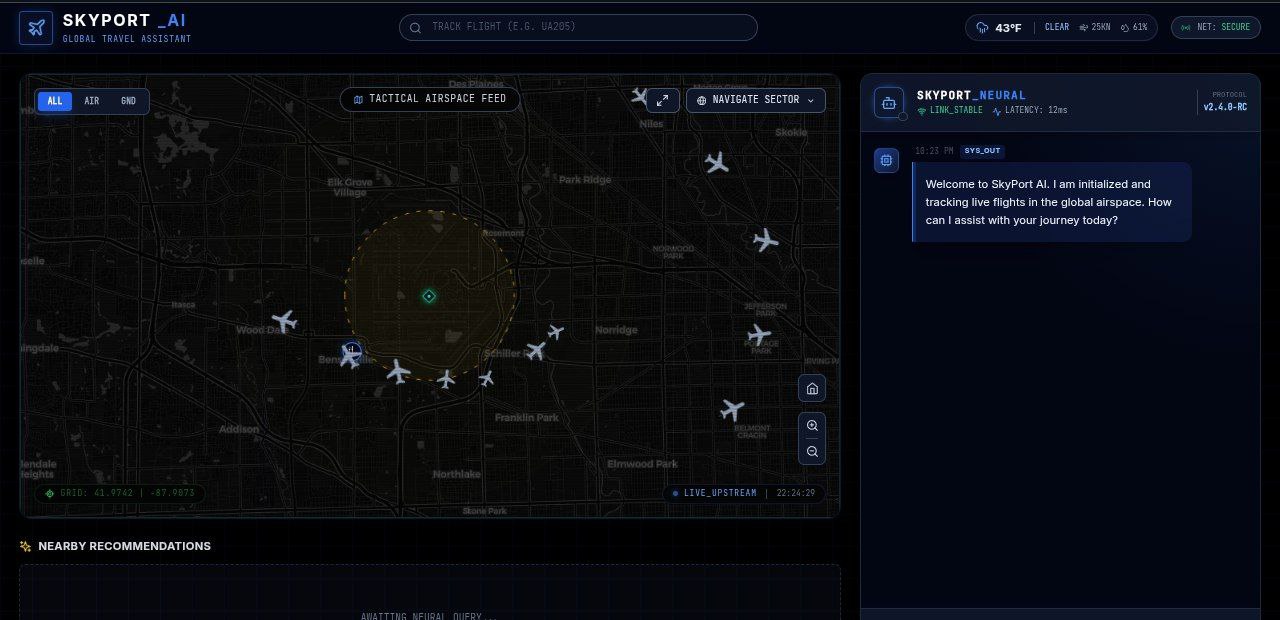
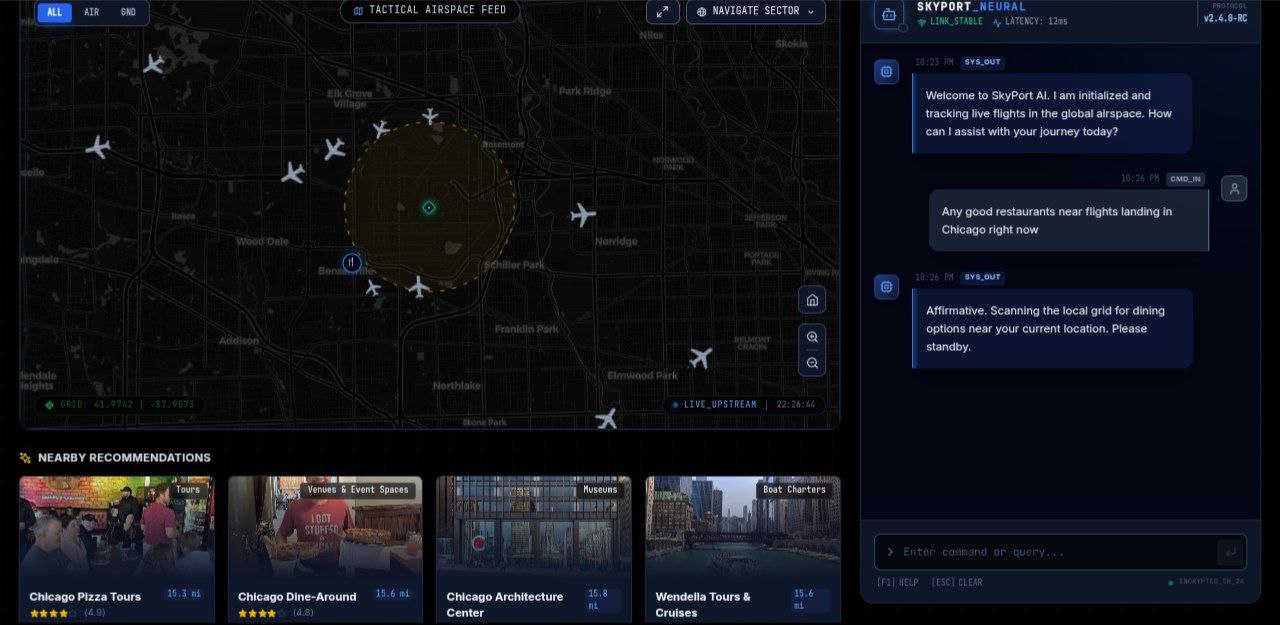
SkyPort AI is a real-time, map-based travel assistant that combines live global flight tracking, AI-powered travel guidance, and nearby recommendations around active airports.
It allows users to:
- Track live flights anywhere in the world
- Ask AI questions about flights, airports, and travel logistics
- Instantly discover nearby hotels, lounges, and dining options
- Explore airspace visually through an interactive map
SkyPort AI bridges the gap between where flights are and what travelers should do next.
How we built it
SkyPort AI is designed as a lightweight, real-time web application:
- Frontend: React 18, TypeScript, Tailwind CSS, Vite
- Mapping: Leaflet.js for fast, interactive geospatial visualization
- Flight Data: OpenSky Network API for live aircraft telemetry
- AI Assistant: Google Gemini Flash for contextual reasoning
- Local Discovery: Yelp Fusion API for nearby amenities
Core Systems
Live Airspace Visualization:
Real-time flight positions rendered as vector overlays on an interactive world map.Context-Aware AI Chat:
The assistant understands user questions in relation to active flights, airports, and map position.Proximity-Based Recommendations:
Nearby hotels, lounges, and restaurants dynamically suggested around airports using live location data.
Challenges we ran into
- Real-time performance: Rendering many moving aircraft efficiently without overwhelming the browser
- Context management: Ensuring AI responses stay grounded in live flight and map data
- API coordination: Synchronizing OpenSky, Yelp, and Gemini responses without blocking the UI
- UX clarity: Making dense aviation data understandable for non-expert users
- Rate limits: Designing around public API usage constraints
Each challenge shaped SkyPort AI into a responsive, user-friendly system rather than a raw data viewer.
Accomplishments that we're proud of
- A functional real-time global flight tracking map
- An AI assistant that provides contextual travel guidance, not generic answers
- Seamless integration of aviation data and local discovery
- A clean, responsive UI optimized for exploration and clarity
- A foundation that can scale to richer travel intelligence features
What we learned
- Real-time data is only valuable when paired with context and guidance
- Visual interfaces dramatically improve understanding of complex systems
- AI feels most useful when it responds to what the user is seeing, not just what they type
- Simplicity in UX is critical when working with dense geospatial information
- Travel tools should reduce cognitive load, not add to it
What's next for SkyPort AI
- Flight delay and disruption intelligence
- Layover-aware recommendations and timelines
- Multi-airport route planning
- User personalization and travel preferences
- Mobile-first and PWA support
- Airline, weather, and NOTAM data integration
Our goal is to evolve SkyPort AI into a real-time decision layer for global travel.
One-line pitch
SkyPort AI turns live global airspace into an intelligent travel assistant combining flight tracking, AI guidance, and nearby discovery in one real-time map.
Built With
- css
- google-gemini
- google-genai-sdk
- html
- javascript
- leaflet.js
- opensky-network-api
- openstreetmap
- react
- rest-apis
- tailwind-css
- typescript
- vite
- yelp-fusion-api


Log in or sign up for Devpost to join the conversation.