-
-
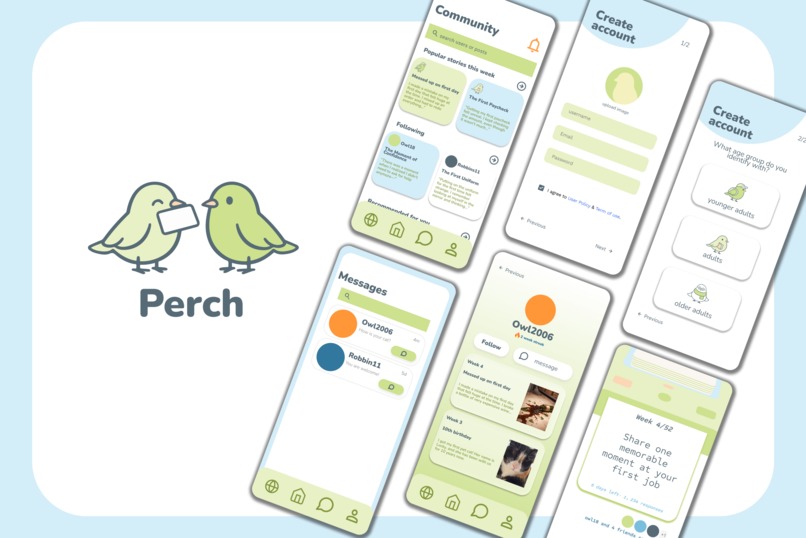
Thumbnail Page
-
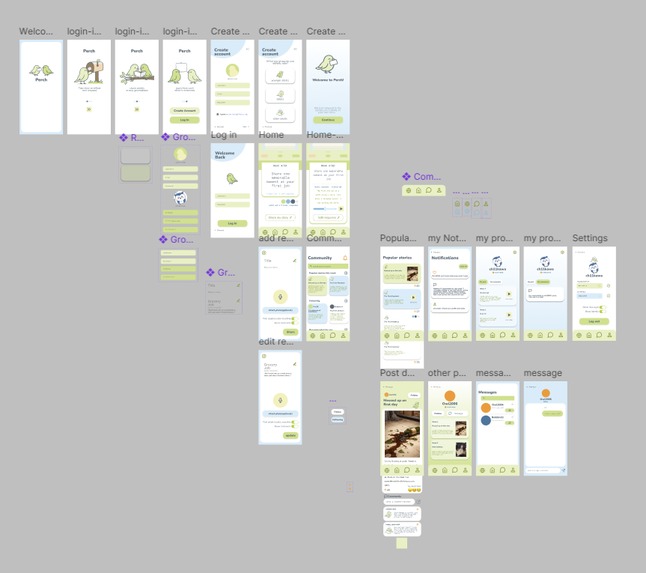
Screens
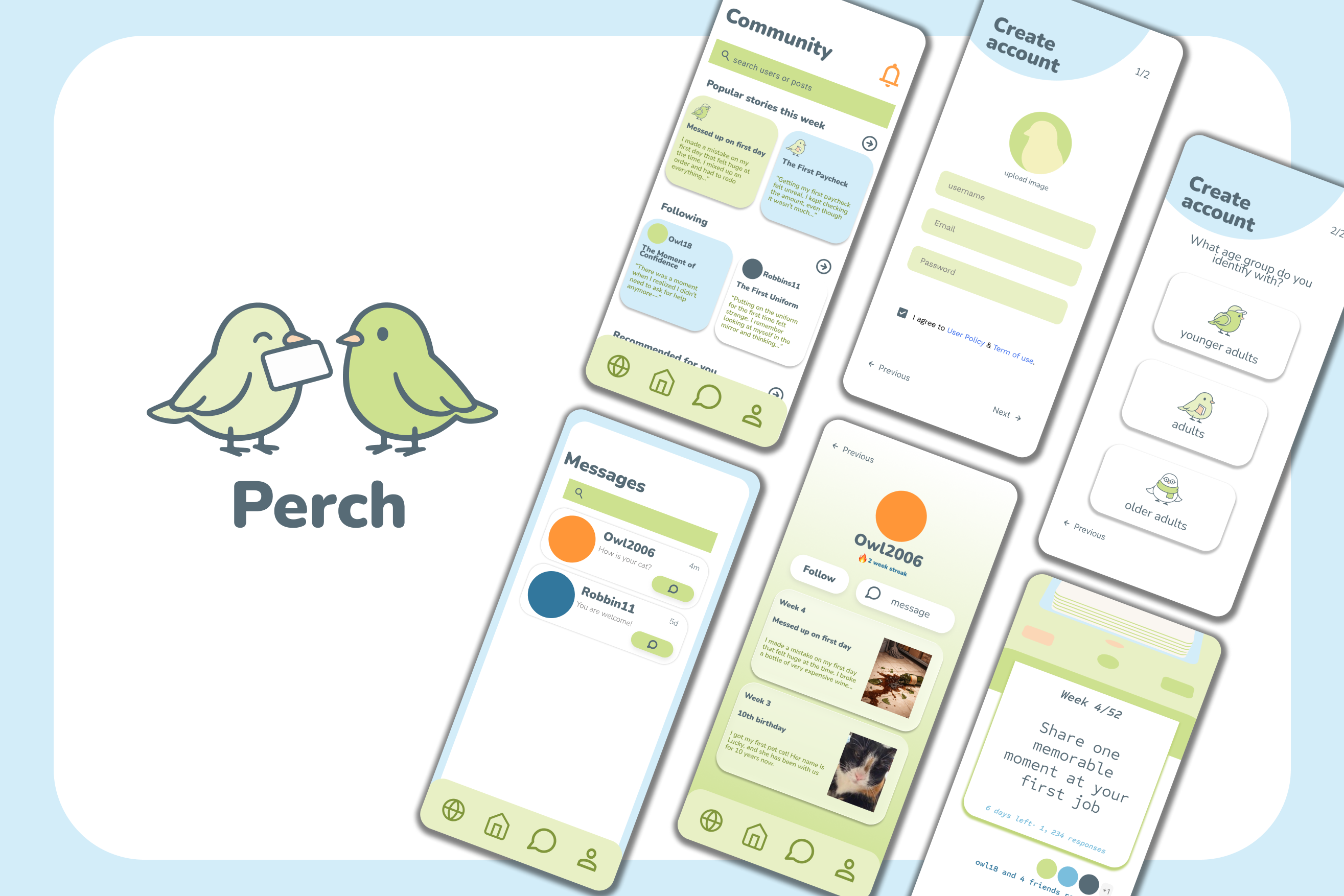
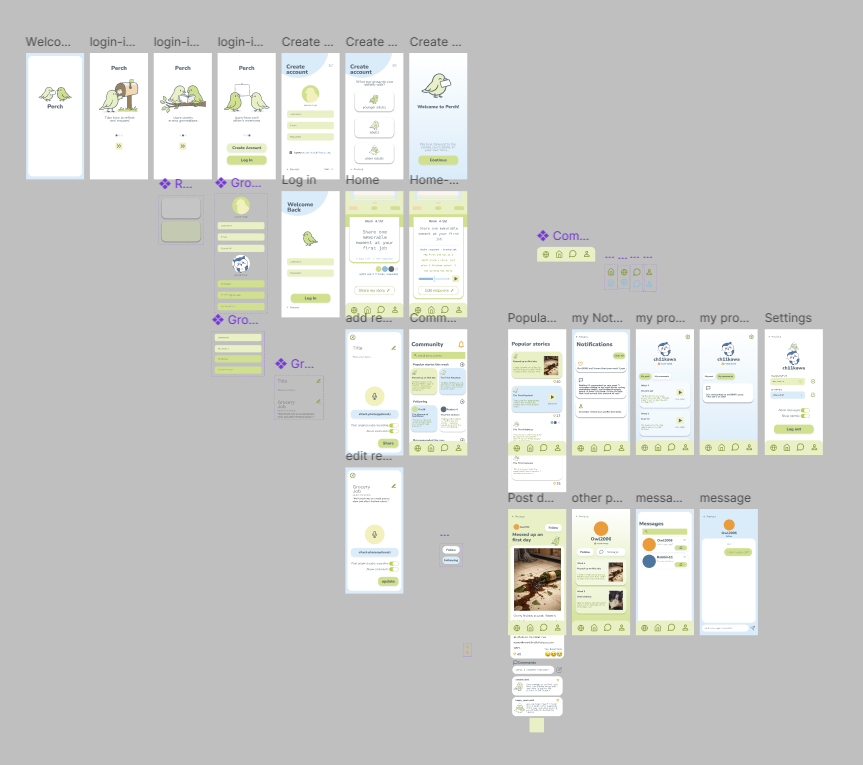
Prototype Link
A video demo
[demo]https://youtu.be/-IoWWZIg1T8
Written Responses
Describe your project
Perch—slow down and listen.
Perch is a quiet, intergenerational storytelling app designed to help people of different ages learn from one another through reflection rather than reaction. Instead of fast-paced feeds or real-time messaging, Perch uses weekly prompts to invite users to share short stories from their lives using audio or text. Other members respond through reflections and comments, encouraging listening and interaction The app is intentionally slow and low-pressure: By structuring interaction through prompts, asynchronous pacing, and reflective responses, Perch creates a calm space where generational distance becomes an opportunity for understanding rather than conflict.
Describe your research process and findings. If you conducted any surveys or interviews, please include the survey form and/or interview questions here. If you conducted secondary research by pulling from online sources, please include a link to your sources. (Max 500 words)
Articles Refereced
[National Library of Medicine]https://pmc.ncbi.nlm.nih.gov/articles/PMC6746070/ [Science Direct]https://www.sciencedirect.com/science/article/pii/S0001691825010765 [ACM]https://dl.acm.org/doi/full/10.1145/3698061.3733250
Initial survey outreach for this project resulted in limited participation, particularly from older age groups. To address this, I turned towards research papers, drawing from well-reviewed HCI and intergenerational communication studies.
An intergenerational ICT learning program(National Library of Medicine) involved 38 older adults (65+) and 42 younger participants (ages 14–15) working in one-to-one digital partnerships. While overall satisfaction scores were high (averaging above 8.7/10), qualitative findings revealed that success depended heavily on pace, reciprocity, and emotional safety, rather than technical instruction alone.
Another study from ACM involved asynchronous intergenerational storytelling with a small group of 6 participants. Despite the small sample size, participants reported feeling more comfortable and less pressured when communication was slow and non-real-time. This suggested that meaningful intergenerational connection does not require lots of engagement, but thoughtful structure.
A third study from Science Direct analyzed intergenerational collaboration and found that groups performed best when communication was balanced and respectful. Groups with power imbalance showed more disengagement, even when participants were motivated.
Across all sources, the central insight was consistent: intergenerational connection succeeds when design supports slowness, reciprocity, and dignity.
Describe your most important design decisions. What research findings and/or user testing results led you to make these decisions? (Max 500 words)
The main design choice was to slow down how people interact. Research found that real-time communication can make people feel pressured and reinforce hierarchies. Perch uses weekly prompts and lets users share at their own pace to lower anxiety and give time for reflection. Another important choice was to let users describe themselves by life stage, such as young adults, adults, or older adults. The wording was carefully chosen to help avoid stereotypes. Audio storytelling was emphasized because research showed that voice helps convey emotion and reduces barriers for older adults. Text transcripts were included for accessibility and to fit the reading habits of the younger generation. Finally, engagement features were intentionally limited. Perch avoids public metrics, rankings, and fast feedback loops. This decision was directly informed by research showing that power imbalance—not lack of interest—often prevents meaningful intergenerational interaction.
If applicable, describe how you utilized AI in your design process in detail. Please explain where AI fit into your workflow, which tools you used, and the specific purpose AI served at that stage. Include a concrete example of how AI influenced a design decision. (Max 500 words)
AI was used as a support tool throughout the design process. GPT 5.2 is used to help brainstorm the app's main functions, write example stories included in the prototype, and make edits to research statements. GPT 5.2 image generation is used to generate the bird icons, and the draft was recolored and refined in Adobe Illustrator.
Built With
- adobe-illustrator
- figma
- gpt5.2

Log in or sign up for Devpost to join the conversation.