Inspiration
Siteline started with a conversation with one of our teammate's fathers, an orthopedic surgeon, about what it takes for a practice to choose a new location. He told us it can take more than three months of work that pulls doctors away from their patients.
A new location means a multi-year lease, a build-out and a team hired on the hope that patients will come. It's one of the biggest bets a healthcare organization makes, whether it's a two-doctor clinic or a hospital system opening its tenth site. Both are working from the same scattered public data.
That data is already available. Census data shows who lives where. CMS records show where competing doctors practice. CDC health measures, city open-data portals and OpenStreetMap fill in the rest. It's just spread across dozens of sites and formats, and every hour a doctor spends piecing it together is an hour taken from patients.
So we asked: what if a practice could make that decision from data, in minutes instead of months? That question became Siteline.
What it does
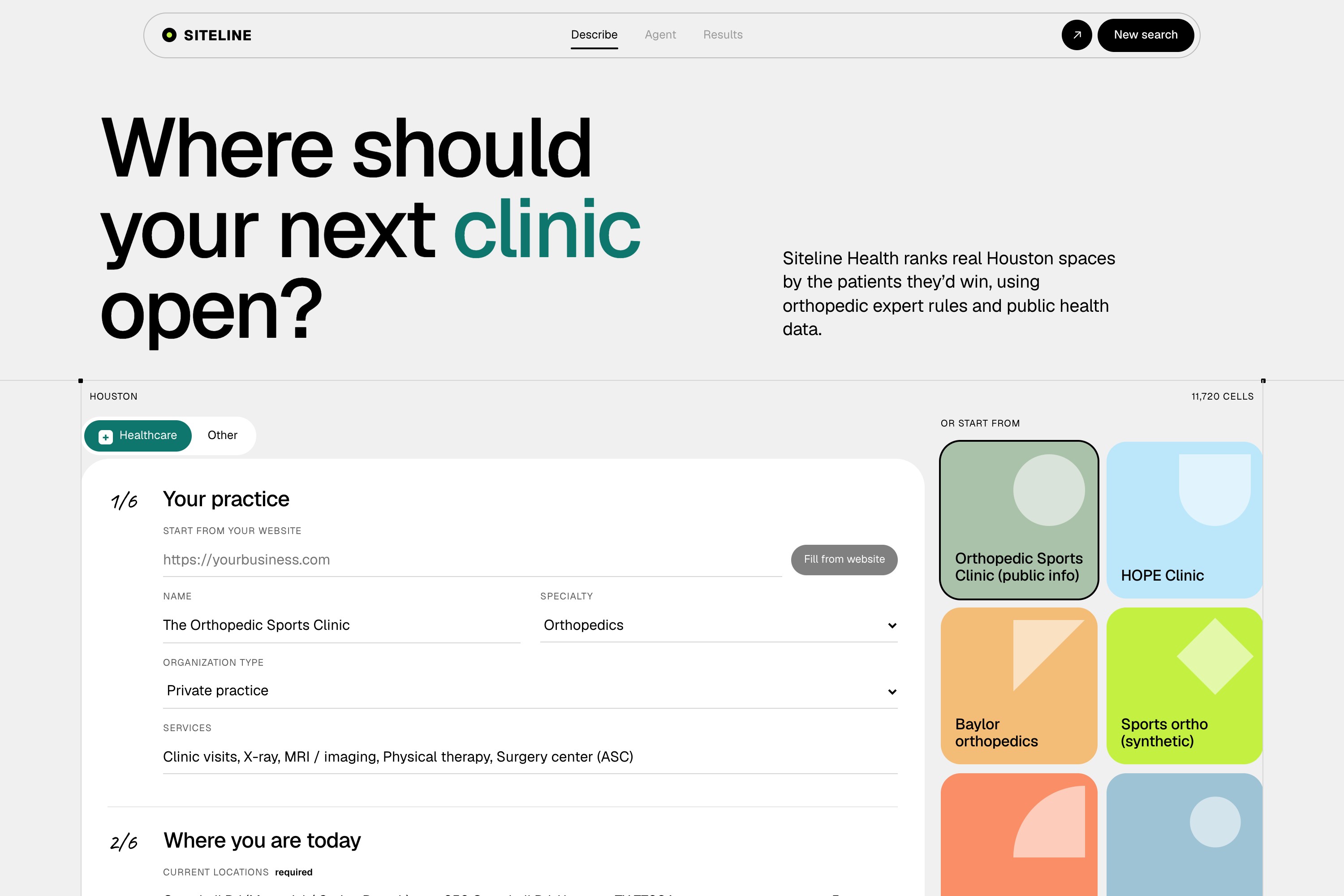
You tell Siteline about your practice the way you'd tell a colleague: what you specialize in, who your patients are, which insurance you take, where your current offices are and how much space you need. Siteline takes it from there.
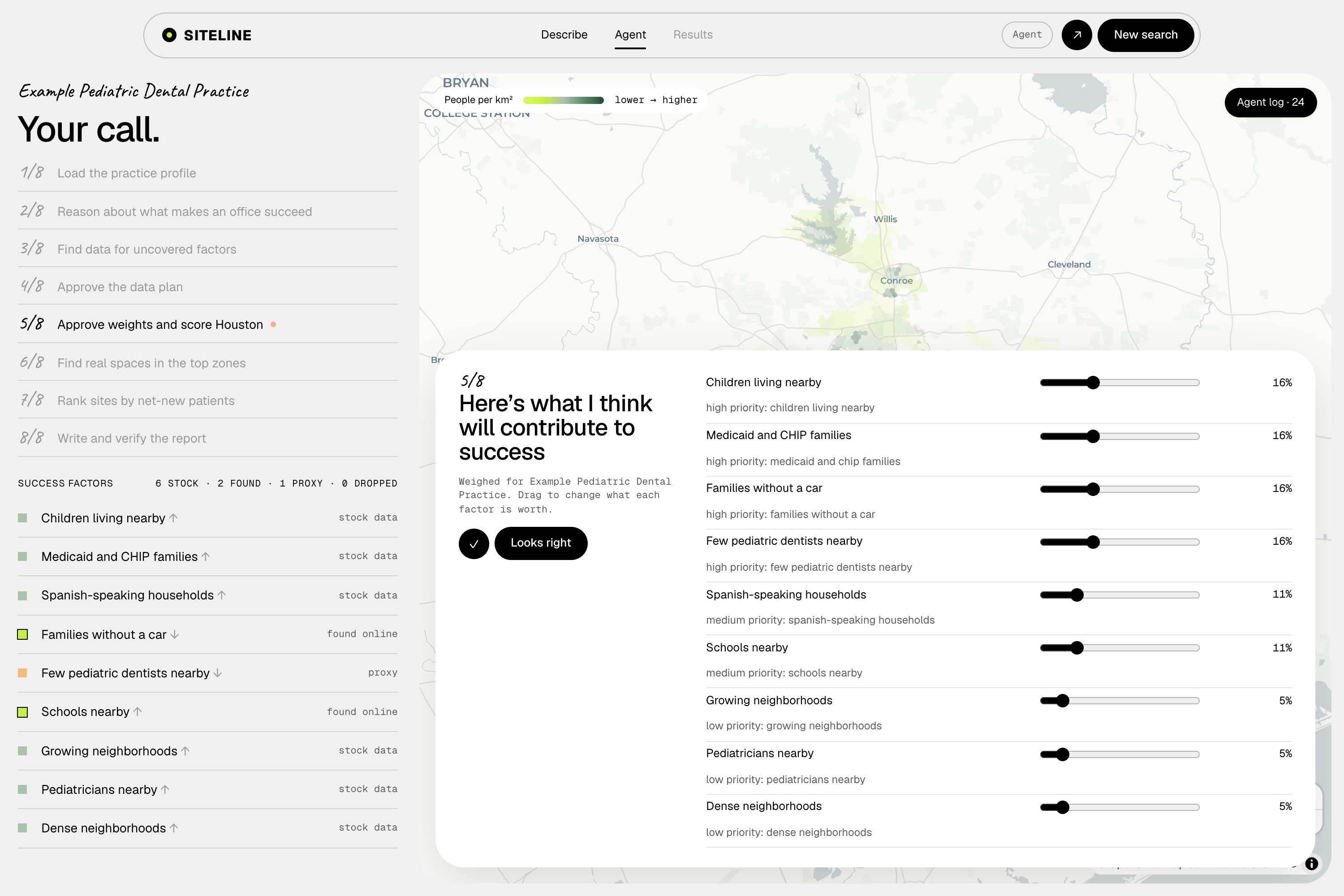
- It figures out what matters for your practice. For an orthopedic group, that might be adults over 45, primary-care doctors nearby who send referrals, and how many other orthopedic surgeons are already close. Every factor comes with a reason and a way to measure it.
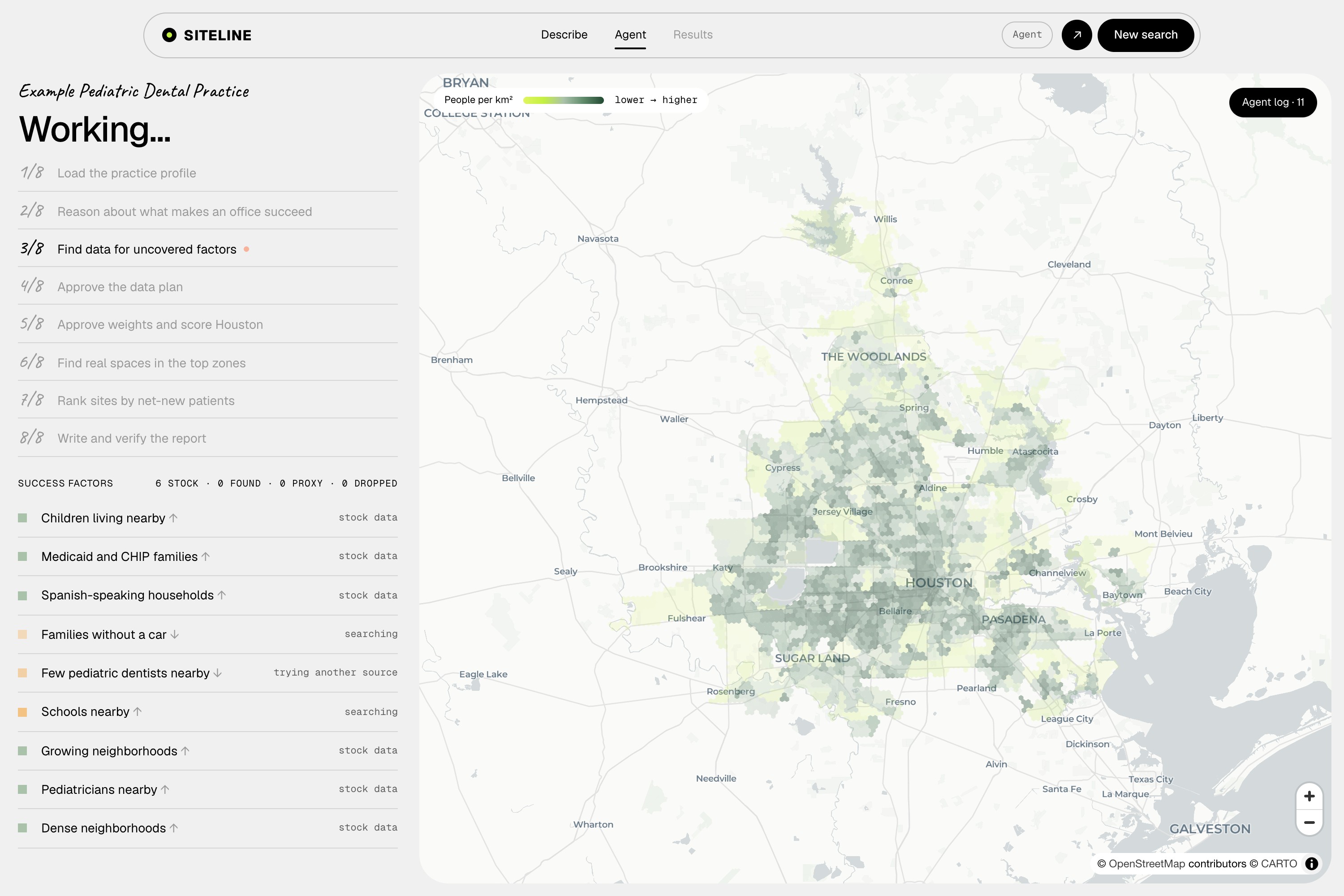
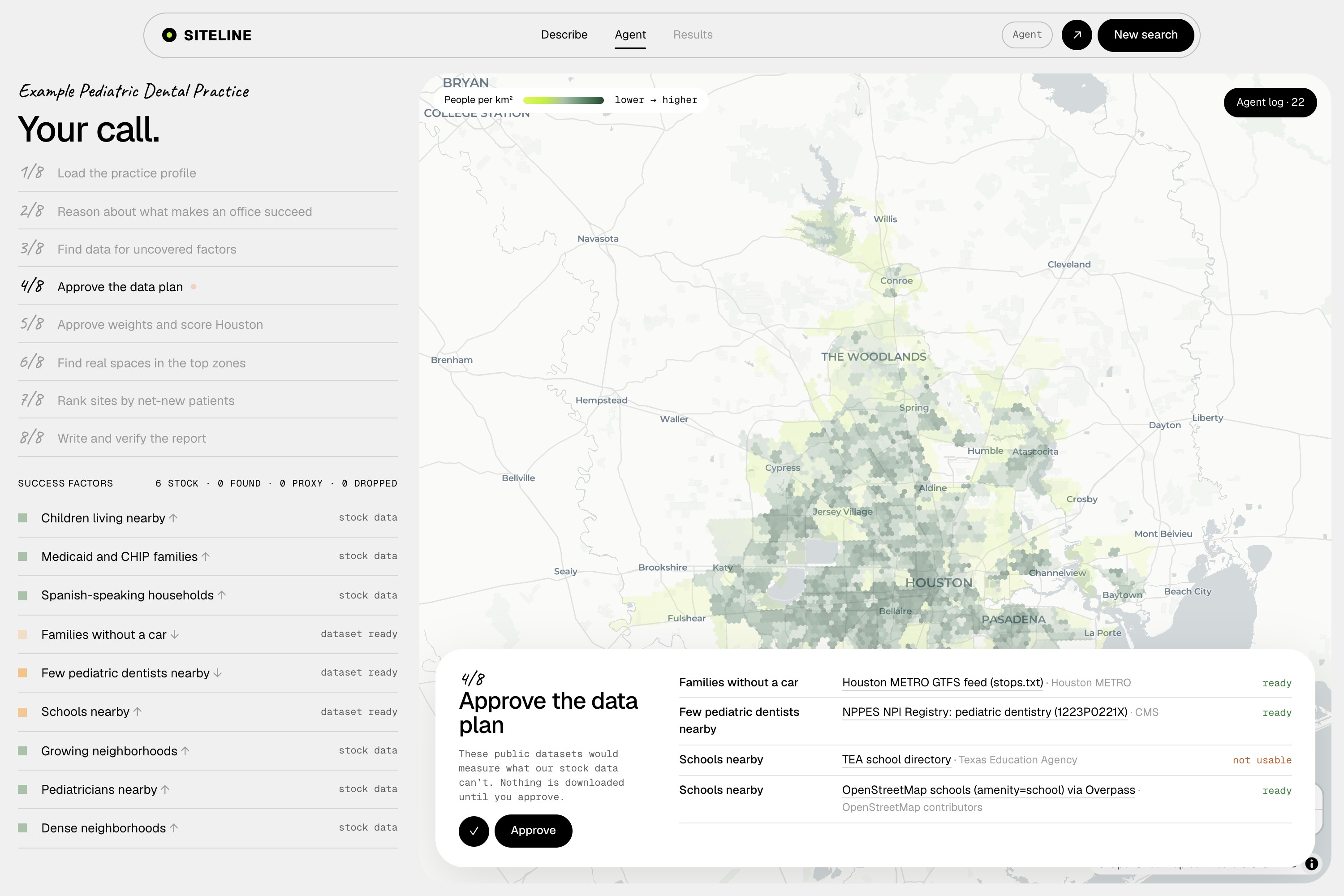
- It goes and finds the data. When our built-in Houston data doesn't cover a factor, scout agents search public data portals live, while you watch.
- It checks with you first. You approve the data it plans to use and how much each factor counts. Nothing is scored without your sign-off.
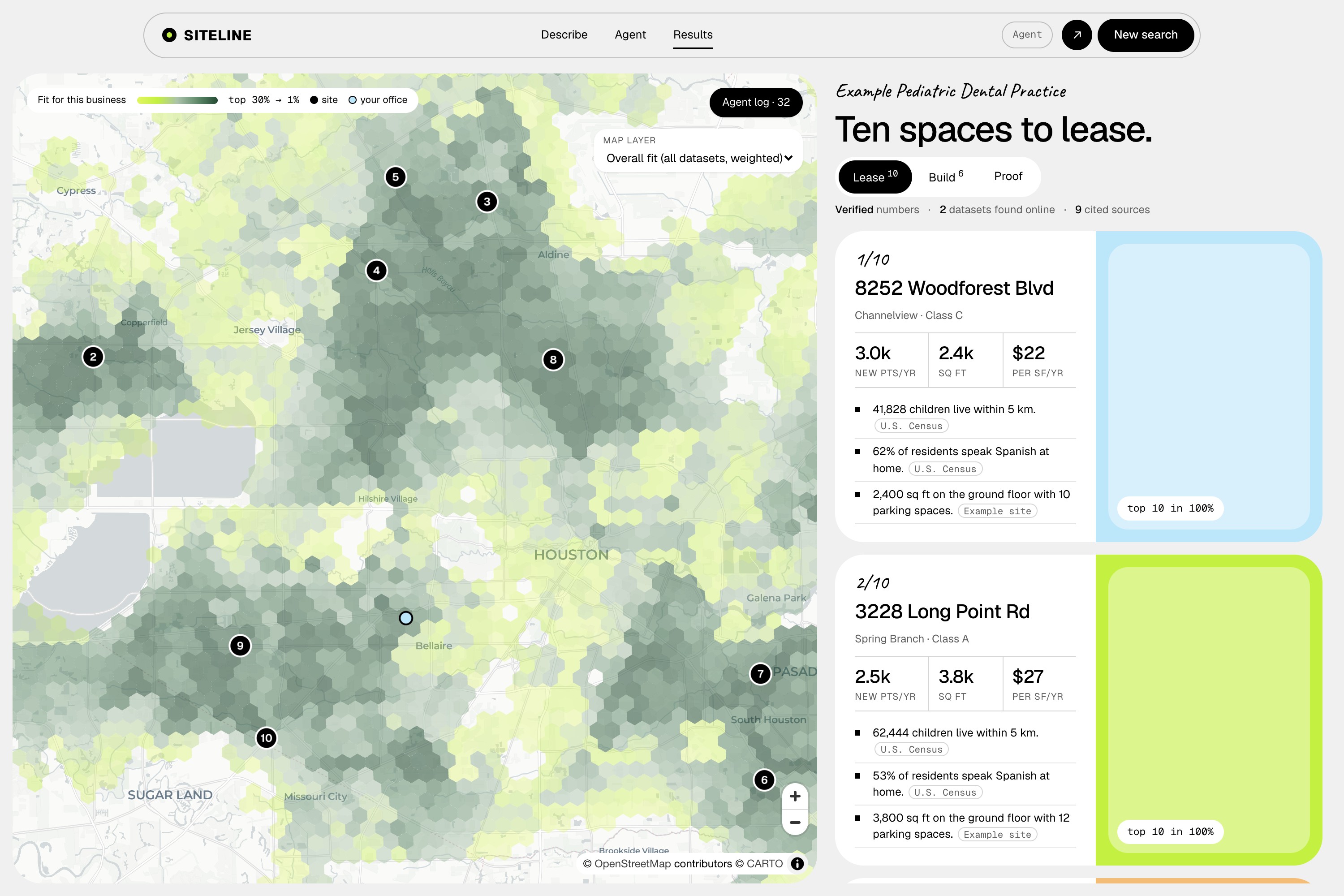
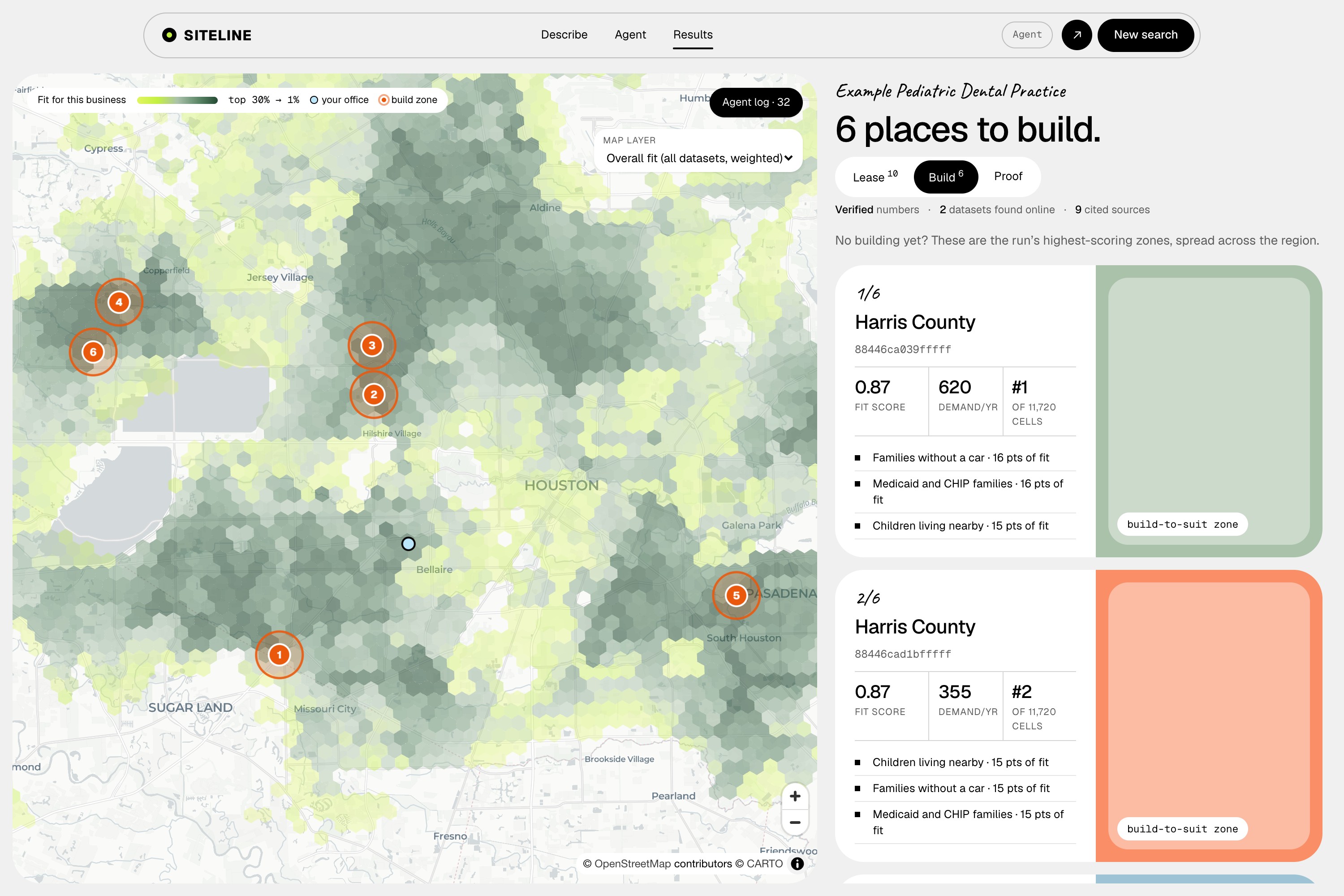
- It scores all of Houston. That's 11,720 neighborhood-sized hexagons across Harris, Fort Bend and Montgomery counties.
- It estimates the new patients each location would bring in, after competitors take their share and after counting the patients your own offices would lose to the new one.
- It finds real space for lease. It ranks actual CoStar listings in the best areas by rent per new patient, with aerial photos and 3D walkthroughs where they exist.
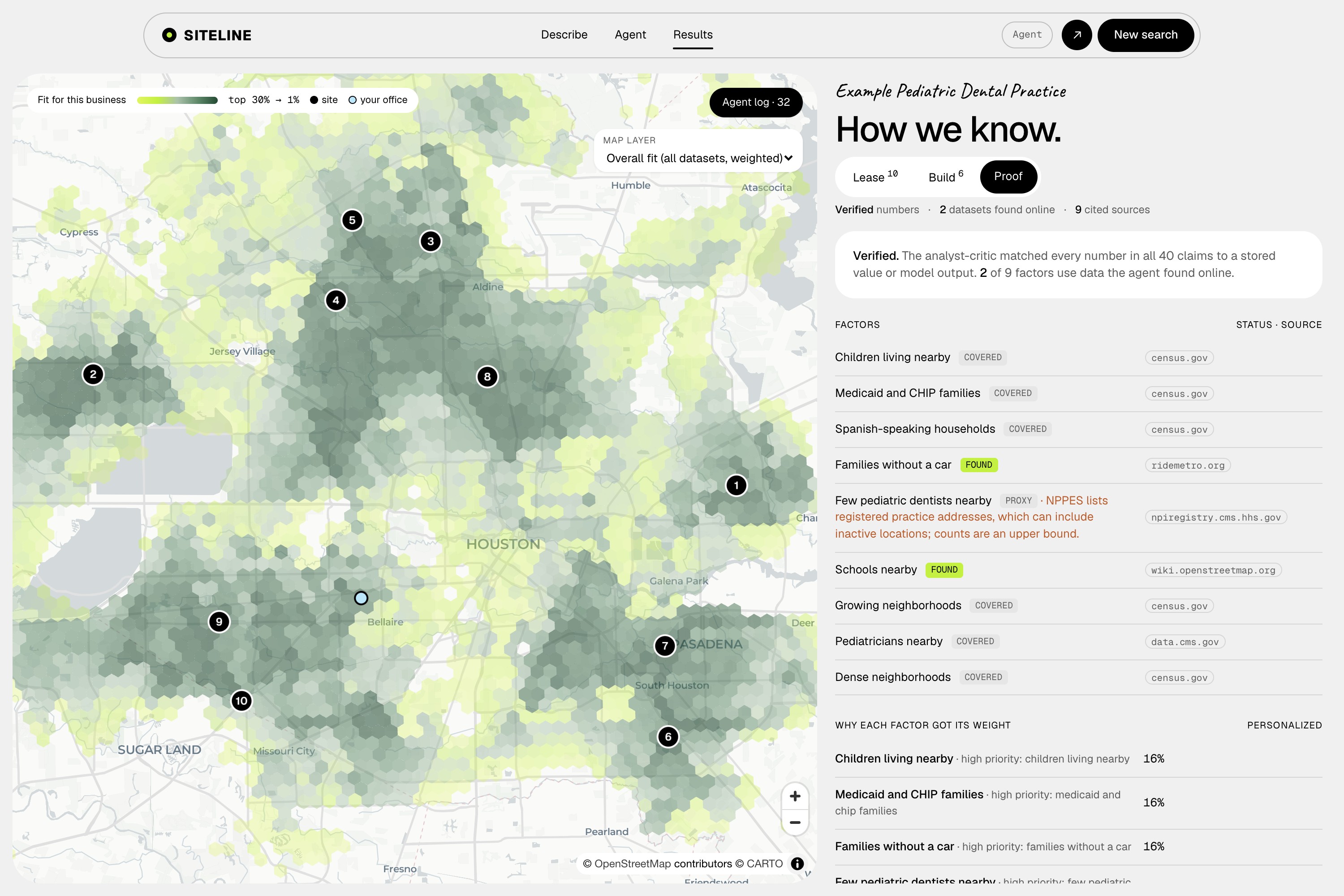
- It double-checks every number. Before you see the top 10, a critic agent traces each figure back to its source.
Siteline was built for healthcare first, but the same engine works for other businesses. A laundromat, a childcare center or a food bank just needs a different list of factors.
How we built it
The AI decides what to measure, and plain Python calculates every number. We set that rule early and never broke it. A language model is great at reasoning about what matters to an orthopedic practice. It shouldn't be trusted to do the arithmetic.
The agents. Siteline runs on Amazon Nova through Amazon Bedrock, orchestrated with deepagents (built on LangGraph). Nova Pro does the thinking: it works out the factors, plans the run and reviews the final report. Nova 2 Lite powers the scouts. Up to ten of them search for data at the same time, each one getting three tries before it falls back to a simpler measure or tells you plainly what it couldn't find.
The app. A FastAPI backend streams every step to the browser as it happens, so you can watch the agents work. The run pauses whenever it needs your approval. The front end is React with a MapLibre map, and each recommended space opens into a sheet with Vexcel aerial photos and Matterport 3D scans.
The data. Everything is public and aggregate, and every number keeps a link to where it came from: U.S. Census for who lives where, CMS for where doctors practice, CDC PLACES for community health, OpenStreetMap for everything else, and city and county open-data portals the scouts find on their own. Houston is divided into Uber's H3 hexagons, so every neighborhood is measured the same way.
The math. Each hexagon is scored on your approved factors, then a Huff gravity model estimates how many patients a new site would win from competitors, net of the ones it would take from your own offices. The final ranking leans mostly on those new patients, with neighborhood fit and the space itself making up the rest. We then randomly vary your weights 200 times to show which picks hold up.
Challenges we ran into
Getting an AI to stop making up numbers. Language models are confident with numbers, even when nothing backs them up. For a doctor about to sign a lease, that's dangerous. So we took numbers away from the model entirely: every figure comes from Python, and a critic agent rejects any sentence whose numbers don't match the stored data.
One failure brought down everything. In an early live run, a single data scout hit its usage limit and the entire run crashed. One missing dataset shouldn't cost you the whole answer. Now each scout fails gracefully: you see a note saying what it couldn't find, and the rest of the run carries on.
Turning words into measurements. "Lots of active older adults nearby" is easy to say and hard to measure across 11,720 hexagons. Connecting what the AI means to a column of real data is the hardest problem in the product, and the one we're still working on.
Accomplishments that we're proud of
It works on real data, end to end. We ran Siteline live for an orthopedic group and for a laundromat. Both runs went from a plain-English description to a checked top 10 of real Houston lease listings. Each run cost about 20 cents of AI compute.
Every number can be traced. Each figure on screen links back to a stored value and a public source. Nothing on screen was invented by a model.
The agents find data on their own. Scouts can find a dataset nobody pre-loaded, check it and use it during the run.
People stay in charge. Siteline asks before it uses data and before it settles the weights. It feels less like an oracle and more like a colleague who shows their work.
What we learned
AI is best at the question, not the answer. Early on, we let the model write its own summaries, and it quoted patient counts that didn't exist in our data. So we split the work: Nova decides what to measure, Python calculates every number, and a critic checks each figure against the stored data before you see it.
Trust is something you design. When we showed early versions, the first question was where the numbers came from. So we made Siteline show its factors, ask for approval before using any data, and link every figure to its source.
Fail gracefully In an early live run, one data scout ran out of budget and crashed the whole run. We changed each scout to fail on its own: it reports what it couldn't find, and the rest of the run keeps going.
Good data is everywhere and nowhere. The scouts found datasets on Houston's open-data portals quickly. The hard part was picking the one that actually answers your question, so each scout previews a dataset's columns and coverage before proposing it.
What's next for Siteline
Every kind of business. Right now, Siteline is focused on healthcare. Each business type needs its own playbook, and next, Siteline will write new playbooks on its own from a simple description.
Customers, not just patients. Siteline already counts the right people for each business: households for a laundromat, young children for a daycare, workers for a lunch spot. Next, we'll replace our estimates with real local numbers.
Proving it. We'll hide one of a business's existing locations and check whether Siteline picks that spot on its own. That becomes our measure of accuracy.
Beyond Houston. The public data we rely on covers the whole country, and the way we map neighborhoods works anywhere. A new city mostly needs its local data and lease listings.
Built to grow. We'll make Siteline faster, reuse data across runs, and handle many more users at once while keeping the cost per run low.
Siteline by text. An early iMessage version already lets an owner ask "where should we open next?" from their phone. Next, we'll make it reliable end to end.
Built With
- agents
- amazon-bedrock
- amazon-nova
- amazon-web-services
- costar
- deck.gl
- deepagents
- fastapi
- h3
- langchain
- langgraph
- langsmith
- llm
- matterport
- openstreetmap
- pydantic
- python
- react
- sqlite
- typescript
- vexcel
