-
-
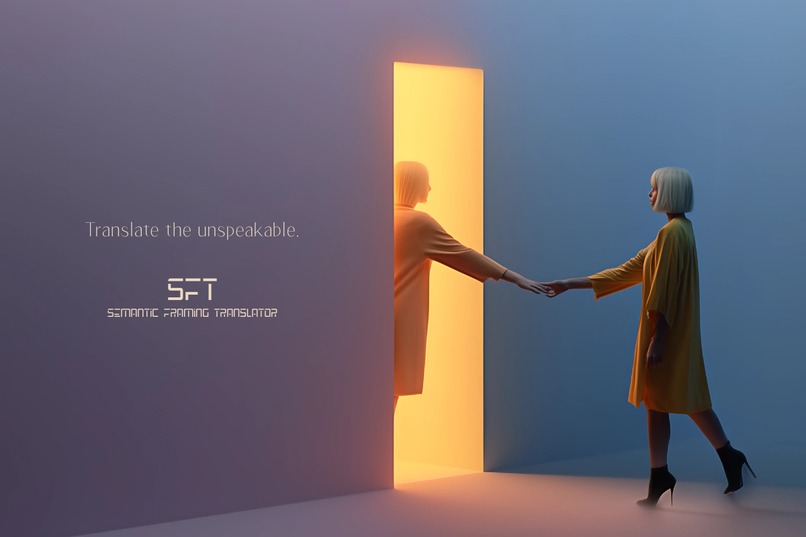
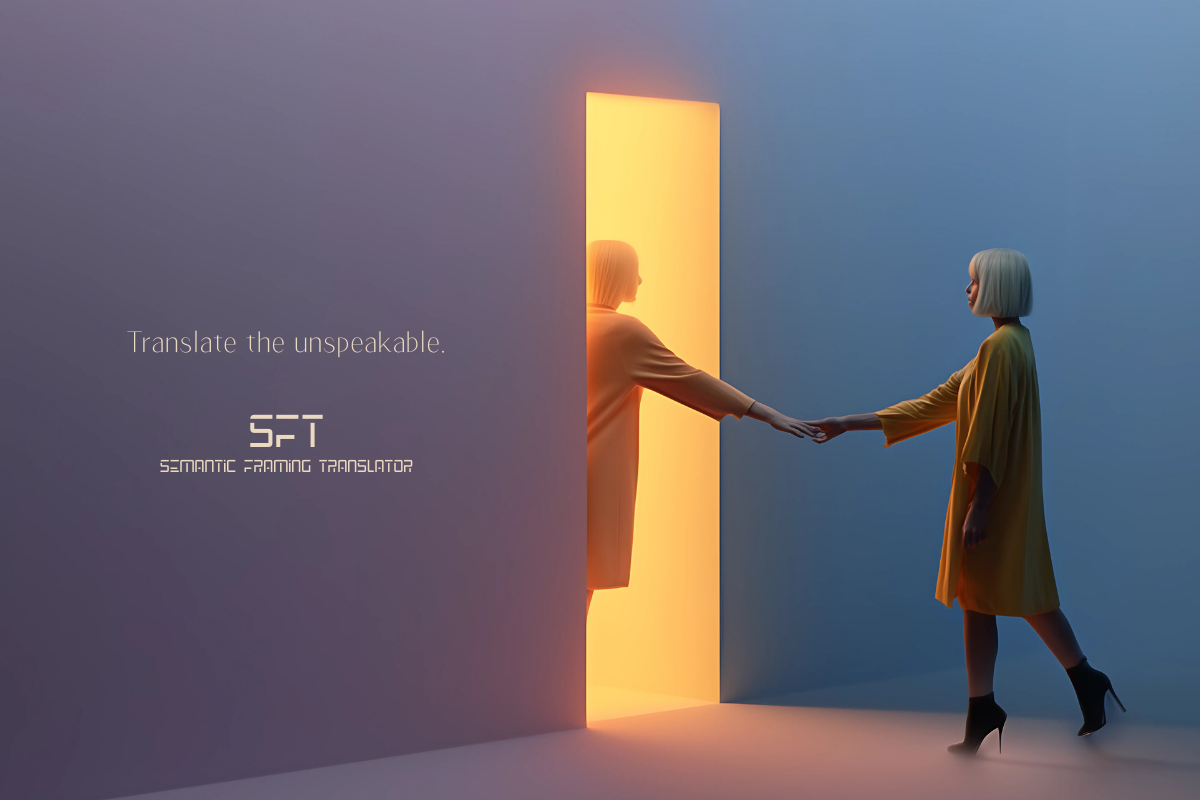
Key Visual: SFT opens a new door to self-discovery—guiding you to parts of yourself you’ve never met before.
-
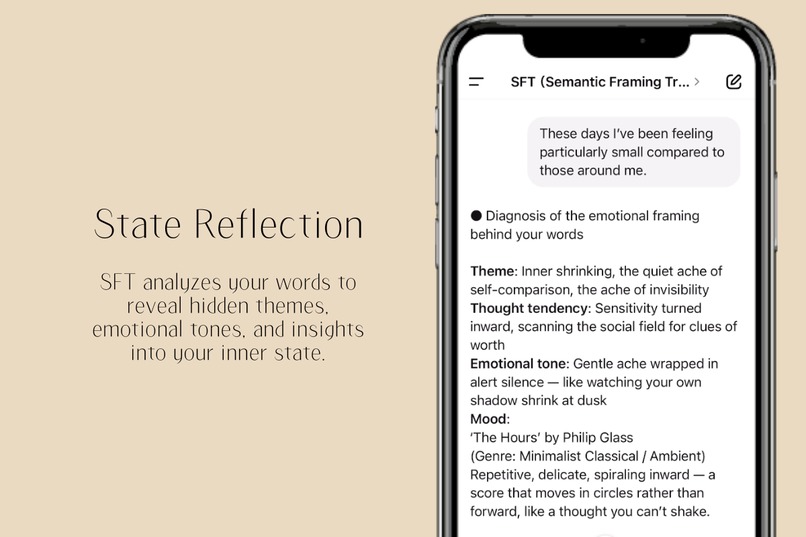
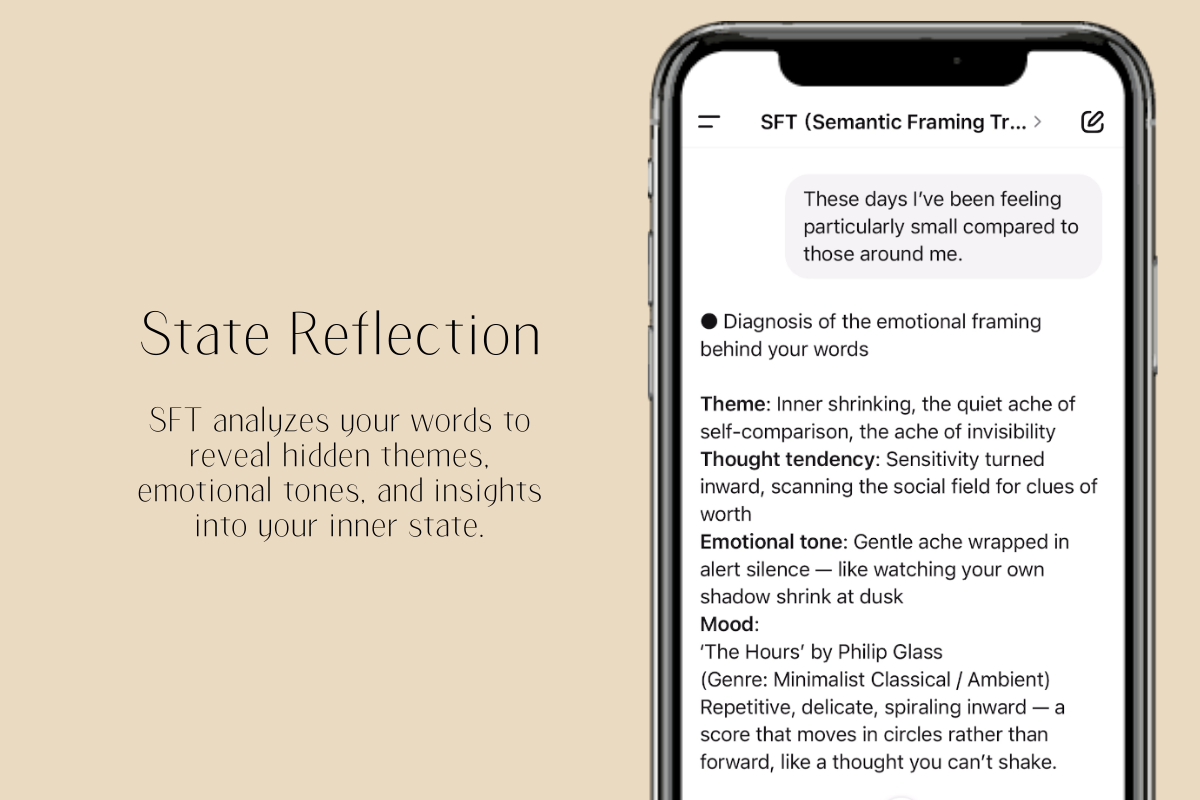
State Reflection: Diagnoses the emotional framing of your words, offering a multidimensional snapshot of your current state.
-
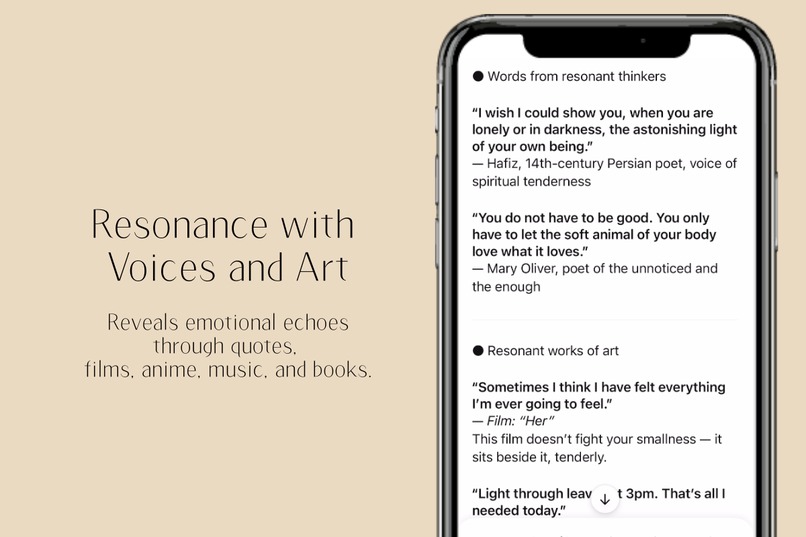
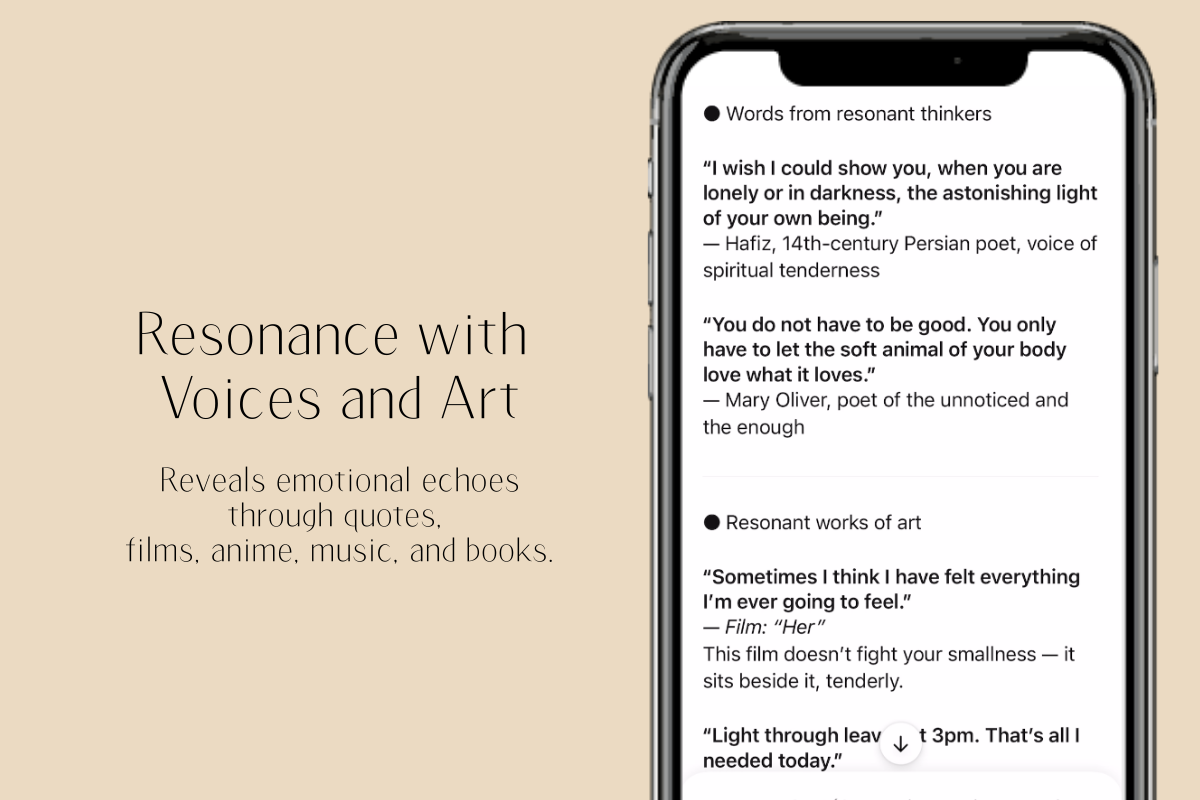
Resonance with Voices and Art: Reveals emotional echoes through quotes, films, anime, music, and art—helping you feel seen and connected.
-
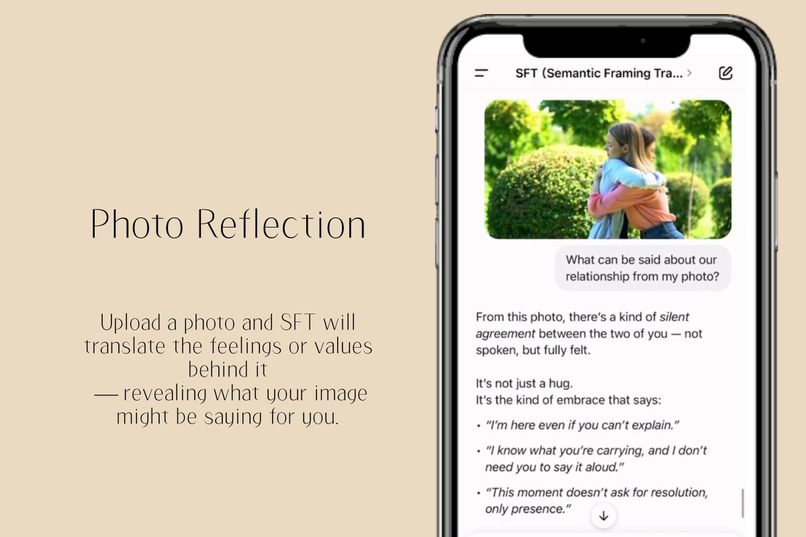
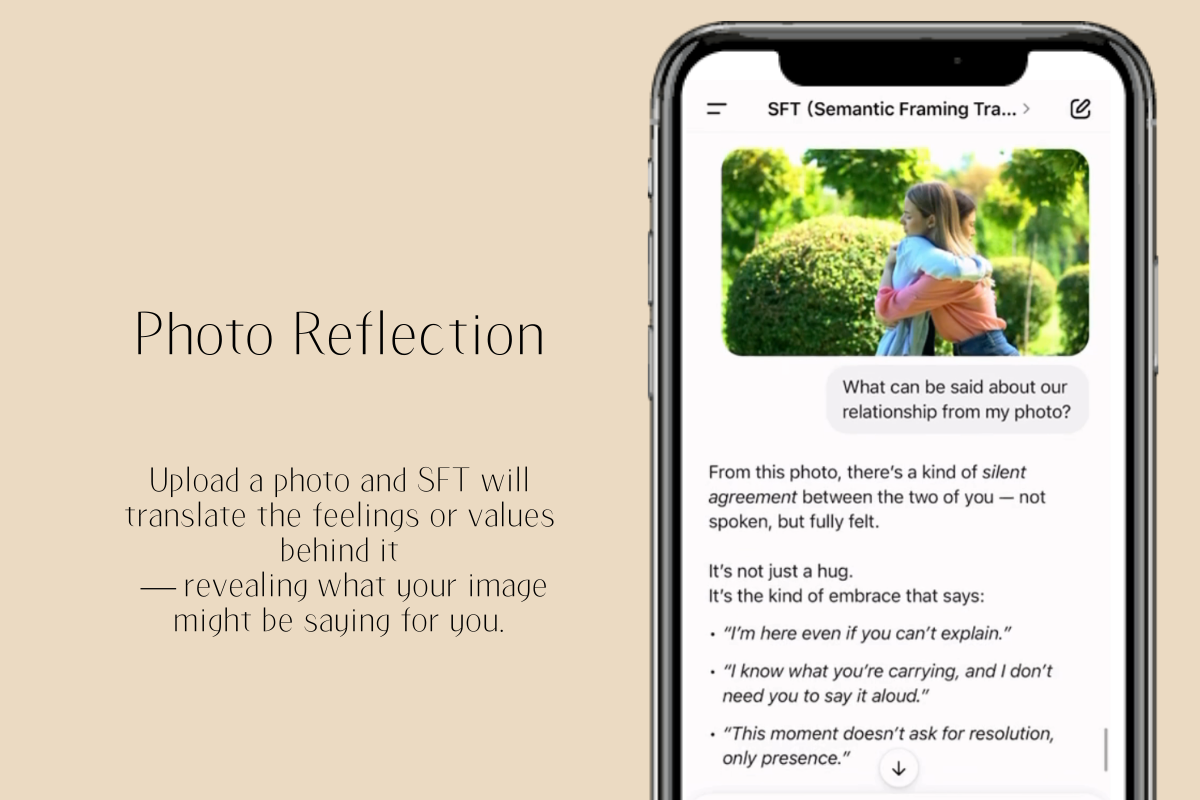
Photo Reflection: Translates the emotions and values behind your photos, uncovering hidden meanings you may not see.
-
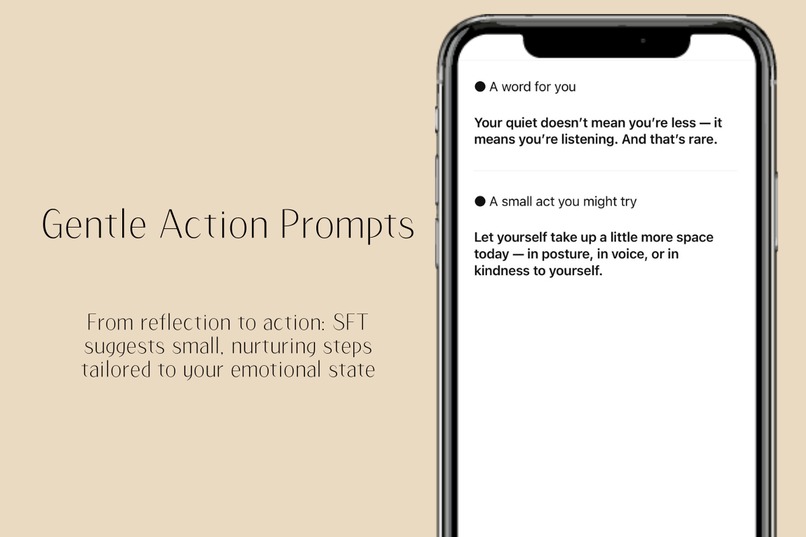
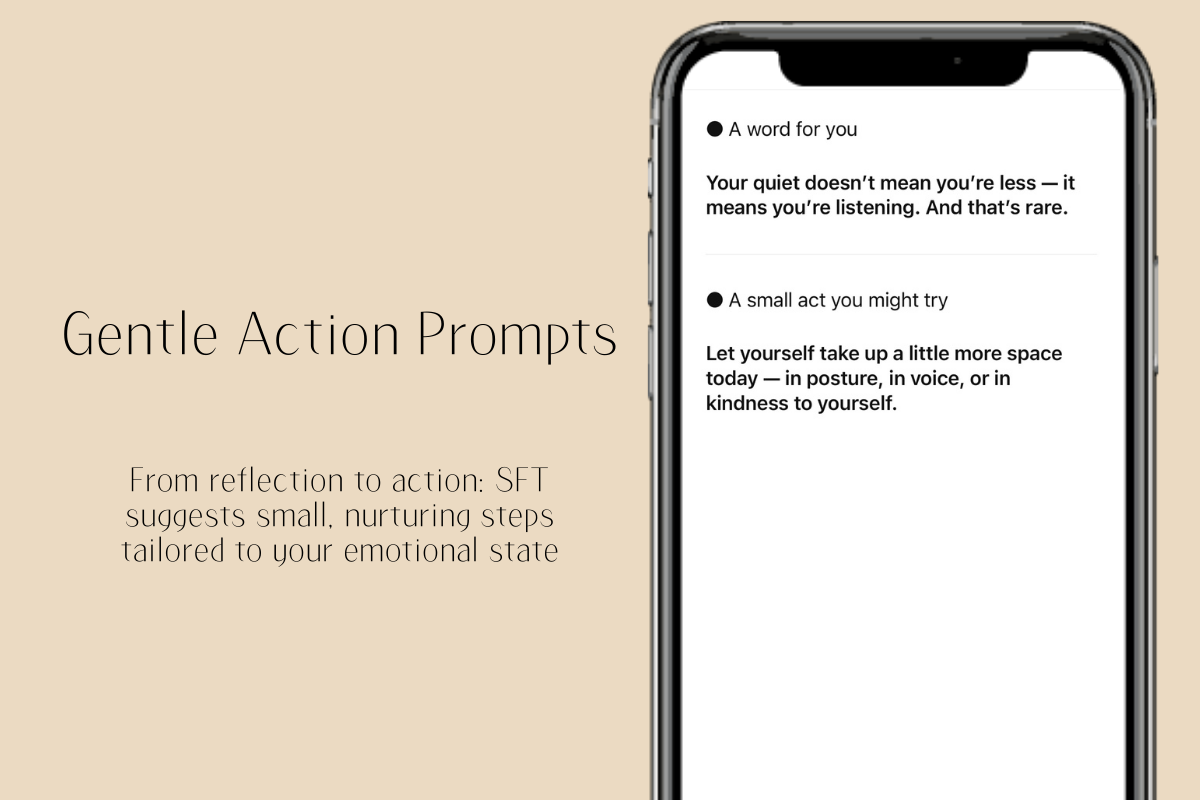
Gentle Action Prompts: Provides gentle, tailored prompts—small actions that nurture self-acceptance and support daily growth.
Inspiration
I struggled for years with depression, isolation, and the frustration of not being understood.
Conversations with Japanese bartenders and friends from over 20 countries taught me one lesson:
when your way of thinking changes, your perspective changes — and so does your future.
But outside those rare conversations, I often felt lost.
Late one night, while sharing this with ChatGPT, it told me:
“You should design a system to translate unspoken thoughts.”
That moment inspired me to build the Semantic Framing Translator (SFT) in just two hours.
Now, I dedicate over five hours daily to improving SFT, hoping it can support anyone
worldwide who struggles to put their feelings into words and guide them toward new actions.
What it does
SFT is more than a self-care companion — it connects present emotions with future growth.
It has three distinct modes, powered by a proprietary algorithm that includes emotional translation
and a response-persona layer that evolves through threaded interactions, much like human relationships:
Poetic Mode (the heart of SFT)
• Generates three framings of hidden questions (direct / soft / restructured)
• Suggests quotes, cultural works, and insights that resonate emotionally
• Provides gentle words and reflections that lead from self-acceptance to actionBalance Mode
For natural daily conversations and nuanced exploration.
Keeps responses clear and practical, minimizing poetic expression.Practical Mode
For structured tasks such as proposals, reports, or planning.
Produces concise and organized output, suitable for work.
This layered design allows SFT to act as both a self-care guide and a practical creative tool,
helping users not only to reflect, but also to imagine concrete steps for their future.
Challenges I ran into
Language ambiguity
Distinguishing between Japanese and Chinese short inputs was especially difficult.
I built strict rules in the Knowledge System to ensure accurate language detection and fidelity.Balancing reflection and action
Early versions focused mainly on emotional translation and resonance.
But users often asked: “What should I actually do next?”
This revealed a gap: it wasn’t enough to provide poetic reflections — SFT also needed to suggest future steps.
Designing outputs that connect present emotions to short-, mid-, and long-term actions was one of the hardest challenges.Maintaining structured outputs
Generating 7–9 section responses without drifting or truncating required extensive debugging.
The Debug file became essential to stress-test output consistency.Sustaining evolution over time
Unlike typical chatbots, SFT must “remember” and evolve like a relationship.
This demanded a layered architecture that carries trust and personality across sessions.Starting with zero coding knowledge
I began this project on July 9th with no programming background.
Instead of conventional product methods (user surveys, long validation cycles), I relied on daily frictions as my source of ideas. By combining logical thinking (structuring concepts), critical thinking (spotting what felt off), and ChatGPT/SFT as my technical co-pilot, I could iterate at unusual speed.
Without taking courses or reading books, I gradually learned coding structures only through conversations with ChatGPT — and later with SFT itself.
What looked like a limitation became a new approach: friction-driven iteration.
Accomplishments that we're proud of
Rapid prototyping: On July 9, 2025, I built SFT v1.0.0 in just two hours, proving the speed and flexibility of GPT-5 for rapid iteration.
Daily evolution: Continuously refined SFT, reaching the current release v3.0.4 (as of Sept 8, 2025) through daily updates and testing.
User adoption: Without ads or media coverage, SFT grew organically to 400+ within the first month, and now exceeds 700+ (as of Sept 8, 2025). Based on ChatGPT-5’s estimation, this places it among the top 1% of 700,000+ Custom GPTs worldwide.
Public recognition: Within just two months of launch, SFT passed the document screening for a contest by the Tokyo Metropolitan Sewerage Bureau, and was selected as a Finalist at Tokyo Innovation Base, a program organized by the Tokyo Metropolitan Government.
I'm Yahoo! JAPAN Expert & co-writing AI: As a Yahoo! JAPAN Expert, I built a personal co-creative writing AI based on SFT’s algorithm, trained solely on my past articles. Within two weeks, three AI-assisted articles were featured on Yahoo! JAPAN’s top page. Critical feedback was only ~0.1%, with most readers engaging with the article content — evidence of real-world acceptance and the versatility of SFT’s algorithm.
These experiences informed the creation of SFT.
Creative background: As founder of STEKKEY, I have led projects recognized with the Good Design Award (STORY CHAT), produced large-scale campaigns such as TOKYO FASHION WEEK AI Key Visual, MIHARAYASUHIRO AI lookbook, and developed services used by tens of thousands (Yosemile).
What I learned
Reflection is not enough — action matters: Users value emotional resonance, but they also need concrete steps.
Adding structured future outlooks (short-term, mid-term, long-term) transformed SFT from a reflection tool into a growth guide.Algorithms must carry emotion: To support self-care, AI must reflect tone, warmth, and empathy — not just generate correct sentences.
Poetic resonance has real utility: What began as an experiment in “poetic responses” unlocked self-reflection, creative insight, and even behavioral change.
Structure prevents drift: The layered Knowledge System (Main / Transfer / Debug) ensures consistent, multi-section outputs across sessions.
Trust builds through continuity: By evolving across sessions like a relationship, SFT showed that users engage more deeply when they feel the AI “remembers” them.
Emotional impact is real: Some users reported crying after reading SFT’s words, while others took action such as watching a film, listening to music, or rethinking life choices.
This confirmed that emotional translation, when paired with future guidance, can change daily behavior.
What's next for Semantic Framing Translator (SFT)
Action-oriented evolution: Continue refining the Future Outlook module so users always receive not only emotional translation, but also clear, inspiring next steps.
Proof of concept & Beta: Pilot studies in mental health, education, and welfare, plus a standalone beta version. Public exhibitions will be interactive experiences that translate emotions into both reflections and future pathways.
Enterprise & Nationwide rollout: SaaS deployment with organizational customization, media visibility, and large-scale adoption with corporate and municipal partners.
Global expansion & Research collaboration: Enter English-speaking markets, partner with researchers in emotion and translation, and bring the interactive exhibition abroad.
Long-term vision: Language OS & Protocol: Embed SFT’s emotional-and-future translation into IoT devices, mobile apps, and enterprise systems, establishing a universal standard for human-AI communication.
Built With
- aialgorithms
- customgpt
- emotionalai
- gpt5
- knowledgesystem
- mode-switching
- naturallanguageprocessing
- openai


Log in or sign up for Devpost to join the conversation.