
Inspiration
SeeNA began with a simple question: what happens when someone feels their vision getting worse, but getting an eye check is not simple?
For many older adults, an eye appointment can involve arranging transport, depending on family members, navigating unfamiliar technology, and travelling while already struggling to see clearly. For people living in rural and remote communities, the nearest eye care professional may be hours away. A routine check can become something that is postponed for months, not because people do not care about their eyesight, but because access is difficult.
We wanted to reduce that first barrier.
A smartphone cannot replace an optometrist, but it can become an accessible first step. It can help someone understand whether their vision may need attention, explain the result in simple language, and give them the confidence to seek professional care sooner.
That idea became SeeNA: See Now and Always.
What it does
SeeNA turns a Phone into a voice-guided vision screening companion.
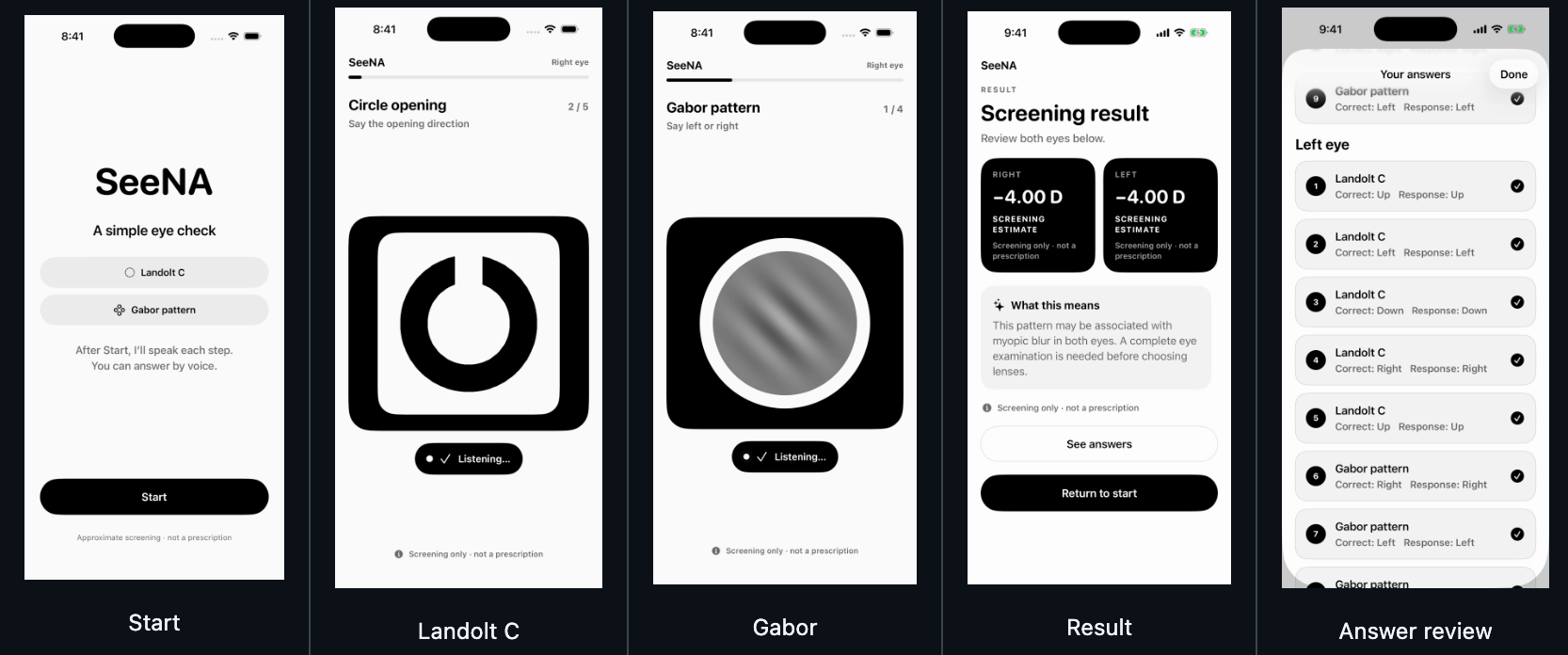
The experience is designed for someone who may not be wearing their glasses or may find conventional eye charts difficult to use. After pressing Start, the user is guided entirely by voice. SeeNA helps them position themselves, confirms when they are ready, and presents one large visual target at a time.
The screening uses two visual tasks:
- Landolt C, where the user identifies the direction of a circle opening
- Gabor patterns, where the user identifies the direction of a striped pattern
SeeNA listens to each answer and waits before moving forward. It accepts natural phrases such as “left,” “up,” or “I cannot see it.” Each eye is screened separately, and the final screen explains the result in clear language. Users can also review every target, the correct answer, and the response SeeNA heard.
The result is a screening estimate, not a medical diagnosis or prescription. Its purpose is to make early vision awareness easier and encourage appropriate professional follow-up.
How we built it
We built SeeNA as a native iOS 26 application using SwiftUI and MVVM architecture.
The iPhone’s TrueDepth camera estimates eye-to-screen distance, while Core Motion checks that the phone remains stable. SeeNA also monitors gaze, face position, lighting, and movement before accepting a response.
The visual targets are generated and scored locally using deterministic mathematics. OpenAI is used only for natural voice interaction, answer transcription, and explaining qualitative results in language that is easier to understand. It cannot create or change the measured result.
We designed the interface around accessibility from the beginning: large targets, minimal text, short spoken instructions, step-based movement guidance, haptics, clear countdowns, and one decision at a time.
Challenges we faced
The hardest part was making the experience work practically, not just technically.
Natural head movement caused distance readings to fluctuate. Voice prompts could interrupt one another or respond too quickly while someone was still moving. Targets that looked correct on a developer’s screen became impossible to identify from a realistic screening distance.
We repeatedly tested and redesigned these moments. We introduced distance smoothing, movement tolerance, stable positioning windows, serialized speech, larger targets, answer-gated progression, and a simple “3, 2, 1, start” transition.
Another important challenge was protecting trust. We separated measurement from AI, kept numerical calculations on the device, added strict quality gates, and made sure SeeNA never presents itself as a replacement for professional eye care.
What we learned
We learned that accessibility is not an extra feature. It changes how the entire product must be designed.
A person with limited vision should not need to read instructions before starting a vision test. A distance measurement should not demand perfect stillness from a real human being. A voice assistant should not speak constantly. It should know when guidance is useful and when silence is better.
Most importantly, we learned that a meaningful health product does not need to replace a professional to create value. Sometimes the most important step is helping someone recognise a problem, understand it, and act sooner.
What comes next
Our next step is structured physical and clinical validation across more participants and Phone models, followed by collaboration with eye care professionals and communities where access is limited.
Our long-term vision is simple: make the first step towards understanding your eyesight available wherever a Phone can reach.
Built With
- arkit
- avfoundation
- core-graphics
- core-motion
- ios
- node.js
- openai-api
- swift
- swiftui
- typescript
- xcode


Log in or sign up for Devpost to join the conversation.