-
-
Advisor-open
-
Overview
-
Comparison
Inspiration
Photo and video productions depend on a fragile combination of permissions, people, locations, daylight, travel, schedules, and creative decisions.
A seemingly small delay can put an entire shoot at risk. Traditional production tools show schedules and checklists, but rarely explain how one change affects the creative result or what a recovery decision will cost.
We built SceneReady to make production intelligence visual, explainable, and actionable — while keeping humans in control of critical decisions.
What it does
SceneReady is a map-first production intelligence platform powered by a real Model Context Protocol (MCP) server.
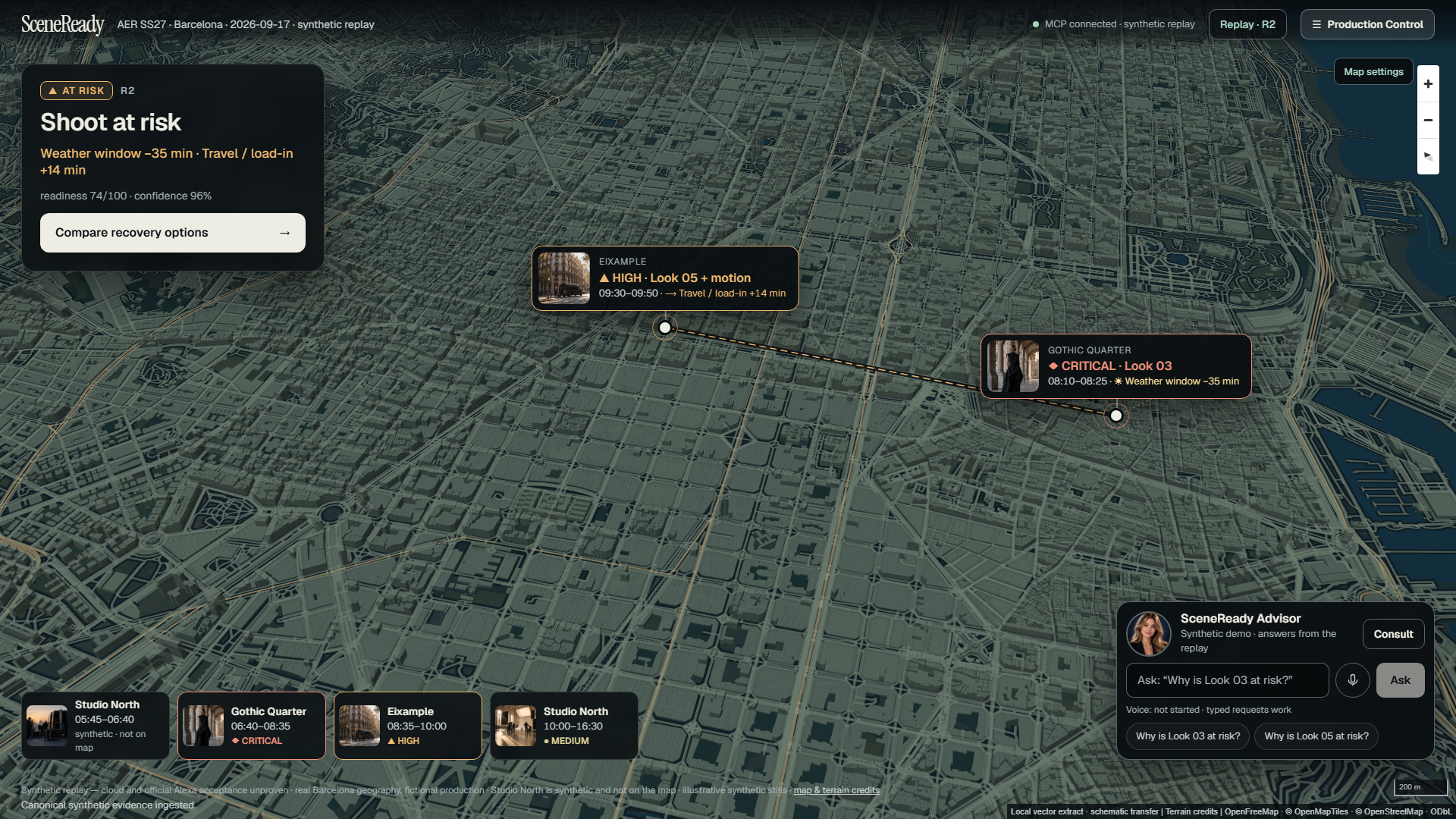
Our interactive demonstration follows a synthetic fashion production across real Barcelona geography.
Key capabilities:
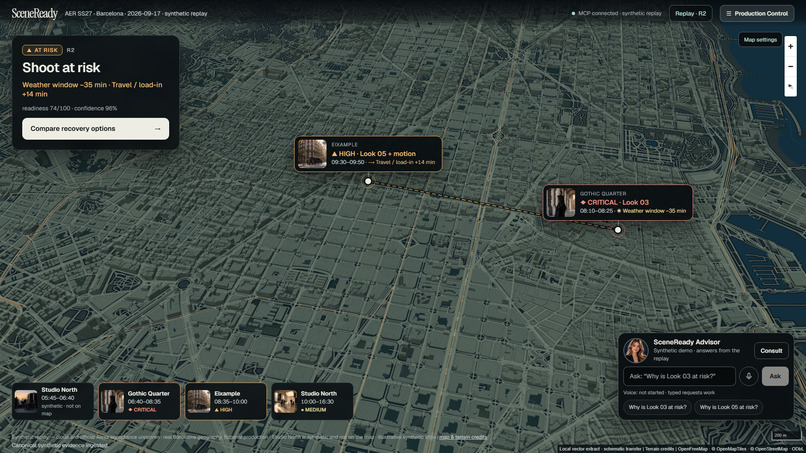
- Visual production intelligence: A spatial map connects shooting locations, schedules, images, activities, and operational risks.
- Evidence-based risk detection: SceneReady identifies missing permissions, daylight constraints, travel delays, and production dependencies.
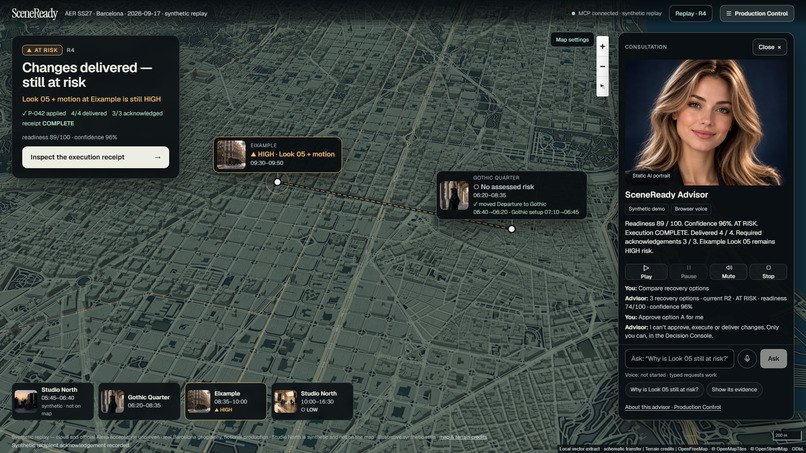
- Contextual AI-ready Advisor: Producers ask structured questions through the Advisor, which calls real read-only MCP tools and visually refocuses the map and affected shots.
- Causal impact analysis: The system traces how a problem affects activities, creative deliverables, and overall readiness.
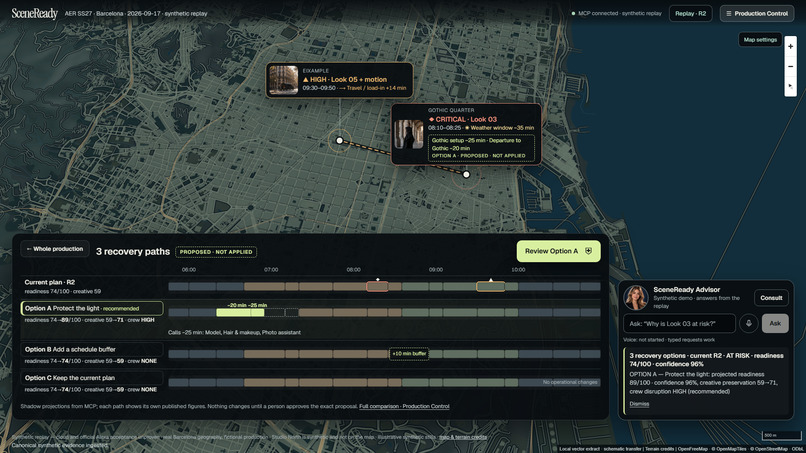
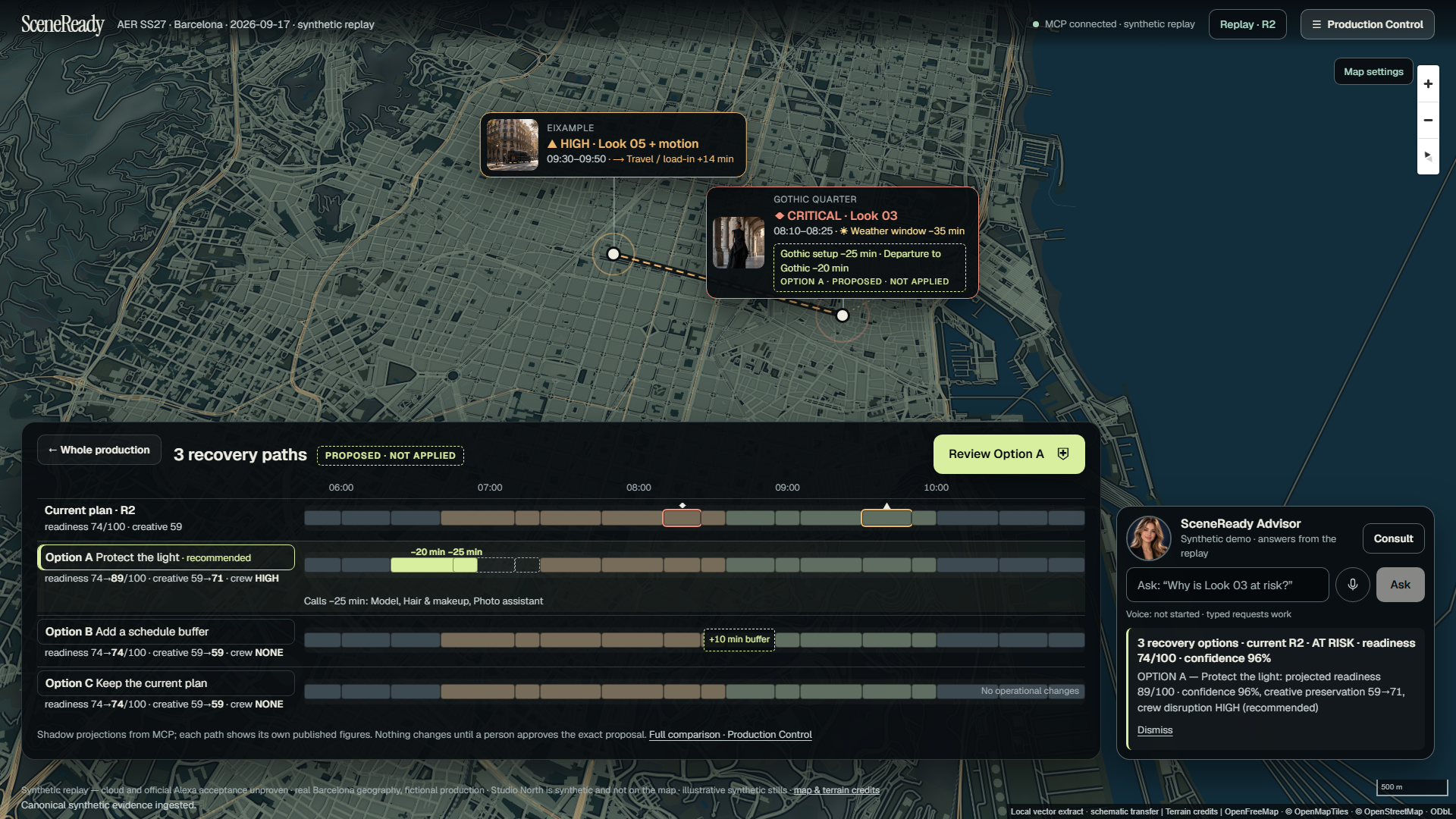
- Recovery simulations: Compare alternative plans before implementing any changes.
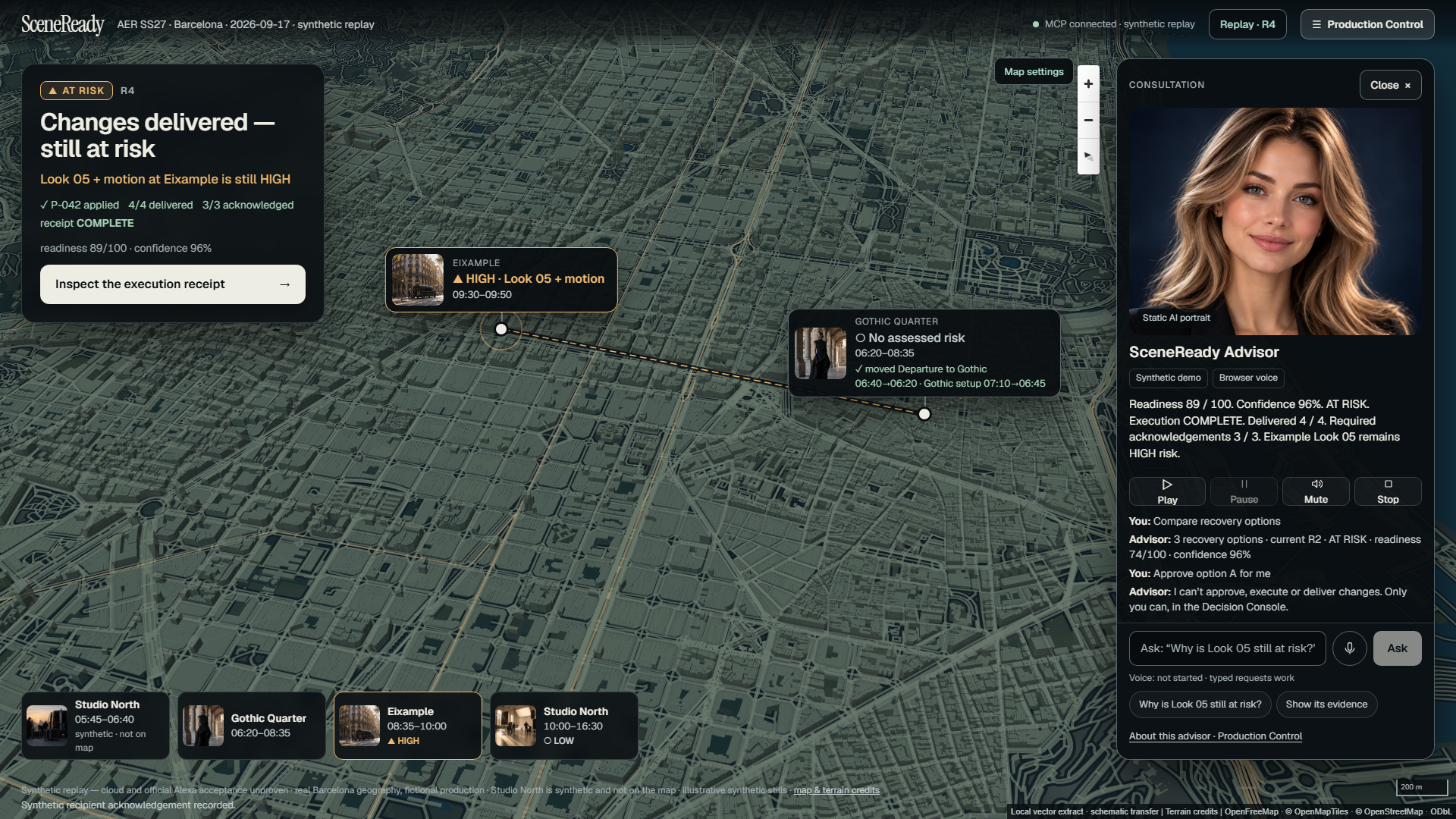
- Human-controlled decisions: The system cannot approve or execute a critical production revision without explicit human authorization.
- Execution accountability: Track deliveries, acknowledgements, and remaining risks after a decision is implemented.
In the demonstration, a 35-minute loss of daylight and a 14-minute travel delay threaten two Barcelona shooting locations.
SceneReady investigates the causes and compares recovery strategies. One proposed option improves projected readiness from 74 to 89, but introduces significant crew disruption.
The producer must explicitly approve the revision.
Even after the changes are completed, SceneReady continues to display a remaining high-risk issue. Execution complete does not automatically mean production safe.
How we built it
SceneReady combines a modular TypeScript architecture with a real MCP server and interactive React application.
The technology includes:
- Model Context Protocol: A working Streamable HTTP server exposing structured production tools.
- Production Intelligence Engine: Evidence, readiness assessment, causal relationships, risk policies, and recovery simulations.
- Spatial Interface: React and MapLibre with credited Barcelona geographic data.
- Adaptive Workspace: MCP responses change the actual visual presentation, not merely the text of a chatbot response.
- Human Authority: Revision-bound confirmation, authorization checks, and protected execution.
- Replay and Evaluation: Deterministic production scenarios, automated tests, and resilience checks.
- Public Deployment: An isolated Docker environment exposed through HTTPS using Cloudflare Tunnel.
The live demonstration supports independent visitor sessions and protects privileged actions from unauthorized MCP clients.
Challenges we ran into
One of the biggest challenges was preserving trust while making complex production information understandable.
We needed to distinguish a high readiness score from a hard legal blocker, and successful execution from genuine operational safety.
Another challenge was preventing AI-driven interfaces from crossing the human authorization boundary.
We also redesigned the original information-dense console into a spatial, map-first experience. The result communicates risk visually while preserving access to the underlying technical evidence.
Accomplishments
We delivered:
- A publicly accessible, functioning MCP application.
- A complete R0–R4 production scenario.
- Three recovery alternatives with meaningful trade-offs.
- Evidence-linked visual investigation.
- Explicit human approval and auditable execution.
- Session isolation, protected authority, and automated regression testing.
- A responsive interface for desktop and mobile.
The system demonstrates how MCP can connect structured operational intelligence with a visual production workflow.
What we learned
A useful assistant should do more than provide answers.
It should show what changed, why it matters, what can be done, and which decisions require a human.
Visual clarity, transparent limitations, and protected authority are as important as automation itself.
What's next
Our next major step is a fully conversational digital production advisor, combining natural voice, expressive avatar animation, and real-time interaction with the same protected MCP tools.
We also plan integrations with real production schedules, crew communications, and commercial production workflows.
The current demonstration uses synthetic production data. Its Advisor supports structured text requests through real MCP tools; live conversational voice and official Alexa+ device integration are not claimed.
SceneReady — Protect the production. Preserve the vision. Keep the human in control.
Built With
- cloudflare-tunnel
- docker
- elevenlabs
- ffmpeg
- maplibre
- mcp
- model-context-protocol
- node.js
- openstreetmap
- playwright
- react
- streamable-http
- typescript
- vite

Log in or sign up for Devpost to join the conversation.