Inspiration
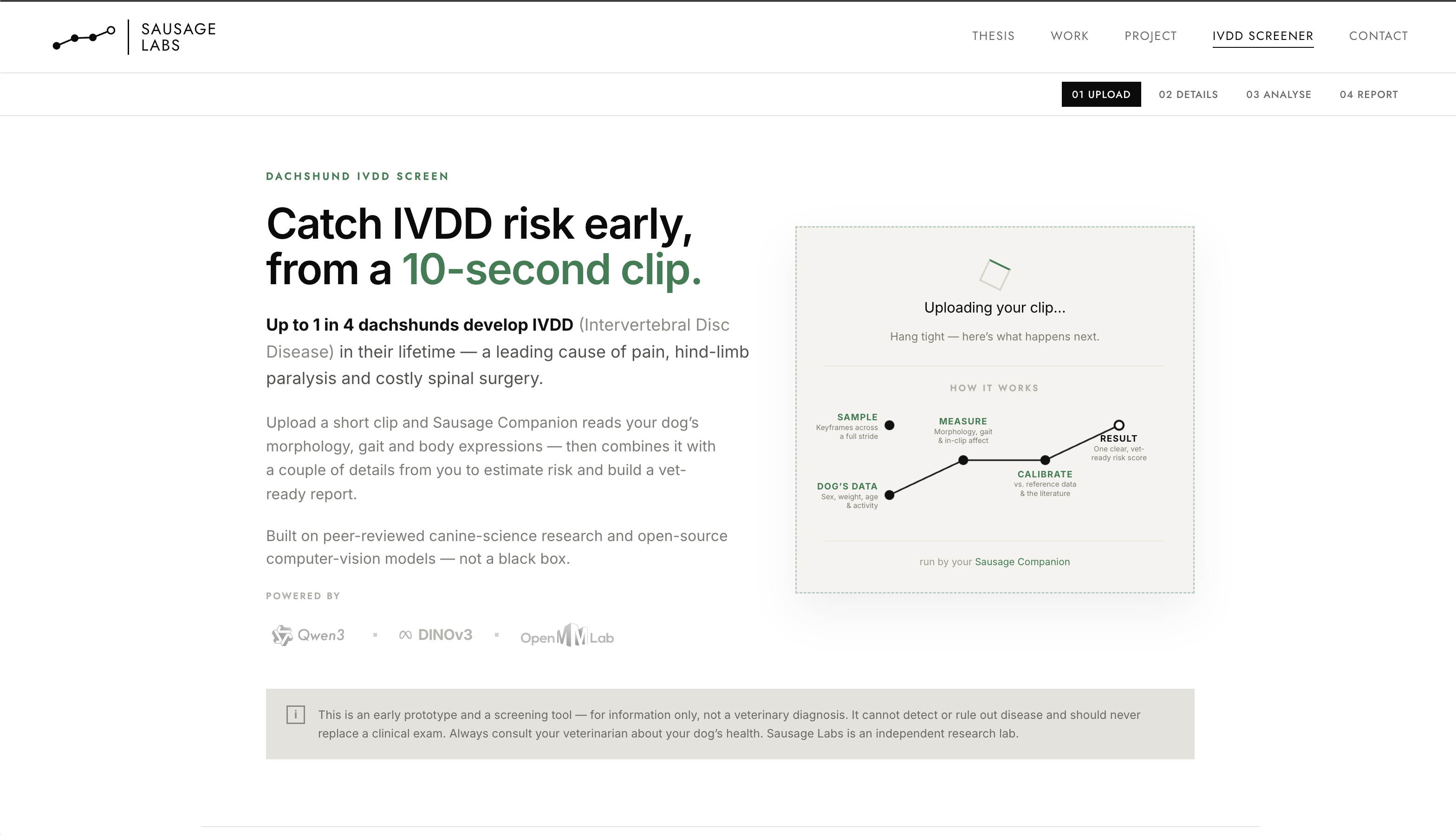
We own a dachshund. So when we learned that up to 1 in 4 dachshunds develop IVDD — intervertebral disc disease, a leading cause of pain, paralysis, and expensive spinal surgery — it wasn't an abstract statistic. The risk is written in the dog's body: a long back relative to height loads the spinal discs. Vets can assess this; owners can't. We wanted to put an early-warning tool in every owner's pocket: point your phone at your dog for ten seconds, get a vet-ready screening.
What it does
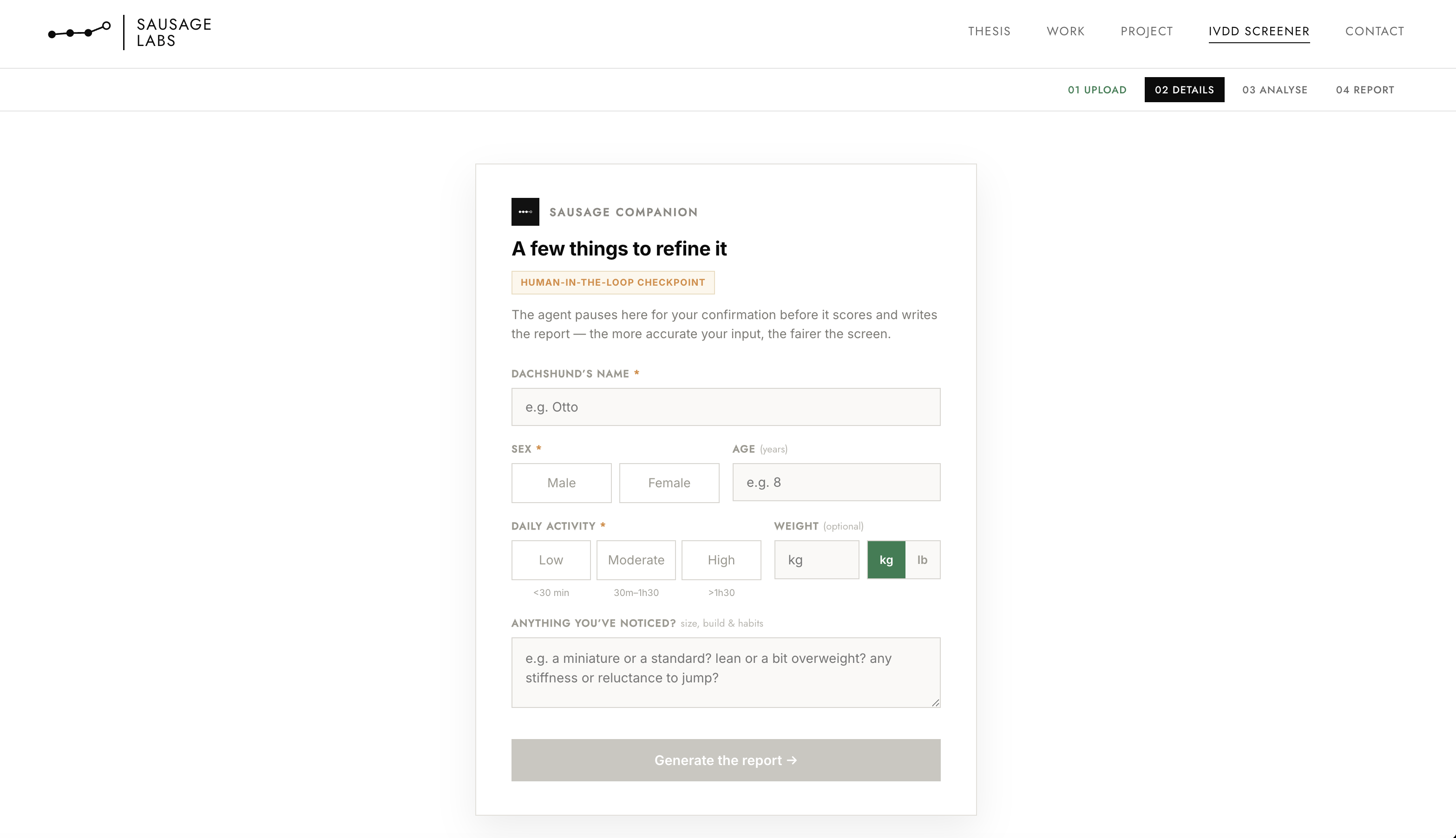
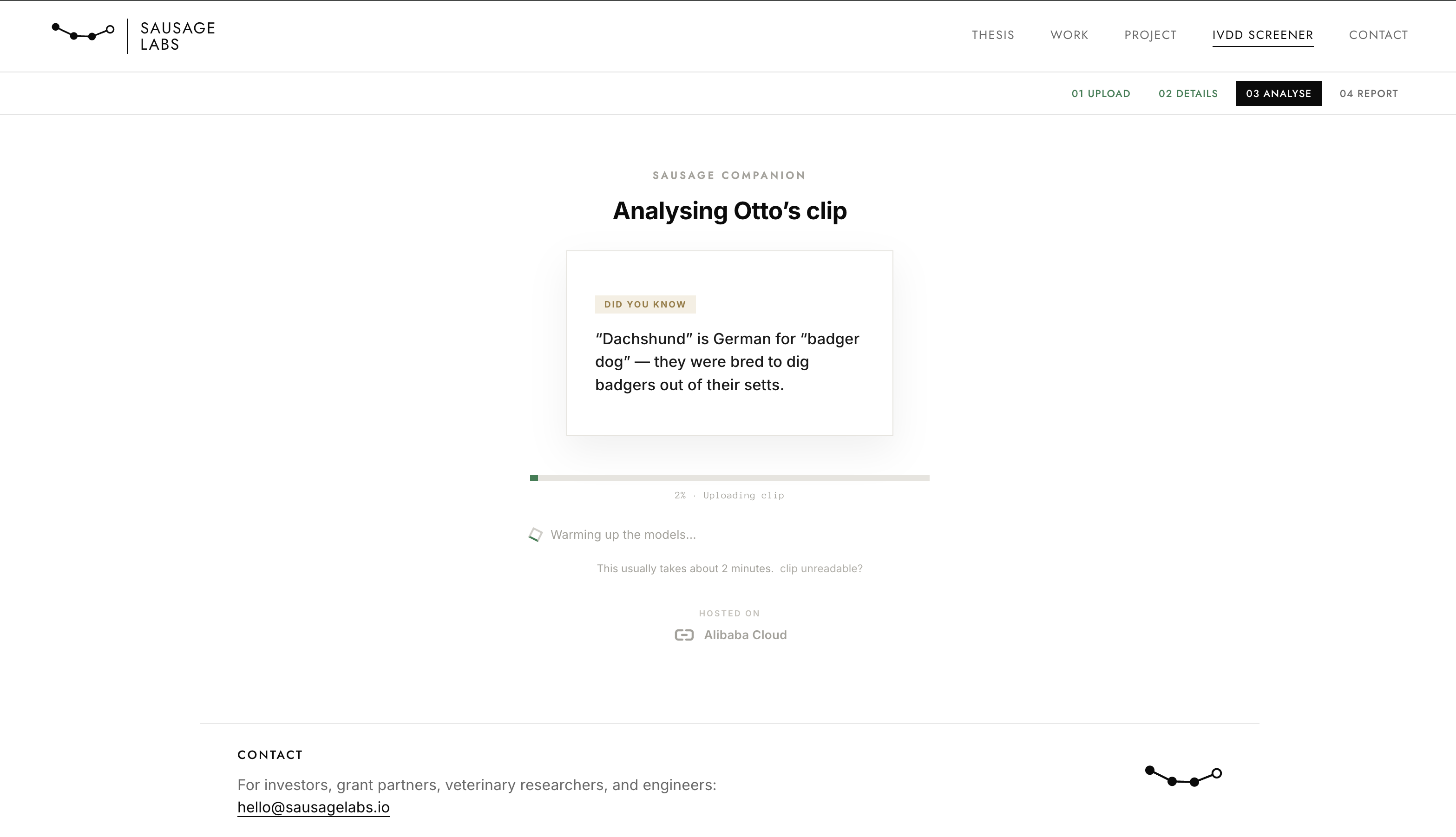
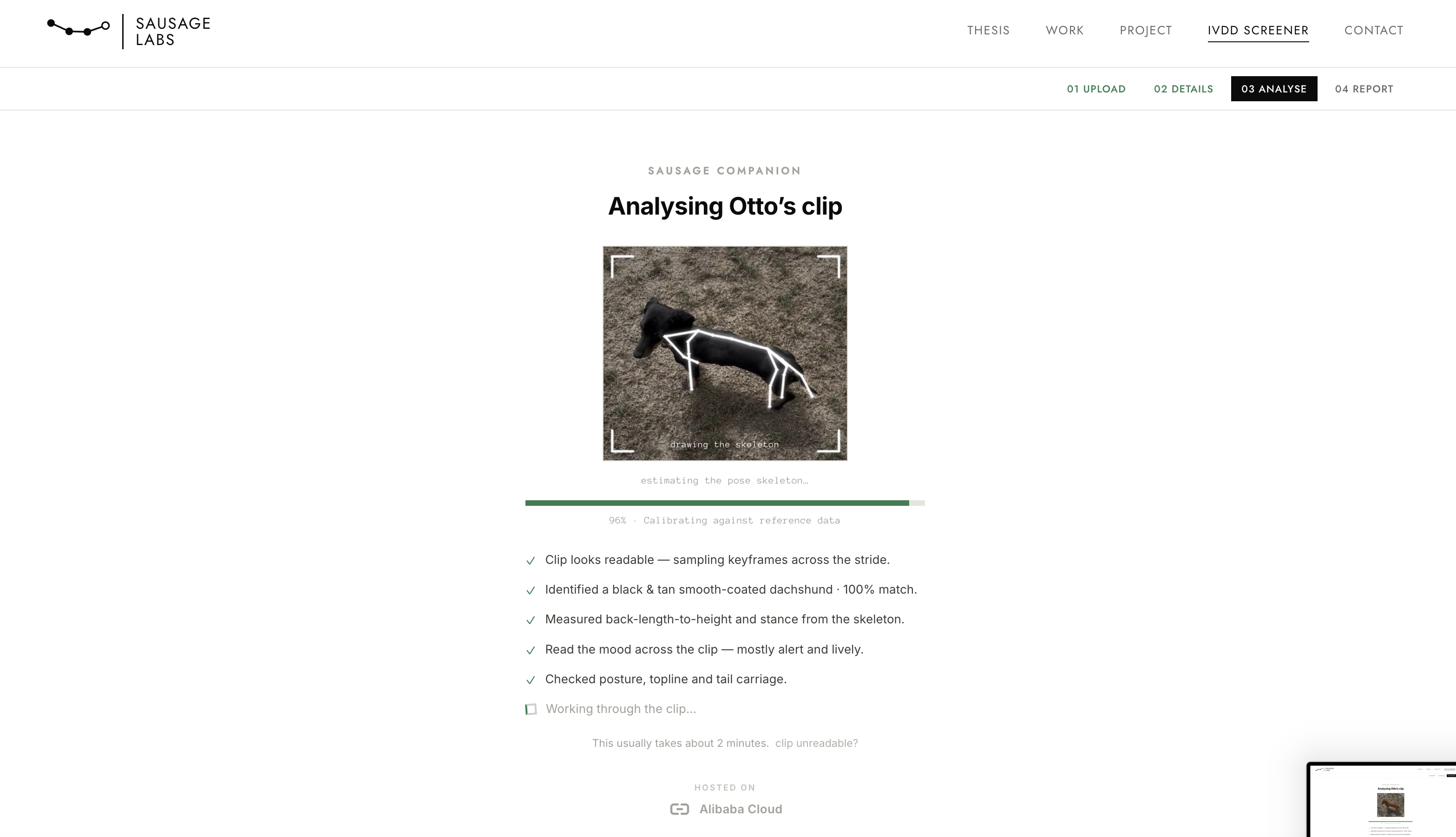
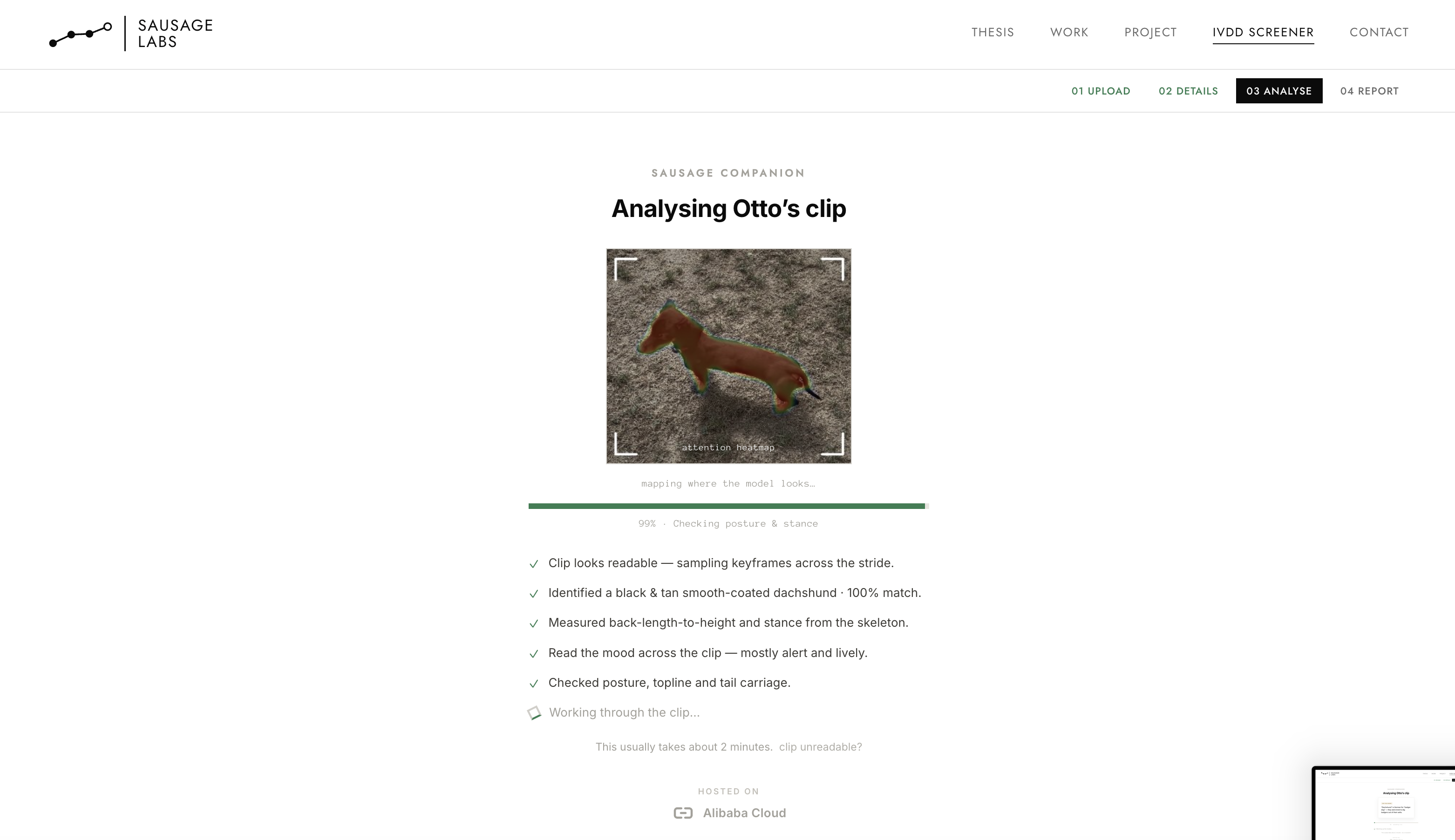
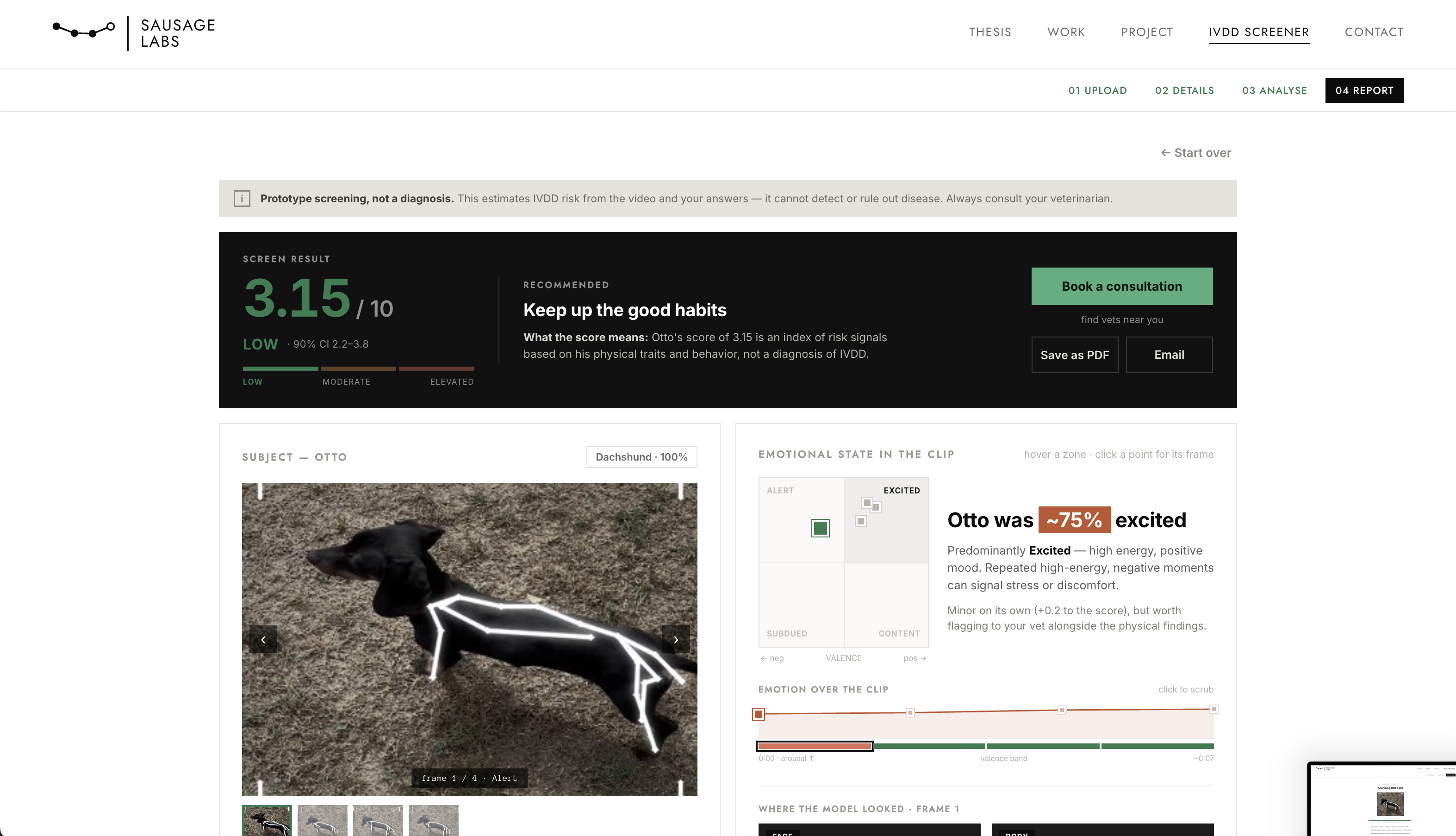
Sausage Labs' agent turns a 10-second phone clip of a dachshund into a screening report, end to end. It confirms the clip is usable, measures the conformation ratios that matter, reads the dog's body language and posture, asks the owner one plain-language question (and parses the messy answer into risk factors), scores the risk 0–10 against the veterinary literature with every factor cited, and routes to the right next step — pausing for the owner to confirm before it surfaces real nearby clinics. Informational screening, not a diagnosis.
How we built it
A Qwen orchestrator (Alibaba Cloud Model Studio / DashScope) drives the workflow, invoking tools over the Model Context Protocol (MCP):
- A private CV service: RTMDet + a fine-tuned RTMPose 34-keypoint dachshund pose model, a frozen DINOv3 ViT-B encoder, our own MobileNetV3 colour CNN, and a 2D→3D lifter that makes the conformation ratios orientation-free.
- Qwen-VL for visible-sign reading, and Qwen for turning the owner's free-text note into structured factors.
- A deterministic, literature-grounded risk score (auditable, not an LLM guess), and a real vet finder via OpenStreetMap.
The whole backend runs on an Alibaba Cloud Simple Application Server, behind Caddy TLS, with a public web front-end.
Challenges we ran into
- Orientation & sim-to-real: owner clips are filmed from any angle, so we built a 2D→3D lifter to keep the ratios literature-accurate, and trained the pose model on mixed synthetic (generated with Unity3D) + real data.
- Data: we annotated 1600 images of dachshunds to train our models. The biggest sausage dog annotated dataset in the world.
What we learned
MCP is a clean seam between the reasoning layer (Qwen) and the perception layer (our CV models) — it's what lets the trust boundary hold. The right split is deterministic Python for the auditable score, Qwen for the genuinely ambiguous parts.
What's next
On mobile on-device path, and partnering with veterinary researchers to validate against clinical outcomes. Go-to-market next.
Built With
- alibaba-cloud
- caddy
- computer-vision
- dashscope
- dinov3
- fastapi
- javascript
- mcp
- mobilenetv3
- model-context-protocol
- onnx
- onnxruntime
- opencv
- openstreetmap
- python
- qwen
- qwen-cloud
- rtmdet
- rtmpose
- scikit-learn


Log in or sign up for Devpost to join the conversation.