-
-
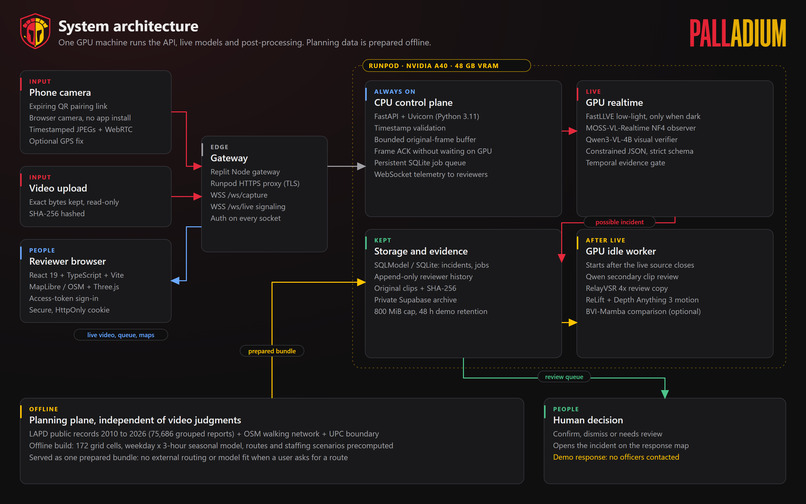
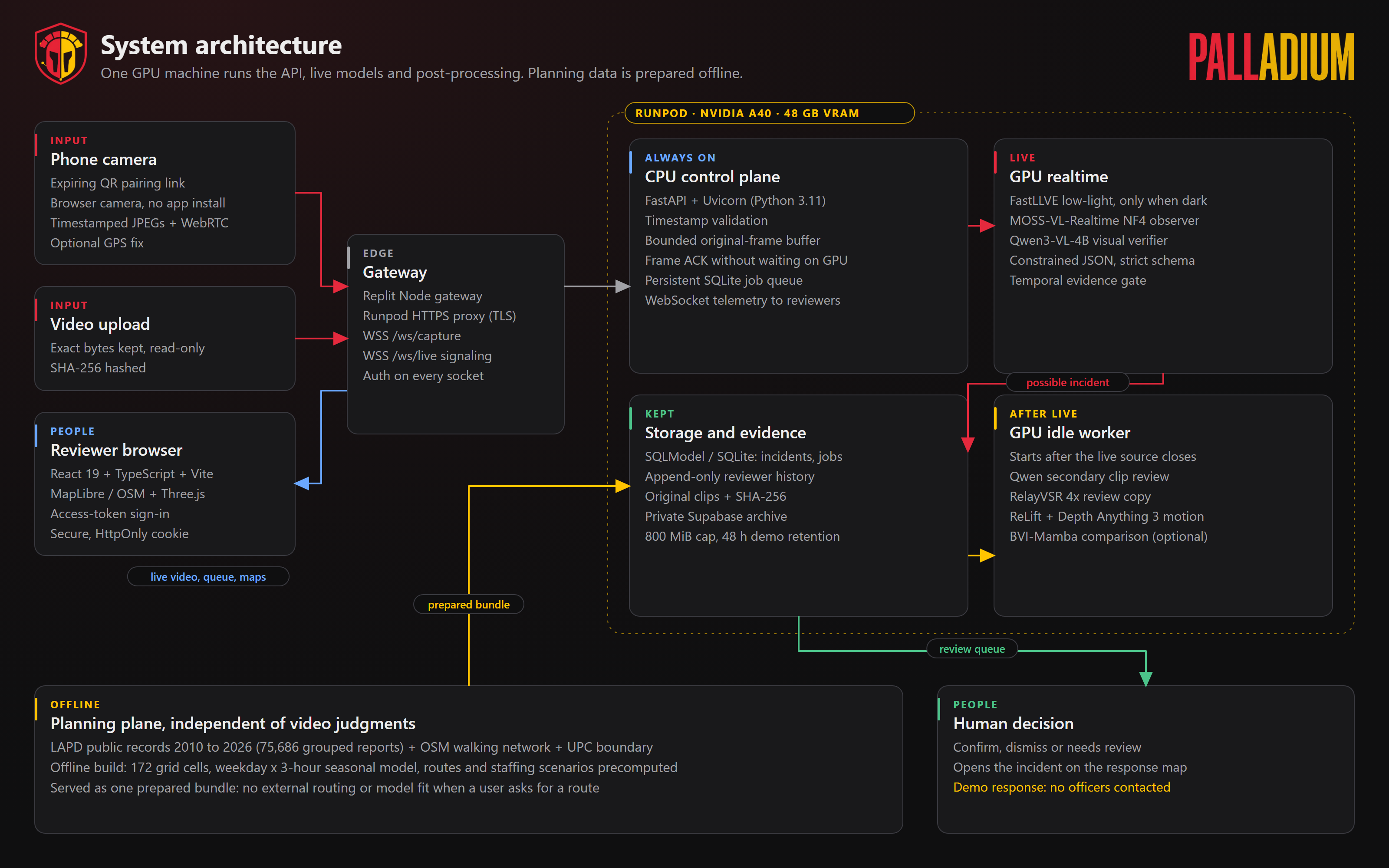
System Architecture
-
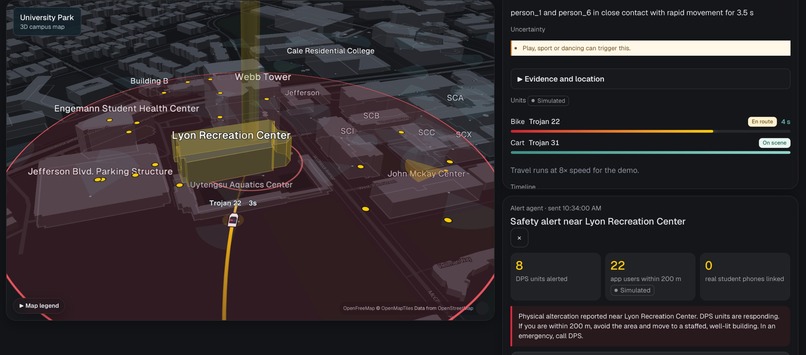
Dispatch Replay
-
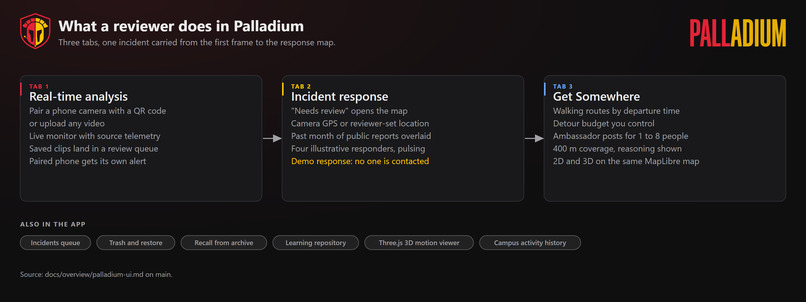
Palladium
-
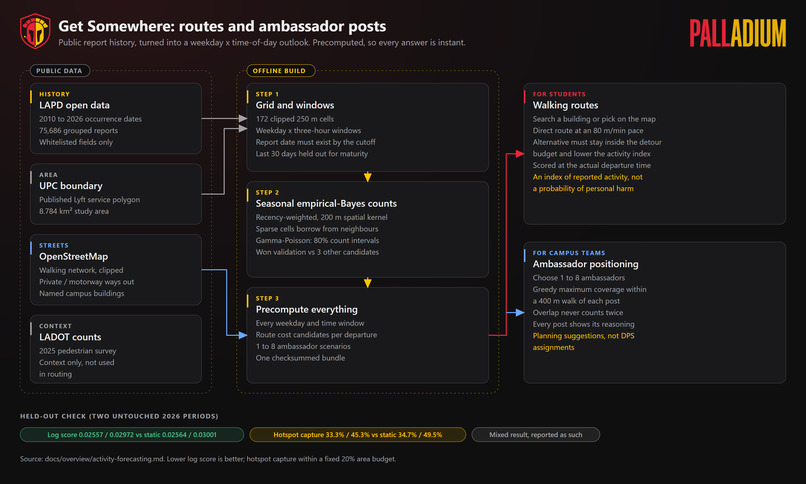
Ambassador posts
-
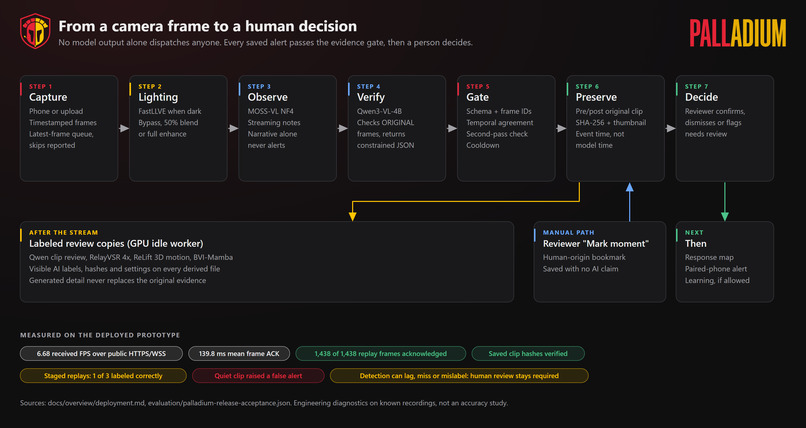
Human decision
-
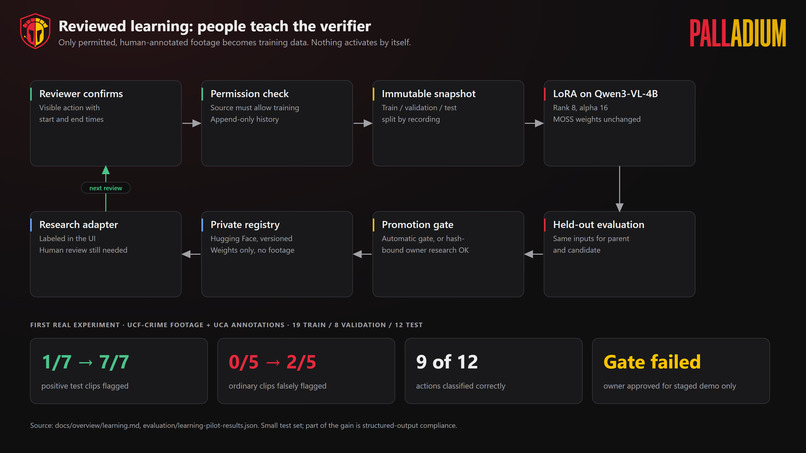
Reviewed learning
-
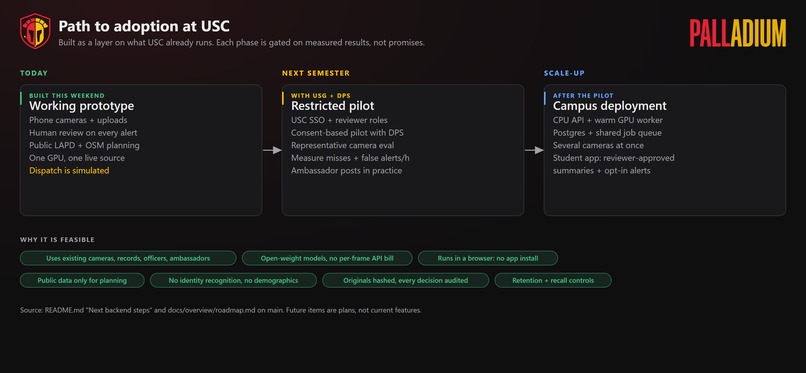
Adoption at USC
Inspiration
On July 24, 2014, Xinran Ji, a USC graduate student, was attacked on his walk home just blocks from campus and died. In 2023 alone, the area around campus saw 53 aggravated assaults and 52 burglaries, and most incidents never get reported. Our teammate Aditya had his chain snatched at the Metro station and never reported it. There weren't enough cameras, and nobody had time to search the footage.
USC's main answer has been getting students off the street. The free Lyft program grew from \$6M in its first year to \$40M a year at its peak. We asked: what if the streets themselves were safer?
A DPS officer and a campus ambassador gave us three pain points:
- Too many cameras, not enough eyes.
- Ambassadors rarely move, and students don't know where they are.
- Students guess which routes are safe at night.
In Greek myth, the Palladium protected Troy: as long as it stood, the city was safe.
What it does
Palladium is an AI layer on USC's existing cameras, incident records, officers and ambassadors.
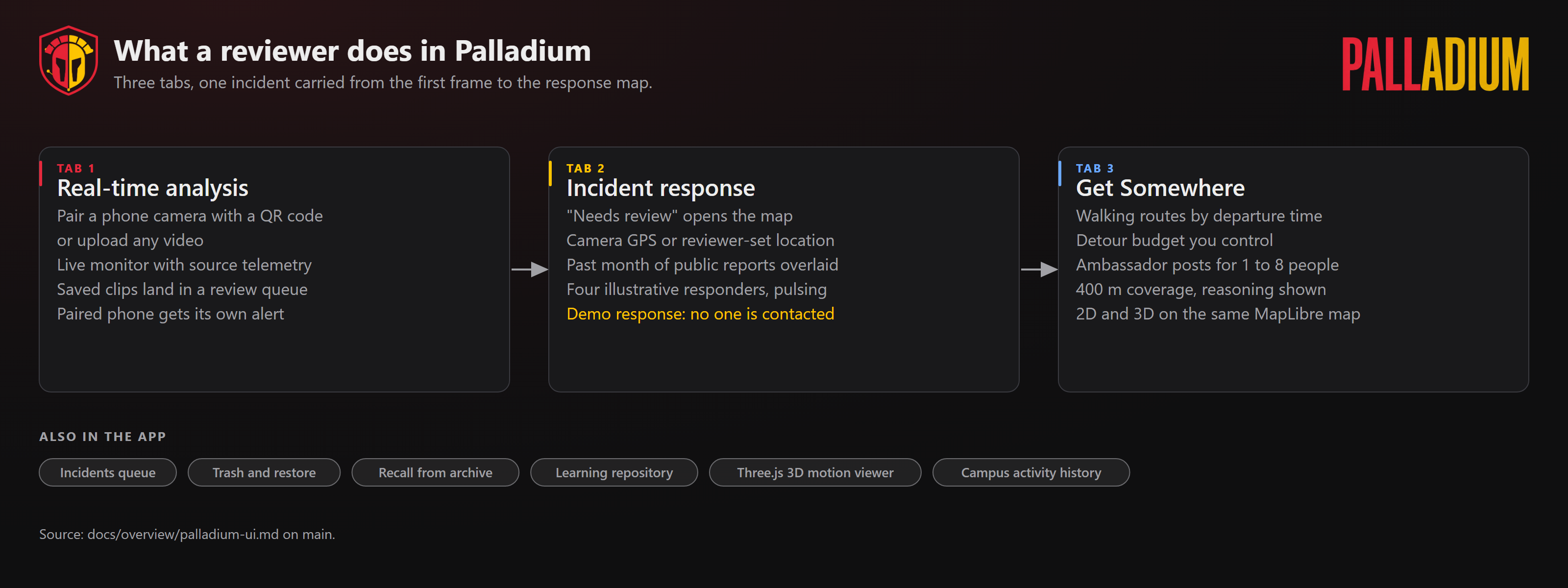
- Real-time analysis: in this demo, a phone stands in for a campus camera. Pair it with a QR code, or upload a video, to see how the model performs live. The AI flags possible incidents, saves the original clip, and a human reviews it. In deployment, the same layer runs on every existing campus camera.
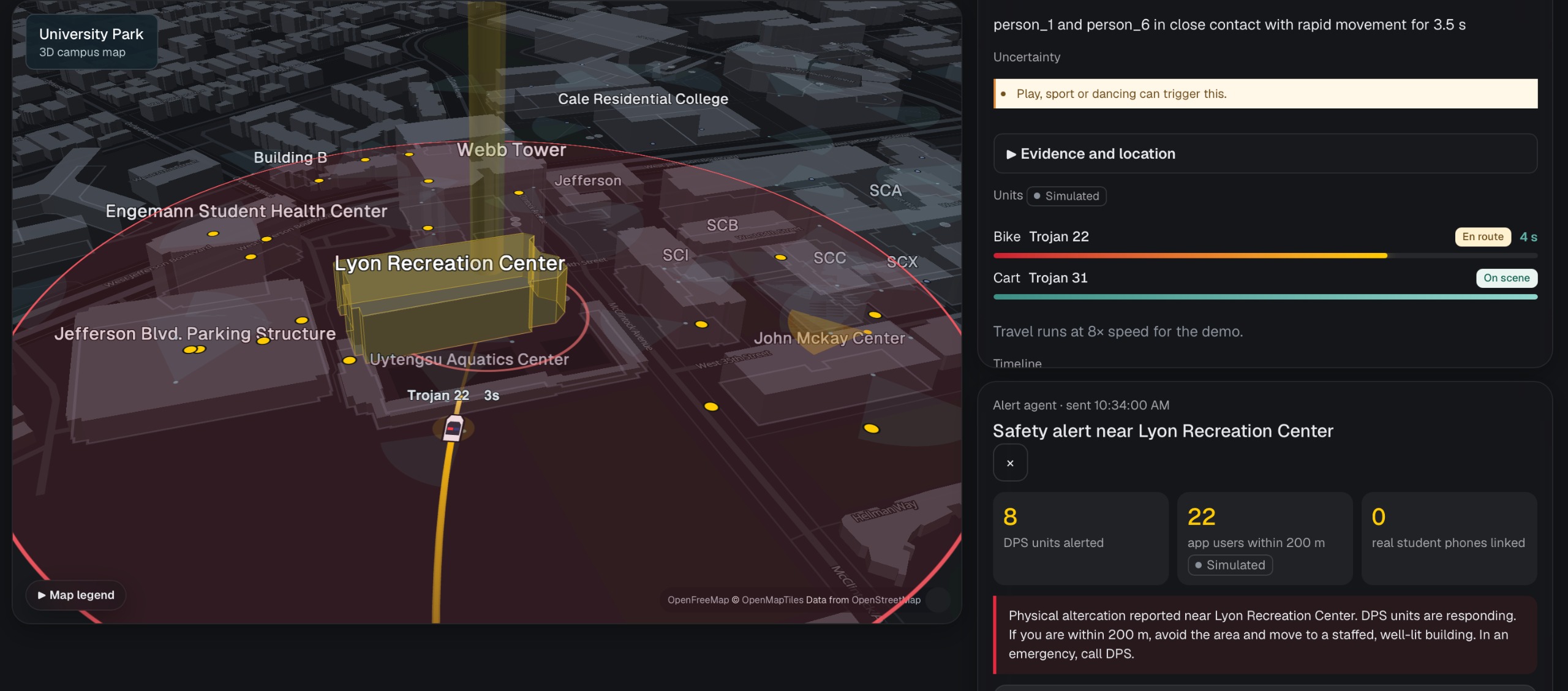
- Incident response: a flagged incident opens on the campus map with the past month of public reports. The responder demo is clearly labeled; no one is contacted.
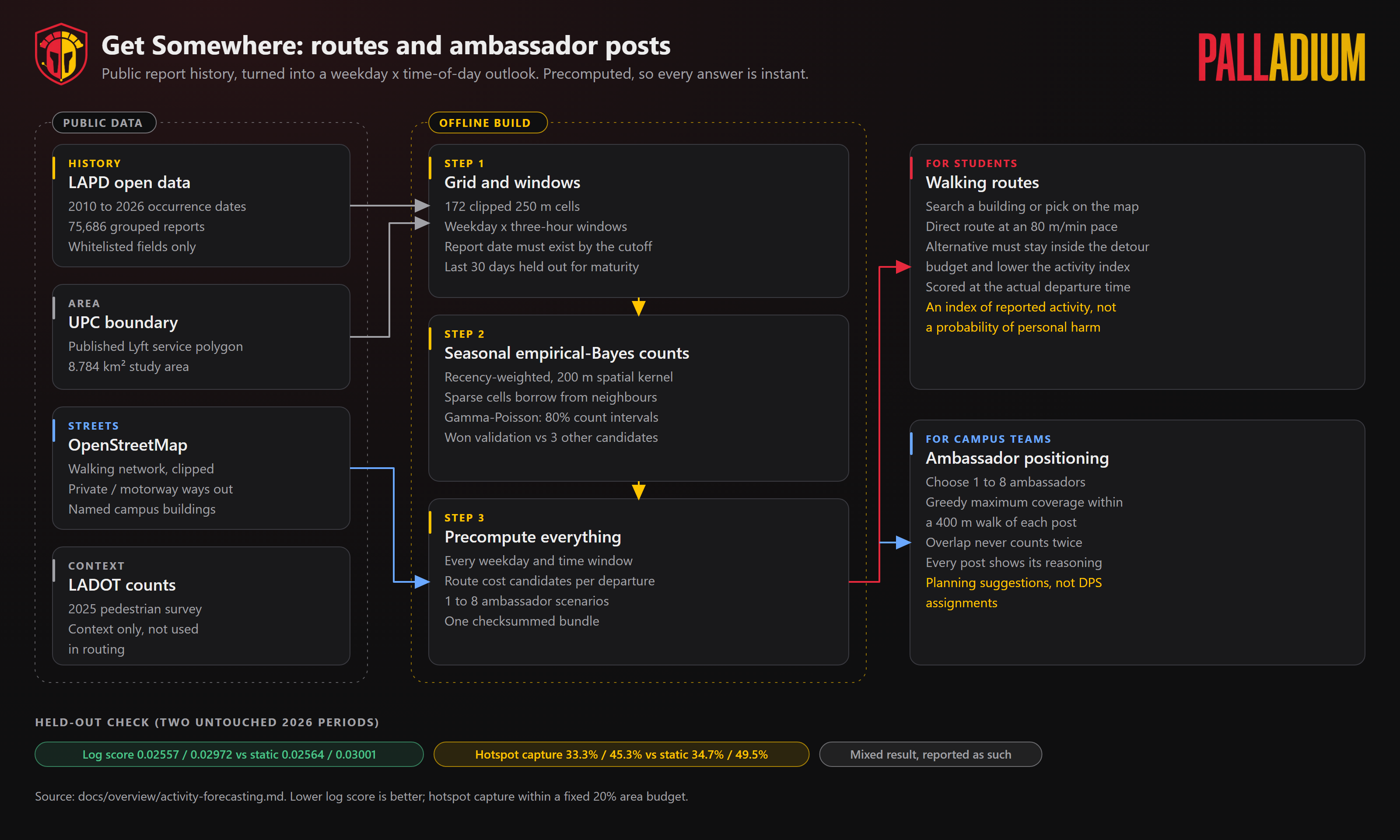
- Get Somewhere: safer walking routes for your departure time, plus suggested ambassador posts with their reasoning.
How we built it
- Frontend: React 19, TypeScript, Vite, MapLibre/OpenStreetMap and Three.js.
- Backend: Python 3.11 and FastAPI on one NVIDIA A40 (Runpod), behind a Replit Node gateway.
- Video: WebRTC for live viewing, and acknowledged JPEG frames over WebSockets for the AI.
- Storage: SQLite, plus a private Supabase archive.
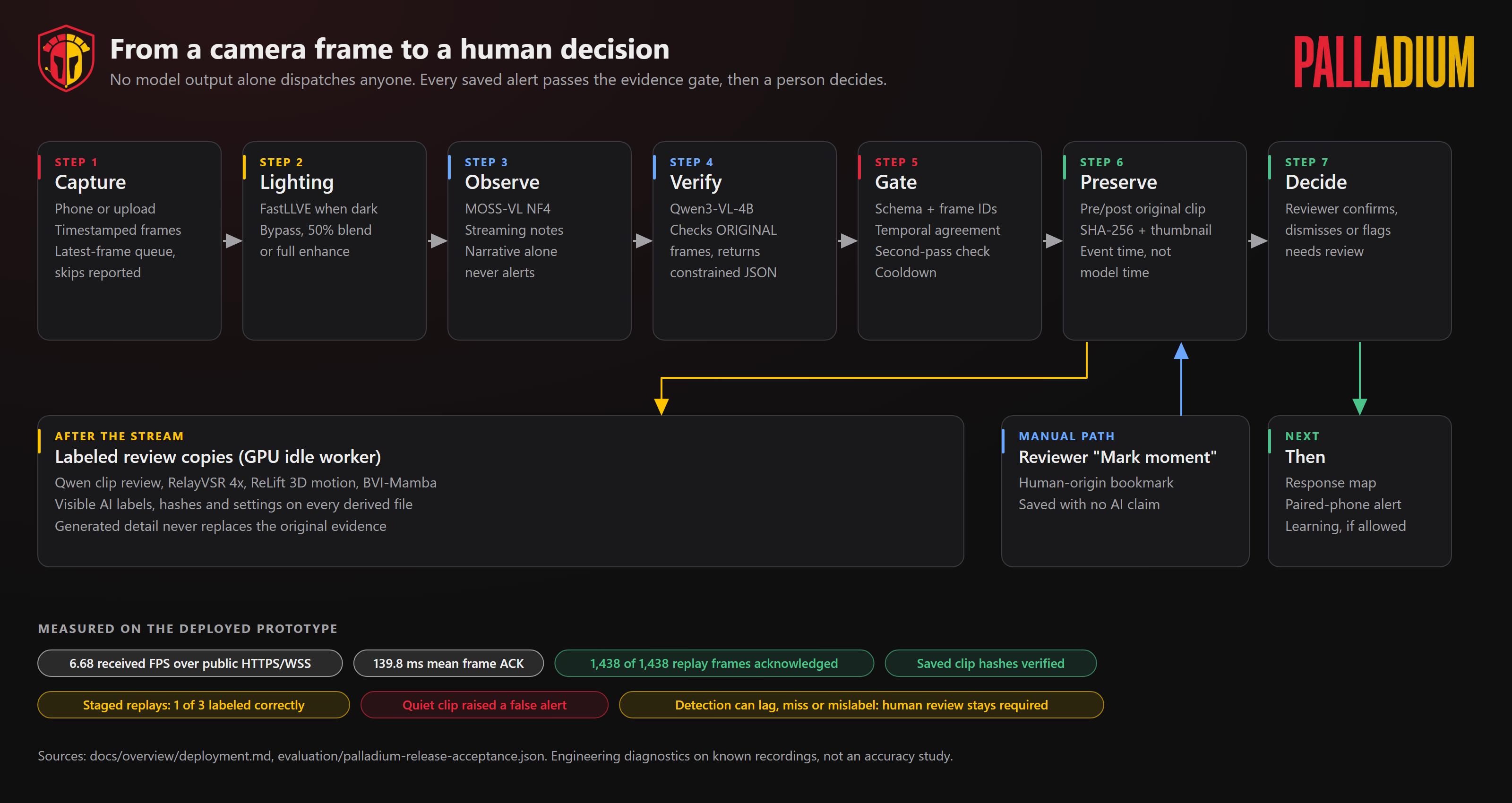
AI pipeline:
- FastLLVE brightens dark footage.
- MOSS-VL-Realtime observes the stream.
- Qwen3-VL-4B checks the original frames and must answer in strict JSON.
- An evidence gate checks the JSON's format, the frame IDs it cites and agreement across time, then runs a second check.
- The original clip is saved with a SHA-256 hash, and a human decides.
The model's free text can never trigger an alert on its own.
Routes: 75,686 public LAPD reports (2010–2026) feed a seasonal empirical-Bayes model over 172 grid cells, one estimate for each weekday × 3-hour window. Each street segment's cost is its walking time τ weighted by its forecast activity q:
$$c_e(\beta) = \tau_e\,(1 + \beta\, q_e), \qquad \beta \in {0.25,\ 0.5,\ 1,\ 2,\ 4}$$
We keep the route with the least reported activity that stays within the detour budget:
$$\min_P \sum_{e \in P} \tau_e\, q_e \quad \text{s.t.} \quad T(P) \le (1+\delta)\, T(P_{\text{direct}})$$
Ambassadors: each new post is placed where it covers the most still-uncovered expected reports within a 400 m walk.
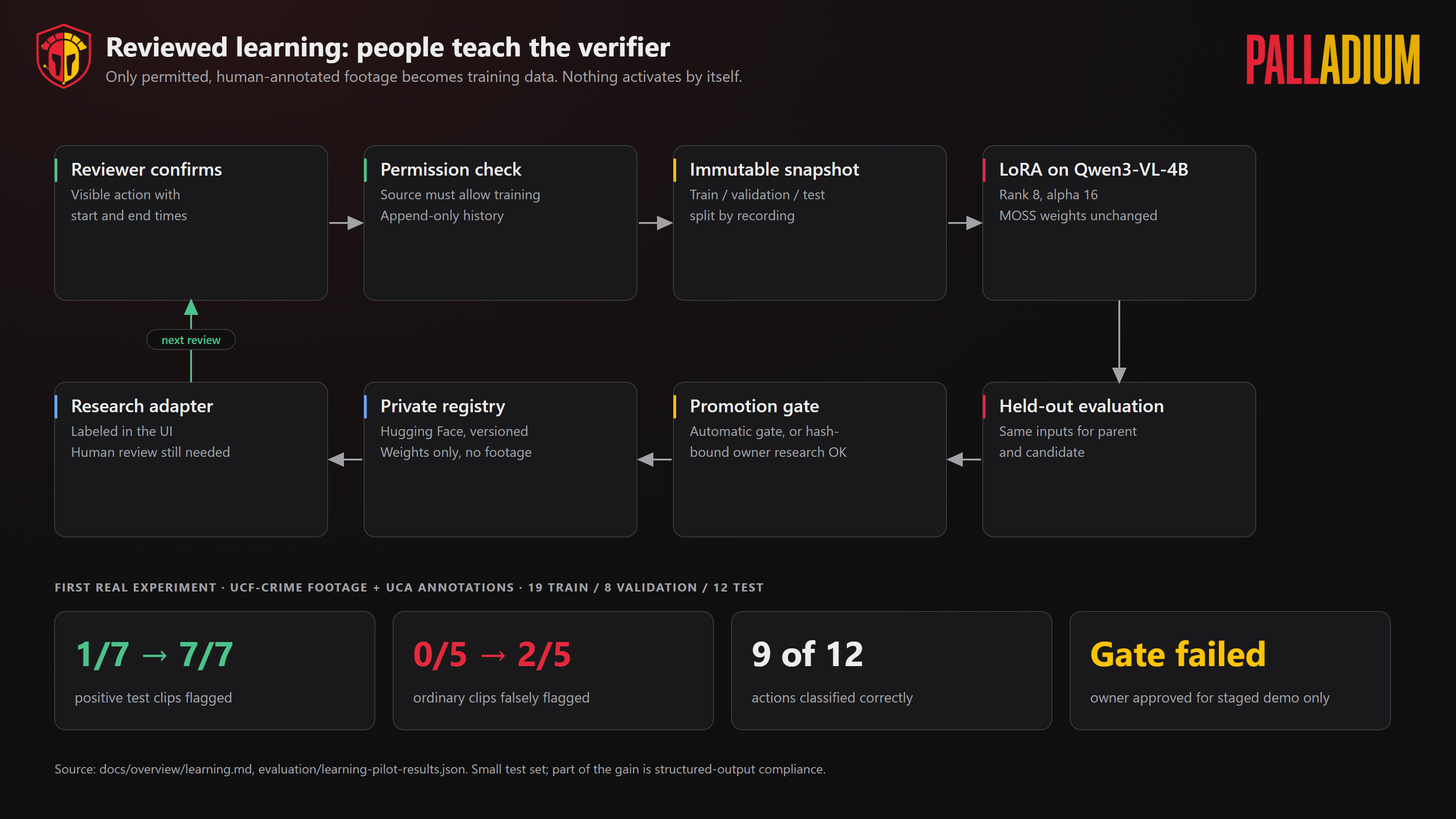
Learning: we trained a LoRA adapter on Qwen3-VL-4B using only permitted, human-annotated clips, and evaluated it on held-out data.
Challenges we ran into
- One GPU, many jobs: live inference always takes priority, and heavy jobs wait. In the release test, 1,438 of 1,438 frames were acknowledged, with a mean acknowledgement time of 139.8 ms.
- Trustworthy AI: MOSS alone failed strict validation, so we split the work into an observer and a verifier. Staged tests still produced a false alert, and we report it openly.
- Evidence integrity: each clip is frozen around the time of the event, not when the model finished, and stays hash-verified.
- Honest results:
- The forecast beat the baseline on log score but not on hotspot capture.
- The LoRA adapter raised flagged positives from 1/7 to 7/7, but false flags rose from 0/5 to 2/5, and our own gate rejected it.
What we learned
The hard part of safety AI is what happens when the model is wrong. Keeping originals, splitting the observer from the verifier, and keeping a human in the loop made the system trustworthy. Officers don't want more screens; they want fewer, better-evidenced moments to review.
What's next
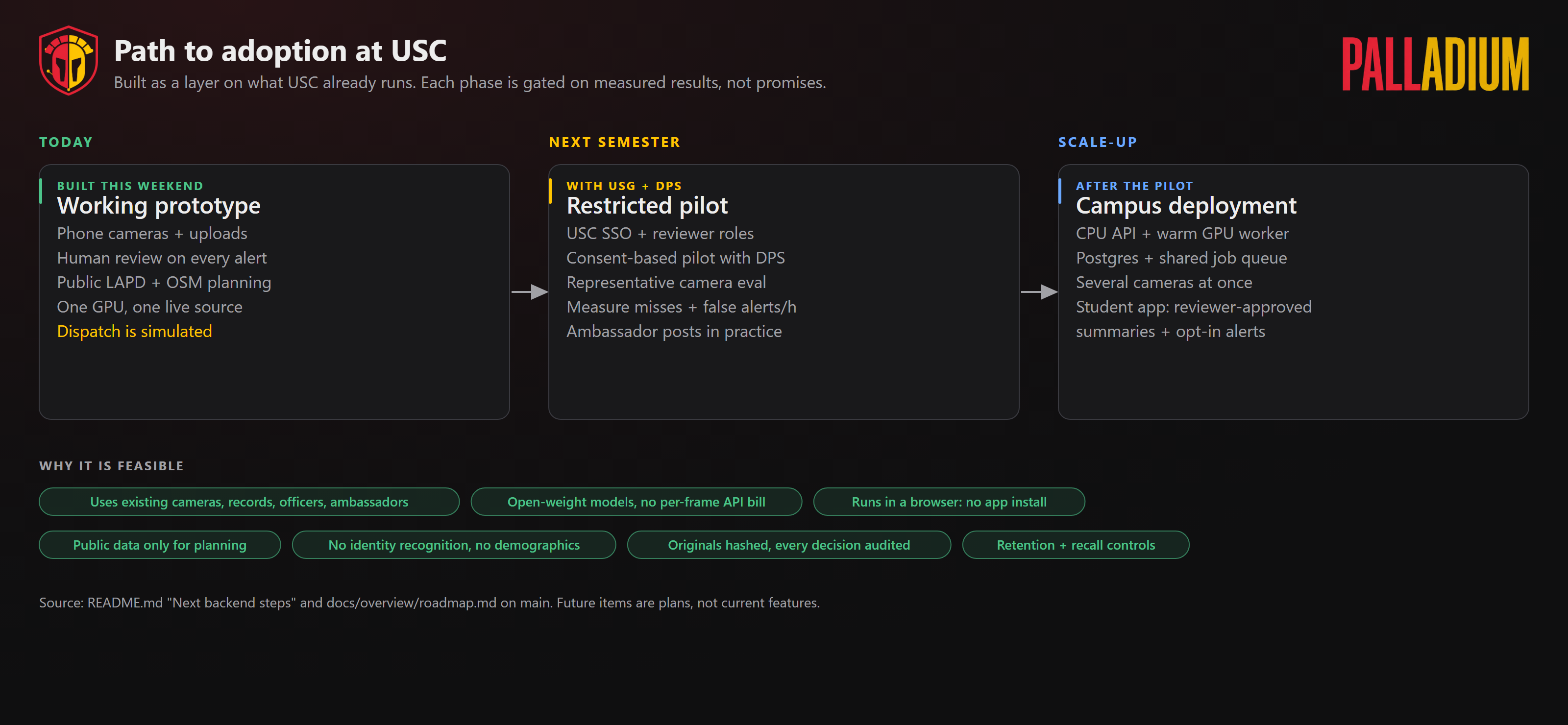
- Every campus camera: run the Palladium layer on USC's existing edge cameras instead of demo phones.
- Multi-agent dispatch: agents that propose which units to send and who to alert, with an officer approving each dispatch.
- Follow the trail: stitch footage across cameras to follow a person or incident as they move across campus.
- Chat with the feeds: ask questions of live and recorded video in plain language, such as "did anyone leave Leavey with a red backpack after 10 pm?", and get quick answers.
- A restricted pilot with USG and DPS, with USC SSO and reviewer roles, measuring missed events and false alerts on real campus cameras.
- A student view that shows reviewer-approved alerts.
Help didn't reach Xinran Ji in time. Palladium is built so that next time, it does. Built by Trojans, for Trojans.
Built With
- fastapi
- fastllve
- hugging-face
- lora
- maplibre
- moss-vl
- node.js
- nvidia-a40
- opencv
- openstreetmap
- pyav
- python
- qwen3-vl
- react
- replit
- runpod
- sqlite
- sqlmodel
- supabase
- three.js
- typescript
- vite
- webrtc
- websockets

