Inspiration
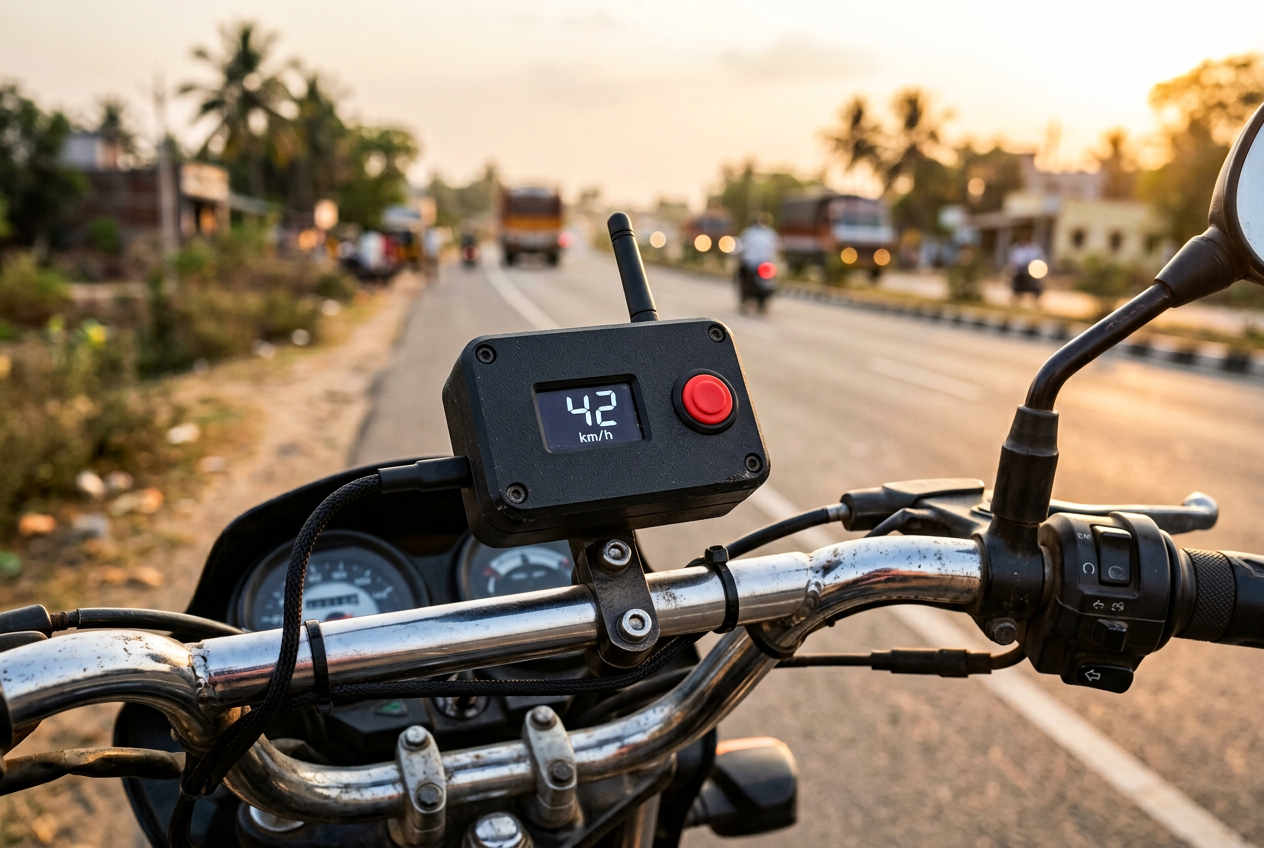
Every year, over 1.5 lakh lives are lost on roads, with two-wheeler riders bearing a massive share of these fatalities. Medical literature highlights the critical importance of the "Golden Hour"—the initial 60 minutes following trauma when rapid medical attention significantly increases survival chances. In reality, victims lying injured on quiet stretches or highways late at night are often left completely undetected. Existing crash-detection mobile apps and smart helmets frequently fail because they rely on charged phone batteries, active mobile data, or riders remembering to wear specialized gear. We wanted to build an always-on, low-cost device attached directly to the vehicle that functions silently on every ride without requiring any user action.
What it does
How we built it
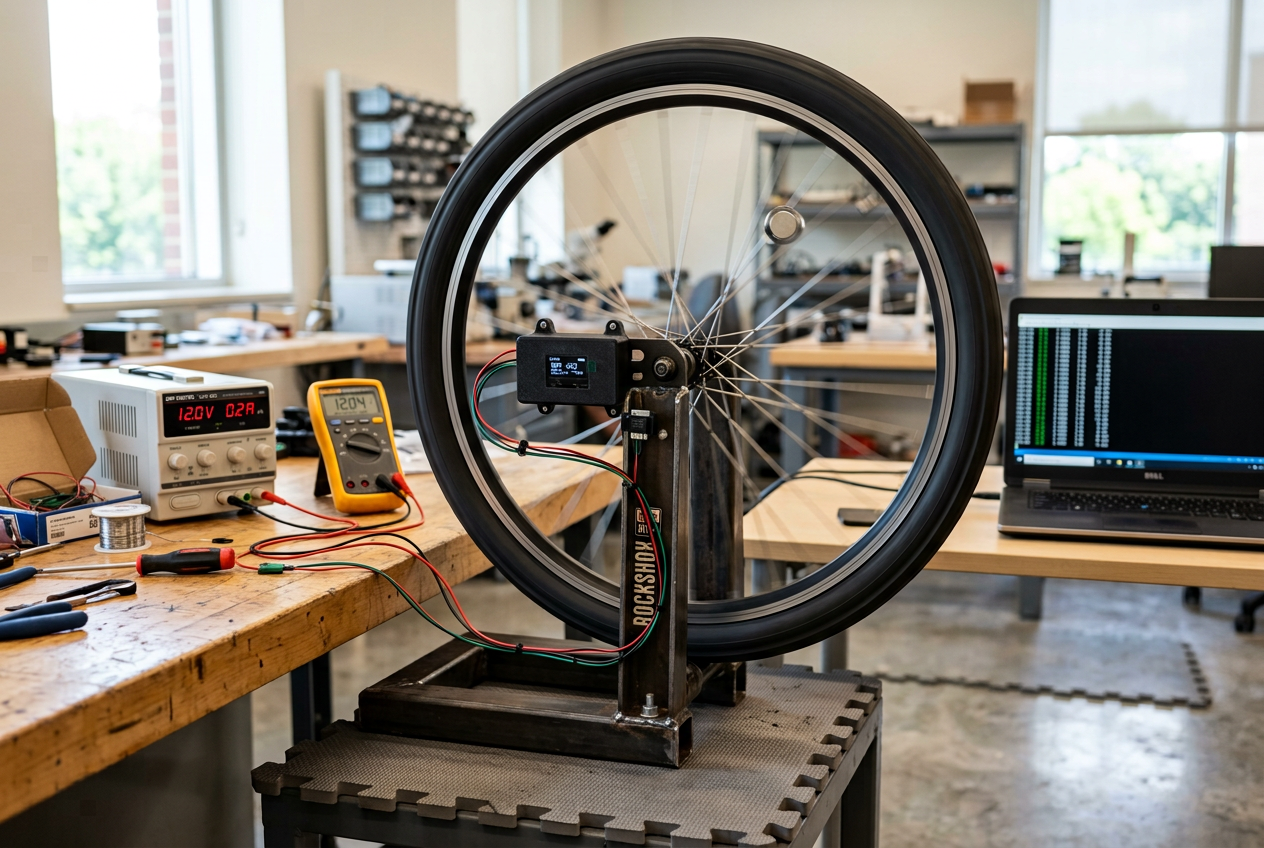
We built our prototype around an ESP32 microcontroller powered directly by the vehicle battery through a buck converter.
The hardware pipeline combines multiple sensors using sensor fusion logic: Wheel Speed: A Hall-effect sensor and wheel magnet measure accurate physical wheel rotation.
Impact & Orientation: An MPU6050 IMU captures total acceleration magnitude $\sqrt{a_x^2 + a_y^2 + a_z^2}$ and vehicle tilt. Location & Cellular Alerting: A NEO-6M GPS module tracks live coordinates, while a SIM800L GSM module dispatches SMS alerts.
User Interface: An OLED display, buzzer, and physical button manage live speed output and the 15-second cancel flow.
On the software side, we implemented a three-stage state machine. First, total acceleration must cross an impact threshold. Second, pre-impact wheel speed must drop by over 60% within 1 second. Third, a complementary filter blending 98% gyroscope data and 2% accelerometer data checks if vehicle tilt exceeds 60° for over 2 seconds. We also built a Firebase-backed volunteer app prototype and a central web dashboard to log incident blackspots and track volunteer response times.
Challenges we ran into
Filtering out normal road disturbances was our biggest challenge. Simple accelerometer setups constantly confuse potholes, speed breakers, and hard braking with actual crashes. Potholes produce sharp vertical spikes under 100 ms while wheel speed continues normally, whereas hard braking produces sustained horizontal deceleration without severe tilt. Tuning the complementary filter and thresholds to reliably differentiate these events required extensive bench testing. Additionally, managing unstable GSM power spikes from the SIM800L module during SMS transmissions required careful power isolation on the prototype board.
Accomplishments that we're proud of
Built a fully working, integrated hardware prototype for under ₹2,500 that functions entirely independent of smartphones and internet connections.
Successfully implemented multi-sensor fusion combining Hall sensor wheel speed, MPU6050 impact forces, and complementary filter tilt angles to eliminate false triggers.
Designed and tested a complete emergency response pipeline spanning hardware detection, SMS dispatches, volunteer app routing, and central web dashboard logging.
What we learned
We gained deep hands-on experience in sensor fusion algorithms, low-level ESP32 firmware development, and embedded state-machine design. We learned how crucial physical wheel speed verification is when separating sudden deceleration from structural impact. We also realized that effective emergency management requires both fast technological detection and community-driven human response layers working in parallel.
What's next for SafeMeter: Smart Crash Detection Speedometer
Transitioning from prototype IMUs to high-G sensors like the ADXL375 (up to $\pm 200\text{ g}$) to capture extreme impact forces seen in high-speed crashes.
Designing a custom, weatherproof (IP67-rated) printed circuit board (PCB) enclosure to reduce production costs down to ₹1,500 at scale.
Training lightweight decision tree classifiers on collected trial data to supplement threshold-based detection logic.
Partnering with delivery logistics fleets, commercial vehicle operators, and municipal bodies to run field pilots and leverage anonymized incident heatmaps for accident blackspot remediation.

Log in or sign up for Devpost to join the conversation.