-
-
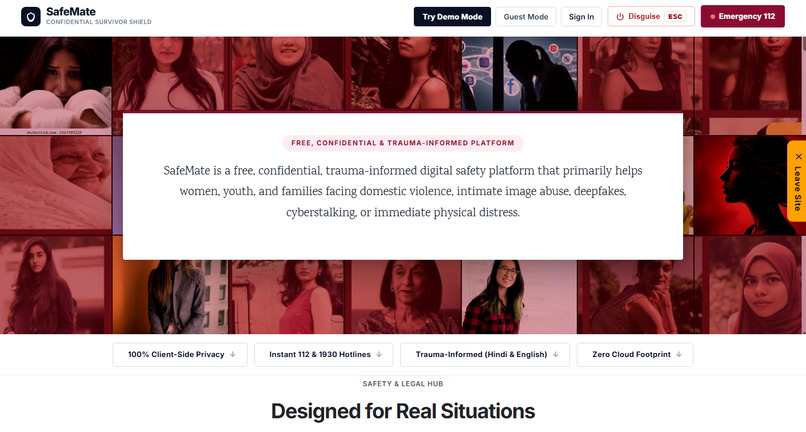
Survivor_Sanctuary_Hub
-
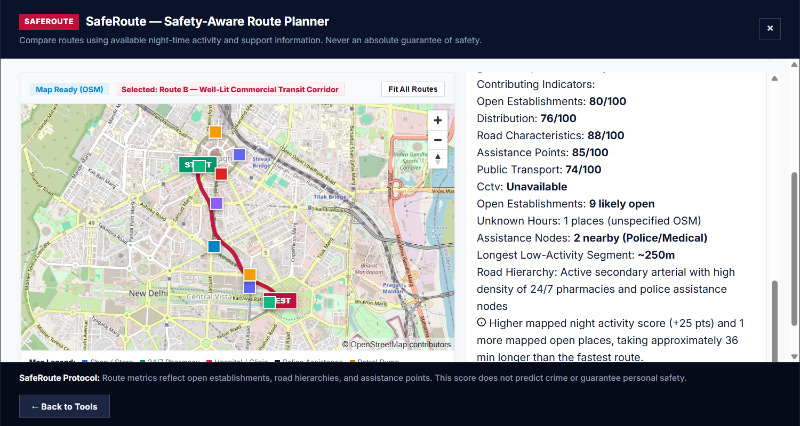
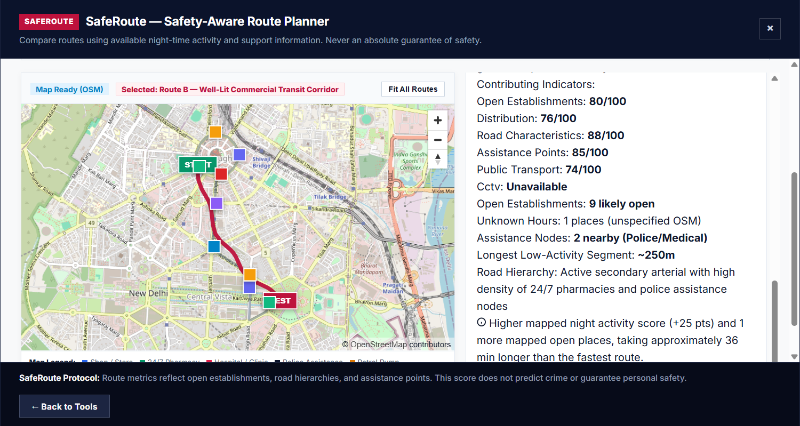
SafeRoute_Safety_Planner
-
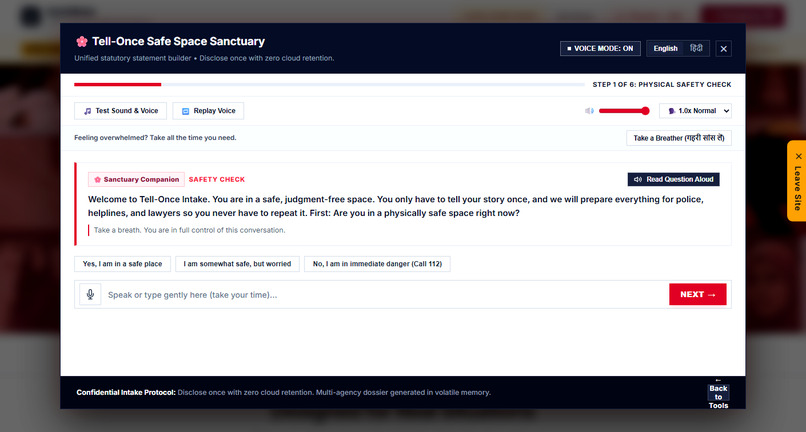
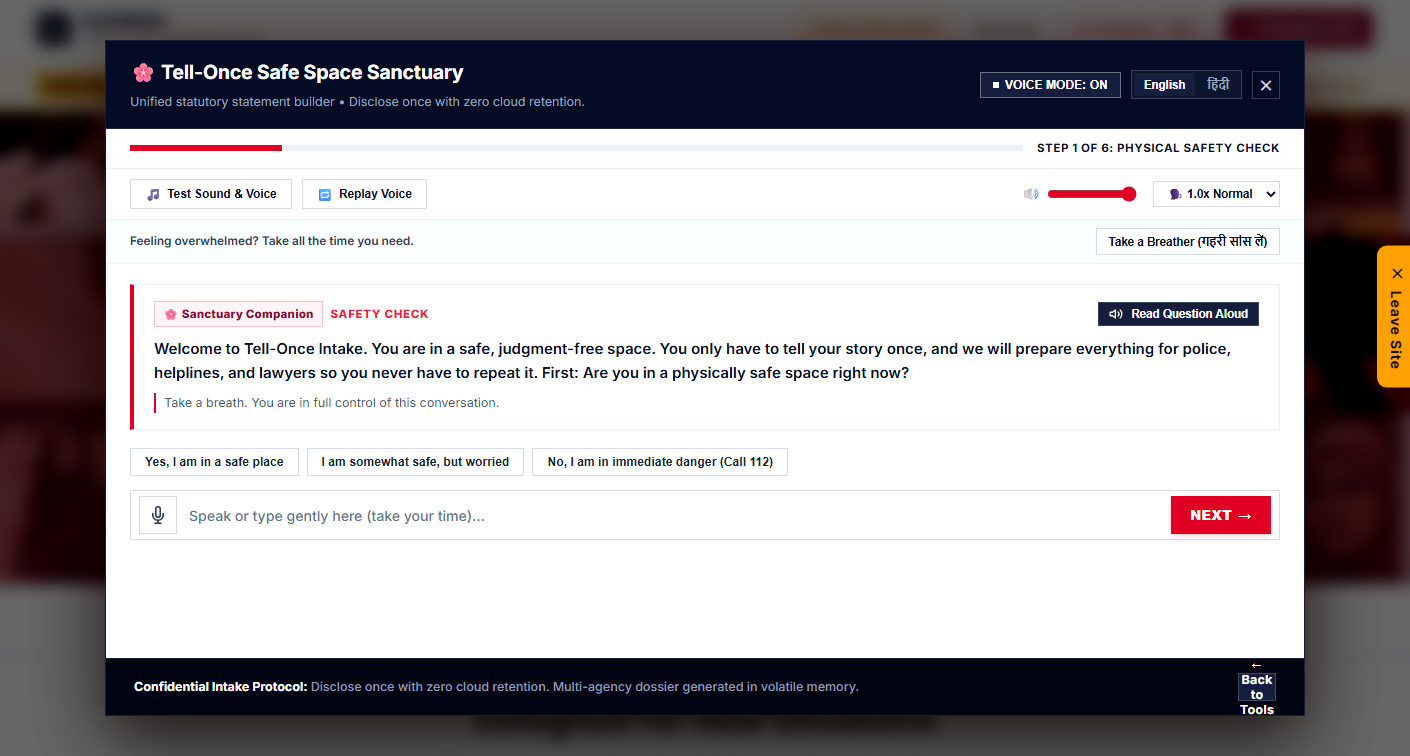
Tell_Once
-
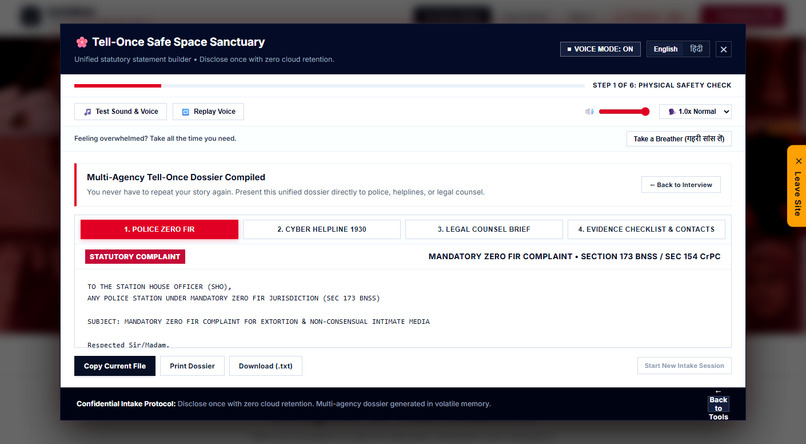
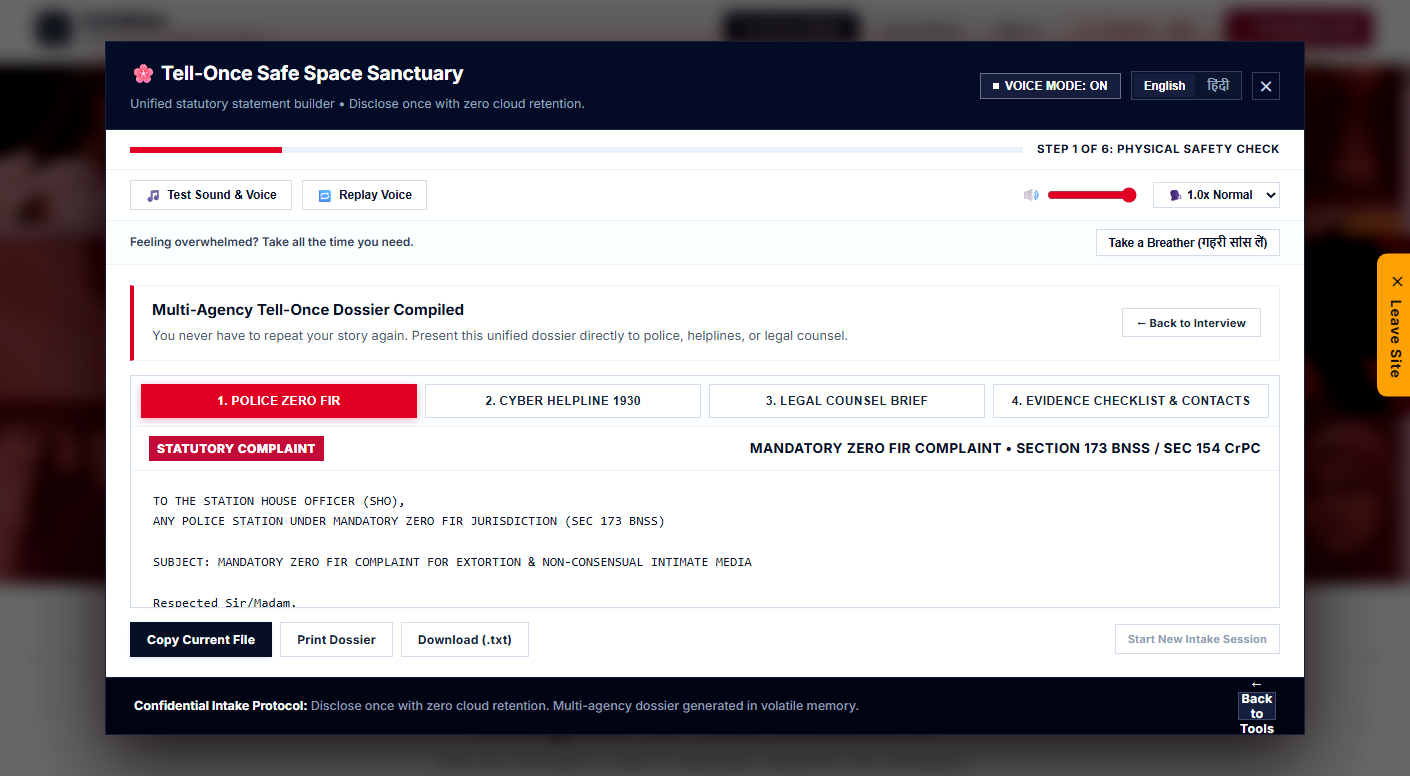
Tell_Once_PDF_Generation
-
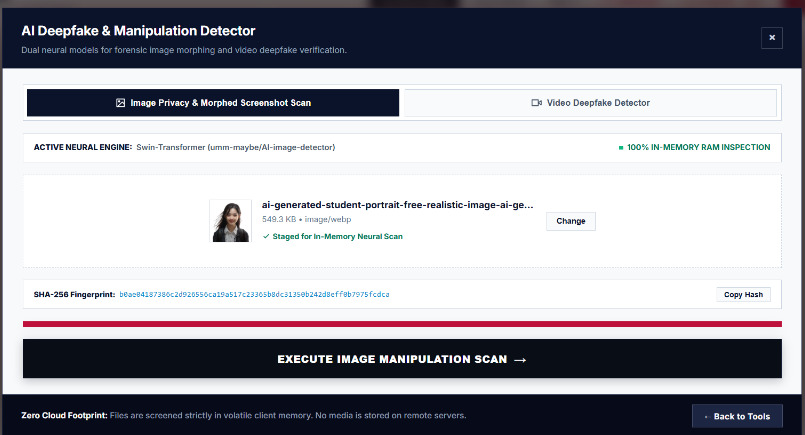
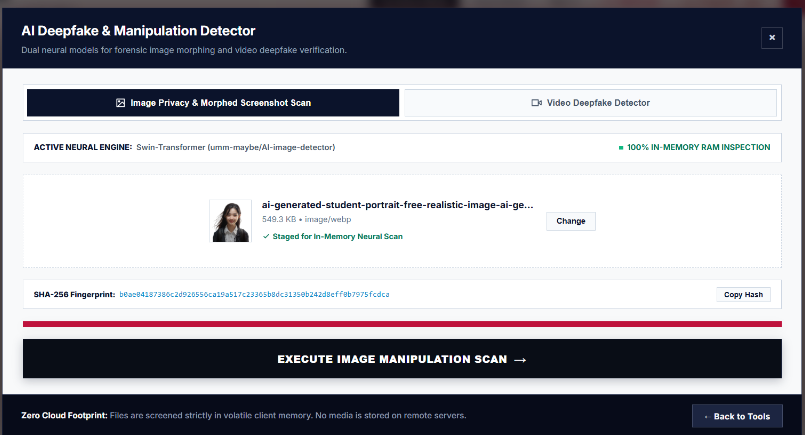
Deepfake_Image_Upload_
-
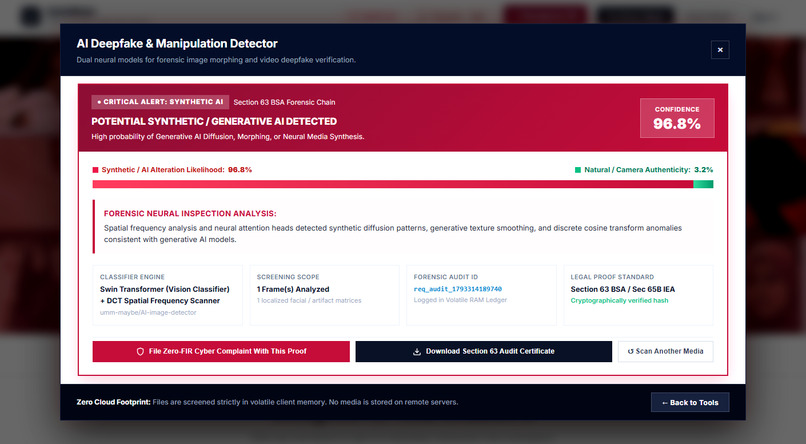
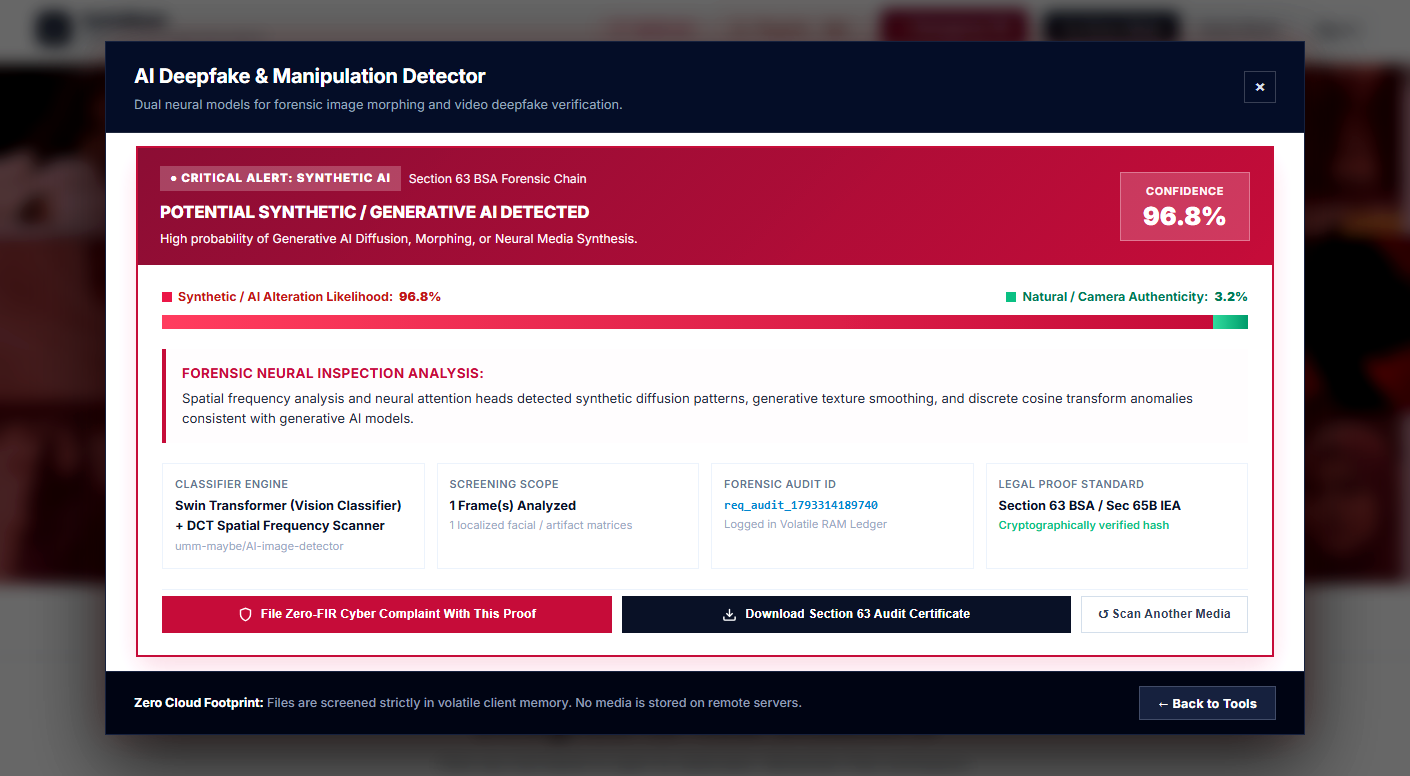
DeepFake_Scan_Result
-
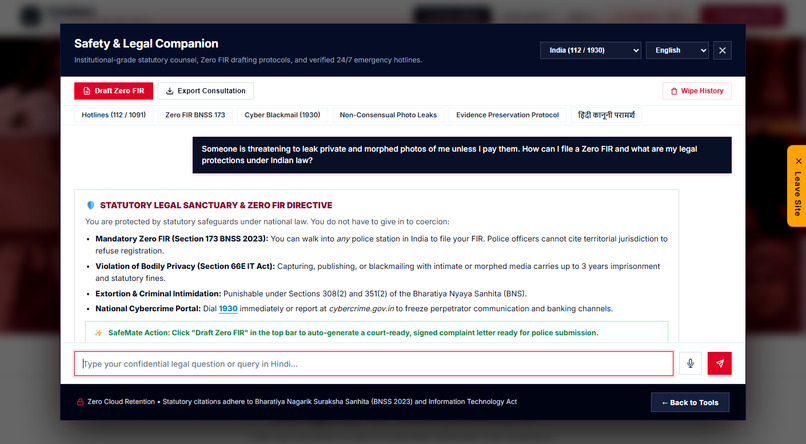
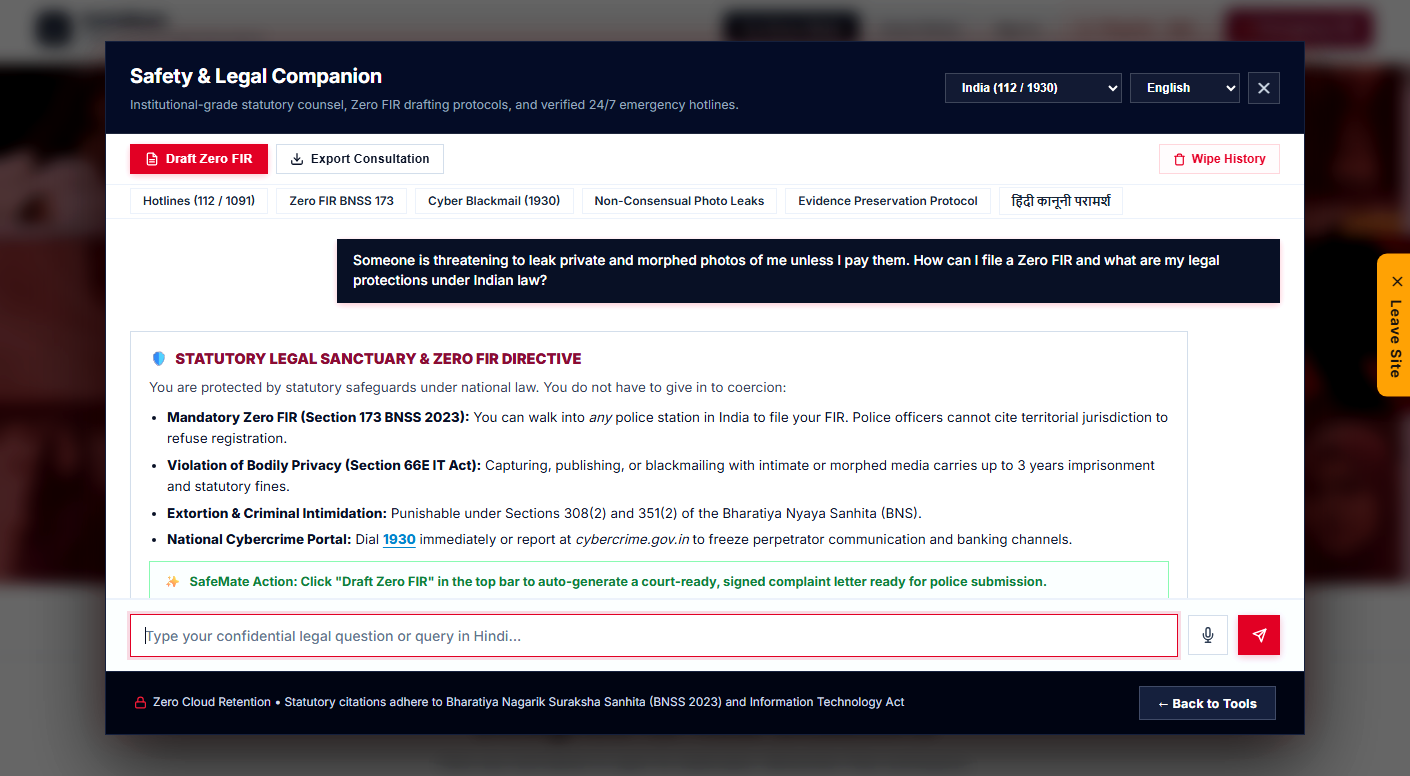
Safetly_And_Legal_Chatbot
-
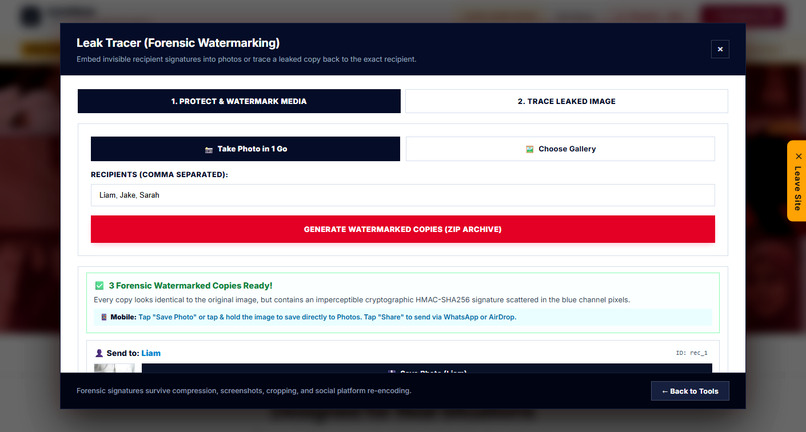
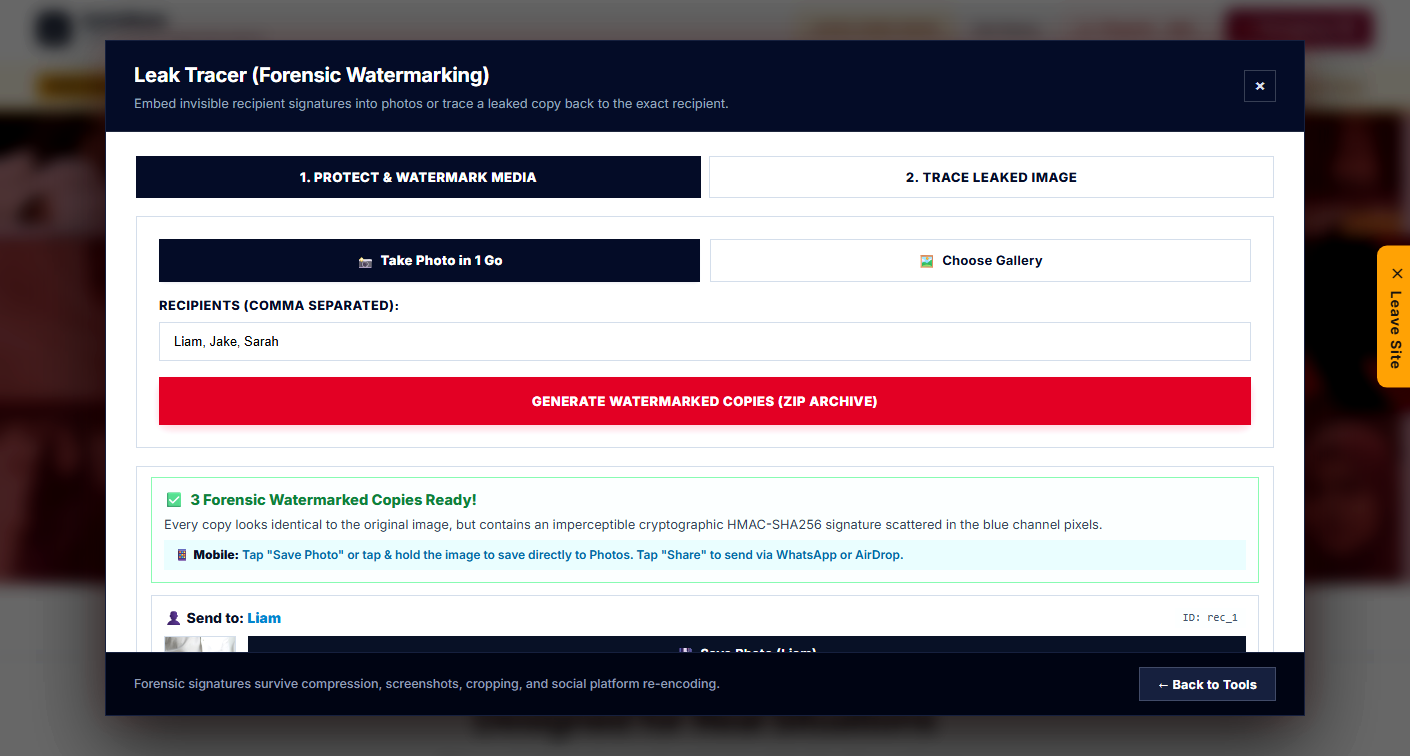
Leak_Tracer_and_Watermark_Generation
-
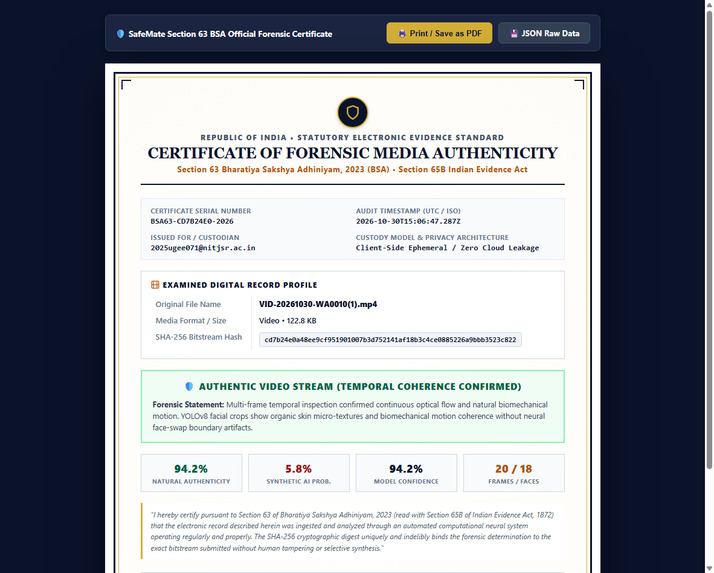
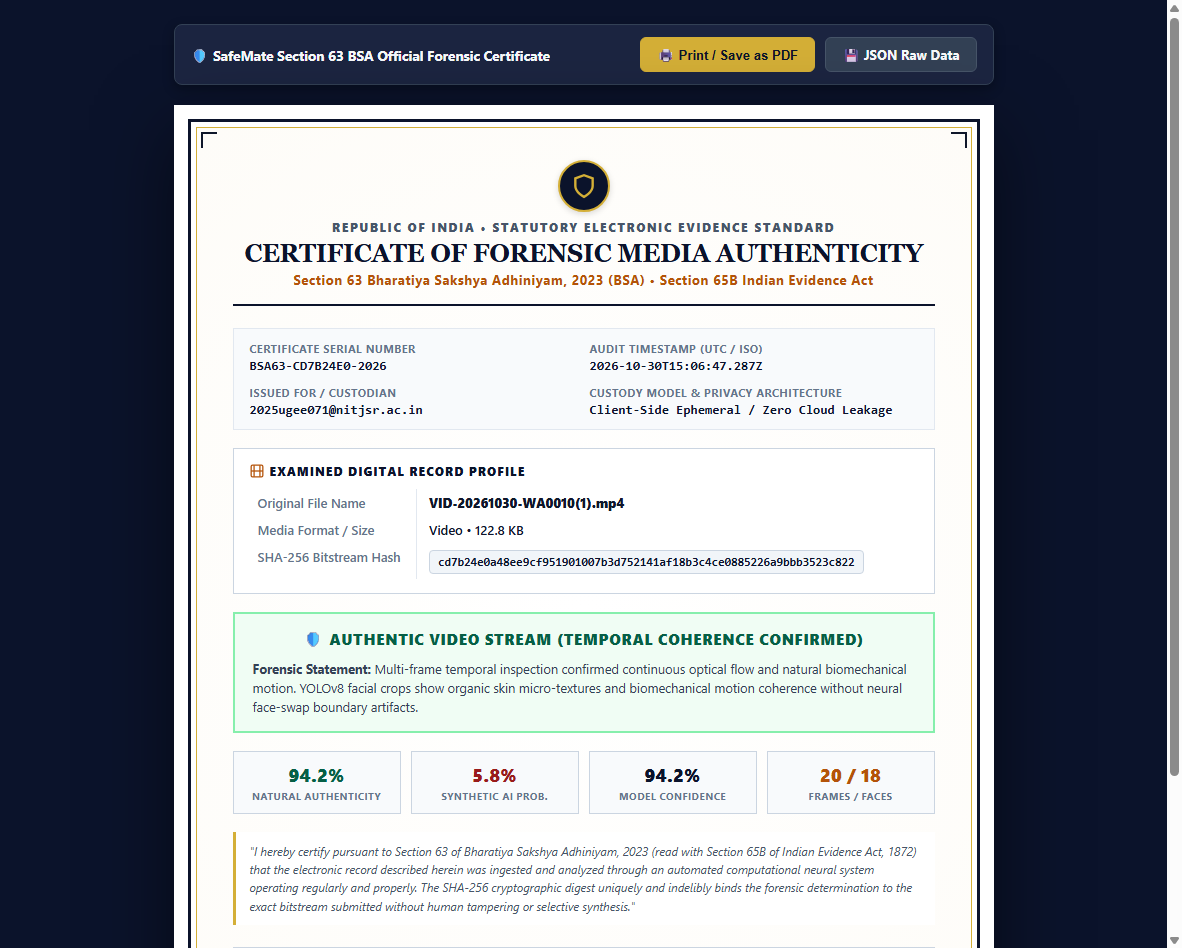
Forensic_certificate
-
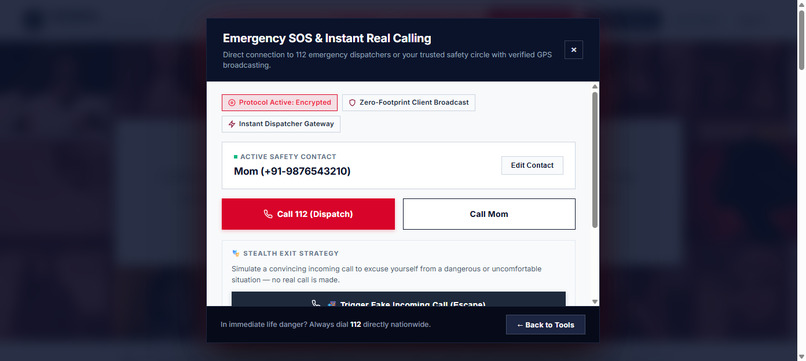
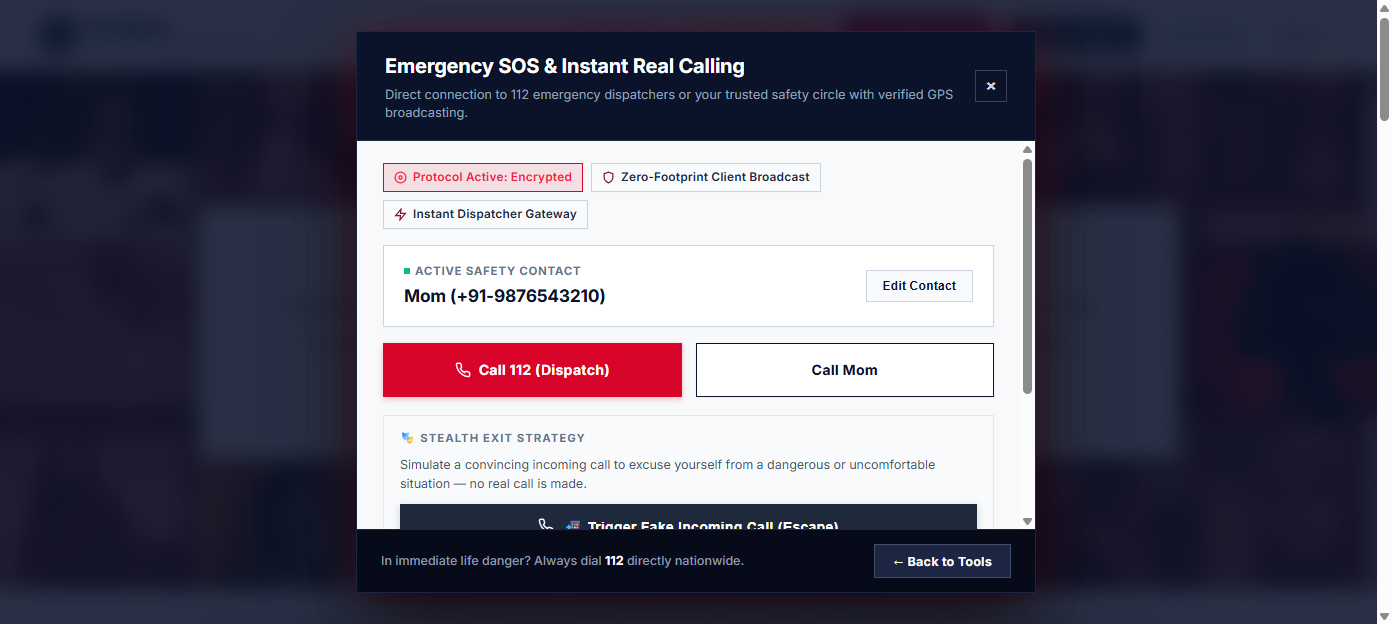
Emergency_SOS_Escape_Option
-
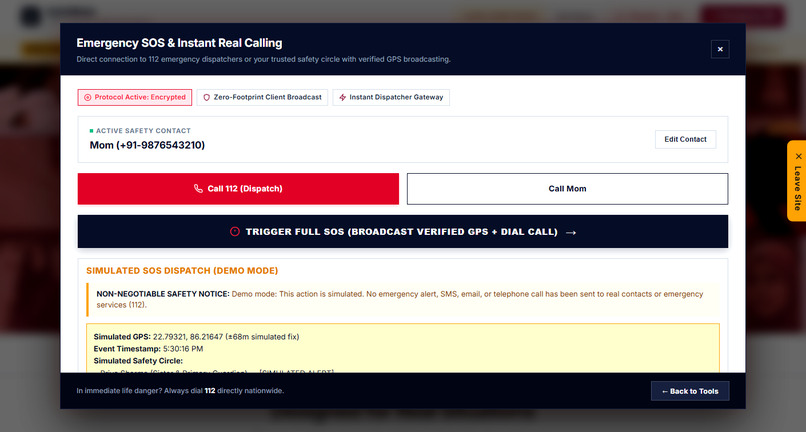
Emergency_SOS_Dispatch
-
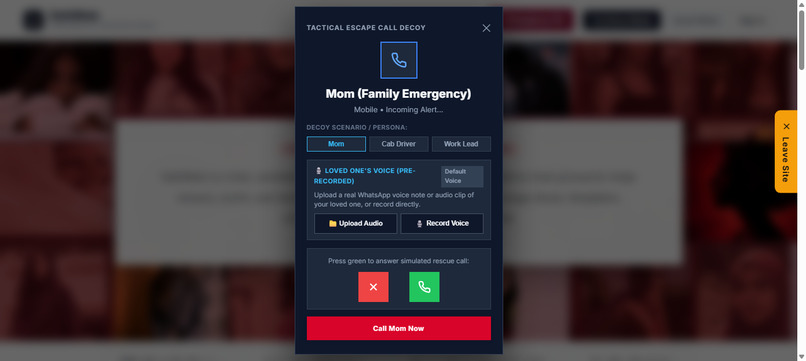
Fake_Call_Escape_Stimulation
-
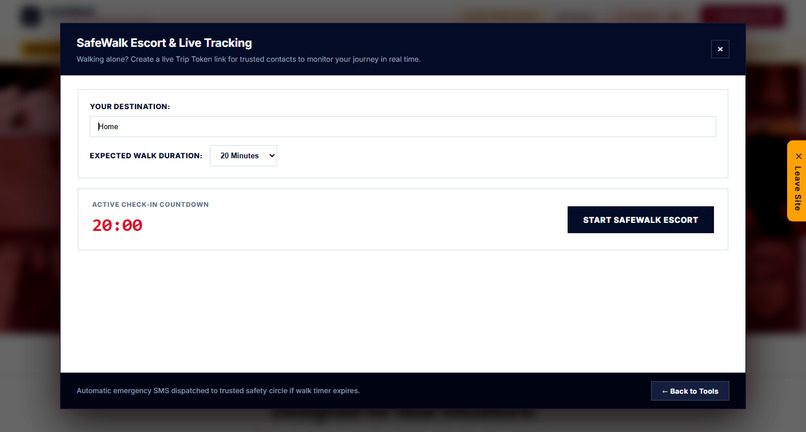
SafeWalk_Active_Escort
-
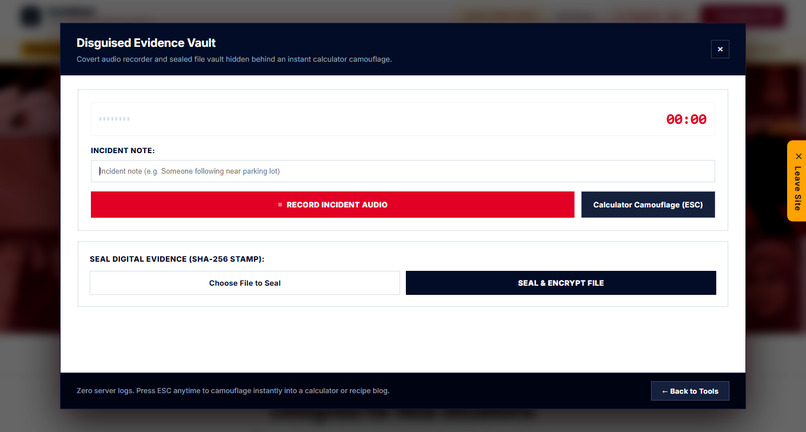
Evidence_Vault
-

Instant_Stealth_Disguise

SafeMate – A Silent Shield
A Digital Sanctuary for Women's Safety, Protection, and Empowerment
1. Inspiration
Safety is not limited to physical spaces anymore. Women face threats across multiple dimensions of everyday life, including domestic violence, cyber harassment, intimate image abuse, AI-generated deepfakes, online blackmail, and unsafe travel environments.
While many existing safety applications focus primarily on emergency SOS buttons or location tracking, they often overlook the different situations in which someone might need help without being able to openly ask for it.
We wanted to approach women's safety differently.
What if a safety platform could protect someone not only during an emergency but also before, during, and after a threatening situation?
This question inspired us to build SafeMate.
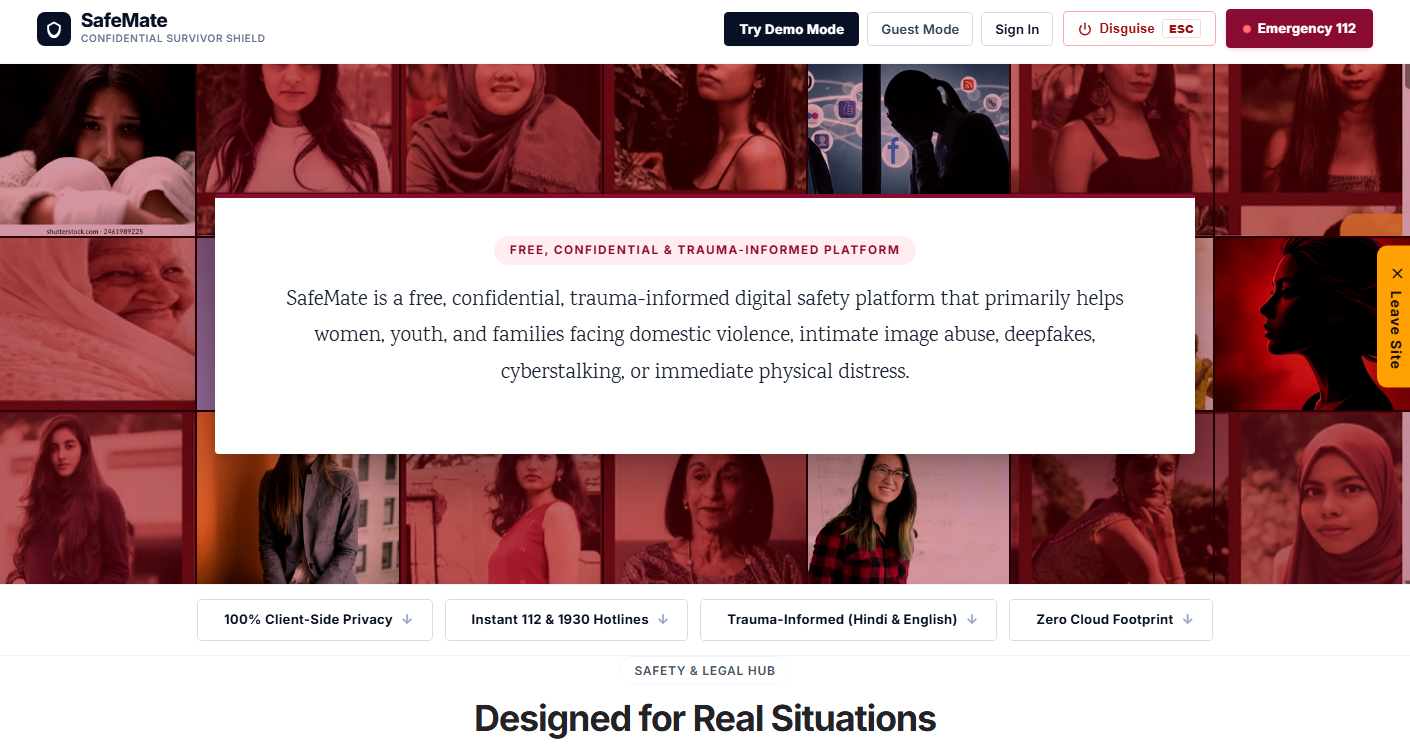
SafeMate is a privacy-first, trauma-informed digital safety platform designed to provide practical assistance across physical safety, digital threats, media authenticity screening, evidence preservation, and access to legal guidance.
Our goal was to bring multiple safety mechanisms together into one accessible platform without making users compromise their privacy.
2. What SafeMate Does
SafeMate addresses five major safety scenarios through an integrated set of features.
A. AI-Powered Media Screening
With the growing misuse of generative AI, distinguishing authentic media from synthetic content has become increasingly difficult.
SafeMate incorporates two independent screening pipelines:
Still-Image AI Screening
- Uses a Swin Transformer-based classifier.
- Screens images for characteristics associated with AI-generated imagery.
- Returns probabilistic classification scores and explanations.
Video Deepfake Screening
- Uses YOLOv8n-Face for face localization.
- Uses the MS-EffGCViT-B0 deepfake classification architecture.
- Samples video frames and analyzes detected facial regions.
- Aggregates frame-level predictions to identify potential manipulation.
Both systems communicate uncertainty and explicitly avoid presenting automated predictions as definitive proof.
B. Tell-Once Legal and Safety Assistant
Explaining a traumatic incident repeatedly can be emotionally exhausting.
SafeMate introduces a Tell-Once incident intake workflow that helps structure an incident narrative into organized documentation.
It includes:
- Guided, trauma-informed incident intake.
- Hindi and English speech interaction.
- Structured Zero FIR complaint drafting referencing Section 173 of BNSS.
- Confidential legal briefing formats.
- Evidence chronology and SHA-256 digest references.
- A safety and legal assistant with structured guidance flows and emergency-priority handling.
The platform also provides official emergency and cybercrime resources, while leaving formal reporting and legal decisions to the user and appropriate authorities.
C. SafeRoute and SafeWalk
SafeMate addresses the risks associated with travelling alone, particularly during nighttime.
- SafeRoute: Compares alternative routes using mapped establishments, road characteristics, and a transparent Night Activity Score.
- Route Comparison: Highlights differences between the fastest route and alternatives with higher mapped night-activity indicators.
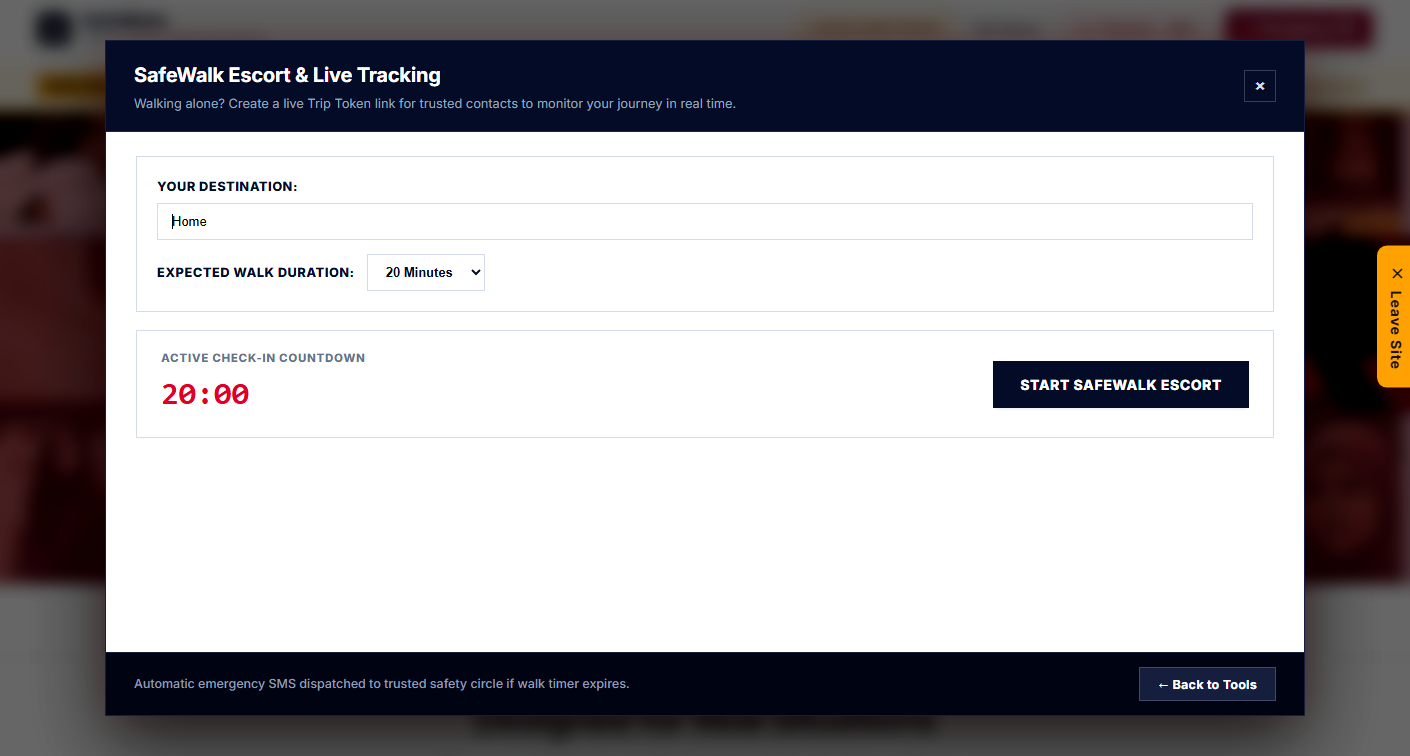
- SafeWalk: Provides trip monitoring, location check-ins, a dead-man's timer, and escalation workflows.
The route score is an indicator based on available mapped information, not a crime prediction or guarantee of personal safety.
D. Digital Evidence Protection and Leak Tracing
SafeMate includes mechanisms designed to help users preserve and trace digital evidence.
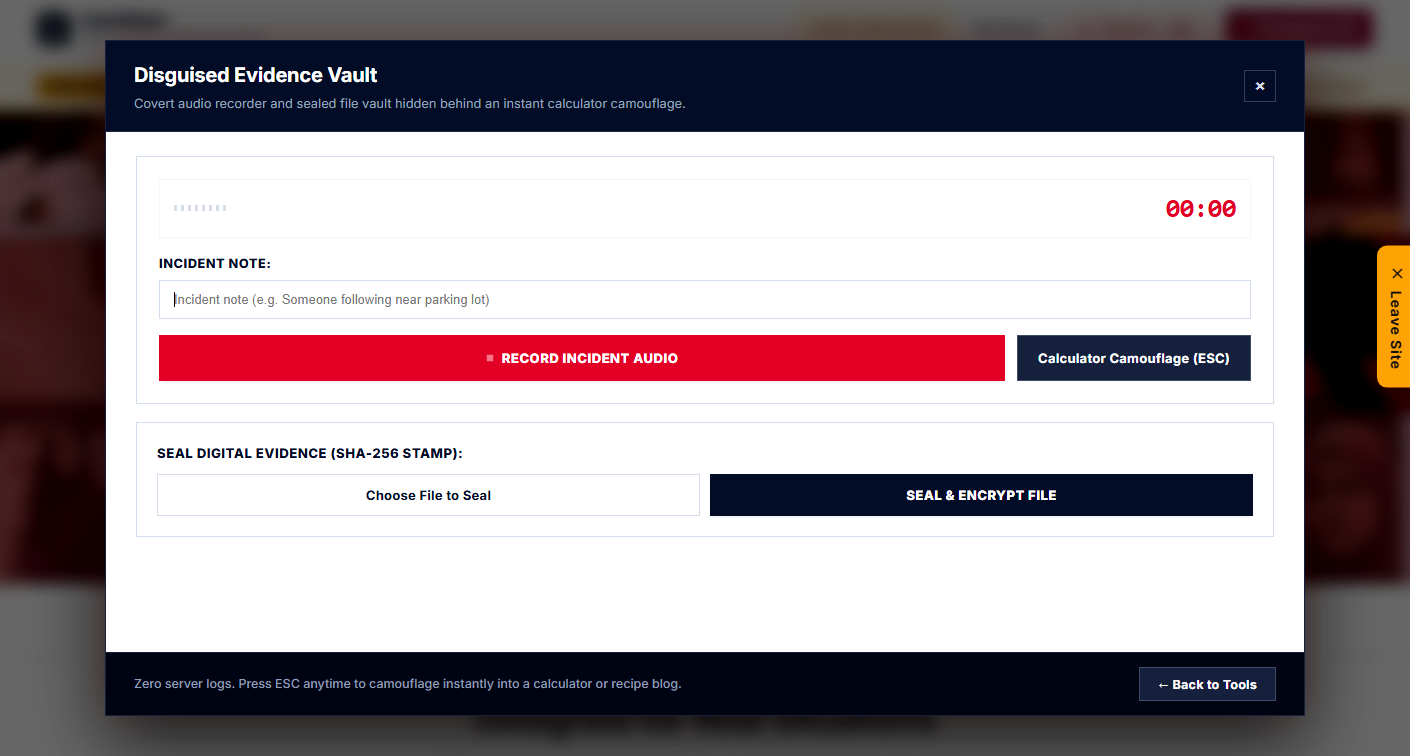
- Evidence Vault: Supports incident evidence uploads, SHA-256 hashing, timestamps, and evidence records.
- Cryptographic Integrity: Generates file digests to help identify subsequent changes to evidence.
- Leak-Tracer: Implements bounded Least Significant Bit (LSB) steganographic fingerprinting to embed and extract recipient-associated information from supported media.
- Source Attribution: Provides mechanisms for investigating the source associated with a recovered fingerprint.
These mechanisms assist with integrity checking and attribution but do not independently establish legal authenticity or admissibility.
E. Emergency Protection and Stealth Assistance
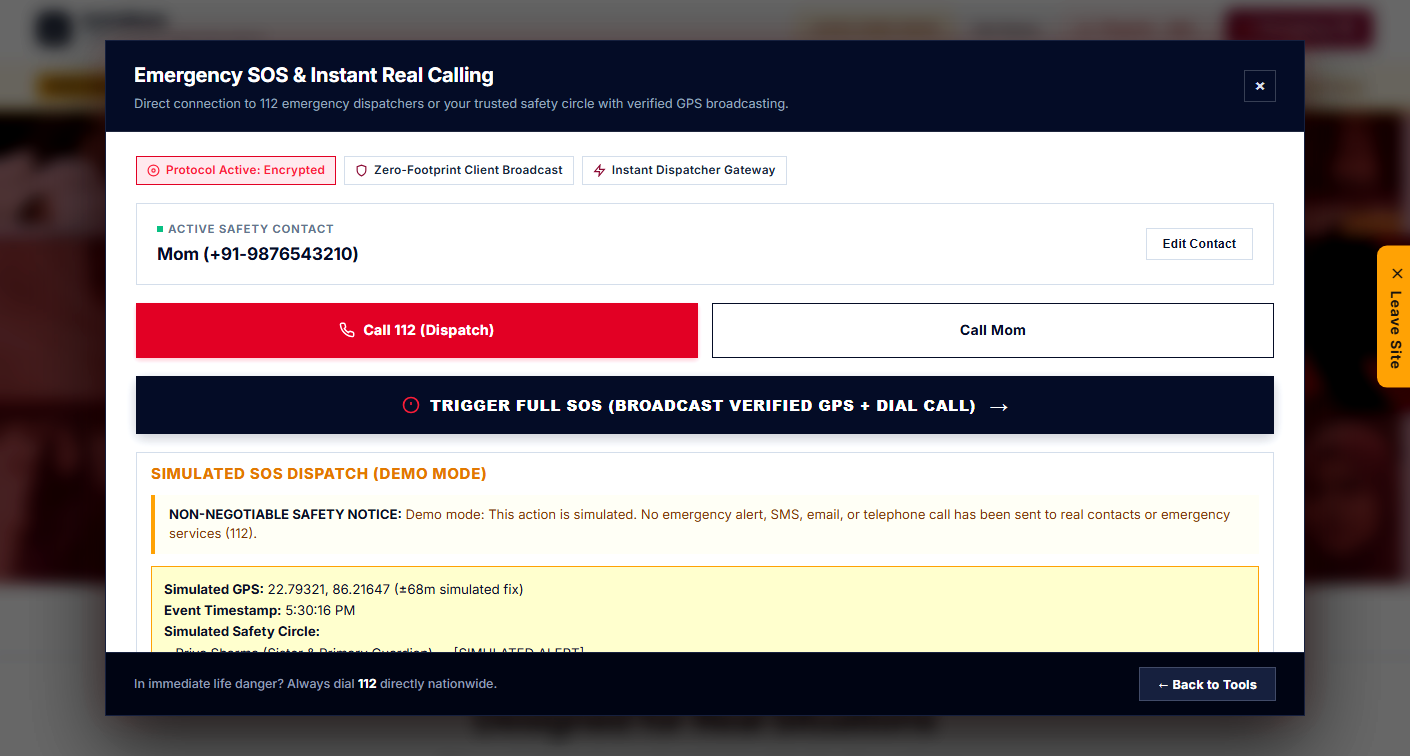
- Emergency SOS: Provides access to emergency calling and configured safety-circle assistance.
- Stealth Panic Disguise: Instantly transforms the application into an ordinary recipe website when the user activates the disguise feature or presses ESC.
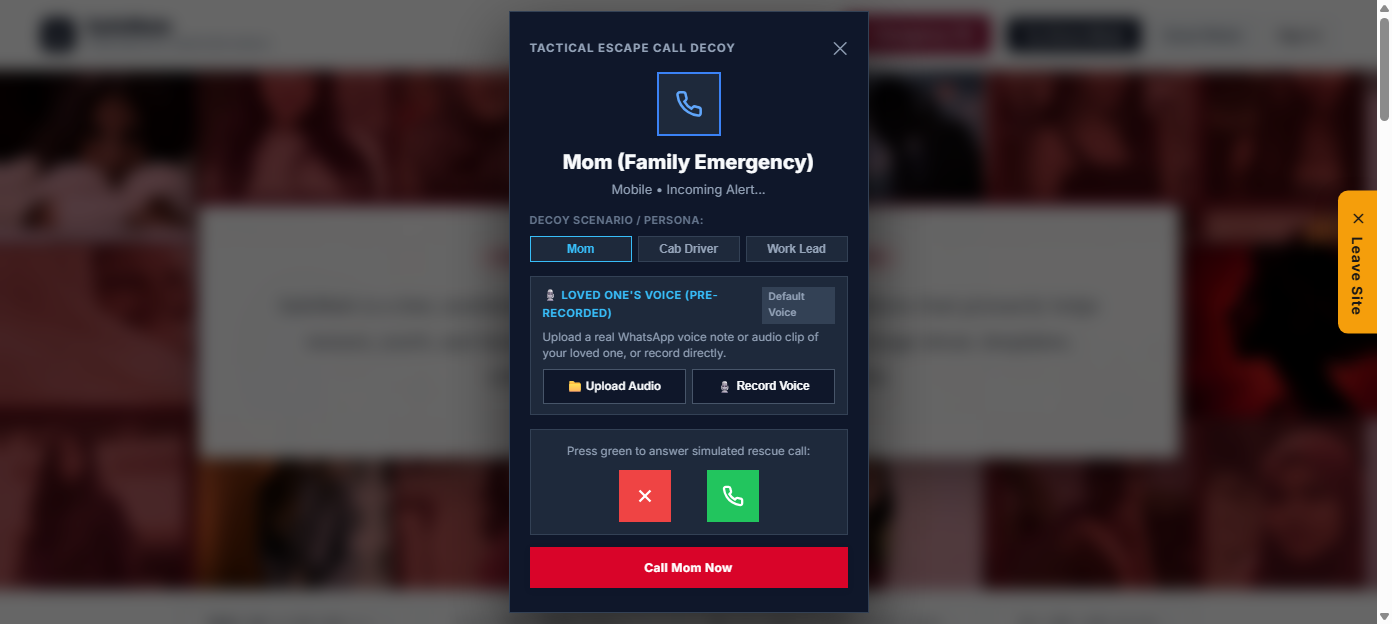
- Fake Escape Call: Simulates an incoming phone call with customizable caller identities and audio options, helping users create an opportunity to leave uncomfortable situations.
- Three Access Modes: Provides Judge Demo Mode, Ephemeral Guest Mode, and Personal Account Mode to accommodate different privacy requirements.
3. How We Built It
We developed SafeMate using a modular architecture combining a responsive React frontend, a Python FastAPI backend, machine learning inference pipelines, and relational data persistence.
Frontend
- React
- Vite
- Vanilla CSS
- MapLibre GL JS
Backend
- Python
- FastAPI
- Uvicorn
- SQLAlchemy
Machine Learning and Computer Vision
- PyTorch
- Hugging Face Transformers
- Swin Transformer
- MS-EffGCViT-B0
- YOLOv8-Face
- OpenCV
Digital Forensics
- NumPy
- Pillow
- Custom bounded LSB steganography
- SHA-256 hashing
Geospatial Services
- OpenStreetMap
- OSRM
- Nominatim
- Overpass API
Security and Authentication
- JWT authentication
- Password hashing
- Role-based access boundaries
- Request validation
- Isolated guest and demo sessions
The backend exposes modular REST APIs for authentication, emergency assistance, SafeWalk, evidence management, media screening, watermarking, legal assistance, and route planning.
4. Privacy and Responsible Design
Privacy is a core design consideration in SafeMate.
We implemented several safeguards:
- Still-image screening uses in-memory processing.
- Video uploads and extracted frames are handled through temporary processing, with cleanup after analysis.
- Judge Demo Mode uses simulated emergency actions rather than contacting real emergency services.
- Guest Mode provides an alternative to creating a personal account.
- Media screening results are presented as probabilistic indicators, not definitive evidence.
- Emergency and legal guidance does not claim to replace professional assistance.
- Users are not required to provide personal credentials simply to explore the demo.
We believe a safety application should never introduce additional risks while attempting to solve an existing problem.
5. Challenges We Addressed
Building an integrated safety platform introduced several technical challenges:
Integrating multiple AI pipelines: Still-image classification and video facial manipulation screening require different processing strategies, model architectures, and input validation mechanisms.
Balancing functionality with privacy: We designed isolated processing workflows and temporary media handling to reduce unnecessary retention of sensitive uploads.
Designing for emergency situations: A conventional interface is not always appropriate in situations involving coercion or immediate physical danger. This motivated the stealth disguise, fake escape call, and simplified emergency access mechanisms.
Making route recommendations explainable: Instead of treating one route as universally safe, SafeRoute exposes measurable indicators and trade-offs between alternative routes.
Handling sensitive evidence: We incorporated cryptographic hashing, structured records, and recipient-associated watermarking to support evidence integrity and investigation workflows.
6. What We Learned
Through building SafeMate, we explored how machine learning, computer vision, geospatial systems, backend engineering, cryptographic techniques, and trauma-informed UX can work together to address a real-world safety problem.
We also learned that building a responsible safety product requires more than implementing features. It requires communicating uncertainty, protecting sensitive information, providing recovery paths, and understanding what happens when a system fails.
7. Future Scope
We envision expanding SafeMate through:
- More comprehensive multilingual safety assistance.
- Improved media screening using newer model architectures.
- Broader verified safety-resource coverage.
- More reliable offline emergency workflows.
- Further privacy and security testing.
- Independent evaluation of detection and route-scoring performance.
8. Our Vision
SafeMate is built around one belief:
Safety should be accessible, discreet, privacy-conscious, and available before a situation becomes an emergency.
We want to move beyond conventional emergency applications and create a unified digital safety ecosystem that empowers individuals to make informed decisions, preserve their digital evidence, and access appropriate support.
SafeMate – A Silent Shield, A Strong Voice.
Built With
- artificial-intelligence
- computer-vision
- fastapi
- hugging-face
- javascript
- jwt
- machine-learning
- maplibre-gl-js
- numpy
- opencv
- openstreetmap
- osrm
- pillow
- python
- pytorch
- react
- sqlalchemy
- sqlite
- steganography
- swin-transformer
- transformers
- vite
