-
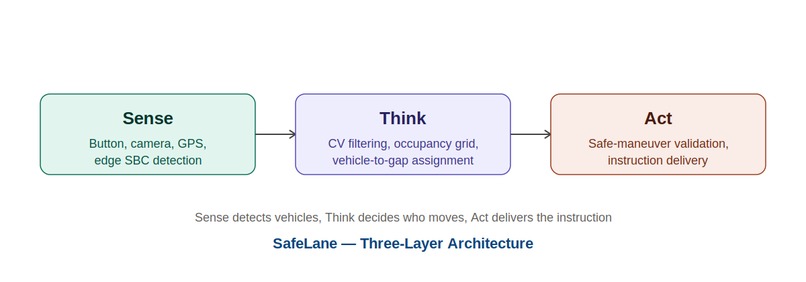
Safelane architecture
-
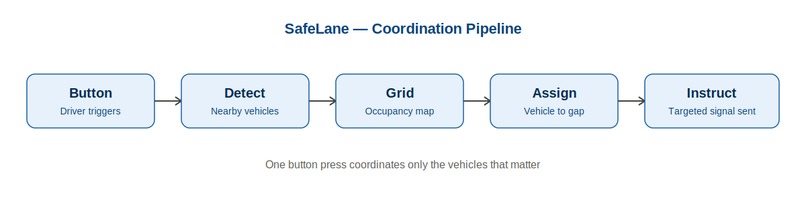
Safelane pipeline
Problem Statement
Every year, ambulances lose critical minutes stuck in traffic — not because drivers are unwilling to move, but because they don't know which direction is safe, or whether moving will actually help. Sirens alert everyone, but coordinate no one. In dense traffic, this uncertainty costs the "golden minutes" that often determine patient survival.
Proposed Solution
SafeLane is a targeted vehicle-coordination system. When an ambulance is blocked, the driver presses a single physical button — no app required. The system then:
- Detects vehicles immediately in front of and beside the ambulance
- Builds a real-time occupancy grid of the surrounding road space
- Calculates the specific movement each relevant vehicle should make to open a path
- Sends only those vehicles a precise instruction (via dashboard display, MQTT, or local BLE fallback)
Don't alert everyone. Coordinate the right vehicles.
Innovation and Technology
SafeLane combines deterministic computer vision with AI-assisted validation, structured across three layers:
- Sense — ESP32 + button trigger, camera(s) and edge SBC (Raspberry Pi 5 / Jetson) for local vehicle detection, GPS and road geometry for positioning
- Think — a vector dot-product cone for coarse front/side filtering, Frenet coordinate projection for curves and flyovers, and the Hungarian Algorithm for one-to-one vehicle-to-gap assignment
- Act — rule-based safe-maneuver validation, deterministic instruction generation, and dual-channel delivery (MQTT over cellular as primary, BLE beacon as local fallback)
AI tools support scene validation on ambiguous cases and ideation — the core occupancy grid and instruction logic remain deterministic and auditable, which matters for a safety-critical system.
Unlike existing V2V or app-based ambulance-alert systems, SafeLane doesn't require universal driver app adoption or vehicle-to-vehicle hardware — it works with cameras and a single button.
Target Users and Potential Impact
Primary users: ambulance drivers and EMS crews navigating urban traffic. Secondary beneficiaries: patients in transit, hospitals awaiting incoming cases, and traffic authorities.
By reducing the time and ambiguity involved in clearing a path, SafeLane directly targets the "golden minute" — the earliest, most critical window in emergency response — with a system that doesn't depend on citywide infrastructure or behavior change.
Implementation Approach
The core pipeline — button trigger, vehicle detection, occupancy grid generation, vehicle-to-gap assignment, and instruction generation — forms the working foundation of SafeLane and is being actively developed.
For this stage, the demo focuses on validating the core coordination logic: detecting relevant vehicles, computing the safest movement for each, and generating targeted instructions. Supporting infrastructure — such as live GPS integration across multiple vehicles and full MQTT network deployment — is modeled using representative test conditions to demonstrate the system at scale.
Planned next steps include RTK-GNSS precision upgrades, HUD/OEM integration, and expanding toward autonomous execution as the system matures.
Team Details
Submitting as an individual — Jovita, 4th-year B.Sc. Computer Science and Mathematics (Honours) student at Christ University, Bengaluru.

Log in or sign up for Devpost to join the conversation.