-
-
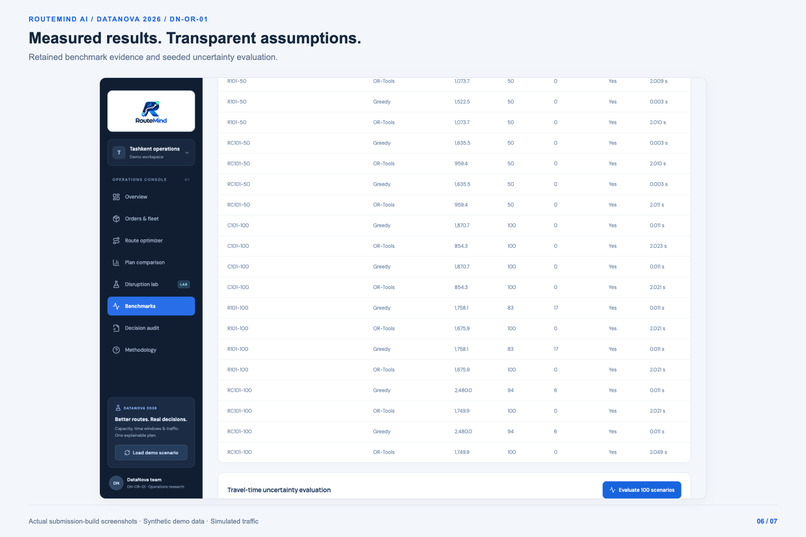
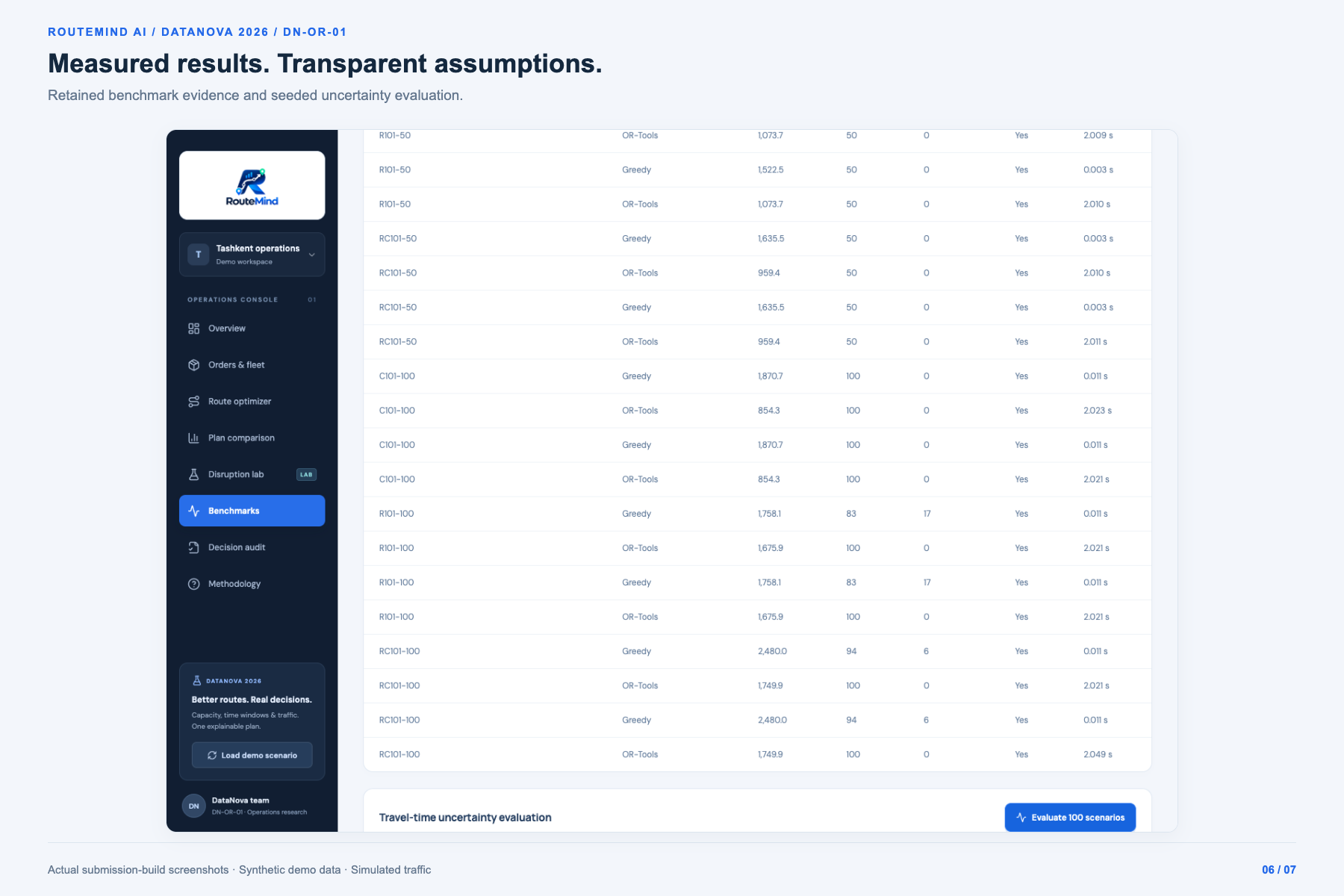
Retained benchmark evidence and seeded uncertainty evaluation.
-
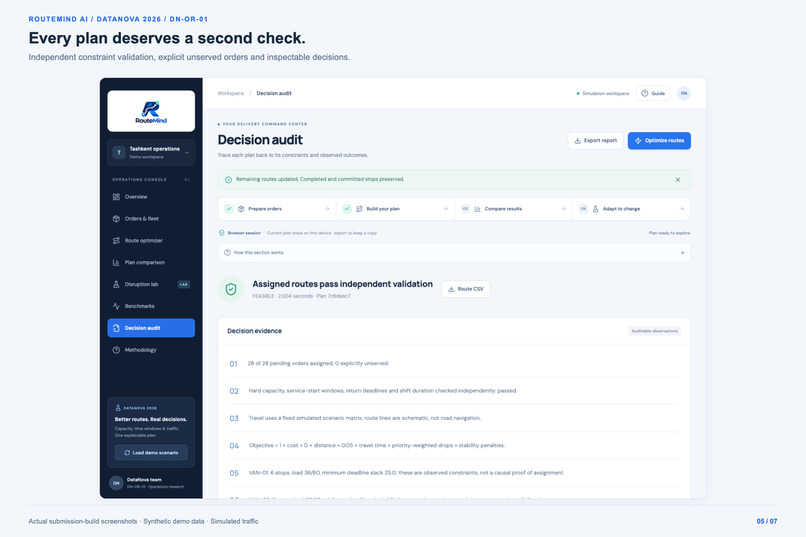
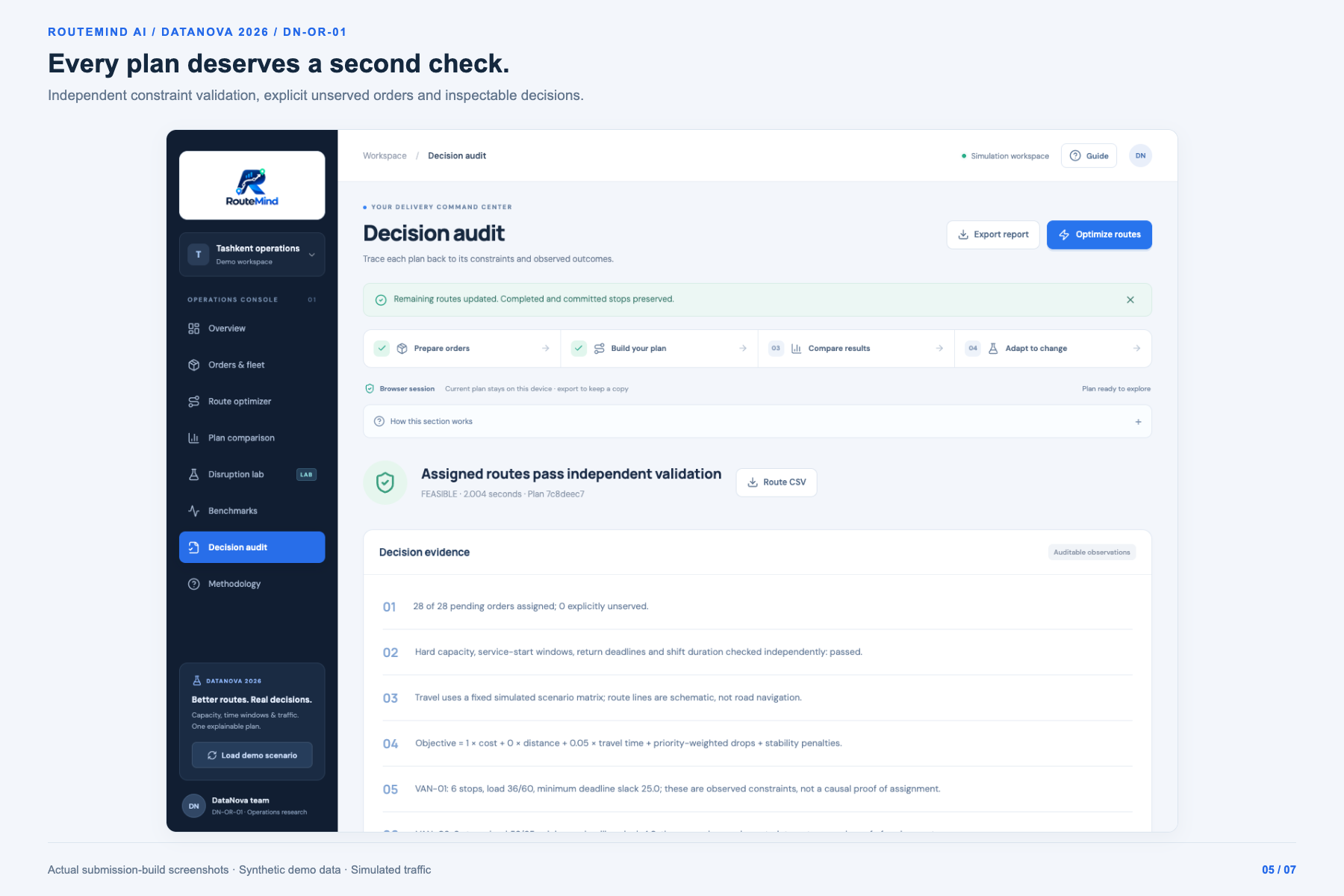
Independent constraint validation, explicit unserved orders and inspectable decisions.
-
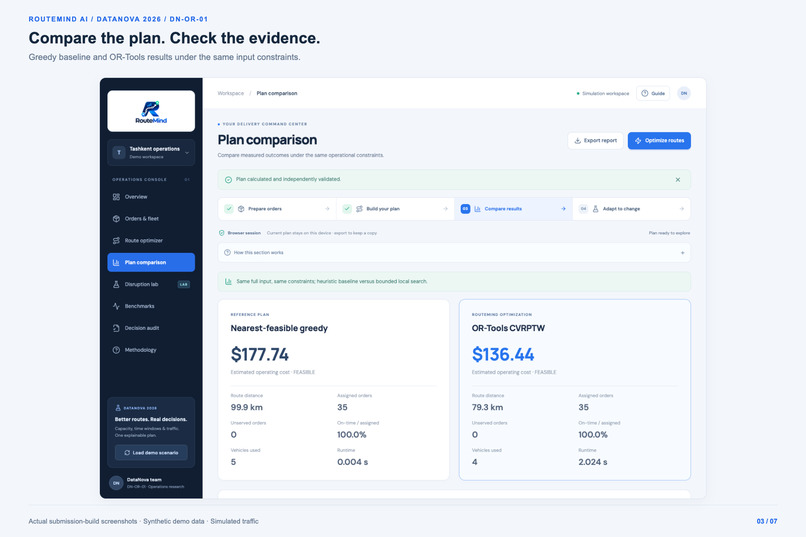
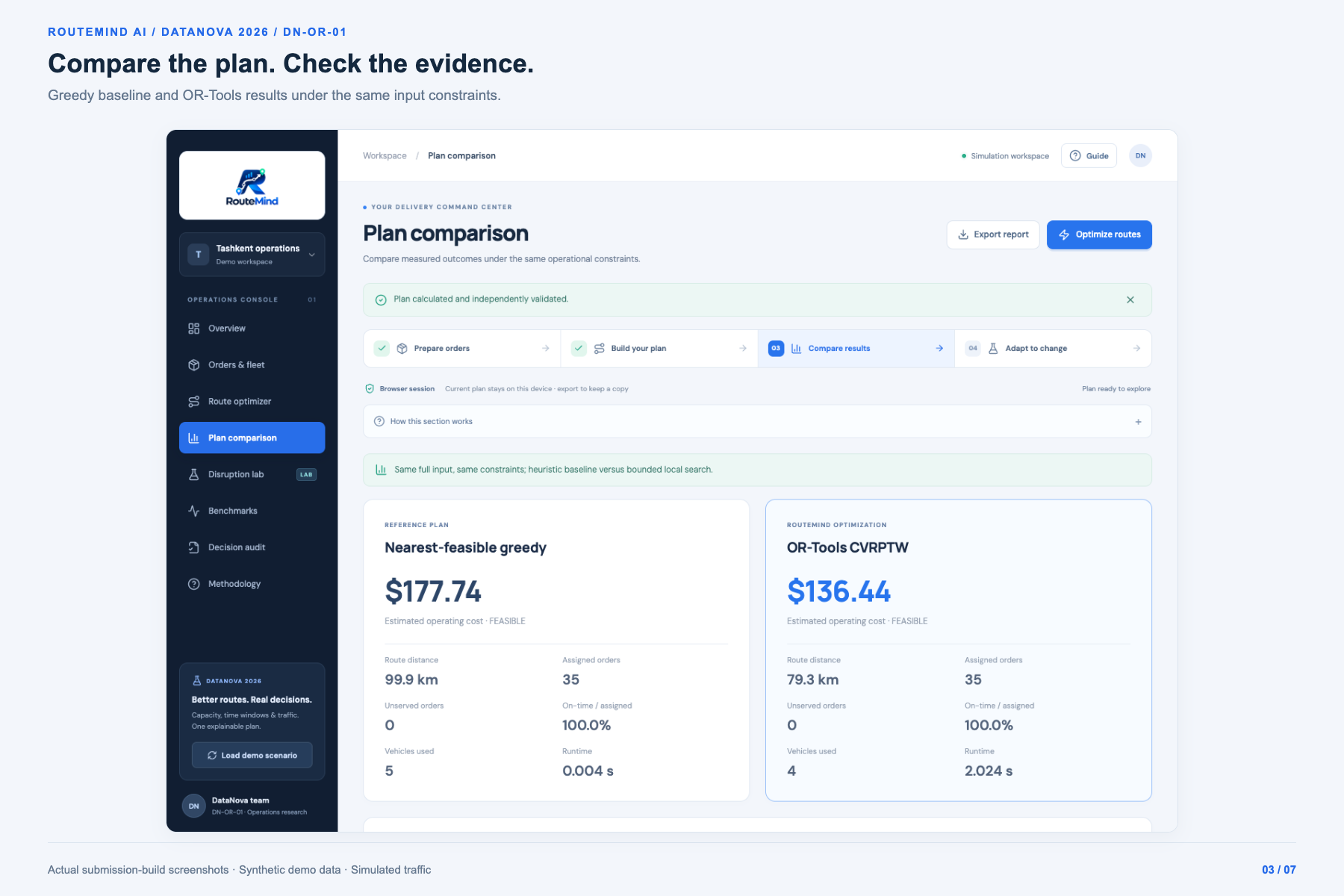
Greedy baseline and OR-Tools results under the same input constraints.
-
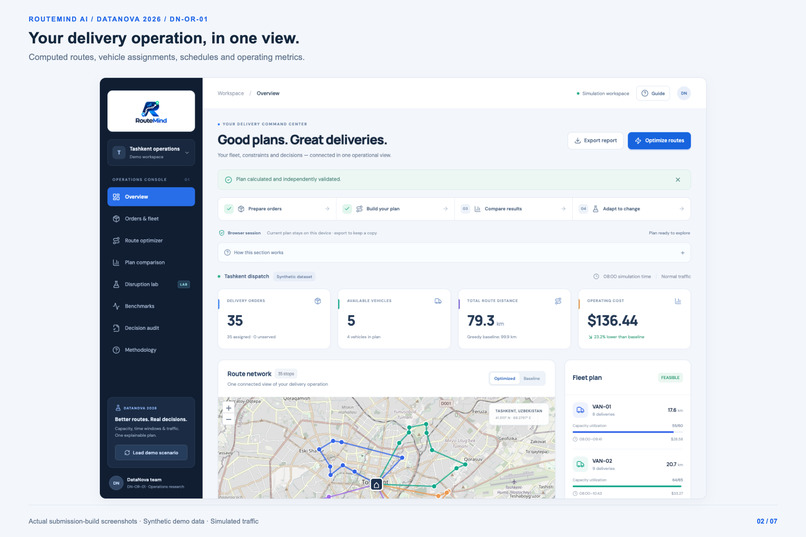
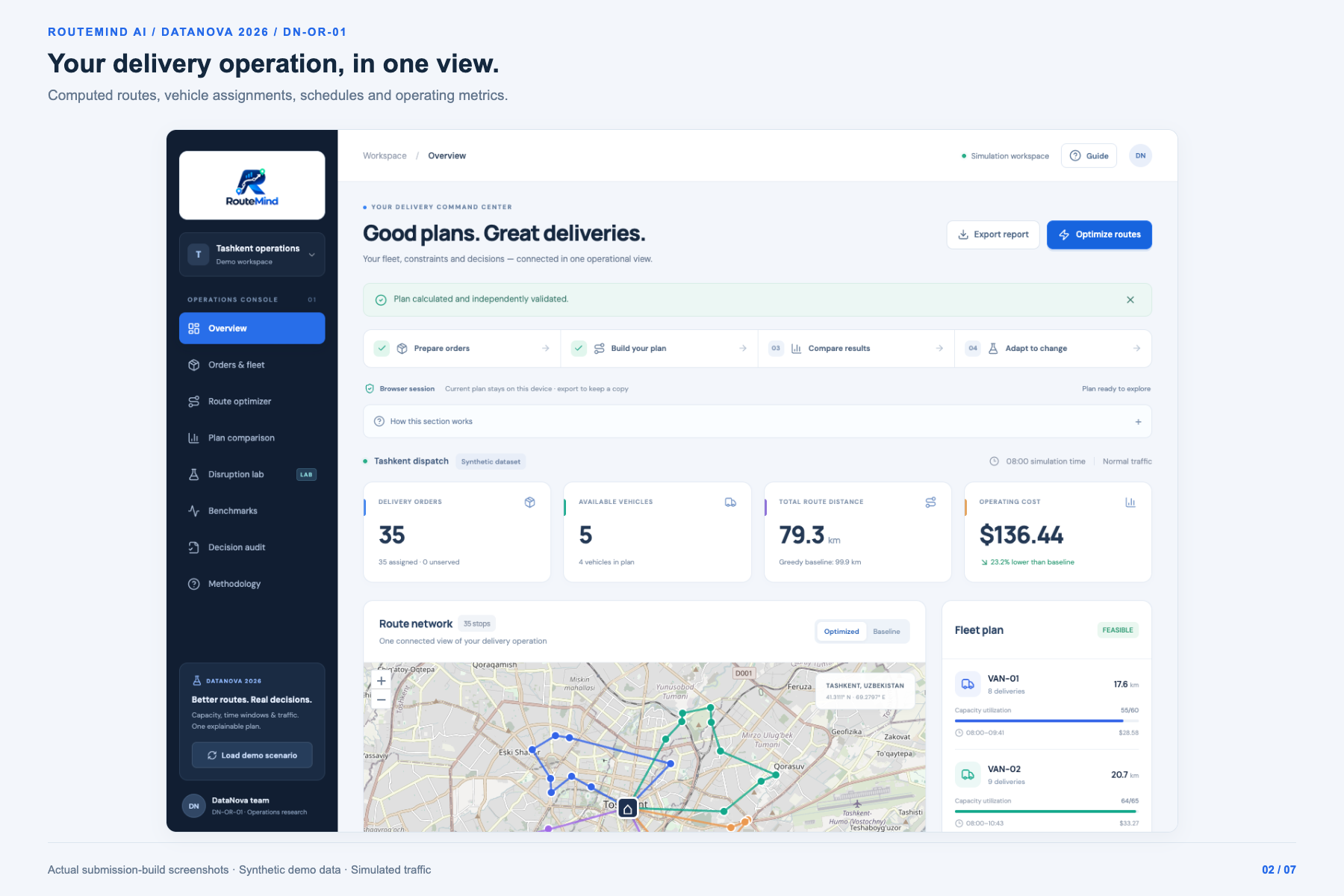
Computed routes, vehicle assignments, schedules and operating metrics.
-
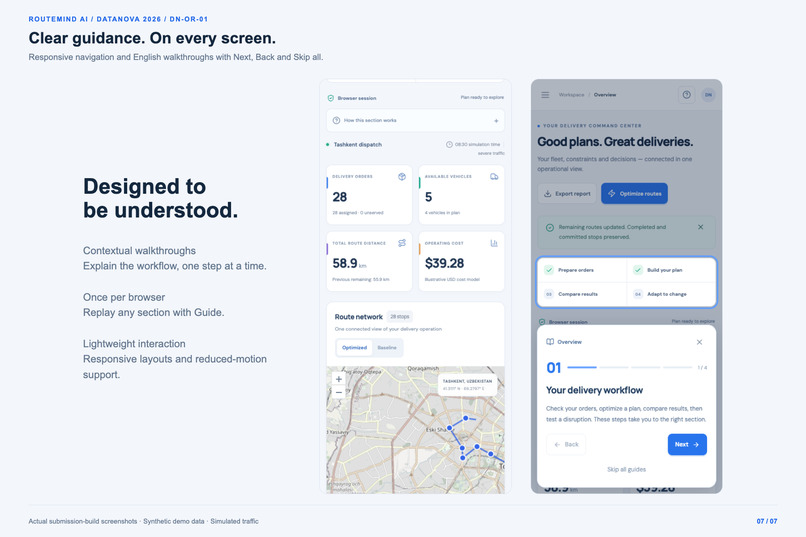
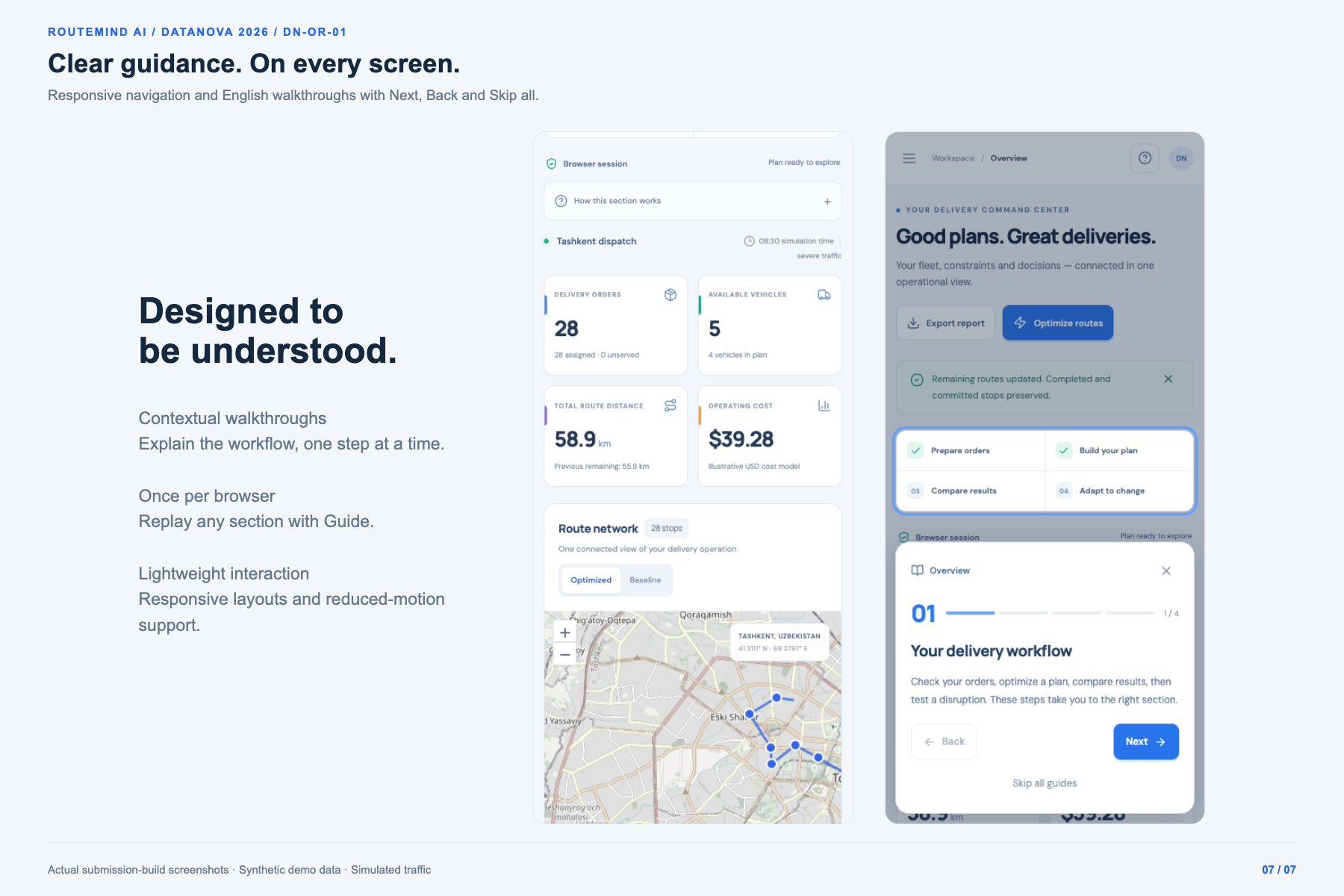
Responsive navigation and English walkthroughs with Next, Back and Skip all.
-
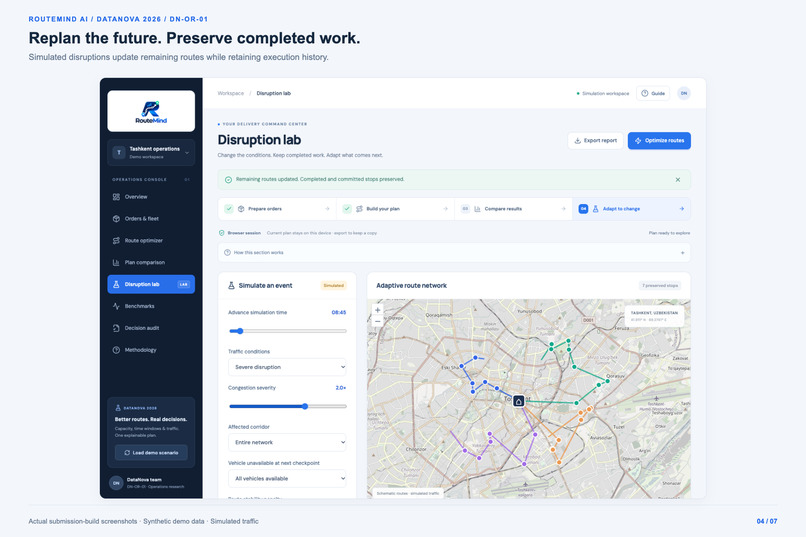
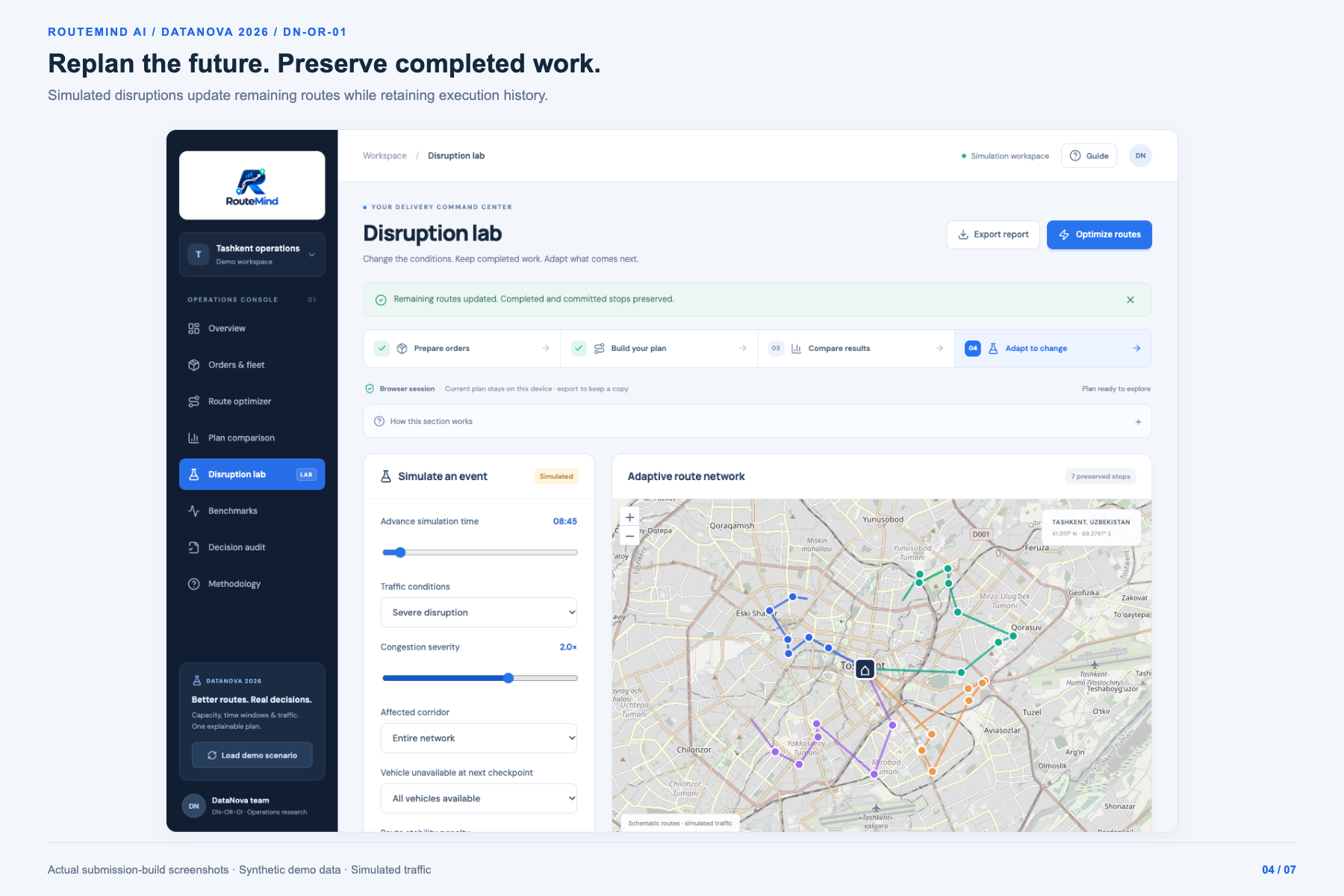
Simulated disruptions update remaining routes while retaining execution history.
-
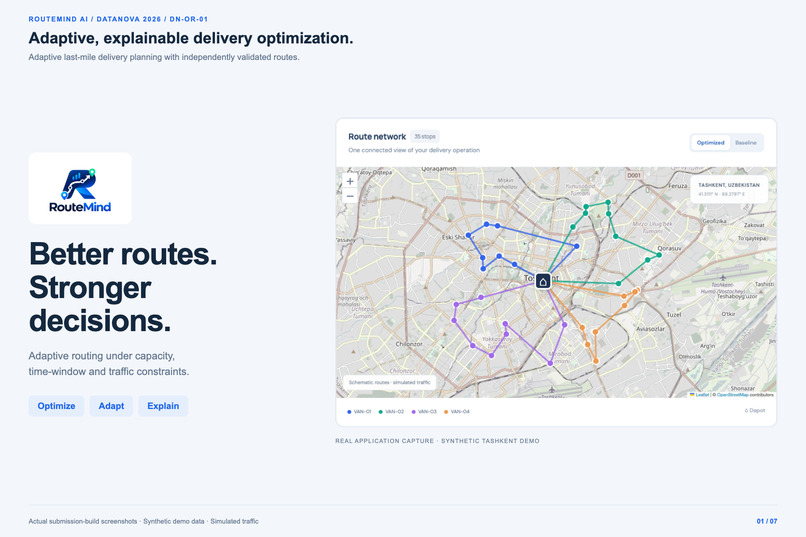
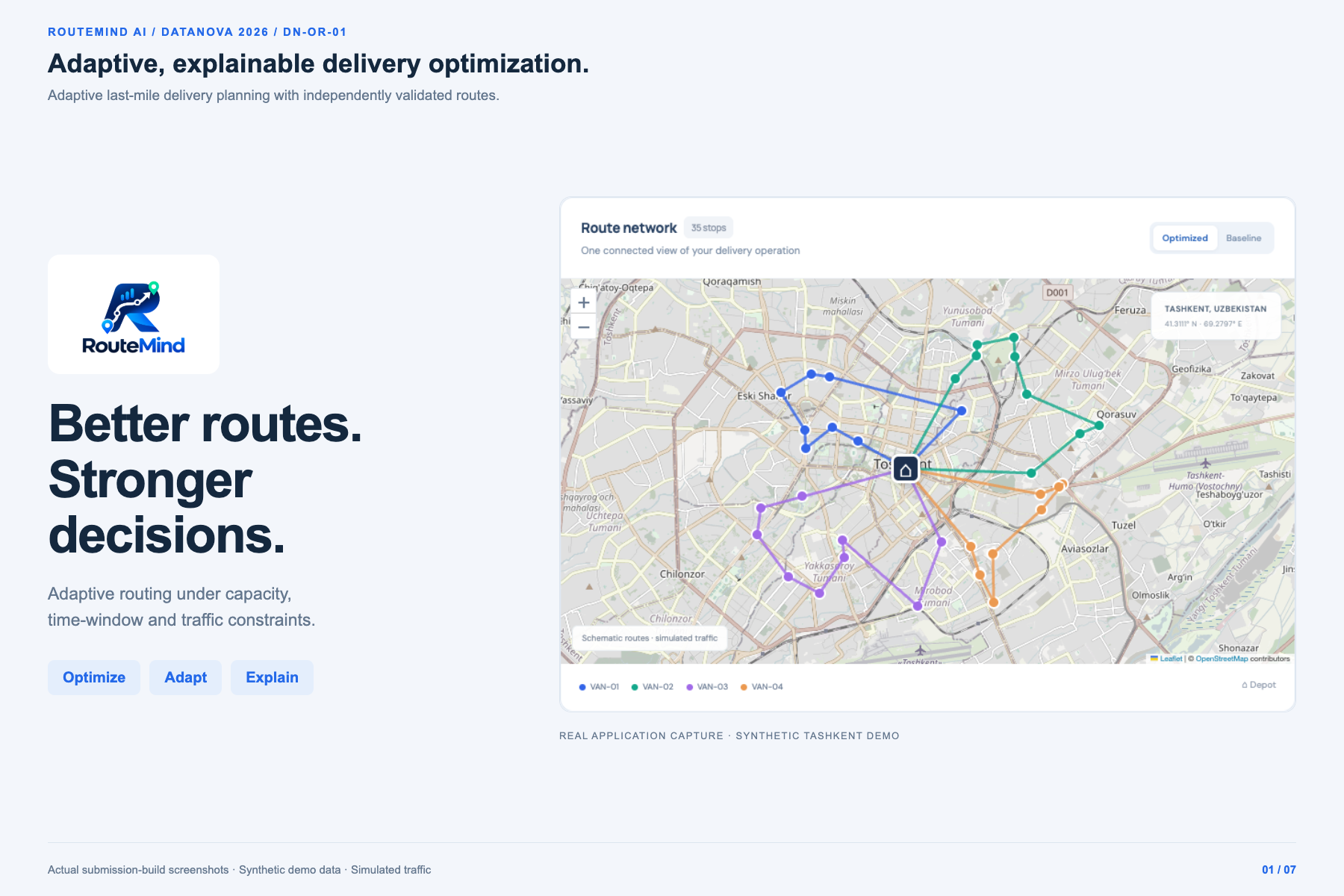
Adaptive last-mile delivery planning with independently validated routes.
Last-mile delivery is not simply about finding the shortest route. Every vehicle has limited capacity, customers have delivery windows, and traffic can invalidate a plan after drivers have departed. I built RouteMind AI around one question: how can a dispatcher adapt to changing conditions without losing track of work already completed? The goal was to create a working, understandable decision-support tool for DataNova’s DN-OR-01 challenge - combining route optimization with operational continuity and transparent evidence. RouteMind AI turns delivery orders and fleet constraints into actionable routing plans. Users can:
- Start with a reproducible 35-order, five-vehicle demo or import orders through CSV.
- Configure vehicle capacities, working hours and operating costs.
- Calculate routes and compare them with an independent greedy baseline.
- Inspect assignments, schedules, capacity utilization and calculated costs.
- Simulate congestion or vehicle unavailability.
- Replan remaining deliveries while preserving completed and committed work.
- Review constraint checks, explicit unserved orders and route changes.
- Evaluate 100 seeded travel-time uncertainty scenarios.
- Export full reports and route schedules. The English interface includes contextual walkthroughs, responsive layouts and reduced-motion support. The frontend uses React, TypeScript and Vite. Leaflet and OpenStreetMap display route assignments, Recharts supports comparisons, and TanStack Query manages API interactions. The backend uses Python, FastAPI, Pydantic and Google OR-Tools to solve a Capacitated Vehicle Routing Problem with Time Windows. Capacity and time dimensions enforce vehicle limits, customer service windows and operating deadlines. A bounded search combines parallel cheapest insertion with guided local search. The objective balances operating cost, distance, travel time and explicit penalties for unserved orders or route changes. A separate validator replays the returned routes to check loads, timing and order accounting. Solver success alone is not treated as sufficient evidence. For adaptive replanning, the system reconstructs the remaining problem from an execution checkpoint. Completed services stay complete, the next committed stop is preserved, and parcels already dispatched retain vehicle ownership. Frontend and backend run together on Vercel. The database-free demo retains the current plan in the browser and sends snapshots for subsequent calculations. PostgreSQL is available for durable server storage. I used OpenAI Codex to assist with implementation, testing, documentation and presentation preparation. The hardest challenge was preserving a physically consistent execution state. Replanning cannot move delivered orders back into the queue or instantly transfer parcels between vans. Distinguishing completed work, committed stops and remaining deliveries was essential. Another challenge was making comparisons fair. A cheaper plan is not necessarily better if it serves fewer customers. RouteMind therefore exposes unserved orders and compares plans over the same operational horizon. Serverless persistence also required care. Temporary server files are not reliable long-term storage, so the demo uses an explicit browser-snapshot workflow instead of silently depending on ephemeral files. Finally, I needed to make a technically complex optimization workflow understandable. Guided tours and decision-audit screens help users connect each control to its operational meaning. In the retained synthetic Tashkent seed-42 experiment, both methods served all 35 deliveries:
- Route distance decreased from 99.92 to 79.33 km: 20.60% lower.
- Illustrative operating cost decreased from $177.74 to $136.44: 23.24% lower.
- Vehicles used decreased from five to four. These are measured results for one synthetic scenario, not guaranteed commercial savings. I also evaluated nine Solomon benchmark instances - C101, R101 and RC101 at 25, 50 and 100 customers - with two runs per instance. All 18 retained OR-Tools runs returned complete feasible assignments; the greedy baseline was complete on 14 of 18 runs.
Under the retained seed-42 severe-traffic scenario, the previous remaining sequence became invalid. Replanning produced valid routes for all 28 remaining deliveries. Other stress scenarios left some orders unserved, which the application reports explicitly.
Verification included 41 backend/API tests, 12 browser tests and a successful production build. Mobile layouts and a workflow under six-times CPU throttling were also checked. A feasible solution, a complete solution and a proven optimum are different claims. I learned that useful optimization requires more than a strong objective function. Execution history, service coverage, understandable explanations and honest evaluation are equally important. Route stability also involves a real trade-off: reducing changes can slightly increase cost. Showing that trade-off helps dispatchers make informed decisions. The contribution is the integrated adaptive workflow: execution-preserving checkpoints, parcel ownership, configurable route-stability penalties and independently checked decision evidence. I do not claim to have invented a new routing algorithm. RouteMind applies established optimization methods to a practical, inspectable dispatch workflow. The next step is a pilot using calibrated road travel times and real operational cost inputs. Future improvements include:
- Road-network routing and validated traffic inputs.
- Physical rescue and parcel-transfer operations.
- Urgent-order insertion during execution.
- Authenticated workspaces and persistent plan history.
- Background solving for larger delivery operations. The current demo uses synthetic orders, simulated traffic, schematic route geometry and illustrative costs. Its uncertainty evaluation is not a trained traffic forecast.
Built With
- docker
- fastapi
- google-or-tools
- leaflet.js
- lucide
- nginx
- numpy
- openstreetmap
- pandas
- postgresql
- pydantic
- pytest
- python
- react
- recharts
- sqlite
- tanstack-query
- typescript
- vercel
- vite
- zod
