Inspiration
I know my grandparents' names, but very little about the lives behind those names or even the names of their parents or grandparents. Someone should have written their stories down.
That absence inspired me to build Rootstory: a place where families can create and explore family trees together, preserve photographs and stories, and make those memories available to the next generation. A family tree should be more than a diagram of names and dates. It should create moments like:
- “I never knew my grandfather did that.”
- “I found a story from a cousin I had never met.”
- “I discovered a connection between two branches of our family.”
- “I am preserving something my children can return to.”
Rootstory organizes those memories around the people and relationships in a family tree. Families can keep a tree private, collaborate with invited relatives, or publish selected history for others to explore. Photos, personal stories, biographical details, and historical sources give each person a life beyond a box in a diagram.
Rootstory itself predates this hackathon and serves as the real host platform for this submission. Building it exposed the new problem I chose to solve during the hackathon.
As trees grew—especially trees created or enriched through research—I saw that completeness and trust were not the same thing. A tree could contain dozens of people and still leave an important question unanswered: What evidence supports these names, dates, and connections?
Checking every person manually is slow, repetitive work. It requires finding gaps, opening many sources, deciding which claims are credible, and carefully updating the tree without turning a guess into family history. Families should not have to choose between an engaging story and a trustworthy record.
That is why I built Rootstory Evidence Agent: to give every family tree an autonomous evidence team that can do the heavy research while leaving the final judgment with the family.
What it does
Rootstory is where the family experiences the history; the Evidence Agent works behind the scenes to strengthen the foundation beneath it.
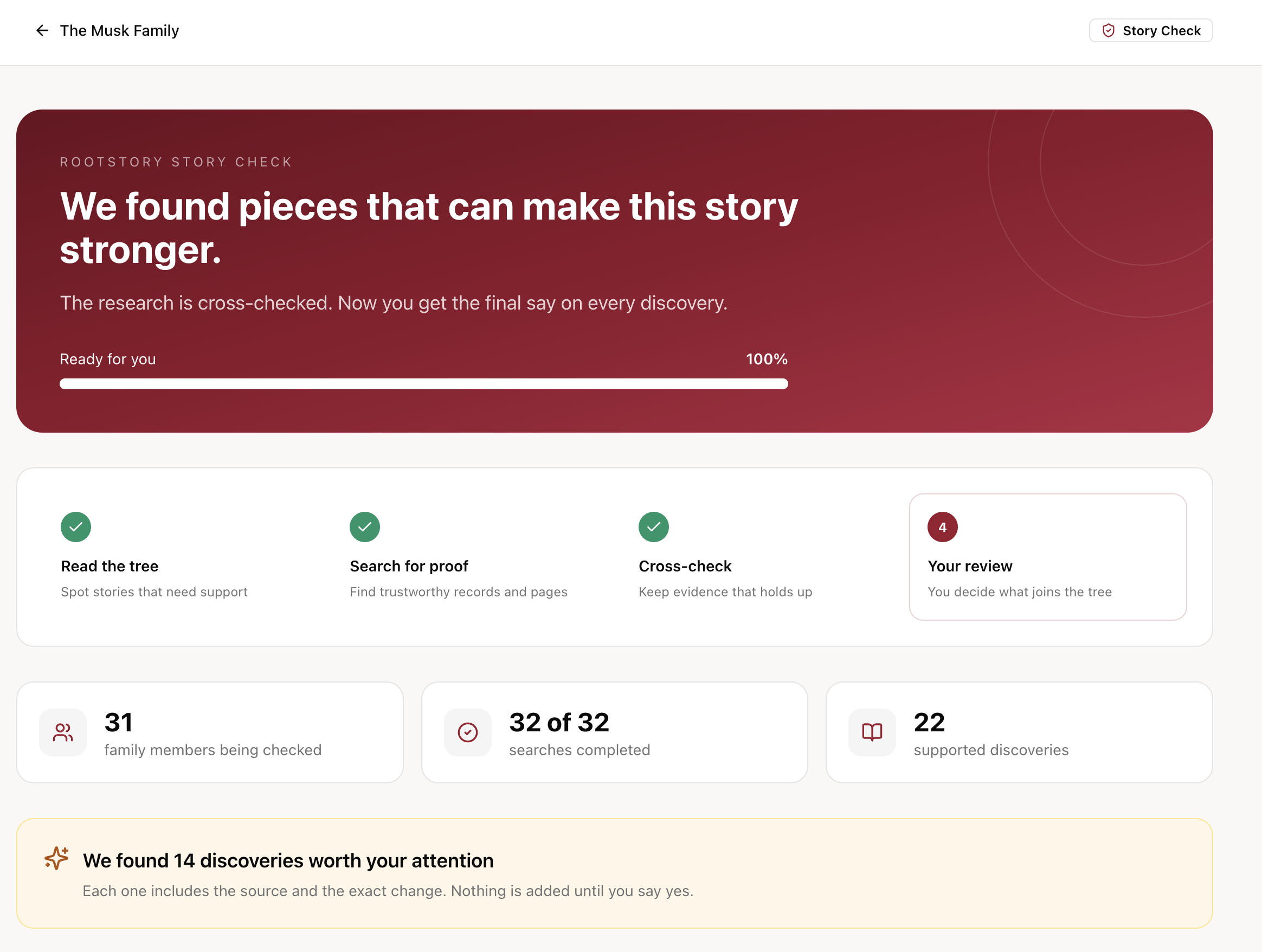
The owner gives the agent one outcome: strengthen the evidence behind this family tree. From there, the agent runs a complete asynchronous workflow:
- It reads a snapshot of the whole tree and calculates its evidence coverage.
- A planner identifies unsupported people, missing facts, possible duplicates, and broken relationship references.
- It converts actionable gaps into independent research tasks and orders them by priority.
- A research specialist investigates one person and one objective at a time with Gemini 3.5 Flash and Google Search grounding.
- A verifier rejects claims without usable sources or sufficient confidence.
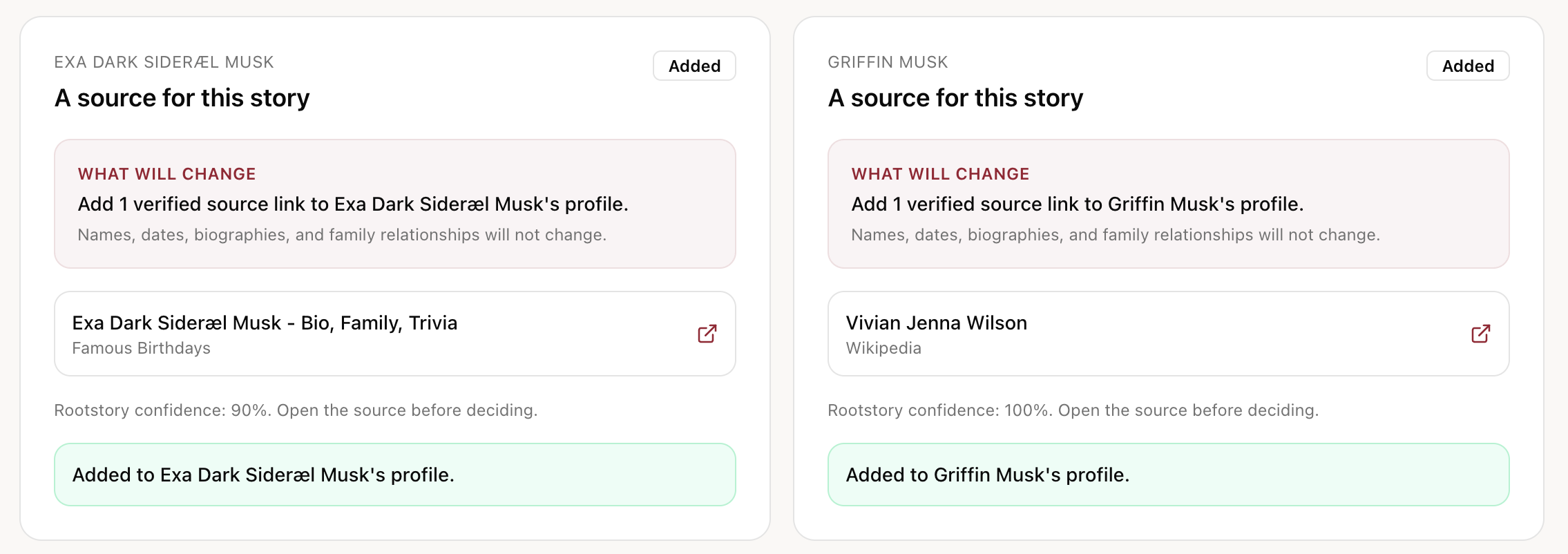
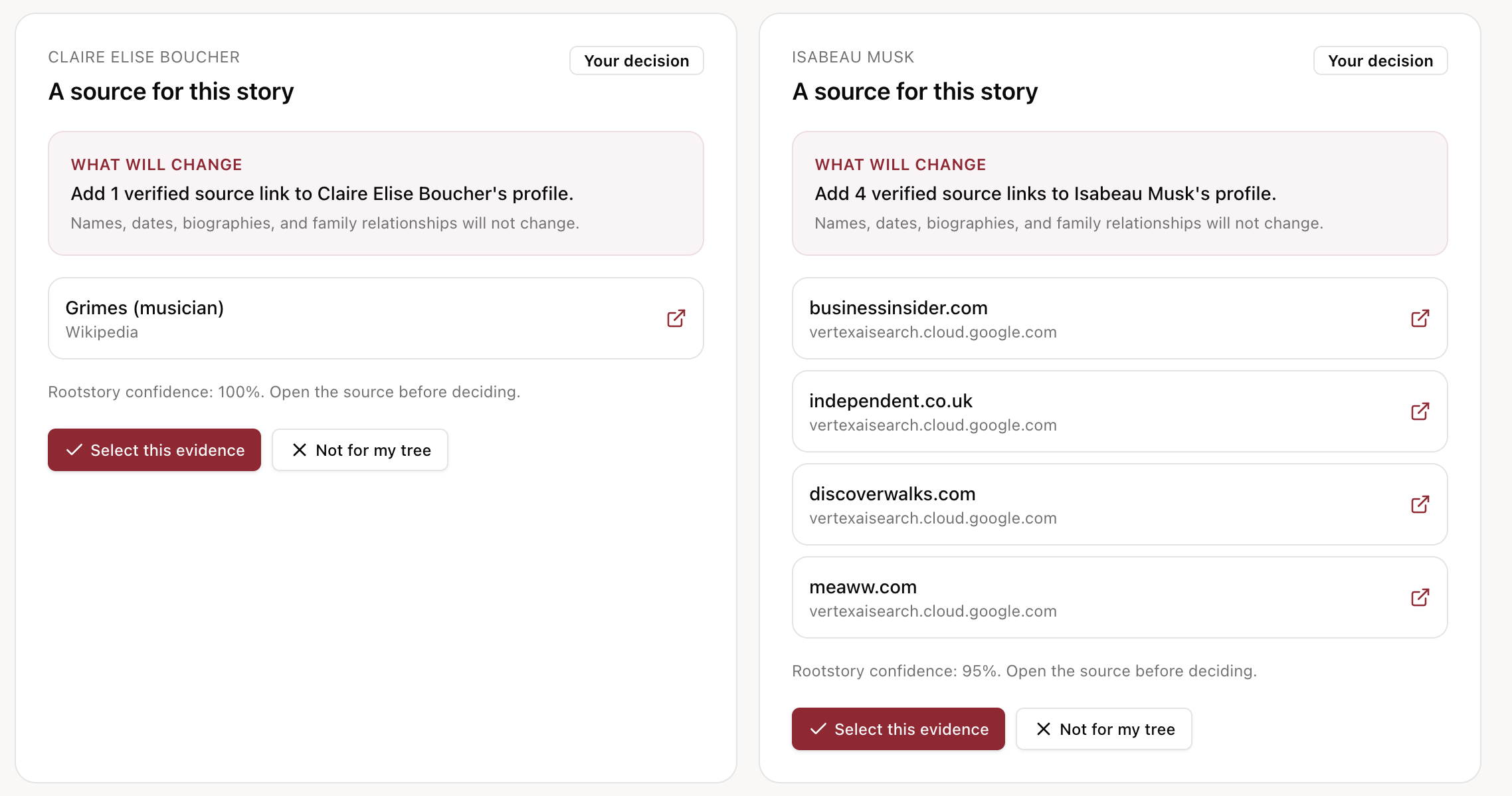
- The agent creates explicit repair proposals containing the person, field, prior value, proposed value, sources, confidence, and risk.
- The tree owner opens the original sources and selects or rejects each discovery.
- Only the selected fields are applied. Unreviewed work remains available for later.
The user can leave while the audit runs. Cloud Tasks processes one durable unit at a time, and Firestore preserves completed work, attempts, events, and proposals. If a model call fails or a Cloud Run instance stops, the next invocation resumes from persisted state instead of restarting the entire tree.
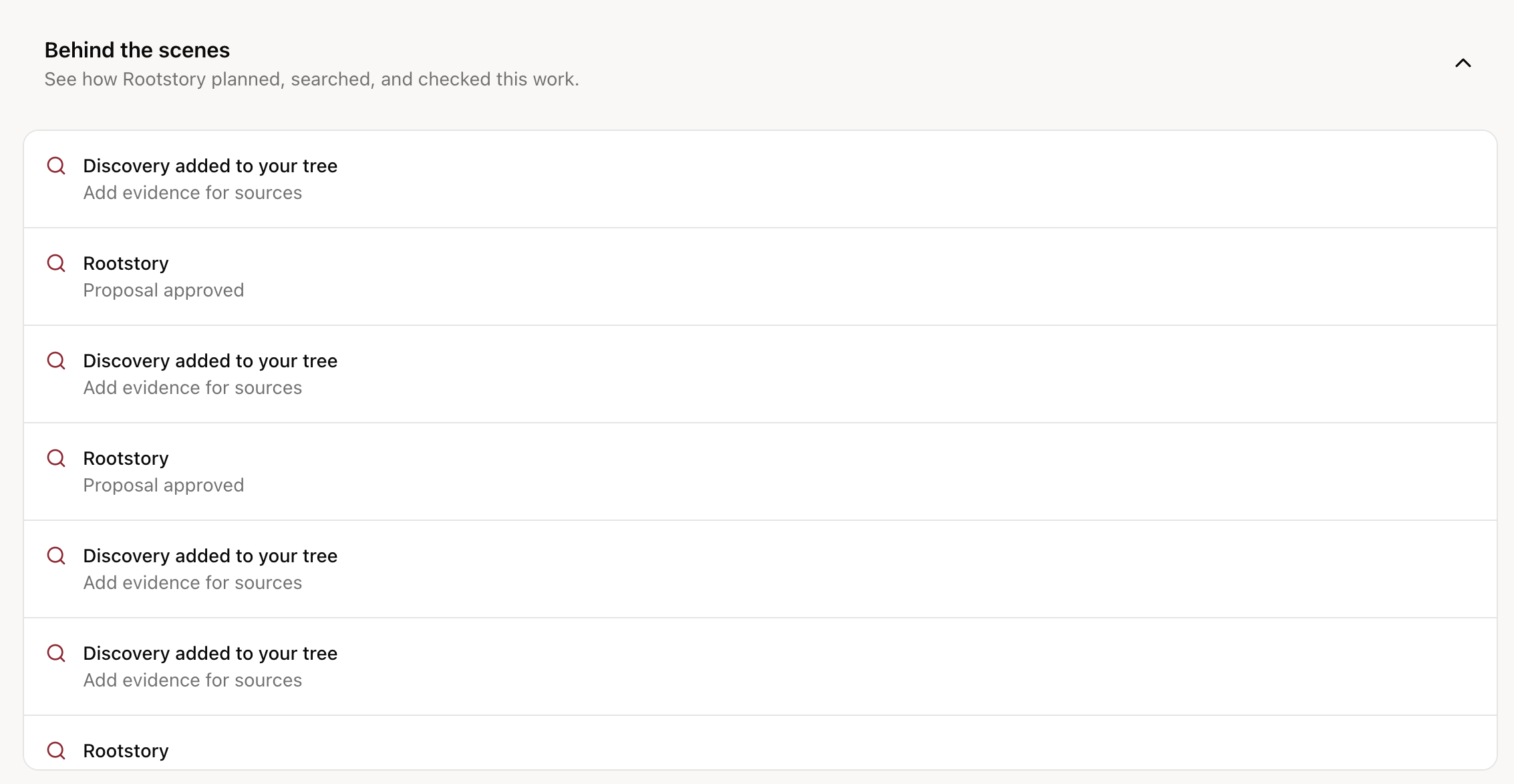
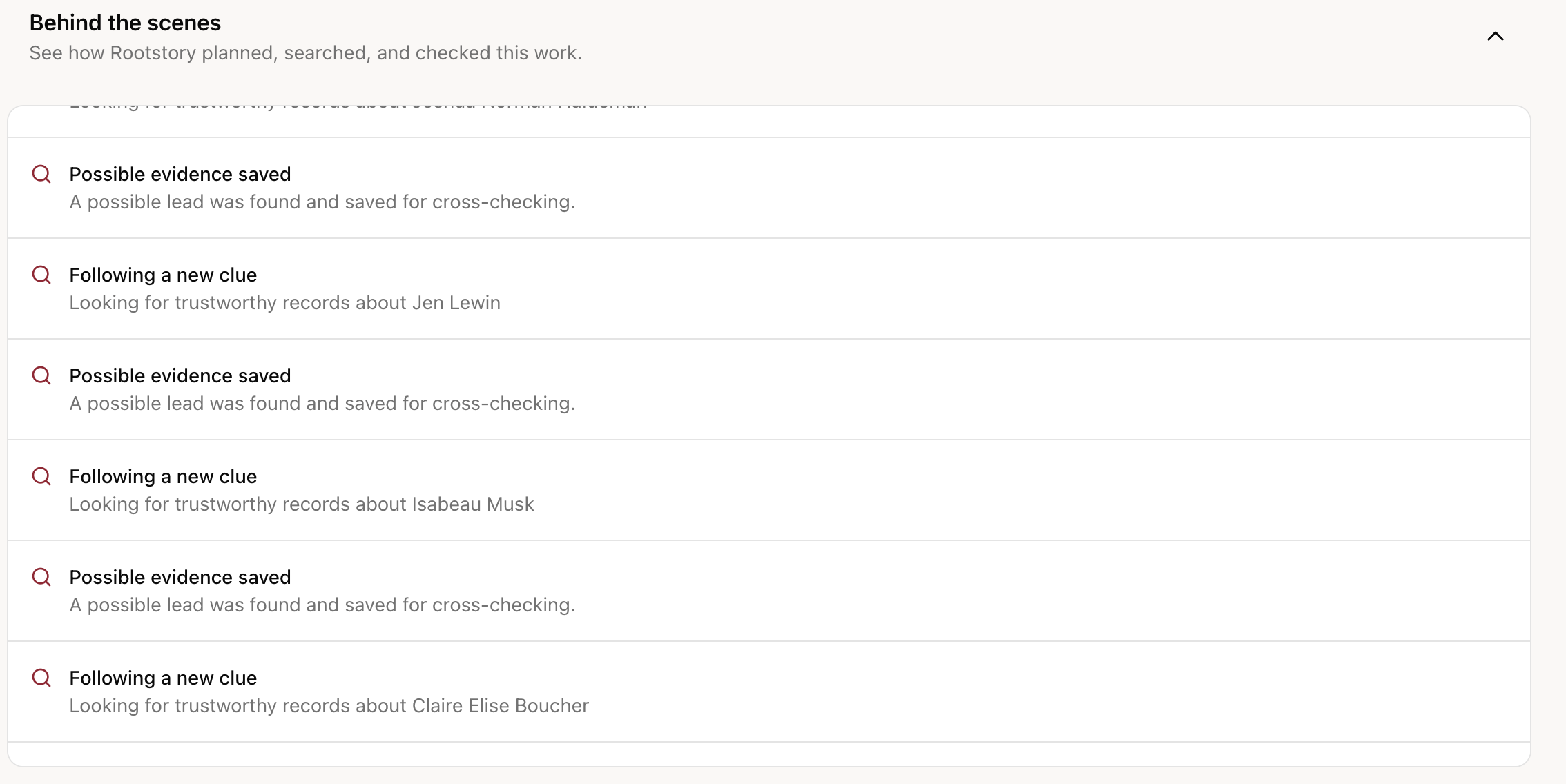
There is no chat box. The experience is a visible journey from reading the tree, through searching and cross-checking, to a human-controlled evidence review.
How I built it
I created the Evidence Agent as a separate Python service with FastAPI and the Google Gen AI SDK. It runs on Cloud Run and uses a durable state machine:
queued → auditing → researching → verifying → awaiting_review → applying → completed
Cloud Tasks invokes an internal worker endpoint for one work unit at a time. Audit runs, tree snapshots, findings, tasks, claims, proposals, and event history are persisted in Firestore. Gemini 3.5 Flash runs through Vertex AI with Google Search grounding. The researcher returns structured claims; it never receives permission to mutate the family tree directly.
The verifier enforces source and confidence policy before a claim becomes a proposal. Rootstory's React interface polls the saved run, translates technical activity into understandable progress, and makes the final mutation boundary explicit: selecting evidence does not change the tree; the owner must perform a separate apply action.
Firebase Authentication protects owner operations. Cloud Tasks calls the internal worker with an OIDC identity and a separate Secret Manager-backed worker credential; the worker endpoint validates the credential before processing work. GitHub Actions uses Workload Identity Federation to test and deploy without storing a downloadable Google Cloud key.
Challenges
Long-running research exceeded ordinary request boundaries. A large tree can produce dozens of research objectives. I changed the workflow from one long request into independently persisted tasks dispatched through Cloud Tasks.
Model and provider limits are normal, not exceptional. Gemini can return quota or transient errors. Each task stores an attempt count and completed work is committed before the next task, so retries do not erase progress.
A citation is not automatically evidence. Generated URLs cannot be trusted simply because they look plausible. The production path prefers grounding metadata returned by Google Search. Fallback pages must be public HTTPS resources, survive redirects, return suitable content, and identify the research subject.
Human approval had to be understandable. Early proposal cards exposed raw patch JSON and an ambiguous “Approve” button. The current interface names the affected person, explains the exact field that will change, states what will not change, separates selection from application, and restores unfinished audits across sessions.
Existing product versus hackathon work needed honest boundaries. Rootstory is an existing host application. The separately deployed Evidence Agent, durable workflow, research and verification pipeline, review experience, and Cloud infrastructure described here are the hackathon project.
What I learned
The hardest part of an agent is not producing an answer. It is owning a workflow safely over time. Useful autonomy required durable state, narrow task boundaries, retry behavior, identity checks, source verification, observable progress, and a clear point where a human remains in control.
I also learned that “human in the loop” is not satisfied by adding an approval button. The user must understand what approval means, which data will change, and whether they can leave and return without losing work.
Features and functionality
- Whole-tree evidence audit and coverage metrics
- Priority-based planning across people and missing fields
- Durable asynchronous research through Cloud Tasks
- Gemini 3.5 Flash research with Google Search grounding
- Server-side fallback source validation and confidence filtering
- Persisted task attempts, findings, events, claims, and proposals
- Live, non-chat progress experience in Rootstory
- Field-specific proposals with original sources
- Human selection followed by a separate apply boundary
- Partial review and cross-session audit recovery
- Firebase owner authentication and credential-protected worker execution
- Agent discovery card at
/.well-known/agent.json
Technologies used
- Gemini 3.5 Flash on Vertex AI
- Google Gen AI SDK
- Google Search grounding
- Cloud Run
- Cloud Tasks
- Firestore
- Firebase Authentication and Firebase Hosting
- Secret Manager-backed worker credential
- Python, FastAPI, Pydantic, HTTPX
- React, TypeScript, Vite
- GitHub Actions and Google Cloud Workload Identity Federation
Other data sources
The agent researches publicly accessible web sources surfaced through Google Search grounding. It stores canonical source titles, publishers, and URLs with each proposal so the reviewer can inspect the evidence directly. It does not treat model-generated text as a source.
Current limitations
- Audit actions are currently restricted to the tree owner.
- The interface restores the latest audit for a tree; a complete audit-history page is planned.
- Decisions are intentionally conservative, but an undo/defer control for individual review decisions is still planned.
- Public web evidence is much richer for notable people than for private relatives; the correct result for many people is therefore no proposal.
Built With
- adk
- cloud-functions
- cloud-run
- cloud-storage
- cloud-tasks
- exa
- familysearch
- fastapi
- firebase
- firestore
- gemini3.5flash
- google-cloud
- mcp
- node.js
- python
- react
- reactflow
- secretmanager
- typescript
- vertexai
- vite
- wikipedia

Log in or sign up for Devpost to join the conversation.