-
-
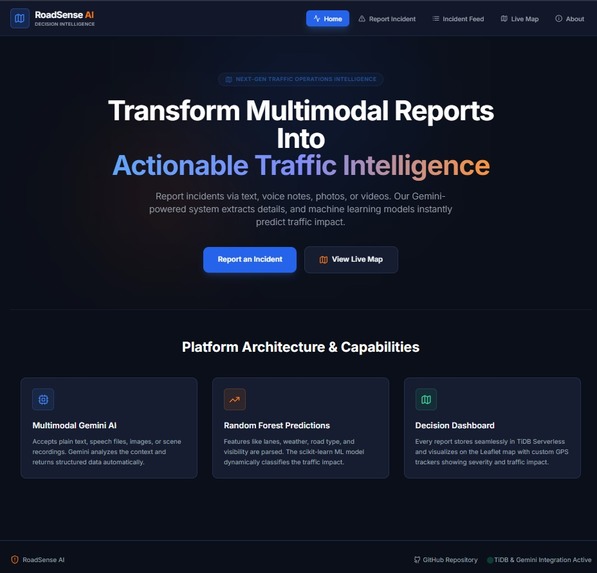
Home
-
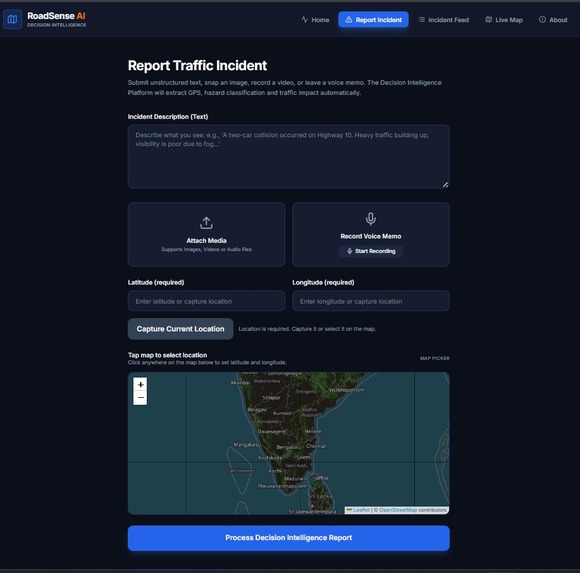
Report Incident
-
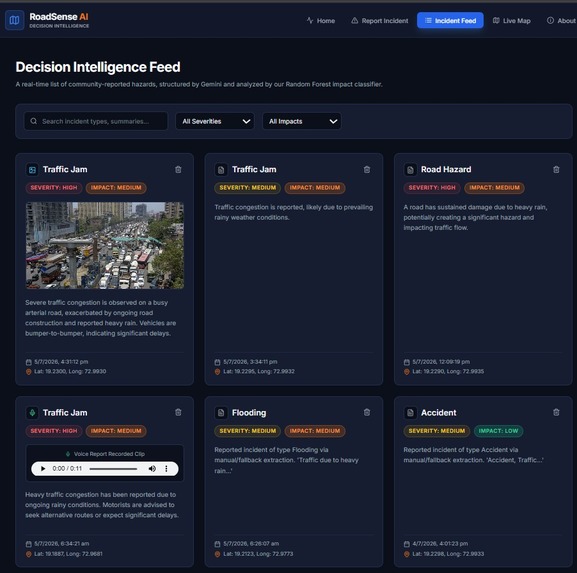
Feed
-
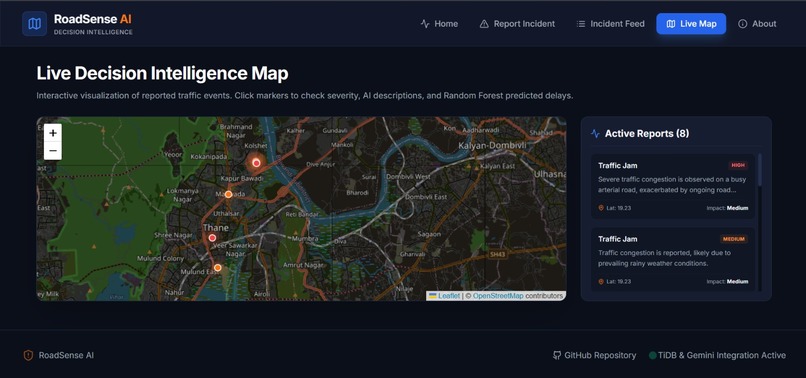
Live map
-
About
-
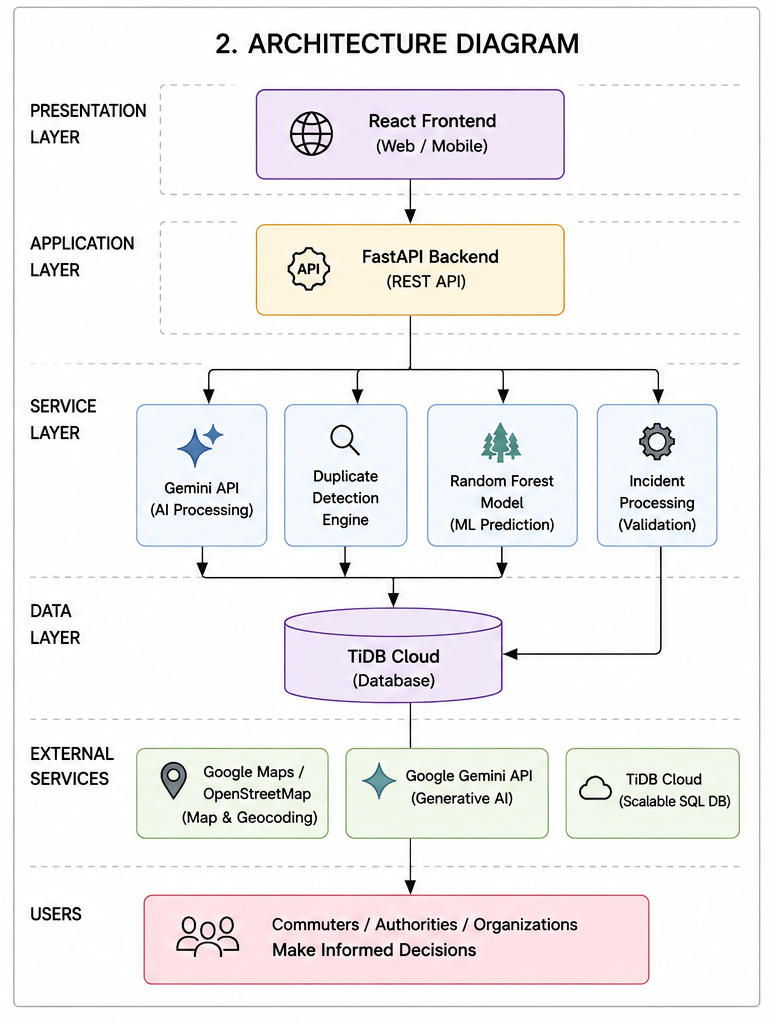
Architecture Diagram
-
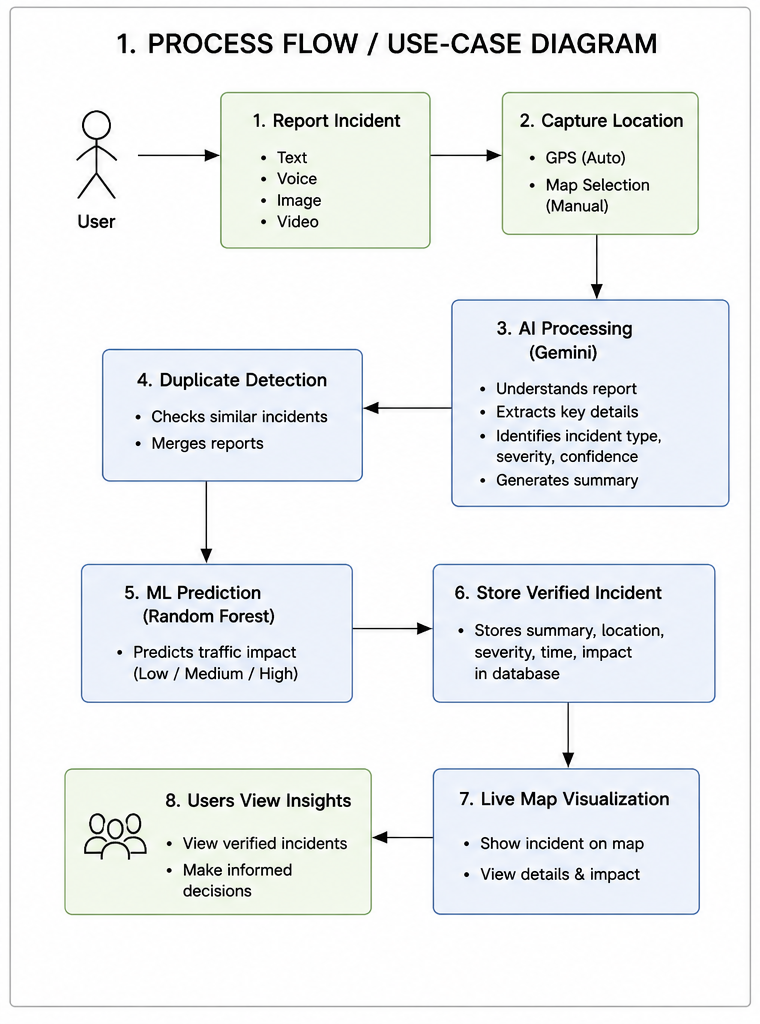
User/Process Flow diagram
Inspiration
It was my exam day when I was stuck in the traffic for almost hours, Luckily my exam was postponed but in the I walked to the exam hall as the traffic was not even budging. That day, I thought if only I knew about this traffic before I would have picked another way. Sure social media like instagram might provide this in their feed but their feed is not specialised for this so something as important as this might slip out of the people's sight which exactly happened in my case. And that's what gave me an inspiration to build something to tackle this problem and the result it RoadSenseAI.
What it does?
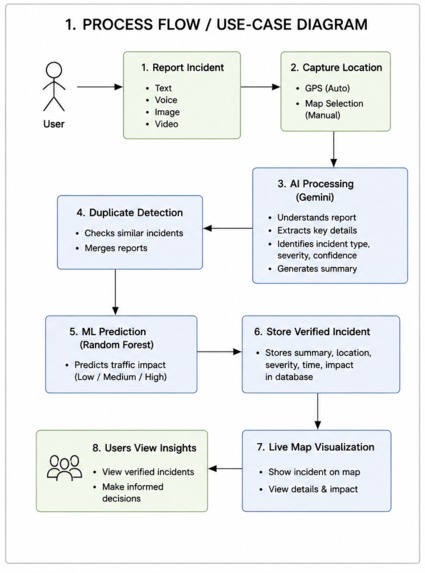
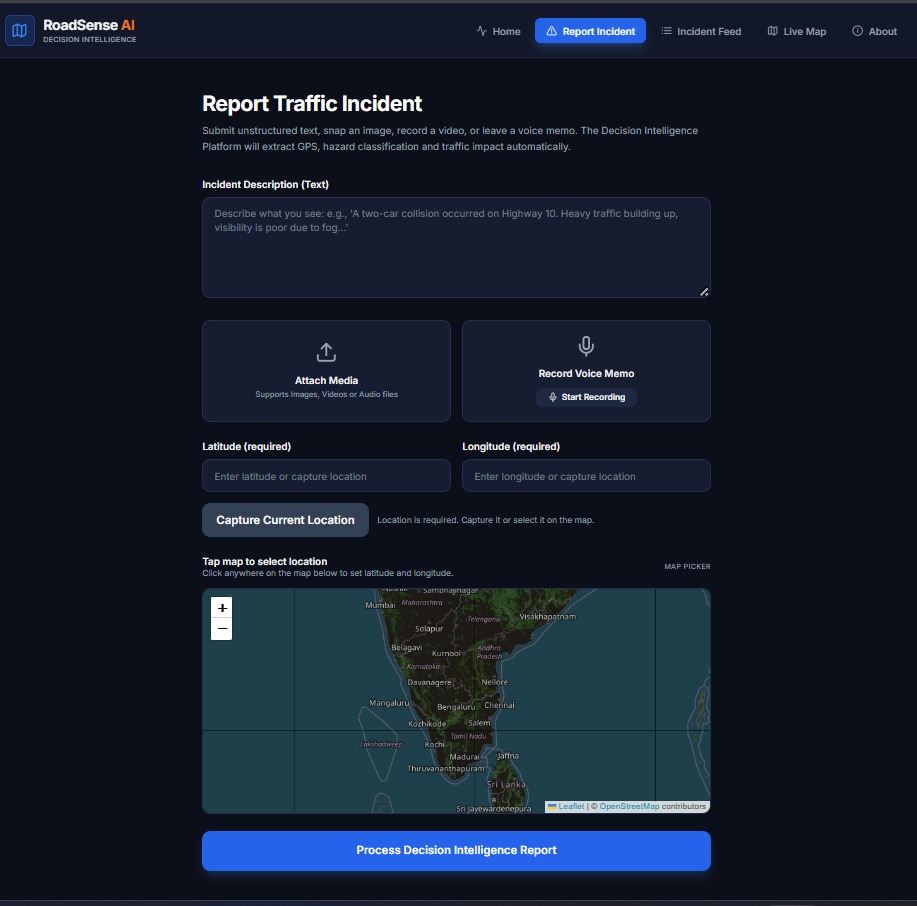
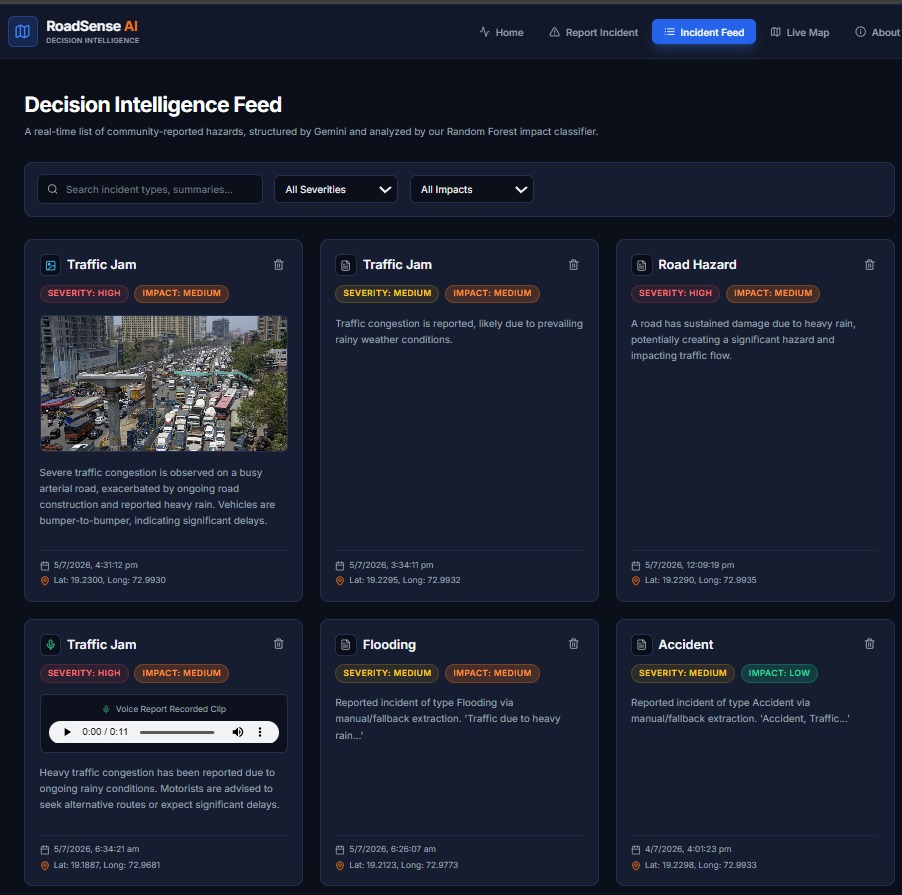
This solution creates a feed for any traffic related issues with proofs like images, videos, text descriptions as well. Similar incidents will be merged together. The Rain forest Machine learning logic is used to determine the severity of the incident. The incidents are stored along with location to maintain clear description of incident and helping people to take decisions accordingly. For the future improvements decided to add Location-Based Smart Notifications, Emergency Vehicle Route Optimization, Predictive Traffic Congestion Forecasting, AI-Based Alternate Route Recommendations.
How I built it?
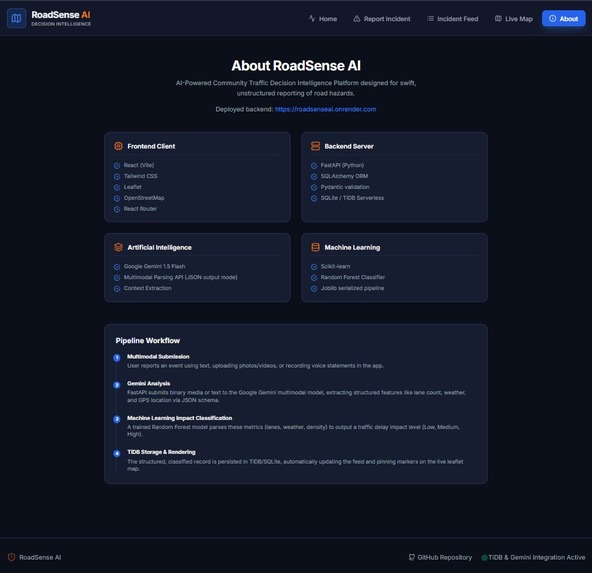
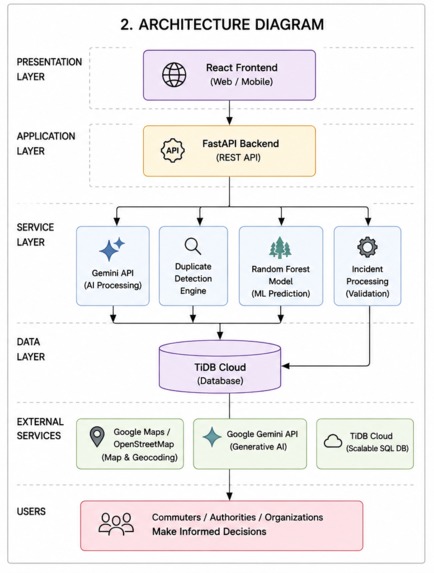
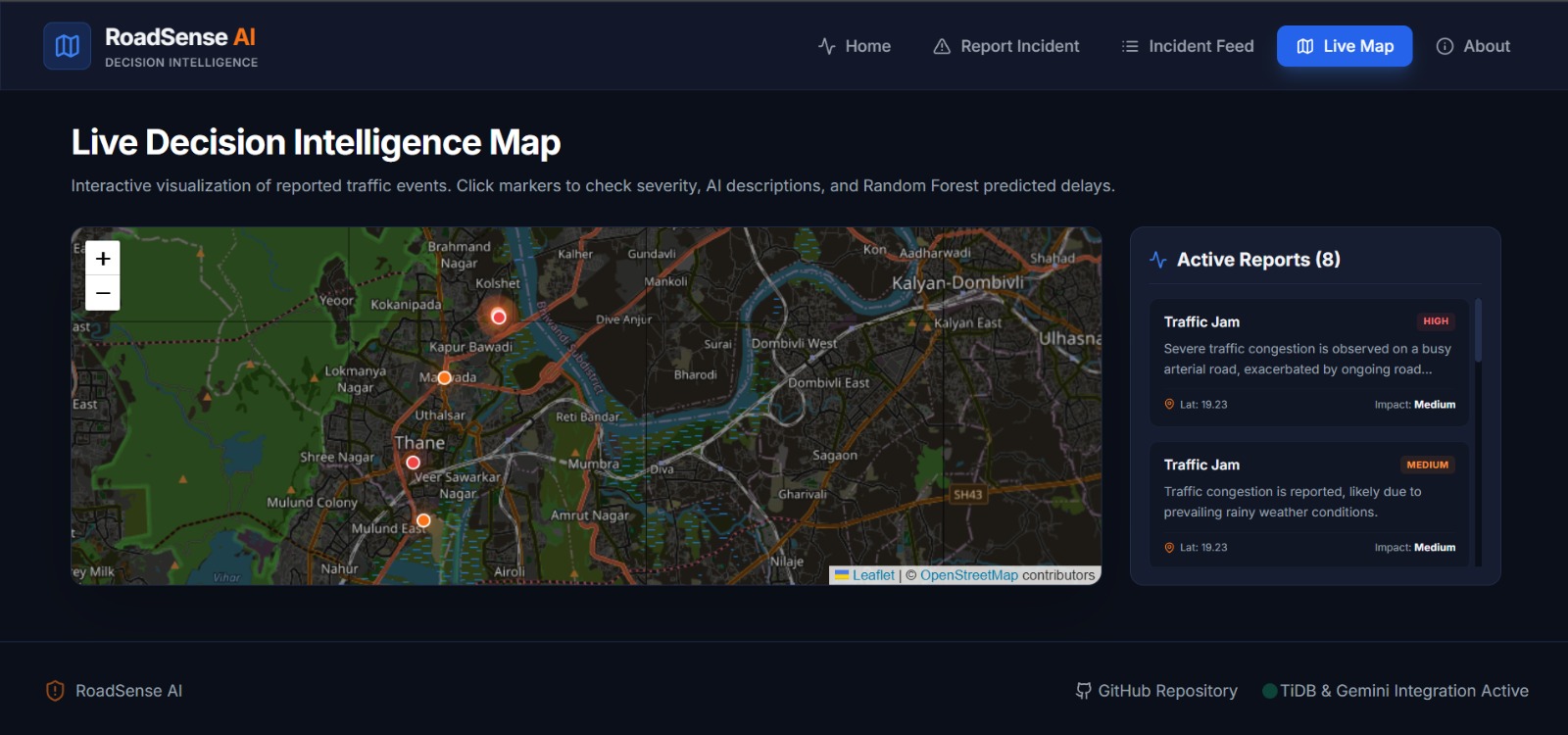
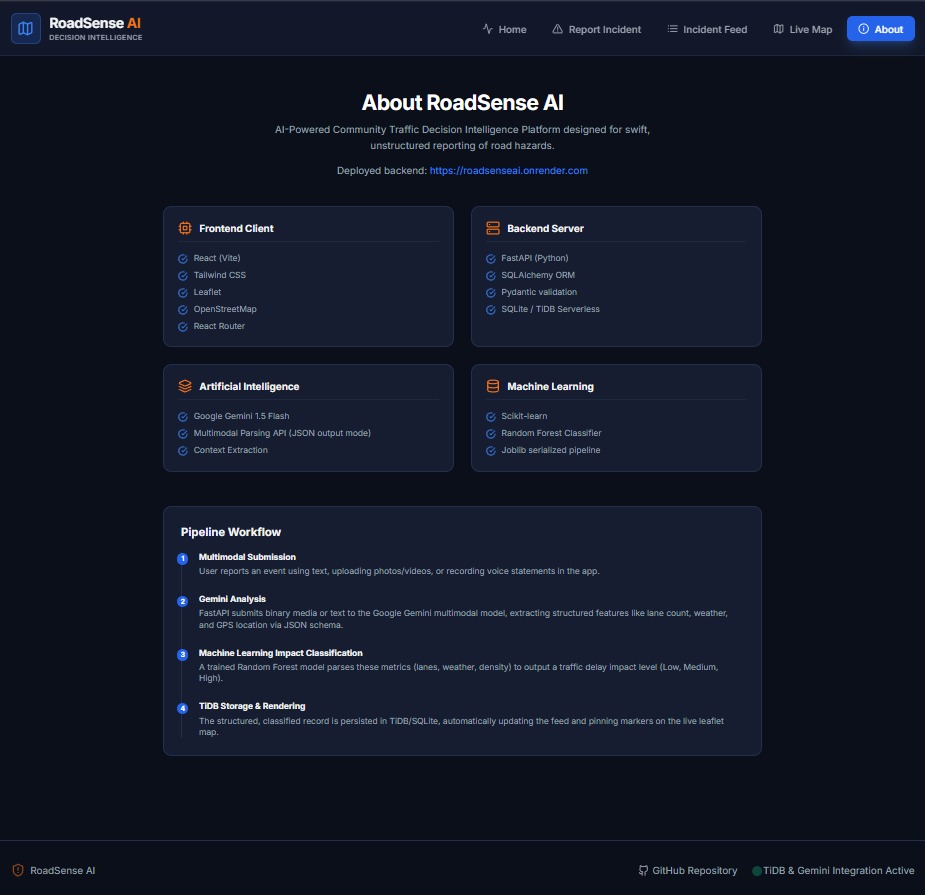
RoadSenseAI was built as a full-stack AI-powered web application using React, FastAPI, TiDB Cloud, Google Gemini API and Scikit-learn. The platform allows users to report road incidents through text, images, voice, or short videos, which are processed by Gemini to extract structured information such as the incident type, location, severity, confidence score, and an AI-generated summary. A Random Forest machine learning model, trained on the Indian Road Accident Dataset (2022–2025), is used to analyze historical accident patterns and support traffic impact prediction. The processed incident data is stored in TiDB Cloud and visualized on an interactive OpenStreetMap using Leaflet, enabling users to view real-time incidents and make informed travel decisions. The application follows a modular architecture with separate frontend, backend, AI, and ML components, ensuring scalability, maintainability, and a seamless user experience.
Challenges I ran into
One of the biggest challenges was processing and integrating multiple input formats including text, images, voice, and video into a unified AI workflow. Extracting accurate and structured incident information from diverse user inputs while maintaining consistency required careful prompt engineering and backend orchestration. Another challenge was identifying a suitable dataset for training the machine learning model and mapping its features to real-world incident reports. Integrating AI-generated insights with the ML model, live map visualization, and TiDB Cloud in a modular and scalable architecture within the limited hackathon timeline also required careful design decisions. Balancing performance, usability, and rapid development while delivering a functional MVP was a key challenge throughout the project.
Accomplishments that I am proud of
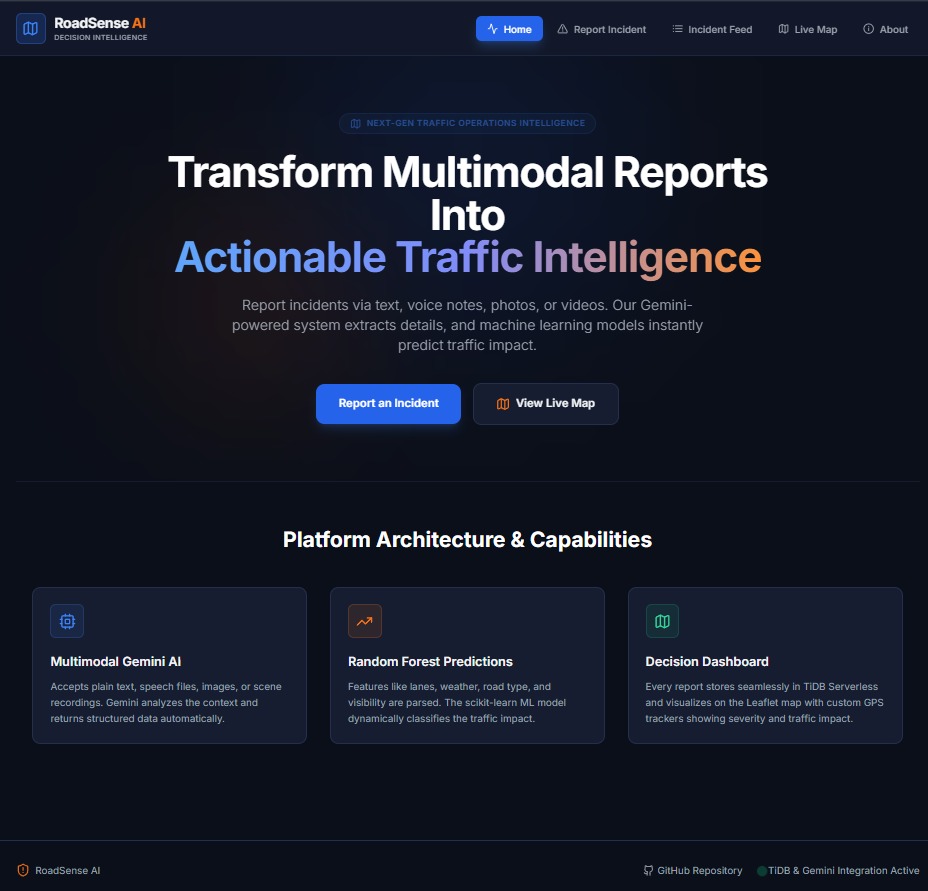
I successfully built RoadSense AI, an AI-powered community traffic decision intelligence platform that transforms unstructured multimodal reports into actionable road intelligence. I integrated Google Gemini to analyze text, images, voice, and video inputs, trained a Machine Learning model using a real-world Indian road accident dataset, and visualized incidents on a live map using OpenStreetMap. We're proud of designing a scalable architecture with React, FastAPI, and TiDB Cloud, while delivering a functional MVP within a very short hackathon timeline.
What I learned
Through this project, I gained hands-on experience in integrating Generative AI with traditional Machine Learning to solve a real-world problem. We learned how to process multimodal user inputs, design effective prompts for LLMs, train and integrate ML models, work with TiDB Cloud, and build scalable full-stack applications using React and FastAPI. More importantly, I learned how to rapidly prototype, prioritize features, and make architectural decisions under tight deadlines.
What's next for RoadSenseAI
My vision is to evolve RoadSense AI into a comprehensive AI-powered urban mobility and public safety platform. Future enhancements include real-time traffic and weather integration, duplicate report detection, AI-powered route recommendations, emergency service notifications, community trust scores, predictive accident hotspot analysis, multilingual support, and dedicated dashboards for traffic authorities and smart cities. We also plan to leverage TiDB's vector search capabilities to build a conversational assistant that allows users and city officials to query historical incident data and receive intelligent insights through natural language.
Built With
- axios
- fastapi
- git
- github
- google-gemini-api
- leaflet.js
- mysql
- openstreetmap
- python
- random-forest
- react
- render
- scikit-learn
- sqlalchemy
- tailwind-css
- tidb-cloud
- vercel
- vite

Log in or sign up for Devpost to join the conversation.