RideSafe AI — Every Ride Deserves a Safer Journey
Inspiration
Every motorcycle journey carries a responsibility: reaching the destination safely. Yet, a helmet may not always be worn correctly, and when an accident occurs, the time between impact and receiving assistance can be critical.
We were inspired by a simple question: What if a helmet could do more than protect a rider's head? What if it could help identify danger, recognize a potential accident, and make it easier to request help?
Traditional helmets provide essential physical protection, but they generally do not monitor the rider's safety status, detect potential crashes electronically, or coordinate emergency notifications. At the same time, connected devices and AI offer opportunities to make everyday transportation more safety-aware.
This led to RideSafe AI, a smart road-safety platform concept that combines intelligent helmet monitoring, sensor-based crash-risk detection, emergency response workflows, and ride analytics.
Our vision is to make connected safety more accessible to everyday riders, students, commuters, delivery partners, and fleet operators. Rather than treating safety as a single action, RideSafe AI explores how safety monitoring could become an integrated part of every journey.
What It Does
RideSafe AI is a connected road-safety platform concept built around a smart helmet and a digital rider dashboard.
1. Smart Helmet Monitoring
The platform includes a helmet-status simulator that represents whether a helmet is being worn and whether the device is connected.
In a future hardware implementation, suitable sensors could detect helmet use and communicate the status to the vehicle or mobile application. The system could then indicate whether the rider is ready to begin a journey.
The current concept demonstrates the intended workflow without claiming physical ignition control.
2. AI-Assisted Accident Detection
A potential accident can produce unusual acceleration, angular velocity, and sudden movement patterns. RideSafe AI explores how accelerometer and gyroscope data could be analyzed to identify suspicious events.
The prototype can demonstrate a threshold-based crash-risk detection workflow using simulated sensor readings. A detected event triggers an incident warning and an opportunity for the rider to confirm their safety.
A production system would require real sensor data, model validation, careful calibration, and testing across different riding conditions to reduce false alarms and missed detections.
3. Emergency Response Workflow
When a potential crash is detected, the platform demonstrates an emergency confirmation process. The rider can cancel the warning if they are safe or proceed through a simulated SOS workflow.
The intended hardware-connected system could include GPS coordinates, incident timestamps, emergency contacts, and authorized notification services.
The prototype does not independently contact an ambulance or guarantee emergency assistance. Those capabilities would require reliable connectivity, secure integrations, and real-world validation.
4. Ride Monitoring
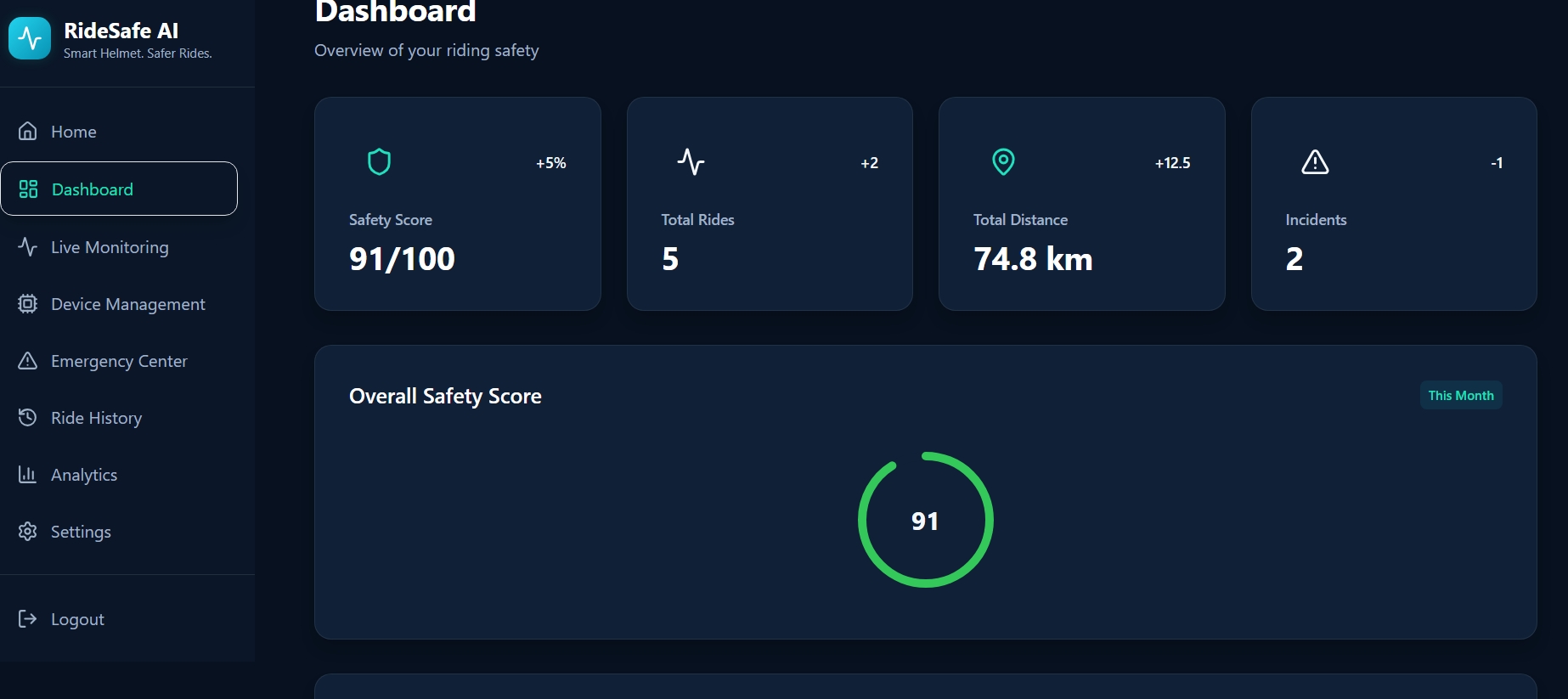
The dashboard brings important ride information together in one place, including simulated device status, ride activity, sensor readings, and incident summaries.
This creates a unified view of the rider's safety journey instead of separating device information, ride history, and incident records across different tools.
5. Safety Analytics
RideSafe AI explores how ride data could help users understand patterns such as sudden braking, unusual movements, and recurring safety events.
A future analytics system could provide weekly summaries, trip histories, and personalized recommendations to encourage safer riding habits. Any safety score would need a clearly defined methodology and validation before being used to assess real riders.
How We Built It
We approached RideSafe AI as a product-development challenge rather than starting with an interface alone.
Step 1: Problem Definition and Planning
Using the Devpost Learn Skill Pack's planning-oriented workflow, we identified the core problem, defined the intended users, and organized the product into manageable modules.
The initial priorities were helmet-status monitoring, potential crash detection, emergency workflows, and ride analytics. Breaking the problem down this way helped establish a clear development direction.
Step 2: Flipped Interaction and User Flows
We used a structured, planning-first approach to think through how riders would interact with the product.
For example, the emergency workflow follows this sequence:
- The device simulator receives or generates sensor readings.
- The detection logic identifies a potential high-impact event.
- The application displays an incident warning.
- A confirmation countdown gives the rider an opportunity to cancel.
- If the rider proceeds, the prototype demonstrates the SOS workflow.
- The incident can be recorded for later review.
This sequence helps make the intended behavior understandable before connecting real hardware.
Step 3: Interface and Dashboard Design
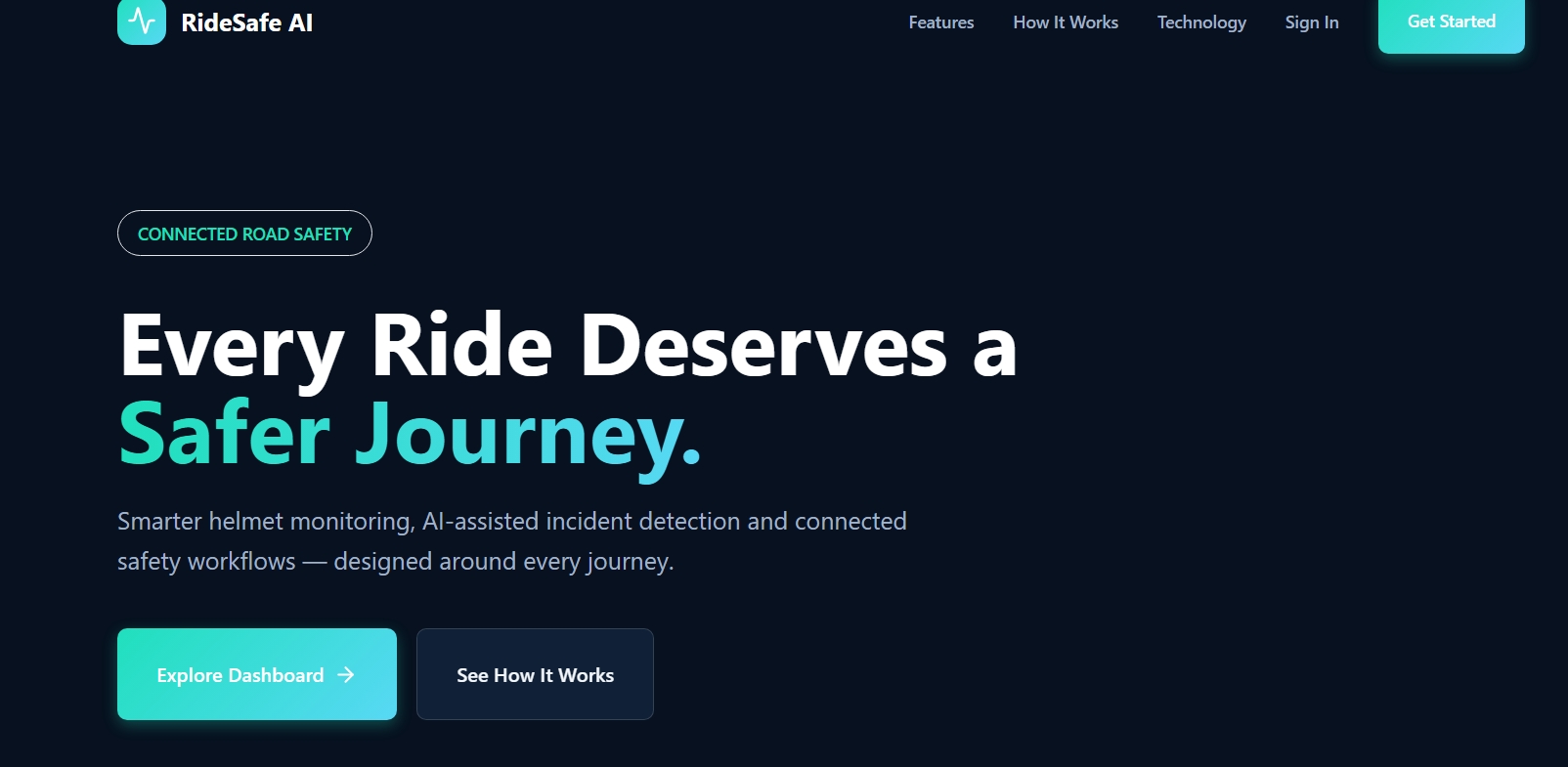
The product interface follows a modern technology-dashboard aesthetic, using a dark navy foundation, teal highlights, clear typography, and distinct visual states for normal operation and emergencies.
The planned interface includes a landing page, rider dashboard, device-monitoring view, emergency center, ride history, analytics, and settings.
The design prioritizes clear information hierarchy so that device status, warnings, and emergency actions remain easy to distinguish.
Step 4: Simulated Device and Detection Logic
For a software-first prototype, simulated sensor readings allow the intended workflow to be explored without requiring a physical helmet during initial development.
A simple threshold-based detector can flag suspicious readings for demonstration. This is a starting point, not a validated accident-prediction model.
A future version could collect data from an inertial measurement unit (IMU), use GPS for location, and communicate through Bluetooth Low Energy (BLE). A trained model could be evaluated against labelled riding and crash-event datasets before any real safety claims are made.
Step 5: Testing and Iteration
The next validation stage focuses on checking normal ride flows, helmet-not-worn states, simulated impact events, emergency cancellation, incident history, and responsive layouts.
Testing must also address false positives, missed events, sensor noise, connectivity failures, and situations in which a rider cannot respond.
The aim is to build a maintainable prototype that can evolve toward a carefully validated hardware-integrated product.
Challenges We Ran Into
Turning a Physical Safety Problem into a Software Prototype
A smart helmet is not just a mobile interface. It depends on sensors, physical placement, connectivity, power management, and reliable communication between components.
We addressed this challenge by separating the digital demonstration from future hardware requirements. This allows the product workflow to be explored while making the remaining engineering work explicit.
Distinguishing Real Accidents from Ordinary Movement
A sudden jolt does not always indicate a crash. Potholes, hard braking, dropping a helmet, and abrupt turns can all produce unusual sensor readings.
A simple threshold can demonstrate the concept, but it cannot reliably distinguish every accident from normal riding. Real deployment would require representative sensor data, multi-sensor analysis, false-alarm evaluation, and extensive testing.
Making Emergency Actions Clear
An emergency interface must communicate urgency without confusing or overwhelming the rider.
The confirmation and cancellation workflow is designed to demonstrate this balance. Real deployment would additionally need reliable delivery acknowledgements, retry handling, secure contact management, and clear failure states.
Managing Hardware and Connectivity Dependencies
GPS and Bluetooth connectivity may be unavailable, delayed, or inaccurate. A device may also lose power or become disconnected during a journey.
A production system would need to communicate these limitations clearly, monitor device health, and avoid presenting unavailable data as live information.
Balancing Ambition with a Feasible MVP
The broader vision includes a smart helmet, vehicle integration, AI-assisted detection, and emergency services. Building all of these components reliably requires more than a web prototype.
We therefore structured the concept around a demonstrable software workflow first, with hardware integration and validation as future development stages.
Accomplishments That We're Proud Of
We are proud to have developed a clear product direction around a meaningful real-world problem: making motorcycle journeys safer through connected technology.
The project brings together several related ideas in a single product experience:
- Helmet-status monitoring and ride-readiness workflows.
- Sensor-based potential crash detection.
- An emergency confirmation and simulated SOS process.
- Ride history and safety analytics.
- A dashboard concept designed to present safety information clearly.
We are also proud of the planning-first approach. Using structured requirements and user flows helps connect the problem statement to specific product features instead of producing a collection of disconnected screens.
Most importantly, RideSafe AI establishes a foundation for future experimentation with IoT hardware, embedded sensing, and validated AI-based event detection.
What We Learned
This project reinforced that useful AI products begin with a clearly defined problem and a realistic understanding of their limitations.
We explored how planning documents can help organize development, how a coding agent can support the implementation process, and how interface design influences a user's ability to understand and respond to important information.
We also learned that AI in a safety-critical environment needs a higher standard of evidence than an ordinary application feature. A plausible demonstration is not proof of real-world reliability.
For RideSafe AI, that means future work must measure false-positive and false-negative rates, test different riding conditions, evaluate GPS accuracy, and validate notification delivery.
Finally, we learned to distinguish between a compelling product vision and a working, tested system. Clear boundaries between simulated behavior and real integrations make a prototype more credible and provide a better foundation for engineering.
What's Next for RideSafe AI
Phase 1: Complete the Software MVP
Finalize the responsive interface, device simulator, incident workflow, ride history, and analytics. Add robust validation, error states, and automated tests for the core user journeys.
Phase 2: Integrate Physical Hardware
Develop a small proof of concept using an appropriate microcontroller, an inertial measurement unit, GPS, and Bluetooth Low Energy.
Test helmet-worn detection using a suitable sensor design and evaluate whether the device can reliably report its status under different conditions.
Phase 3: Validate Crash Detection
Collect or obtain suitable labelled sensor data and evaluate candidate detection methods. Measure false positives, missed events, detection latency, and performance across different riding conditions.
Any trained model would be compared against a documented baseline before making claims about its accuracy.
Phase 4: Build Reliable Emergency Communication
Explore secure emergency-contact management, GPS-based incident details, message-delivery confirmation, and retry mechanisms. Any external emergency-service integration would require appropriate authorization and testing.
Phase 5: Pilot with Real Riders
After safety, privacy, and hardware validation, conduct a controlled pilot with consenting participants. Gather feedback on comfort, usability, alert quality, battery life, and connectivity.
Phase 6: Explore Wider Adoption
If validation demonstrates sufficient reliability, investigate partnerships with helmet manufacturers, delivery fleets, road-safety organizations, and mobility providers.
Our long-term goal is to explore an affordable, accessible safety platform that helps riders become more aware of risk and makes emergency response workflows easier to initiate.
RideSafe AI is a step toward a future in which road safety is not just protective equipment, but a connected and thoughtfully designed experience.
Built With
- artificial-intelligence
- bluetooth
- css
- data-visualization
- gps
- html
- iot
- javascript
- node.js
- react
- responsive-design
- tailwind-css
- typescript
- web-development


Log in or sign up for Devpost to join the conversation.