RiderMate 2.0
AI-Powered Smart Mobility, Rider Safety & Assistance Platform
Motorcycle riders often depend on multiple disconnected applications for navigation, ride tracking, emergency assistance, vehicle maintenance, weather, memories, and rider communities.
We wanted to build something different: a single motorcycle-focused companion that brings these experiences together while remaining useful when connectivity is unreliable.
That idea became RiderMate 2.0.
The Problem
A motorcycle journey involves much more than navigation.
Before and during a ride, riders may need to:
- Check their route
- Monitor their ride
- Access emergency assistance
- Keep track of their motorcycle
- Remember insurance and maintenance information
- Check weather conditions
- Record memorable journeys
- Connect with other riders
- Understand their riding and safety patterns
These experiences are normally spread across different applications.
For a rider, that creates unnecessary friction.
RiderMate was designed around one question:
What if a motorcycle rider could have one intelligent companion for the entire journey?
Our Solution
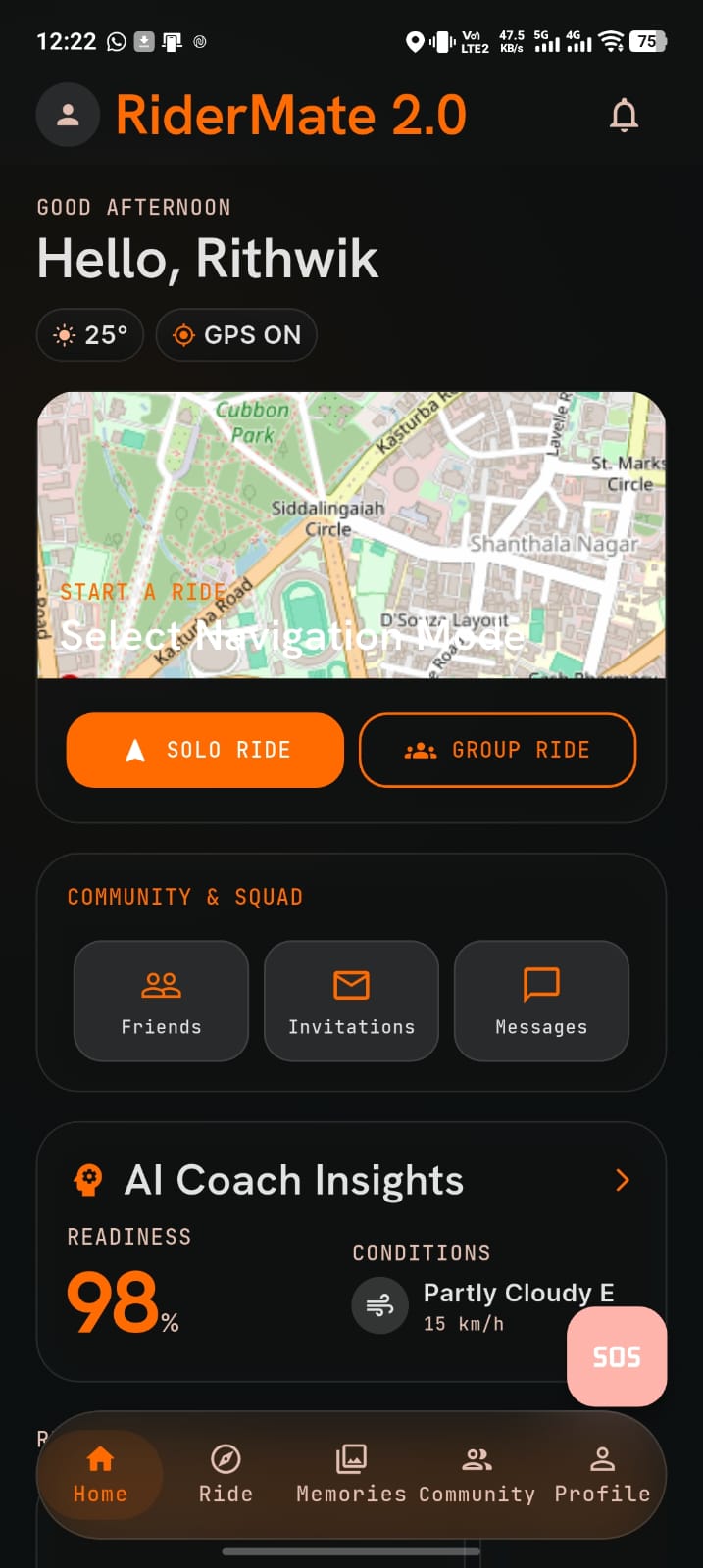
RiderMate 2.0 is an Android-first, offline-first motorcycle companion that combines rider safety, mobility, vehicle management and community features into one application.
The platform brings together:
🛡️ Rider Safety
A dedicated Safety Center provides access to safety-focused functionality and emergency workflows, including SOS assistance.
🚨 Emergency SOS
RiderMate provides an accessible emergency workflow designed to help riders initiate assistance when they need it.
Safety-critical functionality is kept separate from premium functionality so that essential emergency capabilities are not dependent on a subscription.
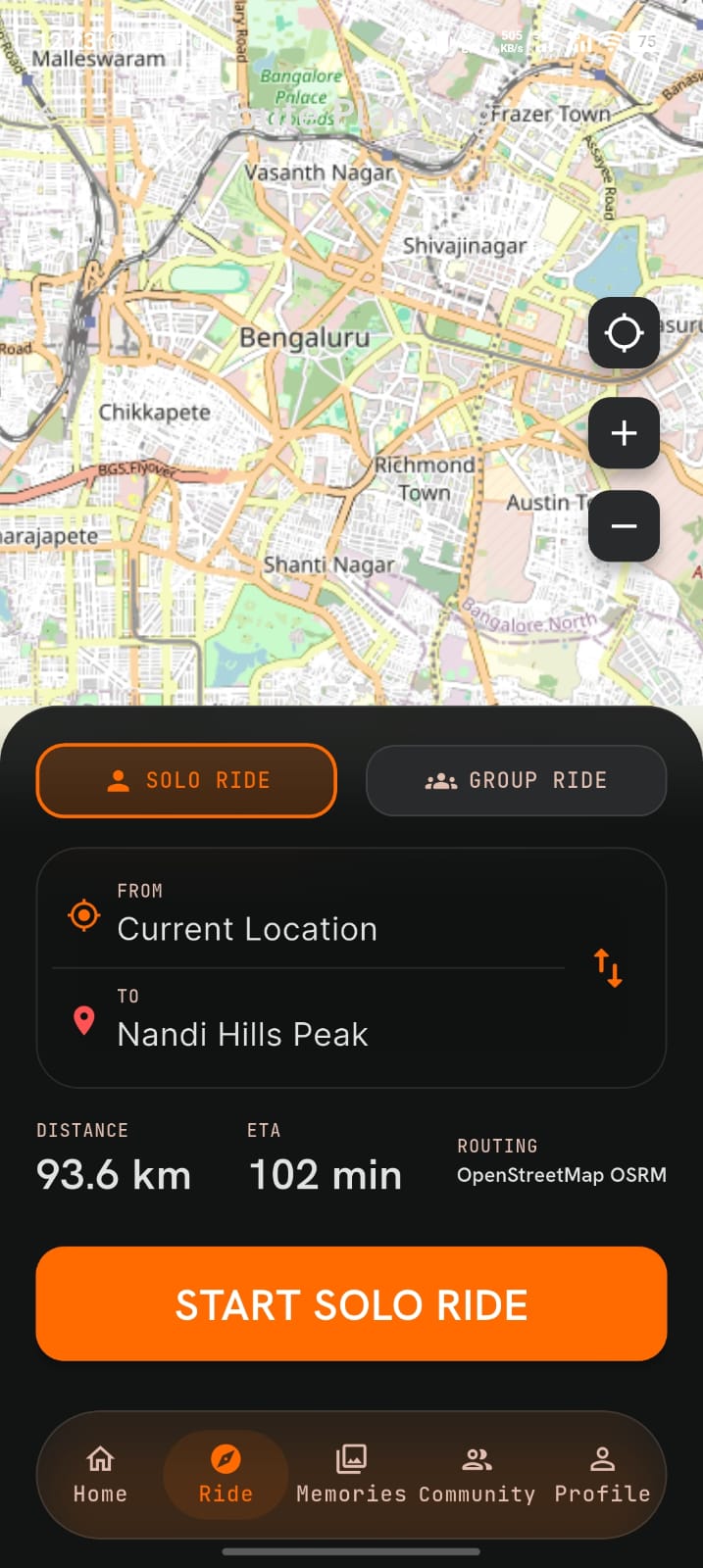
🗺️ Ride Tracking & Navigation
Riders can track journeys using GPS and maintain ride information locally.
The offline-first architecture allows important ride information to remain available even when network connectivity is unreliable.
🤖 AI Safety Assistance
RiderMate incorporates AI-assisted safety functionality to provide riders with contextual guidance and safety-oriented insights.
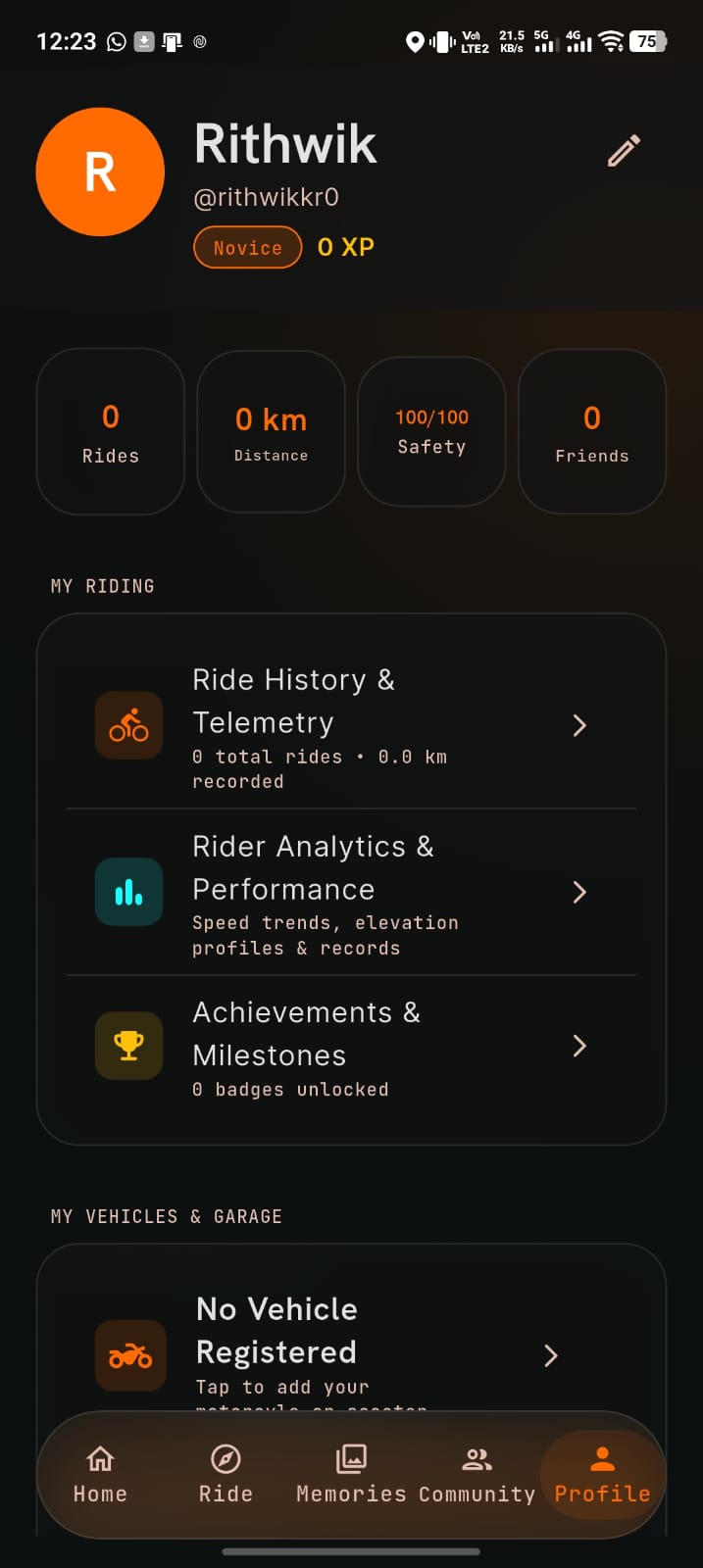
🏍️ Motorcycle Garage
The Garage organizes motorcycle information in one place.
It is designed to help riders keep track of their vehicle, documents, maintenance and related information.
🔧 Vehicle Intelligence
RiderMate brings vehicle management into the riding experience, including maintenance-related information and reminders for documents such as insurance and PUC.
🏆 Safety Points
The application includes a safety-points system intended to encourage traffic-rule awareness and safer riding behavior.
The idea is to make safety more visible instead of treating every ride as only a distance or speed measurement.
🌦️ Weather
Weather information is integrated into the rider experience so environmental conditions can be considered alongside a journey.
📸 Ride Memories
Riders can create memories from their journeys using photos and ride/location information.
The Memories system follows the same offline-first philosophy, allowing riders to capture experiences without depending entirely on network connectivity.
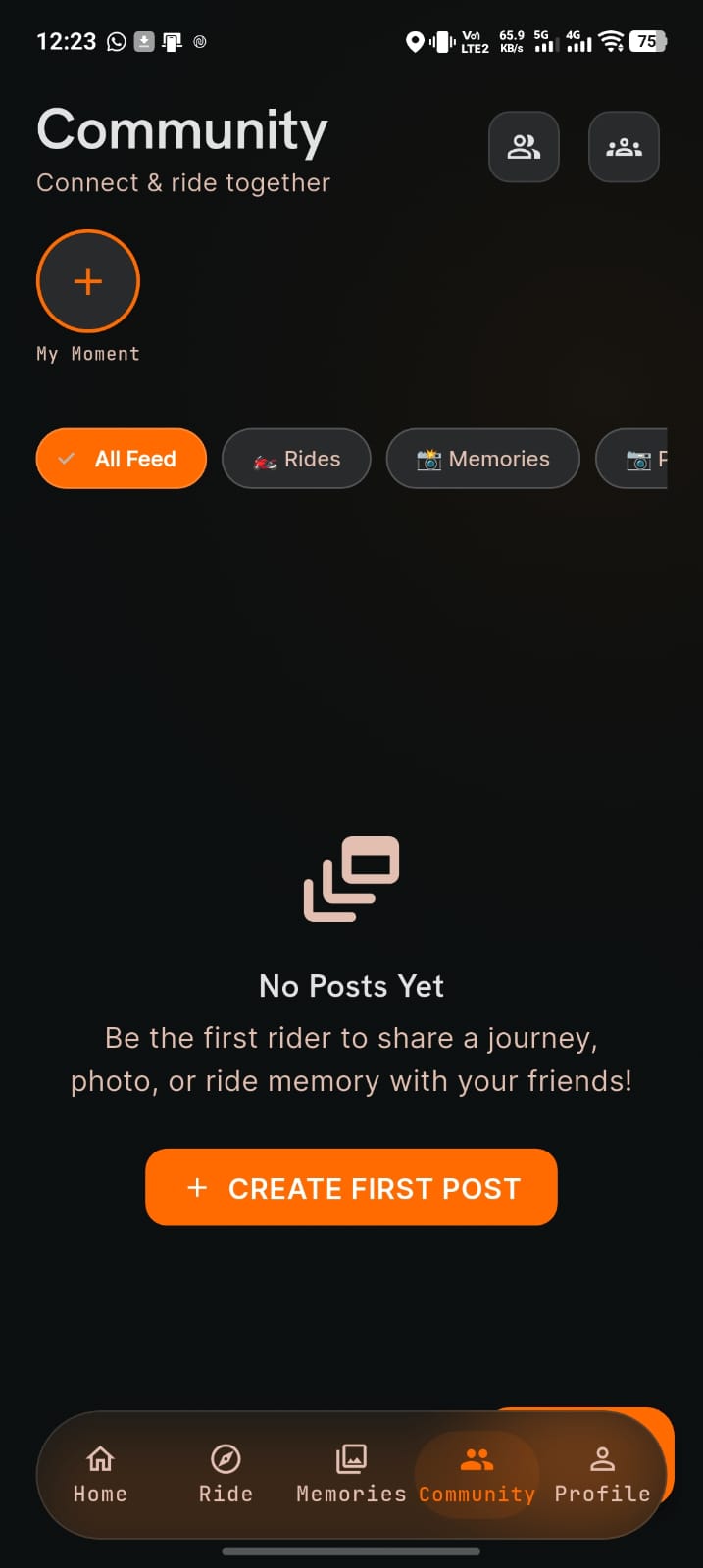
👥 Rider Community
RiderMate also provides social functionality for riders.
The platform is designed around rider-to-rider interaction, posts, friends, communities and group-oriented riding experiences.
Offline-First by Design
One of the central architectural decisions behind RiderMate is offline-first development.
Motorcyclists frequently travel through areas where connectivity may be weak or unavailable.
Instead of assuming that every action requires a permanent internet connection, RiderMate stores important information locally and synchronizes with cloud services when connectivity becomes available.
The application uses local SQLite storage alongside cloud APIs and synchronization services.
This approach makes the application more resilient during real-world rides.
Technology
RiderMate 2.0 is primarily built with:
Mobile
- Flutter
- Dart
- Android
- SQLite
- GPS/location services
- Camera/gallery integration
Backend & Cloud
- FastAPI
- Python
- REST APIs
- Microsoft Azure
- Cloud storage
- Application monitoring
Intelligence
- AI-assisted safety functionality
- Ride intelligence
- Safety scoring
- Traffic-rule points
Monetization
For Shipaton, RiderMate uses RevenueCat to manage the premium subscription experience, including products, entitlements and offerings.
The premium layer is designed around optional advanced functionality while keeping essential rider safety functionality accessible.
Why RevenueCat?
RiderMate is designed as a long-term product rather than only a prototype.
RevenueCat gives us a way to experiment with monetization without building and maintaining separate purchase-management logic for the application.
The architecture separates:
Product → Entitlement → Rider access
This allows the application to evolve its pricing and package structure while keeping the feature-access logic independent from individual store product identifiers.
For example, RiderMate can offer a Pro tier containing advanced ride intelligence, AI assistance, advanced analytics and expanded rider features.
The goal is to build a sustainable product while keeping safety-related functionality accessible.
How We Built It
The project was developed as a modular Flutter application.
The mobile application contains independent functional areas for authentication, rides, safety, memories, vehicle management, weather, community and cloud synchronization.
SQLite provides local persistence while the backend provides cloud-connected functionality.
The architecture was designed so that important operations can continue locally and synchronize later.
This became particularly important when working on ride tracking and memories because those features should not stop functioning simply because a rider temporarily loses connectivity.
Challenges
1. Offline Synchronization
Designing an application that behaves correctly both online and offline was one of the biggest technical challenges.
Data has to remain useful locally while eventually synchronizing with cloud services without creating inconsistent states or duplicate operations.
2. Integrating Many Features
RiderMate combines many different domains:
- GPS
- Safety
- Emergency workflows
- Vehicle management
- Weather
- AI
- Social functionality
- Cloud synchronization
- Local databases
The challenge was not simply implementing each feature independently, but making them work together as one coherent application.
3. Safety-Critical UX
Emergency features require a different design mindset from ordinary application features.
We focused on making important safety actions easy to discover and reducing unnecessary interaction during critical situations.
4. Android Testing
We tested the application through Android builds and emulator workflows, paying particular attention to authentication, local database behavior, GPS workflows, UI layout, offline behavior and application stability.
What We Learned
Building RiderMate taught us that a large application is ultimately a systems-integration problem.
A feature may work perfectly on its own but still fail when combined with authentication, local storage, synchronization, navigation and other modules.
We learned to think about:
- Offline states
- Error recovery
- Data synchronization
- User isolation
- API reliability
- Mobile UX
- Cloud architecture
- Subscription access
- Real-world testing
We also learned that product design and engineering have to evolve together.
What Makes RiderMate Different
RiderMate is not intended to be just another navigation application.
It is designed around the complete motorcycle journey:
Prepare → Ride → Stay Safe → Manage → Remember → Connect
The application combines these stages into a single rider-focused experience.
What's Next
The current platform provides the foundation for a larger smart-mobility ecosystem.
Future development includes:
- More advanced offline navigation
- Richer AI ride assistance
- Real-time group riding
- Improved rider-to-rider communication
- Advanced ride analytics
- Deeper vehicle intelligence
- Expanded cloud synchronization
- Smarter safety recommendations
Our Vision
We want RiderMate to become a digital companion for motorcycle riders rather than another isolated utility.
A rider should be able to start a journey, understand their environment, manage their motorcycle, respond to emergencies, remember their experiences and connect with other riders from one platform.
RiderMate 2.0 — one companion for the entire ride.

Log in or sign up for Devpost to join the conversation.