Inspiration
I do not know how to code in the traditional sense.
But with Codex, I have been able to publish an app and start building several more in only two months. It changed the way I think about everyday problems. Instead of simply accepting an inconvenience, I now think, “Maybe I can build something for that.”
ReviewTrace came from one of those small frustrations.
After testing an app on a real iPhone, I would record the screen and explain problems out loud. But later, I still had to watch the recording again and type the same feedback into Codex.
I wanted a simple tool that could preserve what I said and when I said it, so I would not have to rewrite the same review twice.
What it does
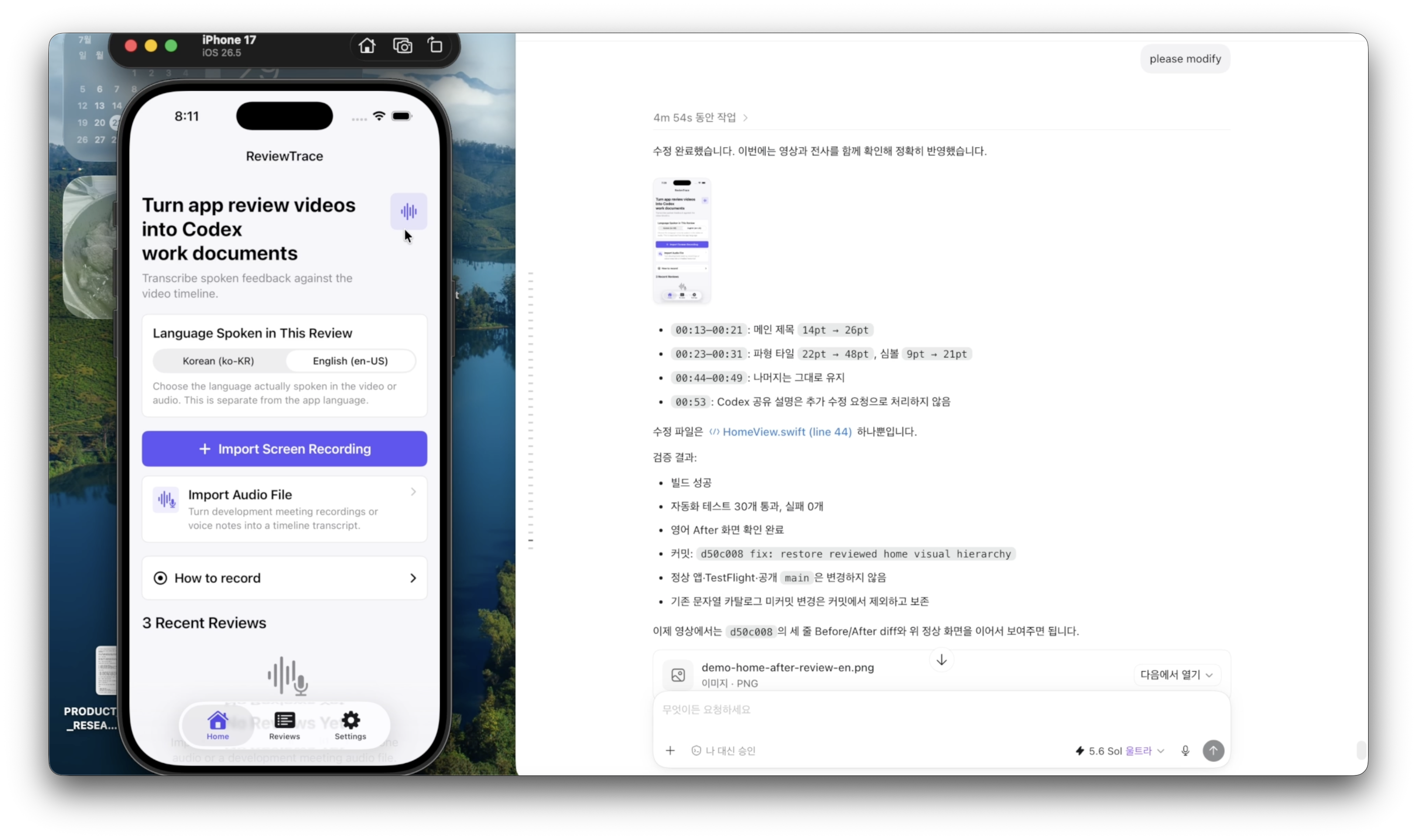
ReviewTrace imports an iPhone screen recording with microphone audio and turns the spoken review into a timestamped timeline.
Each comment stays connected to the moment it was spoken. I can tap a comment to return to that point in the video, see the matching screen frame, and export a Codex-ready package containing the recording, transcript, and implementation requests.
ReviewTrace does not replace my judgment with an automatic issue summary. It simply preserves the review I already made so Codex can work from the original context.
The app supports Korean and English speech transcription, and its interface can also be used in Korean or English independently from the spoken language.
Large recordings can be optimized separately from transcription with progress, cancellation, and retry. The export policy targets 540p, 30 fps, 2.7 Mbps video, and 128 kbps audio. When a recording must be split to stay at or below 280 MB per file, every part includes both its original-recording time range and its file-local time range for Codex.
How I built it
ReviewTrace is a native SwiftUI iPhone app built with Apple Speech, AVFoundation, AVKit, PhotosUI, and XCTest.
It extracts audio from a screen recording, divides longer audio into silence-aware overlapping chunks, transcribes each chunk, and maps every timestamp back to the original video timeline.
For visual context, it extracts the video frame that matches each readable transcript row. Frames load asynchronously and are cached to avoid blocking the timeline while scrolling.
The export flow creates a Codex-ready review package with the recording, timestamped transcript, and clear implementation instructions.
ReviewTrace itself makes no OpenAI runtime API calls. GPT-5.6 and Codex were used to shape and build the developer workflow, while runtime media processing stays in the Apple-platform app.
ReviewTrace began as a private experimental prototype. Before Build Week, it already included media import, Apple Speech transcription, chunk processing, retry, transcript timelines, export formats, and large-video optimization.
During Build Week, GPT-5.6 helped me clarify the product idea and reduce it to one focused workflow. Codex inspected my experimental code, preserved the working pipeline, and added the direct Codex handoff, timestamped visual timeline, Korean and English localization, regression tests, build verification, and release preparation.
The Build Week version came together in one focused day because Codex allowed me to turn that experiment into a coherent, testable developer tool.
Challenges I ran into
The main technical challenge was keeping speech, video, and timestamps synchronized, especially when longer recordings were divided into multiple audio chunks.
Each chunk produces its own local timestamps, but the final transcript must still point to the exact moment in the original recording. Overlapping chunks also help preserve words near a boundary, but they require duplicate reduction when the timeline is merged.
The more important product challenge was deciding what not to add.
Codex already understands natural product feedback well, so ReviewTrace did not need another AI layer to rewrite my words into issues, priorities, or summaries. It only needed to preserve the original evidence reliably.
Accomplishments that I am proud of
I am proud that the Build Week version turned a private experiment into a focused developer workflow without hiding the original evidence.
ReviewTrace now keeps the recording, timestamped speech, screen frames, and implementation instructions together while leaving the final judgment with me.
I am also proud that a small personal experiment became a working iPhone developer tool during one focused day of Build Week work with Codex.
What I learned
I learned that Codex does more than help me write code. It expands the range of problems I believe I can solve.
Before Codex, building an app was something I could only imagine. Now, when I encounter an inconvenience, I can consider making a small tool for myself.
ReviewTrace may not be needed forever. I expect Codex will eventually understand a review video directly and apply the requested changes without an intermediate app. That is fine. ReviewTrace is a simple bridge for the tools we have today.
What matters more is the change in mindset. Codex is allowing a non-developer like me to create, experiment, and enter areas that were previously inaccessible.
Codex did not just help me build ReviewTrace. It changed me from someone who accepts inconveniences into someone who tries to build solutions for them.
What's next
I want to keep using Codex to build tools for problems and subjects that interest me.
I am already experimenting with a Morse code learning app and an app for learning Braille. They are more ambitious and not easy to build, but before Codex I would not have believed I could attempt them at all.
Next, I also want to test ReviewTrace with longer recordings, more iPhone models, and additional reviewers. I plan to measure Korean and English transcription quality before expanding to more speech languages.
ReviewTrace is a practical bridge for today's development workflow, and the lessons from building it will shape the tools I create next.
Try it out
Built With
- apple-speech
- avfoundation
- avkit
- codex
- gpt-5.6
- photosui
- swift
- swiftui
- xcode
- xctest